
Judge, 1917-05-12 · page 9 of 28
Judge — May 12, 1917 — page 9: what you’re looking at
What you’re looking at
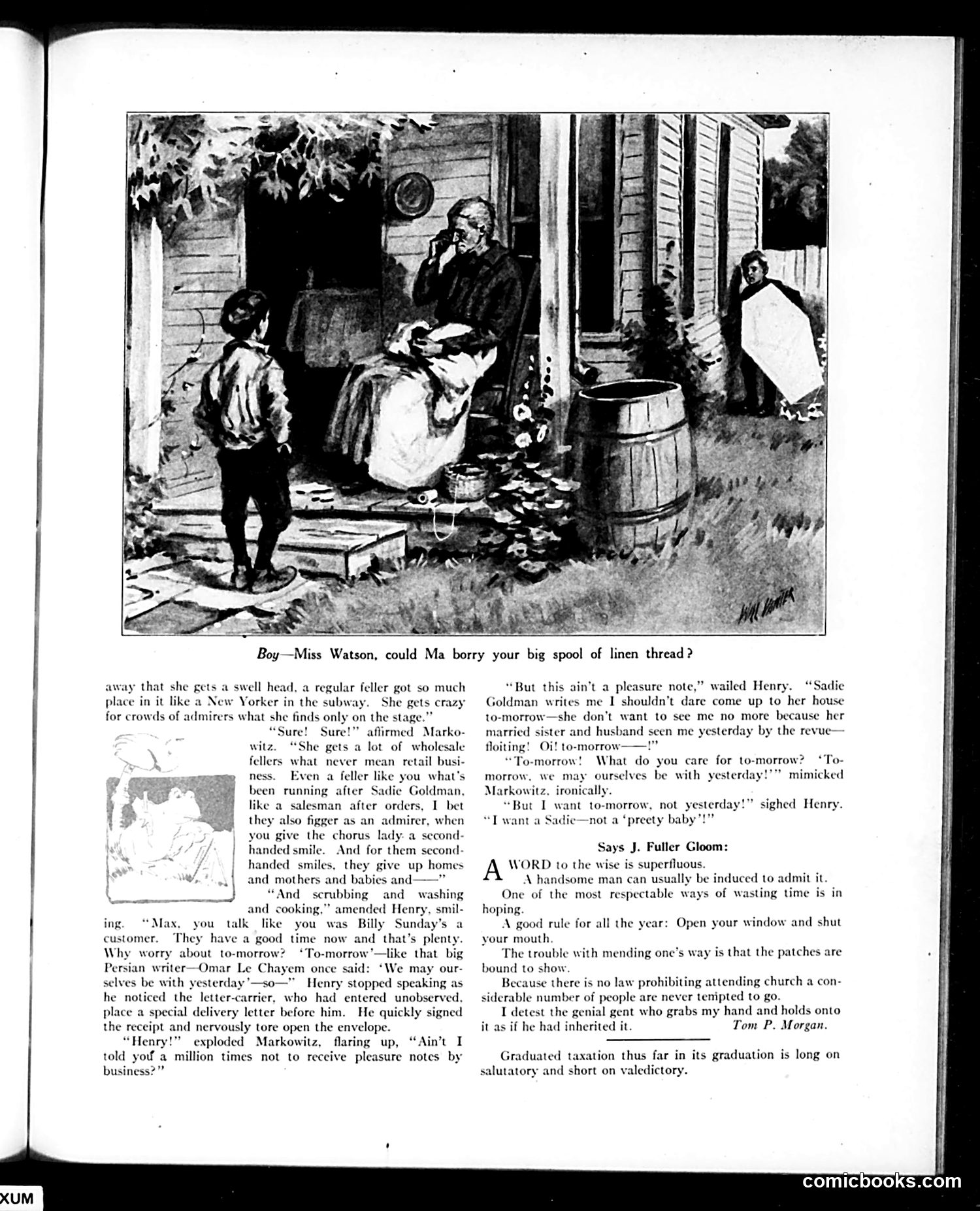
This page contains a comic story about Henry and his boss Markowitz, a clothing manufacturer. The satire centers on **working-class immigrant life** in early 20th-century America. The plot: Henry receives a special delivery letter from Sadie Goldman (a chorus girl) rejecting him because her married sister spotted him at a revue. Markowitz mocks Henry's romantic troubles, then cynically quotes the Persian poet Omar Khayyam about living for today, not worrying about tomorrow. **The satire's point**: Markowitz ironically lectures Henry about not fretting over the future—yet Henry actually *does* care about consequences (losing Sadie), exposing Markowitz's hollow philosophy. The humor comes from their contrasting attitudes toward responsibility and pleasure. The cartoon above shows tenement life, illustrating the working-class immigrant setting. The "Says J. Fuller Gloom" section offers unrelated satirical aphorisms mocking human nature.
📄 Transcribed text from this page (OCR, searchable)
Machine-transcribed from the original scan — historical spelling and the odd misread are preserved.
NM SS SES ad NES } “I~ \ = \ im! fe \-# ia) ES) fe a Ut away that she gets a swell head, a regular feller got so much place in it like a New Yorker in the subway. She gets crazy for crowds of admirers what she finds only on the stage.” Sure! Sure!” aflirmed Mark witz. “She gets a lot of wholesale at never mean retail busi- " na feller like you what's been running after Sadie Goldman, sman_ after orders, I bet n admirer, when you give the chorus lady: a second- handed smile. And for them second- handed smiles, they give up homes | and mothers and babies and—” } “And rubbing and washing and cooking,” amended Henry, smil- lax, you talk like you was Billy Sunday’s a good time now and that’s plenty. ¢ that big ing. customer. They have Why worry about to-morrow? ‘To-morrow’—I Persian writer—Omar Le Chayem once said: ‘We may our- selves be with yesterday’—so—” Henry stopped speaking he noticed the letter-carrier, who had entered unobserved. place a special delivery letter before him. He quickly signed the receipt and nervously tore open the envelope. “Henry!” exploded Markowitz, flaring up, “Ain’t I told yorf a million times not to receive pleasure notes by business?” Boy—Miss Watson, could Ma borry your big spool of linen thread ? “But this ain't a pleasure note,” wailed Henry. “Sadie Goldman writes me I shouldn't dare come up to her house to-morrow—she don’t want to see me no more because her married sister and husband seen me yesterday by the revue floiting! Oi! to-morrow “To-morrow! What do you care for to-morrow? ‘To- * mimicked morrow, we may ourselves be with yesterday Markowitz, ironically. “But I want to-morrow, not yesterd: “LT want a Sadie—not a ‘preety baby’!” sighed Henry. Says J. Fuller Gloom: A WORD to the wise is superfluous. A handsome man can usually be induced to admit it One of the most respectable ways of wasting time is in hoping. ‘A good rule for all the y your mouth The trouble with mending one’s way is that the patches are bound to show Because there is no law prohibiting attending church a con- siderable number of people are never tenipted to go. I detest the genial gent who grabs my hand and holds onto it as if he had inherited it. Tom P. Morgan. : Open your window and shut Graduated taxation thus far in its graduation is long on salutatory and short on valedictory. comicbooks.com