
Judge, 1917-05-12 · page 12 of 28
Judge — May 12, 1917 — page 12: what you’re looking at
What you’re looking at
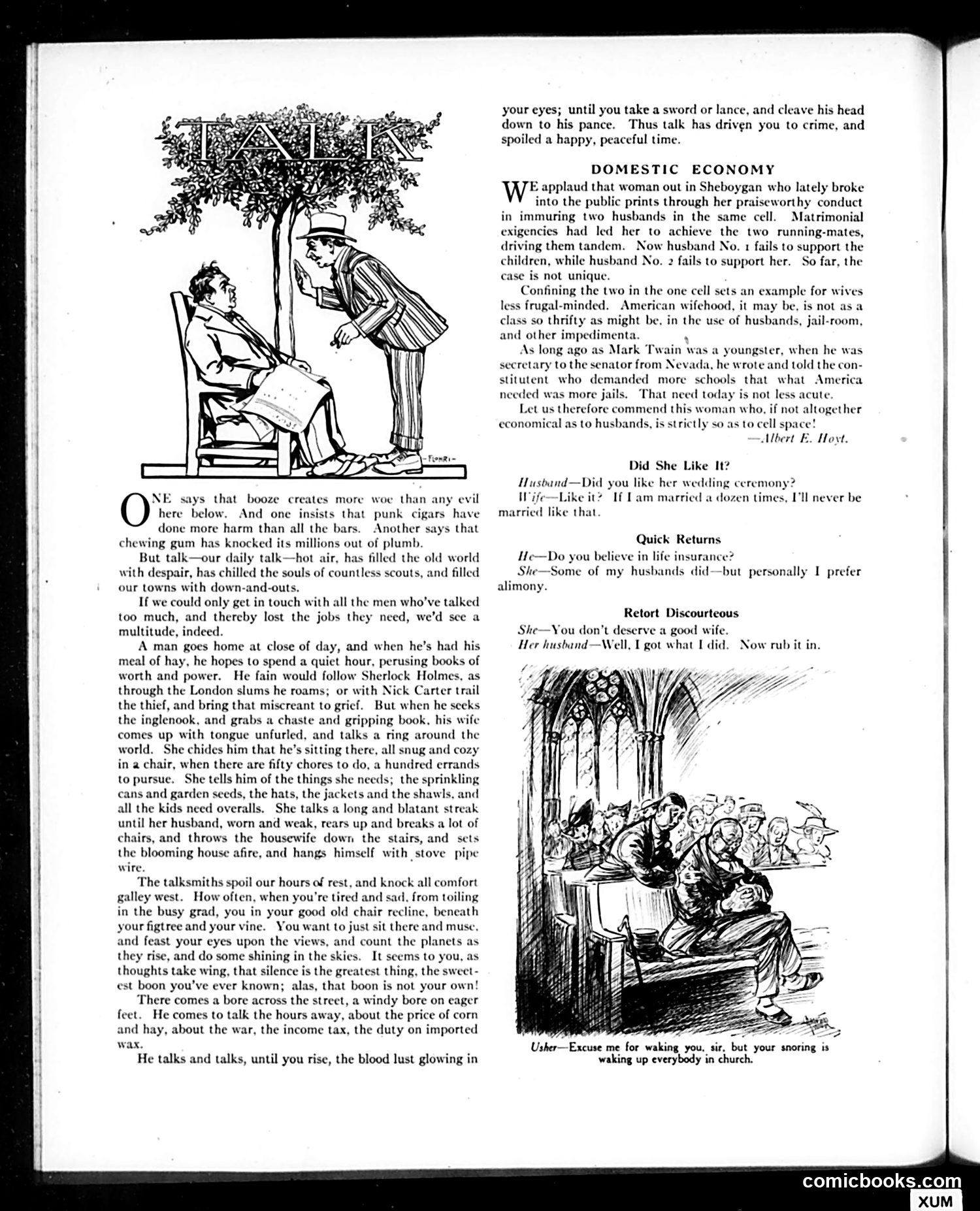
This page contains two distinct satirical pieces typical of early 20th-century American humor. **"Domestic Economy"** mocks a Sheboygan woman who imprisoned two non-supporting husbands in the same jail cell. The piece uses this real case to satirize wives' supposed wastefulness with husbands as a resource. It invokes Mark Twain's (then-recent) quip that America needed more jails than schools, suggesting society's real problem is criminal excess rather than education. The satire targets both marital dysfunction and social disorder through exaggerated praise of this woman's "economy." **The opening section** attacks excessive talking as society's greatest evil—surpassing booze, cigars, and chewing gum. It depicts a tired husband's domestic peace destroyed by his wife's incessant chatter about household tasks, escalating to violence and suicide. The accompanying cartoon illustrates this domestic conflict. Both pieces employ Judge's characteristic absurdist humor to critique American domestic life, gender relations, and social problems, using hyperbole and dark comedy to make their points about contemporary anxieties.
📄 Transcribed text from this page (OCR, searchable)
Machine-transcribed from the original scan — historical spelling and the odd misread are preserved.
NE says that booze creates more woe than any evil here below. And one insists that punk cigars have | done more harm than all the bars. Another says that | chewing gum has knocked its millions out of plumb. | But talk—our daily talk—hot air, has filled the old world with despair, has chilled the souls of countless scouts, and filled our towns with down-and-outs. If we could only get in touch with all the men who've talked | too much, and thereby lost the jobs they need, we'd sce a | multitude, indeed. A man goes home at close of day, and when he’s had his meal of hay, he hopes to spend a quiet hour, perusing books of { worth and power. He fain would follow Sherlock Holmes. through the London slums he roams; or with Nick Carter trail the thief, and bring that miscreant to grief. But when he seeks the inglenook, and grabs a chaste and gripping book, his wife comes up with tongue unfurled, and talks a ring around the world. She chides him that he’s sitting there, all snug and cozy in a chair, when there are fifty chores to do, a hundred errands to pursue. She tells him of the things she needs; the sprinkling cans and garden seeds, the hats, the jackets and the shawls, and all the kids need overalls. She talks a long and blatant streak until her husband, worn and weak, rears up and breaks a lot of chairs, and throws the housewife down the stairs, and sets the blooming house afire, and hangs himself with stove pipe wire. . The talksmiths spoil our hours of rest, and knock all comfort galley west. How often, when you're tired and sad, from toiling in the busy grad, you in your good old chair recline, beneath your figtree and your vine. You want to just sit there and muse, and feast your eyes upon the views, and count the planets as they rise, and do some shining in the s| It seems to you, as thoughts take wing, that silence is the greatest thing, the swe est boon you've ever known; alas, that boon is not your own! There comes a bore across the street, a windy bore on eager feet. He comes to talk the hours away, about the price of corn and hay, about the war, the income tax, the duty on imported wax. | He talks and talks, until you rise, the blood lust glowing in your eyes; until you take a sword or lance, and cleave his head down to his pance. Thus talk has driven you to crime, and spoiled a happy, peaceful time. DOMESTIC ECONOMY E applaud that woman out in Sheboygan who lately broke into the public prints through her praiseworthy conduct in immuring two husbands in the same cell. Matrimonial exigencies had led her to achieve the two running-mates, driving them tandem. Now husband No. 1 fails to support the children, while husband No. 2 fails to support her. So far, the case is not unique. Confining the two in the one cell sets an example for wive: less frugal-minded. American wifehood, it may be, is not as a class so thrifty as might be, in the use of husbands, jail-room, and other impedimenta. 4 As long ago as Mark Twain was a youngster, when he was secretary to the senator from Nevada, he wrote and told the con- stitutent who demanded more schools that what America needed was more jails. That need today is not less acute. Let us therefore commend this woman who, if not altogether economical as to husbands, is strictly so as to cell spac Albert E. Hovt. Did She Like It? Husband—Did you like her wedding ceremony? Wife—Like it? “If Lam married a dozen times, I'll never be married like that. Quick Returns He—Do you believe in life insurance? She—Some of my husbands did—but personally I prefer alimony. Retort Discourteous She—You don’t deserve a good wife. Her husband—Well, I got what I did. Now rub it in. gn, x= P ¥ Usher—Excuse me for waking you, sir, but your snoring is waking up everybody in church. comicbooks.com