
Judge, 1917-05-12 · page 16 of 28
Judge — May 12, 1917 — page 16: what you’re looking at
What you’re looking at
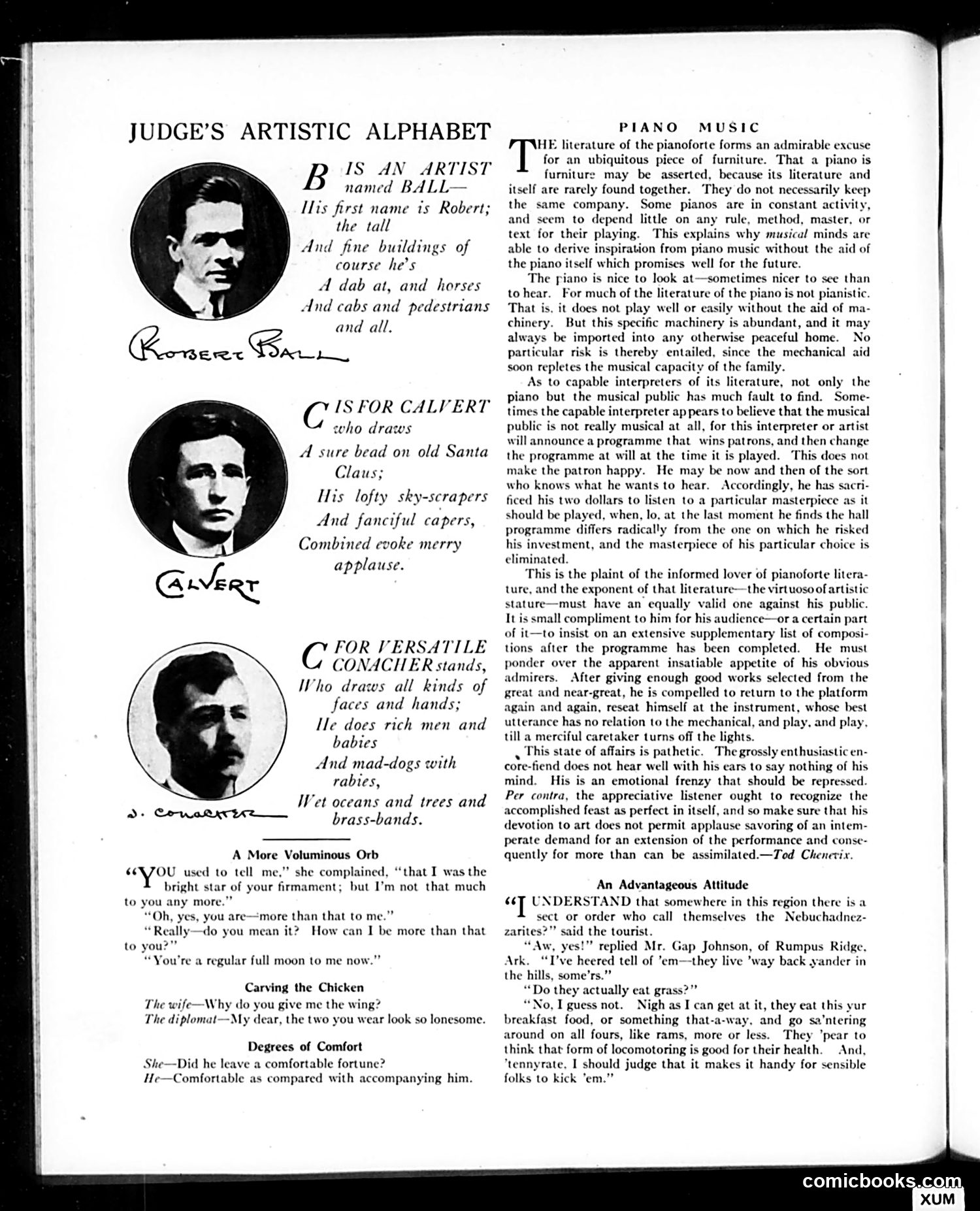
This page presents **satirical character sketches of cartoonists** working for Judge magazine, written as humorous alphabet entries. The text identifies three artists by their last names and caricatures: **Robert Ball** (who draws buildings, horses, and street scenes), **Calvert** (known for Santa Claus and architectural drawings), and **S. Conacher** (versatile figure artist). The accompanying jokes mock domestic life and social pretense—a husband comparing his wife's diminished importance to a "full moon," a diplomat's double meaning about carving chicken, and a wife questioning whether a departed husband's fortune was comfortable to *leave behind*. The "Piano Music" essay satirizes both piano culture and virtuoso performers—criticizing concert pianists who change programs arbitrarily, audiences who demand endless encores, and the gap between piano literature and actual playability.
📄 Transcribed text from this page (OCR, searchable)
Machine-transcribed from the original scan — historical spelling and the odd misread are preserved.
JUDGE’S ARTISTIC ALPHABET IS AN ARTIST named BALL— His first name is Robert; the tall And fine buildings of course he’s A dab at, and horses And cabs and pedestrians and all, (Kosece Bac, 1S FOR CALVERT who draws A sure bead on old Santa Claus; His lofty sky-scrapers And fanciful capers, Combined evoke merry applause. Giverr FOR VERSATILE CONACHER stands, Who draws all kinds of faces and hands; He does rich men and babies And mad-dogs with rabies, Wet oceans and trees and brass-bands. A More Voluminous Orb 66YVOU used to tell me,” she complained, “that I was the bright star of your firmament; but I’m not that much to you any more.” “Oh, yes, you are—more than that to me.” “Really—do you mean it? How can I be more than that to you?” “You're a regular full moon to me now.” Carving the Chicken The wife—Why do you give me the wing? The diplomat—My dear, the two you wear look so lonesome. Degrees of Comfort She—Did he leave a comfortable fortune? He—Comfortable as compared with accompanying him. PIANO MUSIC HE literature of the pianoforte forms an admirable e: alr for an ubiquitous piece of furniture. That a piano is furniture may be asserted, because its literature and itself are rarely found together. They do not necessarily keep the same company. Some pianos are in constant activity, and seem to depend little on any rule, method, master, or text for their playing. This explains why musical minds are able to derive inspiration from piano music without the aid of the piano itself which promises well for the future. The piano is nice to look at—sometimes nicer to see than to hear. For much of the literature of the piano is not pianistic. That is. it does not play well or ea without the aid of ma- chinery. But this specific machinery is abundant, and it may always be imported into any otherwise peaceful home. No particular risk is thereby entailed, since the mechanical aid soon repletes the musical capacity of the family. As to capable interpreters of its literature, not only the piano but the musical public has much fault to find. Some- times the capable interpreter ap pears to believe that the musical public is not really musical at all, for this interpreter or artist will announce a programme that wins patrons, and then change the programme at will at the time it is played. This does not make the patron happy. He may be now and then of the sort who knows what he wants to hear. Accordingly, he has ficed his two dollars to listen to a particular masterpiece should be played, when, lo, at the last moment he finds the hall programme differs radically from the one on which he risked his investment, and the masterpiece of his particular choice is eliminated. This is the plaint of the informed lover of pianoforte lit ture, and the exponent of that literature—the virtuoso of art stature—must have an equally valid one against his public. It is small compliment to him for his audience—or a certain part of it—to insist on an extensive supplementary list of composi- tions after the programme has been completed. He must ponder over the apparent insatiable appetite of his obvious admirers. After giving enough good works selected from the great and near-great, he is compelled to return to the platform again and again, reseat himself at the instrument, whose best utterance has no relation to the mechanical, and play, and play, till a merciful caretaker turns off the lights. . This state of affairs is pathetic. The grossly enthusiastic en- core- fiend does not hear well with his ears to say nothing of his mind. His is an emotional frenzy that should be repressed. Per contra, the appreciative listener ought to recognize the accomplished feast as perfect in itself, and so make sure that his devotion to art does not permit applause savoring of an intem- perate demand for an extension of the performance and conse- quently for more than can be assimilated.—Tod Chenevix. An Advantageous Attitude !NDERSTAND that somewhere in this region there is a sect or order who call themselves the Nebuchadnez- zarites?”’ said the tourist. replied Mr. Gap Johnson, of Rumpus Ridge, red tell of ’em—they live ’way back “ the hills, some “Do they actually eat grass?” “No, I guess not. Nigh as I can get at it, they eat this yur breakfast food, or something that-a-way, and go sa’ntering around on all fours, like rams, more or less. They ‘pear to think that form of locomotoring is good for their health. And, ‘tennyrate, I should judge that it makes it handy for sensible folks to kick ‘em.”” comicbooks.com