
Judge, 1917-05-12 · page 10 of 28
Judge — May 12, 1917 — page 10: what you’re looking at
What you’re looking at
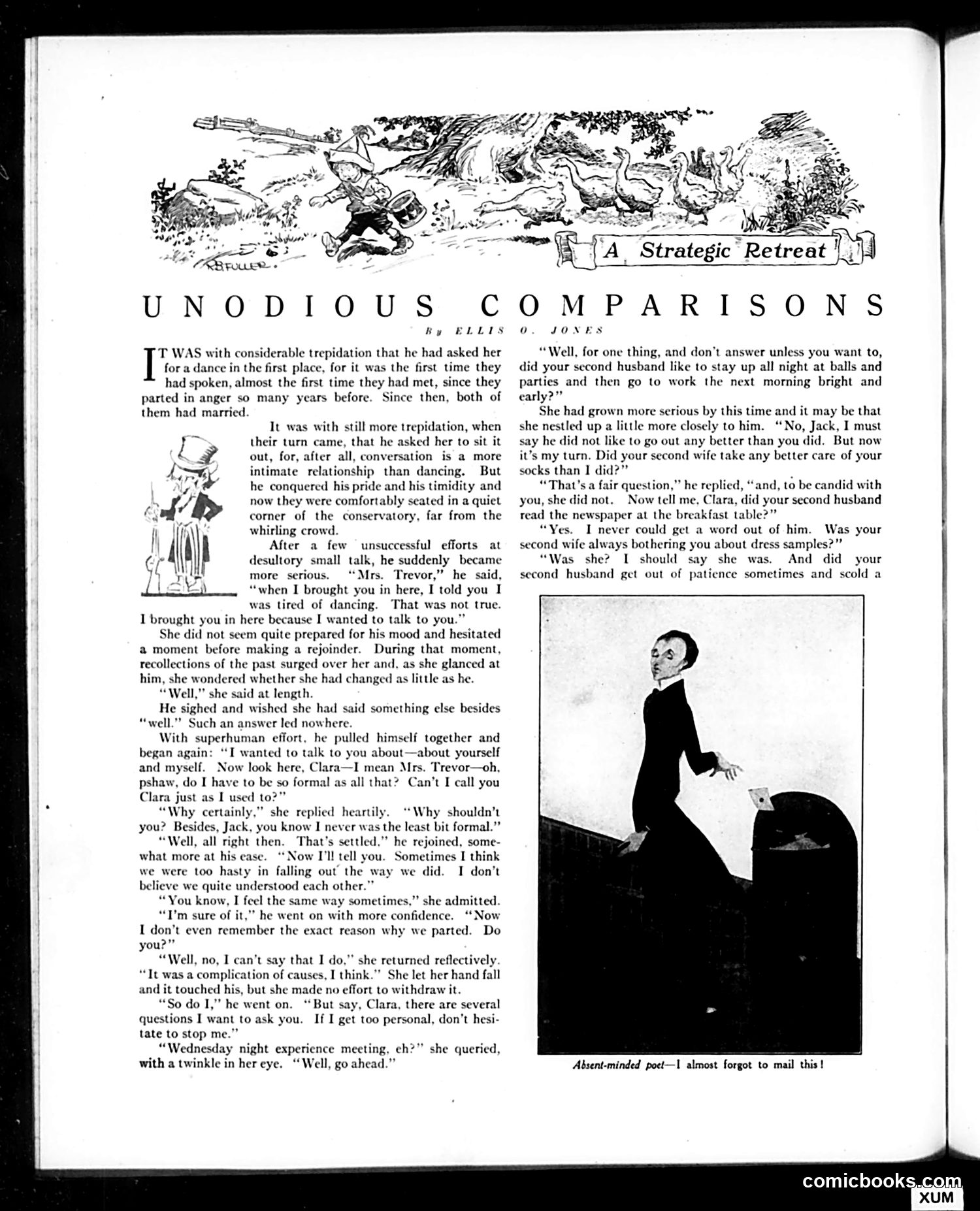
This story-based page depicts a sentimental reunion between two former lovers, Jack and Clara, now each married to other people. They reunite at a social event and discuss their past relationship and current marriages. The satire targets **romantic nostalgia and marital dissatisfaction**. The couple realizes they may have ended their relationship prematurely, then systematically catalog their spouses' faults—late-night partying habits, poor sock care, newspaper-reading at breakfast, nagging about dress samples, impatience. The humor lies in their **discovery that their current marriages replicate the same annoying patterns** they apparently complained about before. The cartoon's title "A Strategic Retreat" (top) and the illustration of an absent-minded poet reinforce the theme: both characters are retreating into nostalgic comparison rather than appreciating what they have. The piece satirizes how people romanticize past relationships while overlooking that their problems may be universal rather than partner-specific—or, darkly, that they themselves are the common problem.
📄 Transcribed text from this page (OCR, searchable)
Machine-transcribed from the original scan — historical spelling and the odd misread are preserved.
UNODIOUS C By ELLIS T WAS with considerable trepidation that he had asked her I for a dance in the first place, for it was the first time they had spoken, almost the first time they had met, since they parted in anger so many years before. Since then, both of them had married. It was with still more trepidation, when their turn came, that he asked her to sit it out, for, after all, conversation is a more intimate relationship than dancing. But he conquered his pride and his timidity and now they were comfortably seated in a quiet corner of the conservatory, far from the whirling crowd. After a few unsuccessful efforts at desultory small talk, he suddenly became more serious. ‘Mrs. Trevor,” he said, “when I brought you in here, I told you I was tired of dancing. That was not true. I brought you in here because I wanted to talk to you.” She did not seem quite prepared for his mood and hesitated a moment before making a rejoinder. During that moment, recollections of the past surged over her and, as she glanced at him, she wondered whether she had changed as little as he. “Well,” she said at length. He sighed and wished she had said something else besides “well.” Such an answer led nowhere. With superhuman effort, he pulled himself together and began again: “TI wanted to talk to you about—about yourself and myself. Now look here, Clara—I mean Mrs. Trevor—oh, pshaw, do I have to be so formal as all that? Can’t I call you Clara just as I used to?” “Why certainly,” she replied heartily. “Why shouldn’t you? Besides, Jack, you know I never was the least bit formal.” “Well, all right then. That's settled.” he rejoined, some- what more at his ease. “* Now I'l! tell you. Sometimes I think we were too hasty in falling out the way we did. I don’t believe we quite understood each other.” “You know, I feel the same way sometimes,” she admitted “I'm sure of it,” he went on with more confidence. ‘Now I don’t even remember the exact reason why we parted. Do you?” “Well, no, I can’t say that I do,” she returned reflectively “It was a complication of causes, I think.’ She let her hand fall and it touched his, but she made no effort to withdraw it. “So do I,” he went on. “But say, Clara, there are several questions I want to ask you. If I get too personal, don’t hesi- tate to stop me.” “Wednesday night experience meeting, ch?” she queried, with a twinkle in her eye. “Well, go ahead.” oon ae gee Retreat raha a a OMPARISONS O. JONES “Well, for one thing, and don’t answer unless you want to, did your second husband like to stay up all night at balls and parties and then go to work the next morning bright and carly?” She had grown more serious by this time and it may be that she nestled up a little more closely to him. ‘No, Jack, I must say he did not like to go out any better than you did. But now it’s my turn. Did your second wife take any better care of your socks than I did?” . “That's a fair question,” he replied, “and, to be candid with you, she did not. Now tell me, Clara, did your second husband read the newspaper at the brea’ pe fast table? “Yes. I never could get a word out of him. Was your second wife always bothering you about dress samples?” “Was she? I should say she was. And did your second husband get out of patience sometimes and scold a Absent-minded poet—I| almost forgot to mail this! comicbooks,com