
A complete issue · 28 pages · 1917
Judge — April 28, 1917
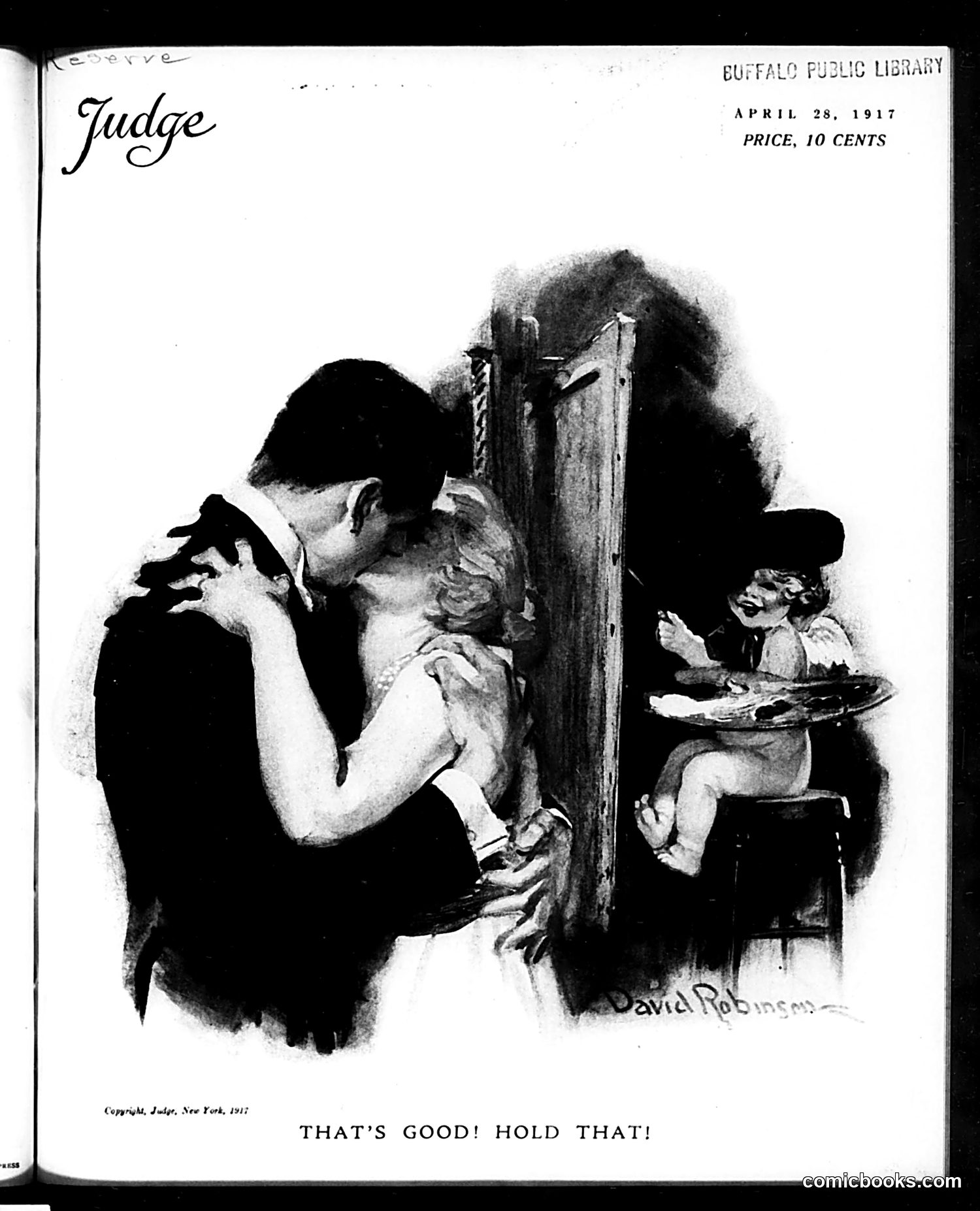
This Judge magazine cover from April 28, 1917 depicts a man photographing or painting a cherub (cupid figure) while a woman poses the child. The caption "That's Good! Hold That!" suggests they're capturing an idealized image. The cartoon likely satirizes wartime propaganda or artistic representation during World War I (America had just entered the war weeks before this issue). The cherub traditionally symbolizes innocence and love, so the scene may mock the sanitization or romanticization of war through popular media and art—the instruction to "hold that" pose suggesting the artificial staging of uplifting imagery for public consumption during a brutal conflict. The artist is credited as David Robinson.
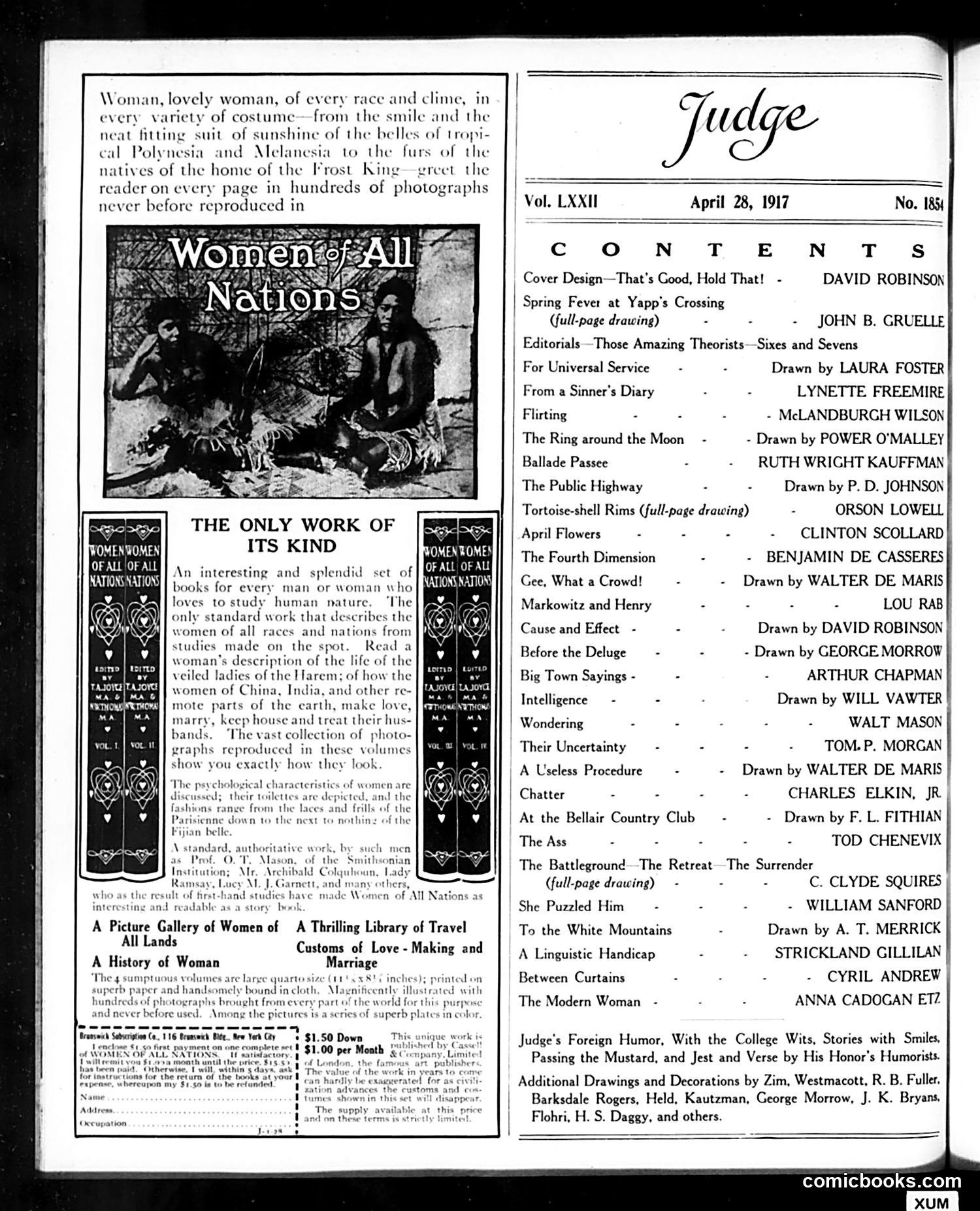
This is primarily a **contents/advertising page** rather than a cartoon. The left side advertises "Women of All Nations," a two-volume illustrated work describing women across races and climates, emphasizing it as "the only work of its kind." It promotes sections on women's psychology, appearance, and customs from various lands. The right side lists the magazine's contents for this issue, featuring cartoons and articles by various artists and writers. The cover design by David Robinson is noted, along with numerous satirical pieces and drawings addressing social topics typical of 1917 America. The page reflects early 20th-century publishing and illustrates Judge's mix of advertisements, humor, and social commentary.
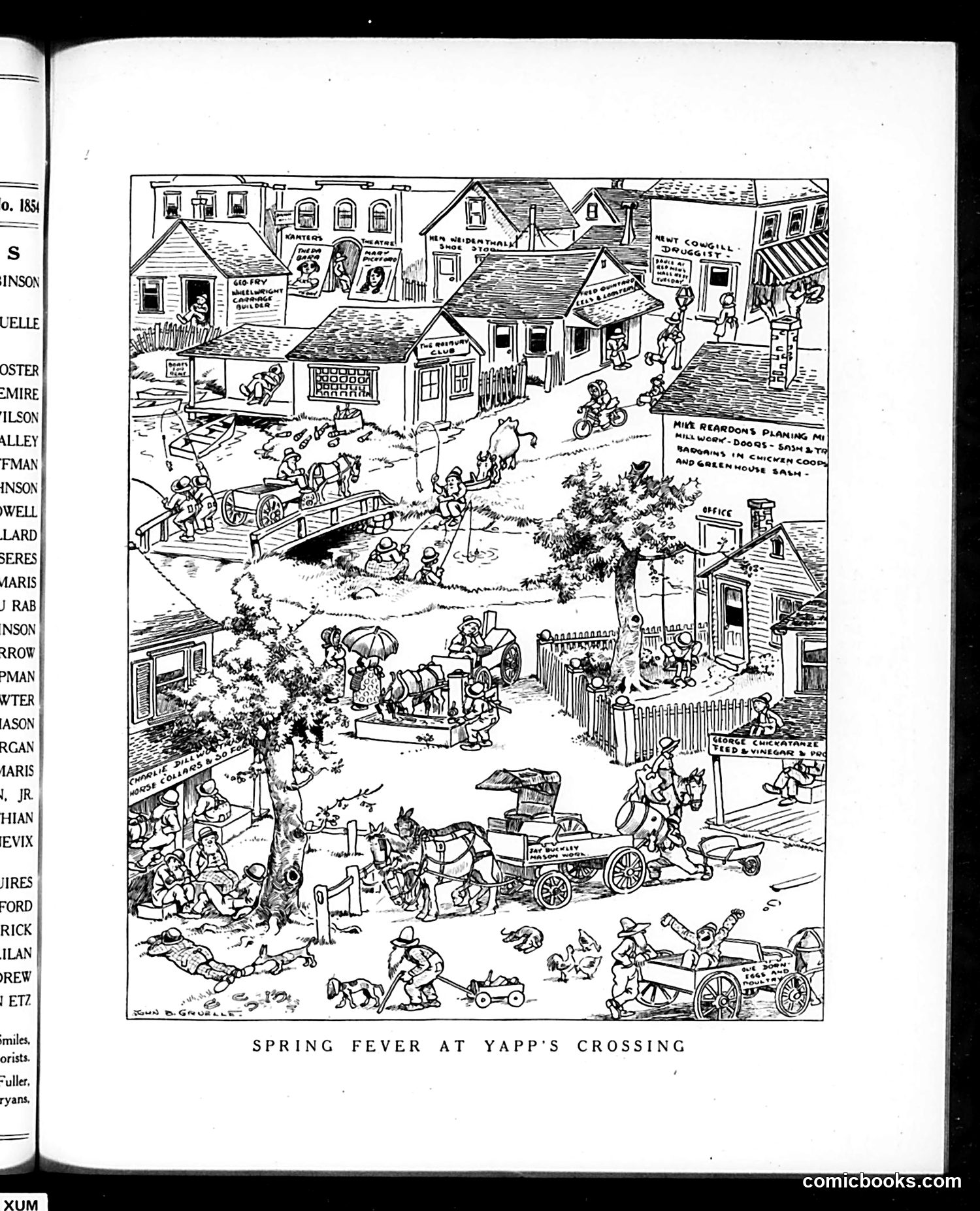
This satirical illustration depicts a rural American community gripped by "spring fever"—the restless energy and distraction that arrives with warm weather. The cartoon shows villagers abandoning work and responsibilities: children play, adults idle under a tree, horses pull empty carts, and general chaos reigns. A bandstand or gazebo suggests festive distraction. The satire targets the seasonal loss of productivity and propriety when spring arrives. Signs visible in buildings reference "Miss Reardon's" activities, likely indicating local gossip or romantic entanglements. The illustration's humor lies in contrasting orderly village life with this sudden, spring-induced pandemonium where normal rules dissolve into unfocused merriment and distraction—a universal human experience presented as comic social commentary.
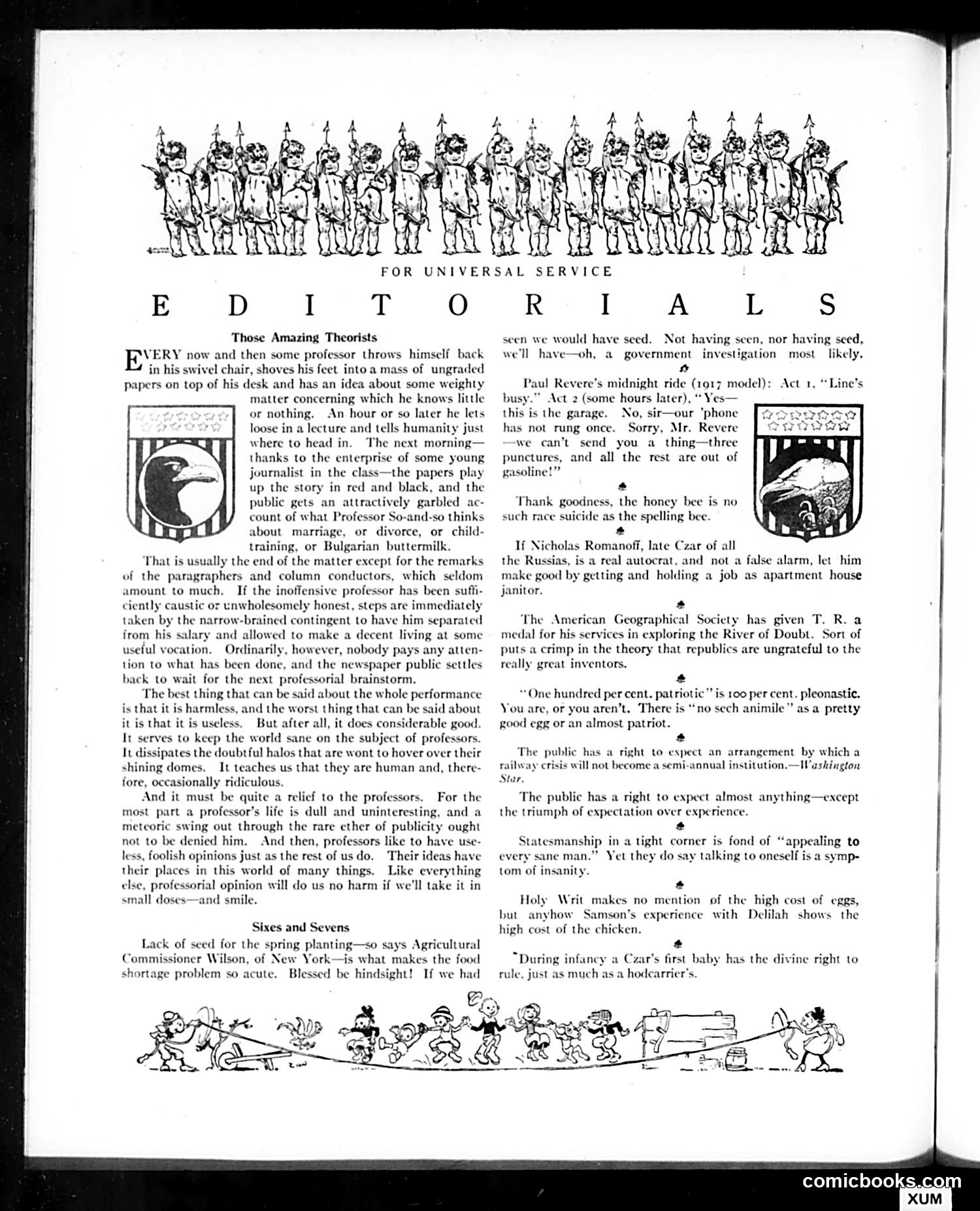
This page from *Judge* magazine contains three satirical editorials: 1. **"Those Amazing Theorists"**: Mocks professors who pontificate on serious social issues (marriage, divorce, child-rearing, labor) without practical knowledge. The satire suggests academics generate worthless noise that newspapers reproduce uncritically. 2. **"Sixes and Sevens"**: References Agricultural Commissioner Wilson of New York, criticizing his explanation that seed shortage caused food shortages as inadequate—implying either incompetence or dishonesty in addressing the crisis. 3. **Various brief quips**: Include jokes about Paul Revere's midnight ride, Nicholas Romanoff (Russian Tsar) as an "autocrat," and observations about American society—the spelling bee, railway crises, and egg prices. The overall tone targets institutional incompetence and intellectual pretension.
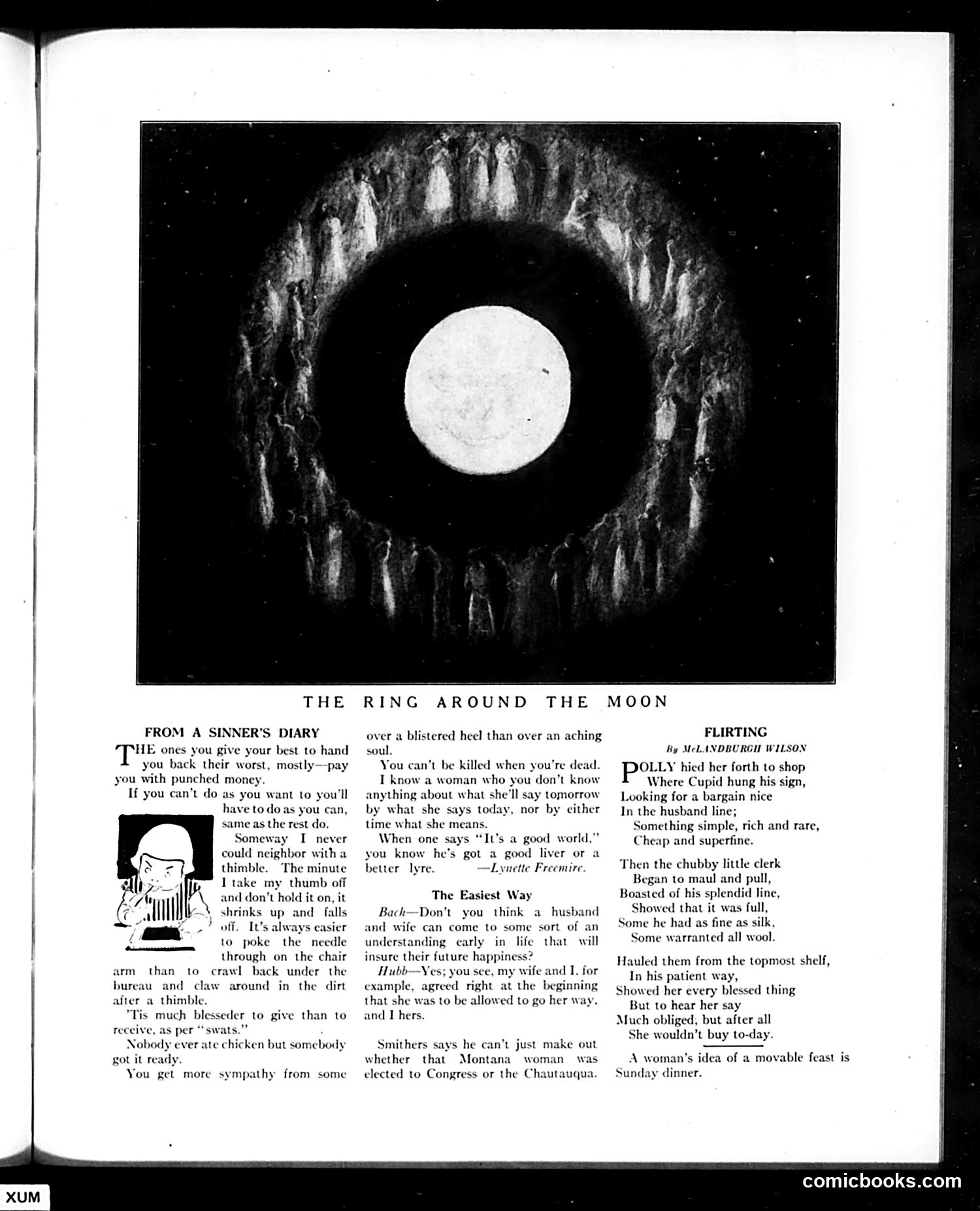
This page from *Judge* magazine contains three separate pieces of satirical writing rather than political cartoons: **"From a Sinner's Diary"** mocks marital compromise, suggesting couples accept mediocrity rather than pursue happiness—a jab at conventional marriage advice. **"The Easiest Way"** satirizes a couple who agreed early in marriage that the wife could "go her way" and the husband his. The piece cynically suggests such arrangements inevitably fail. **"Flirting"** by McLandburgh Wilson presents a humorous poem about a woman named Polly who shops aggressively, boasts about her husband's wealth, but refuses to actually buy anything—satirizing pretentious consumer behavior and materialistic display among women. The decorative header image of the moon ringed by dark formations appears purely decorative and unrelated to the text below.
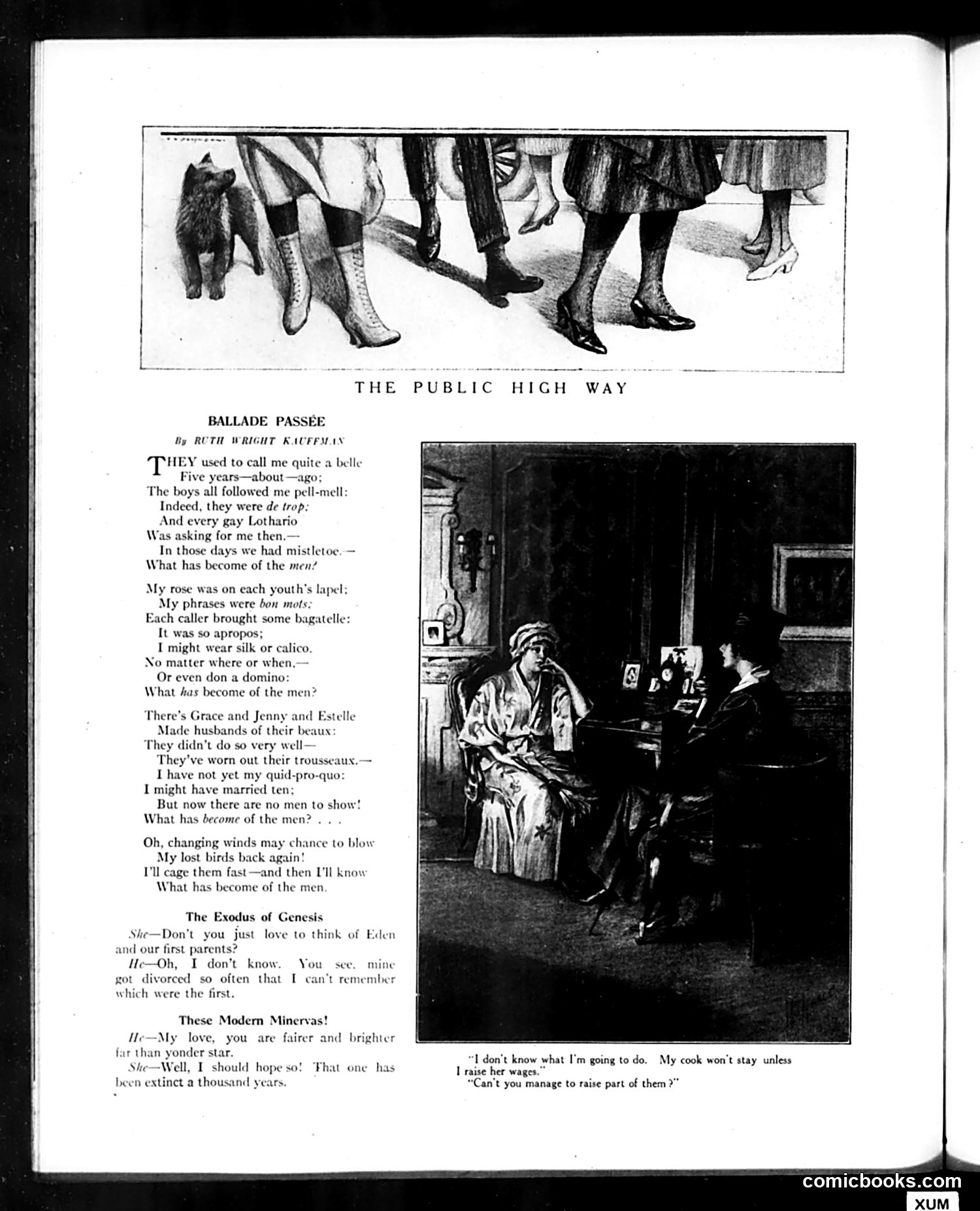
**Top illustration:** Shows women's legs and feet in various boots and shoes, with a small dog. This satirizes women's fashions of the era, particularly footwear styles. **"Ballade Passée" poem by Ruth Wright Kauffman:** A nostalgic lament about the speaker's past popularity ("five years ago"). She recalls when men pursued her, brought her gifts ("bagatelle"), and competed for her attention. Now she's unmarried and forgotten, asking repeatedly "What has become of the men?" The satire mocks women's dependence on male attention and courtship for social value and identity. **Lower illustration and caption:** Shows a domestic scene where a woman tells a man about wage negotiations with her cook. This jokes about the "servant problem"—post-WWI labor shortages and servants' increased wage demands—reflecting class anxieties of the period.
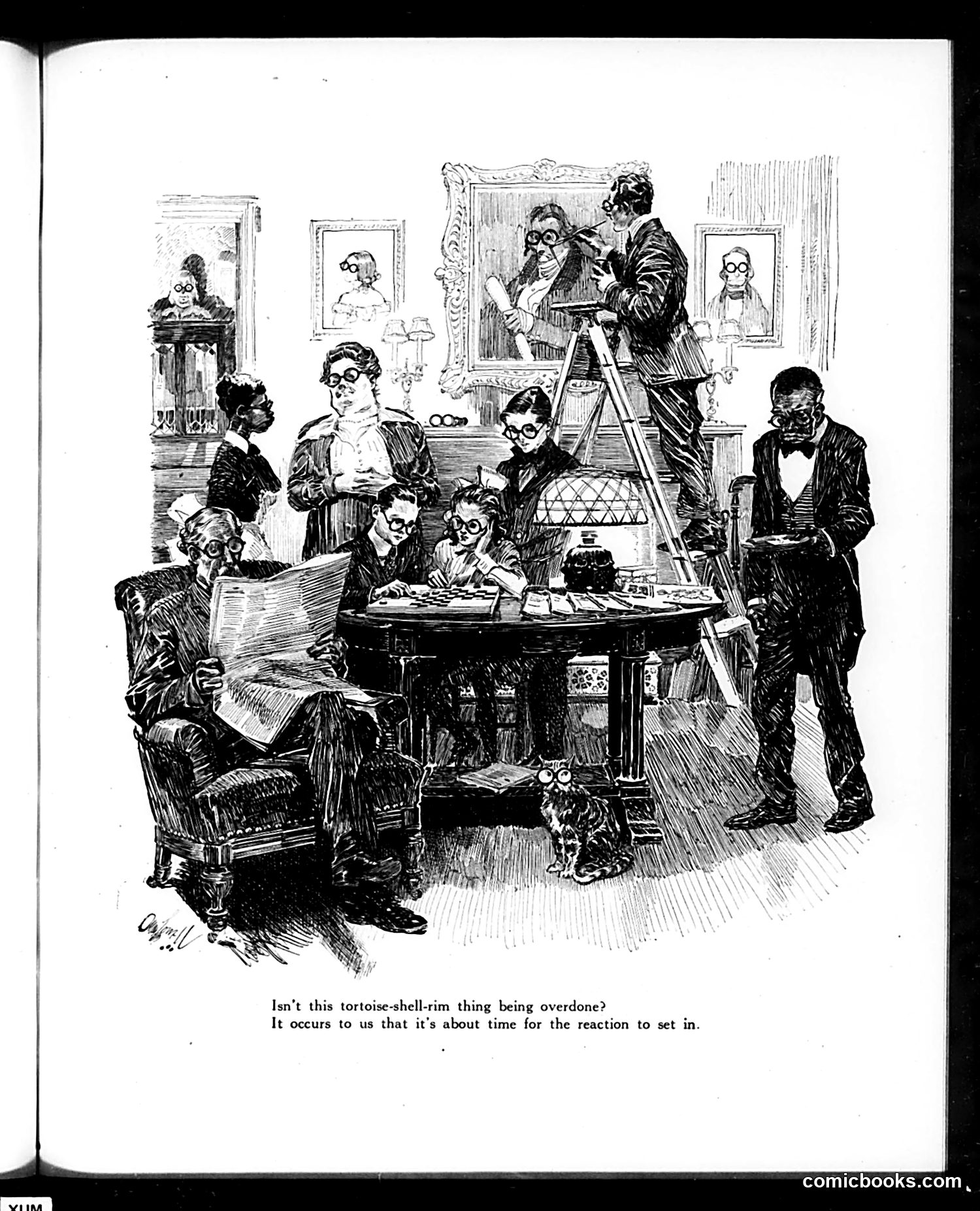
This cartoon satirizes a **fashion trend for tortoise-shell-rimmed eyeglasses** that was apparently popular when this *Judge* magazine issue was published. The scene shows a wealthy household where nearly every person visible—from servants to family members to visitors—wears identical tortoise-shell-rimmed spectacles, regardless of whether they appear to need them. The joke is that the fashion has become so ubiquitous and absurd that it's ripe for ridicule. The caption expresses the cartoonist's view that this trend has been "overdone" and suggests it's time for public taste to shift away from it ("the reaction to set in"). The humor relies on visual exaggeration: the universal adoption of identical eyewear across all social classes suggests mindless conformity and herd mentality in fashion consumption—a recurring target of satirical magazines.
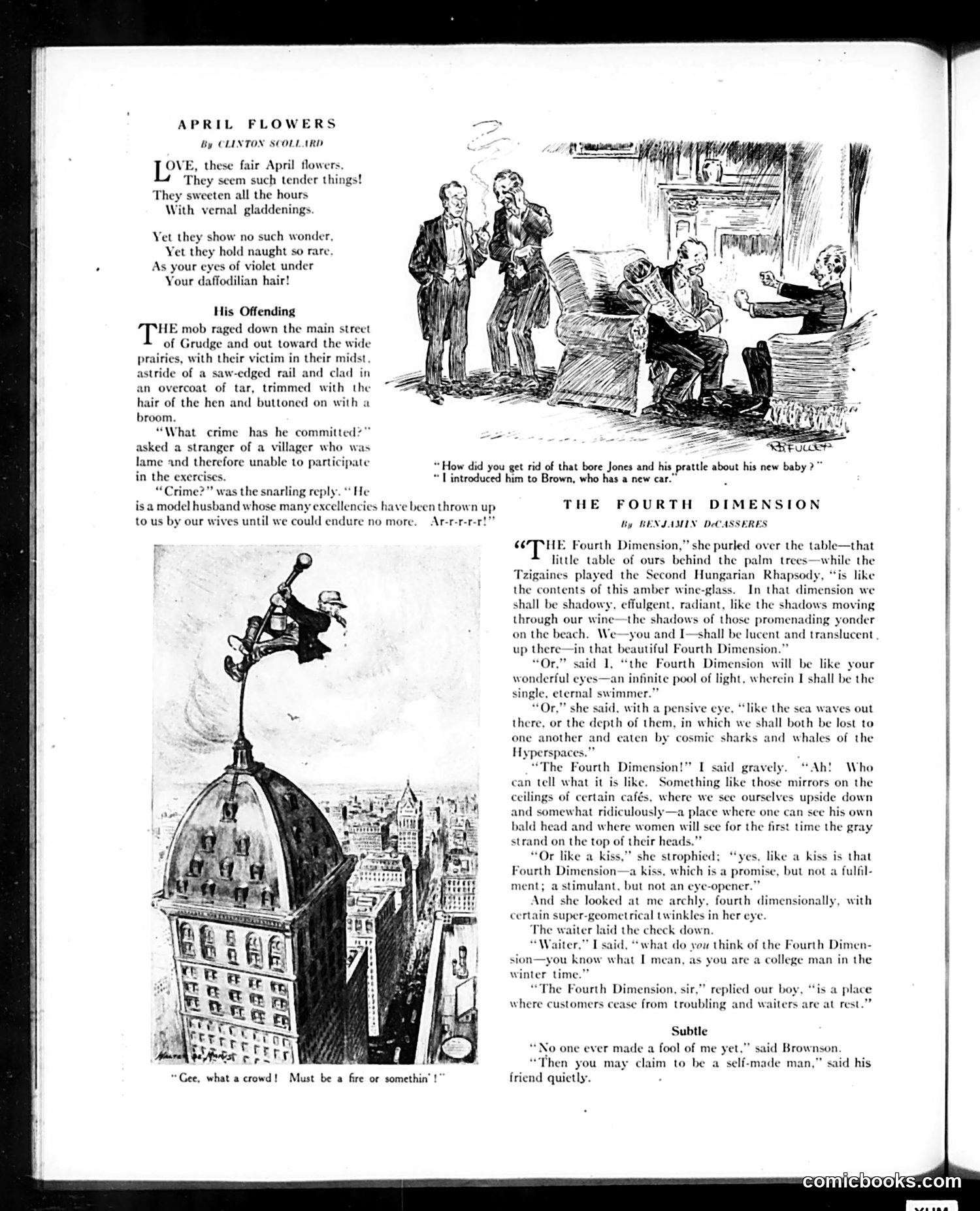
This page contains three distinct pieces of satirical content: **"April Flowers"** is romantic poetry by Clinton Scollard—not satirical, just sentimental verse about spring. **"His Offending"** satirizes domestic complaints. A small town has tarred-and-feathered a man whose only "crime" is being an exemplary husband whose virtues wives constantly praise to their husbands, making the husbands feel inadequate by comparison. The joke mocks both nagging wives and insecure men. **"The Fourth Dimension"** is philosophical satire about a couple at a romantic restaurant discussing abstract concepts (likely referencing newer mathematical/scientific theories of dimensionality popular in early 20th-century intellectual circles). The waiter's punchline—defining the Fourth Dimension as a place "where customers cease from troubling and waiters are at rest"—mocks pretentious philosophical conversation by grounding it in working-class cynicism. **"Subtle"** is a one-line joke about self-made men and foolishness. The illustrations support these narratives with period-appropriate sketches of the scenes described.
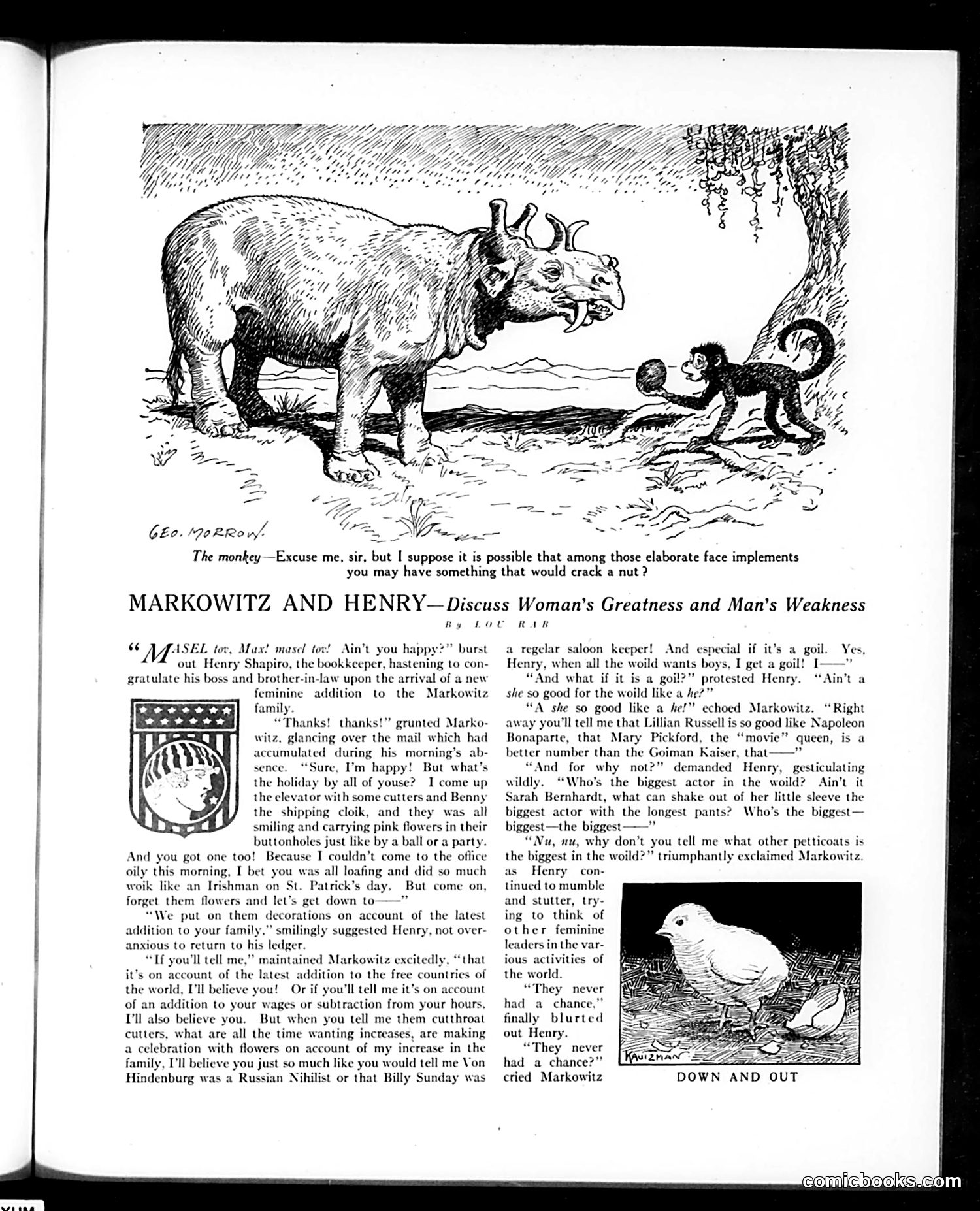
This page contains two separate satirical pieces from *Judge* magazine: **Top cartoon**: A monkey approaches a rhinoceros, asking if among its "elaborate face implements" (horns, thick skin) it might have something to crack a nut. The joke mocks people who attribute intelligence or capability to physical features—the implication being that powerful appearance doesn't equal practical usefulness. **"Markowitz and Henry" story**: A dialogue between a Jewish boss (Markowitz) and his bookkeeper (Henry Shapiro), written in exaggerated Yiddish-inflected English. The satire critiques gender attitudes: when Markowitz complains his newborn is a girl rather than a boy, Henry defends women by naming famous actresses (Sarah Bernhardt, Mary Pickford, Lillian Russell). Markowitz counters that these women succeeded *despite* disadvantage, not because of equal opportunity. Henry's final admission—"They never had a chance"—ironically proves Markowitz's point about systemic inequality, though framed as male weakness rather than female oppression. The satire targets both male chauvinism and the gap between rhetorical celebration of women's achievements and actual equality.
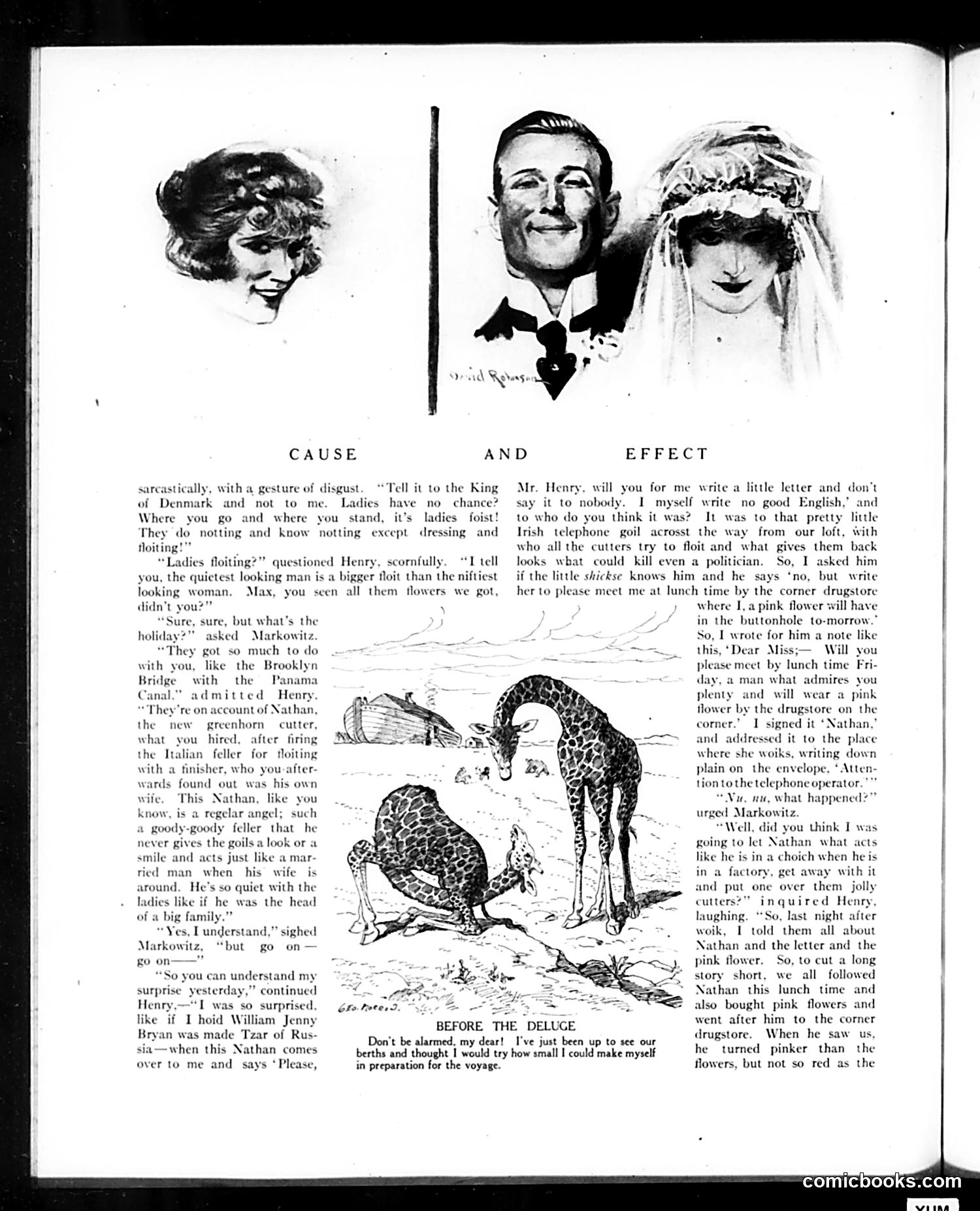
This page satirizes workplace romance and ethnic humor common in early 20th-century American comedy. The narrative describes Nathan, a virtuous Jewish factory cutter, being tricked into writing a love letter to an Irish telephone operator by his coworker Henry (both appear to be Jewish immigrants based on their Yiddish-inflected English dialogue). The joke's "effect" is that Henry and the other workers follow Nathan to the drugstore rendezvous, embarrassing him publicly. The illustration "Before the Deluge" shows giraffes preparing for a flood—likely a visual pun on Nathan's impending romantic "flood" of shame. The humor relies on ethnic stereotypes, workplace pranks, and the contrast between Nathan's pious behavior and his secret romantic interest. The comedic setup trades on readers' familiarity with immigrant factory life and inter-ethnic workplace dynamics of the era.
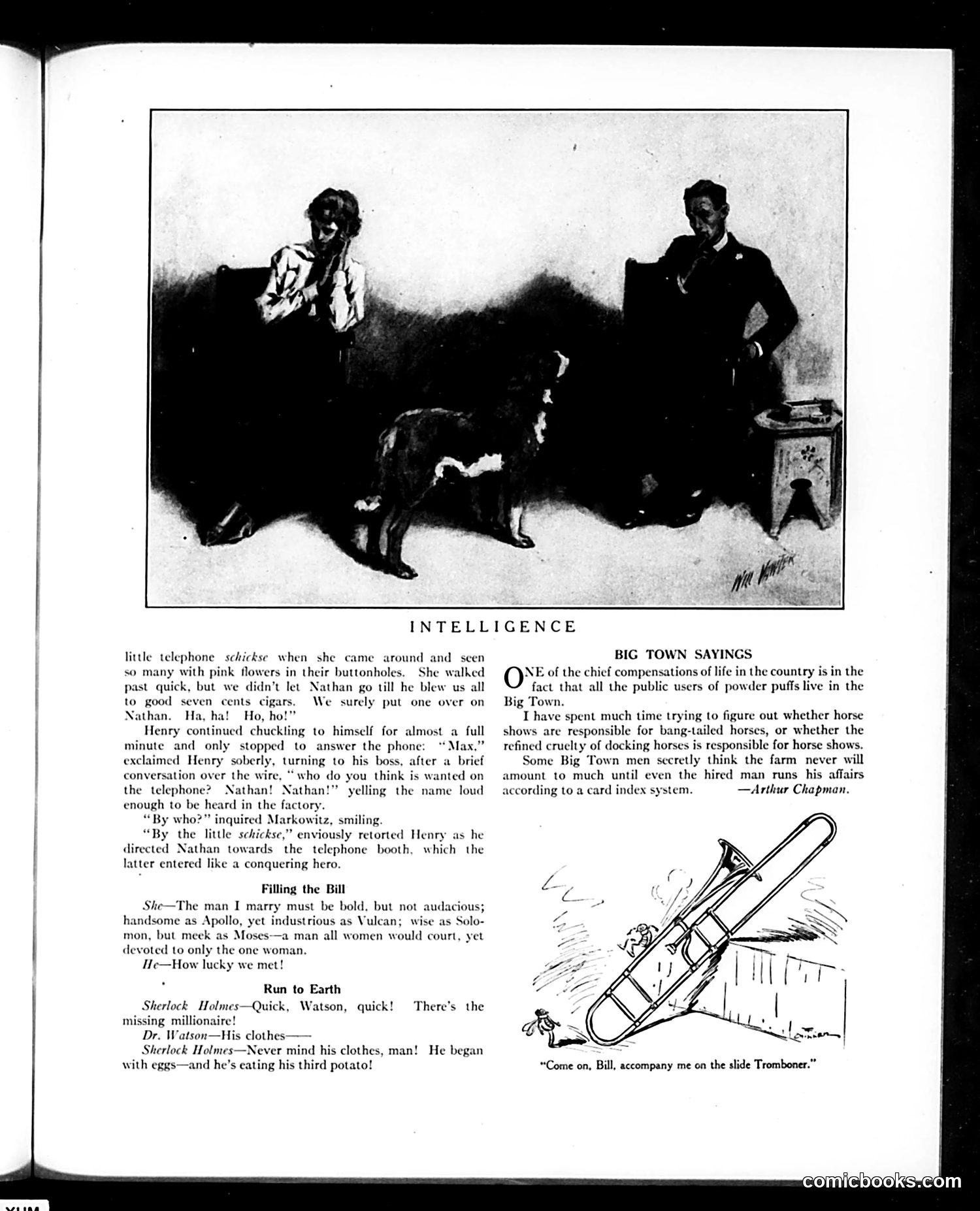
The page contains three satirical pieces: **"Intelligence"** (top cartoon): Shows two seated figures observing a dog, likely mocking someone's poor judgment or gullibility. The humor relies on visual irony. **"Big Town Sayings"** (middle text): A brief essay by Arthur Chapman satirizing urban attitudes about farm life, specifically the misconception that farms are unprofitable. Chapman suggests wealthy townspeople wrongly believe farmers can't succeed financially—a commentary on class prejudice and rural-urban disconnect. **Three short dialogue jokes** ("Filling the Bill," "Run to Earth"): Quick quips featuring Sherlock Holmes and Watson characters, typical of Judge's humor format—wordplay and absurdist scenarios. The overall page reflects early 20th-century American satirical magazine conventions: mixing visual cartoons with brief satirical essays and jokes targeting social pretension and urban-rural misunderstandings.
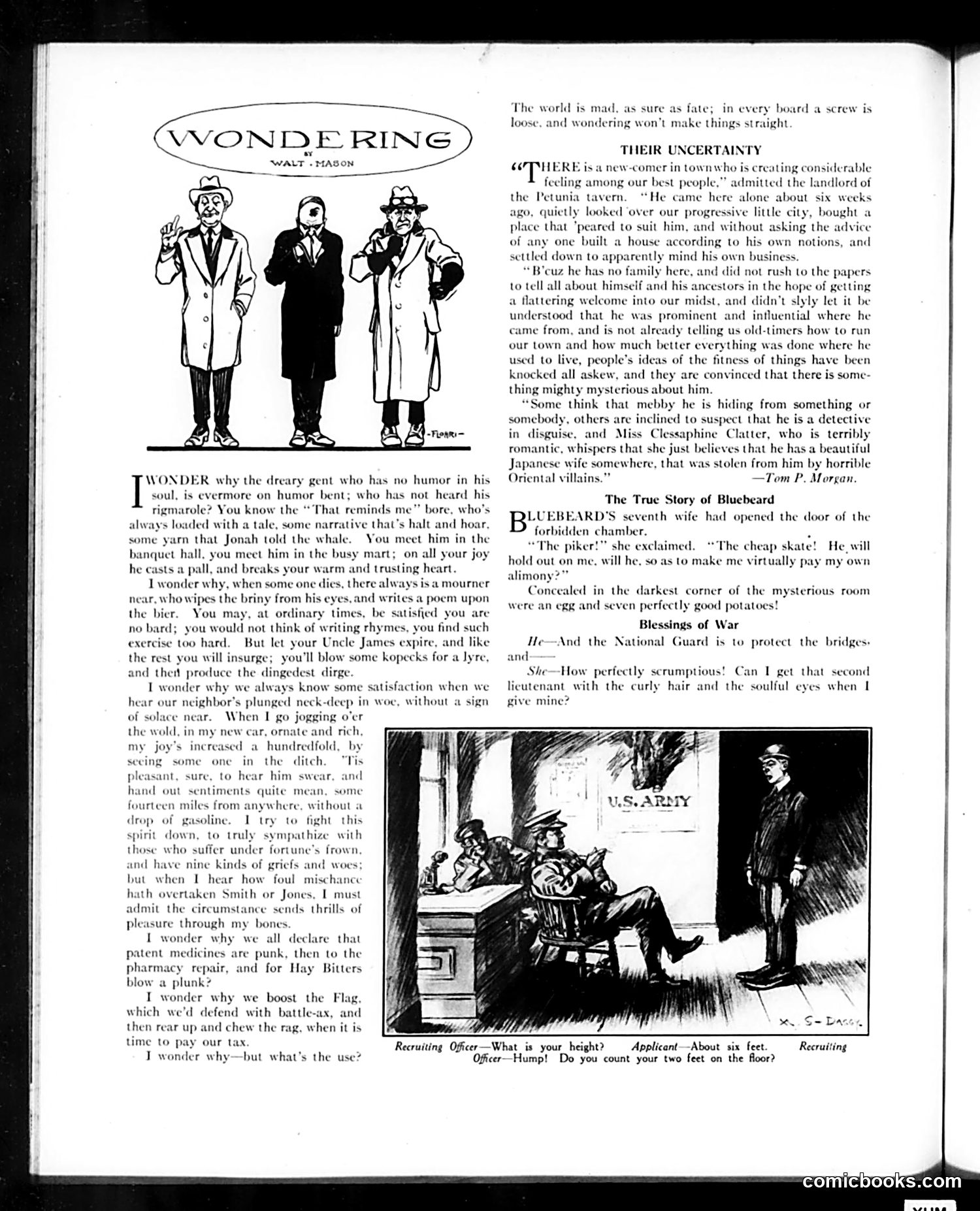
This page contains two distinct pieces of satirical humor: **"Wondering"** (left column): A philosophical poem lamenting human nature's contradictions—we claim to dislike gossips yet enjoy others' misfortunes; we mock patent medicines then buy them; we glorify the flag yet resent paying taxes. The "dreary gent" opening refers to the universal bore who kills joy with tedious anecdotes. This is gentle social satire about human hypocrisy. **The bottom cartoon** shows a U.S. Army recruiting officer interviewing an applicant, making a joke about the recruit's height: the officer asks how tall he is, the applicant says six feet, and the officer quips "Do you count your two feet on the floor?"—suggesting the man is so short he barely reaches six feet when standing. **"Their Uncertainty"** describes small-town suspicion of a newcomer who simply minds his own business without bragging about his past or origins. Townsfolk interpret his quiet discretion as suspicious, inventing theories he's a detective or hiding something. It satirizes how ordinary small-town gossip manufactures mystery from normalcy.
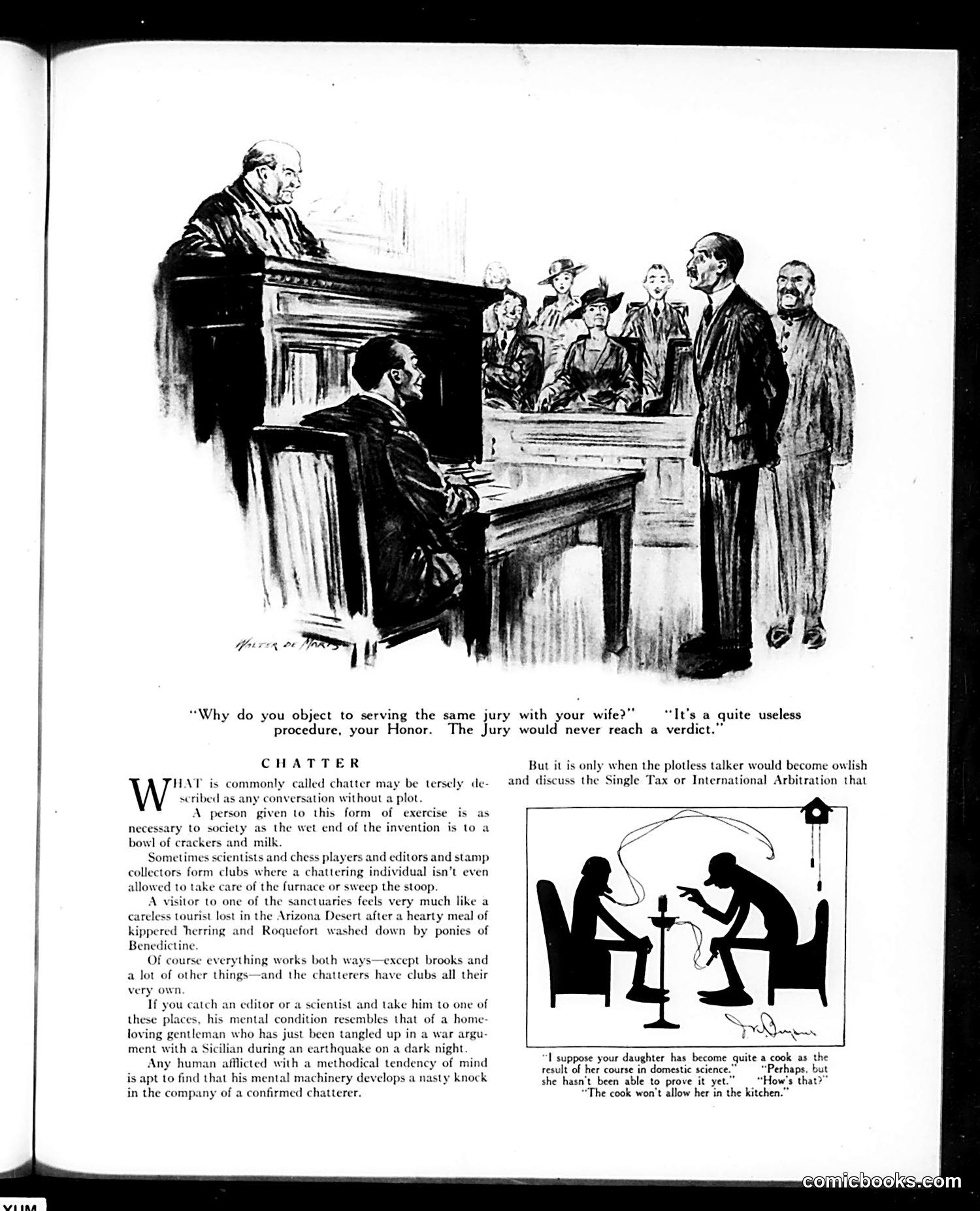
**Top Cartoon:** A courtroom scene satirizing gender relations. A man objects to serving on a jury with his wife, arguing they'd never reach a verdict—implying married couples engage in endless argument. This jokes about marital discord and women's recent entry into jury duty (women's suffrage was expanding during this era). **"Chatter" Essay:** A humorous piece defining chatter as purposeless conversation. It contrasts "chattering individuals" (described as socially useless) with serious professionals like scientists and editors who actively exclude such people from their clubs. The essay suggests chatty people form their own separate social circles. **Bottom Cartoon:** Depicts a domestic scene where a father learns his daughter completed a cooking course but can't practice—"the cook won't allow her in the kitchen." This satirizes women's education: formal training in "domestic science" proves useless when traditional household hierarchies (the established cook) prevent its application. Both pieces mock social pretension and gender dynamics of the period.
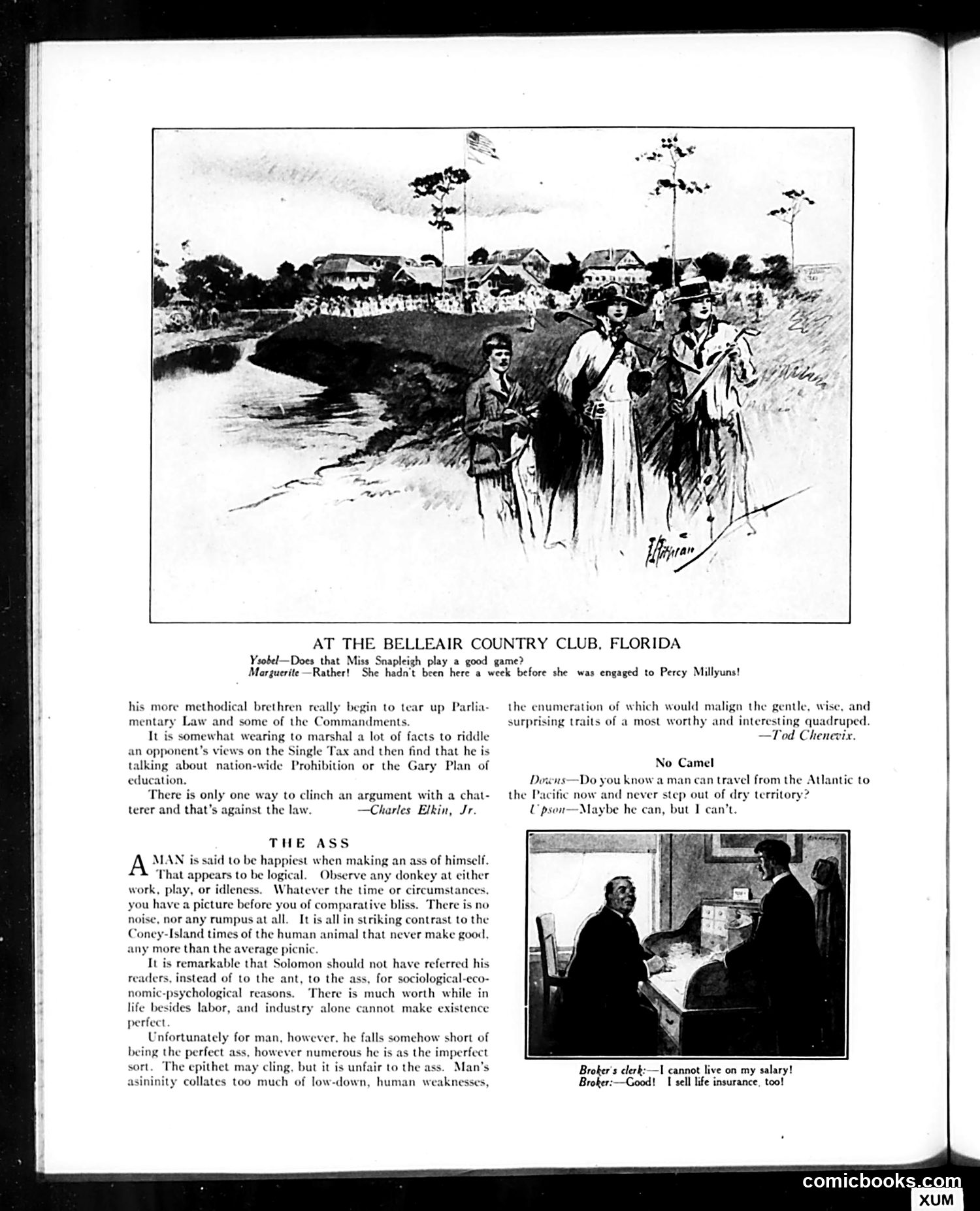
**Top Cartoon**: "At the Belleair Country Club, Florida" satirizes gold-digging among wealthy socialites. Two women discuss Miss Snapleigh, who secured an engagement to "Percy Millyuns" (a pun on "millions") within a week of arriving at this exclusive Florida resort. The joke mocks the mercenary marriage practices of upper-class women seeking wealthy husbands. **"The Ass" Essay**: A philosophical piece arguing that donkeys are happier than humans because they lack ambition and competitive drives. It critiques how men, unlike asses, suffer from "asininity" rooted in "low-down, human weaknesses"—a tongue-in-cheek commentary on human folly. **Bottom Cartoons**: Two brief jokes—one about traveling across America without leaving "dry territory" (Prohibition-era reference to alcohol availability), another darkly joking that a broker sells life insurance to underpaid clerks, implying financial desperation. The page reflects early 20th-century satirical commentary on class, wealth, Prohibition, and economic anxiety.
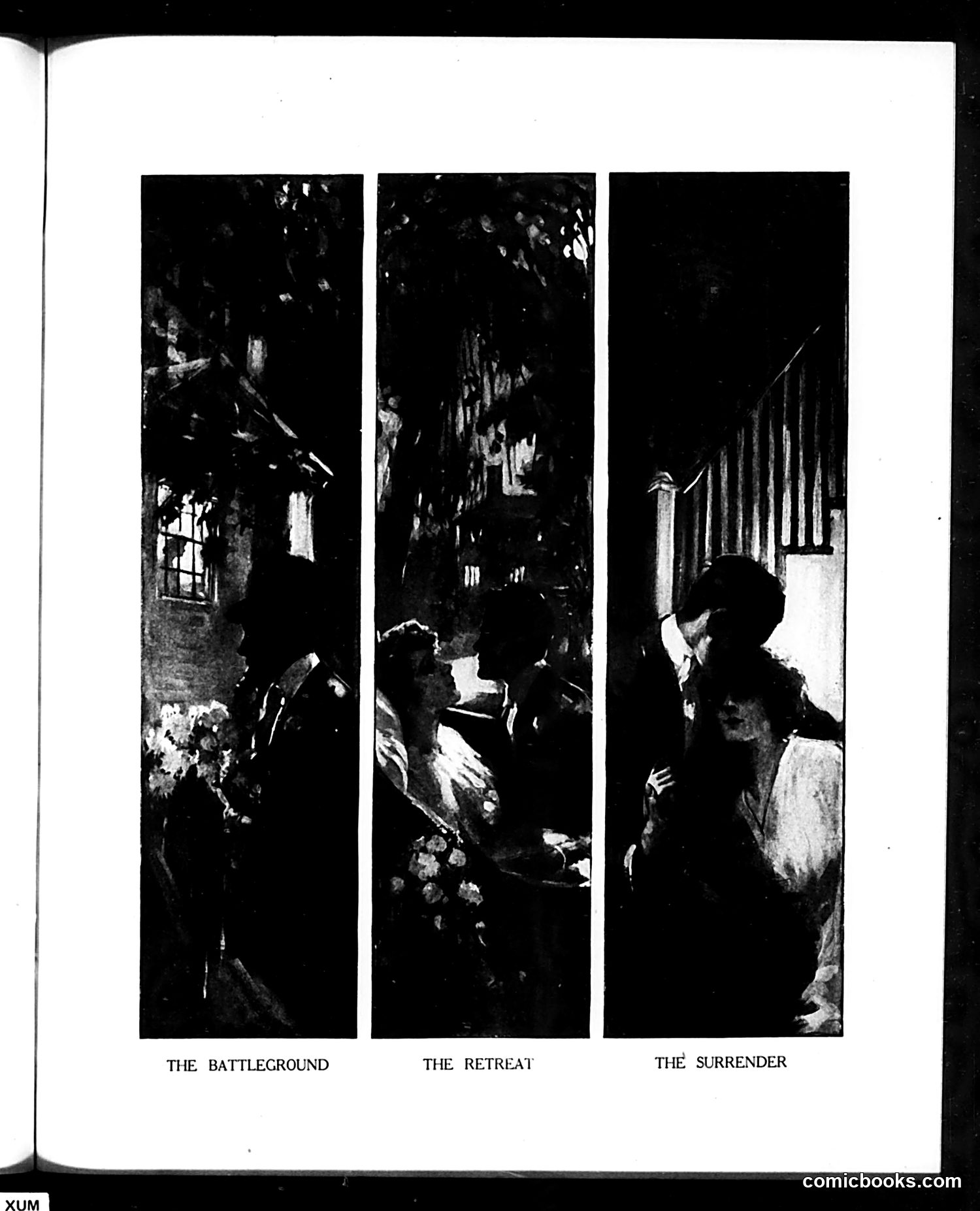
This appears to be a three-panel dramatic sequence from *Judge* magazine depicting a narrative progression titled "The Battleground," "The Retreat," and "The Surrender." The darkly lit scenes show figures in what appears to be an interior setting with architectural elements (windows, pillars, doorways). The silhouetted composition and theatrical staging suggest this illustrates a political or social conflict rather than literal military action—the titles use war terminology metaphorically. Without additional text or caption, the specific political reference remains unclear. The imagery could satirize labor disputes, political negotiations, social reform debates, or legal proceedings common to early 20th-century American politics. The dramatic progression from confrontation to capitulation implies commentary on a power struggle's outcome, though identifying the particular figures or events requires additional context beyond what's visible here.
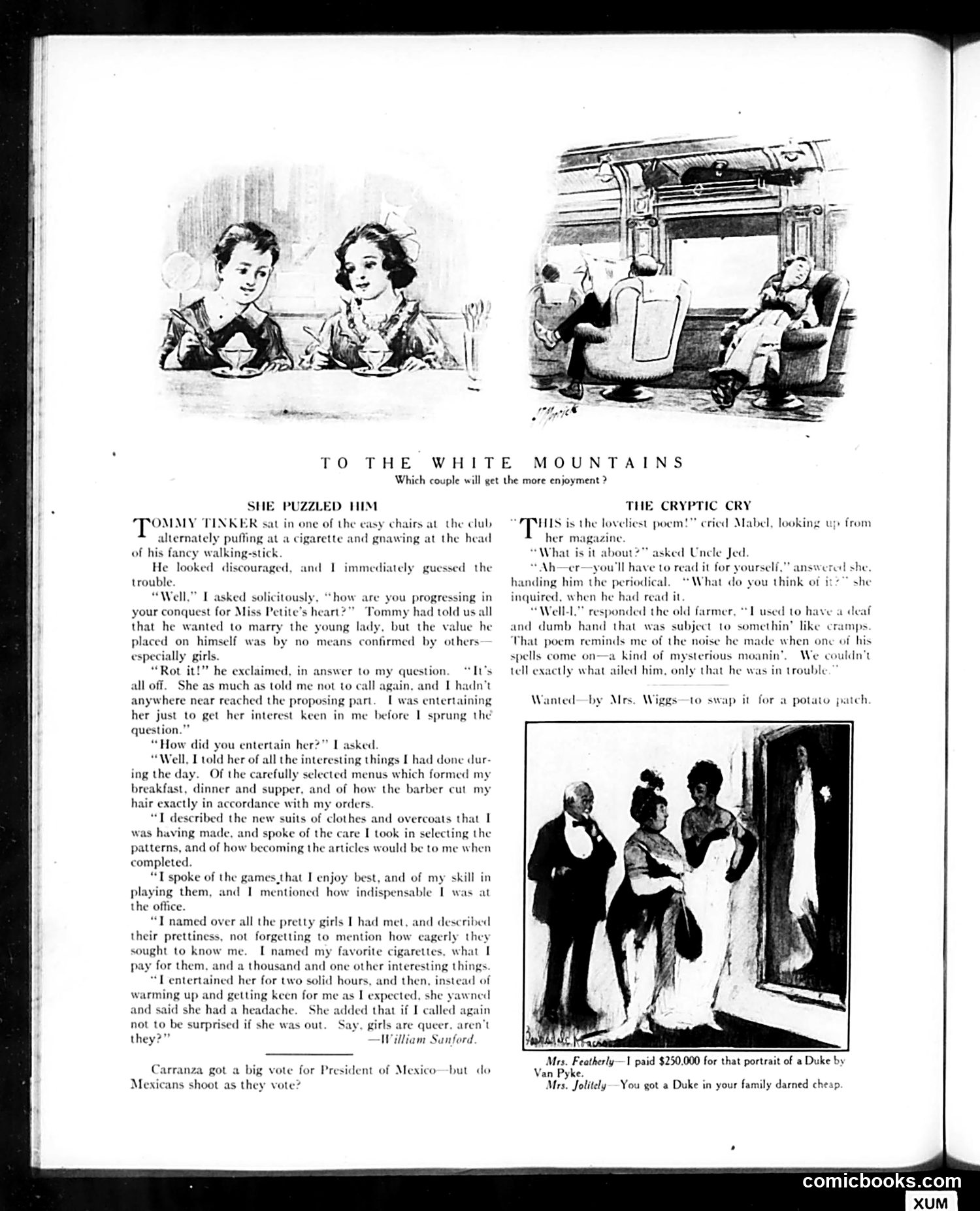
**"She Puzzled Him"** satirizes self-absorbed courting. Tommy Tinker bores a young woman by spending two hours discussing only himself—his meals, clothes, haircuts, office importance, and conquests of other women—then is bewildered when she rejects him and claims a headache. The joke: his complete obliviousness to her lack of interest. The satire targets vain, self-centered men who mistake their own achievements for romantic appeal. **"The Cryptic Cry"** parodies pretentious poetry appreciation. Mabel calls a poem "loveliest," but when Uncle Jed reads it, he can only compare it to the inarticulate cries of a deaf and dumb farmhand in distress. The satire mocks both poetry that sounds like nonsense and people who praise literature they don't understand. The page title "To the White Mountains" frames these as contrasting couples—implying which pair would actually enjoy a vacation together based on their compatibility.
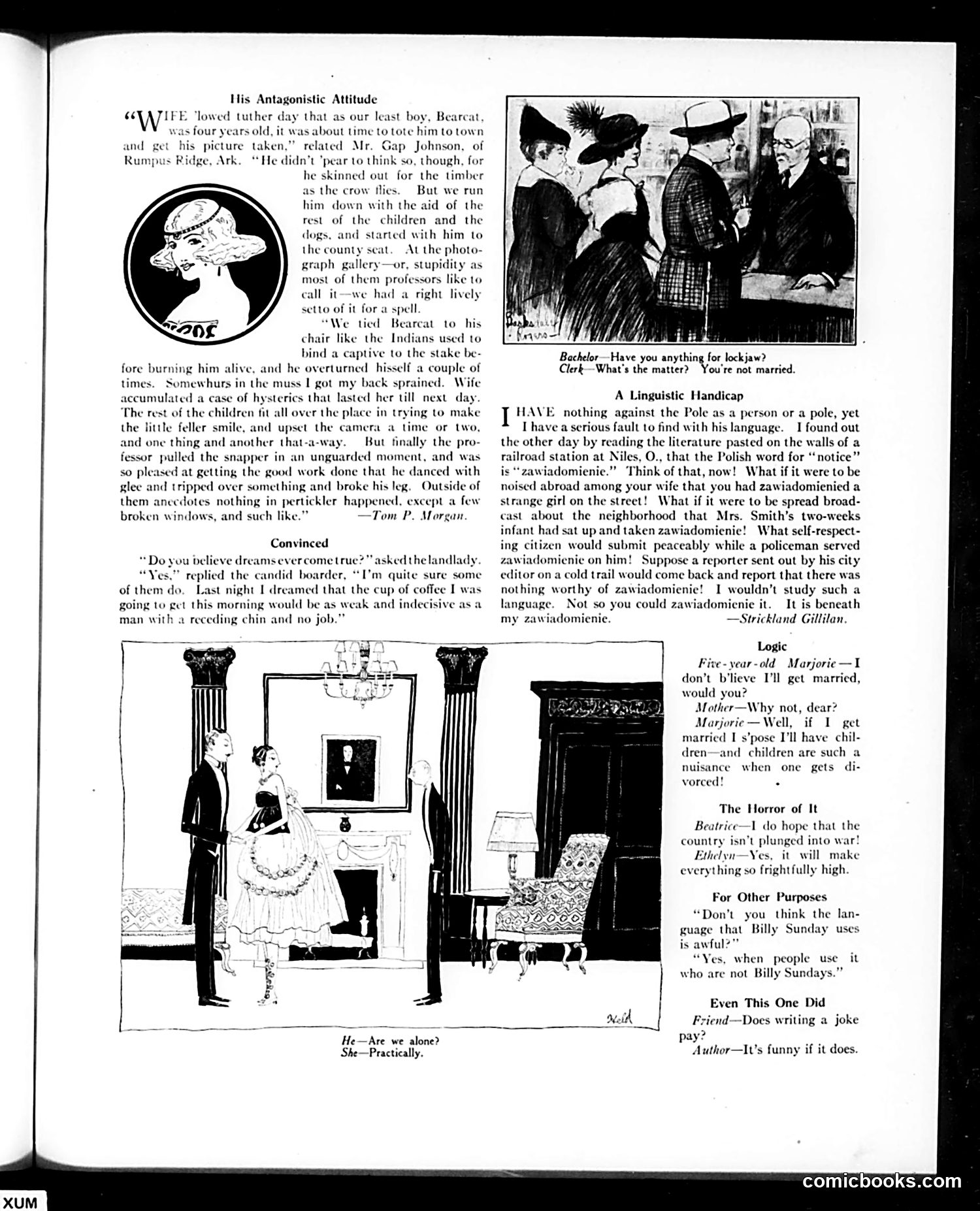
This page from *Judge* contains several satirical pieces typical of early 20th-century American humor: **"His Antagonistic Attitude"** mocks rural parenting through Mr. Gap Johnson's anecdote about photographing his unruly young son "Bearcat." The humor lies in the chaos—the child must be tied to a chair, family members fight throughout, the photographer breaks his leg—all for one photo. It satirizes both stubborn frontier children and the pomposity of professional photographers. **"A Linguistic Handicap"** ridicules Polish language by fixating on the word "zawiadomieniec" (notice), suggesting it's absurdly unpronounceable and unfit for polite society. This reflects period prejudice against Eastern European immigrants and their "difficult" languages. The remaining shorts are domestic humor: a boarder's cynical dream about weak coffee, bachelor/lockjaw wordplay, a child's logical objection to marriage (fearing divorce complications), and commentary on Billy Sunday (likely the famous evangelist). The overall tone reflects class-conscious, xenophobic American humor typical of the era.
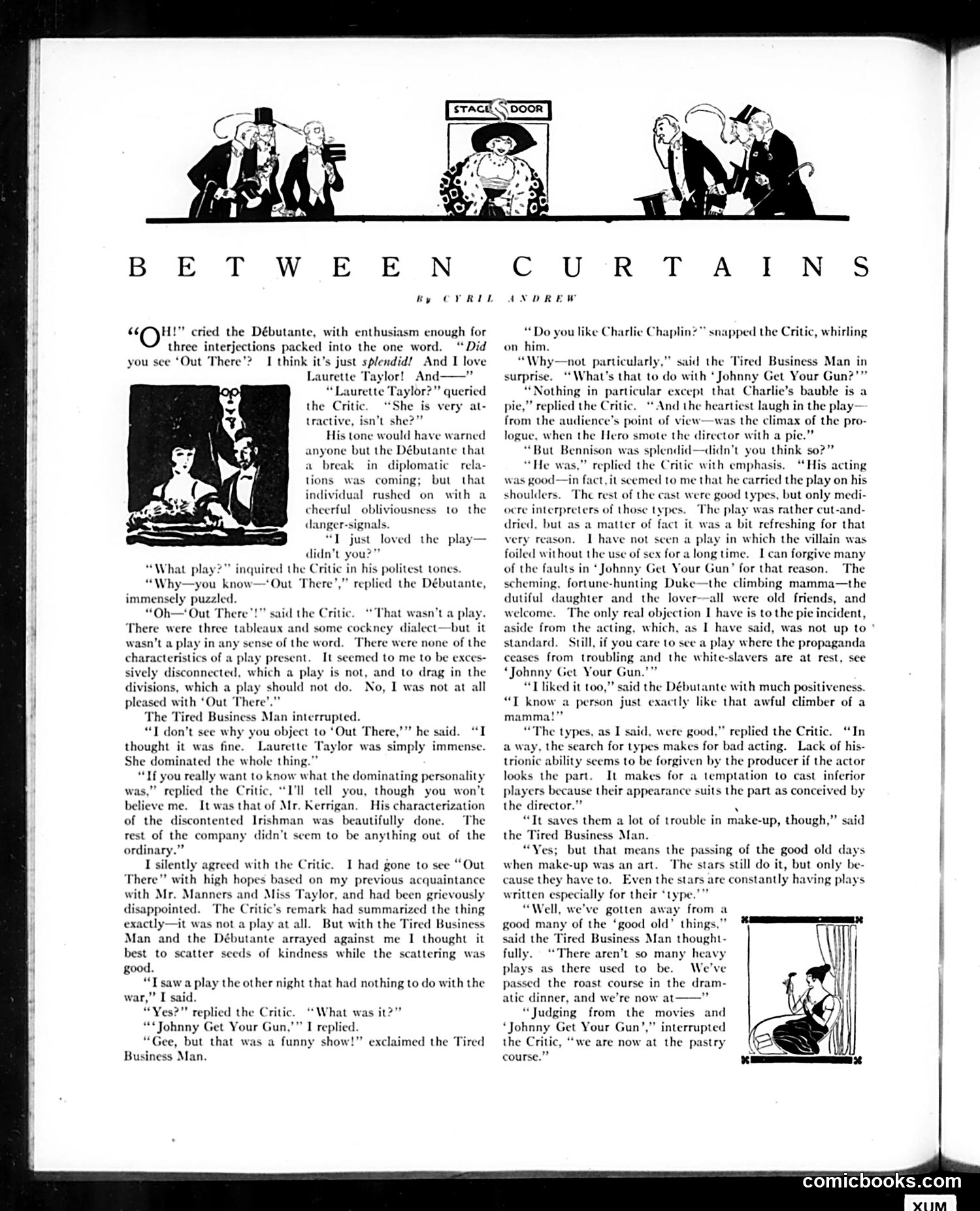
This theatrical criticism piece satirizes three archetypal theater-goers debating two 1910s plays: "Out There" and "Johnny Get Your Gun." **The Characters:** - The **Critic**: A pompous, analytically harsh reviewer who deconstructs everything - The **Débutante**: An enthusiastic but shallow socialite who loves spectacle and stars (like Laurette Taylor) - The **Tired Business Man**: A working-class patron seeking simple entertainment **The Satire:** The piece mocks the gap between sophisticated dramatic criticism and popular entertainment. The Critic dismisses "Out There" as lacking dramatic structure despite its star power, while praising "Johnny Get Your Gun" for avoiding melodramatic clichés—yet the Tired Business Man and Débutante simply enjoyed the pie-in-face gag. Andrew illustrates how different audiences evaluate theater: critics demand artistic merit; the wealthy want star appeal; ordinary people want laughs. The Critic's intellectual standards clash amusingly with everyone else's simpler pleasures, suggesting a fundamental divide in how Americans experienced theater.
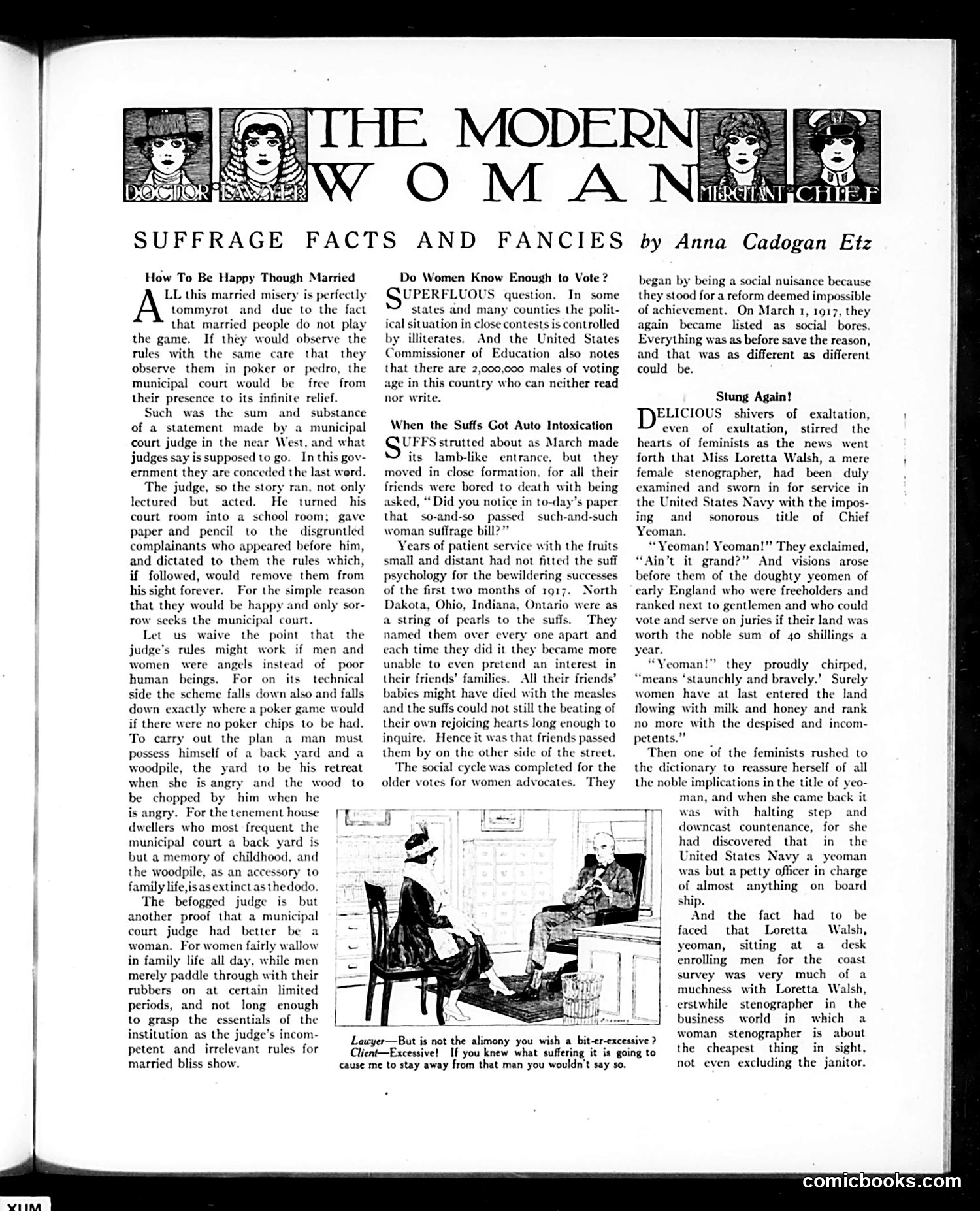
This satirical article by Anna Cadogan Etz mocks the women's suffrage movement circa 1917. The main cartoon (visible center-left) depicts a lawyer and client—likely illustrating the article's opening about matrimonial disputes, where a municipal judge improbably prescribed "rules" for happy marriage (yard work, woodpiles) as if marriage were a game like poker. The satire undercuts the judge's condescending solution as useless for tenement dwellers. Etz also ridicules suffragists themselves: she dismisses concerns about voting literacy (noting illiterate men already vote), then cruelly mocks female suffrage advocates for becoming insufferable "social bores" around 1917, obsessively celebrating incremental state victories (Dakota, Ohio, Indiana, Ontario) while boring their friends to death with constant references to legislative wins. The "Loretta Walsh" item (bottom right) references a woman seeking Navy enrollment—positioning this as absurd given women's supposedly limited capabilities. Etz's satire cuts multiple ways: attacking male judges' incompetence *and* feminists' obnoxiousness, suggesting neither sex competently handles serious matters.
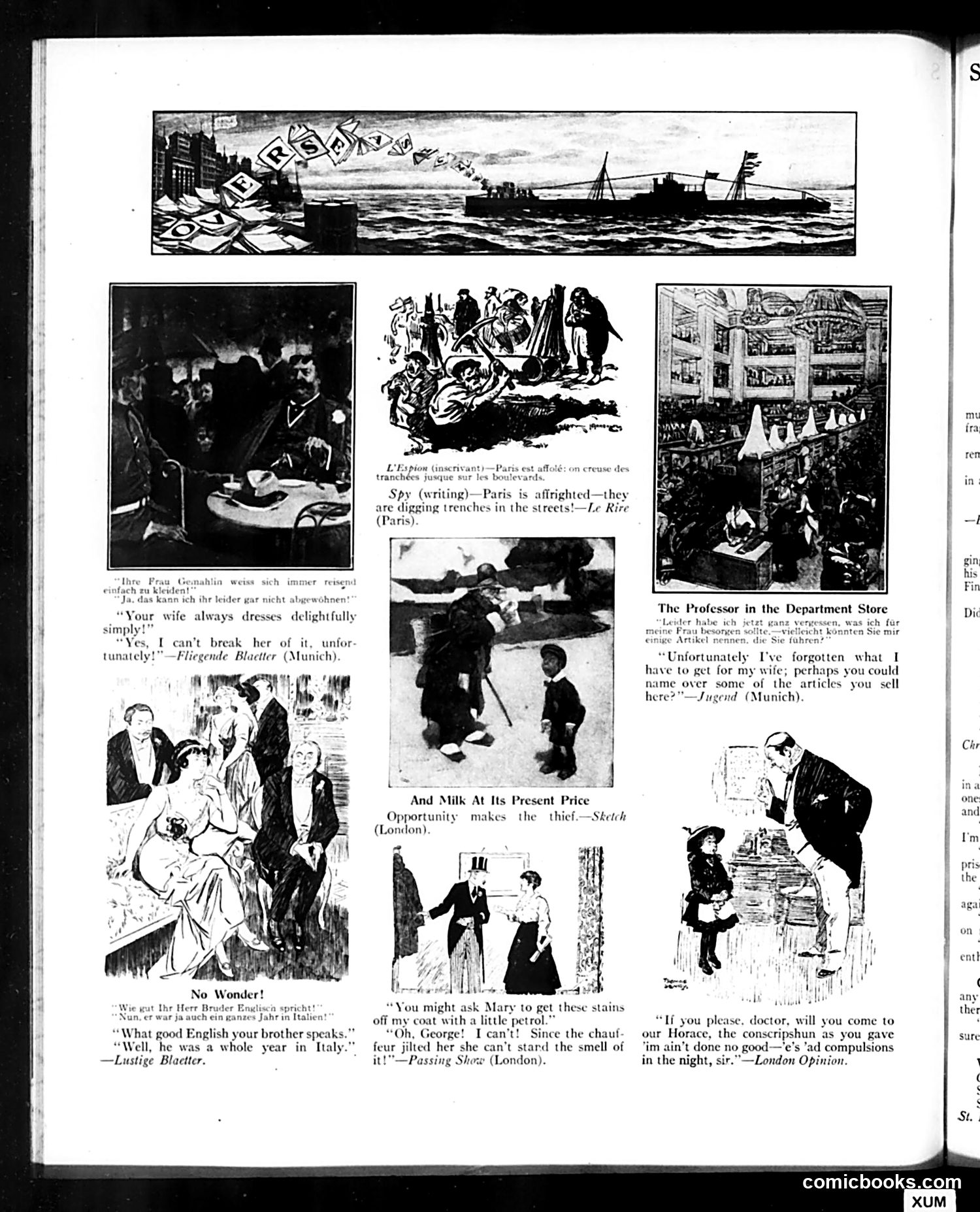
This page collects satirical cartoons and jokes from European publications, offering social commentary on WWI-era life across multiple countries. The opening cartoon depicts **Paris during wartime**, with civilians frightened by defensive trench-digging in city streets—satirizing the disruption of normal urban life by military preparations. The remaining cartoons mock **domestic absurdities and class tensions**: A wife's expensive fashion habits; a husband shopping for his wife but forgetting what she needs; a professor browsing department stores; theft driven by economic hardship ("opportunity makes the thief"); a servant using petrol (gasoline) to clean a coat; marital discord over infidelity; and a doctor called to treat a patient suffering nighttime "compulsions" (likely psychological distress from wartime anxiety). The cartoons employ German, French, and English sources, suggesting *Judge* presented international satire reflecting shared wartime anxieties about economic strain, social disruption, and personal relationships strained by war conditions. The humor relies on recognizing everyday frustrations magnified by extraordinary circumstances.
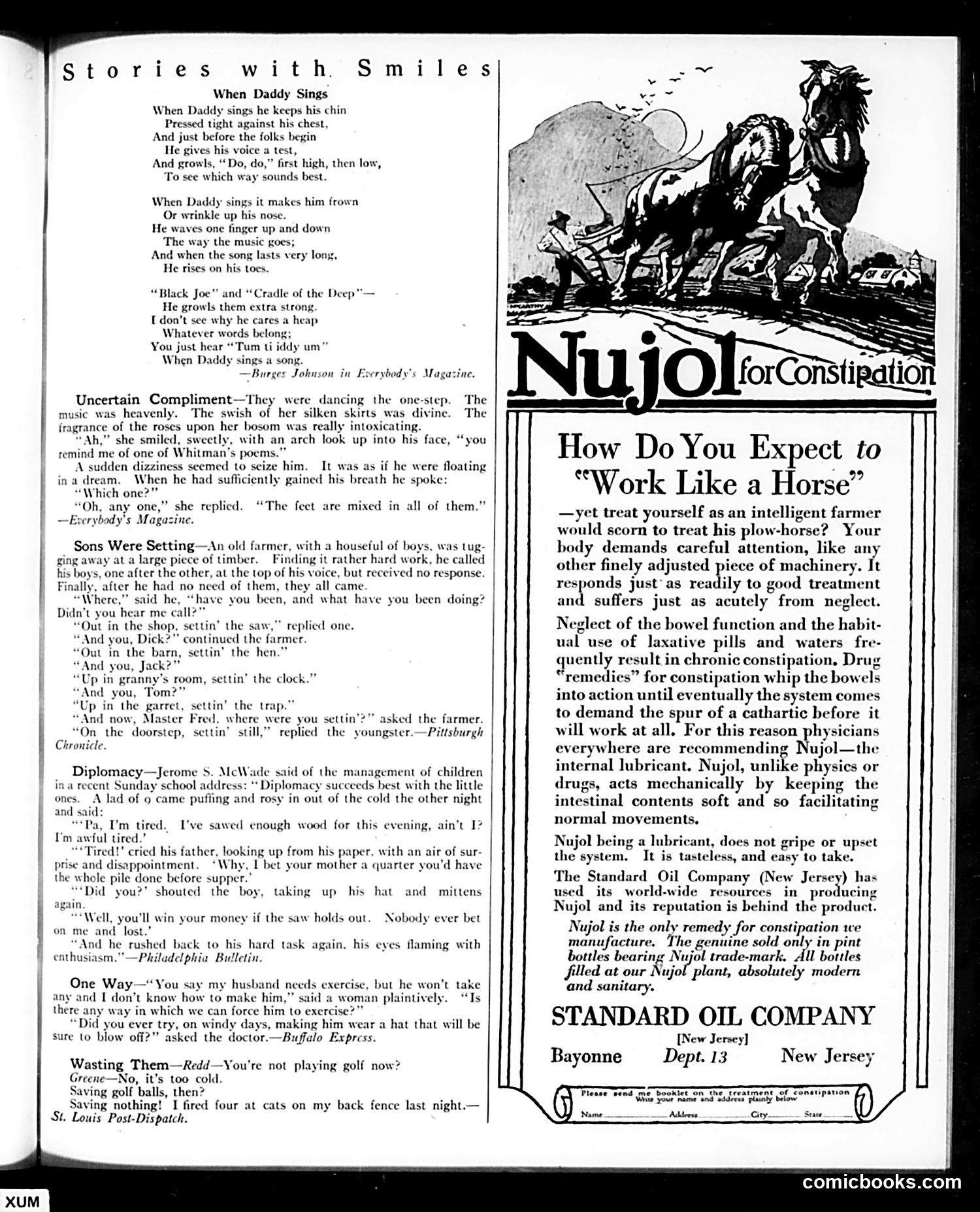
This page contains humorous anecdotes rather than political cartoons. The left side features lighthearted domestic comedy pieces drawn from contemporary magazines like *Everybody's* and the *Pittsburgh Chronicle*: - **"When Daddy Sings"**: Satirizes fathers' singing habits—their peculiar physical contortions and inability to articulate lyrics properly. - **"Sons Were Setting"**: A rural pun-based joke where boys mishear their father's calls, creating double meanings ("settin' the hen" instead of working). - **"Diplomacy"**: Shows a child manipulating his father through reverse psychology about completing chores. The right side is a **full-page advertisement for Nujol**, a mineral oil laxative. The ad uses persuasive messaging comparing bowel health to maintaining farm equipment, reflecting early 20th-century patent medicine marketing that emphasized internal cleanliness as vital to health. The page exemplifies Judge's mix of genteel domestic humor and period advertising—no political satire or caricature present.
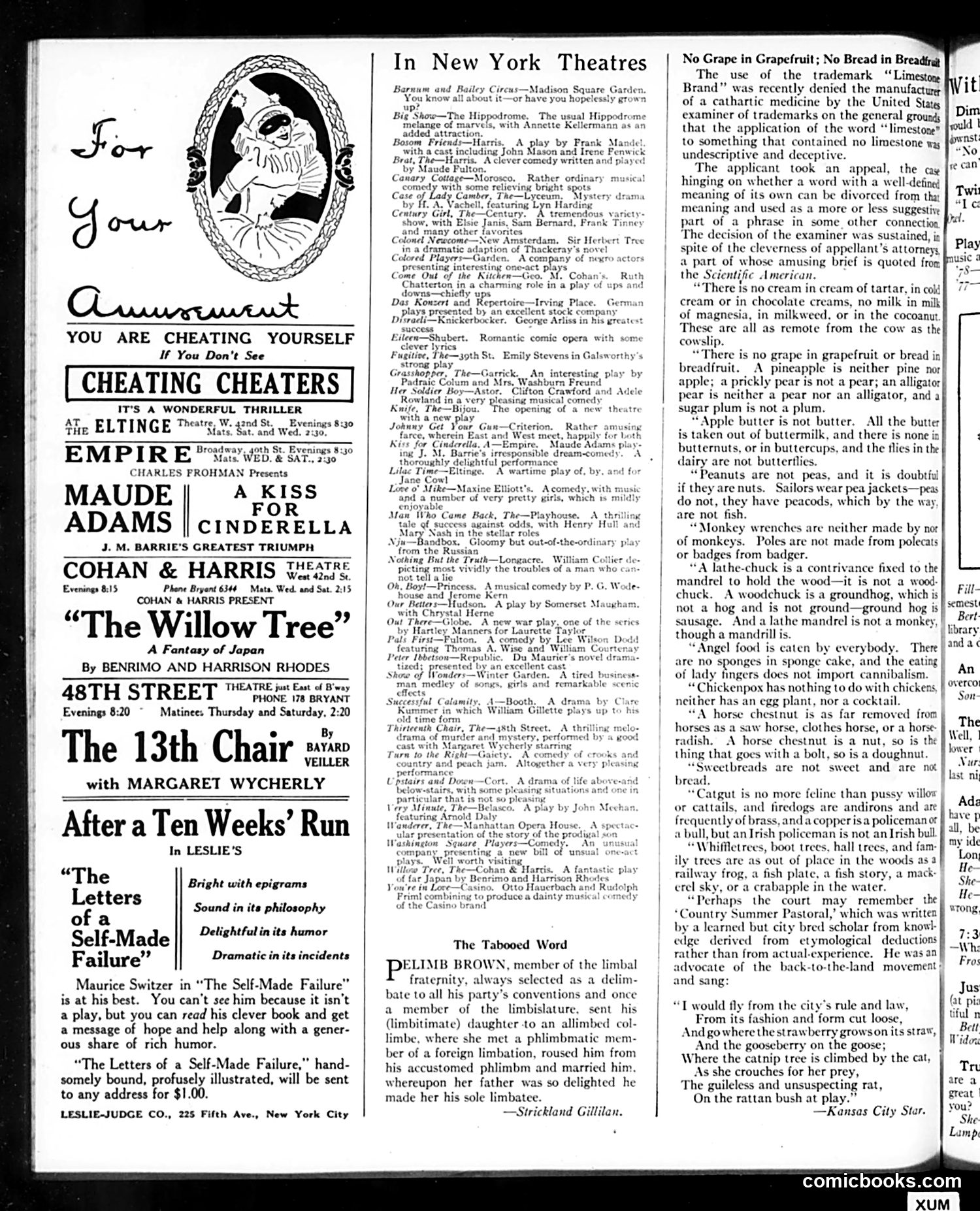
This page is primarily **theatrical advertising** from an early 20th-century issue of Judge magazine. The dominant content showcases Broadway productions and theater promotions. The cartoon at top-left depicts **Santa Claus** with the caption "For Your Amusement: YOU ARE CHEATING YOURSELF If You Don't See CHEATING CHEATERS." This is a straightforward advertisement encouraging theatergoers to see the play "Cheating Cheaters," using Santa as a cheerful endorsement figure. The bulk of the page contains listings of New York theatrical productions (including "The Willow Tree," "The 13th Chair," and "Cinderella") and advertisements for theatrical publications. The notable satirical content appears at bottom: **"The Tabooed Word"** by Strickland Gillilan is a humorous piece using absurdist wordplay, repeatedly inserting "limb" into words ("limbislature," "limbatee") to mock the era's speech censorship—likely referencing contemporary debates about what words were considered improper for public discussion or print media.
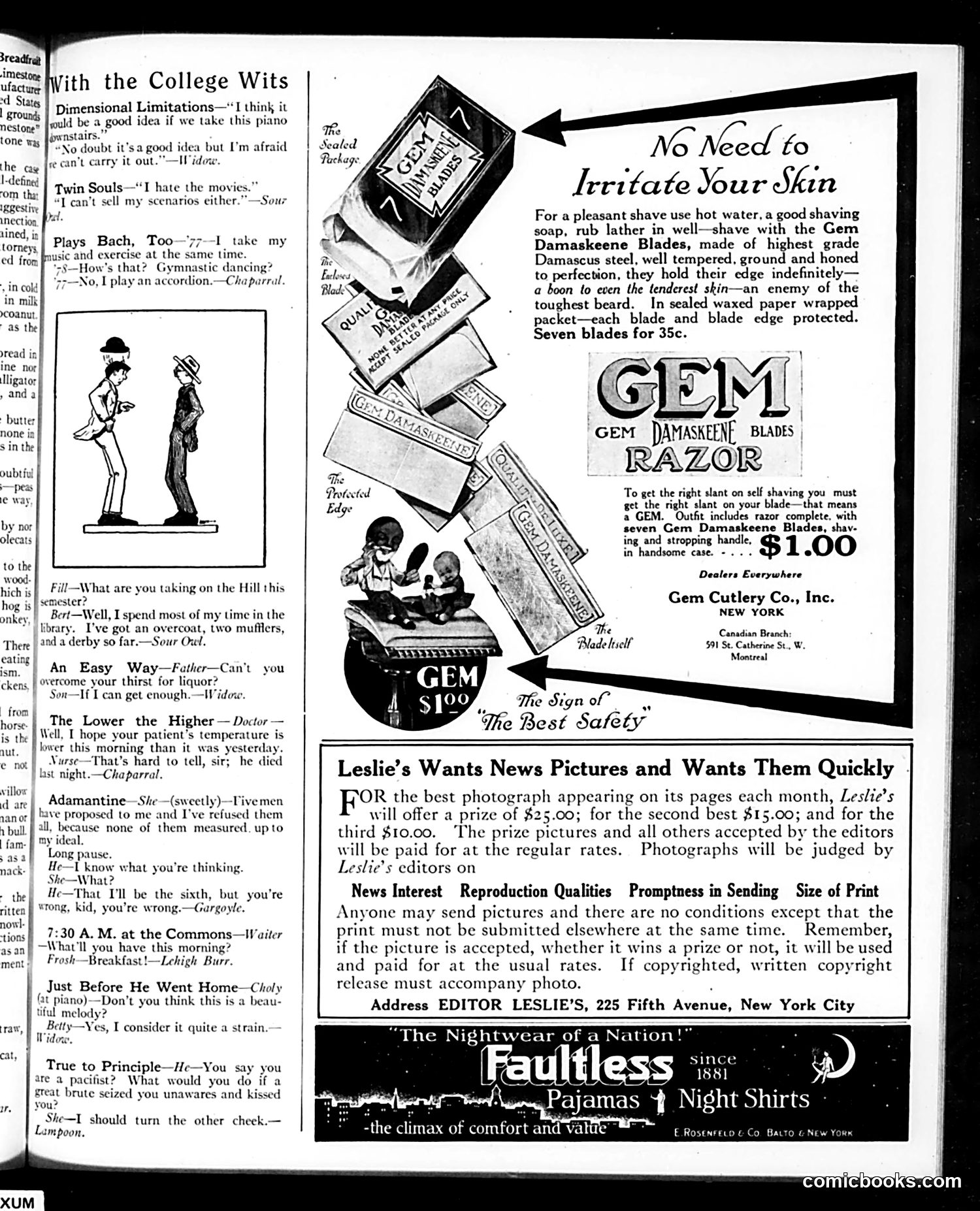
This page from *Judge* contains primarily **humor columns and advertisements** rather than political cartoons. The left column features brief comedic anecdotes labeled "With the College Wits"—lighthearted jokes about college students, faculty, and everyday situations (pianos on stairs, music practice, romantic rejection). These reflect early 20th-century campus humor typical of the era. The right side is dominated by **product advertisements**: a Gem Damaskeene razor ($1.00), a Leslie's magazine photo contest ($25 prize), and Faultless pajamas. These ads are unrelated to satire. The cartoons shown are simple line drawings accompanying the jokes—a man and woman in formal dress, and children playing—illustrating the humorous scenarios described. **Bottom line**: This is a **humor and advertising page** with no discernible political or social satire. The content reflects early 20th-century college culture and consumer marketing rather than commentary on current events.
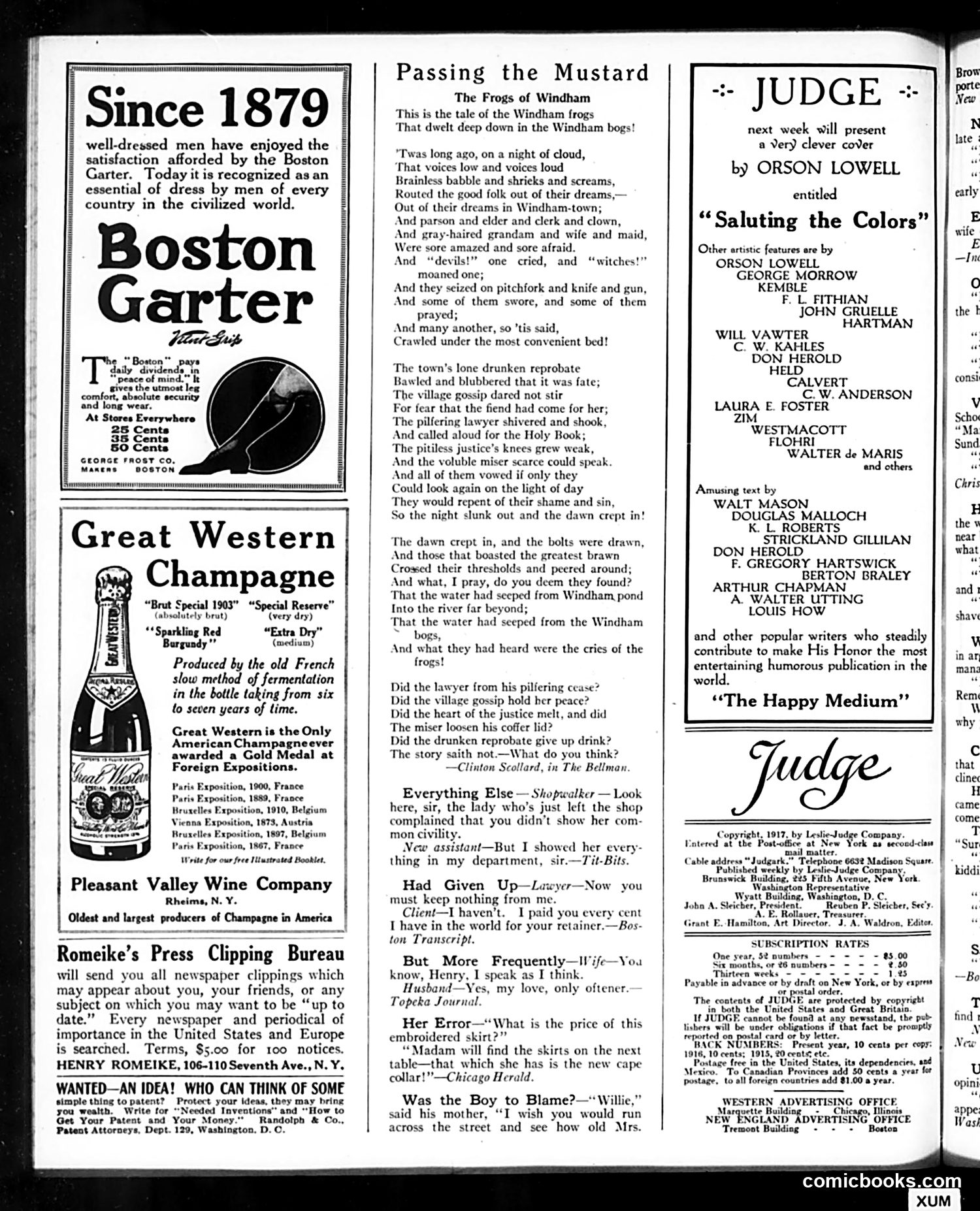
This page from **Judge** (1917) is primarily **advertising and humorous text**, not political cartoons. The **main content** is a lengthy poem, "The Frogs of Windham," a cautionary tale by Clinton Scollard. It humorously describes a New England town's panic during an unexplained nighttime commotion. Townspeople—including a lawyer, gossip, miser, and drunk—fear demonic forces and swear reform. Dawn reveals the "terror" was merely frogs croaking from Windham pond. The joke: **people revert to old habits** once danger passes, implying moral reform is superficial. **Advertisements dominate**: - Boston Garter suspenders (since 1879) - Great Western Champagne (claims American award) - Romeike's Press Clipping Bureau - Wine company **Brief humorous shorts** include workplace and marriage jokes with predictable punchlines (assistant oversells; lawyer charges everything; wife speaks constantly). The **JUDGE masthead** announces next week's cover story "Saluting the Colors" by Orson Lowell. This is a **typical entertainment/advertising issue**, not satirical commentary.
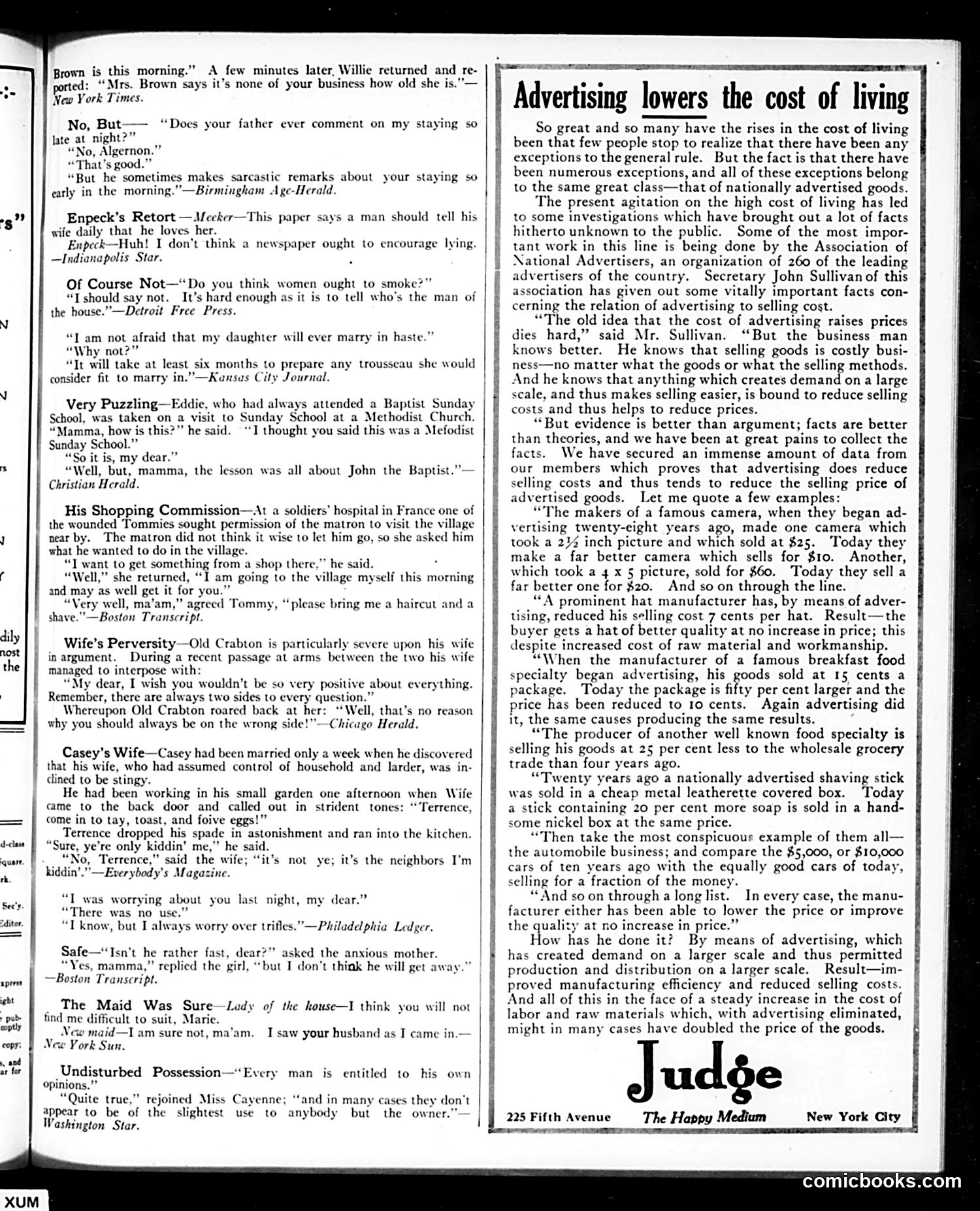
This page contains primarily **satirical short humor pieces** rather than political cartoons—typical of Judge magazine's format. The left column features brief anecdotes mocking domestic relationships and social conventions: - Husbands' reluctance to express affection or admit wives' age - Gender dynamics around smoking and household authority - Wedding preparations taking excessive time - A child's confusion between Baptist and Methodist theology The right column is a **full-page advertisement** masquerading as editorial content, promoting the Association of National Advertisers. It argues that advertising reduces consumer prices by increasing sales volume and manufacturing efficiency. The piece cites examples: camera prices dropping from $25 to $10, hat production costs falling, and breakfast food package prices reducing from 15 to 10 cents. **Context for modern readers:** This represents early 20th-century advertising attempting to counter public anxiety about rising costs of living by claiming advertising benefits consumers—a self-interested argument from the advertising industry itself, presented without skepticism. The satire targets conventional domestic life; the "advertisement" reveals period concerns about inflation and advertising's role in commerce.
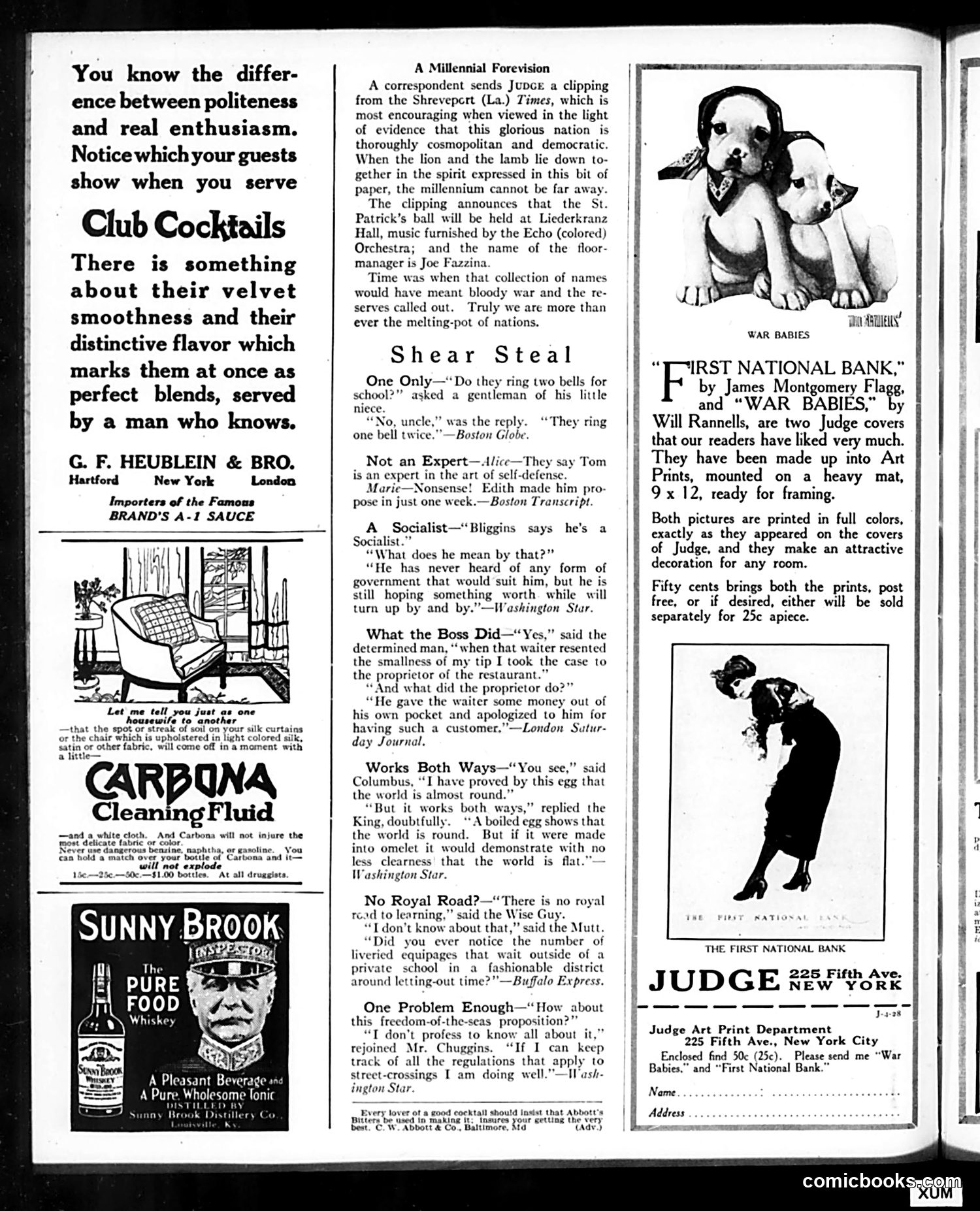
This page is primarily **advertisements and humor shorts**, not political cartoons. The main editorial content is "A Millennial Forevision," satirizing American optimism about national unity. It notes that a St. Patrick's ball in Shreveport, Louisiana—with an Irish name (Liederkranz Hall), a "colored" orchestra (Echo), and an Italian floor manager (Joe Fazzina)—would have sparked "bloody war" in the past. The piece celebrates this as proof America has become "the melting-pot of nations," gently mocking the grandiose language of early-1900s ethnic harmony rhetoric. The page includes Judge's trademark short humor bits ("Shear Steal," "Not an Expert," etc.)—brief joke exchanges with minimal political content—alongside product advertisements (Club Cocktails, Carbona Cleaning Fluid, Sunny Brook Whiskey). The bottom features **art print advertisements** for Judge magazine covers featuring dogs ("War Babies"), suggesting these were commercial offerings. Overall: a typical Judge page mixing satire, advertising, and light humor rather than hard-hitting political commentary.
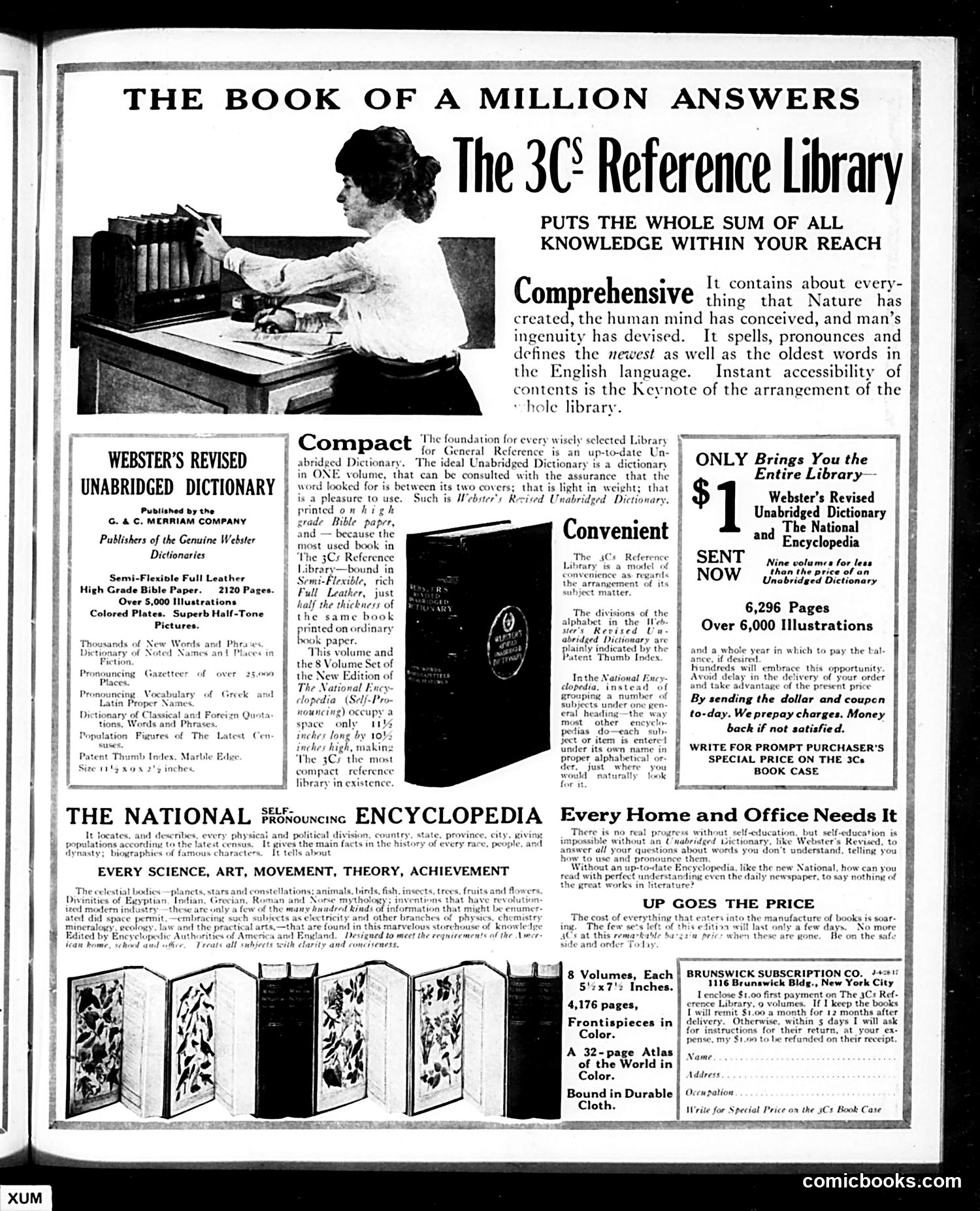
This is primarily a **full-page advertisement**, not a cartoon or satirical content. It promotes "The 3C's Reference Library"—a multi-volume encyclopedia and dictionary set marketed as affordable, comprehensive home reference material. The page includes: 1. **Product showcase**: Images of bound volumes with decorative spines, emphasizing durability and aesthetic appeal for home display. 2. **Marketing appeal to middle-class readers**: Positioned as making "the whole sum of all knowledge within your reach" for just $1 (plus installment payments), this targets households seeking self-improvement and educational access during what appears to be the early 20th century. 3. **Comparative positioning**: It contrasts favorably against Webster's Revised Unabridged Dictionary, emphasizing compactness and convenience. 4. **Subscription model**: The Brunswick Subscription Company offers installment purchasing ($1 down, then monthly payments), reflecting consumer credit practices of the era. There is **no political satire or cartoon commentary** on this page—it's straightforward advertising aimed at aspirational readers wanting home educational resources.
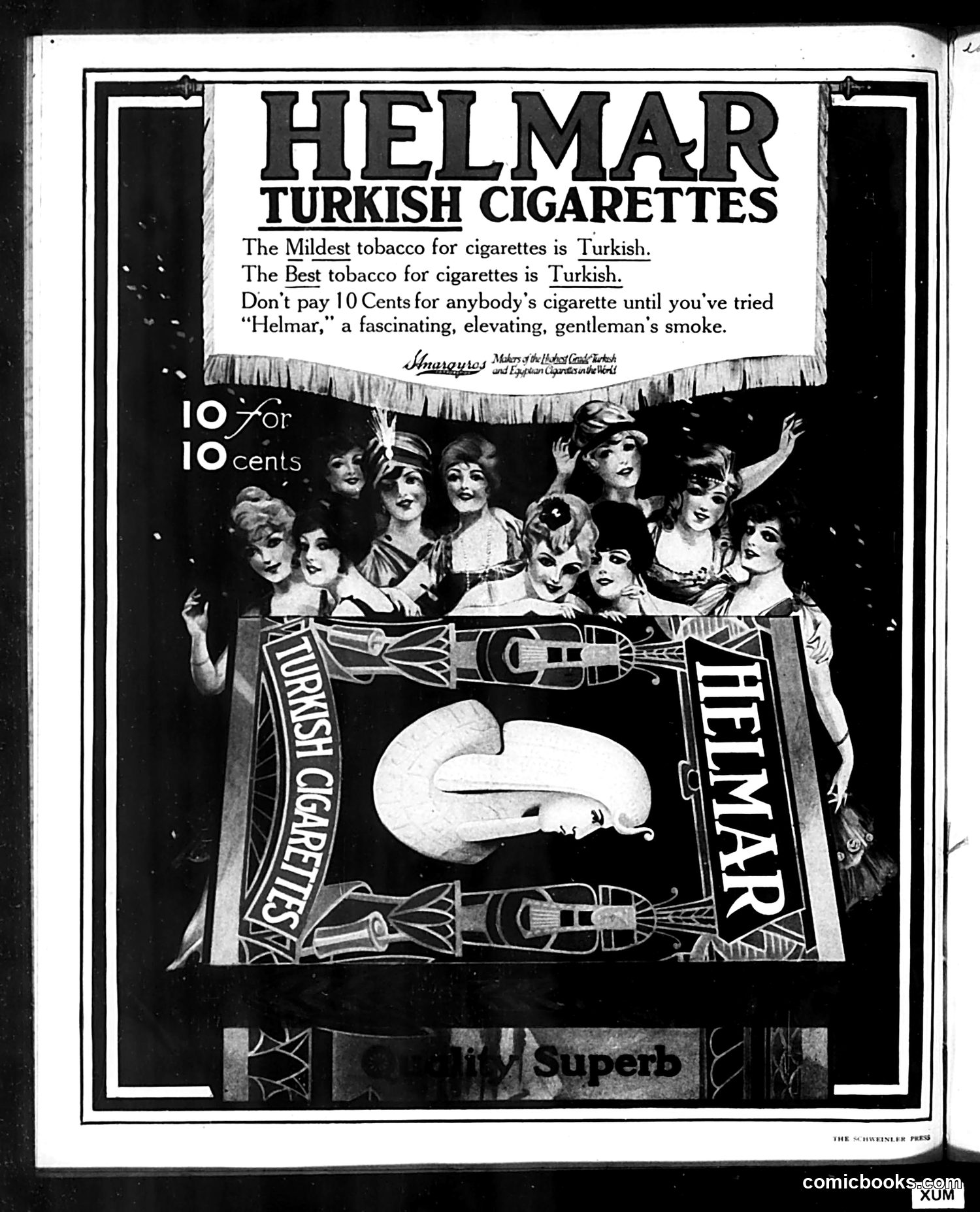
This is a full-page advertisement for Helmar Turkish cigarettes, not political satire. The ad features a group of stylized women in 1920s fashion surrounding an ornate frame containing a large cigarette. The copy emphasizes Turkish tobacco's superiority—claiming it's both the "mildest" and "best" for cigarettes—and urges readers to try Helmar before purchasing competing brands at higher prices (10 cents versus Helmar's apparent lower cost). The "gentleman's smoke" language and fashionable female imagery reflect early 20th-century advertising conventions designed to associate the product with sophistication and leisure. There appears no satire here—it's straightforward commercial promotion typical of Judge magazine's advertising content.