
Judge, 1917-04-28 · page 10 of 28
Judge — April 28, 1917 — page 10: what you’re looking at
What you’re looking at
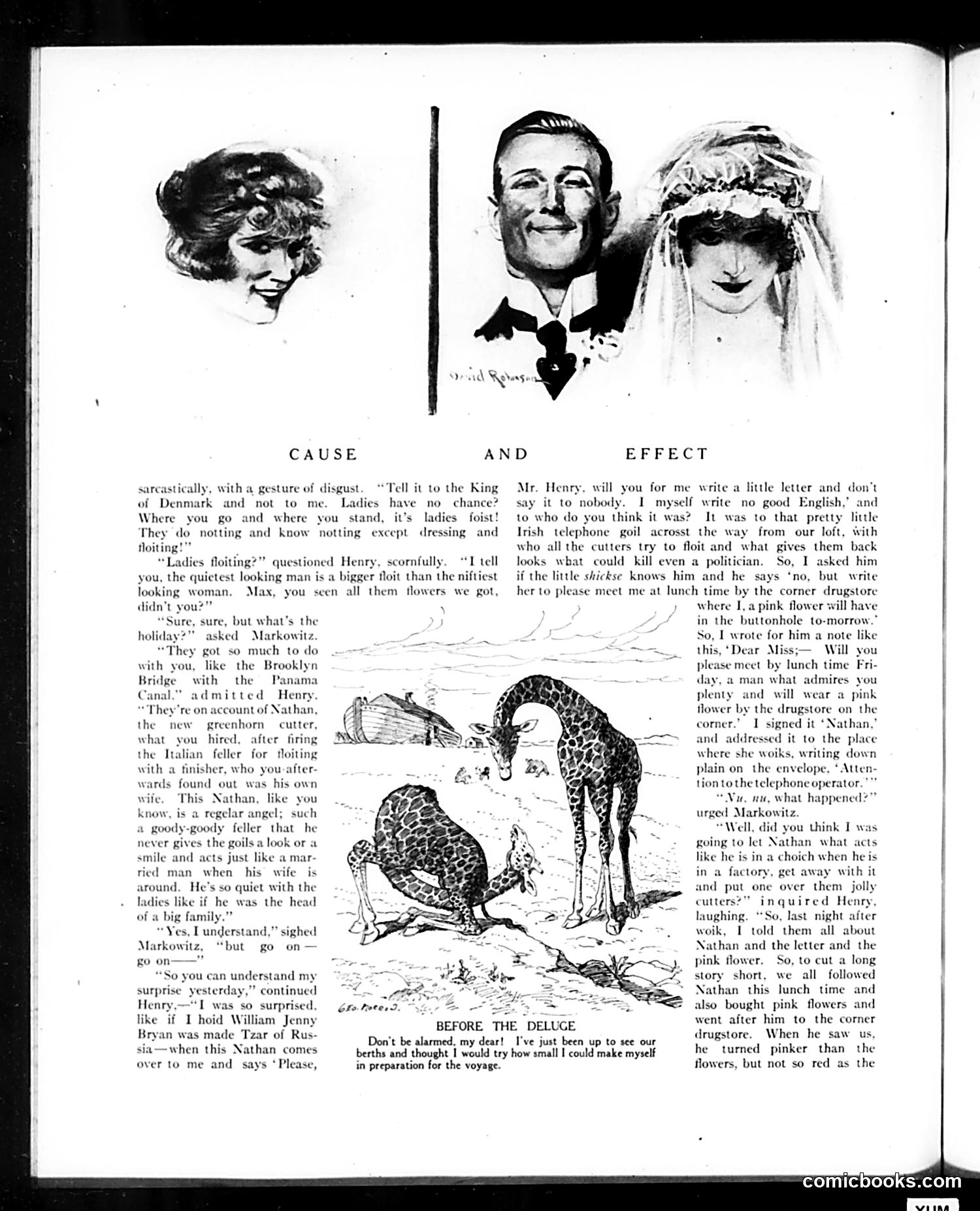
This page satirizes workplace romance and ethnic humor common in early 20th-century American comedy. The narrative describes Nathan, a virtuous Jewish factory cutter, being tricked into writing a love letter to an Irish telephone operator by his coworker Henry (both appear to be Jewish immigrants based on their Yiddish-inflected English dialogue). The joke's "effect" is that Henry and the other workers follow Nathan to the drugstore rendezvous, embarrassing him publicly. The illustration "Before the Deluge" shows giraffes preparing for a flood—likely a visual pun on Nathan's impending romantic "flood" of shame. The humor relies on ethnic stereotypes, workplace pranks, and the contrast between Nathan's pious behavior and his secret romantic interest. The comedic setup trades on readers' familiarity with immigrant factory life and inter-ethnic workplace dynamics of the era.
📄 Transcribed text from this page (OCR, searchable)
Machine-transcribed from the original scan — historical spelling and the odd misread are preserved.
CAUSE “Tell it to the King Ladies have no chance? stand, it's foist! sarcastically, with a gesture of disgust of Denmark Where and not to go and where me. you you ladies “Ladies floiting?” questioned Henry, scornfully. “I tell you, the quietest looking man is a bigger floit than the niftiest looking woman. Max, you seen all them flowers we got, didn’t you?” 5 “Sure, sure, but what's the holiday?” asked Markowitz. “They got so much to do with you, like the Brooklyn - Bridge with the Panama Canal.” admitted Henry. ‘They're on account of Nat the new greenhorn cutter, what you hired, after firing the Italian feller for foiting with a finisher, who you-after- wards found out was his own wife. This Nathan, like you know, is a regelar angel; such a goody-goody feller that he never gives the goils a look or a smile and acts just like a mar- ried man when his wife is around, He’s so quiet with the ladies like if he was the head of a big family.” “Yes, [understand n, ” sighed Markowitz, “but go on — go on—"” “So you can understand my surprise yesterday,” continued Henry “I was so surprised, like if I hoid William Jenny Bryan was made Tzar of Rus- sia—when this Nathan comes over to me and ‘Please, 6 fo fotos d. Don’t be alarmed, my dear! says in preparation for the voyage. AND BEFORE THE DELUGE berths and thought I would try how small | could make myself EFFECT Mr. Henry. will you for me write a little letter and don’t say it to nobody. I myself write no good English,’ and to who do you think it was? It was to that pretty little Irish telephone goil acrosst the way from our loft, with who all the cutters try to floit and what gives them back looks what could kill even a politician. So, I asked him if the little shickse knows him and he says ‘no, but write her to please meet me at lunch time by the corner drugstore where I k flower will have in the buttonhole to-morrow.’ So, I wrote for him a note like ~~ this, ‘Dear Miss;— Will you ~~ please meet by lunch time Fri- day, a man what admires you plenty and will wear a pink flower by the drugstore on the corner.’ I signed it ‘Nathan,’ and addressed it to the place where she woiks, writing down plain on the envelope, *Atten- tion tothe telephone operator. *** “Nu. nu, what happened?” urged Markowitz. “Well, did you think I was going to let Nathan what acts like he is in a choich when he is in a factory, get away with it and put one over them jolly cutters?” inquired Henry, laughing. “So, last night after woik, I told them all about Nathan and the letter and the pink flower. So, to cut a long story short, we all followed Nathan this lunch time and also bought pink flowers and went after him to the corner drugstore. When he saw us, he turned pinker than the flowers, but not so red as the Pa I've just been up to see our comicbooks.com