
Judge, 1917-04-28 · page 19 of 28
Judge — April 28, 1917 — page 19: what you’re looking at
What you’re looking at
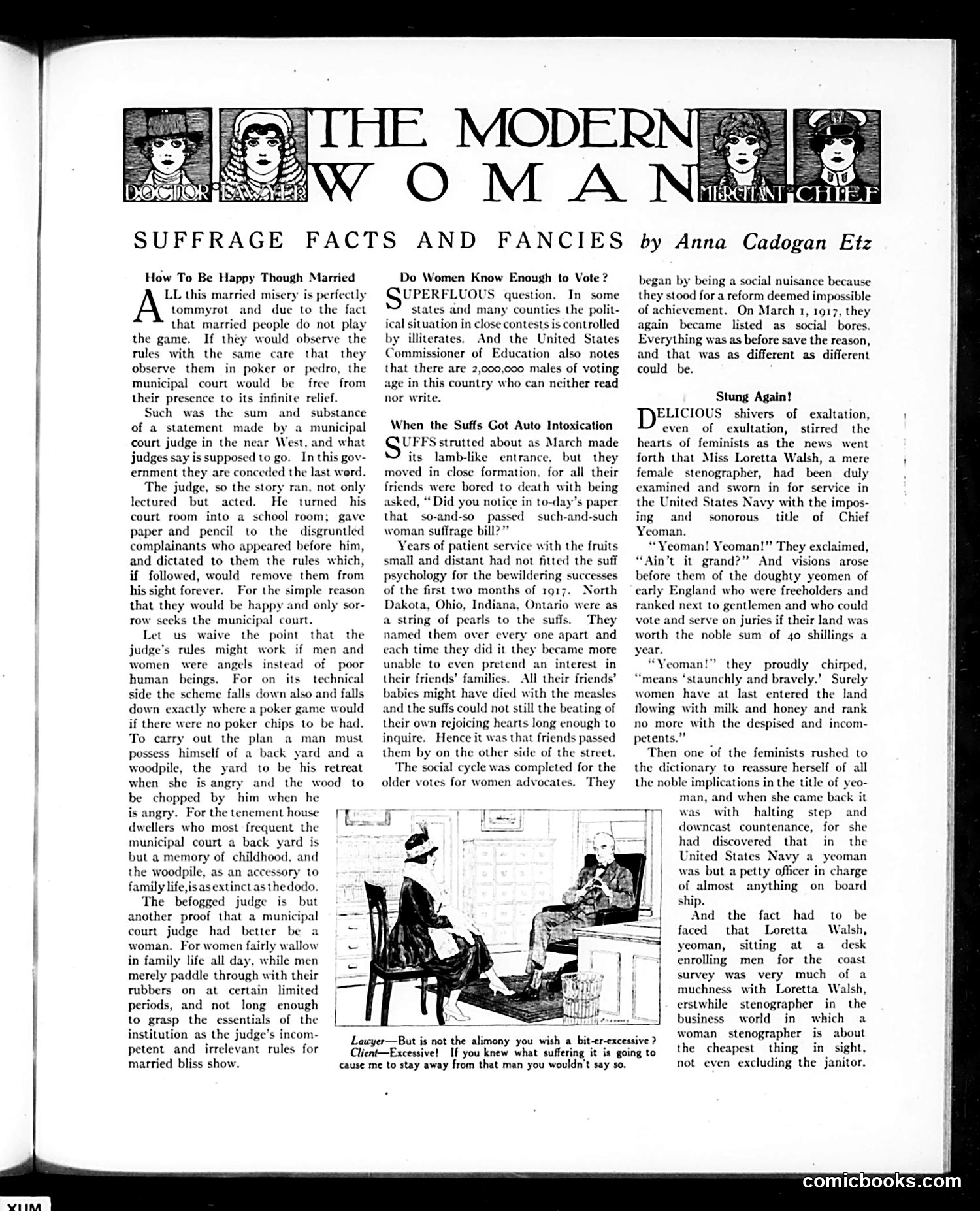
This satirical article by Anna Cadogan Etz mocks the women's suffrage movement circa 1917. The main cartoon (visible center-left) depicts a lawyer and client—likely illustrating the article's opening about matrimonial disputes, where a municipal judge improbably prescribed "rules" for happy marriage (yard work, woodpiles) as if marriage were a game like poker. The satire undercuts the judge's condescending solution as useless for tenement dwellers. Etz also ridicules suffragists themselves: she dismisses concerns about voting literacy (noting illiterate men already vote), then cruelly mocks female suffrage advocates for becoming insufferable "social bores" around 1917, obsessively celebrating incremental state victories (Dakota, Ohio, Indiana, Ontario) while boring their friends to death with constant references to legislative wins. The "Loretta Walsh" item (bottom right) references a woman seeking Navy enrollment—positioning this as absurd given women's supposedly limited capabilities. Etz's satire cuts multiple ways: attacking male judges' incompetence *and* feminists' obnoxiousness, suggesting neither sex competently handles serious matters.
📄 Transcribed text from this page (OCR, searchable)
Machine-transcribed from the original scan — historical spelling and the odd misread are preserved.
WrIAA SUFFRAGE FACTS AND FANCIES by Anna Cadogan Etz How To Be Happy Though Married LL this married misery is perfectly tommyrot and due to the fact that married people do not play the game. If they would observe the tules with the same care that they observe them in poker or pedro, the municipal court would be free from their presence to its infinite relief. Such was the sum and substance of a statement made by a municipal court judge in the near West, and what judges say is supposed to go. In this gov- ernment they are conceded the last word. The judge, so the story ran, not only lectured but acted. He turned his court room into a school room; gave paper and pencil to the disgruntled complainants who appeared before him, and dictated to them the rules which, if followed, would remove them from his sight forever. For the simple reason that they would be happy and only sor- row secks the muni court. Let us waive the point that the judge’s rules might work if men and women were angels instead of poor human beings. For on its technical side the scheme falls down also and falls down exactly where a poker game would if there were no poker chips to be had. To carry out the plan a man must possess himself of a back yard and a woodpile, the yard to be his retreat when she is angry and the wood to be chopped by him when he is angry. For the tenement house [ dwellers who most frequent the municipal court a back yard is but a memory of childhood, and the woodpile, as an accessory to family life,is as extinct as thedodo. The befogged judge is but another proof that a municipal court judge had better be a woman. For women fairly wallow in family life all day, while men merely paddle through with their tubbers on at certain limited periods, and not long enough to grasp the essentials of the institution as the judge’s incom- petent and irrelevant rules for married bliss show. Do Women Know Enough to Vote? UPERFLUOUS question. In some states and many counties the polit- ical situation in close contests is controlled by illiterates. And the United States Commissioner of Education also notes that there are 2,000,000 males of voting age in this country who can neither read nor write. When the Suffs Got Auto Intoxication St strutted about as March made its lamb-like entrance, but they moved in close formation, for all their friends were bored to death with being asked, “Did you notice in to-day’s paper that so-and-so passed such-and-such woman suffrage bill?” Years of patient service with the fruits small and distant had not fitted the suff psychology for the bewildering s es of the first two months of 1917. Dakota, Ohio, Indiana, Ontario were as a string of pearls to the sufis. They ach time they did it they became more etend an interest in their friends All their friends’ babies might have died with the measles and the suffs could not still the beating of their own rejoicing hearts long enough to inquire. Hence it was that friends passed them by on the other side of the street. The social cycle was completed for the older votes for women advocates. They unable to ¢ began by being a social nuisance because they stood for a reform deemed impossible of achievement. On March 1, 1917, they again became listed as social bores. Everything was as before save the reason, and that was as different as different could be. Stung Again! ELICIOUS shivers of exaltation, even of exultation, stirred the hearts of feminists as the news went forth that Miss Loretta Walsh, a mere female stenographer, had been duly examined and sworn in for service in the United States Navy with the impos- ing and sonorous title of Chief Yeoman. “Yeoman! Yeoman!” They exclaimed, Ain’t it grand?” And visions arose before them of the doughty yeomen of early England who were freeholders and ranked next to gentlemen and who could vote and serve on juries if their land was worth the noble sum of 4o shillings a year, Yeoman!” they proudly chirped, “means ‘staunchly and bravely.’ Surely women have at last entered the land flowing with milk and honey and rank no more with the despised and incom- petents.”” Then one of the feminists rushed to the dictionary to reassure herself of all the noble implications in the title of yeo- man, and when she came back it } was with halting step and downcast countenance, for she had discovered that in the United States Navy a yeoman was but a petty officer in charge of almost. anything on board ship. And the fact had to be faced that Loretta Walsh, yeoman, sitting at a desk enrolling men for the coast survey was very much of a muchness with Loretta Walsh, erstwhile stenographer in the business world in’ which a Lawyer—But is not the alimony you wish a bit-er-excessive ? Client—Excessive! If you knew what suffering it is going cause me to stay away from that man you wouldn’t say so. woman stenographer is about the cheapest thing in sight, to not even excluding the janitor. comicbooks.com