
Judge, 1917-04-28 · page 25 of 28
Judge — April 28, 1917 — page 25: what you’re looking at
What you’re looking at
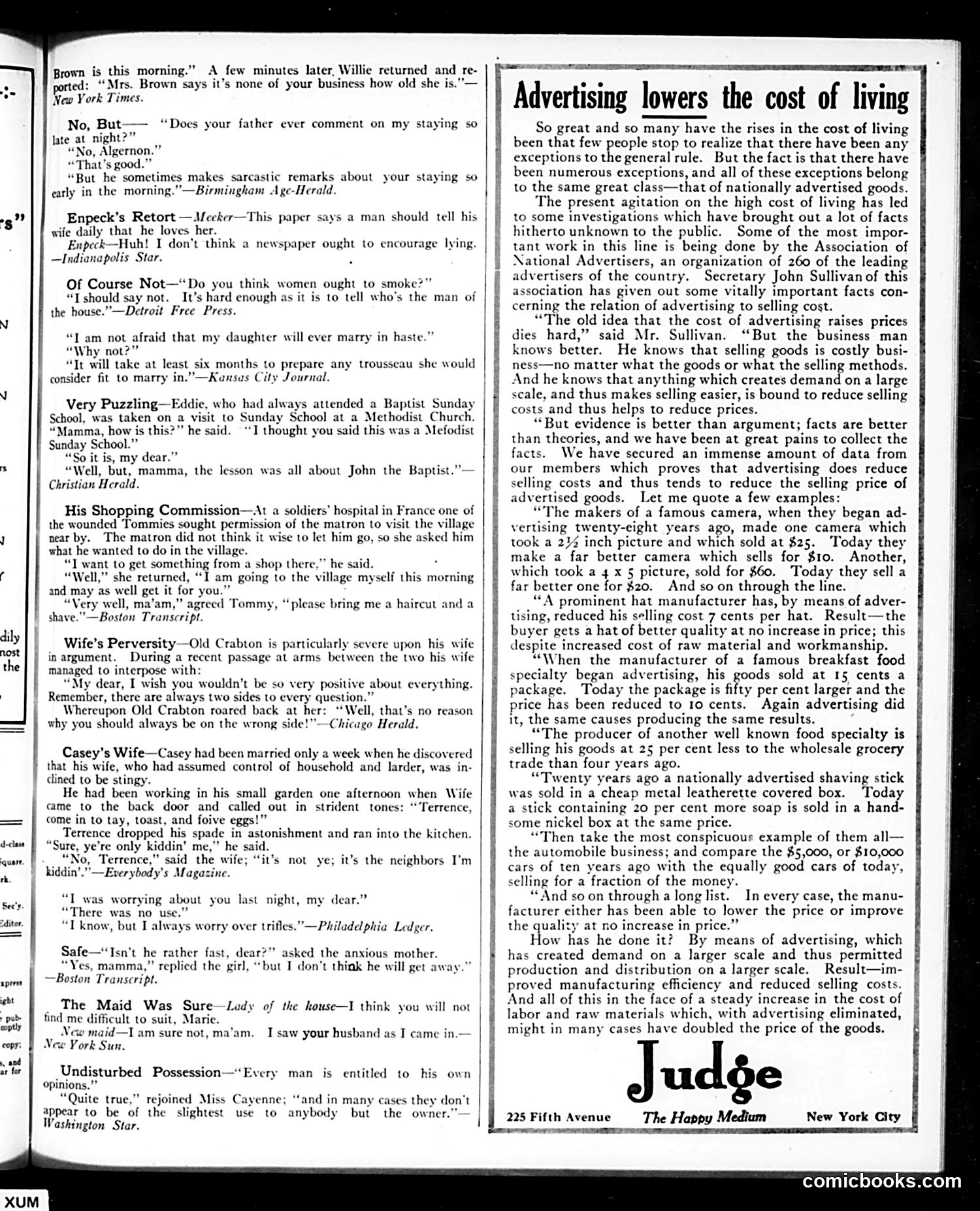
This page contains primarily **satirical short humor pieces** rather than political cartoons—typical of Judge magazine's format. The left column features brief anecdotes mocking domestic relationships and social conventions: - Husbands' reluctance to express affection or admit wives' age - Gender dynamics around smoking and household authority - Wedding preparations taking excessive time - A child's confusion between Baptist and Methodist theology The right column is a **full-page advertisement** masquerading as editorial content, promoting the Association of National Advertisers. It argues that advertising reduces consumer prices by increasing sales volume and manufacturing efficiency. The piece cites examples: camera prices dropping from $25 to $10, hat production costs falling, and breakfast food package prices reducing from 15 to 10 cents. **Context for modern readers:** This represents early 20th-century advertising attempting to counter public anxiety about rising costs of living by claiming advertising benefits consumers—a self-interested argument from the advertising industry itself, presented without skepticism. The satire targets conventional domestic life; the "advertisement" reveals period concerns about inflation and advertising's role in commerce.
📄 Transcribed text from this page (OCR, searchable)
Machine-transcribed from the original scan — historical spelling and the odd misread are preserved.
Brown is this morning.” A few minutes later, Willie returned and re- oe all ‘s. Brown says it’s none of your business how old she is.”"— Wen Vore Times. Advertising lowers the cost of living No, But—— “Does your father ever comment on my staying so So great and so many many have the rises in the cost of living hate at gi es been that few people stop to realize that there have been any ne "eeood.” exceptions to the general rule. But the fact is that there have ut he sometimes makes sarcastic remarks about your staying so | been numerous exceptions, and all of these exceptions belong early in the morning.” —Birmingham Age-Herald. | to the same great class—that of nationally advertised goods. | The present agitation on the high cost of living has led to some investigations which have brought out a lot of facts hitherto unknown to the public. Some of the most impor- tant work in this line is being done by the Association of National Advertisers, an organization of 260 of the leading advertisers of the country. Secretary John Sullivan of this association has given out some vitally important facts con- cerning the relation of advertising to selling cost. “The old idea that the cost of advertising raises prices dies hard,” said Mr. Sullivan. “But the business man knows better. He knows that selling goods is costly busi- ness—no matter what the goods or what the selling methods. And he knows that anything which creates demand on a large scale, and thus makes selling easier, is bound to reduce selling costs and thus helps to reduce prices. “But evidence is better than argument; facts are better than theories, and we have been at great pains to collect the facts. We have secured an immense amount of data from our members which proves that advertising does reduce selling costs and thus tends to reduce the selling price of advertised goods. Let me quote a few examples: “The makers of a famous camera, when they began ad- vertising twenty-cight years ago, made one camera which took a 24 inch picture and which sold at $25. ‘Today they make a far better camera which sells for $10. Another, which took a 4 x § picture, sold for $60. Today they sell a far better one for 320. And so on through the line. “A prominent hat manufacturer has, by means of adver- tising, reduced his selling cost 7 cents per hat. Result—the buyer gets a hat of better quality at no increase in price; this despite increased cost of raw material and workmanship. “When the manufacturer of a famous breakfast food Enpeck’s Retort —Meeker—This paper says a man should tell his wife daily that he loves her. Enpeck—Huh! I don’t think a newspaper ought to encourage lying. Indianapolis Star. : Of Course Not—“Do you think women ought to smoke?” “T should say not. It’s hard enough as it is to tell who’s the man of the house.”"—Detroit Free Press. “Tam not afraid that my daughter will ever marry in haste.”” “Why not?” “It will take at least six months to prepare any trousseau she would | consider fit to marry in.”—Kansas City Journal. | Very Puzzling—Eddie, who had always attended a Baptist Sunday School, was taken on a visit to Sunday School at a Methodist Church. “Mamma, how is this?” he said. “I thought you said this was a Mefodist Sunday School.” it is, my dear.” “Well, but, mamma, the lesson was all about John the Baptist.”— Christian Herald. His Shopping Commission—at a soldiers’ hospital in France one of the wounded Tommies sought permission of the matron to visit the village near by. The matron did not think it wise to let him go, so she asked him what he wanted to do in the village. “T want to get something from a shop there,”’ he said. * “Well,” she returned, “I am going to the village myself this morning and may as well get it for you. “Very well, ma’am,” agreed Tommy, “please bring me a haircut and a shave.”—Boston Transcript. Wife’s Perversity—Old Crabton is particularly severe upon his wife in argument. During a recent passage at arms between the two his wife “My dear, I wish you wouldn't be so very positive about everything. | Remember, there are always two sides to every question.” Whereupon Old Crabton roared back at “Well, that’s no reason why you should always be on the wrong side Chicago Herald. package. Today the package is fifty per cent larger and the price has been reduced to 10 cents. Again advertising did it, the same causes producing the same results. “The producer of another well known food specialty is selling his goods at 25 per cent less to the wholesale grocery trade than four years ago. “Twenty years ago a nationally advertised shaving stick was sold in a cheap metal leatherette covered box. Today a stick containing 20 per cent more soap is sold in a hand- some nickel box at the same price. “Then take the most conspicuous example of them all— the automobile business; and compare the $5,000, or $10,000 cars of ten years ago with the equally good cars of today, selling for a fraction of the money. “And so on through a long list. In every case, the manu- facturer either has been able to lower the price or improve the quality at no increase in price.’ low has he done it? By means of advertising, which has created demand on a larger scale and thus permitted production and distribution on a larger scale. Result—im- proved manufacturing efficiency and reduced selling costs. And all of this in the face of a steady increase in the cost of labor and raw materials which, with advertising eliminated, might in many cases have doubled the price of the goods. J udge i 225 Fifth Avenue The Happy Medium New York City A TERETE Casey’s Wife—Casey had been married only a week when he discov that his wife, who had assumed control of household and larder, w: clined to be stingy. He had been working in his small garden one afternoon when Wife came to the back door and called out in strident tones: ‘Terrence, come in to tay, toast, and foive eggs!” _ Terrence dropped his spade in astonishment and ran into the kitchen. ye’re only kiddin’ me,” h | Terrence,” said the wife; “it’s not ye; it’s the neighbors I'm | Everybody's Magazine. as worrying about you last night, my dear.” There was no wu: “I know, but I always worry over trifles.”"—Philadel phia Ledger. | Safe—‘Isn’t he rather fast, dear?” asked the anxious mother. “Yes, mamma,” replied the girl, “but I don’t think he will get away.” —Boston Transcript. The Maid Was Sure—Lady of the house—I think you will not | find me difficult to suit, Marie. _ New maid—I am sure not, ma’am. I saw your husband as I came in.— New York Sun. | i i H & i | i | managed to interpose with: specialty began advertising, his goods sold at 15 cents a | i ] q | | f ] opinions.” “Quite true,” rejoined Miss Cayenne; “and in many cases they don’t appear to be of the slightest use to anybody but the owne | Undisturbed Possession—“Every man is entitled to his | Washington Star. ! comicbooks.com