
Judge, 1917-04-28 · page 4 of 28
Judge — April 28, 1917 — page 4: what you’re looking at
What you’re looking at
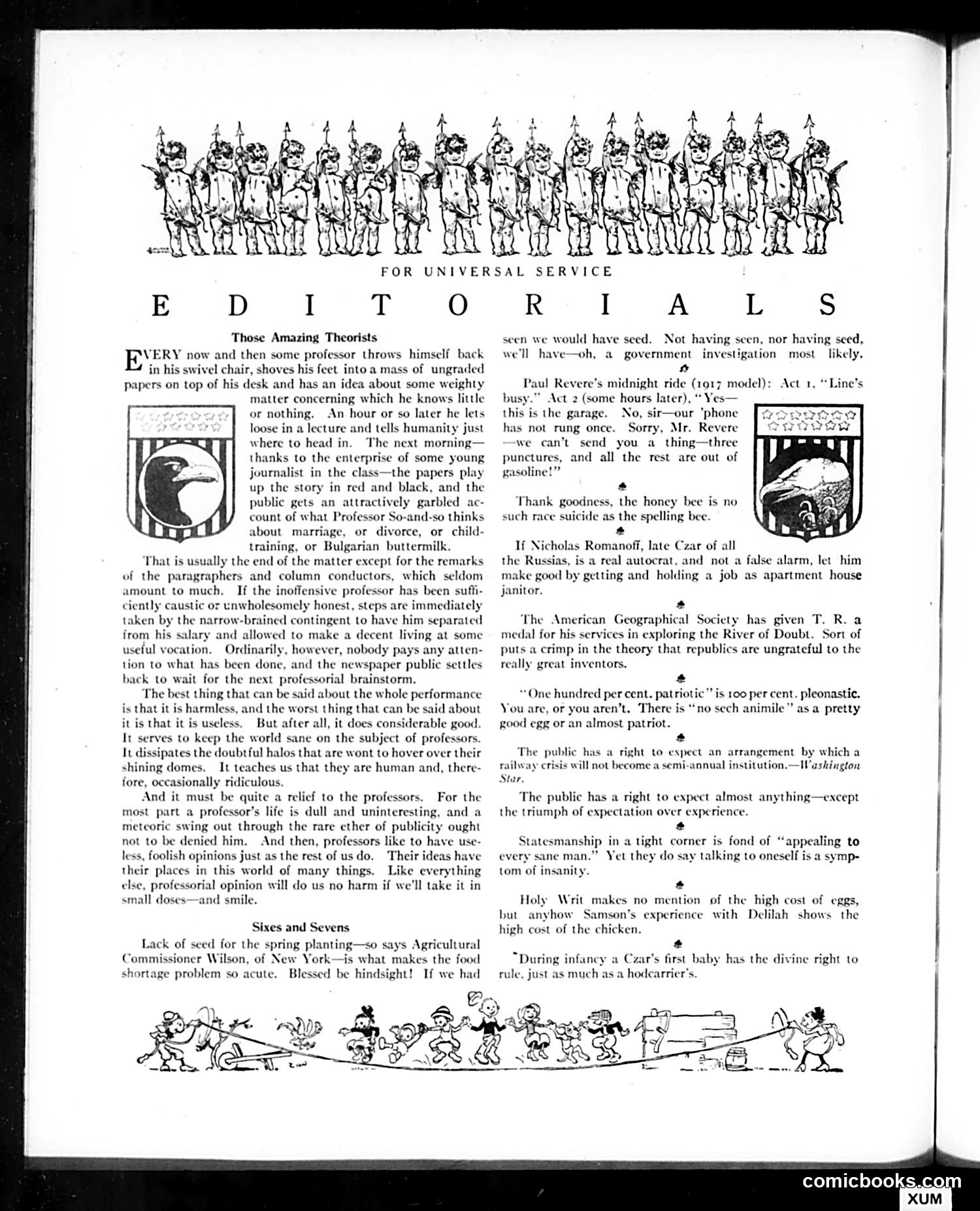
This page from *Judge* magazine contains three satirical editorials: 1. **"Those Amazing Theorists"**: Mocks professors who pontificate on serious social issues (marriage, divorce, child-rearing, labor) without practical knowledge. The satire suggests academics generate worthless noise that newspapers reproduce uncritically. 2. **"Sixes and Sevens"**: References Agricultural Commissioner Wilson of New York, criticizing his explanation that seed shortage caused food shortages as inadequate—implying either incompetence or dishonesty in addressing the crisis. 3. **Various brief quips**: Include jokes about Paul Revere's midnight ride, Nicholas Romanoff (Russian Tsar) as an "autocrat," and observations about American society—the spelling bee, railway crises, and egg prices. The overall tone targets institutional incompetence and intellectual pretension.
📄 Transcribed text from this page (OCR, searchable)
Machine-transcribed from the original scan — historical spelling and the odd misread are preserved.
I T Those Amazing Theorists nd then some professor throws himself back desk and has an idea about some weighty matter concerning which he knows little or nothing. An hour or so later he lets loose in a lecture and tells humanity just where to head in. The next morning— thanks to the enterprise of some young journalist in the class—the papers play up the story in red and black, and the public gets an attractively garbled ac- count of what Professor So-and-so thinks about marriage, or divorce, or child- training, or Bulgarian buttermilk. That is usually the end of the matter except for the remarks of the paragraphers and column conductors, which seldom amount to much. If the inoffensive professor has been sufti- ciently caustic or unwholesomely honest, steps are immed taken by the narrow-brained contingent to have separated from his salary and allowed to make a decent living at some useful vocation. Ordinarily, however, nobody pays any atten- tion to what has been done, and the newspaper public settles back to wait for the next professorial brainstorm. The best thing that can be said about the whole performance is that it is harmless, and the worst thing that can be said about it is that it is useless, But after all, it does considerable good. It serves to keep the world sane on the subject of professors. It dissipates the doubtful halos that are wont to hover over their shining domes. It teaches us that they are human and, there- fore, occasionally ridiculous. And it must be quite a relief to the professors. For the most part a professor’s life is dull and uninteresting, and a meteoric swing out through the rare ether of publicity ought not to be denied him. And then, professors like to have use- less, foolish opinions just as the rest of us do. ‘Their ideas have their places in this world of many things. Like everything else, professorial opinion will do us no harm if we'll take it in small doses—and smile. Sixes and Sevens Lack of seed for the spring planting—so says Agricultural Commissioner Wilson, of New York—is what makes the food shortage problem so acute. Blessed be hindsight! If we had FOR UNIVERSAL SERVICE R I seen we would have seed. Not having nor having seed, we'll have—oh, a government investigation most likely. Fd Paul Revere’s midnight ride (1917 model): Act 1, * Line’s busy.” Act 2 (some hours later), * Yes— this is the garage. No, sir—our ‘phone has not rung once. Sorry, Mr. Revere we can’t send you a thing—three punctures, and all the rest are out of gasoline!” * Thank goodness, the honey bee is no such race suicide as the spelling bee. 2 If Nicholas Romanoff, late Czar of all the Russ js a real autocrat, and not a false alarm, let him make good by getting and holding a job as apartment house janitor. 2 The American Geographical Society has given T. R. a medal for his services in exploring the River of Doubt. Sort of puts a crimp in the theory that republics are ungrateful to the really great inventors. 2 “One hundred per cent. patriotic” is 100 per cent. pleonastic. You are, or you aren’t. There is *‘no sech animile” as a pretty good egg or an almost patriot. 2 The public has a right to expect an arrangement by which a railway crisis will not become a semi-annual institution. —Washington Sar, nything—except The public has a right to expect almost the triumph of expectation over experienc ¢ Statesmanship in a tight corner is fond of “appealing to every sane man.” Yet they do say talking to oneself is a symp- tom of insanity. Holy Writ makes no mention pf the high cost of eggs, but anyhow Samson's experience with Delilah shows the high cost of the chicken. 2 Czar’s first baby has the divine right to sa hodearrier’s, i= Sp So ee “During infancy », justas much a ey comicbooks.com