
Judge, 1917-04-28 · page 18 of 28
Judge — April 28, 1917 — page 18: what you’re looking at
What you’re looking at
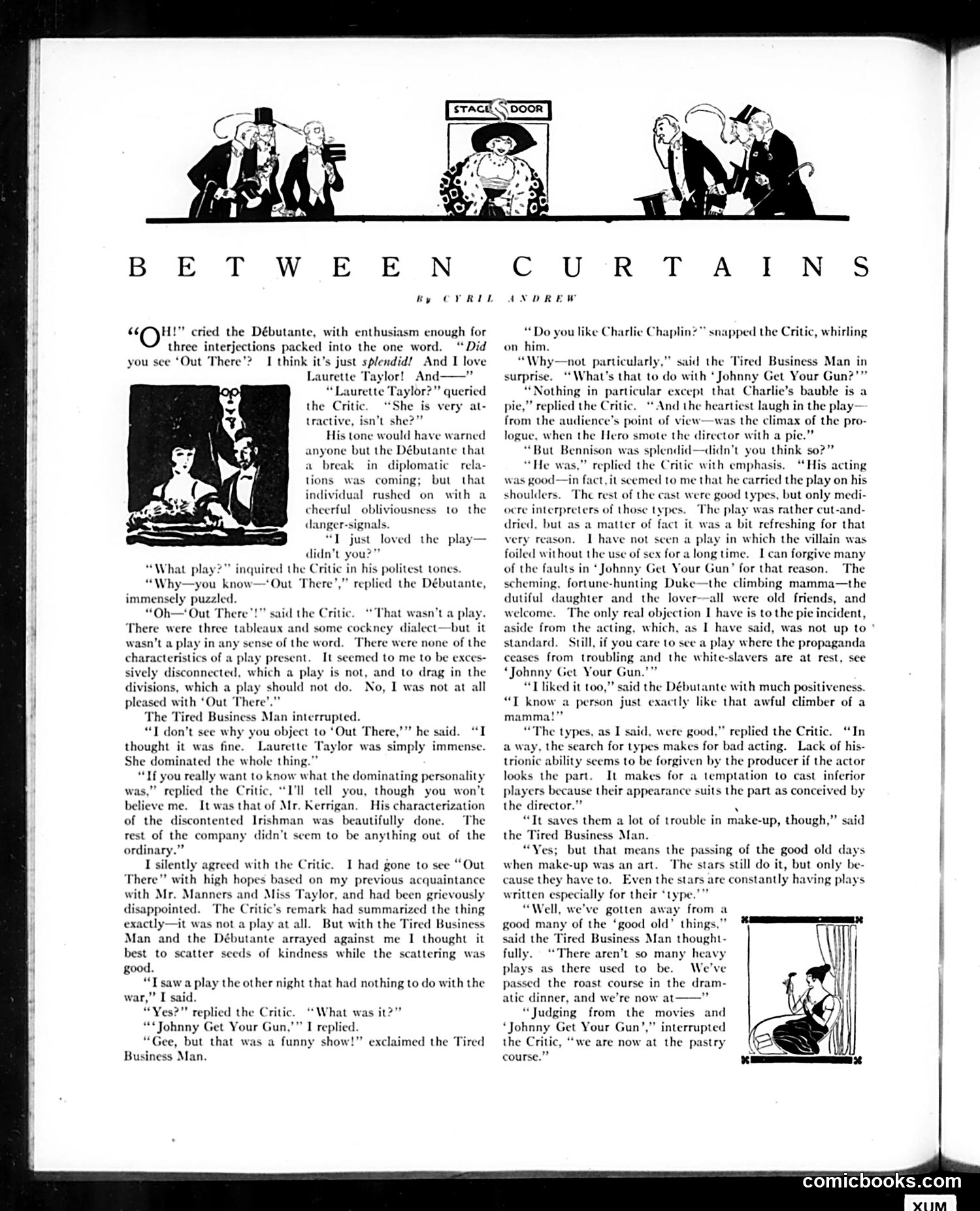
This theatrical criticism piece satirizes three archetypal theater-goers debating two 1910s plays: "Out There" and "Johnny Get Your Gun." **The Characters:** - The **Critic**: A pompous, analytically harsh reviewer who deconstructs everything - The **Débutante**: An enthusiastic but shallow socialite who loves spectacle and stars (like Laurette Taylor) - The **Tired Business Man**: A working-class patron seeking simple entertainment **The Satire:** The piece mocks the gap between sophisticated dramatic criticism and popular entertainment. The Critic dismisses "Out There" as lacking dramatic structure despite its star power, while praising "Johnny Get Your Gun" for avoiding melodramatic clichés—yet the Tired Business Man and Débutante simply enjoyed the pie-in-face gag. Andrew illustrates how different audiences evaluate theater: critics demand artistic merit; the wealthy want star appeal; ordinary people want laughs. The Critic's intellectual standards clash amusingly with everyone else's simpler pleasures, suggesting a fundamental divide in how Americans experienced theater.
📄 Transcribed text from this page (OCR, searchable)
Machine-transcribed from the original scan — historical spelling and the odd misread are preserved.
BET W EEN LT @ jl cried the Débutante, with enthusiasm enough for three interjections packed into the one word. “Did ¢ ‘Out There’? I think it’s just splendid! And I love Laurette Taylor!) And——” “Laurette Taylor?” queried the Critic. She is very at- tractive, isn’t shi His tone would have warned anyone but the Débutante that a break in diplomatic rel tions was coming; but that individual rushed on with a cheerful obliviousness to the danger-signals. “ZT just loved the play— didn’t you?” “What play?” inquired the Critic in his politest tones. “Why—you know—Out There’,” replied the Débutante, immensely puzzled. “Oh—‘Out There’!” said the Critic. “That wasn’t a pla; There were three tableaux and some cockney dialect—but it wasn’t a play in any sense of the word. ‘There were none of the characteristics of a play present. It seemed to me to be ively disconnected, which a play is not, and to drag in the s, which a play should not do. No, I was not at all ed with ‘Out There’ The Tired Business Man interrupted. “I don’t see why you object to ‘Out There,’” he said. “I thought it was fine. Laurette Taylor was simply immense. She dominated the whole thing. If you really want to know what the dominating personality was,” replied the Critic, “I'll tell you, though you won't eve me. It was that of Mr. Kerrigan. His characte ion of the discontented Irishman was beautifully done. The rest of the company didn’t seem to be anything out of the ordinary.” I silently agreed with the Critic. I had gone to see “Out There” with high hopes based on my previous acquaintance with Mr. Manners and Miss Taylor, and had been grievously disappointed. The Critic’s remark had summarized the thing exactly—it was not a play at all. But with the Tired Business Man and the Débutante arrayed against me I thought it best to scatter seeds of kindness while the scattering was good. “T saw a play the other night that had nothing to do with the war,” I said. “Yes?” replied the Critic. “W was it?” “‘Johnny Get Your Gun,’” I replied. “Gee, but that was a funny show!” exclaimed the Tired Business Man. you s by CYRIL C U RTA S (NDOREW N “Do you like Charlie Chaplin?” snapped the Critic, whirling on him. “Why surprise. “What's that to do with ‘Johnny Get Your Nothing in particular except that Charlie’s bauble is a pie,” replied the Critic.“ And the heartiest laugh in the play from the audience's point of view—was the climax of the pro- logue, when the Hero smote the director with a pic.” ‘as splendid—idn't you think so?” * replied the Critic with emphasis. “His acting was good—in fact, it seemed to me that he carried the play on his shoulders. The rest of the cast were good types, but only medi- ocre interpreters of those types. The play was rather cut-and- dried, but as a matter of fact it was a bit refreshing for that very reason. I have not scen a play in which the villain was foiled without the use of sex for a long time. I can forgive m of the faults in ‘Johnny Get Your Gun’ for that reason. scheming, fortune-hunting Duke—the climbing mamma—the dutiful daughter and the lover—all were old friends, and welcome. The only real objection I have is to the pie incident, aside from the acting. i id, was not up to standard. Still, if you care to see a play where the propaganda ceases from troubling and the white-slavers are at rest, see ‘Johnny Get Your Gun.’” “T liked it too,” said the Débutante with much posi ness. “I know a person just exactly like that awful climber of a mamma!” “The types, as I said, were good,” replied the Critic. “In . the search for types makes for bad acting. Lack of his- trionic ability seems to be forgiven by the producer if the actor looks the part. It makes for a temptation to cast inferior players because their appearance suits the part as conceived by the director.” R “Tt saves them a lot of trouble in make-up, though,” said the Tired Business Man. “Yes; but that means the passing of the good old ¢ when make-up was an art. The stars still do it, but only cause they have to. Even the stars are constantly having plays written especi: for their ‘tyy “Well, we've gotten away from a good many of the ‘good old” things. said the Tired Business Man thought- fully. “There aren’t so many heavy pl as there used to be. We've not particularly,” said the Tired Business Man in passed the roast course in the dram- atic dinner, and we're now at “Judging from the movies and ‘Johnny Get Your Gun’,” interrupted the Critic, “we are now at the pastry course.” comicbooks.com