
A complete issue · 32 pages · 1916
Judge — December 23, 1916
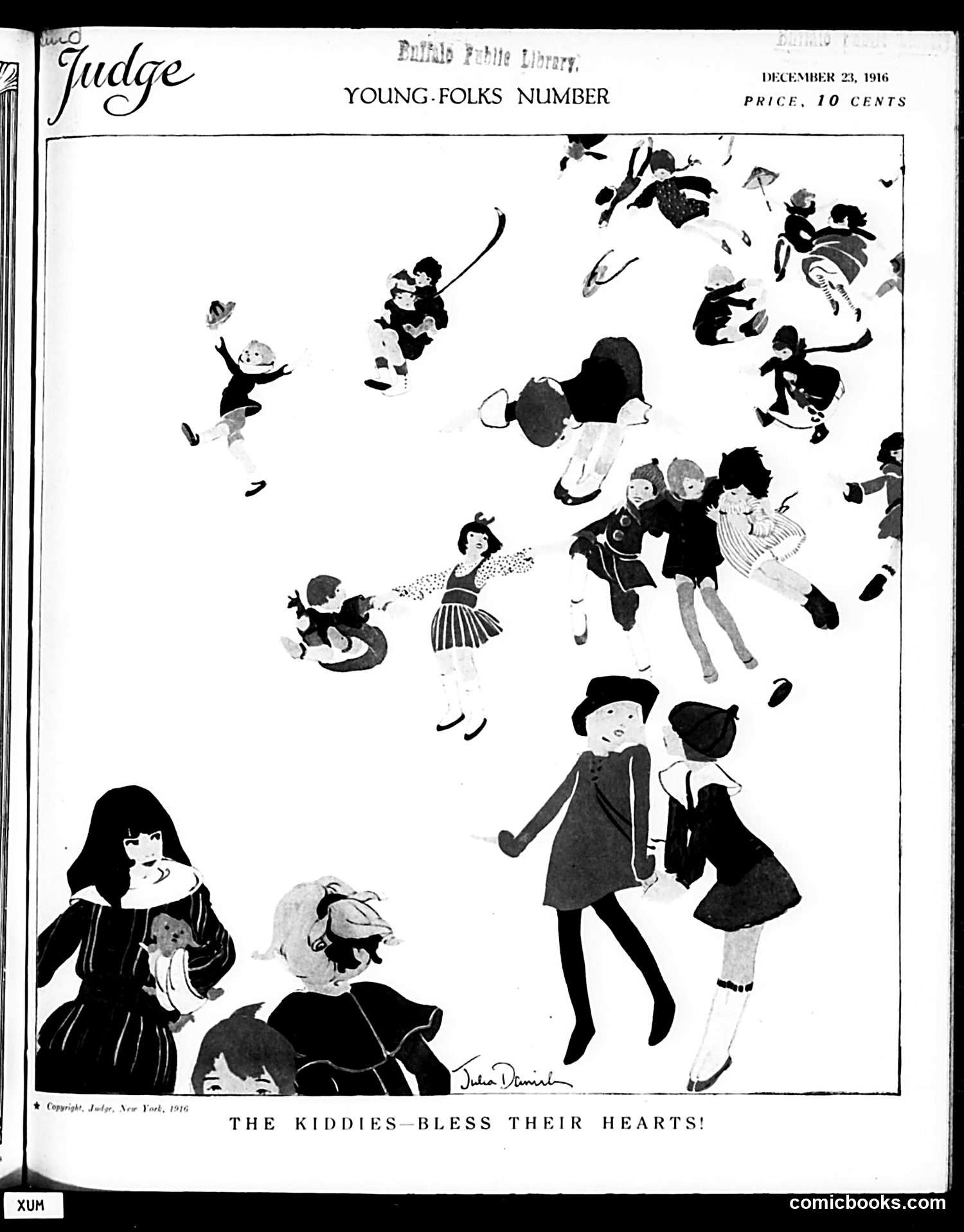
This is the cover of Judge magazine's "Young Folks Number" from December 23, 1916. The illustration, titled "The Kiddies Bless Their Hearts!" depicts numerous children engaged in energetic play and movement—running, jumping, playing with toys, and interacting together. The image appears to be a straightforward celebration of childhood joy and exuberance rather than political satire. The composition captures the chaotic energy and innocence of children at play, arranged across the page in a dynamic composition. Given the date (Christmas issue 1916) and the lack of identifiable caricatures or political figures, this seems designed as festive holiday content for Judge's young readers, rather than satirical commentary. The title's sentiment is sentimental rather than ironic.
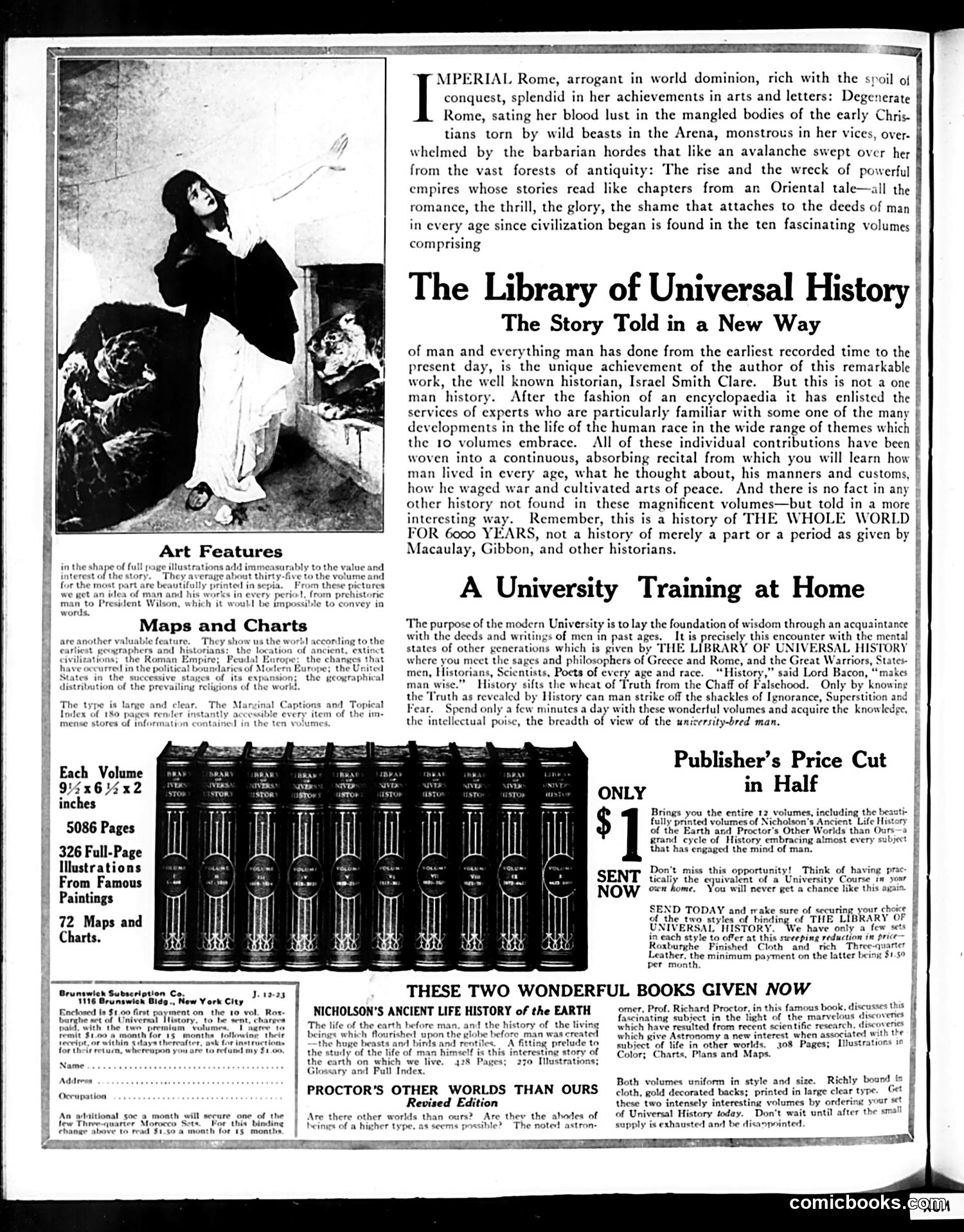
This page is primarily **advertising**, not satire or political commentary. It promotes "The Library of Universal History," a 10-volume encyclopedic set by historian Israel Smith Clare, marketed as "university training at home." The left side features classical artwork—a silhouetted figure surrounded by historical imagery (tigers, classical elements)—meant to evoke the grandeur of civilization and history itself. This visual accompanies promotional text emphasizing the work's comprehensiveness: covering "the whole world for 6000 years." The advertisement emphasizes value ("Publisher's Price Cut in Half") and includes subscription details. The smaller text references bonus volumes like "Nicholson's Ancient Life History of the Earth." No political satire is evident. This is straightforward commercial content typical of early 20th-century Judge magazine's back pages.
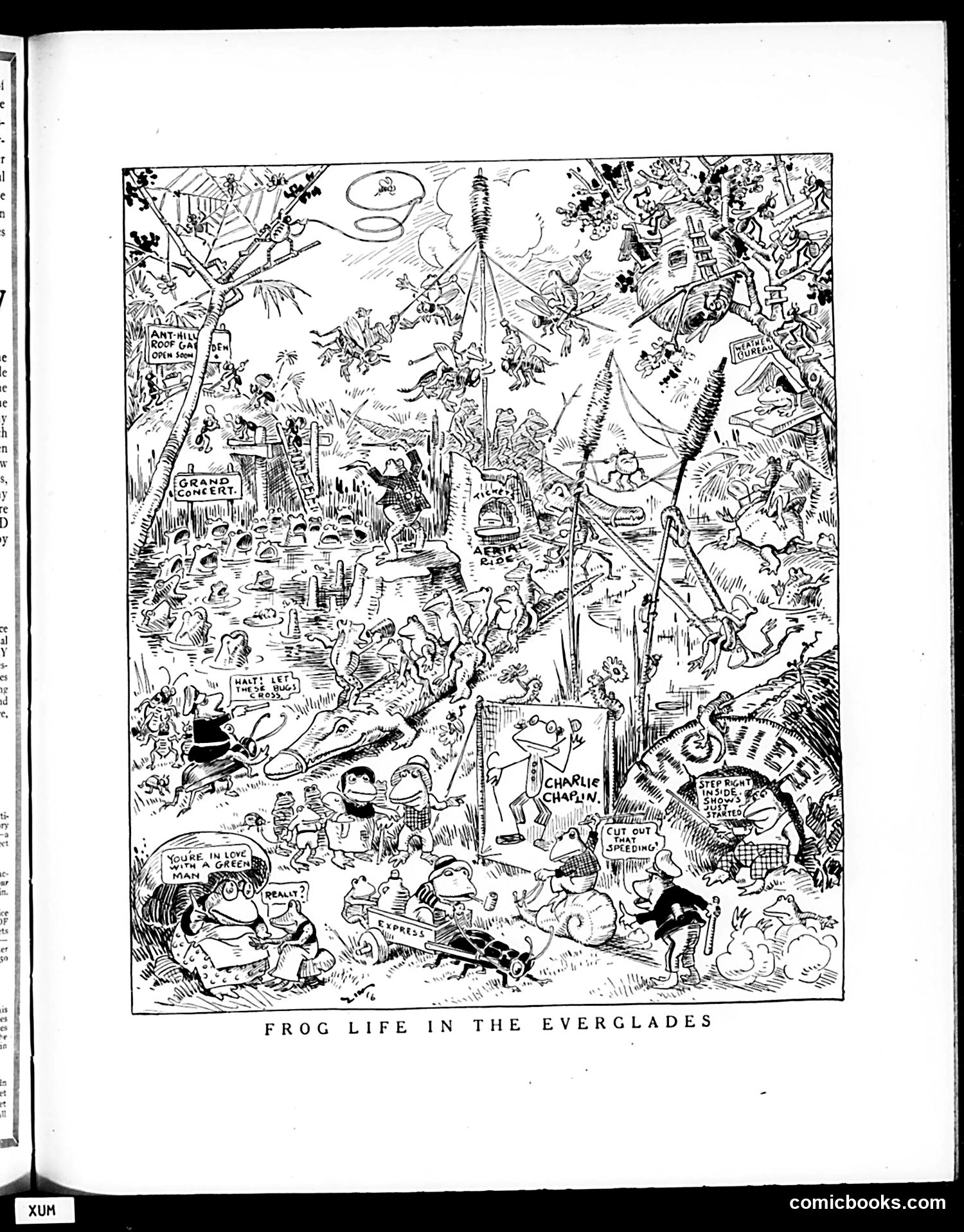
This is a satirical cartoon anthropomorphizing frogs as human characters in a Florida Everglades setting. The detailed scene depicts frogs engaging in various human activities—appearing to conduct business, entertainment, and social interactions. Visible text references include "Charlie Chaplin" (the famous silent film star), suggesting parody of popular culture figures. Signs mentioning "Grand Hotel" and "Aero Ride" indicate the frogs have built human-style civilization complete with hospitality and amusement attractions. The satire appears to mock human society by showing animals mimicking its institutions and behaviors. This reflects early 20th-century Judge magazine's typical approach: using anthropomorphic animals to comment on contemporary American society and its absurdities through humorous exaggeration and social critique.
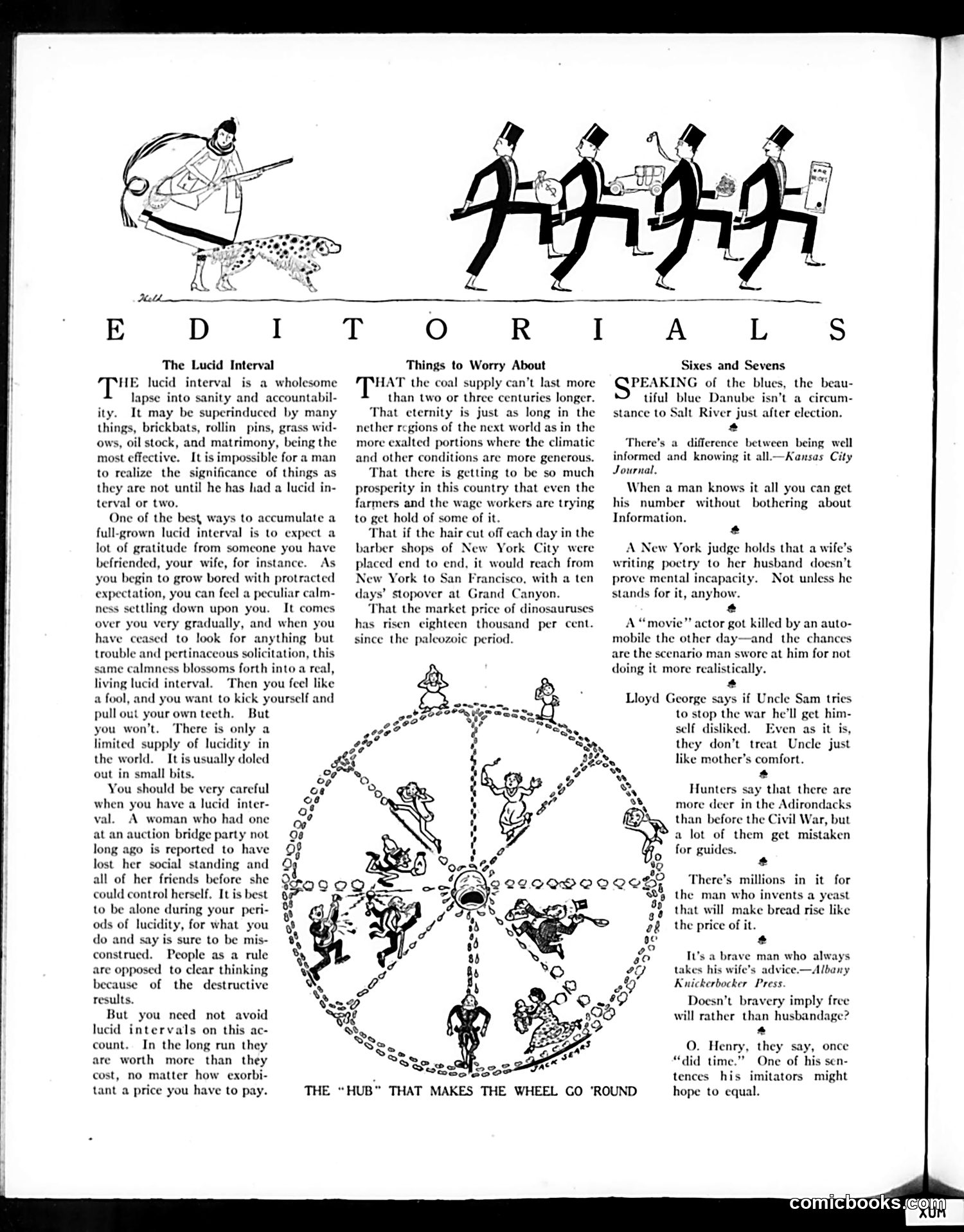
This is an editorial page from *Judge* magazine featuring satirical commentary on contemporary issues. The top left cartoon shows a hunter with a rifle and dog—likely satirizing indiscriminate hunting or resource extraction. The central illustration depicts a large wheel labeled "THE 'HUB' THAT MAKES THE WHEEL GO 'ROUND" with various figures engaged in different activities, symbolizing the interconnected nature of economic or social systems. The right column, "Sixes and Sevens," contains brief satirical quips on current topics: coal supply shortages, dinosaur fossils' rising market price, wives' poetry, movie realism, Uncle Sam's war efforts, and hunting guides. These appear to be topical references from the WWI era, though specific dates are unclear from the image alone.
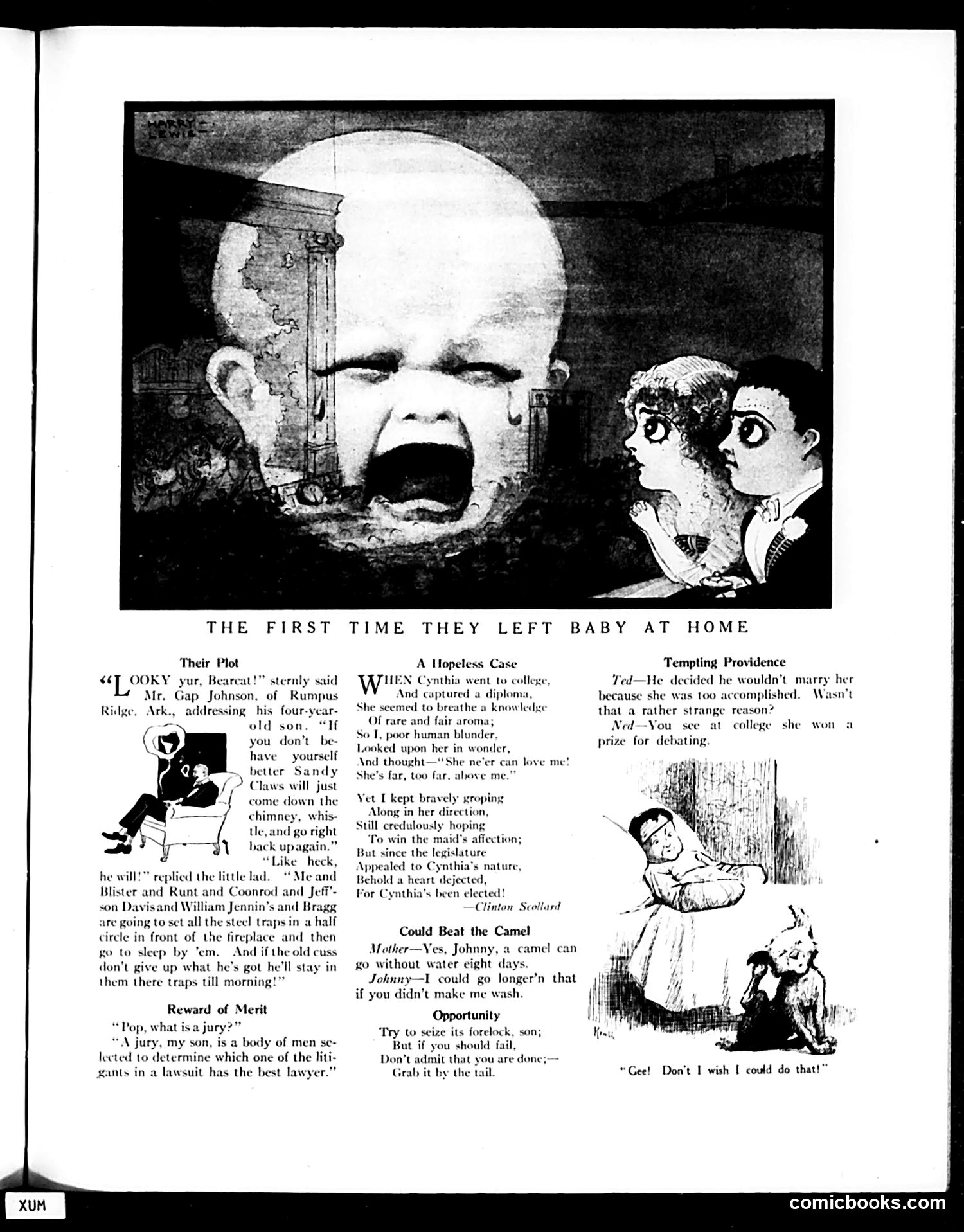
This page from Judge magazine contains humorous short pieces and illustrations about domestic life and parenting, rather than political content. **"The First Time They Left Baby at Home"** (top) shows parents' anxiety—a massive, screaming infant head dominates the image while two adults look horrified, illustrating exaggerated parental worry. The text pieces below are advice-column style humor: "Their Plot" depicts a father's stern threat to his son; "A Hopeless Case" satirizes romantic disappointment at college; "Tempting Providence" jokes about avoiding marriage; and "Could Beat the Camel" is a mother-child dialogue about endurance. "Reward of Merit" and "Opportunity" are brief witticisms about juries and seizing chances. The page emphasizes early-20th-century middle-class domestic anxieties and humor, with no apparent political satire.
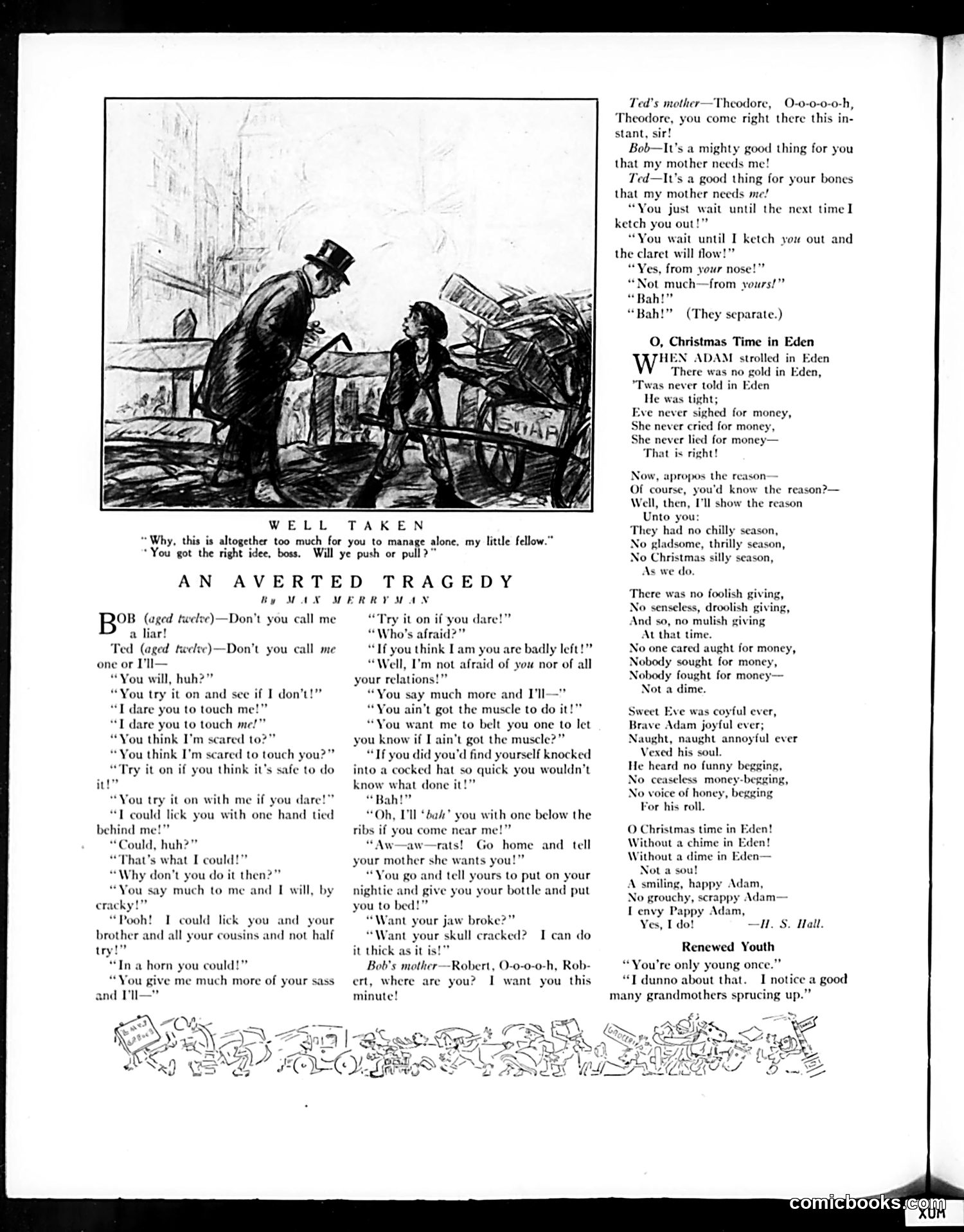
This page contains two satirical pieces: **"An Averted Tragedy"** (cartoon and dialogue): Two twelve-year-old boys, Bob and Ted, escalate through increasingly aggressive threats and boasts—daring each other to fight with mounting bravado. The humor lies in their elaborate posturing: each threat is met with counter-threats about fighting prowess, physical damage, and family members. The "tragedy" is averted only when both boys' mothers simultaneously call them home, forcing them to abandon their confrontation. The satire mocks how boys' masculine posturing collapses immediately under parental authority. **"O, Christmas Time in Eden"** (poem): A nostalgic critique of modern commercialism. The piece contrasts Eden—where Adam and Eve had no greed, no money-seeking, no gift-giving anxiety—with contemporary Christmas, characterized by "foolish giving," materialism, and "money-begging." The satire laments how modern commerce and consumerism have corrupted what should be a simpler, happier season. **"Renewed Youth"**: A brief joke suggesting grandmothers are rejuvenating themselves—likely a commentary on changing social attitudes toward aging and appearance.
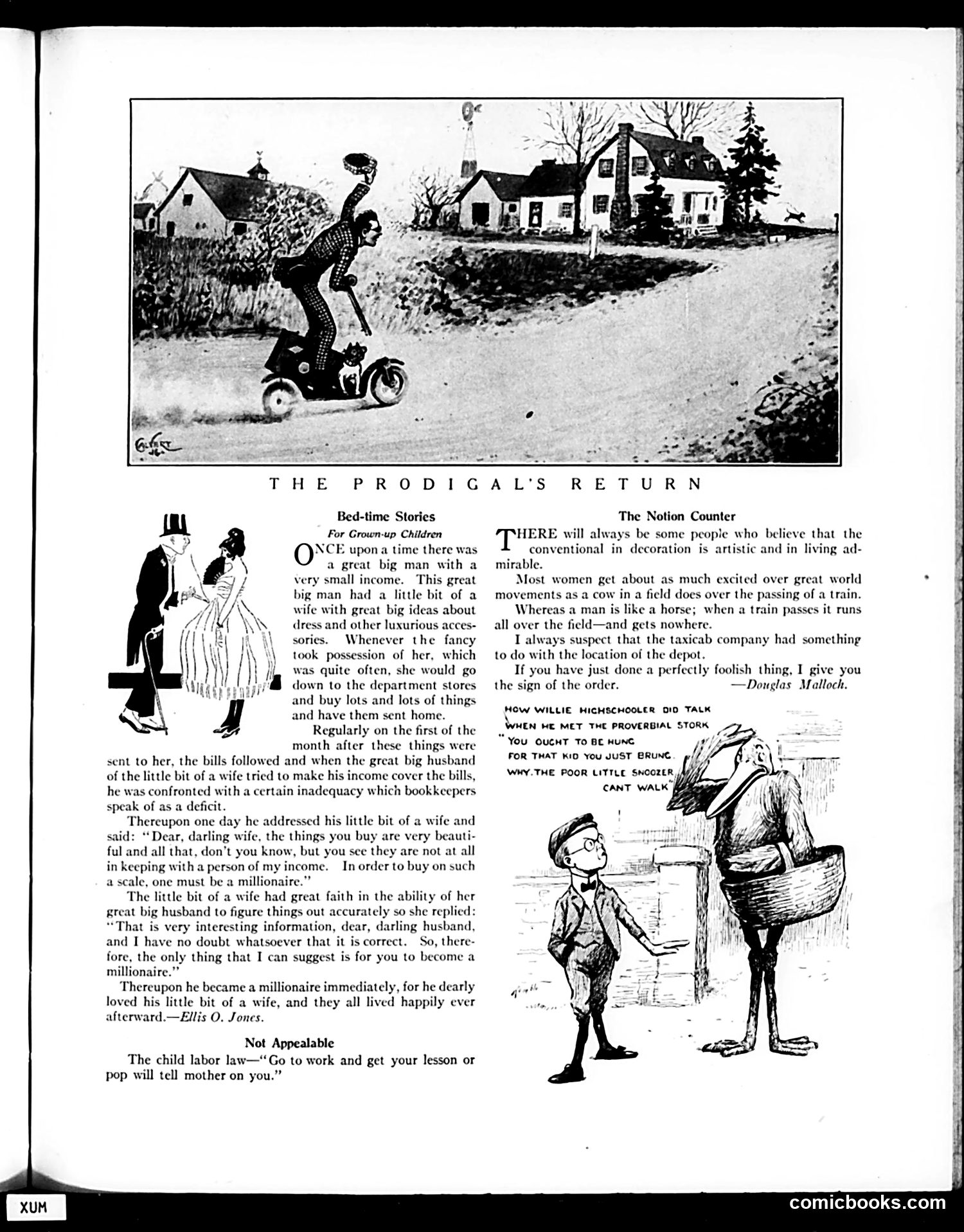
**Top Illustration ("The Prodigal's Return"):** Shows a man on an early motorized scooter/motorcycle returning to a rural homestead. This appears to be a visual metaphor for modernization intruding on traditional countryside life. **"Bed-time Stories" (Left):** A satirical fairy tale about marital finances. A wealthy-looking wife continuously overspends on luxuries while her "great big man" husband struggles with insufficient income. When she suggests he simply "become a millionaire," he does so immediately. The satire targets: (1) frivolous female consumerism and shopping habits, (2) the assumed financial incompetence of wives, and (3) the era's gender dynamics around household spending. It's presented as humorous fantasy. **"The Notion Counter" (Right):** Social commentary dismissing women's interest in "world movements," comparing them unfavorably to men's engagement (even if ultimately futile). Includes a brief joke about a high schooler meeting a newborn, making crude observations about the baby's physical abilities. **Overall tone:** Early 20th-century satirical commentary on gender roles, consumerism, and social conventions, typical of Judge magazine's satirical approach.
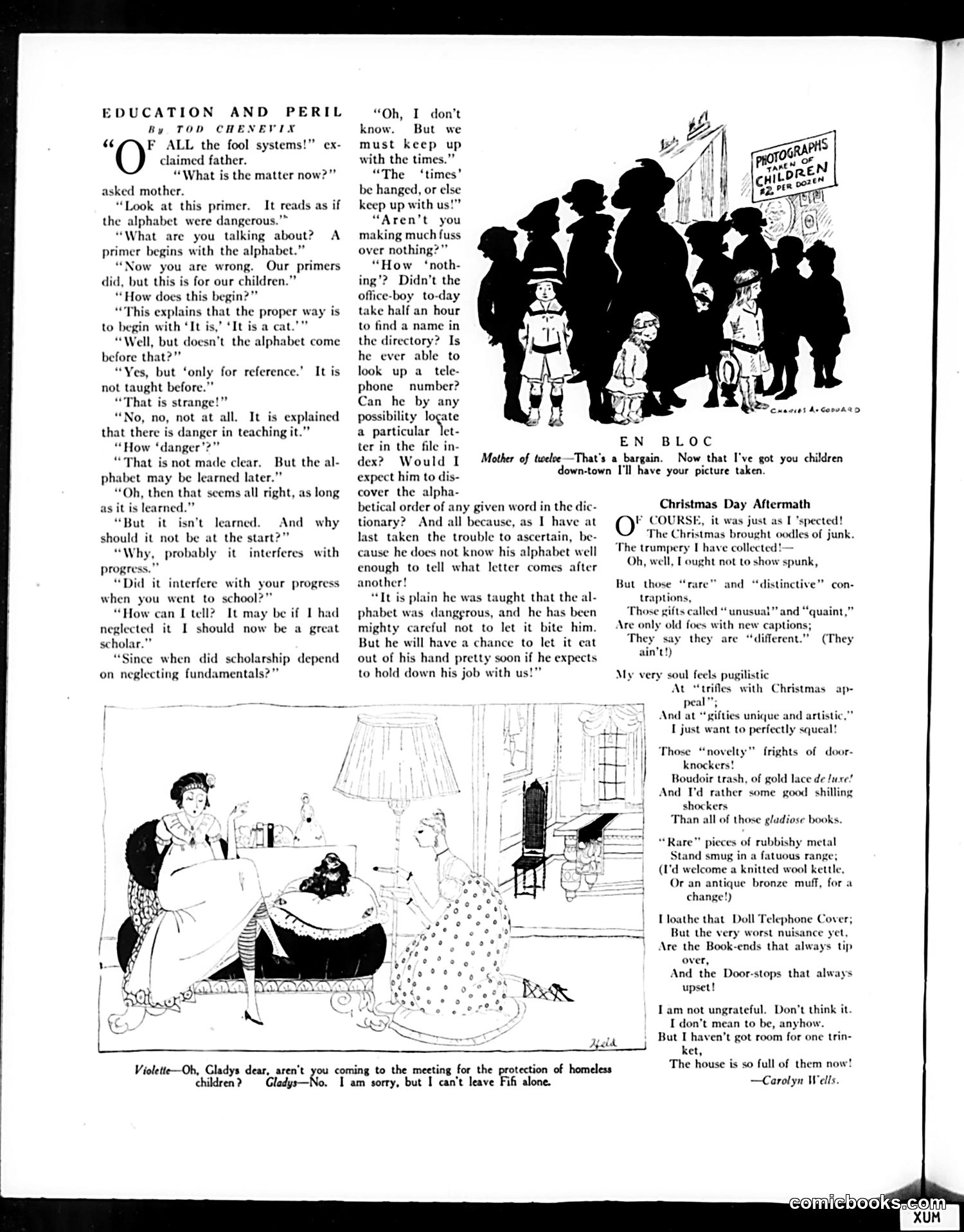
This page contains two satirical pieces from *Judge* magazine critiquing early 20th-century American life: **"Education and Peril"** mocks progressive educational theory. A father complains that modern primers teach reading through full sentences ("It is a cat") rather than mastering the alphabet first. He argues this impractical approach—justified by educators as avoiding "danger"—produces incompetent adults (like an office boy who can't alphabetize). The satire targets reformers who abandon proven fundamentals in favor of trendy, vague pedagogical ideas that ultimately harm students' practical skills. **"Christmas Day Aftermath"** and the accompanying cartoon satirize consumerism and cluttered domesticity. A mother with twelve children complains about receiving useless novelty gifts—"rare" junk marketed as "unique" or "artistic"—rather than practical items. The cartoon depicts a visit to get children photographed, reducing them to commodities. Together these pieces critique commercialization, conspicuous consumption, and the gap between marketing hype and actual value in Gilded Age America.
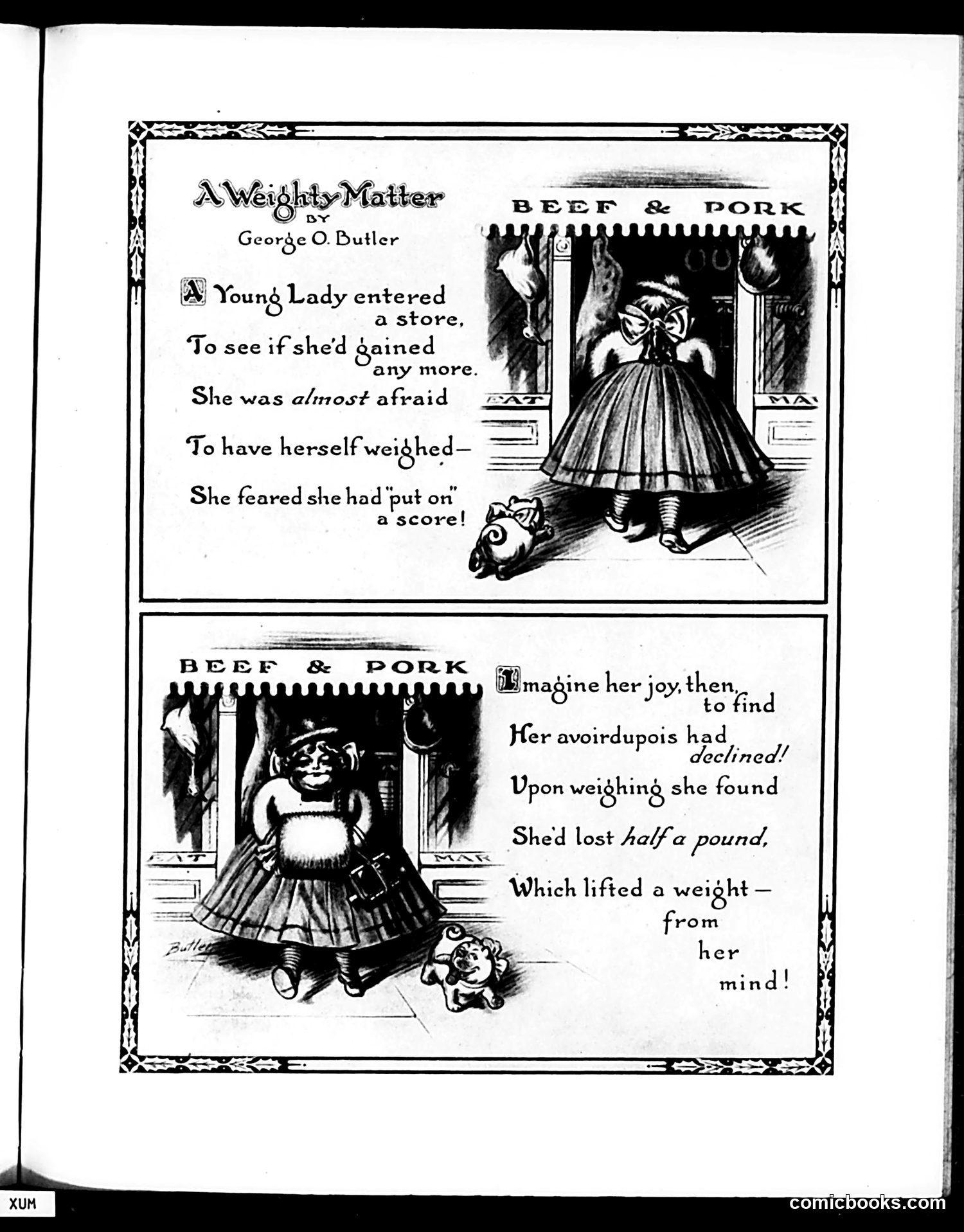
This comic strip satirizes women's anxiety about weight and appearance. A young woman nervously enters a butcher shop (marked "Beef & Pork") to weigh herself, fearing she has gained weight—using "put on a score" as a pun (score = twenty pounds). The joke relies on the period's social expectation that women should obsessively monitor their bodies. The punchline: she's actually *lost* half a pound, which "lifted a weight from her mind"—a play on words where emotional relief matches physical weight loss. The cartoon mocks both feminine vanity and the culture pressuring women about their appearance, presenting her anxiety as somewhat ridiculous while reinforcing that weight loss equals happiness.
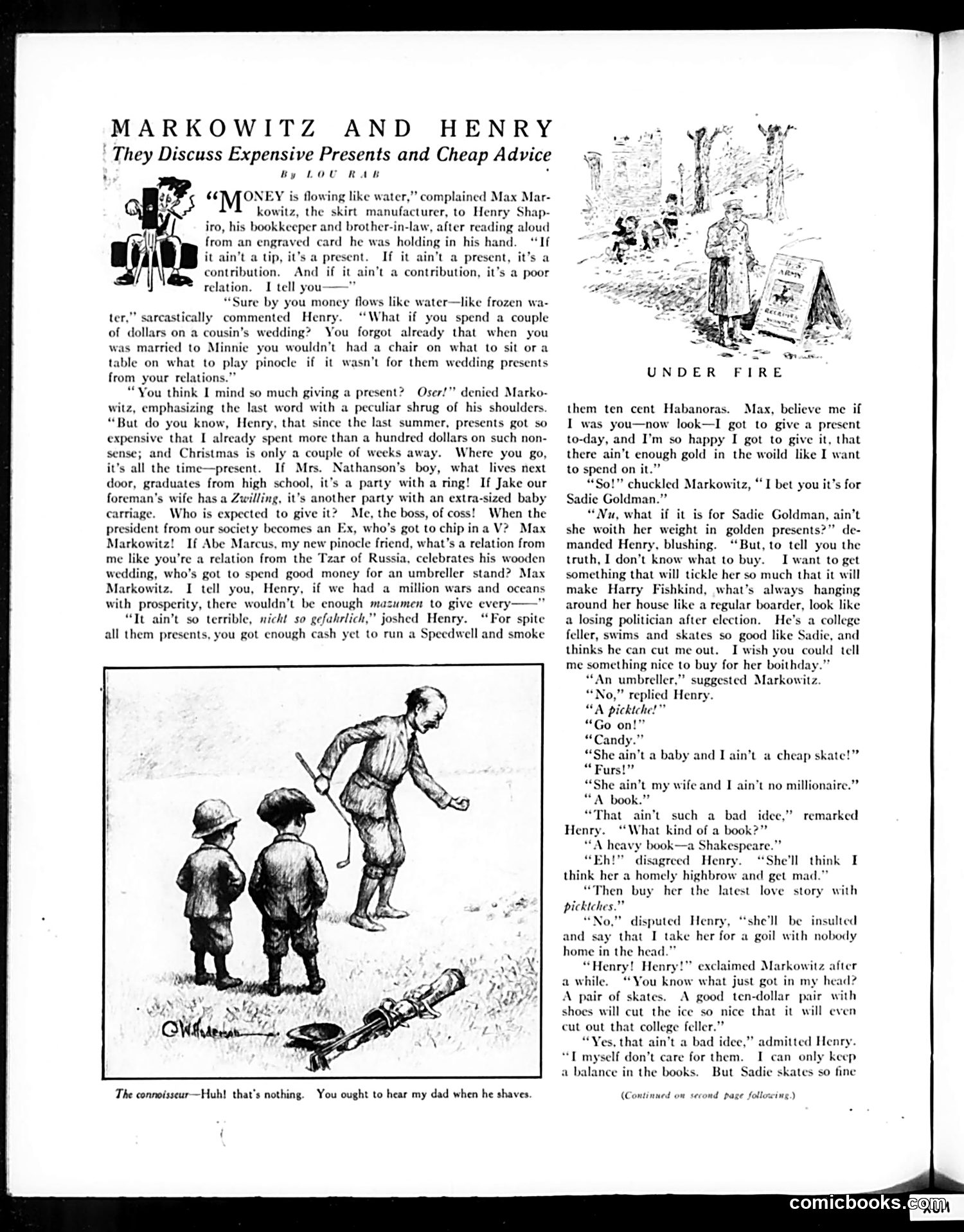
This is a humorous dialogue between two Jewish immigrant characters—Max Markowitz, a wealthy skirt manufacturer, and Henry Shapiro, his bookkeeper and brother-in-law. The satire targets the financial and social pressures of gift-giving in early 20th-century America. **The joke:** Max complains that money "flows like water" because he's constantly expected to give expensive gifts—for weddings, graduations, parties, and religious occasions. Henry sarcastically notes Max's money actually "flows like frozen water" (reluctantly), reminding him he once depended on wedding gifts himself. The dialogue then shifts to Henry seeking gift advice for his romantic interest, Sadie Goldman, wanting to outshine a rival suitor (Harry Fishkind). Each suggestion—umbrella, picture, candy, book—is rejected as inappropriate. **The satire** mocks both the social obligation to give expensive presents and the anxiety surrounding romantic competition, while depicting immigrant Jewish life with affectionate stereotypes (Yiddish phrases, materialistic concerns, social climbing).
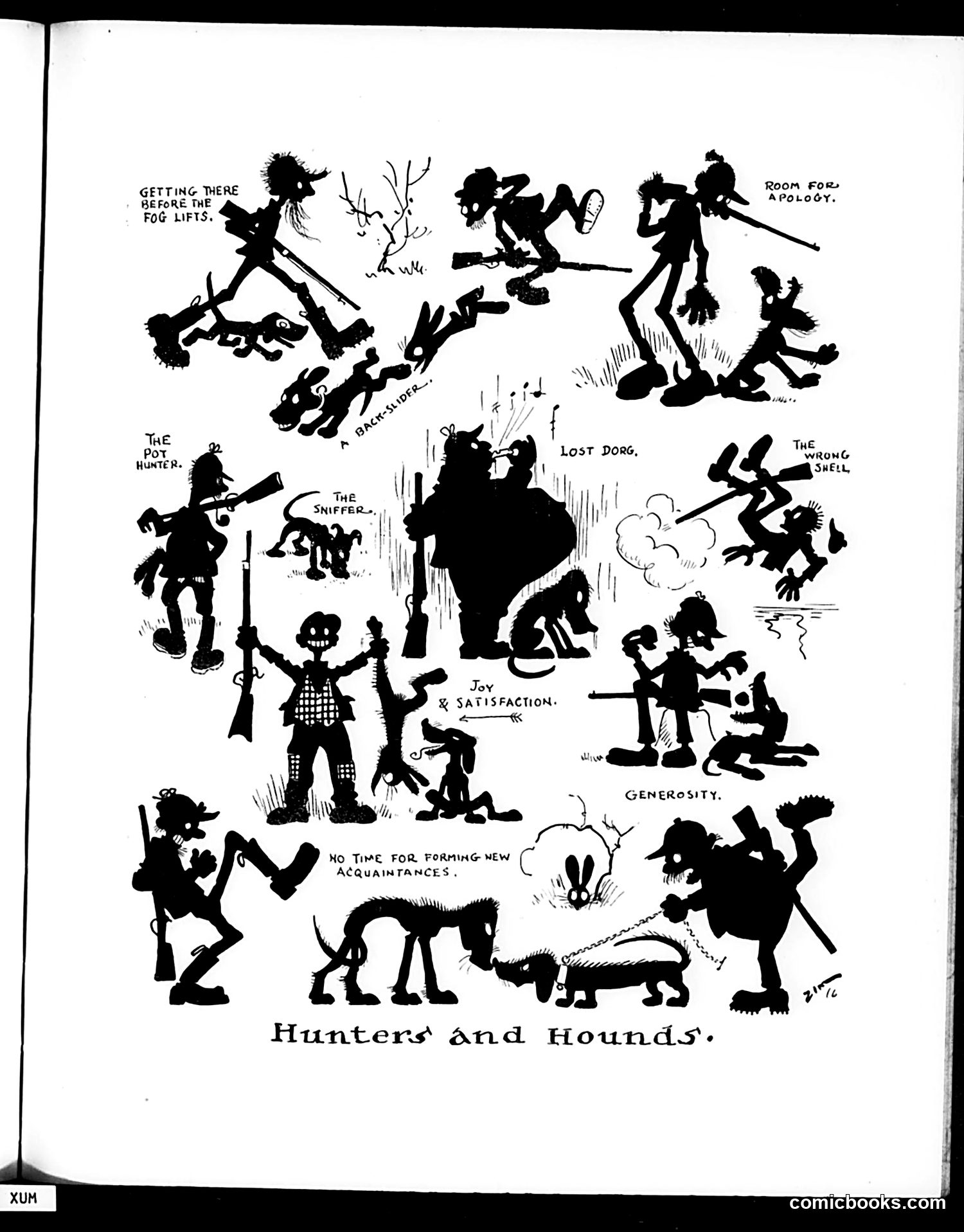
This Judge magazine page uses hunting metaphors to mock various political figures and social types. Each silhouette represents a different character type engaged in chaotic pursuit—literally "hunters and hounds." The labeled vignettes ridicule specific behaviors: "The Pot Hunter" (someone pursuing wealth), "The Sniffer" (an informant or scandal-seeker), "Lost Dog," "Joy & Satisfaction," "Generosity," and "The Wrong Shell" (misfiring efforts). The title frames these figures as predatory pursuers engaged in fruitless or foolish chases. "Room for Apology" suggests political figures refusing accountability. The overall satire mocks the era's political corruption, opportunism, and social pretension—depicting public figures as animals engaged in undignified scrambling rather than principled governance.
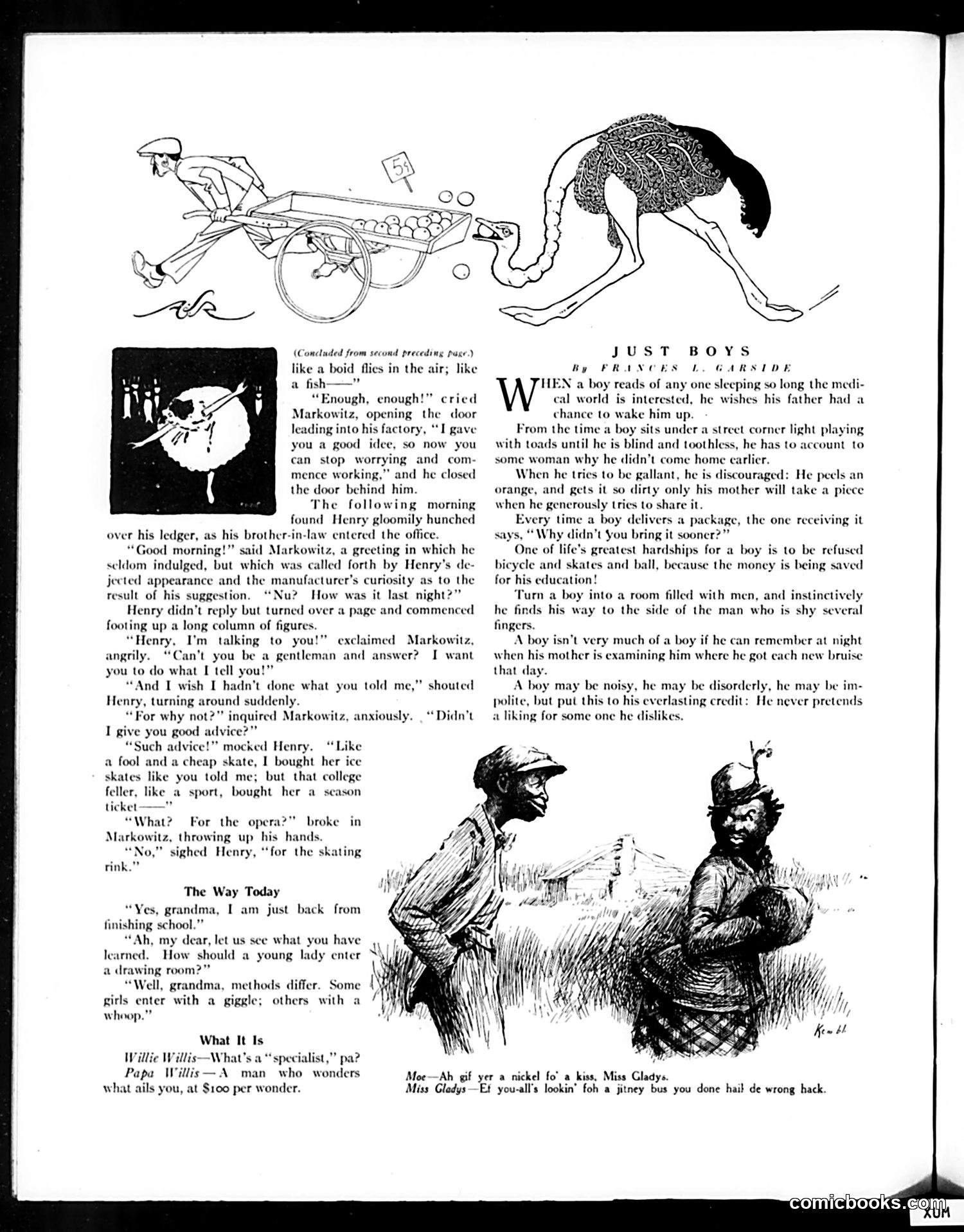
This page contains two distinct pieces of satirical content: **"Just Boys"** (main article): A commentary on boyhood that catalogs the contradictions and frustrations of being a boy. It mocks how boys are simultaneously discouraged from gallant behavior, denied desires (bicycles, skates) in favor of education savings, yet expected to account for their whereabouts and injuries. The satire targets parental hypocrisy and society's conflicting expectations of youth. **The Henry/Markowitz narrative** (continued story): Depicts a working-class Jewish character (Markowitz, identifiable by the Yiddish "Nu?") who gives his brother-in-law Henry romantic advice. Henry foolishly follows it, buying ice skates for a girl, only to be outdone by a wealthier "college feller" who purchases an opera ticket. The joke satirizes class anxiety and the inadequacy of working-class courtship rituals against wealthier competitors. **The bottom sketch** appears to mock racial stereotypes with exaggerated dialect humor typical of the era's offensive conventions.
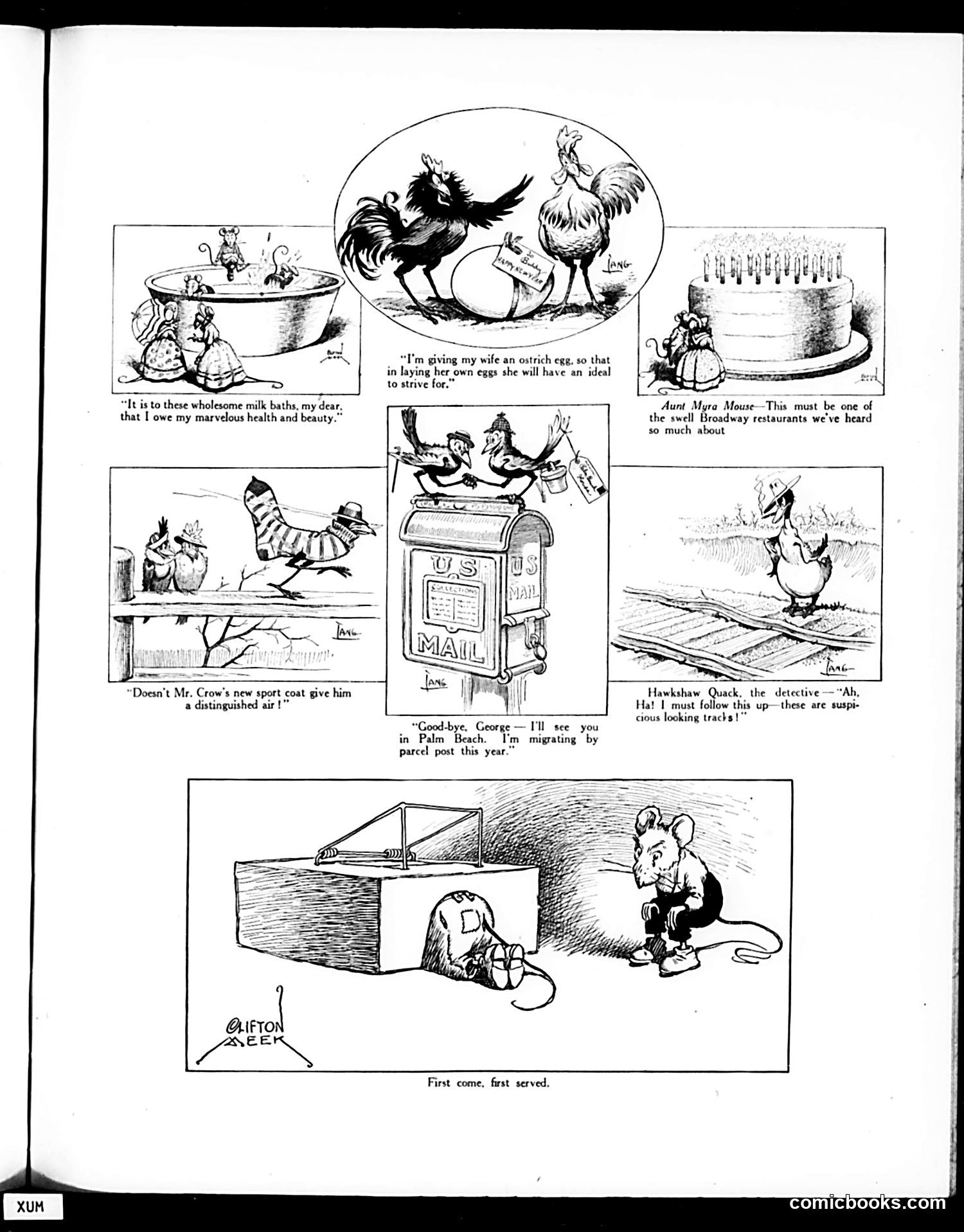
This page contains six animal-themed comic vignettes satirizing human society and vanity: 1. **Milk baths for beauty**: Mocks wealthy women's cosmetic obsessions by showing fashionable mice claiming milk baths ensure health and beauty. 2. **Ostrich egg gift**: Satirizes absurd gift-giving and self-improvement pretensions among the wealthy. 3. **Broadway restaurants**: References contemporary upscale dining culture, with mice patronizing fancy establishments. 4. **Crow's sport coat**: Gentle mockery of fashion consciousness and status-seeking through clothing. 5. **Parcel post migration**: Jokes about wealthy people's seasonal migration to Palm Beach, depicted literally as animals mailing themselves. 6. **Detective and suspicious tracks** (bottom): Features "Hawkshaw Quack," a parody detective character, unable to recognize obvious animal footprints—satirizing incompetent investigators or absurdly overwrought mystery narratives. The overarching theme: anthropomorphic animals mimicking human social pretensions, vanity, and folly. The humor relies on incongruity and exaggeration of contemporary upper-class behaviors.
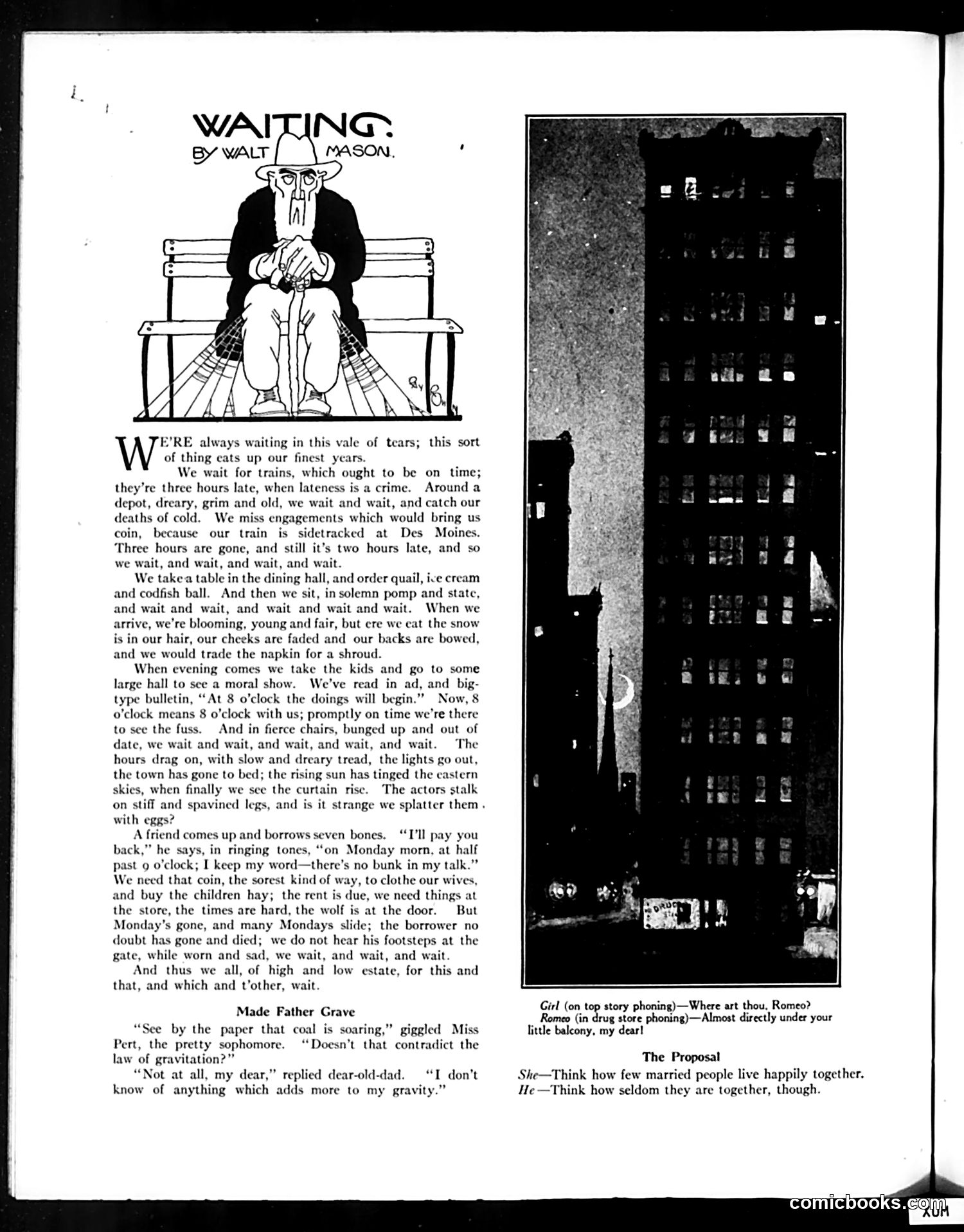
This is a humorous poem satirizing the universal frustration of waiting—for late trains, restaurant service, theatrical performances, and borrowed money repayment. Mason catalogs the mundane miseries of everyday life: a train sidetracked in Des Moines leaving passengers stranded for hours, a fancy dinner that becomes pointless after such delays, an evening show that starts hours behind schedule, and a friend who borrows money promising repayment "Monday" but never returns. The cartoon's central figure—an elderly man hunched on a bench—embodies this exhaustion. The satire targets not politics but modern life's unreliability: transportation failures, broken promises, and institutional inefficiency that waste citizens' time and money while they wait helplessly. The repetitive "wait and wait" refrain emphasizes the grinding, inescapable nature of these delays across social classes ("high and low estate").
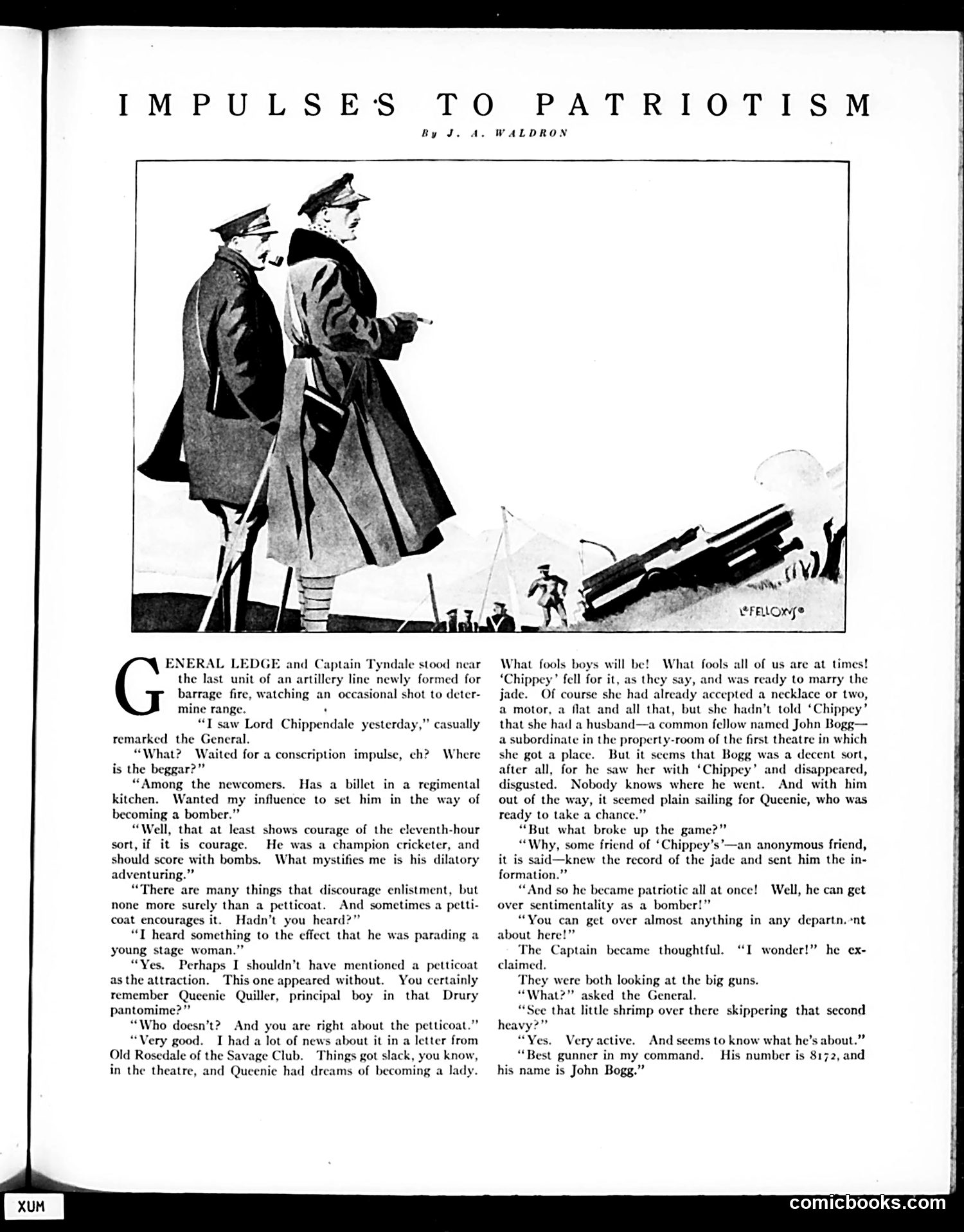
This story satirizes motivations for military enlistment during WWI. General Ledge and Captain Tyndale discuss Lord Chippendale, a wealthy cricketer who delayed enlisting until recently—prompted not by patriotism but by romantic betrayal. Chippendale nearly married Queenie Quiller, a stage actress with a hidden past: she was already married to John Bogg, a theater stagehand. When an anonymous informant revealed her deception, Chippendale's romantic illusions shattered, driving him to enlist as a bomber—motivated by wounded pride rather than duty. The irony: Bogg, the "common" subordinate, proves the truly honorable man (leaving quietly rather than competing), and now serves as Chippendale's superior officer—"the best gunner" in the unit. The satire mocks how personal disappointment, not patriotic impulse, drives enlistment, while suggesting that genuine character transcends social class.
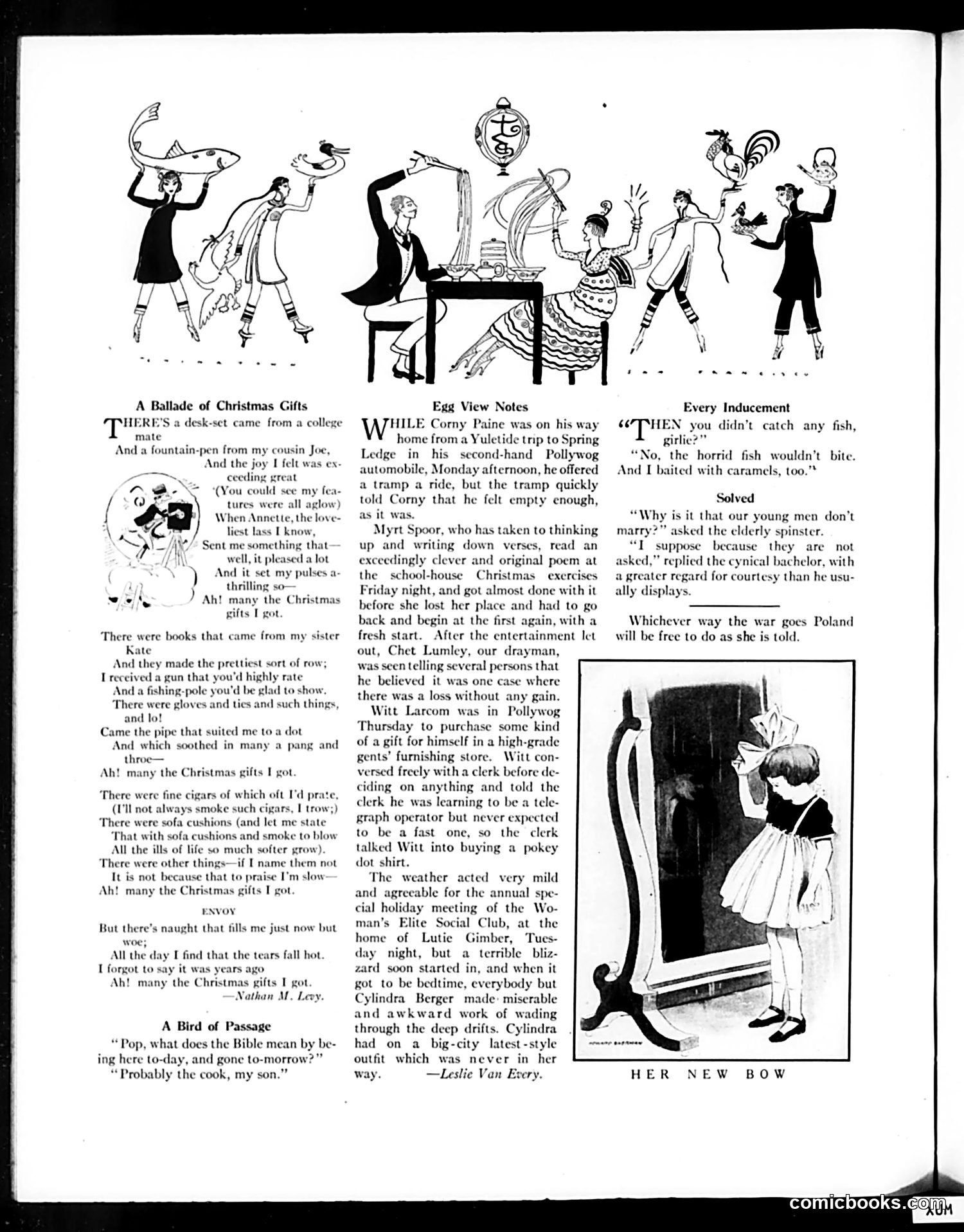
This page contains three distinct pieces of satirical humor typical of early 20th-century American magazines: **"A Ballad of Christmas Gifts"** is a sentimental poem about receiving various gifts, ending with emotional reflection—likely satirizing overwrought Christmas sentimentality of the era. **"A Bird of Passage"** is a brief joke where a father explains that the Bible phrase about being "here today, gone tomorrow" refers to servants/cooks—poking fun at domestic help turnover. **"Egg View Notes"** (illustrated top) appears to be small-town gossip humor, mocking rural characters and their pretensions: a man too poor to refuse a ride, a woman losing her place while reciting poetry, and a man buying an unfashionable "pokey dot shirt." The final item references Poland's political status, suggesting this is from WWI or immediate post-war period when Poland's independence was contested. The illustration "Her New Bow" shows a girl with a new bow, likely accompanying one of these pieces. The overall tone is genteel mockery of American social life—rural simplicity, fashion mishaps, and sentimental excess.
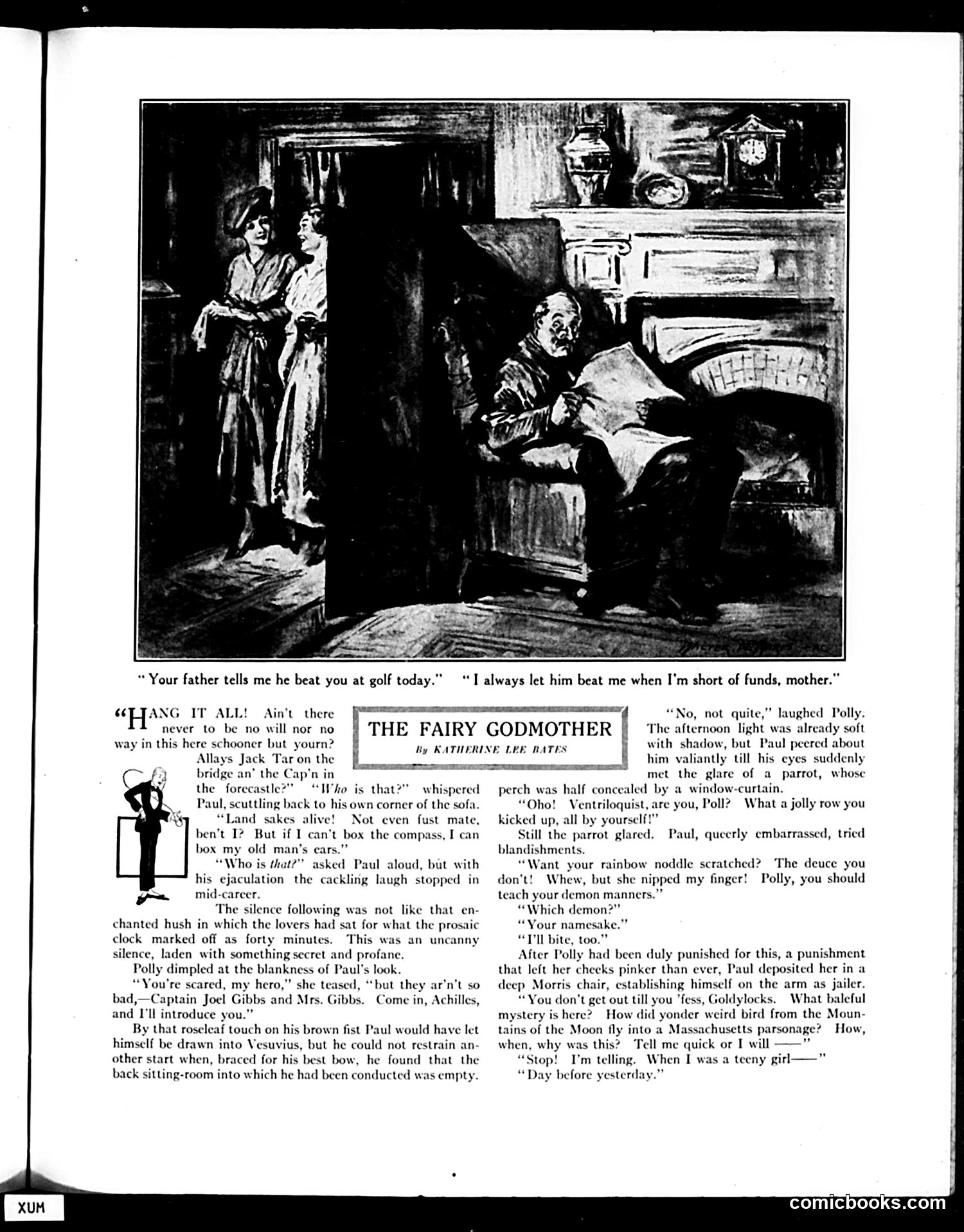
This page presents a serialized romantic comedy story rather than a political cartoon. The narrative follows a young man named Paul visiting his sweetheart Polly at her home, where he's initially frightened by what appears to be mysterious voices—only to discover they're being produced by a parrot concealed behind a window curtain. The humor derives from Paul's embarrassment and confusion, Polly's playful teasing, and the mild romantic tension between them (including references to Paul "punishing" Polly with kisses). The dialogue reflects period attitudes toward courtship and gender dynamics typical of early 20th-century American magazine humor. The framing illustration shows two domestic scenes: women at a doorway, and a man being fooled by the ventriloquist's parrot trick. There's no identifiable political satire—this is entertainment content designed for Judge magazine's readership.
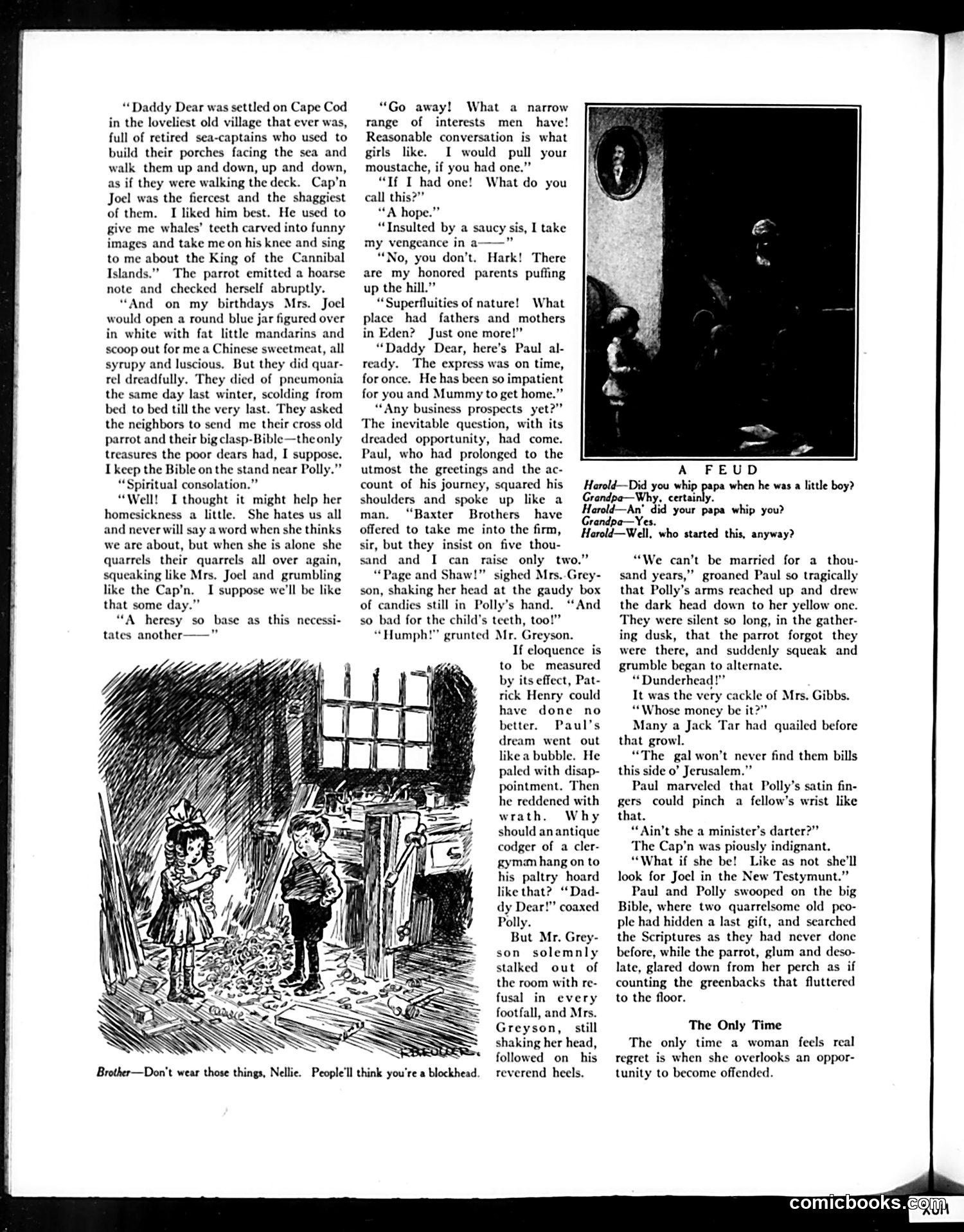
This page contains two distinct satirical pieces lampooning middle-class social conventions circa early 1900s. The main story mocks sentimental storytelling and parental disapproval of romance. A young woman (Polly) tells a long, emotionally manipulative tale about deceased Cape Cod sea-captains to justify keeping their querulous parrot. When her suitor Paul seeks her father's approval for marriage—needing funds to join a business—the clergyman father refuses coldly, crushing Paul's hopes. The satire targets both excessive Victorian sentimentality and fathers' financial gatekeeping over their daughters' futures. The lower cartoon, "A Feud," humorously depicts cyclical domestic conflict: children ask their grandparents who started family quarrels, tracing blame backward through generations with no clear origin—suggesting feuds perpetuate absurdly through inertia rather than justified cause. The small dialogue at bottom mocks narrow male interests and women's intellectual aspirations, suggesting contemporary gender role friction.
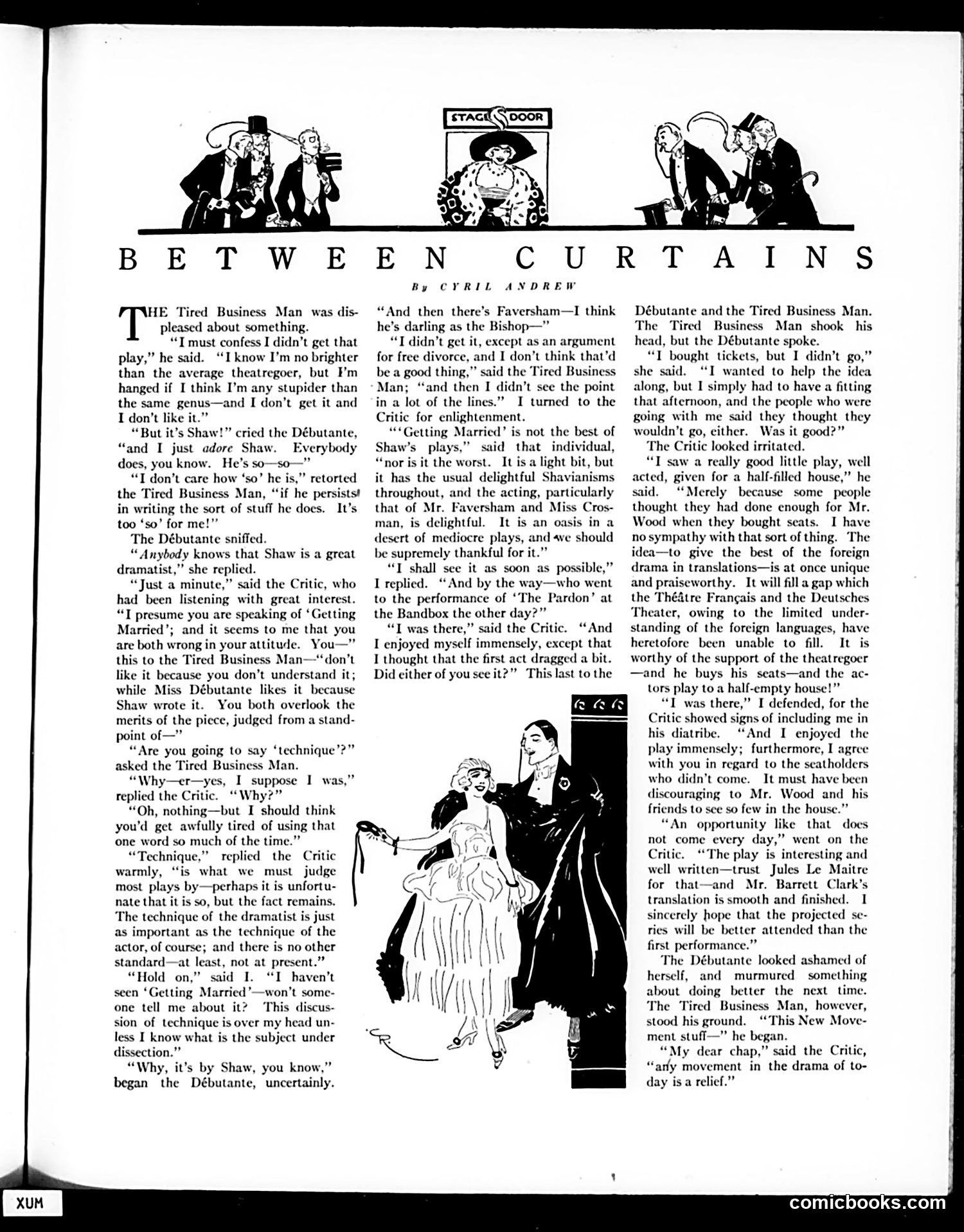
This is a theatrical satire featuring three stock characters debating a Shaw play ("Getting Married"): a philistine **Tired Business Man** who finds it incomprehensible; a pretentious **Débutante** who admires Shaw simply because he's fashionable; and a self-important **Critic** who judges all drama by "technique"—a word he uses so reflexively that the Tired Business Man mocks it. The satire targets early 20th-century theater culture: the snobbish gatekeeping around modernist dramatists, the shallow enthusiasm of society women, and critics' reliance on jargon over actual aesthetic judgment. The Critic also criticizes audiences for buying tickets to experimental theater (like translations at the Théâtre Français) without attending, undermining artistic ventures through performative support rather than genuine engagement. The humor lies in exposing pretension across all three types of theatergoer.
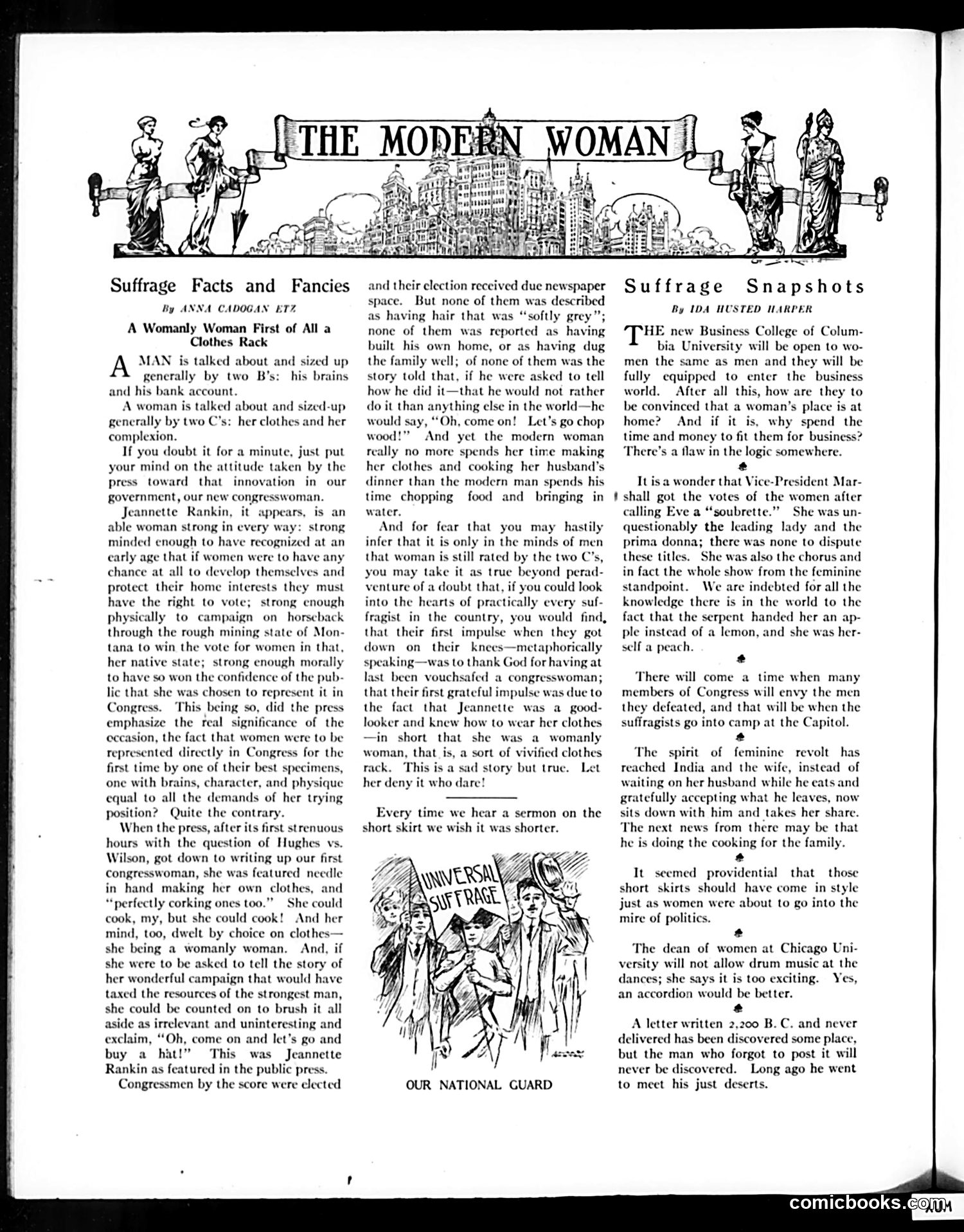
This *Judge* magazine page satirizes the media's treatment of **Jeannette Rankin**, the first woman elected to Congress (1916). **The Satire:** Author Anna Cadogan Etz criticizes how newspapers covered Rankin's historic election. While male congressmen received substantive coverage, Rankin was described primarily through appearance—her sewing skills, cooking ability, and clothes-making. The piece argues this reflects society's obsession with women's "two C's": clothes and complexion, versus men's "two B's": brains and bank account. **The Irony:** Etz notes that modern women actually spend no more time on domestic tasks than modern men, yet remain judged by these standards. She further observes that even suffragists themselves—fighting for women's rights—unconsciously valued Rankin mainly for being a "womanly woman" and attractive clothes-wearer, rather than celebrating her political accomplishment. **The Cartoon ("Our National Guard"):** The illustration appears to depict suffragists with a banner, though details are unclear. The page mocks gendered media bias and internalized sexism among women themselves.
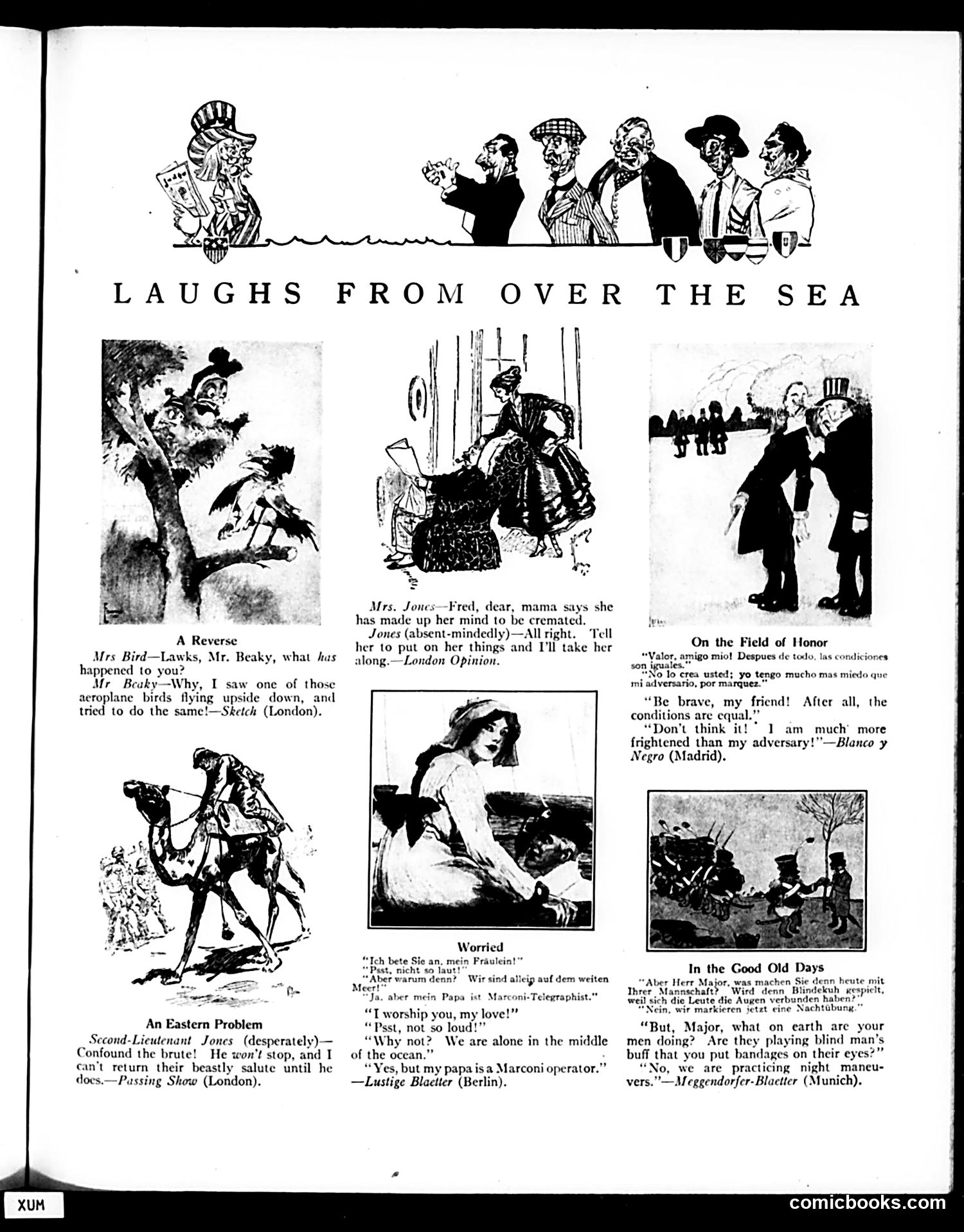
This page collects humorous cartoons and captions from European satirical magazines, translated for American readers. The jokes rely on period-specific military and social contexts: **"A Reverse"** mocks early aviation through slapstick—a man imitates an upside-down airplane and crashes. **"An Eastern Problem"** satirizes colonial military protocol: a British officer cannot return a camel's salute until it stops moving, creating absurd formality. **"Worried"** jokes about wireless technology—a couple's romantic whispers are overheard by the woman's father, a Marconi (telegraph) operator. **"On the Field of Honor"** plays on WWI battlefield anxiety: soldiers claim superiority in fear over their enemies. **"In the Good Old Days"** mocks military training: soldiers practice night maneuvers while blindfolded, presented as absurdly outdated. The page demonstrates how international humor was shared across borders, with jokes reflecting common anxieties about modern warfare, technology, and military culture during the early 20th century.
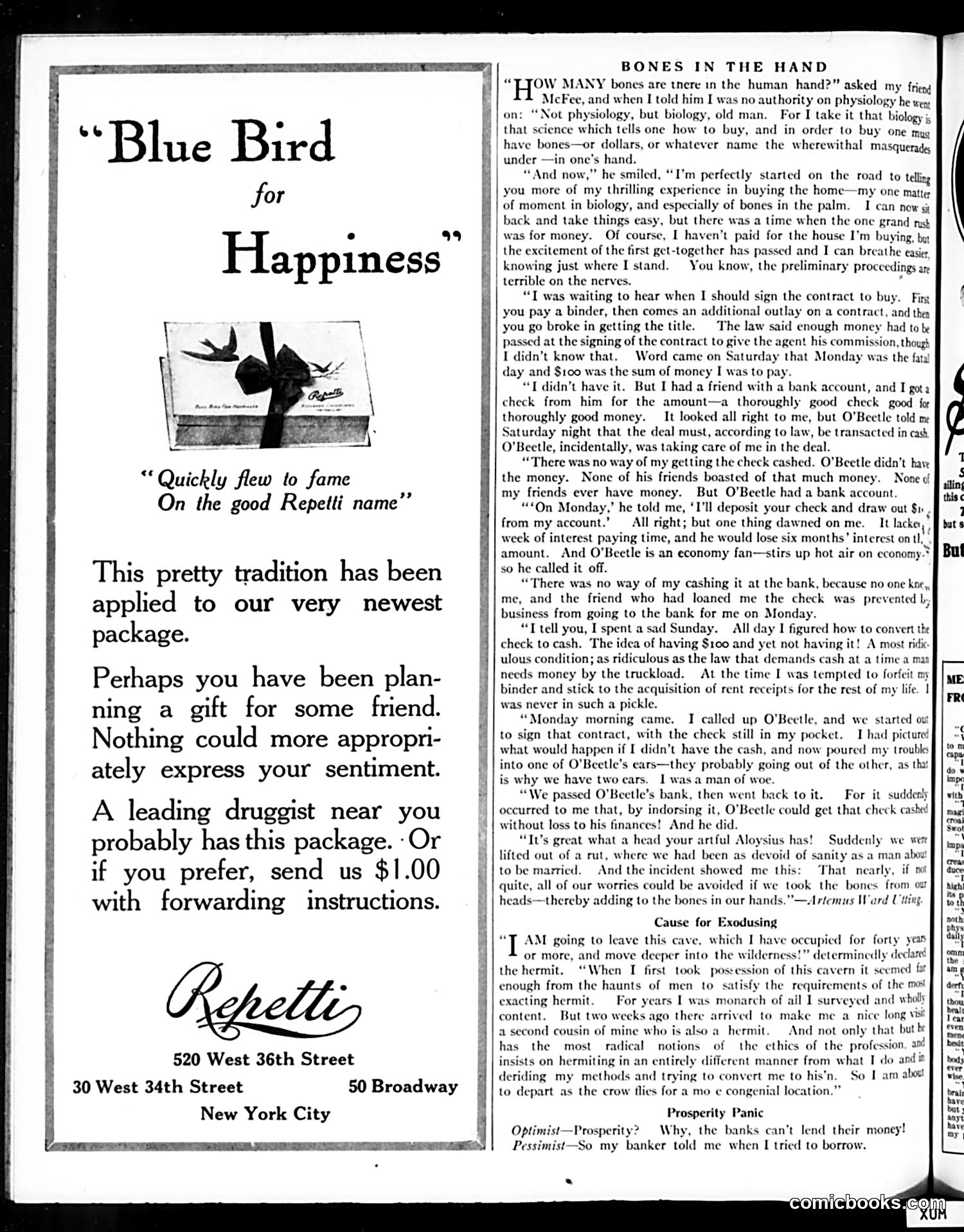
**Left page:** An advertisement for Repetti perfume/cologne positioned as an ideal gift. The "Blue Bird" references Maeterlinck's famous 1908 play symbolizing happiness—a popular cultural touchstone of the era. The ad suggests giving this product expresses sentiment appropriately to friends. **Right page:** A humorous narrative about purchasing a home, using "bones" (slang for money/dollars) as its central metaphor. The unnamed narrator describes the bureaucratic frustration of needing $100 in *cash* to close a real estate deal, despite possessing a perfectly good check. His friend O'Beetle refuses to help convert it, citing lost interest during "economy" times. The story satirizes both banking inflexibility and the absurdity of legal requirements demanding physical currency rather than negotiable instruments—a common complaint during this era of real estate transactions and financial regulation.
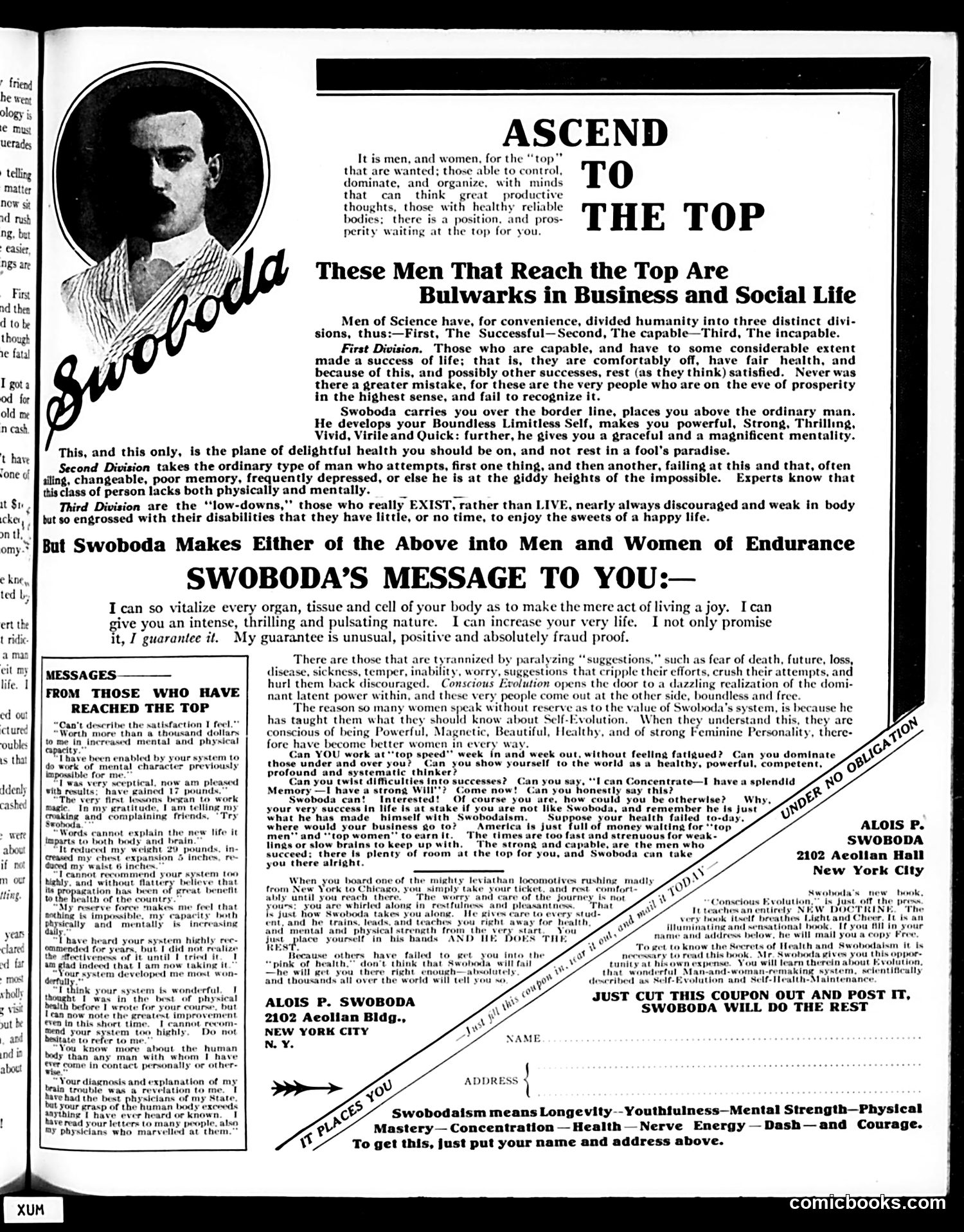
This page is primarily a **pseudoscientific self-help advertisement** masquerading as editorial content, typical of early 20th-century magazines. **The Subject:** Alois P. Swoboda promotes a system claiming to transform people's physical and mental capabilities through unspecified means (likely mail courses or personal instruction). **The "Satire"** (if any exists): Judge appears to be running this as genuine advertorial content rather than satire. The page uses pseudo-scientific language dividing humanity into three classes—the successful, capable, and incapable—promising Swoboda can elevate anyone to peak performance. **What a Modern Reader Should Know:** This reflects pre-FDA advertising standards when extraordinary health claims faced minimal regulation. The vague promises ("vitalize every organ"), testimonials from unnamed satisfied clients, and guaranteed results are hallmarks of quackery. The mention of "Conscious Evolution" suggests New Thought movement influence, popular in this era. The page is **not political satire** but rather demonstrates how credulous publications were toward dubious self-improvement schemes.
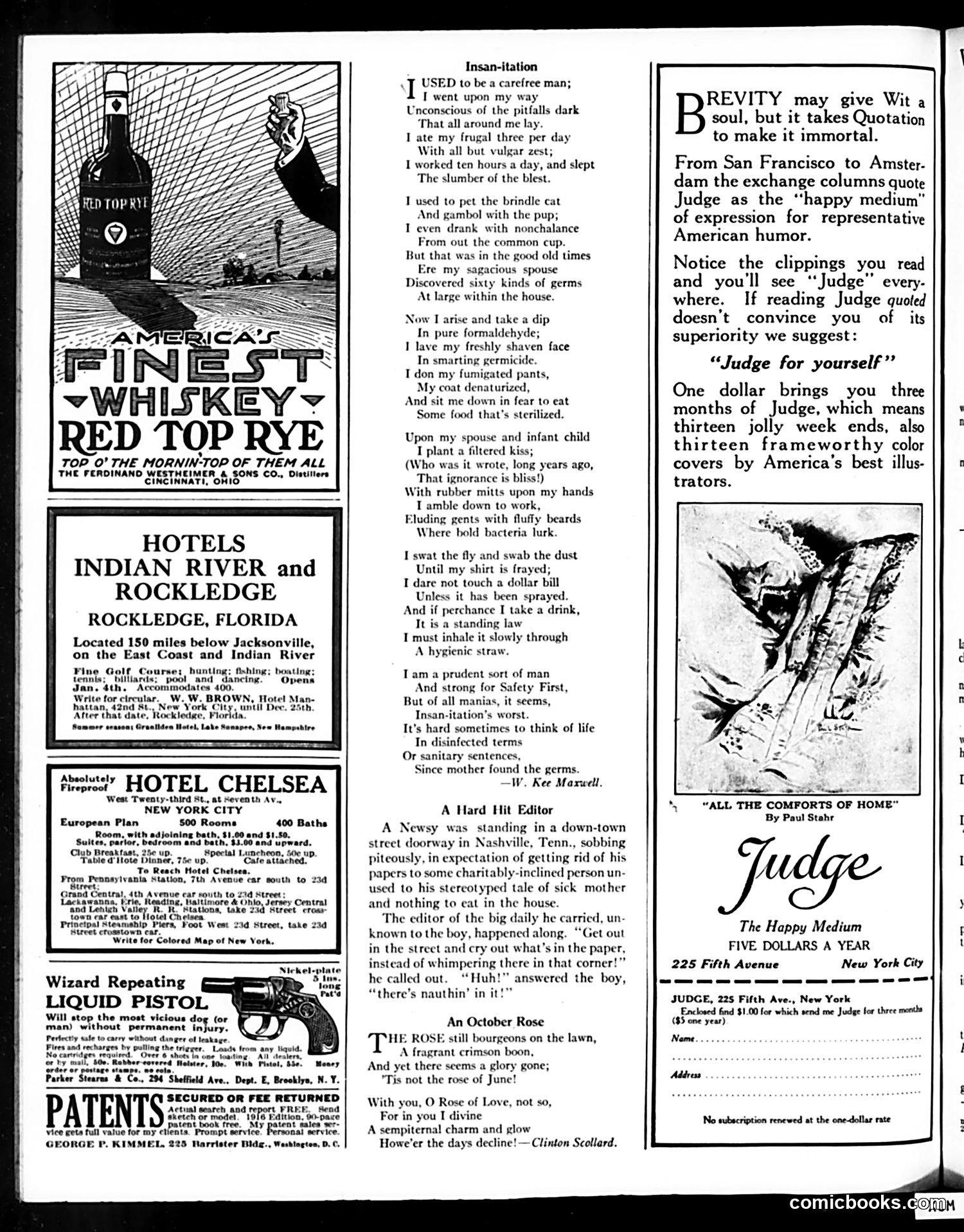
This page is primarily **advertisements and filler content** typical of early 20th-century magazines, with one satirical poem of note. **The main satirical content** is "Insan-itation" by W. Kee Maxwell—a humorous poem mocking the obsessive germaphobia and sanitization mania that had gripped American society following scientific discoveries about bacteria and disease transmission. The poem describes a formerly carefree man whose wife, having learned about "sixty kinds of germs," now forces him into an absurdly sterile existence: using germicide, fumigated clothes, filtered kisses, and hygienic straws. **The satire's point**: This reflects genuine early-1900s anxiety about newly-discovered germs. While germ theory was scientifically valid, some people took hygiene precautions to comedic extremes—the poet calls this obsession "insan-itation" (insanity + sanitation). The remaining content consists of hotel and product advertisements typical of Judge magazine's revenue model, plus a brief anecdote about a newsboy ("A Hard Hit Editor").
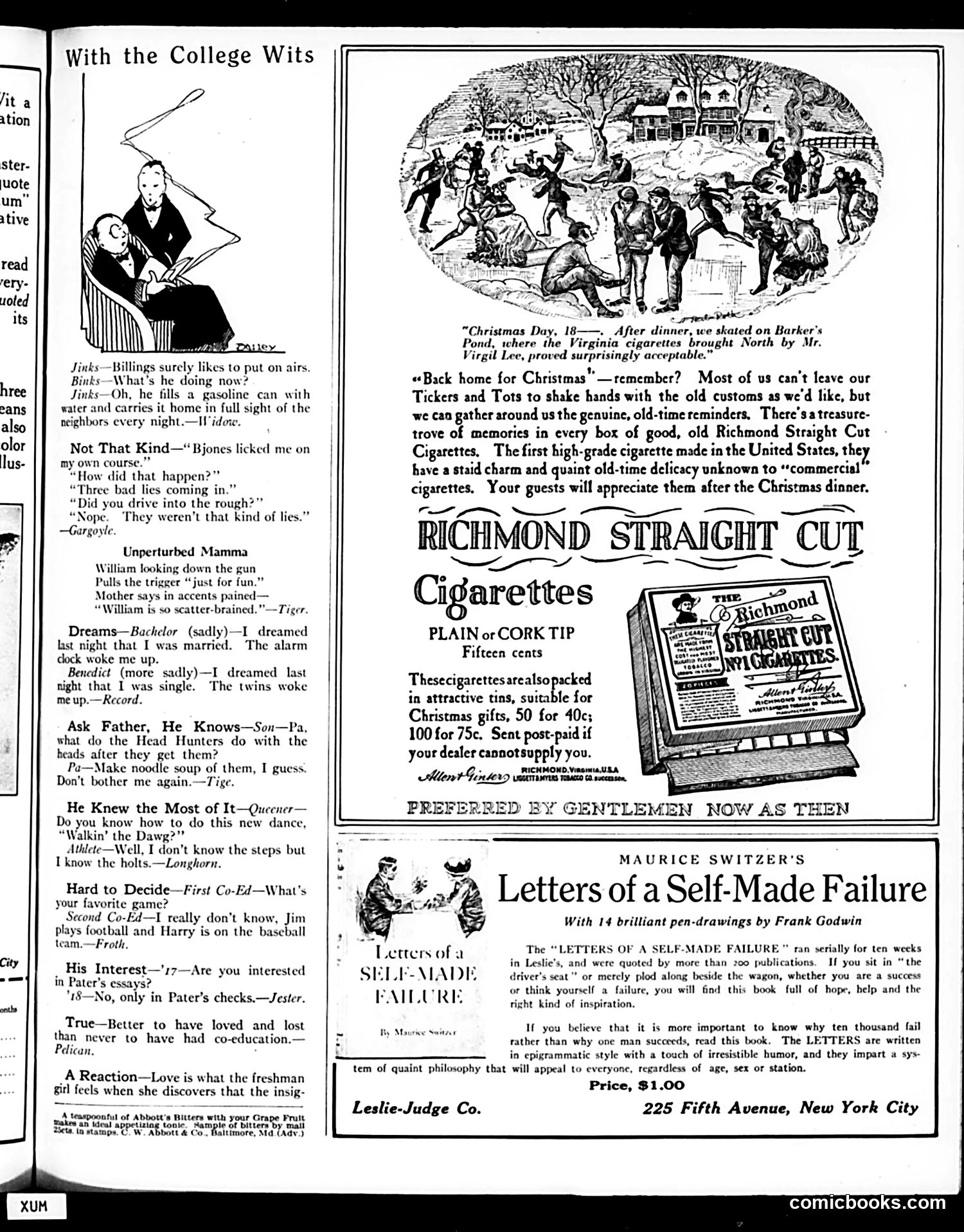
This page from *Judge* contains college humor and period advertising rather than political satire. **The "College Wits" Section**: Brief jokes targeting college students and young men, poking fun at affectation (a student pretending to be tough by carrying a water-filled gas can), lying, distracted mothers, romantic entanglements, and dating priorities. The humor is light and domestic, typical of early 20th-century collegiate mockery. **The Dominant Advertisement**: Richmond Straight Cut Cigarettes dominates the page with a nostalgic Christmas scene. The ad emphasizes these as "the first high-grade cigarette made in the United States" and appeals to gentlemen's tastes and tradition—marketing through patriotic and class-conscious appeals. The accompanying vignette romanticizes pre-industrial Christmas customs. **Bottom Advertisement**: *Letters of a Self-Made Failure* by Maurice Switzer, a self-help book promising philosophical wisdom about failure and success. The page reflects early 20th-century consumer culture and genteel humor aimed at educated, affluent readers.
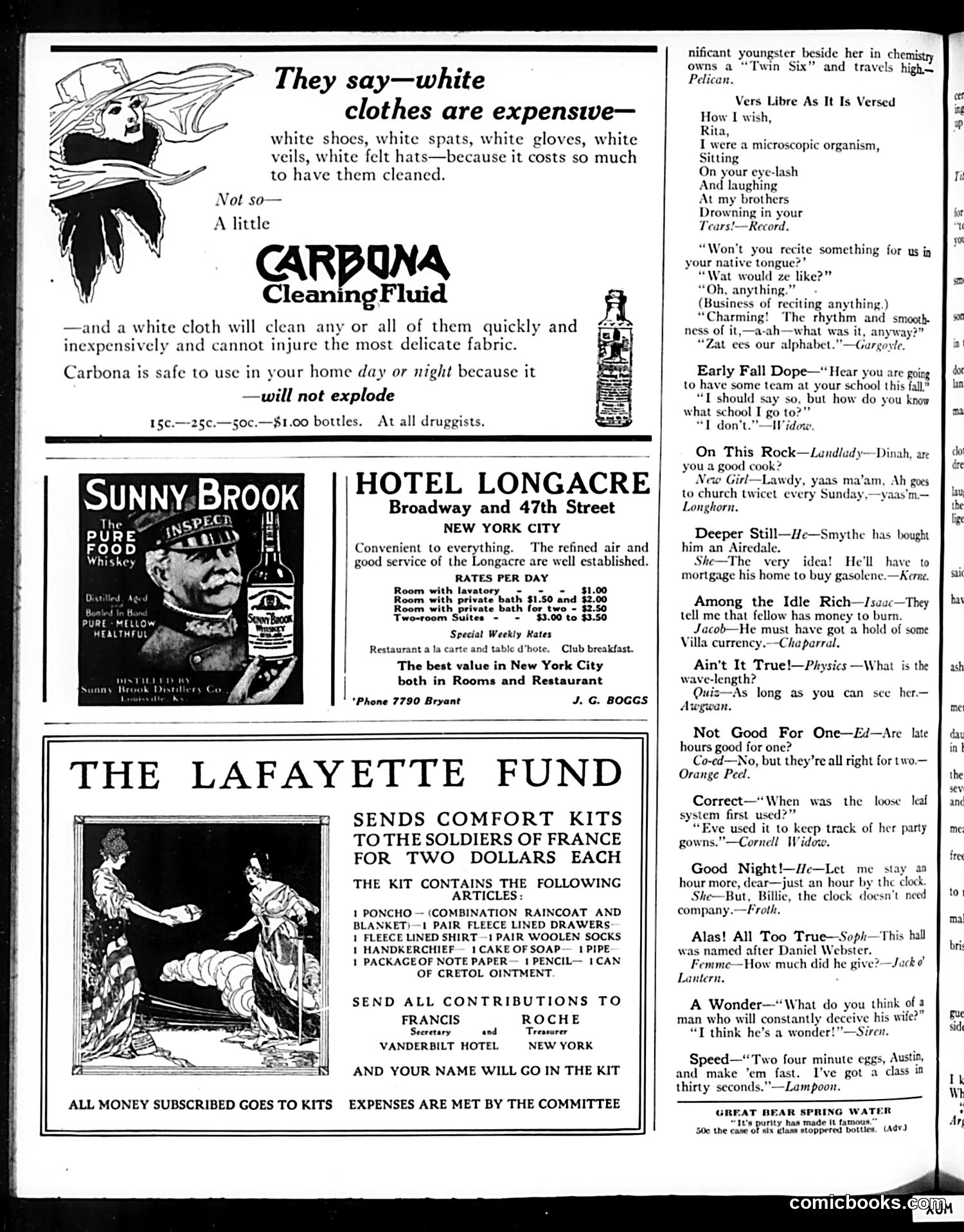
This page is primarily **advertising and humor content** rather than political satire. The main elements are: **Carbona Cleaning Fluid Advertisement:** Uses a fashionable woman to market a cleaning product, addressing the expense of maintaining white clothing (shoes, gloves, hats) popular among the wealthy during this era. The ad emphasizes that Carbona is safe and won't "explode"—likely referencing concerns about flammable cleaning solvents of the period. **Hotel Longacre Ad:** Standard New York City hotel advertising. **Lafayette Fund Appeal:** A charitable drive soliciting $2 donations for comfort kits sent to French soldiers during World War I (the kit includes blankets, socks, soap, and writing materials). **Right Column:** College humor—brief jokes and witticisms from various university publications, covering romantic misadventures, ethnic humor, and student life. Notable is the crude ethnic dialect humor typical of the 1910s-20s era. The page reflects **wartime charitable appeals** alongside commercial advertising and collegiate humor popular in this period.
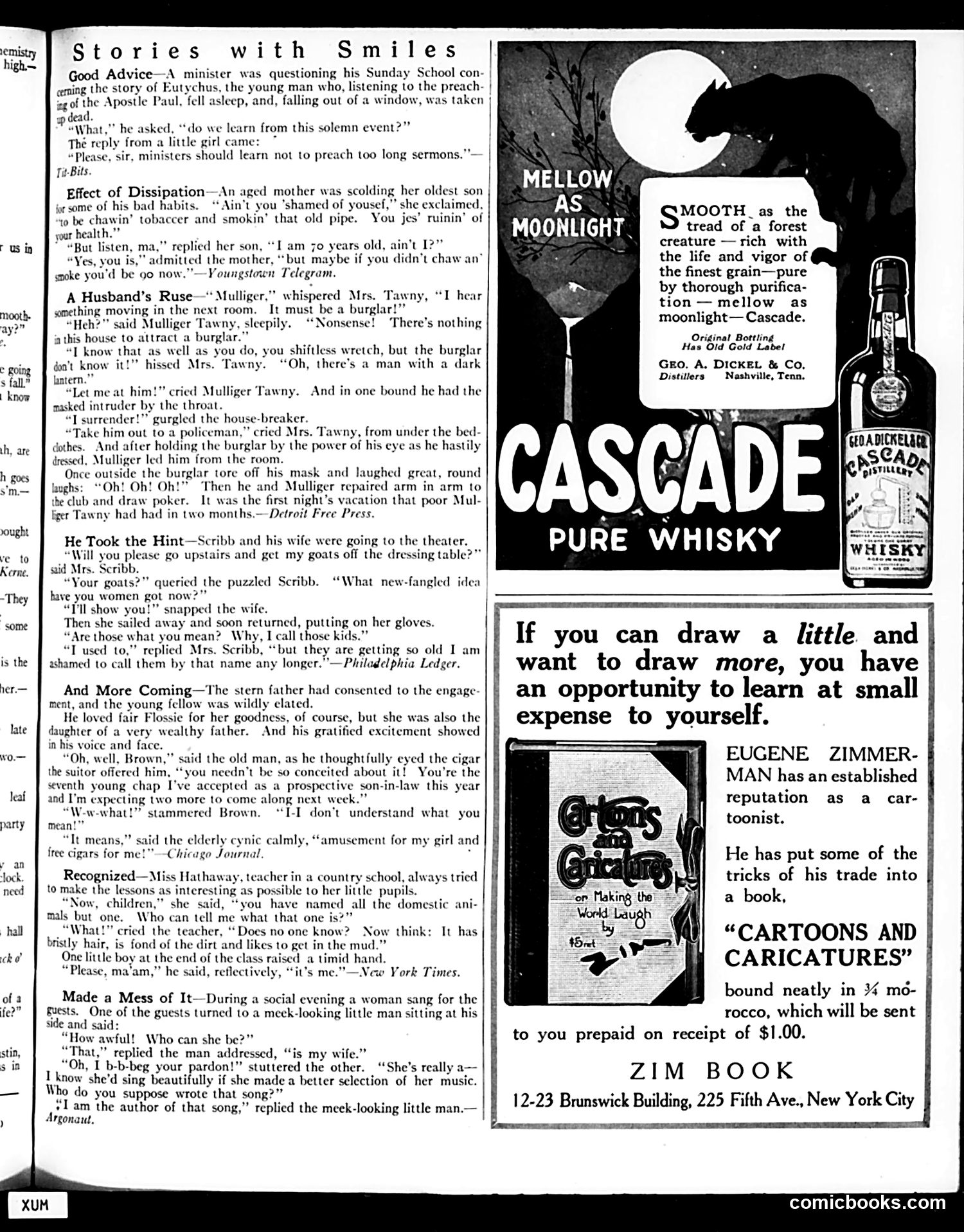
This page from the satirical magazine *Judge* contains primarily **humorous anecdotes** rather than political cartoons. The "Stories with Smiles" section presents brief comedic tales mocking human behavior: **Key jokes include:** - A Sunday School lesson about consequences (a boy falls asleep and out a window) - An aged mother's complaint about her son's tobacco and pipe habits—he replies he's 70 and might be worse without them - A husband's marital ruse where a burglar becomes his best friend after a confrontation - Confusion over whether "goats" refers to actual animals or something else - A wealthy father's cynical amusement at accepting multiple sons-in-law as "entertainment" and for free cigars - A schoolteacher's question about unnamed domestic animals answered unexpectedly by a student **The satire targets:** domestic life pretenses, aging vices, marital dynamics, and class presumption. These are gentle, middle-class humor pieces rather than sharp political commentary. The advertisements (Cascade whiskey, Eugene Zimmerman's cartoonery book) occupy significant space, indicating this is primarily a commercial publication.
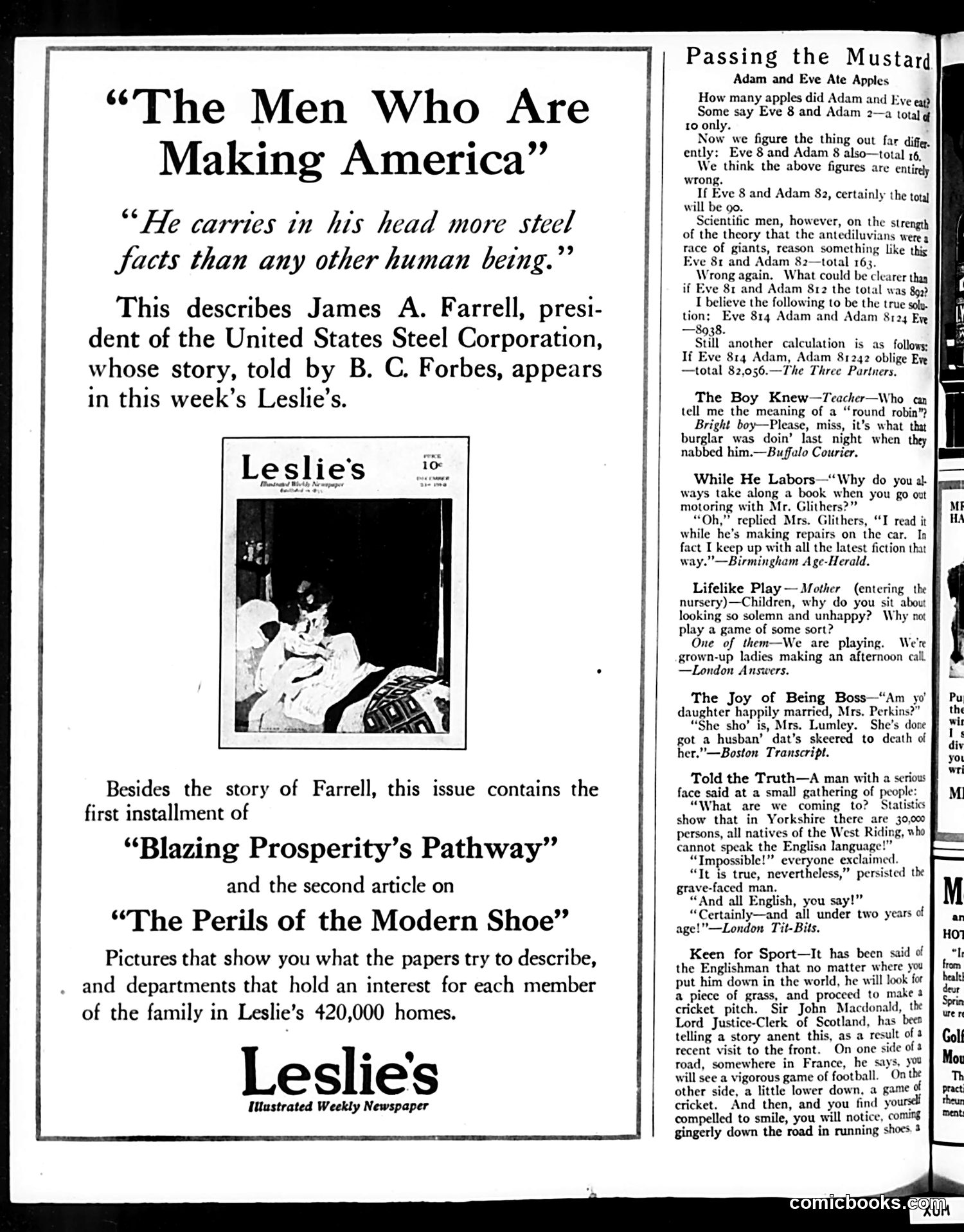
This page is primarily **advertising for Leslie's Illustrated Weekly Newspaper**, promoting its coverage of James A. Farrell, president of U.S. Steel—presented as one of "The Men Who Are Making America." The quote about carrying "more steel facts than any other human being" plays on Farrell's industry role. The advertisement emphasizes Leslie's broad appeal across 420,000 homes with stories on prosperity and consumer goods. The right column contains **vintage humor shorts**—brief jokes typical of early 20th-century magazines. These include puns ("round robin" burglar joke), domestic comedy (wives reading while husbands repair cars), and gentle satire on British character (Englishmen playing cricket anywhere). The humor is gentle, family-oriented, and reflects period attitudes about gender, class, and nationality—notably depicting women as passive and non-English speakers as objects of amusement. The page reflects **prosperity-era consumer culture** and mainstream magazine advertising conventions of the period.
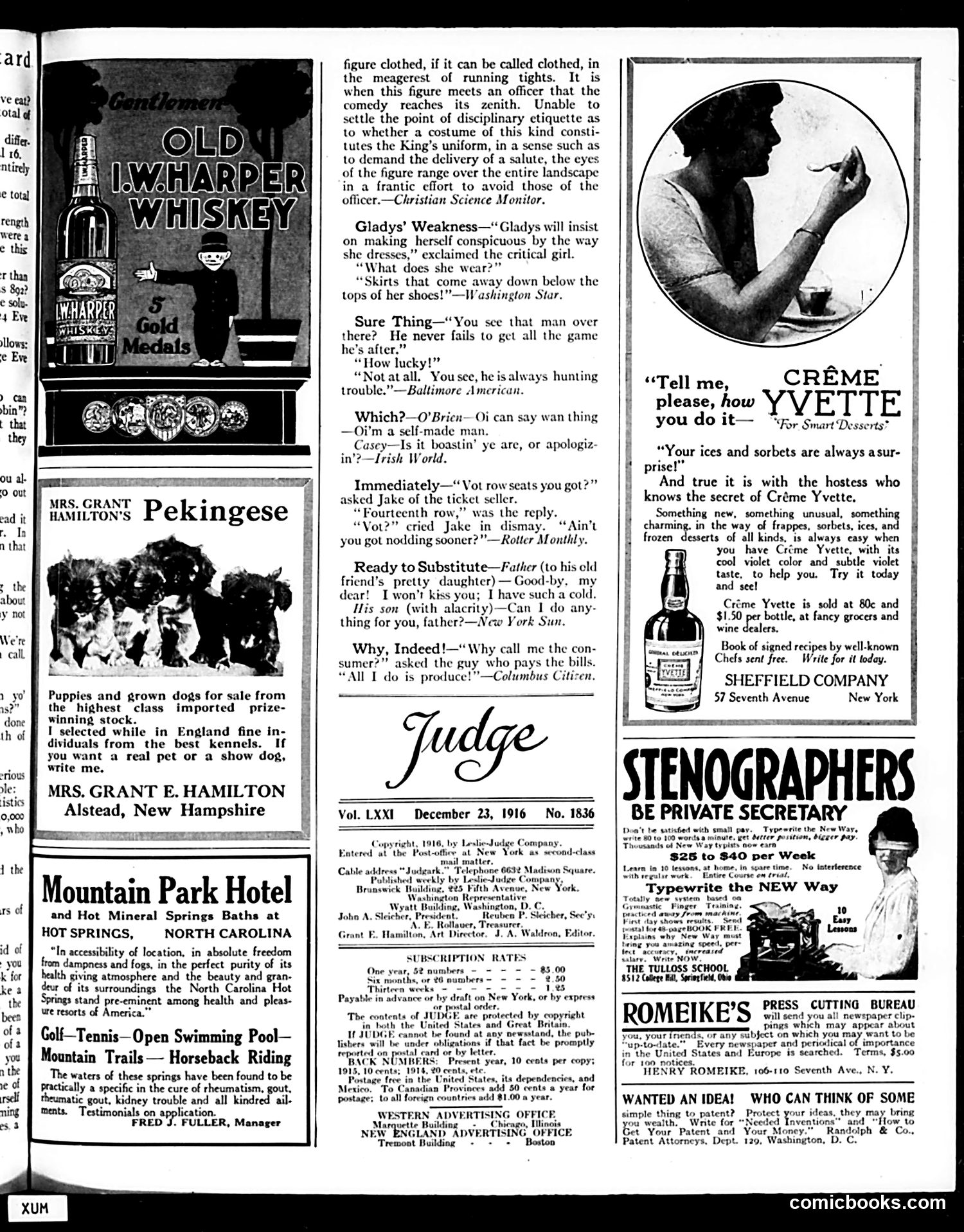
This is primarily a **advertisements and humor page** from Judge, the American satirical weekly. The page contains: **Humor Section** (center): Brief jokes lampooning domestic life and social behavior—a woman overly concerned with fashion, a persistent hunter, an immigrant's confused English, etc. These are mild observational humor typical of early 20th-century magazines. **Advertisements** dominate: Old I.W. Harper Whiskey, Crème Yvette liqueur, Pekingese puppies, Mountain Park Hotel, stenography correspondence courses, and press clipping services. These ads reflect 1916 consumer interests (alcohol, luxury goods, secretarial training). **Key context**: This is **Prohibition-era advertising**—liquor ads appeared freely until 1920 when alcohol became illegal. The stenography ads reflect women entering the workplace as secretaries. The page lacks overt political satire; it's mainly commercial content with filler humor, typical of Judge's revenue model combining light social commentary with paid advertisements.
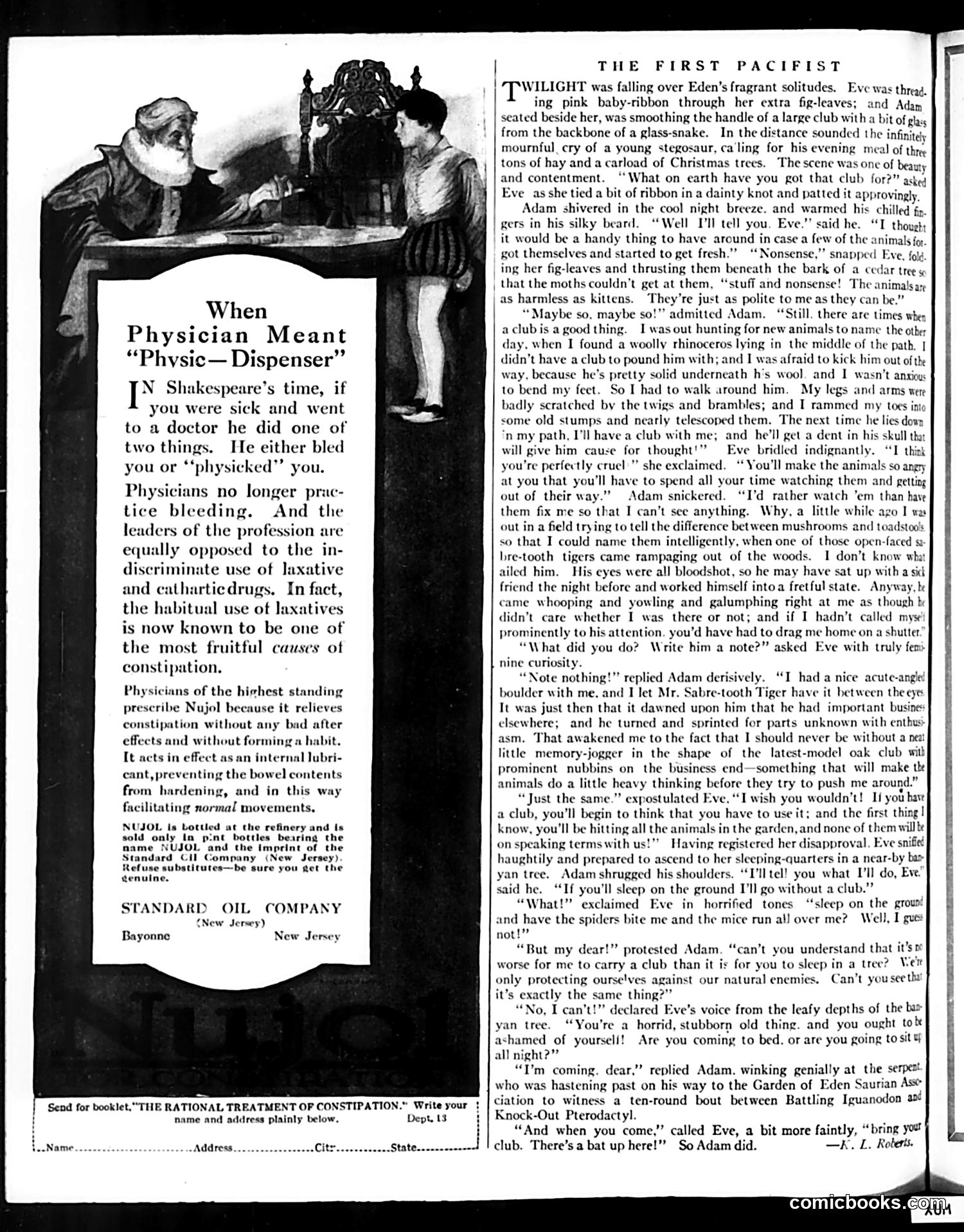
This page contains two distinct pieces: **Left side:** A Nujol laxative advertisement disguised as medical commentary. It criticizes outdated 17th-century medical practices (bloodletting, aggressive "physicking") to promote mineral oil as a modern, habit-free constipation remedy. The satirical framing mocks old medicine while selling a product. **Right side:** "The First Pacifist," a humorous story about Adam and Eve debating whether tools/weapons are necessary. Eve argues animals are harmless; Adam counters with practical examples of dangerous wildlife encounters where a club would have helped. The satire targets pacifism and idealism by showing them impractical against actual threats—likely a commentary on 1910s-era peace movements versus real-world dangers. The figure illustrations show a couple in period dress engaged in domestic discussion, though specific identities aren't marked as caricatures of real people.
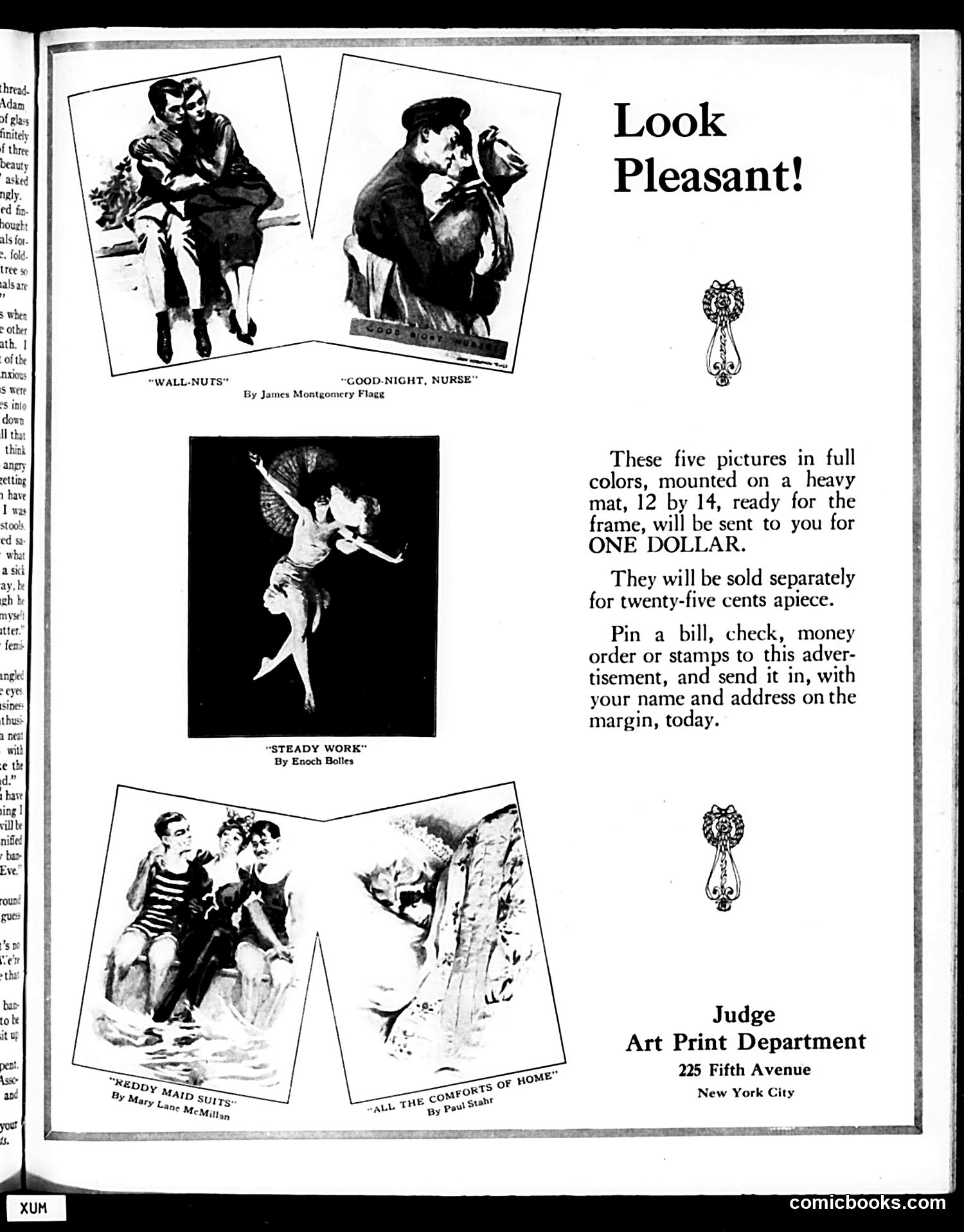
This is primarily an **advertisement** for art prints rather than political satire. Judge's Art Print Department offers five illustrated prints by notable artists of the era (James Montgomery Flagg, Enoch Boltes, Paul Stahr, and Mary Lane McMilkin) for sale. The images depict **domestic and romantic scenes typical of early 20th-century illustration**: couples embracing, a woman at leisure, people socializing, and domestic comfort. The titles—"Wall-Nuts," "Good-Night Nurse," "Steady Work," "Reddy Maid Suits," and "All the Comforts of Home"—reference everyday life and courtship humor. There is **no evident political or satirical content**. This represents Judge functioning as a commercial vehicle: the magazine published humorous artwork and sold reproductions to readers. The pricing ($1 complete set or 25 cents individually) and ordering instructions indicate standard mail-order merchandising of the period.

This is a **commercial advertisement**, not political satire. It promotes Postum, a caffeine-free grain beverage marketed as a coffee substitute. The circular design reads "HEALTH FIRST" around the outer ring, with "Drink POSTUM" and the slogan "There's a Reason" at center. The 1918 copyright by Postum Cereal Co. suggests this ran during World War I, when coffee was rationed or discouraged for health/patriotic reasons. The "health first" messaging reflects period wellness concerns and wartime conservation messaging. Postum's famous marketing slogan "There's a Reason" emphasized that avoiding caffeine was a smart, health-conscious choice—a common advertising approach of the era positioning the product as modern, scientific, and beneficial.