
Judge, 1916-12-23 · page 7 of 32
Judge — December 23, 1916 — page 7: what you’re looking at
What you’re looking at
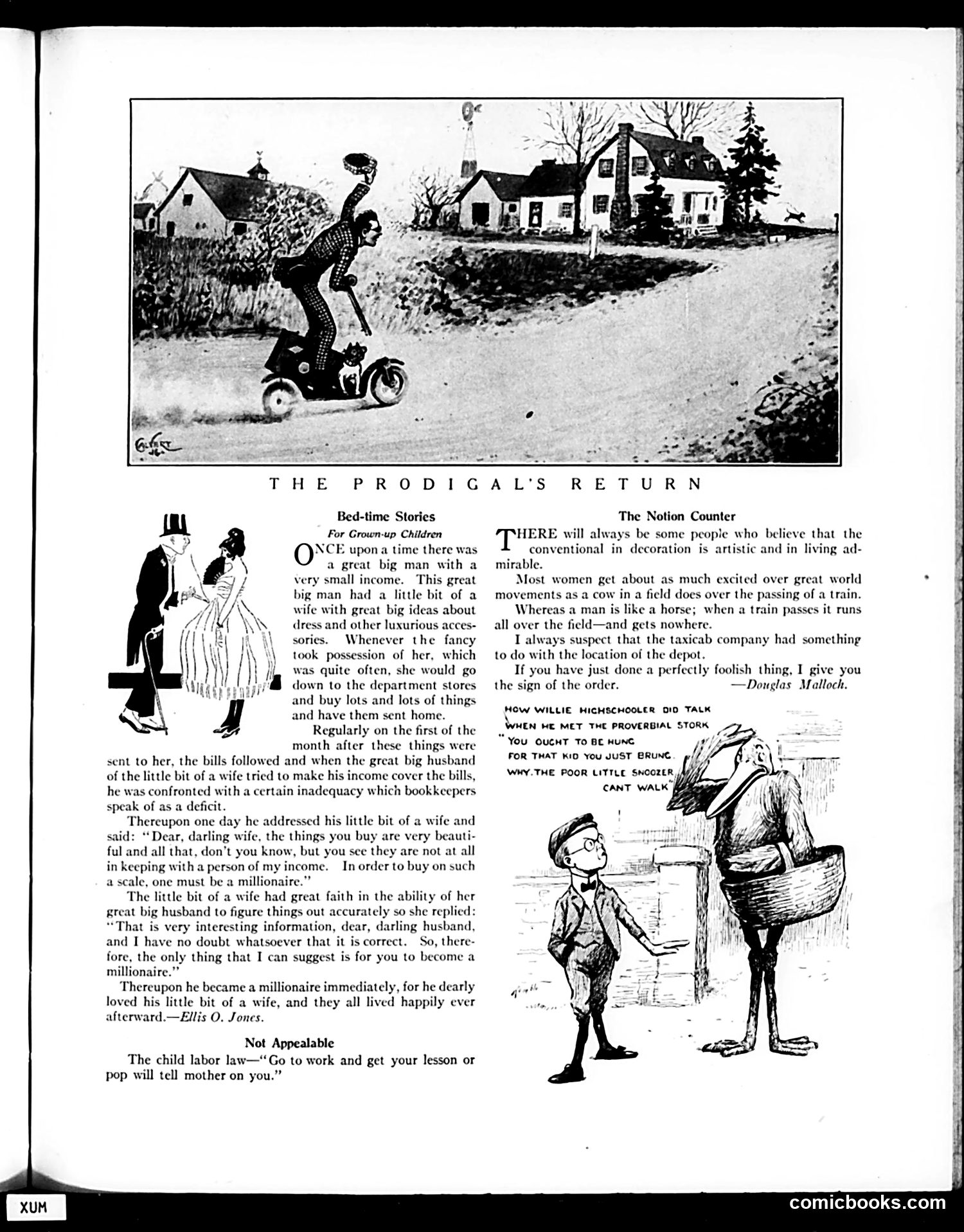
**Top Illustration ("The Prodigal's Return"):** Shows a man on an early motorized scooter/motorcycle returning to a rural homestead. This appears to be a visual metaphor for modernization intruding on traditional countryside life. **"Bed-time Stories" (Left):** A satirical fairy tale about marital finances. A wealthy-looking wife continuously overspends on luxuries while her "great big man" husband struggles with insufficient income. When she suggests he simply "become a millionaire," he does so immediately. The satire targets: (1) frivolous female consumerism and shopping habits, (2) the assumed financial incompetence of wives, and (3) the era's gender dynamics around household spending. It's presented as humorous fantasy. **"The Notion Counter" (Right):** Social commentary dismissing women's interest in "world movements," comparing them unfavorably to men's engagement (even if ultimately futile). Includes a brief joke about a high schooler meeting a newborn, making crude observations about the baby's physical abilities. **Overall tone:** Early 20th-century satirical commentary on gender roles, consumerism, and social conventions, typical of Judge magazine's satirical approach.
📄 Transcribed text from this page (OCR, searchable)
Machine-transcribed from the original scan — historical spelling and the odd misread are preserved.
HE Bed-time Stories For Grown-up Children ONCE upon a time there was a great big man with a very small income. This great big man had a little bit of a wife with great big ideas about dress and other luxurious acces- sori Whenever the fancy took possession of her, which was quite often, she would go down to the department stores and buy lots and lots of things and have them sent home. Regularly on the first of the month after these things were sent to her, the bills followed and when the great big husband of the little bit of a wife tried to make his income cover the bills, he was confronted with a certain inadequacy which bookkcepers speak of as a deficit. Thereupon one day he addressed his little bit of a wife and said: “Dear, darling wife, the things you buy are very beauti- ful and all that, don’t you know, but you sce they are not at all in keeping with a person of my income. In order to buy on such a scale, one must be a millionaire.” The little bit of a wife had great faith in the ability of her big husband to figure things out accurately so she replied: “That is very interesting information, dear, darling husband, and I have no doubt whatsoever that it is correct. So, there- fore, the only thing that I can suggest is for you to become a millionaire.” Thereupon he became a millionaire immediately, for he dearly loved his little bit of a wife, and they all lived happily ever afterward.—Ellis O. Jones. Not Appealable The child labor law—‘‘Go to work and get your lesson or pop will tell mother on you.” PRODIGAL'S RETURN The Notion Counter HERE will always be some people who believe that the conventional in decoration is artistic and in living ad- mirable. Most women get about as much excited over great world movements as a cow in a ficld does over the passing of a train. Whereas a man is like a horse; when a train passes it runs all over the field—and gets nowhere. T always suspect that the taxicab company had something to do with the location of the depot. If you have just done a perfectly foolish thing, I give you the sign of the order. —Douglas Malloch. HOW WILLIE HICHSCHOOLER O10 TALK WHEN ME MET THE PROVERBIAL STORK “You OUCHT To BE KUNG fy FOR THAT KID You JUST ERUNG WHY.THE POOR LITTLE SNCOZER,, CANT WALK’ comicbooks.com