
Judge, 1916-12-23 · page 19 of 32
Judge — December 23, 1916 — page 19: what you’re looking at
What you’re looking at
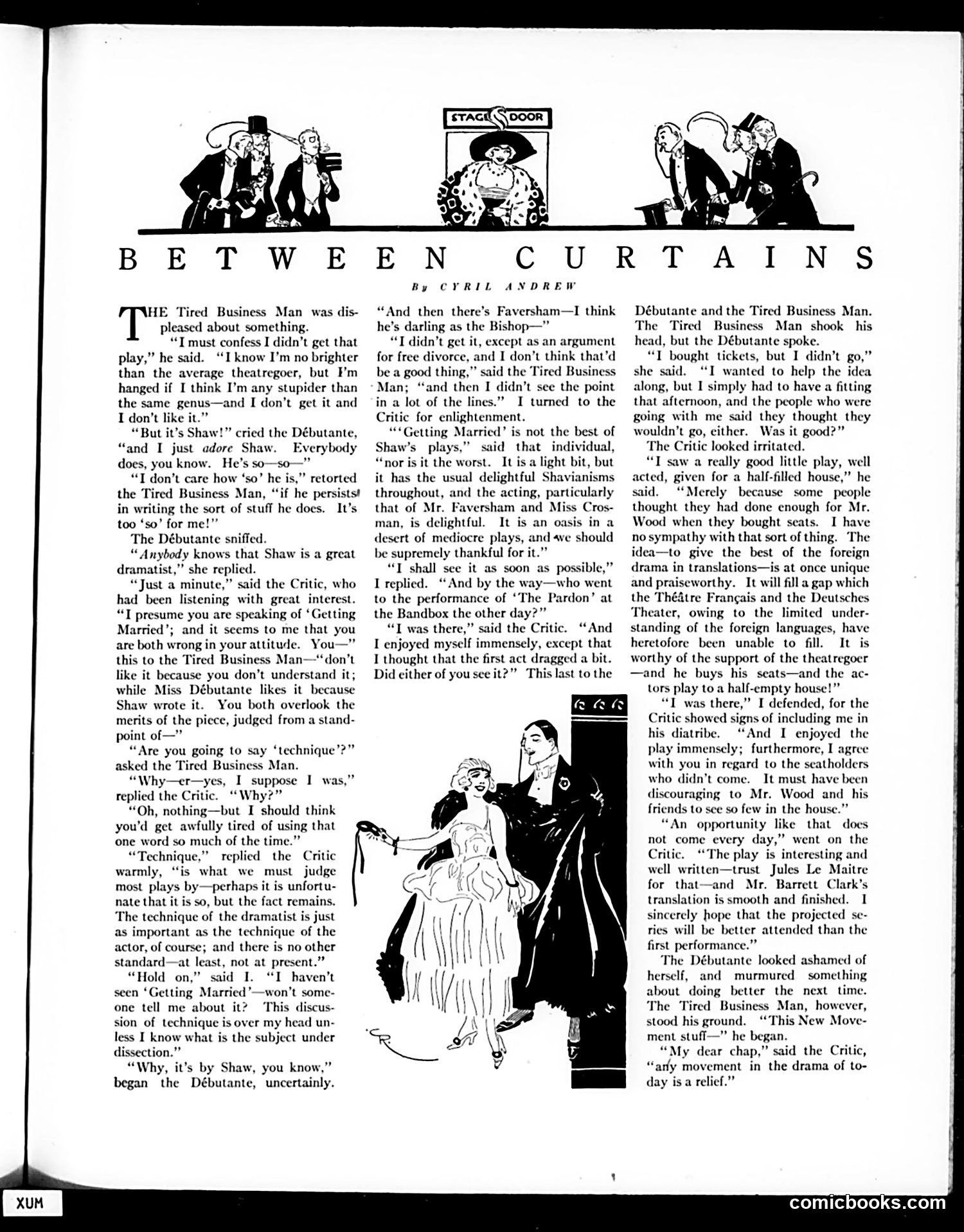
This is a theatrical satire featuring three stock characters debating a Shaw play ("Getting Married"): a philistine **Tired Business Man** who finds it incomprehensible; a pretentious **Débutante** who admires Shaw simply because he's fashionable; and a self-important **Critic** who judges all drama by "technique"—a word he uses so reflexively that the Tired Business Man mocks it. The satire targets early 20th-century theater culture: the snobbish gatekeeping around modernist dramatists, the shallow enthusiasm of society women, and critics' reliance on jargon over actual aesthetic judgment. The Critic also criticizes audiences for buying tickets to experimental theater (like translations at the Théâtre Français) without attending, undermining artistic ventures through performative support rather than genuine engagement. The humor lies in exposing pretension across all three types of theatergoer.
📄 Transcribed text from this page (OCR, searchable)
Machine-transcribed from the original scan — historical spelling and the odd misread are preserved.
BE TWE HE Tired Business Man was dis- T pleased about something. “I must confess I didn’t get that play,” he said. ‘‘I know I’m no brighter than the average theatregoer, but ’'m hanged if I think I’m any stupider than the same genus—and I don’t get it and I don’t like it “But it’s Shaw!” cried the Débutante, “and I just adore Shaw. Everybody does, you know. He’s -" “T don’t care how ‘so’ he is,” retorted the Tired Business Man, “if he persists! in writing the sort of stuff he does. It’s too ‘so’ for me!”” The Débutante sniffed. “ Anybody knows that Shaw is a great dramatist,” she replied. “Just a minute,” said the Critic, who had been listening with great interest. “T presume you are speaking of ‘Getting Married’; and it seems to me that you are both wrong in your attitude. You—" this to the Tired Business Man—don’t like it because you don’t understand it; while Miss Débutante likes it because Shaw wrote it. You both overlook the merits of the piece, judged from a stand- point of—” “Are you going to say ‘technique’?” asked the Tired Business Man. “Why—er—y I suppose I was,” replied the Critic. “Why?” “Oh, nothing—but I should think you'd get awfully tired of using that one word so much of the time.” “Technique,” replied the Critic warmly, “is what we must judge most plays by—perhaps it is unfortu- nate that it is so, but the fact remains. The technique of the dramatist is just as important as the technique of the actor, of course; and there is no other standard—at least, not at present.” “Hold on,” said I. “I haven't seen ‘Getting Married’—won't some- one tell me about it? his discus- sion of technique is over my head un- less I know what is the subject under dissection.” “Why, it’s by Shaw, you know,” began the Débutante, uncertainly. E N By CYRIL ANDREW “And then there’s Faversham—I think he’s darling as the Bishop—”’ “T didn’t get it, except as an argument for free divorce, and I don’t think that'd be a good thing,” said the Tired Business Man; “and then I didn’t see the point in a lot of the lines.” I turned to the Critic for enlightenment. “*Getting Married’ is not the best of Shaw’s plays,” said that individual, “nor is it the worst. It is a light bit, but it has the usual delightful Shavianisms throughout, and the acting, particularly that of Mr. versham and M Cros- man, is delightful. It is an oasis in a desert of mediocre plays, and ave should be supremely thankful for it.”” “T shall see it as soon as possible,” I replied. “And by the way—who went to the performance of ‘The Pardon’ at the Bandbox the other day?” “T was there,” said the Critic. “And I enjoyed myself immensely, except that I thought that the first act dragged a bit. Did either of you see it?” This last to the CURTAINS Débutante and the Tired Business Man. The Tired Business Man shook his head, but the Débutante spoke. “I bought tickets, but I didn’t go,” she said. “I wanted to help the idea along, but I simply had to have a fitting that afternoon, and the people who were going with me said they thought they wouldn’t go, cither. Was it good?” The Critic looked irritated. “T saw a really good little play, well acted, given for a half-filled house,” he said. “Merely because some people thought they had done enough for Mr. Wood when they bought seats. I have no sympathy with that sort of thing. The idea—to give the best of the foreign drama in translations—is at once unique and praiseworthy. It will fill a gap which the ThéAtre Frangais and the Deutsches Theater, owing to the limited under- standing of the foreign languages, have heretofore been unable to fill. It is worthy of the support of the theatregoer —and he buys his seats—and the ac- tors play to a half-empty house!” “T was there,” I defended, for the Critic showed signs of including me in his diatribe. nd I enjoyed the play immensely; furthermore, I agree with you in regard to the seatholders who didn’t come. It must have been discouraging to Mr. Wood and his friends to sce so few in the house.” “An opportunity like that does not come every day,”’ went on the Critic. “The play is interesting and well written—trust Jules Le Maitre for that—and Mr. Barrett Clark's translation is smooth and finished. 1 sincerely hope that the projected se- ries will be better attended than the first performance.” The Débutante looked ashamed of herself, and murmured something about doing better the next time. The Tired Business Man, however, stood his ground. “This New Move- ment stuff—” he began. “My dear chap,” said the Critic, “any movement in the drama of to- day isa relief.” comicbooks.com