
Judge, 1916-12-23 · page 14 of 32
Judge — December 23, 1916 — page 14: what you’re looking at
What you’re looking at
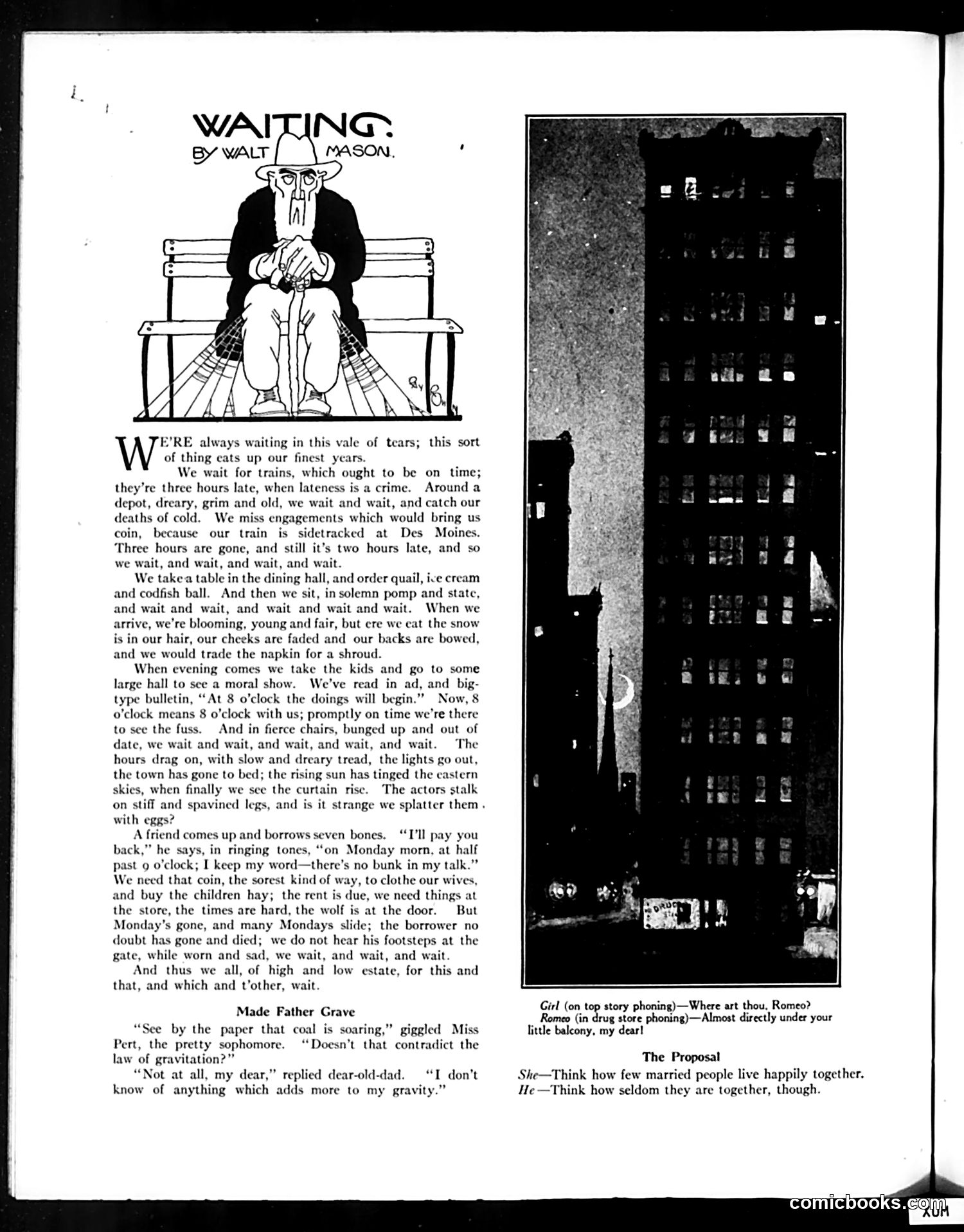
This is a humorous poem satirizing the universal frustration of waiting—for late trains, restaurant service, theatrical performances, and borrowed money repayment. Mason catalogs the mundane miseries of everyday life: a train sidetracked in Des Moines leaving passengers stranded for hours, a fancy dinner that becomes pointless after such delays, an evening show that starts hours behind schedule, and a friend who borrows money promising repayment "Monday" but never returns. The cartoon's central figure—an elderly man hunched on a bench—embodies this exhaustion. The satire targets not politics but modern life's unreliability: transportation failures, broken promises, and institutional inefficiency that waste citizens' time and money while they wait helplessly. The repetitive "wait and wait" refrain emphasizes the grinding, inescapable nature of these delays across social classes ("high and low estate").
📄 Transcribed text from this page (OCR, searchable)
Machine-transcribed from the original scan — historical spelling and the odd misread are preserved.
rs. t for trains, which ought to be on time; they’re three hours late, when lateness is a crime. Around a depot, dreary, grim and old, we wait and wait, and catch our deaths of cold. We miss engagements which would bring us coin, because our train is sidetracked at Des Moines. Three hours are gone, and still it’s two hours late, and so we wait, and wait, and wait, and wait. We takea table in the dining hall, and order quail, ice cream and codfish ball. And then we sit, in solemn pomp and state, d wait and wait, and wait and wait and wait. When we arrive, we're blooming, young and fair, but ere we eat the snow is in our hair, our cheeks are faded and our backs are bowed, and we would trade the napkin for a shroud. When evening comes we take the kids and go to some large hall to see a moral show. We've read in ad, and big- type bulletin, “At 8 o’clock the doings will begin.” Now, 8 o'clock means 8 o'clock with us; promptly on time we're there to see the fuss. And in fierce chairs, bunged up and out of date, we wait and wait, and wait, and wait, and wait. The hours drag on, with slow and dreary tread, the lights go out, the town has gone to bed; the rising sun has tinged the eastern es, when finally we sce the curtain rise. The actors stalk on stiff and s ned legs, and is it strange we splatter them . with eggs? A friend comes up and borrows seven bones. “I'll pay you back,” he says, in ringing tones, ‘ton Monday mom, at half past 9 o'clock; I keep my word—there's no bunk in my talk.” We need that coin, the sorest kind of way, to clothe our wives, and buy the children hay; the rent is due, we need things at the store, the times are hard, the wolf the door. But Monday’s gone, and many Mondays slide; the borrower no doubt has gone and died; we do not hear his footsteps at the gate, while worn and sad, we wait, and wait, and wait And thus we all, of high and low estate, for this and that, and which and t’other, wait. Made Father Grave “See by the paper that coal is soaring,” giggled Miss Pert, the pretty sophomore. ‘Doesn't that contradict the law of gravitation?” ‘ot at all, my dear,” replied dear-old-dad. “I don’t know of anything which adds more to my gravity.” Girl (on top story phoning)—Where art thou, Romeo? oe 4 Romeo (in drug store phoning)—Almost directly under your little balcony, my dear! The Proposal She—Think how few married people live happily together. He—Think how seldom they are together, though.