
Judge, 1916-12-23 · page 15 of 32
Judge — December 23, 1916 — page 15: what you’re looking at
What you’re looking at
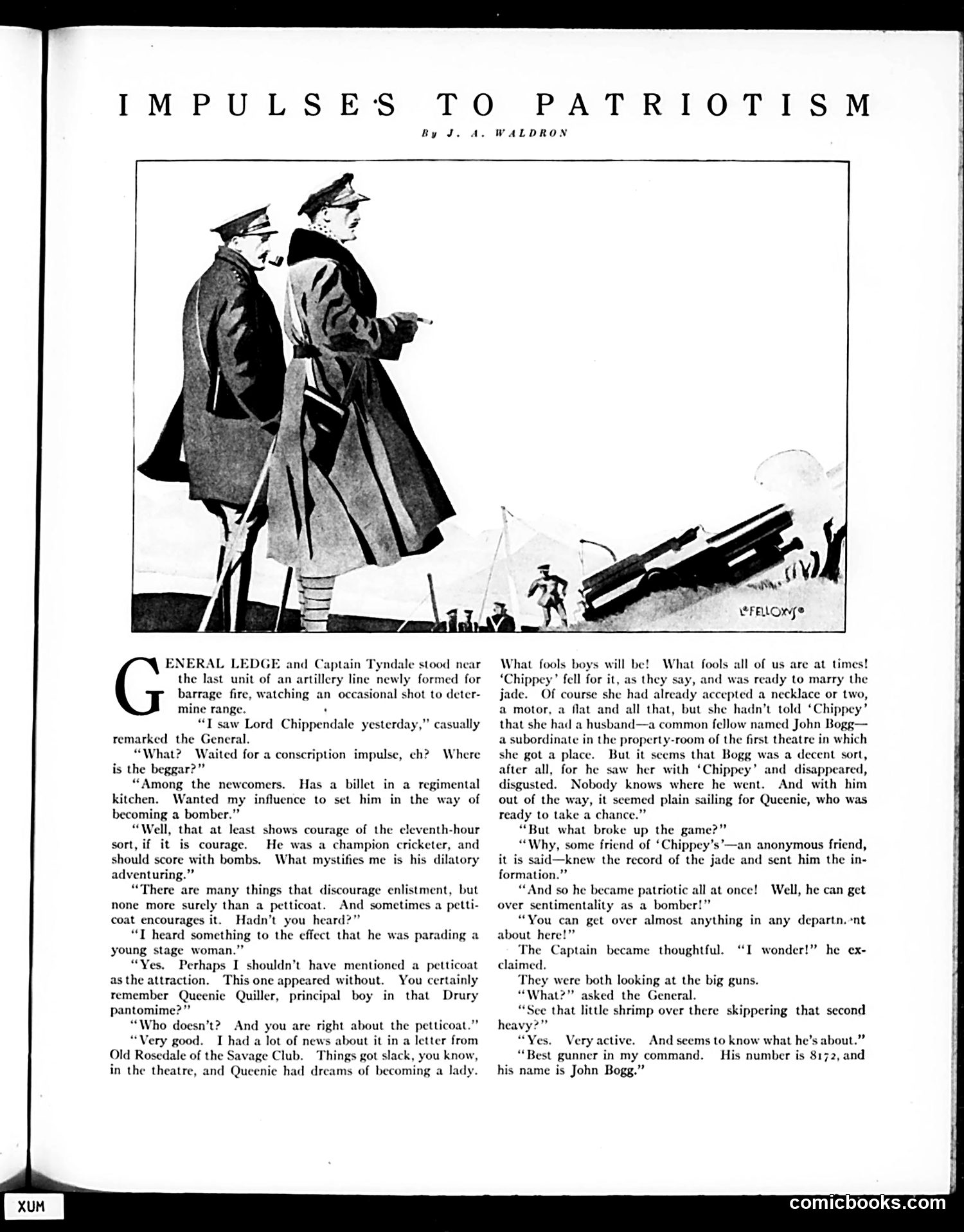
This story satirizes motivations for military enlistment during WWI. General Ledge and Captain Tyndale discuss Lord Chippendale, a wealthy cricketer who delayed enlisting until recently—prompted not by patriotism but by romantic betrayal. Chippendale nearly married Queenie Quiller, a stage actress with a hidden past: she was already married to John Bogg, a theater stagehand. When an anonymous informant revealed her deception, Chippendale's romantic illusions shattered, driving him to enlist as a bomber—motivated by wounded pride rather than duty. The irony: Bogg, the "common" subordinate, proves the truly honorable man (leaving quietly rather than competing), and now serves as Chippendale's superior officer—"the best gunner" in the unit. The satire mocks how personal disappointment, not patriotic impulse, drives enlistment, while suggesting that genuine character transcends social class.
📄 Transcribed text from this page (OCR, searchable)
Machine-transcribed from the original scan — historical spelling and the odd misread are preserved.
IMPULSES TO PATRIOTISM By J. A. WALDRON ENERAL LEDGE and Captain Tyndale stood near the last unit of an artillery line newly formed for barrage fire, watching an occasional shot to deter- mine range. . “T saw Lord Chippendale yesterday,” casually remarked the General. “What? Waited for a conscription impulse, ch? is the beggar?” “Among the newcomers. Has a billet in a regimental kitchen. Wanted my influence to set him in the way of becoming a bomber.” “Well, that at least shows courage of the eleventh-hour sort, if it is courage. He was a champion cricketer, and should score with bombs. What mystifies me is his dilatory adventuring.” “There are many things that discourage enlistment, but none more surely than a petticoat. And sometimes a petti- coat encourages it. Hadn't you heard?” “T heard something to the effect that he was parading a young stage woman.”” “Yes. Perhaps I shouldn’t have mentioned a petticoat asthe attraction. This one appeared without. You certainly remember Queenie Quiller, principal boy in that Drury pantomime?” “Who doesn’t? And you are right about the petticoat. “Very good. I had a lot of news about it in a letter from Old Rosedale of the Savage Club. Things got slack, you know, in the theatre, and Queenie had dreams of becoming a lady. Where FELONS® What fools all of us are at times! hippey’ fell for it, as they say, and was ready to marry the jade. Of course she had already accepted a necklace or two, a motor, a flat and all that, but she hadn’t told ‘Chippey’ that she had a husband—a common fellow named John Bogg— a subordinate in the property-room of the first theatre in which she got a place. But it seems that Bogg was a decent sort, after all, for he saw her with ‘Chippey’ and disappeared, disgusted. Nobody knows where he went. And with him out of the way, it seemed plain sailing for Queenic, who was ready to take a chance.” “But what broke up the game?” “Why, some friend of ‘Chippey’s’—an anonymous friend, it is said—knew the record of the jade and sent him the in- formation.” “And so he became patriotic all at once! over sentimentality as a bomber!” “You can get over almost anything in any departn.-nt about here!” The Captain became thoughtful. “I claimed. They were both looking at the big guns. What?” asked the General. ee that little shrimp over there skippering that second What fools boys will be! Well, he can get wonder!” he ex- And seems to know what he’s about.” Very active. His number is 8172, and “Best gunner in my command. his name is John Bogg.” comicbooks.com