
Judge, 1916-12-23 · page 18 of 32
Judge — December 23, 1916 — page 18: what you’re looking at
What you’re looking at
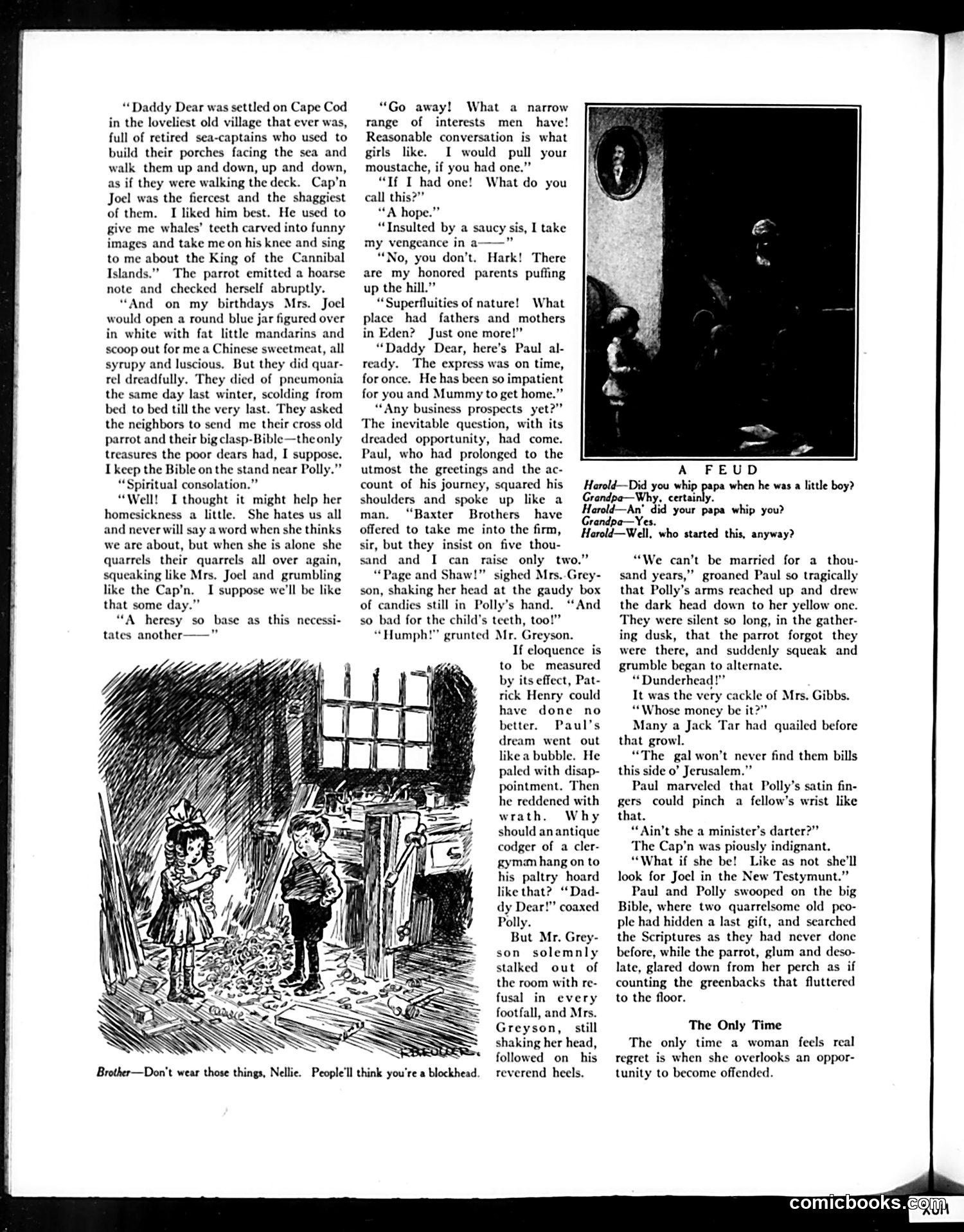
This page contains two distinct satirical pieces lampooning middle-class social conventions circa early 1900s. The main story mocks sentimental storytelling and parental disapproval of romance. A young woman (Polly) tells a long, emotionally manipulative tale about deceased Cape Cod sea-captains to justify keeping their querulous parrot. When her suitor Paul seeks her father's approval for marriage—needing funds to join a business—the clergyman father refuses coldly, crushing Paul's hopes. The satire targets both excessive Victorian sentimentality and fathers' financial gatekeeping over their daughters' futures. The lower cartoon, "A Feud," humorously depicts cyclical domestic conflict: children ask their grandparents who started family quarrels, tracing blame backward through generations with no clear origin—suggesting feuds perpetuate absurdly through inertia rather than justified cause. The small dialogue at bottom mocks narrow male interests and women's intellectual aspirations, suggesting contemporary gender role friction.
📄 Transcribed text from this page (OCR, searchable)
Machine-transcribed from the original scan — historical spelling and the odd misread are preserved.
“Daddy Dear was settled on Cape Cod in the loveliest old village that ever was, full of retired sea-captains who used to build their porches facing the sea and walk them up and down, up and down, as if they were walking the deck. Cap'n Joel was the fiercest and the shaggiest of them. I liked him best. He used to give me whales’ tecth carved into funny images and take me on his knee and sing to me about the King of the Cannibal Islands.” The parrot emitted a hoarse note and checked herself abruptly. “And on my birthdays Mrs. Joel would open a round blue jar figured over in white with fat little mandarins and scoop out for me a Chinese sweetmeat, all syrupy and luscious. But they did quar- rel dreadfully. They died of pneumonia the same day last winter, scolding from bed to bed till the very last. They asked the neighbors to send me their cross old parrot and their big clasp-Bible—theonly treasures the poor dears had, I suppose. I keep the Bible on the stand near Polly.” “Spiritual consolation.” “Well! I thought it might help her homesickness a little. She hates us all and never will say a word when she thinks we are about, but when she is alone she quarrels their quarrels all over again, squeaking like Mrs. Joel and grumbling like the Cap'n. I suppose we'll be like that some day.” “A heresy so base as this necessi- tates another——" Brother—Don't wear those things, Nellie. People’ll think you're a blockhead. “Go away! What a narrow range of interests men have! Reasonable conversation is what girls like. I would pull your moustache, if you had one.” “If I had one! What do you call this?” “A hope.” “Insulted by a sauc: my vengeance in a— “No, you don’t. Hark! There are my honored parents puffing up the hill.” “Superfluities of nature! What place had fathers and mothers in Eden? Just one more!” “Daddy Dear, here’s Paul al- ready. The express was on time, for once. He has been so impatient for youand Mummy to get home.” “‘Any business prospects yet?” The inevitable question, with its dreaded opportunity, had come. Paul, who had prolonged to the utmost the greetings and the ac- count of his journey, squared his shoulders and spoke up like a man. “Baxter Brothers have offered to take me into the firm, sir, but they insist on five thou- sand and I can raise only two. “Page and Shaw!” sighed Mrs..Grey- son, shaking her head at the gaudy box of candies still in Polly’s hand. “And so bad for the child’s teeth, too!” “Humph!” grunted Mr. Greyson. If eloquence is to be measured by its effect, Pat- rick Henry could have done no better. Paul’s dream went out like a bubble. He paled with disap- pointment. Then he reddened with wrath. Why should anantique codger of a cler- gymam hang on to his paltry hoard like that? “‘Dad- dy Dear!” coaxed Polly. But Mr. Grey- son solemnly stalked out of the room with re- fusal in every footfall, and Mrs. Greyson, still shaking her head, followed on his reverend heels. is, I take A FEUD Harold—Did you whip papa when he was a little boy? Grendpo- Why, cera 3 ” d—An’ did your papa whip you? Grandpa—Yes. Harold—Well, who started this, anyway? “We can’t be married for a thou- sand years,” groaned Paul so tragically that Polly’s arms reached up and drew the dark head down to her yellow one. They were silent so long, in the gather- ing dusk, that the parrot forgot they were there, and suddenly squeak and grumble began to alternate. “Dunderhead!”” It was the very cackle of Mrs. Gibbs. “Whose money be it?” Many a Jack Tar had quailed before that growl. “The gal won’t never find them bills this side o’ Jerusalem.” Paul marveled that Polly’s satin fin- gers could pinch a fellow’s wrist like that. “‘Ain’t she a minister’s darter?” The Cap'n was piously indignant. “What if she be! Like as not she'll look for Joel in the New Testymunt.” Paul and Polly swooped on the big Bible, where two quarrelsome old pco- ple had hidden a last gift, and searched the Scriptures as they had never done before, while the parrot, glum and deso- late, glared down from her perch as if counting the greenbacks that fluttered to the floor. The Only Time The only time a woman feels real regret is when she overlooks an oppor- tunity to become offended. comicbooks.