
A complete issue · 28 pages · 1916
Judge — August 26, 1916
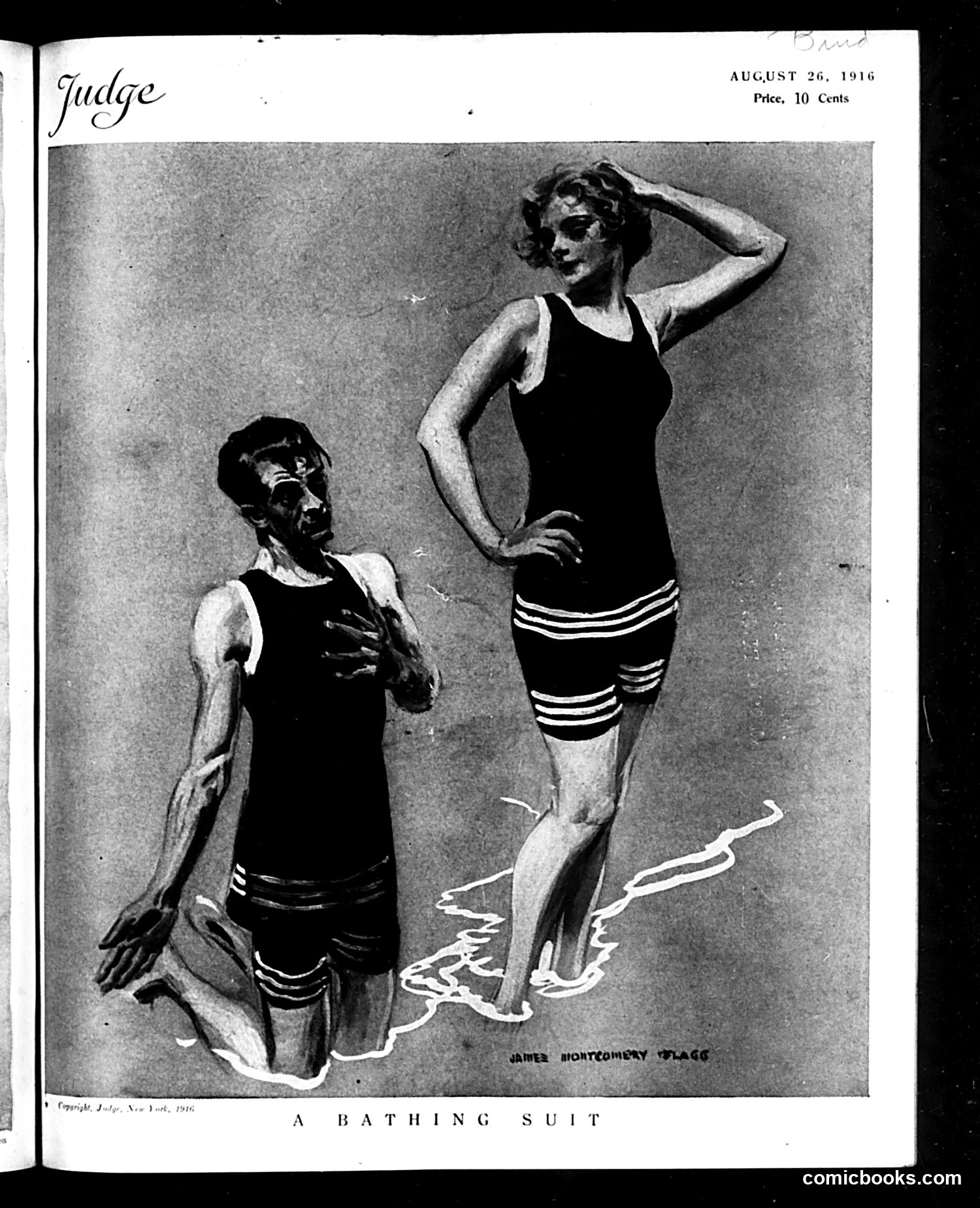
This illustration by James Montgomery Flagg depicts two figures in swimwear standing in water, apparently comparing their bathing suits. The cartoon appears to satirize changing fashion standards for swimwear during the 1910s, when women's bathing costumes were becoming increasingly abbreviated and form-fitting—a source of social controversy and debate. The contrast between the two figures suggests commentary on evolving attitudes toward acceptable beachwear. The woman's more streamlined, shorter suit with horizontal stripes represents modern style, while the man's fuller coverage may represent traditional conventions. The satire likely mocks either prudish resistance to fashion change or the absurdity of the ongoing debate over women's modest beachwear during this period.
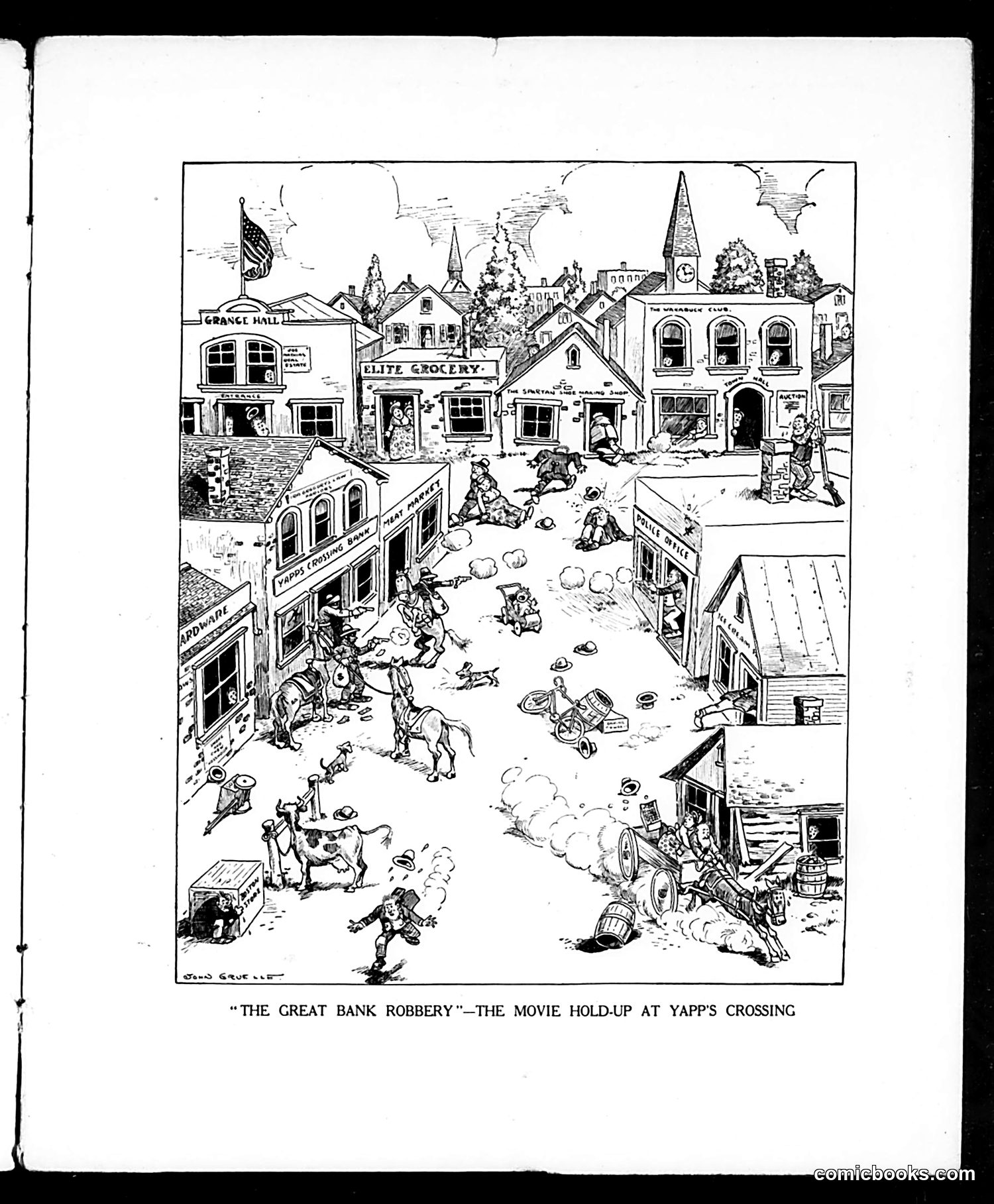
This satirical cartoon depicts a chaotic street scene labeled as a movie production hold-up at "Yapp's Crossing." The illustration shows a small-town main street with various buildings—a Grange Hall, Elite Grocery, and church—surrounded by numerous people, horses, and film equipment in disarray. The satire appears to mock the disruption caused by film productions coming to small towns. The title's phrase "movie hold-up" is a pun: rather than a bank robbery, it's a film shoot (likely of a Western or crime drama) that has figuratively "held up" or disrupted normal town life. The crowded, anarchic scene emphasizes how moviemaking operations overtook and overwhelmed quiet rural communities during the silent film era.
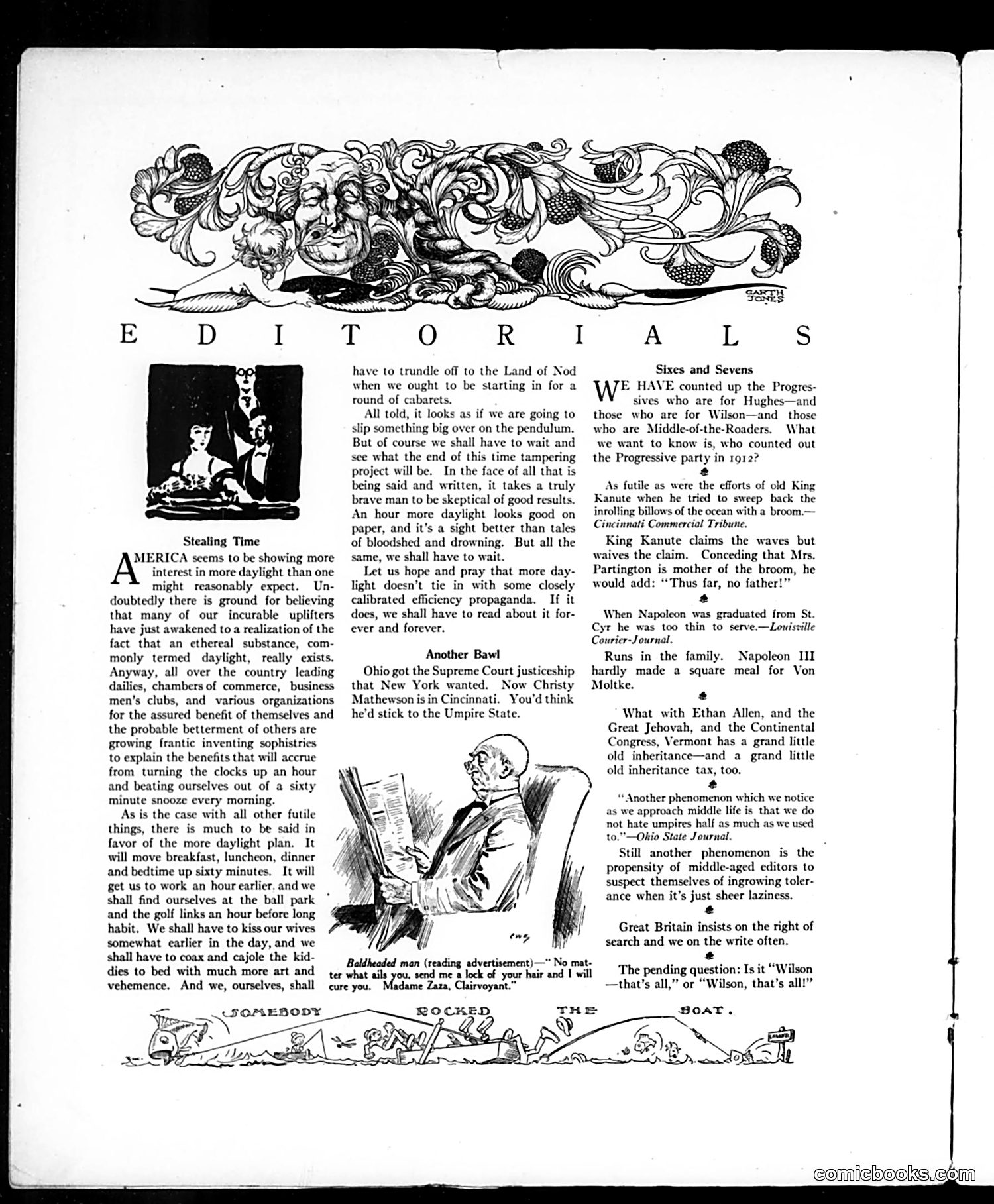
This editorial page contains three distinct pieces: 1. **"Stealing Time"** - A critique of daylight saving time. The author argues skeptically that the proposed time shift won't deliver promised efficiency gains, calling it "futile" propaganda. The piece expresses doubt about whether moving clocks will actually save fuel or improve productivity. 2. **"Sixes and Sevens"** - Political commentary questioning which Progressive candidates the magazine should support in an upcoming election (appears to reference 1917 politics, though unclear which specific race). 3. **"Another Bawl"** - Satirizes Ohio's Supreme Court justice appointment, mocking the rivalry between New York and other states' political systems. A cartoon depicts a "Bedside man" reading advertisements, with accompanying humor about advertising's persuasive power.
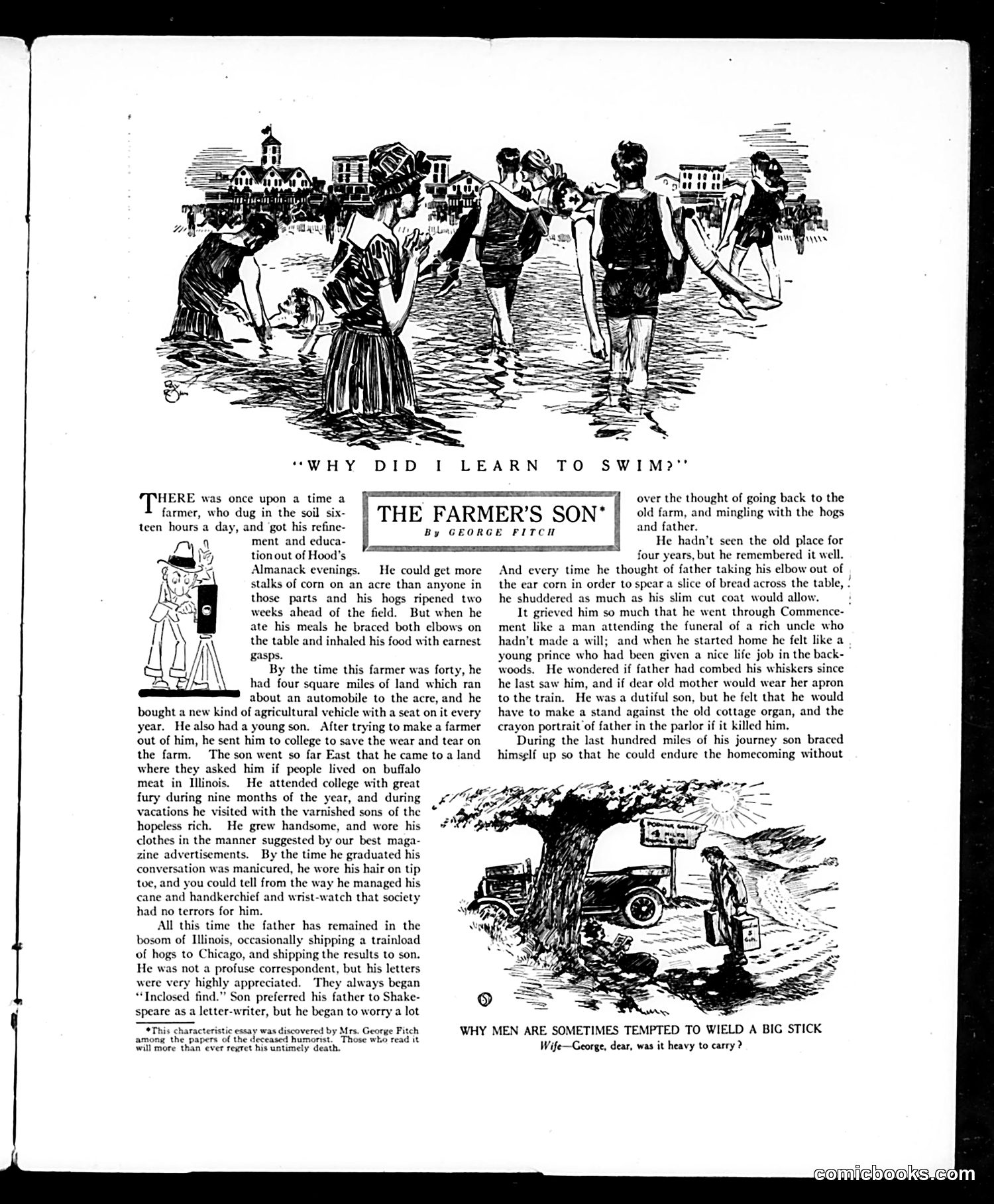
This story by George Pitch satirizes the tensions between rural and urban American life in the early 20th century. The farmer's son, educated away from home and exposed to urban sophistication, becomes embarrassed by his rural origins. He's ashamed of his father's farming life and manual labor—so much so that he literally hides when returning home. The bottom cartoon jokes about masculine pride: a wife asks her husband if a large stick is "heavy to carry," implying he's wielding it to prove his manhood rather than for practical purpose. The satire targets class anxiety and the perceived pretentiousness of educated youth who reject their humble backgrounds for cosmopolitan affectations.
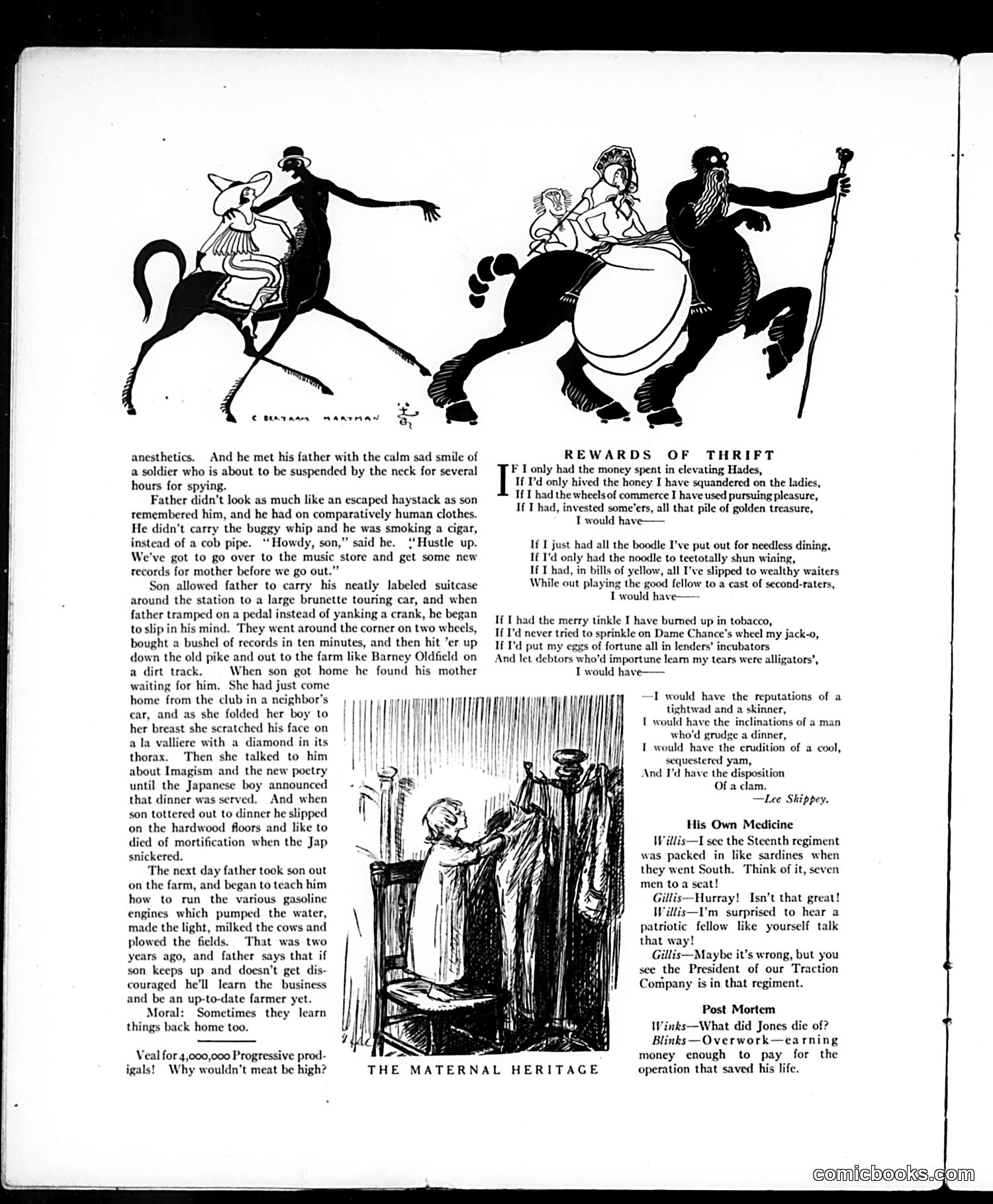
This page contains three separate satirical pieces mocking American social changes in the early 20th century. **"The Maternal Heritage"** (top cartoon): Depicts a son returning home from the city, shocked to find his rural parents have modernized. Father drives a motorcar, smokes cigars, and plays records; mother wears diamonds and discusses Imagism. The satire targets anxiety about rural America's rapid industrialization and cultural shifts—parents adopting urban sophistication, creating comic generational role-reversal. **"Rewards of Thrift"** (poem): Lee Shippey's verse sardonically lists all the money squandered on luxuries—dining, women, gambling, tobacco—then concludes that thrift would only earn him a reputation as a "tightwad." The joke critiques 1920s consumer culture: even virtuous restraint yields no reward in a society obsessed with spending and pleasure. **"His Own Medicine"** and **"Post Mortem"**: Brief satirical dialogues. The first mocks a businessman's hypocrisy about crowded conditions when his own company profits from them. The second darkly jokes about working oneself to death to afford life-saving surgery—commentary on economic hardship and exploitative labor conditions.
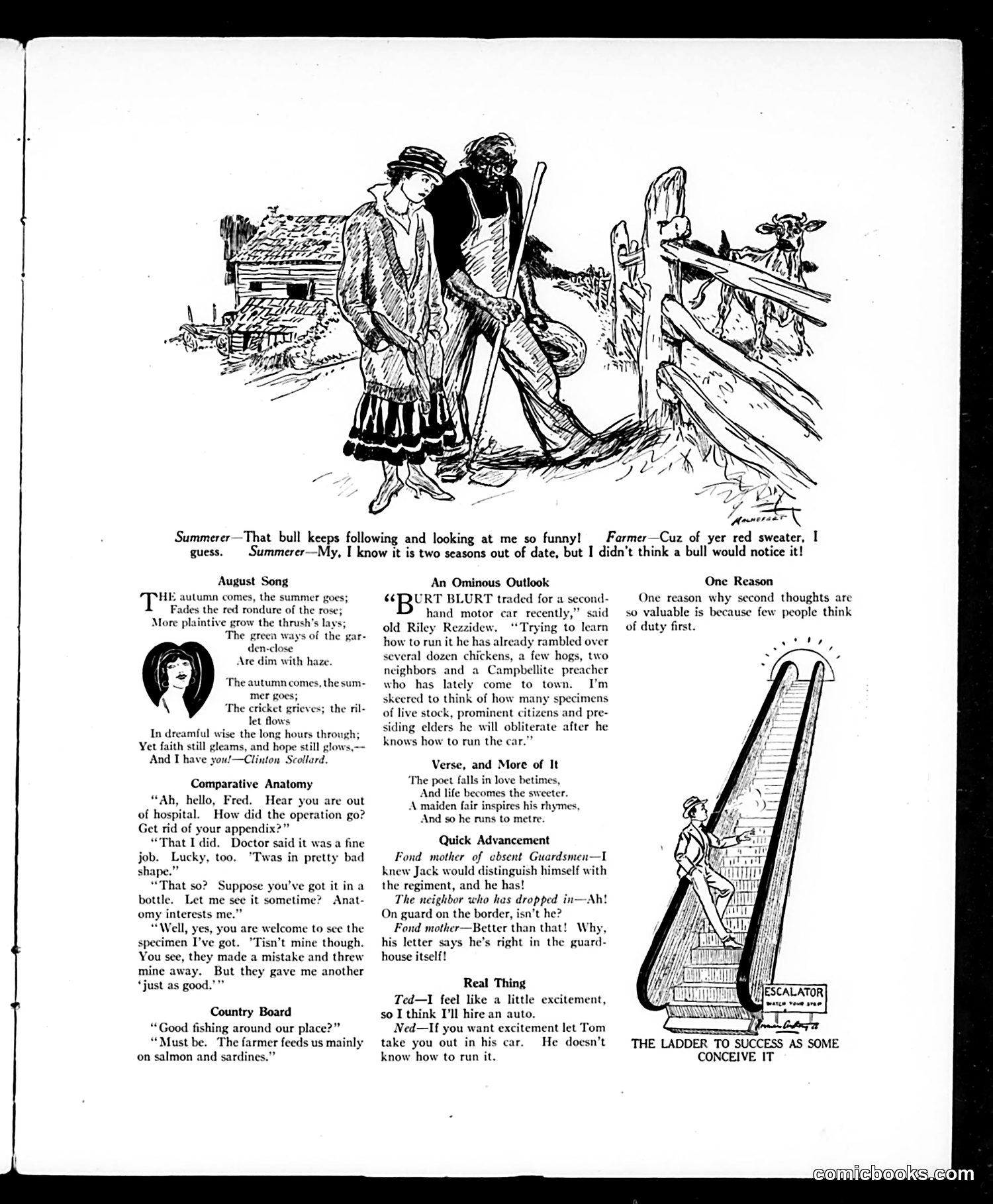
This Judge magazine page contains several short satirical pieces mocking early 1900s social anxieties: **Top cartoon:** A woman's outdated fashion (red sweater) amuses a bull—humor based on fashion consciousness and rural/urban divide. **"An Ominous Outlook":** Satirizes the dangerous incompetence of early automobile drivers. A man learning to drive has already killed livestock, neighbors, and a preacher. This reflects genuine public fear about automobiles as new, unpredictable technology threatening traditional rural life. **"Real Thing":** Similar auto anxiety—hiring a car for "excitement" is less thrilling than riding with someone who literally cannot drive, inverting normal logic. **"Quick Advancement":** Gentle military humor about a soldier's mother misunderstanding "guard duty" as prestigious when he's actually in the guardhouse (jail). **"Comparative Anatomy":** Dark hospital humor about surgical mix-ups with removed organs. The page reflects turn-of-the-century concerns: automobile danger, medical uncertainty, and changing social customs.
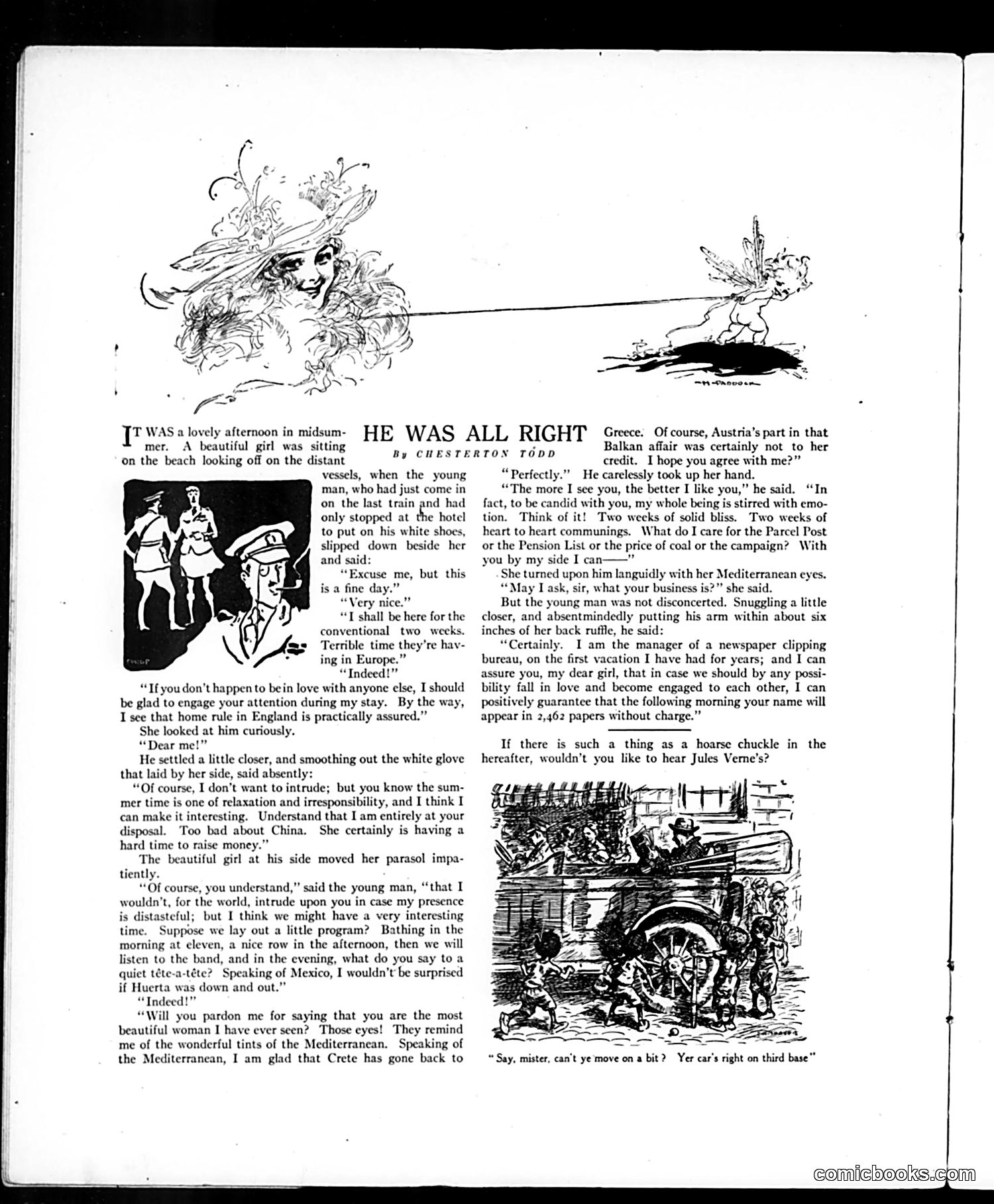
This satirical story mocks the vapid romantic pursuits of the Edwardian leisure class. A young man on vacation aggressively pursues a beautiful woman on a beach, constantly interrupting his romantic overtures with casual name-dropping of current political crises—Home Rule in England, trouble in China, Mexico's instability, the Balkan crisis, Crete's status. The joke is that he treats weighty geopolitical events as mere conversational garnish, utterly trivial compared to his vacation romance. His ultimate "selling point" reveals his true banality: he promises her newspaper fame by having her name appear in 2,462 papers if they become engaged—leveraging his job at a newspaper clipping bureau. The cartoon satirizes how affluent young men of the era used superficial worldliness and false emotional intensity to impress women, while remaining essentially self-absorbed and materialistic. His indifference to real-world suffering contrasts sharply with his manufactured passion.
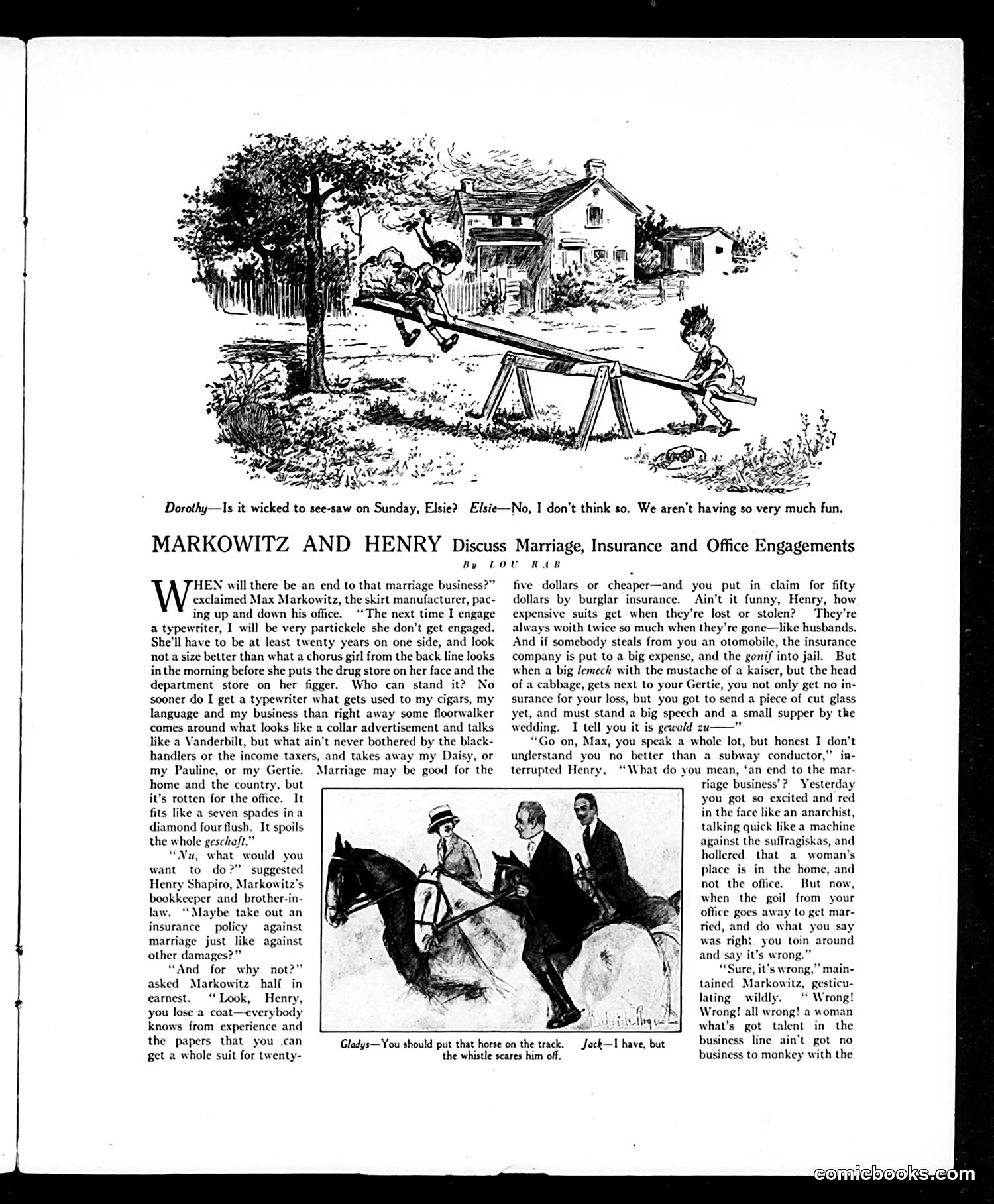
This page from *Judge* magazine contains two distinct pieces of humor: **The Seesaw Cartoon (top):** A simple joke about children on a seesaw. One girl asks if it's "wicked" to seesaw on Sunday (when religious observance traditionally restricted recreational activities). The punchline—"We aren't having so very much fun"—mocks the Puritan work ethic: the girls find the activity so dull it barely counts as enjoyment anyway. **"Markowitz and Henry" (main story):** A satirical dialogue between two Jewish businessmen (identifiable by names and Yiddish expressions like "geschaft" and "gonif") discussing marriage as an uninsurable loss. Markowitz complains that when employees marry, they leave unexpectedly—unlike stolen goods, which insurance covers. He sarcastically suggests "marriage insurance." The satire targets both: (1) turn-of-the-century gender anxieties about women in the workplace, and (2) the immigrant Jewish business community's practical, mercantile approach to life's problems. The humor relies on ethnic dialect and stereotypes common to *Judge's* era.
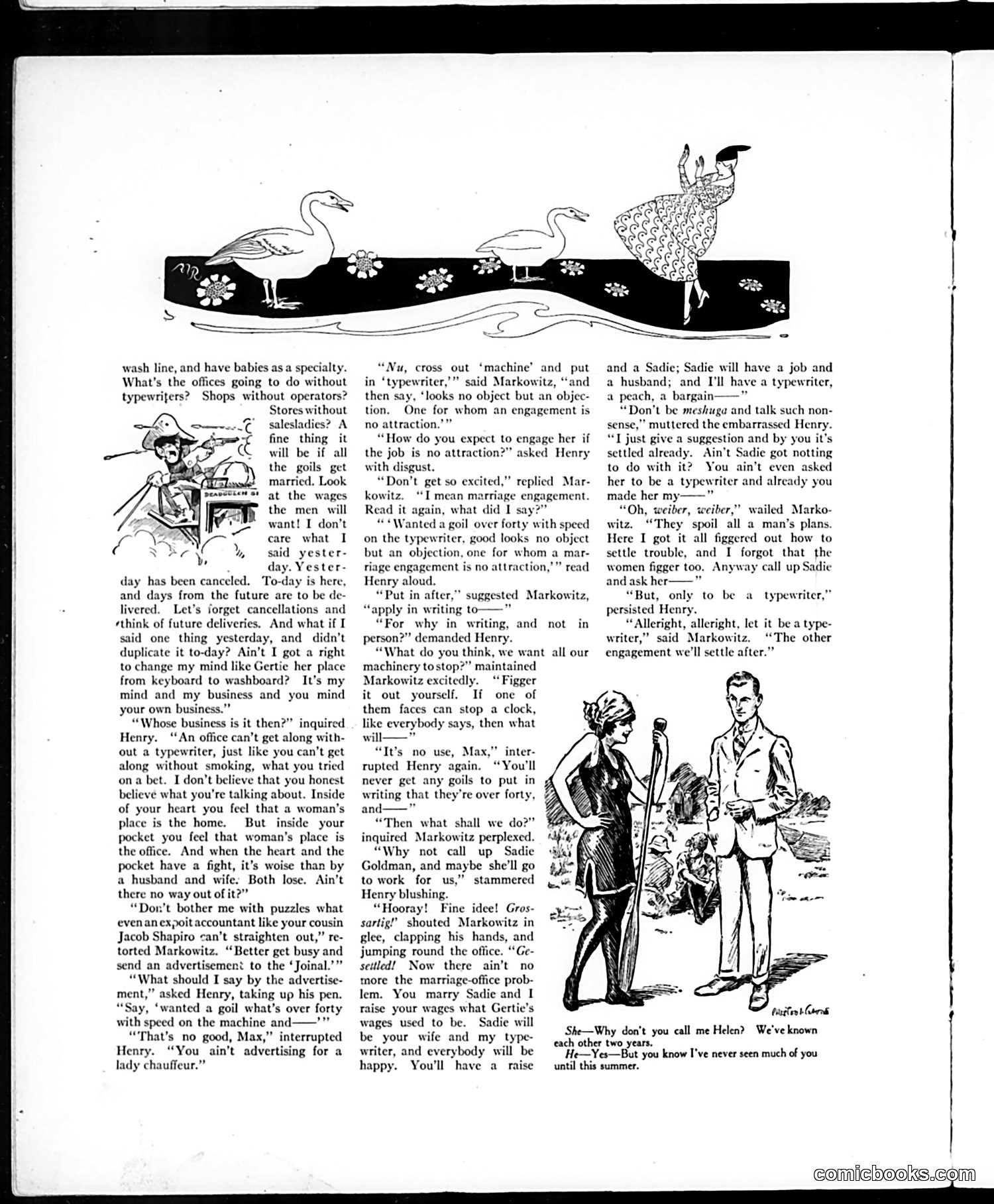
This page satirizes early 20th-century workplace tensions around women's employment. The dialogue between characters Markowitz and Henry concerns typewriter operators—nearly all women then—and fears that if they marry, businesses lose essential workers. The satire works on multiple levels: Henry initially argues women *should* stay home, yet he profits from paying them less than men. When forced to confront this hypocrisy, he blushes. Markowitz's "solution"—Henry marrying his female typist Sadie so she works as both wife *and* unpaid typewriter operator—exposes the absurdity of treating women as interchangeable office machinery. The Yiddish phrases ("Nu," "weiber," "meshuga") indicate the characters are Jewish immigrants, typical for Judge's humor targeting ethnic communities. The cartoon above shows fashionable women, likely mocking contemporary "modern woman" anxieties. The joke ultimately critiques how employers viewed women's labor: replaceable, exploitable, and naturally belonging in domestic rather than professional roles.
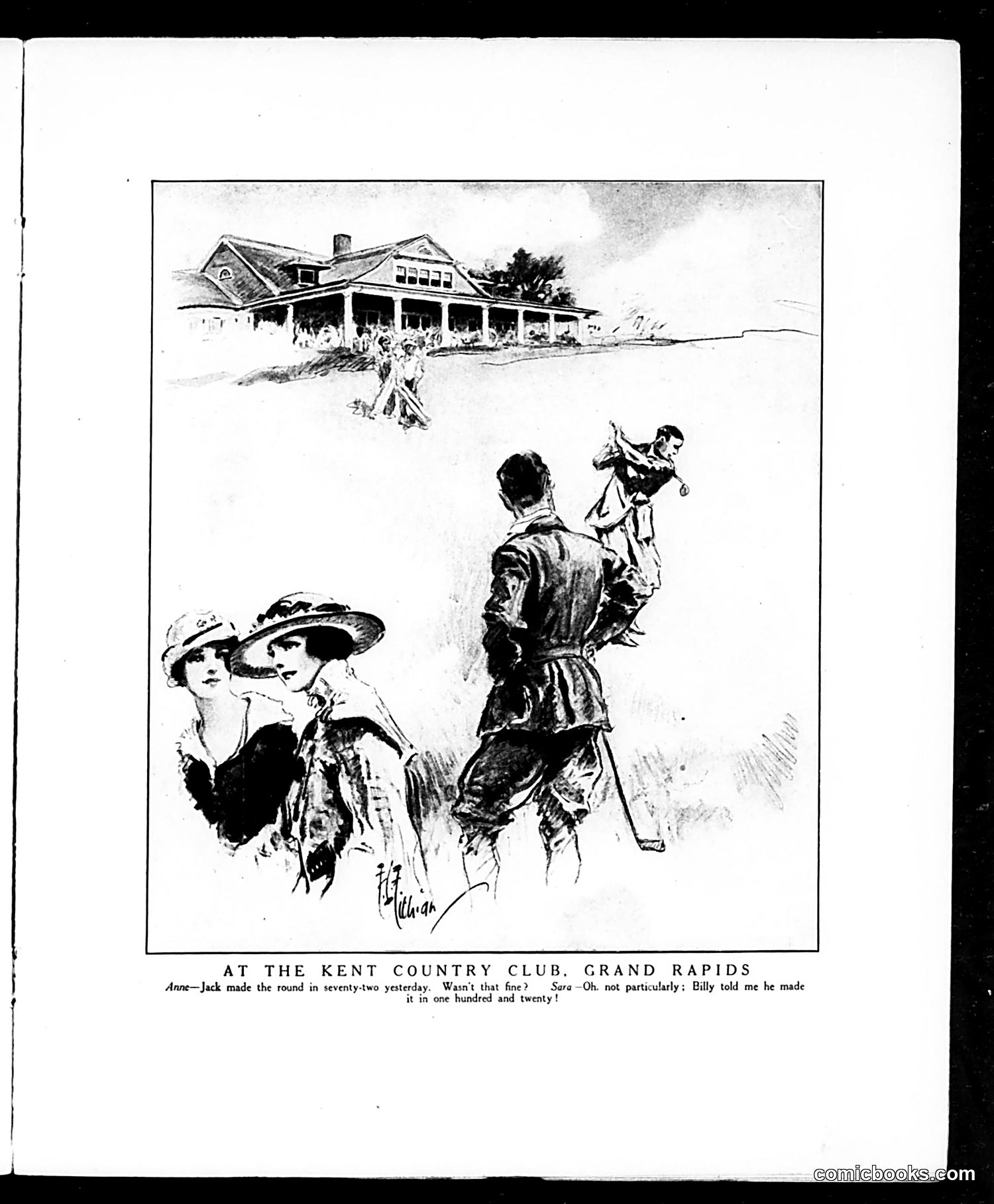
This is a golf joke from Judge magazine. Two women (Anne and Sara) are discussing their husbands' golf scores at an exclusive country club. Anne proudly mentions that "Jack" shot 72—actually an excellent score. Sara dismisses it, claiming her husband Billy shot 120. The satire targets marital dynamics and male braggadocio. Sara's claim is absurd; a score of 120 is terrible golf, yet she treats it as normal or even acceptable from her husband. The joke mocks both the wives' credulity and the husbands' apparent dishonesty about their athletic abilities. It's also satirizing the pretensions of country-club culture, where wealthy men gather to play golf and presumably exaggerate their accomplishments to impress each other and their spouses.
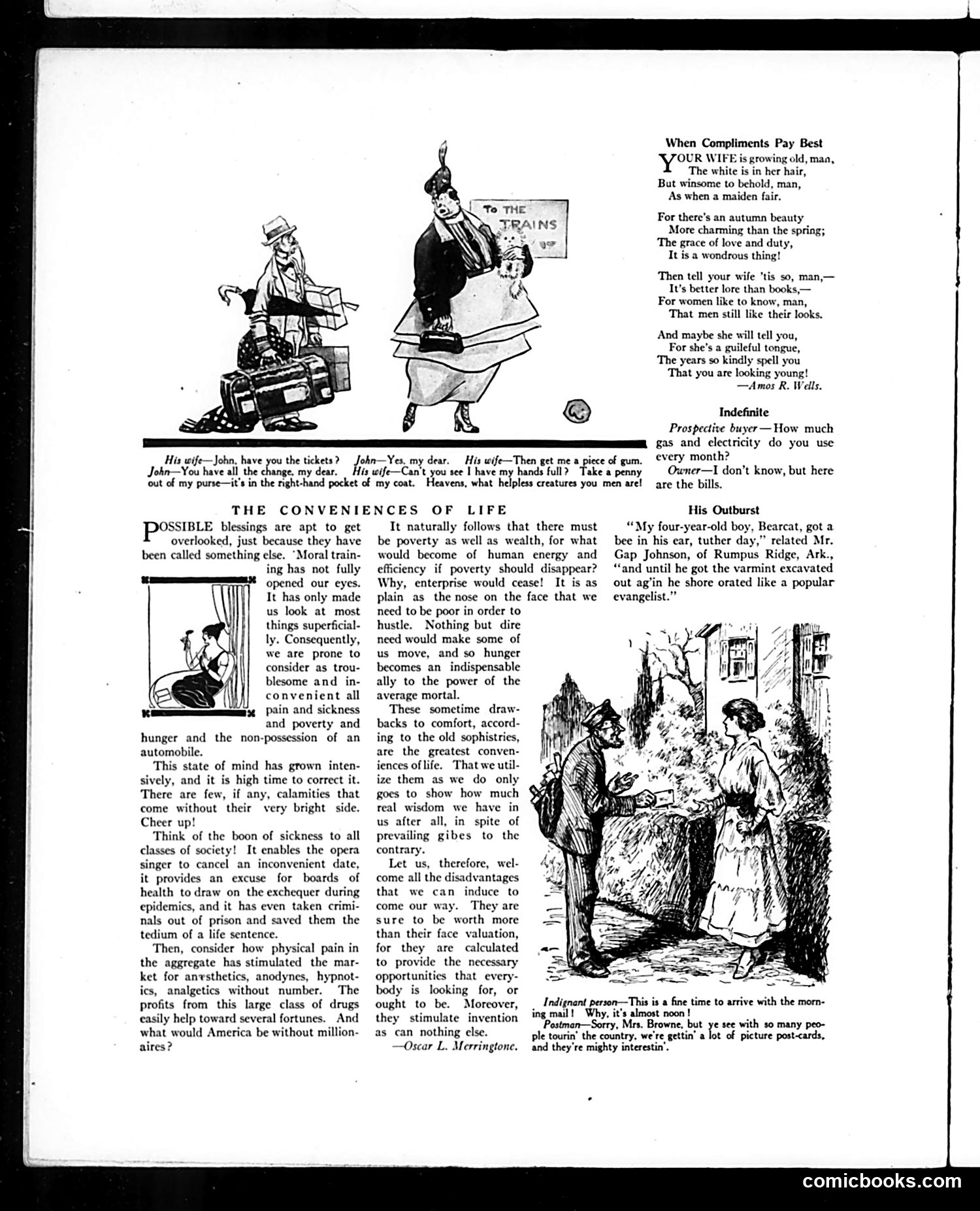
This page contains several satirical pieces typical of early 20th-century humor: **"The Conveniences of Life"** is a philosophical satire attributing absurd "benefits" to society's hardships. The author (Oscar L. Merringtone) uses ironic logic to argue that poverty, sickness, and pain are actually desirable because they drive commerce, innovation, and human effort. It's mock-serious social commentary poking fun at those who rationalize inequality. **The cartoon vignettes** depict domestic scenes: a couple at a train station where the wife manages finances while the husband holds tickets, illustrating the wife's practical competence versus male helplessness. **"When Compliments Pay Best"** is sentimental verse advising men to compliment aging wives, with the cynical suggestion that flattery works better than literature. **"His Outburst"** is a rural dialect joke about a child's dramatic reaction to a bee in his ear. The overall page reflects Judge's typical mix of light domestic humor, mild social satire, and sentimental poetry—gentle mockery rather than biting political commentary.
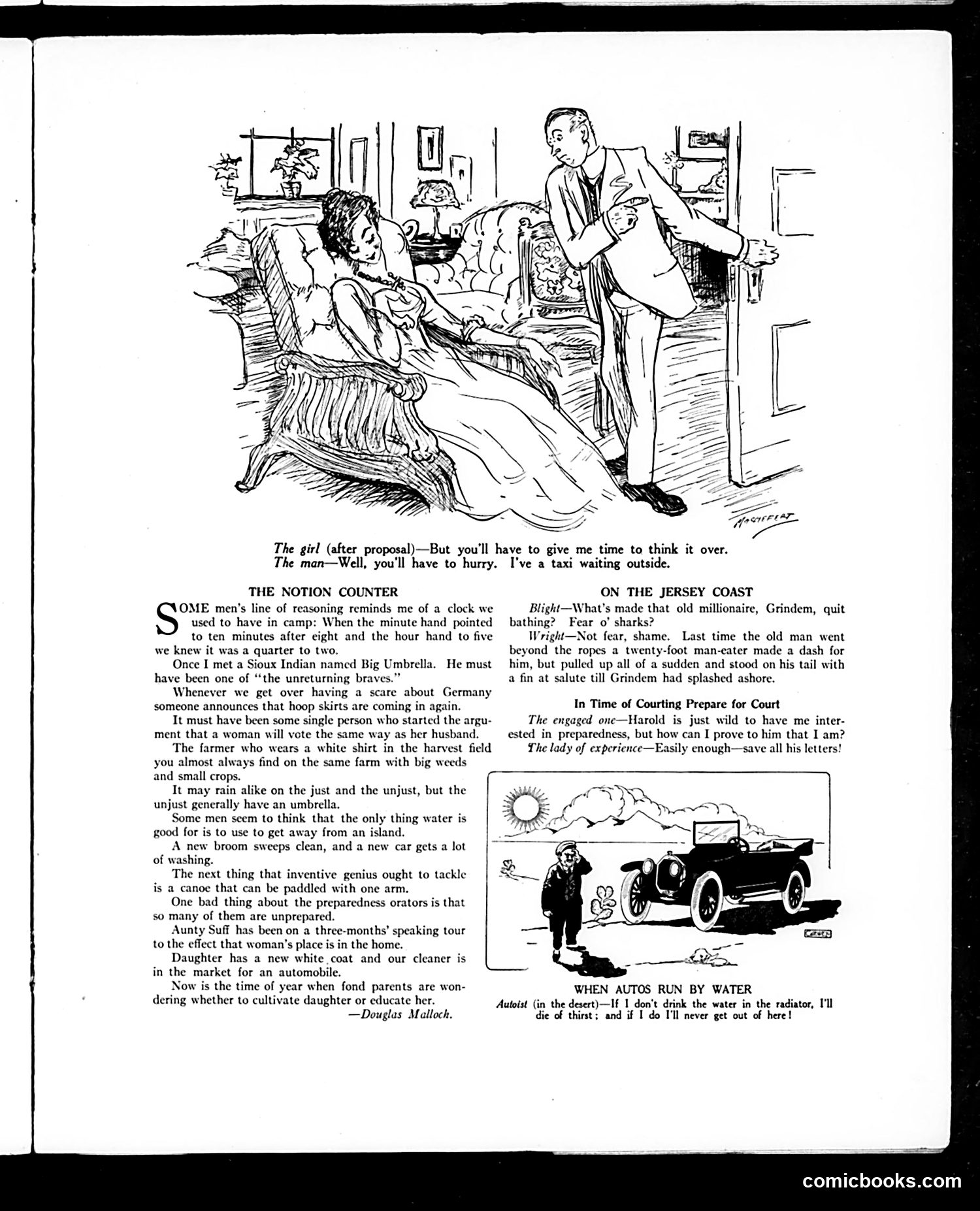
This page contains several short satirical pieces typical of Judge magazine's humor: **Top cartoon**: A man proposes to a woman who asks for time to think. He pressures her because "I've a taxi waiting outside"—satirizing male impatience and the transactional nature of courtship. **"The Notion Counter"**: A collection of brief, disconnected observations on contemporary life. Notable references include: - Concern about Germany (likely WWI-era anxiety) - Criticism of women's suffrage advocates ("Aunty Suff") and the claim that women will vote identically to husbands - Commentary on fashion (hoop skirts) and social preparedness **"On the Jersey Coast"**: A joke about a millionaire who stops swimming after a shark incident, implying the shark showed him respect/deference—absurdist humor. **"When Autos Run by Water"**: A desert car driver's dilemma—drinking radiator water to survive thirst risks poisoning him, leaving him stranded. Dark humor about automobiles' unreliability. The page reflects early 20th-century anxieties: war, women's changing roles, technology adoption, and social change.
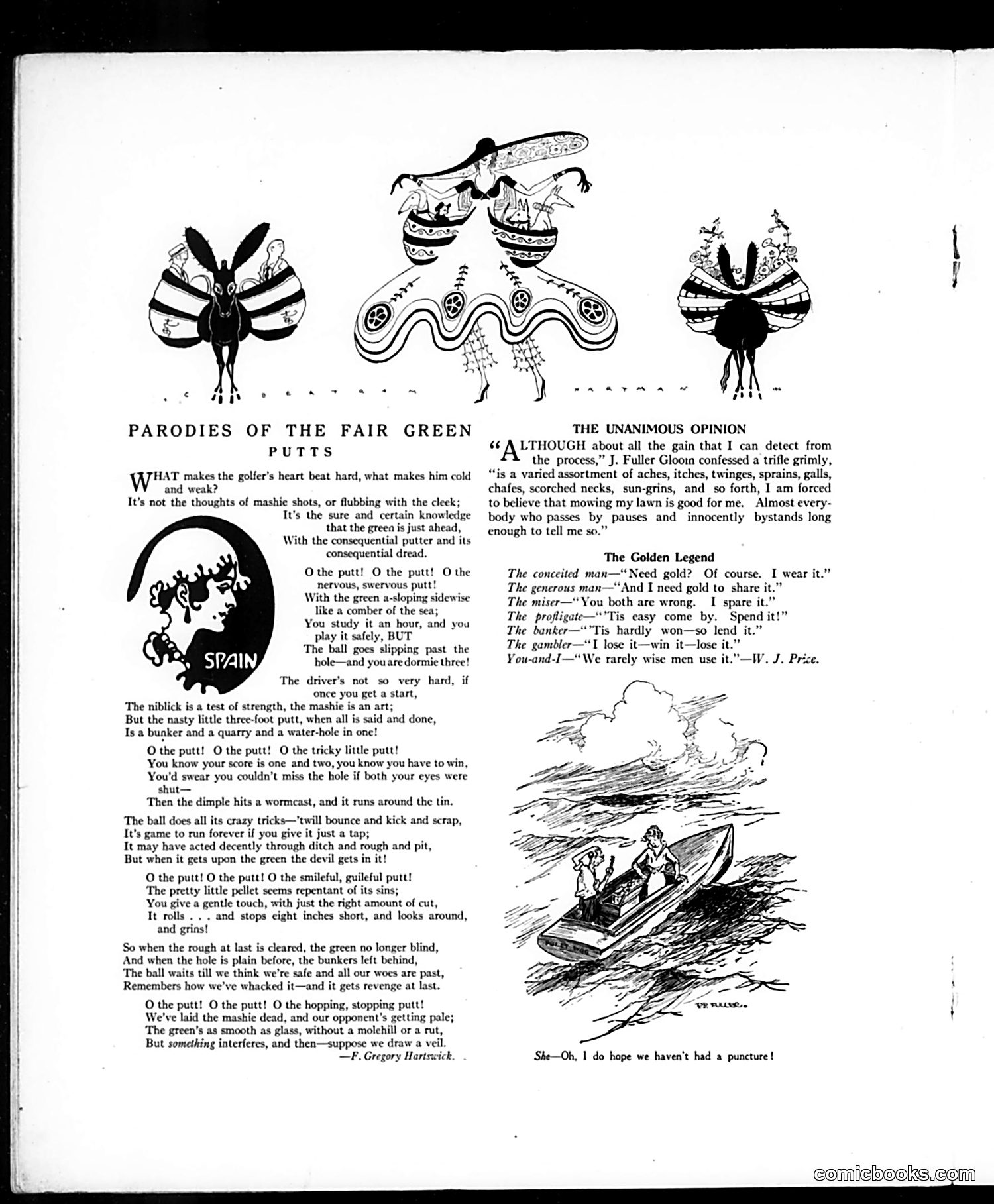
This page from *Judge* magazine contains golf and social satire typical of early 20th-century humor. **"Parodies of the Fair Green Putts"** mocks golfers' anxiety over putting—the final, seemingly simplest stroke that often fails due to tiny imperfections in the green. The poem exaggerates the psychological drama: players study endlessly, yet the ball inexplicably veers off due to "wormcasts" (earthworm mounds) or other minute obstacles. It's satirizing golfers' perfectionism and their tendency to blame external factors rather than skill. **"The Unanimous Opinion"** jokes about lawn-mowing as supposed health benefit. J. Fuller Gloom admits he gains only "aches, itches, twinges," yet neighbors constantly insist it's "good for" him—satirizing unsolicited advice and folk wisdom. **"The Golden Legend"** is a light aphorism contrasting character types' relationships with money: the conceited man wears it, the generous shares it, the miser hoards it, the gambler loses it—with a final quip that "you-and-I" rarely use money wisely. The bottom cartoon shows a couple boating, worrying about a puncture (likely their boat tire or inner tube), reflecting period anxieties about early automobile/recreational technology.
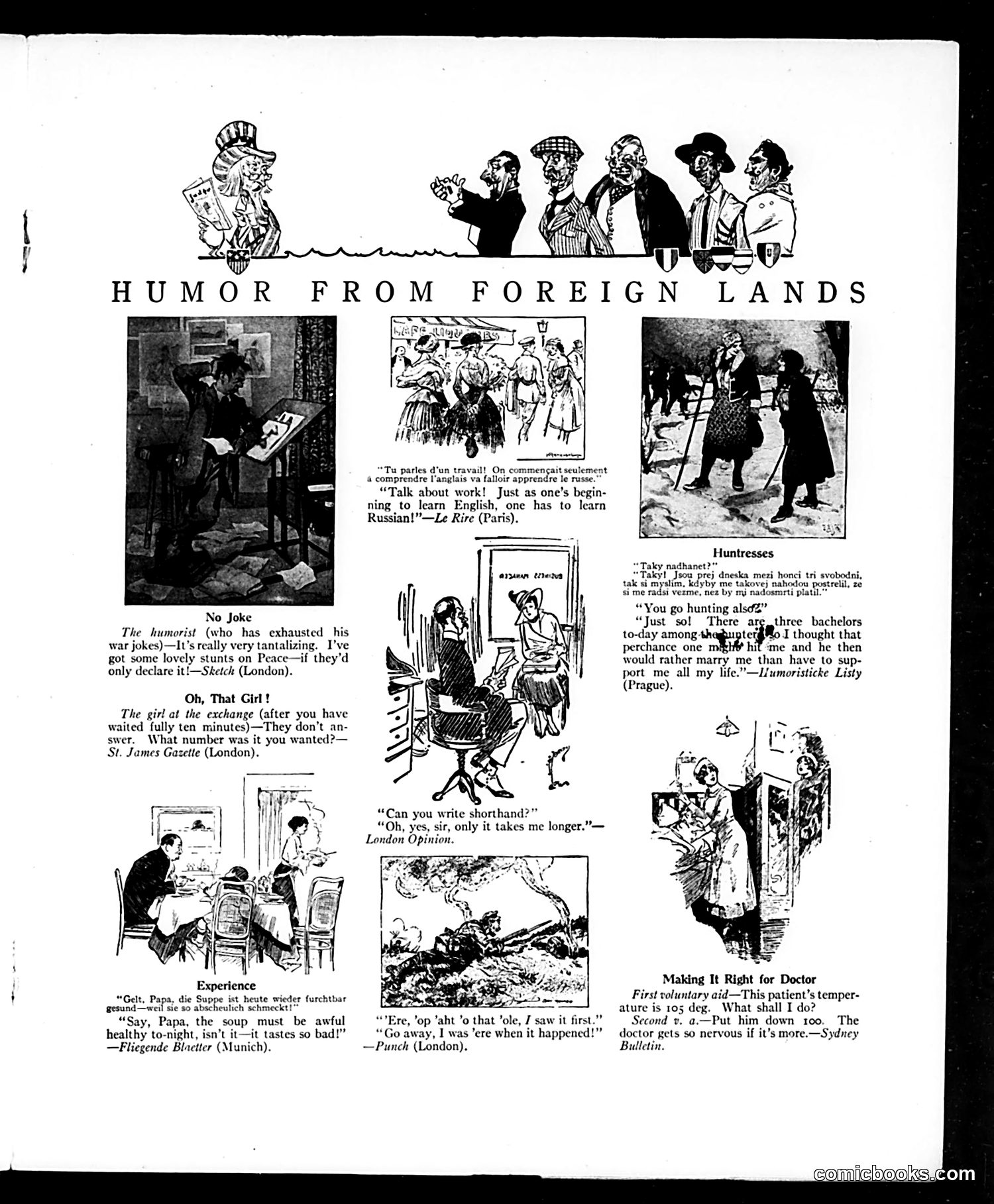
This page collects brief satirical jokes translated from European publications, reflecting early 20th-century social anxieties and observations. The jokes target: war profiteers (a humorist hoarding peacetime material), telephone operators' incompetence, German health obsessions, language barriers (learning Russian alongside English), stenography's difficulty, hunting accidents, and medical dishonesty. The recurring themes—workplace frustrations, generational tensions ("Say, Papa"), and institutional absurdity—suggest post-WWI anxieties about modern life's complexity. The caricatured figures (exaggerated facial features in the header) represent generic "foreign types." The satire assumes American readers find European social conventions amusingly alien or absurd. By presenting jokes from *Punch*, *Le Rire*, and other publications, Judge positions itself within an international comedy community while subtly asserting American superiority through bemused distance.
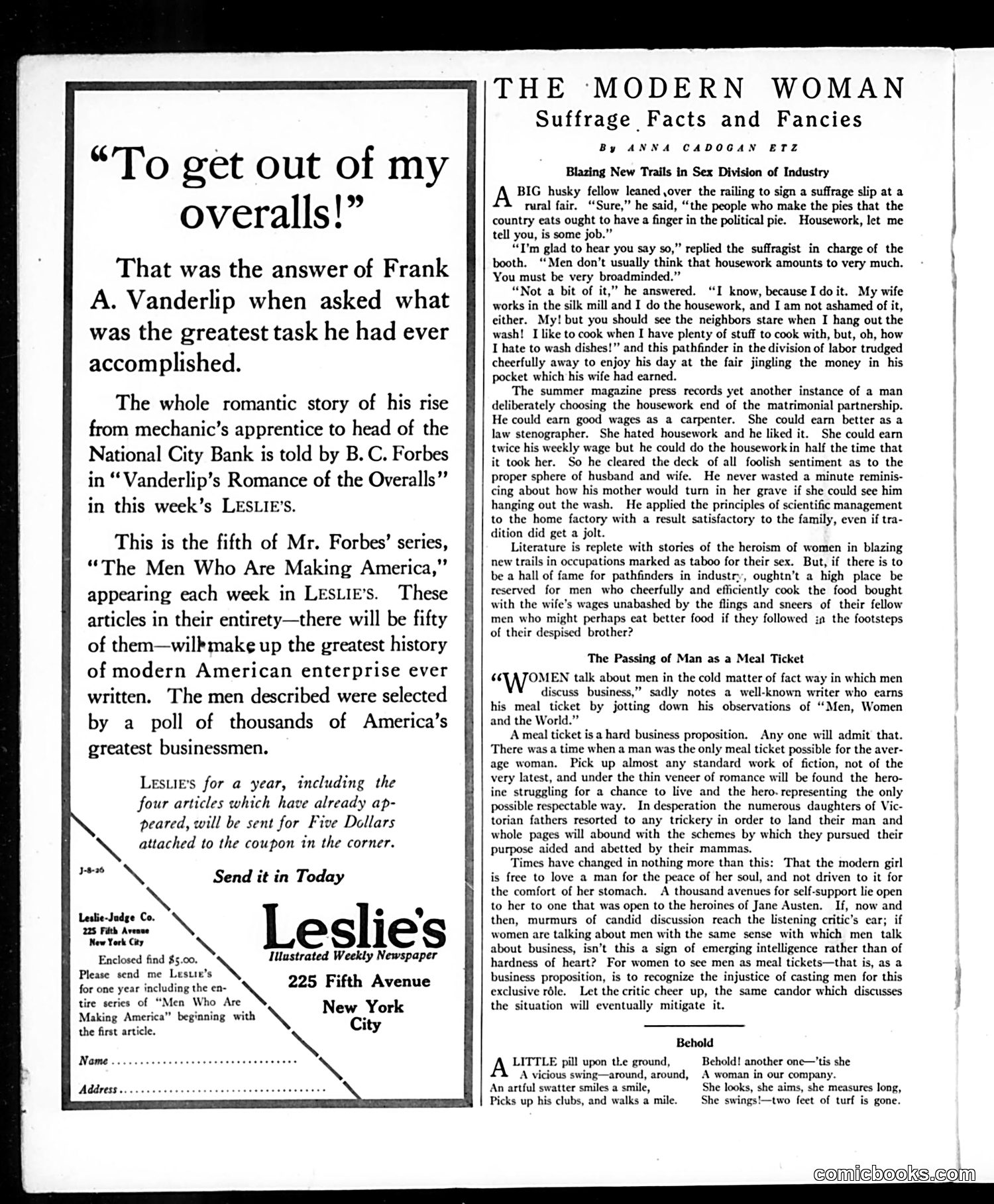
This page contains two distinct sections: **Left Side - Advertisement/Feature:** Promotes B.C. Forbes's series "The Men Who Are Making America" in Leslie's Illustrated Weekly. It profiles Frank A. Vanderlip, who rose from mechanic's apprentice to head of National City Bank. The quote "To get out of my overalls!" represents his greatest achievement—social mobility through hard work. This celebrates American entrepreneurship and the self-made man narrative popular in early 20th-century business journalism. **Right Side - Opinion Column:** Anna Cadogan Etz discusses women's suffrage and changing gender roles in work. She argues that housework deserves political recognition and celebrates men who do domestic labor without shame, citing examples of couples rationally dividing labor (wife earning wages, husband managing household). The piece critiques outdated gender conventions while framing economic efficiency as progressive. Both sections reflect early-1900s debates about women's rights, labor, and traditional gender roles.
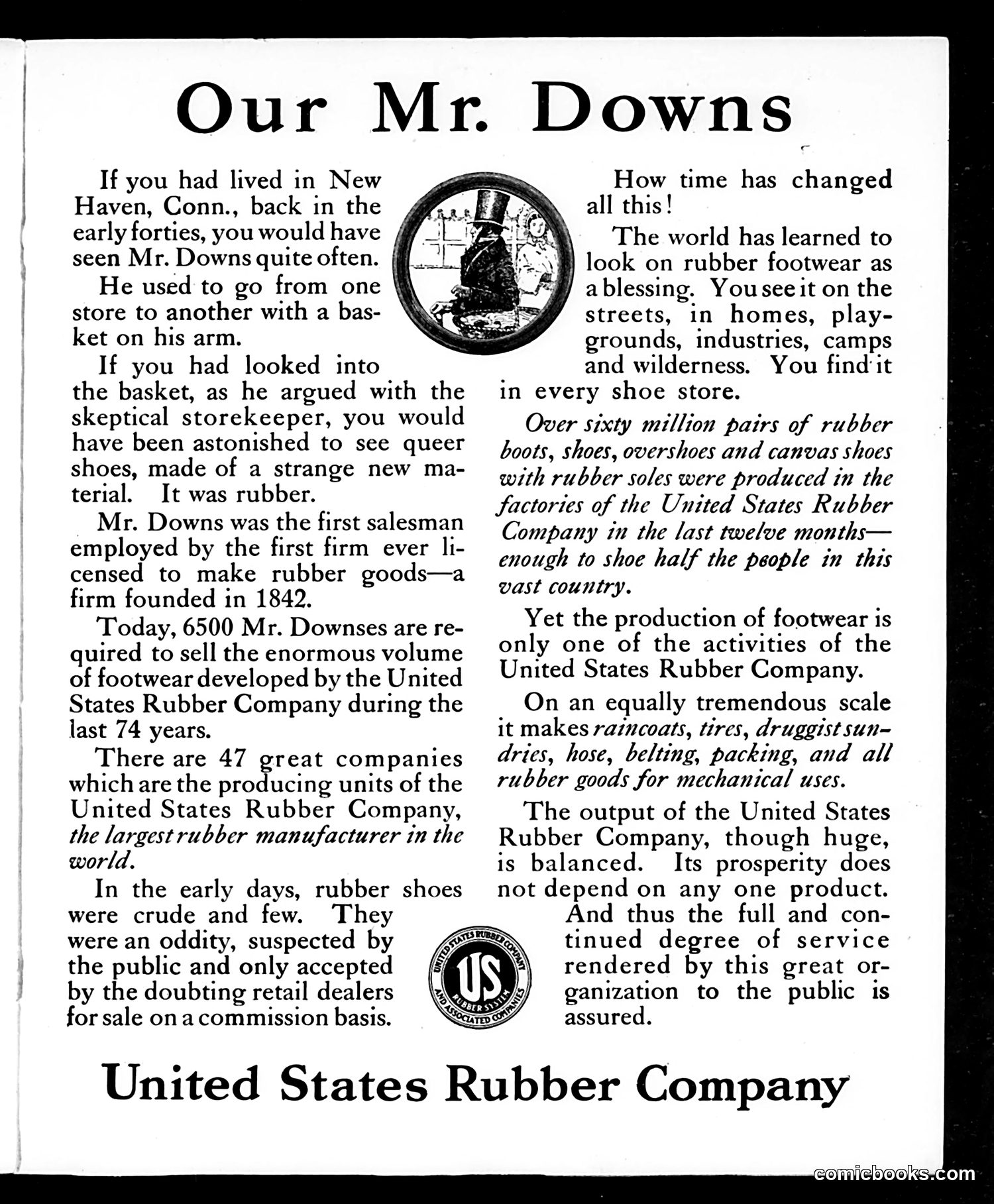
This is **corporate advertising**, not satire. The piece celebrates the United States Rubber Company's growth from a novelty to an industry giant. The narrative centers on "Mr. Downs," the first salesman hired by the original rubber goods firm (founded 1842). He allegedly carried rubber shoes door-to-door in 1840s New Haven, Connecticut, facing skeptical shopkeepers who viewed rubber footwear as a bizarre oddity. The piece uses Downs as a symbol of how far rubber products have come: from suspected novelty to ubiquitous necessity. It boasts that 6,500 modern salesmen now distribute 60+ million pairs annually across streets, homes, playgrounds, and industries. The underlying message: the U.S. Rubber Company transformed public perception and created an entire market. The ad emphasizes the company's scale (47 producing units), diversification (raincoats, tires, belts), and stability—positioning it as economically sound and essential to American life.
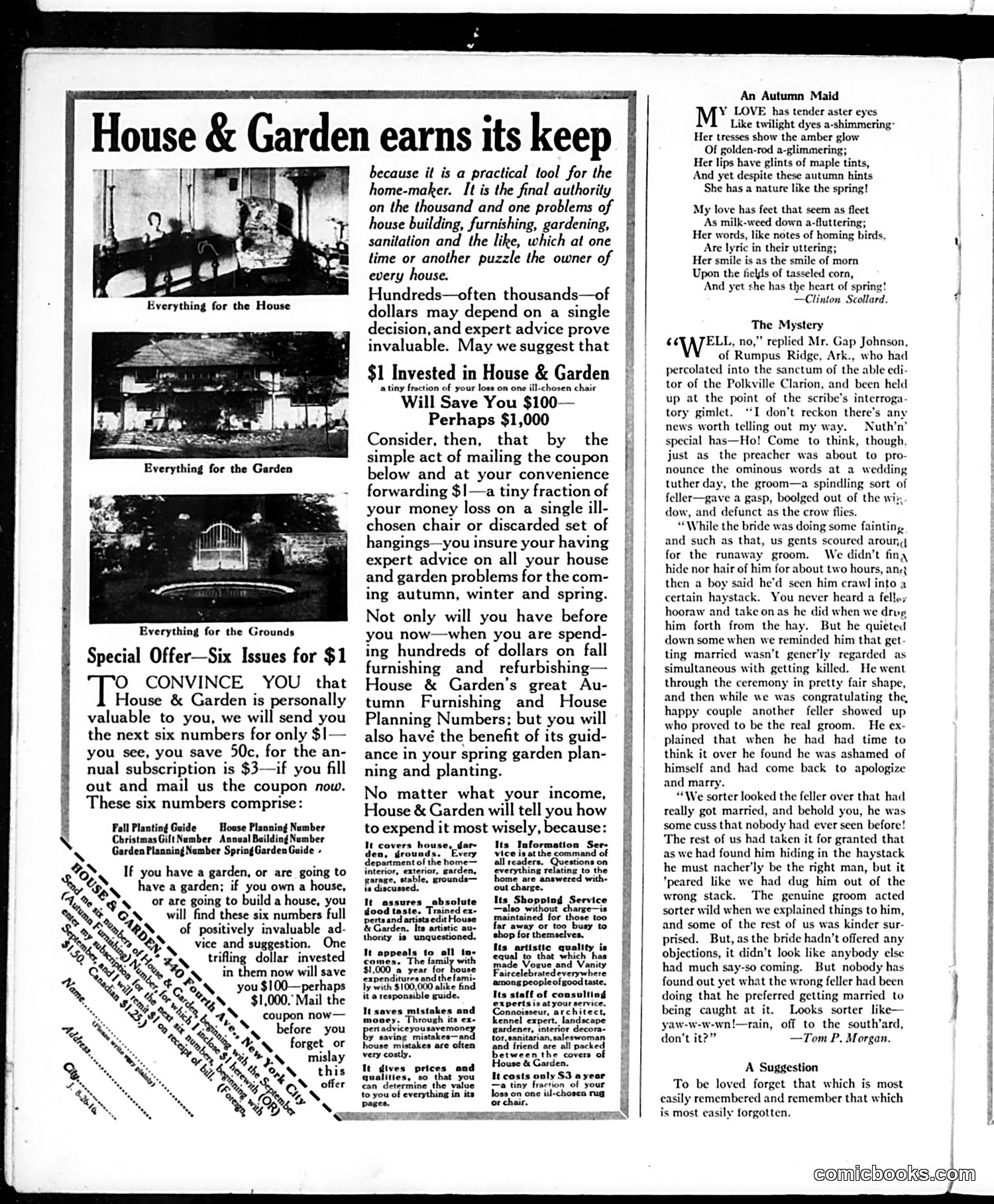
This page is primarily **advertising**, not political satire. It features a full-page advertisement for *House & Garden* magazine, promoting a subscription deal: six issues for $1 (claiming a 50-cent savings). The ad uses persuasive copy emphasizing that expert home advice could save homeowners "$100—Perhaps $1,000" on single purchasing mistakes. It lists the magazine's features: consulting experts (architect, landscaper, decorator), artistic quality comparable to *Vogue*, and a shopping service. The three photographs at left show domestic interiors and gardens, illustrating the magazine's subject matter. On the right are two poems: "An Autumn Maid" (romantic verse about a woman) and "The Mystery" (a short story excerpt about a groom at a wedding). **No political satire or caricature is present.** This is a straightforward commercial page from *Judge* magazine's advertising section, typical of early 20th-century magazine layouts mixing editorial content with promotions.
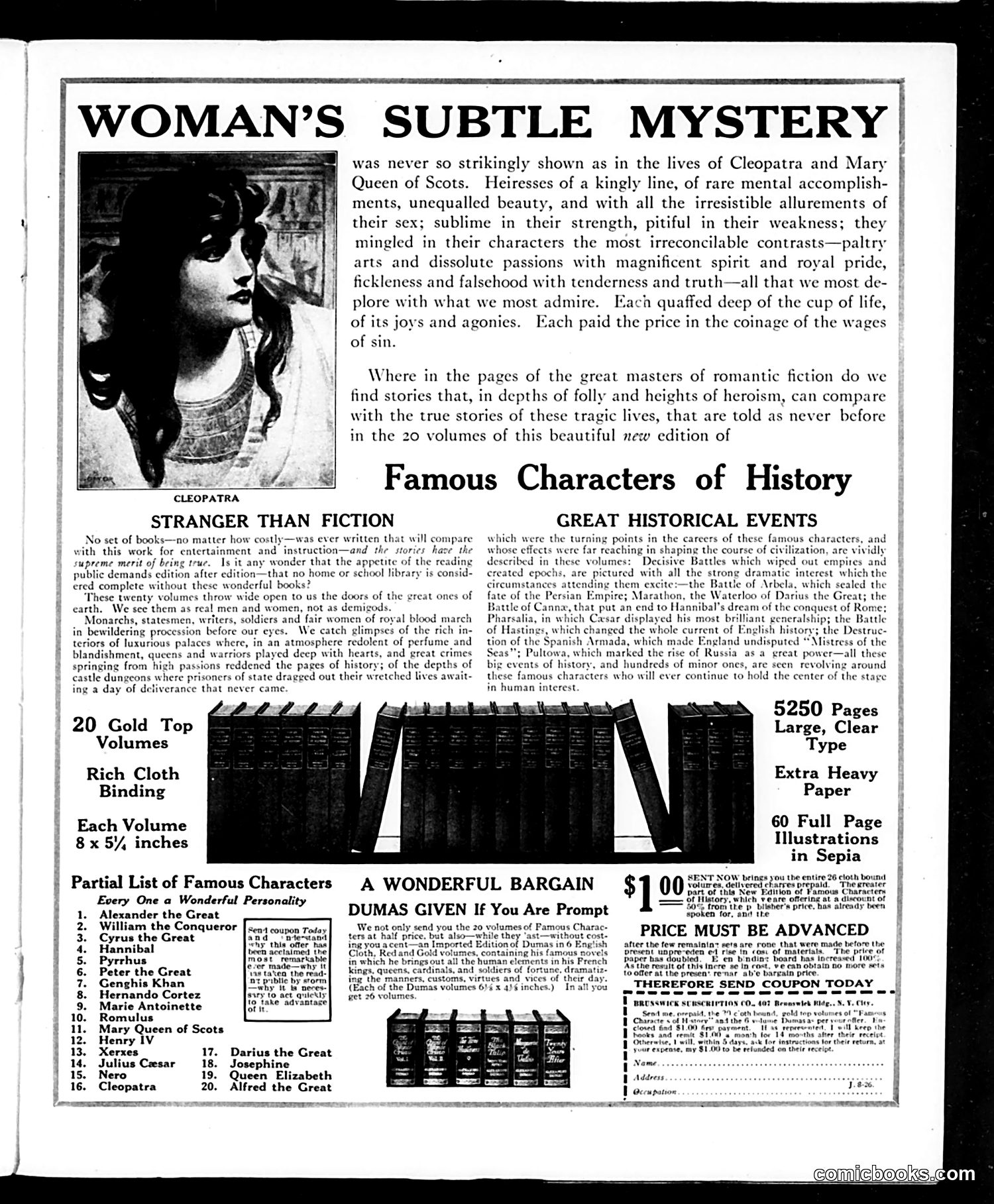
This is primarily an **advertisement**, not a cartoon or satire. It promotes a 20-volume encyclopedic set titled "Famous Characters of History." The page uses a romanticized opening section about historical women (Cleopatra and Mary Queen of Scots) to market the books. The text emphasizes dramatic narratives—describing these figures as embodying contradictions of "sublime strength" and "weakness," passion and pride—to appeal to readers seeking dramatic historical narratives "stranger than fiction." The advertisement lists 20 famous historical figures (Alexander the Great, Julius Caesar, Napoleon, etc.) and promotes the set as offering 5,250 pages with illustrations. It frames history as entertainment, claiming these true stories rival romantic fiction in their depths of "folly and heroism." **The appeal is clear**: presenting dry historical facts as gripping drama to justify the $1.00 price (marked down from higher cost, purchaser must act promptly). This is straightforward early 20th-century direct-mail marketing dressed in flowery literary language.
This page contains **two separate pieces**, not a political cartoon: **Left side:** An advertisement for Collier's magazine promoting a new fiction series called "Our Square" by Samuel Hopkins Adams. It advertises stories featuring "Bohemian" characters in New York's Greenwich Village—appealing to readers interested in urban village life and literary fiction. **Right side:** A humorous short story titled "All the World is Like Missouri," about a workaholic businessman named Taylor who reluctantly attends his college's baseball game. The joke centers on how the game revitalizes him—he becomes so energized that he bribes his own son with promises of touring cars for each base scored, ultimately offering four cars. The punchline (partially cut off) jokes that the boy will "sell them." The story satirizes **American business culture and workaholism** in the 1910s, suggesting that even hardened businessmen need recreation, though Taylor characteristically monetizes even his family's athletic achievement.
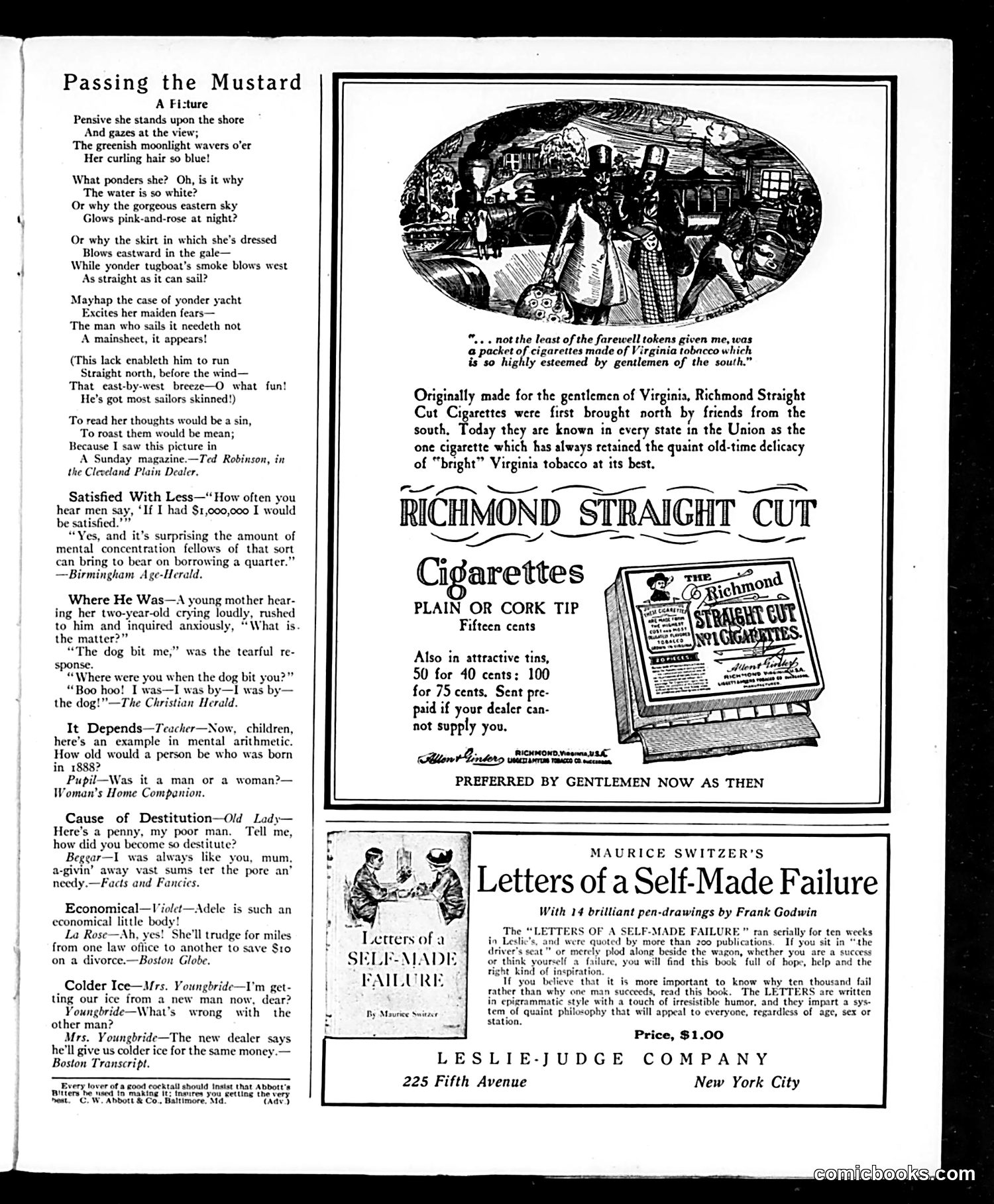
This page contains primarily **humorous short jokes and advertisements** rather than political cartoons. The left side features brief satirical humor pieces typical of Judge magazine's style—absurdist observations about human nature. Examples include a woman pondering nonsensical things while gazing at the ocean, and jokes about financial anxiety, divorce costs, and marital disputes. These reflect early 20th-century middle-class concerns and gender dynamics. The right side is dominated by **advertising**: a Richmond Straight Cut Cigarettes ad emphasizing Virginia heritage and gentleman appeal, and a book advertisement for "Letters of a Self-Made Failure" by Maurice Switzer. The cigarette ad notably appeals to nostalgia ("preferred by gentlemen now as then") and regional prestige. The book advertisement promises practical wisdom about success and failure. There are no identifiable political figures or specific satirical targets visible. This appears to be a typical Judge page balancing entertainment content with commercial advertising revenue.
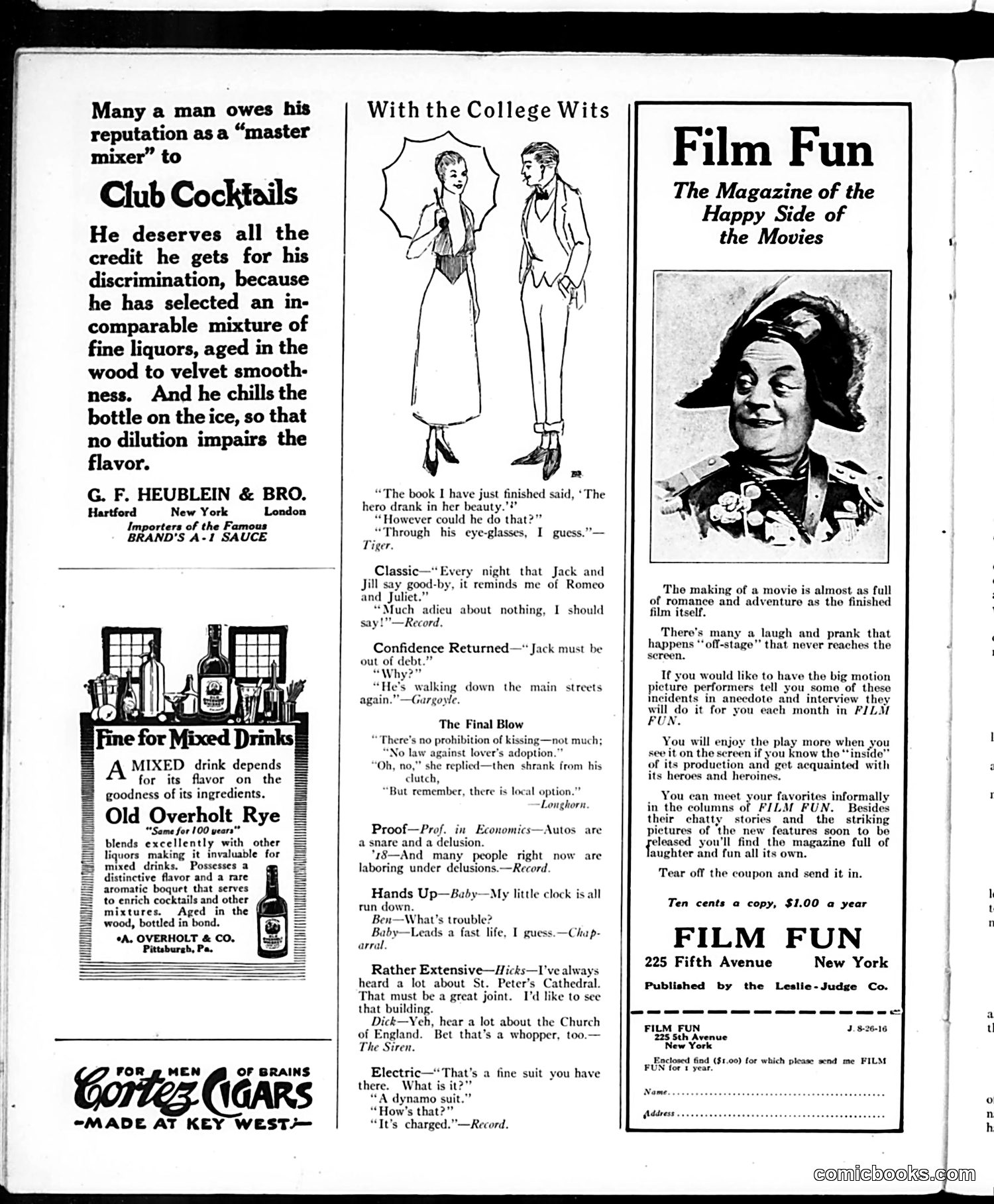
This page comprises primarily **advertisements and a magazine promotion**, not political satire. The left side advertises alcoholic beverages (Club Cocktails, Old Overholt Rye, Cortes Cigars)—products marketed to affluent men as indicators of taste and sophistication. The middle section contains light humor jokes about romance, economics, and everyday situations typical of 1920s-era magazine filler. The right side promotes *Film Fun*, a companion magazine focused on movie industry gossip and behind-the-scenes anecdotes about performers. The small photograph appears to be a silent-film actor, though identification is unclear from the image alone. **Historical context**: This reflects Prohibition-era advertising (alcohol was still being marketed despite legal restrictions) and the emerging celebrity culture around early Hollywood. The overall tone emphasizes consumer sophistication and entertainment consumption rather than social or political commentary.
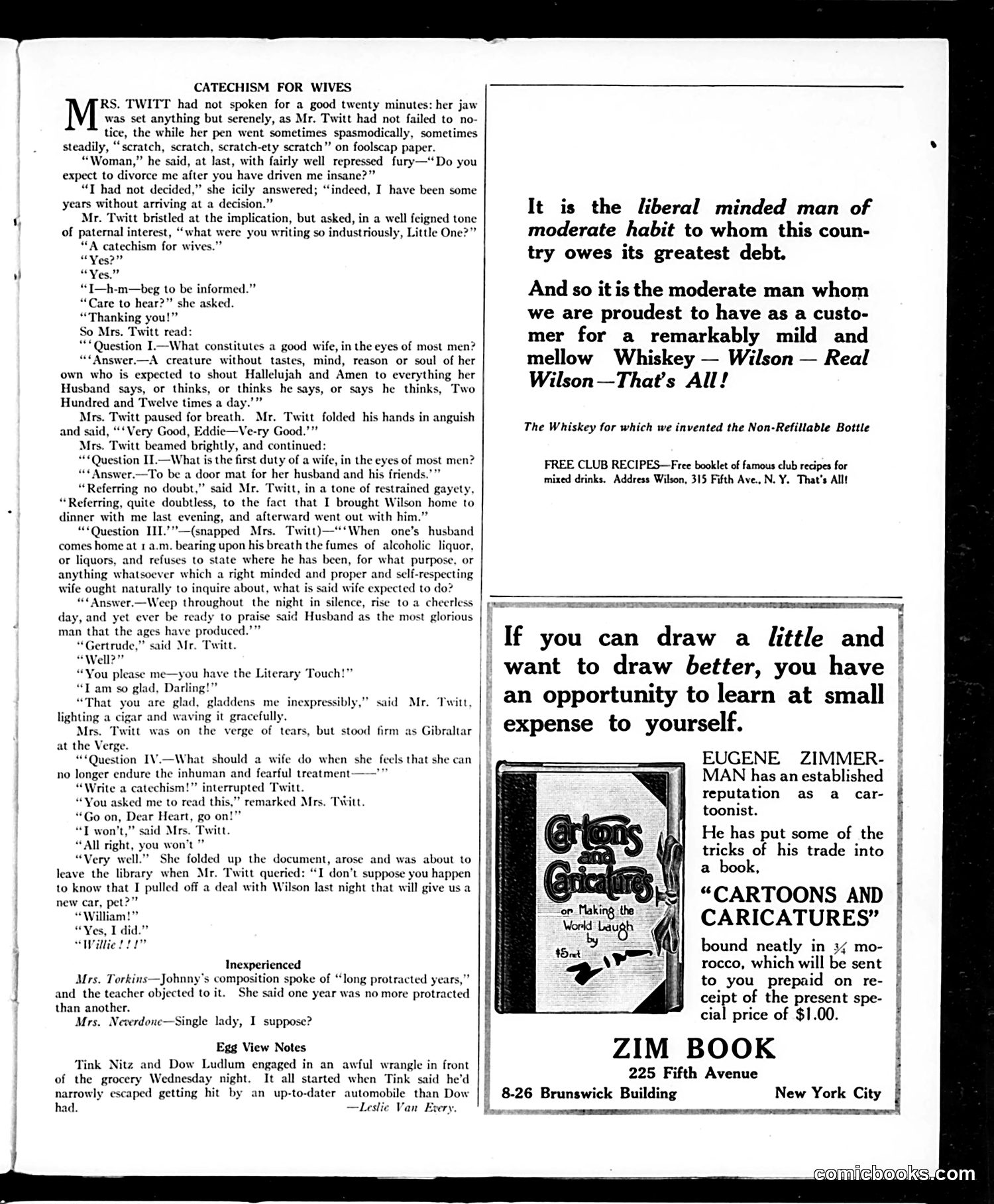
This story satirizes early 20th-century marriage expectations and gender relations. Mrs. Twitt, frustrated by her husband's behavior, writes a "catechism" (instructional text) exposing the absurd expectations placed on wives: they should be submissive, unquestioning "doormats," and silently endure their husbands' drinking and infidelities without complaint. The satire works by having Mrs. Twitt articulate these expectations so starkly that their injustice becomes obvious. Her husband, initially dismissive, gradually recognizes her point—particularly when she reaches Question III about his coming home drunk at 1 a.m. without explanation. The story critiques male privilege and the lack of agency afforded to married women of the era, presenting an early feminist perspective wrapped in humor. Mrs. Twitt's refusal to continue reading when Mr. Twitt suddenly becomes conciliatory suggests women's growing willingness to challenge marital inequality.
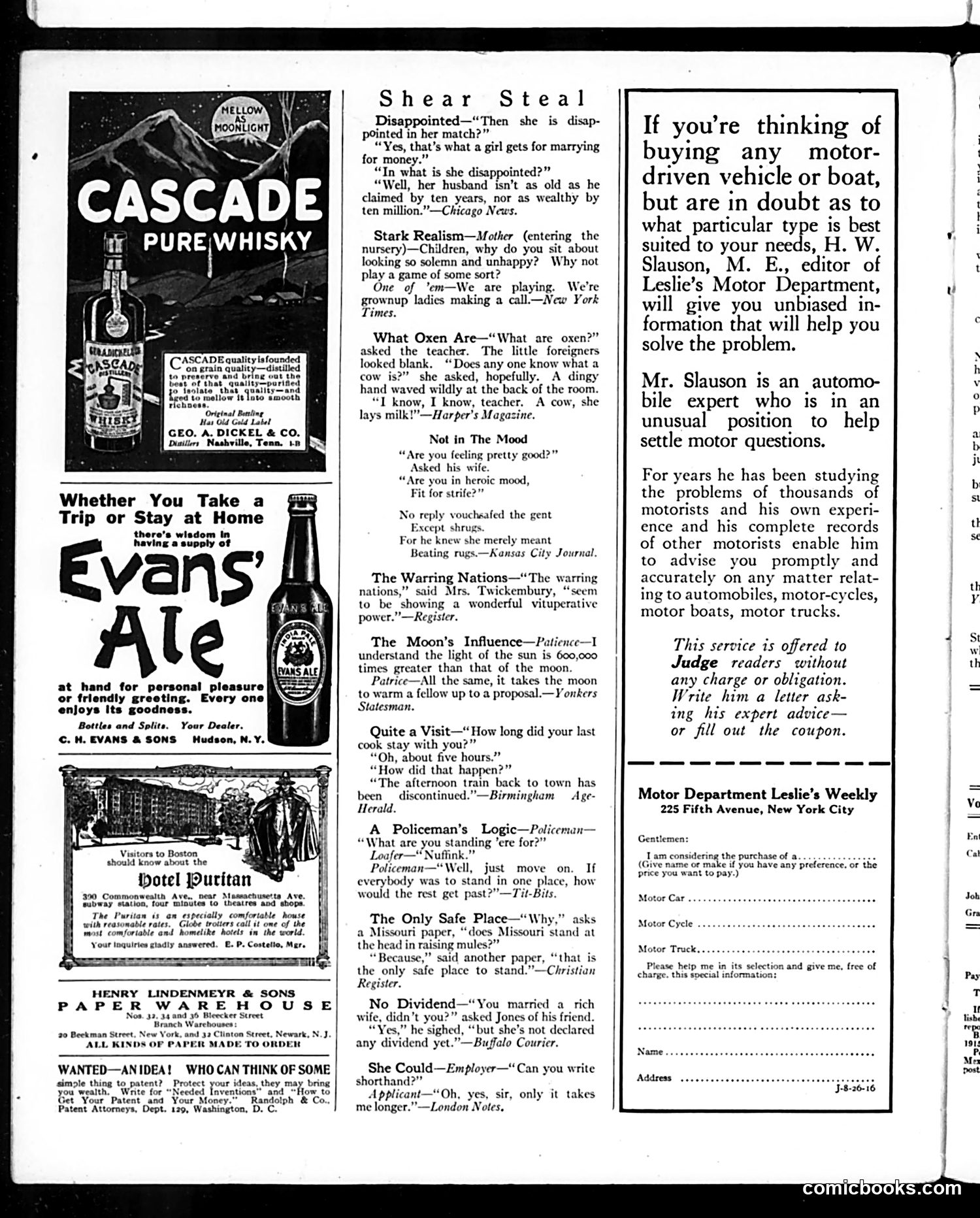
This page is primarily **advertisements and humorous short jokes** rather than political cartoons. The satirical content consists of brief, topical humor pieces typical of Judge magazine's format. The jokes mock everyday life: a woman disappointed in her wealthy husband (who lied about his age and fortune), children playing "grown-up ladies making calls" too seriously, a teacher's student confusing cows with milk-laying animals, a husband avoiding his wife's hint about beating rugs, and a policeman's circular logic about loitering. The page also features **product advertising** (Cascade Whisky, Evans' Ale, Hotel Puritan in Boston) and service ads (paper warehouse, patent attorneys). The right sidebar advertises Leslie's Motor Department, offering free automotive advice to readers. These jokes reflect early 20th-century domestic life and gender roles—wives nagging husbands, servants leaving jobs quickly, and traditional courtship rituals—presented as gentle satire rather than sharp social critique.
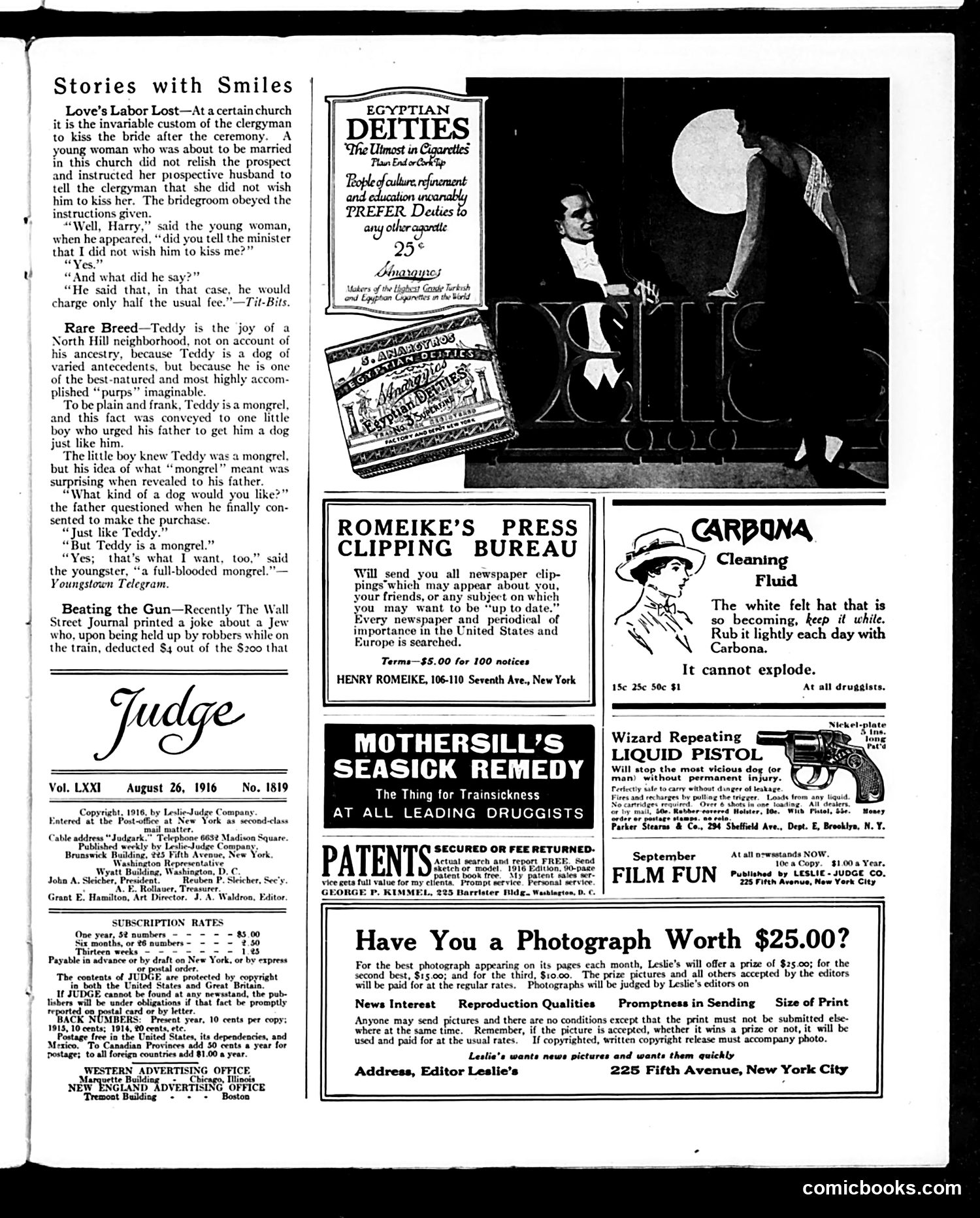
This page consists primarily of **short humorous anecdotes and advertisements**—not political cartoons. The three brief jokes exemplify Judge's "Stories with Smiles" humor typical of the era: 1. **"Love's Labor Lost"**: A bride instructs her husband to tell the clergyman not to kiss her after the ceremony. The minister's response—that he'll charge only half his usual fee—is the punchline, satirizing clergy expectations. 2. **"Rare Breed"**: A boy wants a dog "just like Teddy" and insists it be "a full-blooded mongrel," misunderstanding the term. The humor lies in the child's logical but absurd interpretation. 3. **"Beating the Gun"**: References a Wall Street Journal anecdote about a Jewish robbery victim deducting $4 from $200 stolen—relying on period stereotypes about Jewish financial shrewdness. The remaining content consists of **period advertisements** (Egyptian Deities cigarettes, Mothersill's seasick remedy, Carbona cleaning fluid) with no political significance. This is a typical advertising-heavy Judge page rather than a satirical commentary issue.
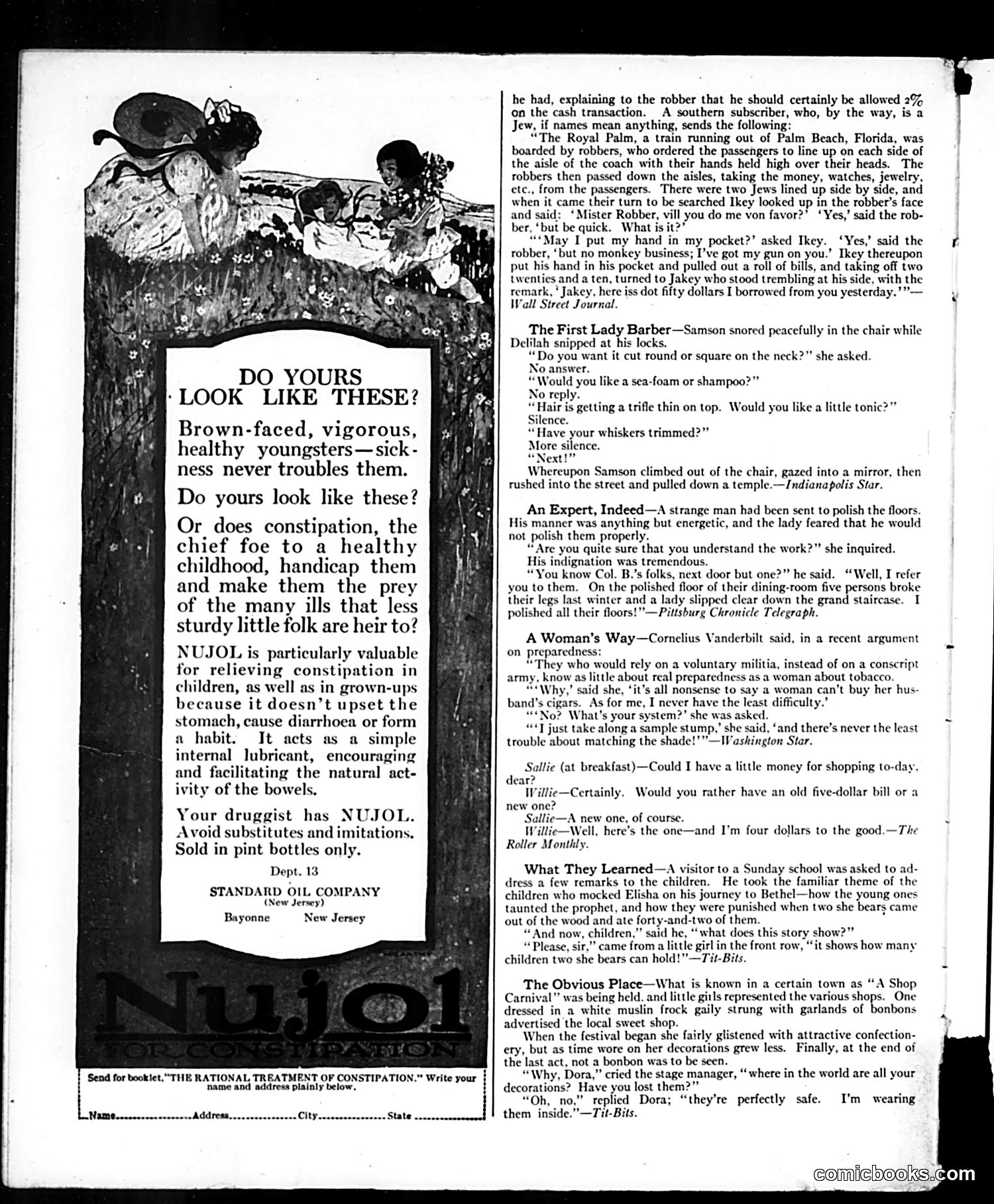
This page combines a **patent medicine advertisement** with several **humorous anecdotes**. ## The Advertisement The left side promotes **Nujol**, a mineral oil laxative made by Standard Oil. It uses before/after imagery suggesting healthy versus constipated children—a common early 20th-century advertising tactic that exploited parental anxieties about children's health. The product claimed to be a gentle "internal lubricant" without side effects. ## The Humor Pieces The right side contains short jokes typical of Judge magazine's satirical content: - **"The First Lady Barber"**: A Biblical Samson/Delilah reference where a female barber's silence drives Samson mad, playing on anxieties about women entering traditionally male professions. - **Jewish stereotypes**: A story mocking "Ikey" and "Jakey," using caricatured Yiddish-inflected English ("vill," "iss") to portray Jewish passengers as penny-pinching even during a robbery—reflecting period antisemitic stereotypes common in early 20th-century American humor. - **Other brief jokes** about floor polishing, preparedness, and domestic humor. The page reflects Judge's mix of commercial advertising and social satire, with humor that trades in ethnic caricature typical of that era.
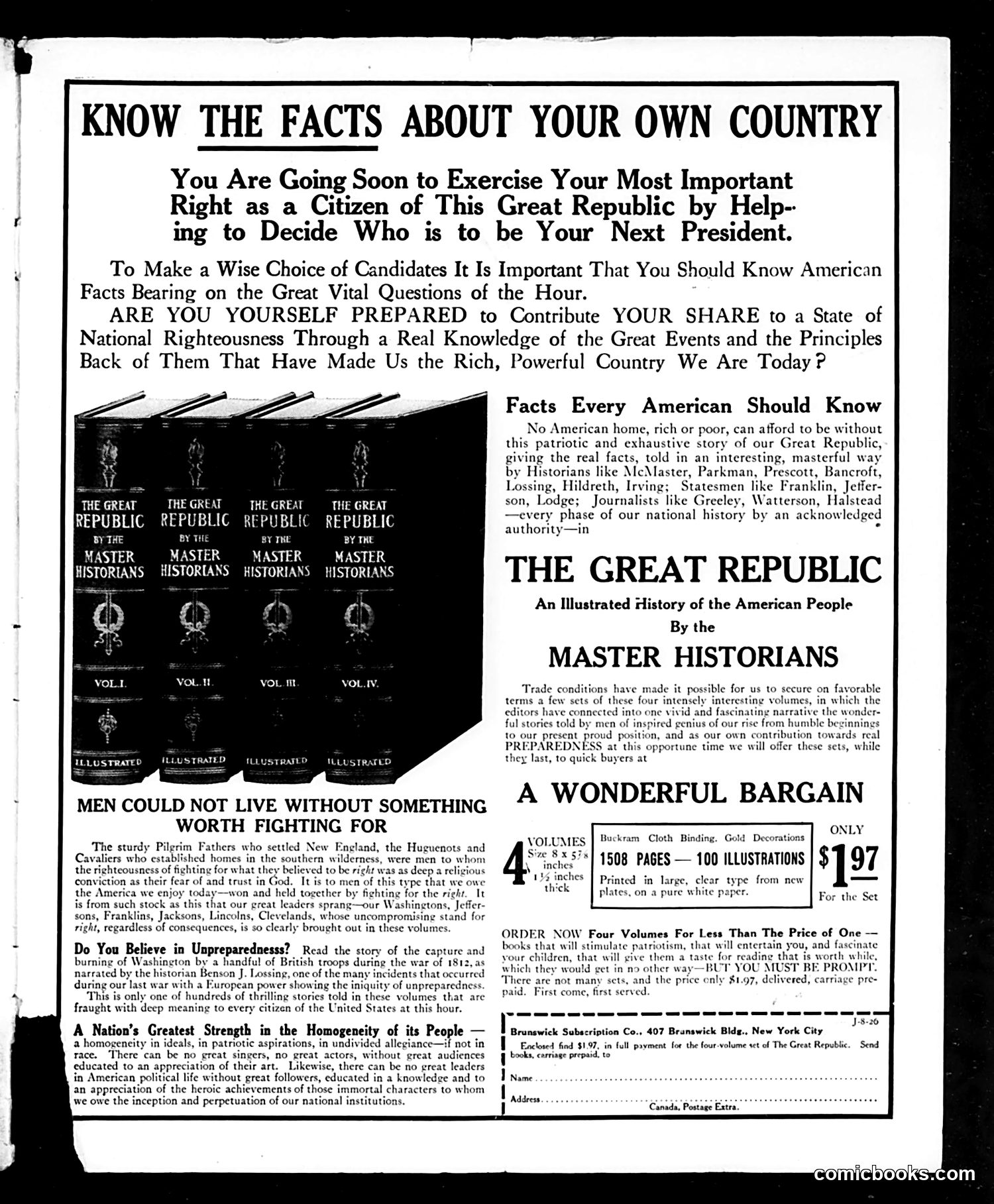
This is **primarily a book advertisement**, not a satirical cartoon. It promotes a four-volume history set called *The Great Republic* by the "Master Historians." The ad frames patriotic education as civic duty, appearing during an election cycle ("helping to decide who is to be your Next President"). It emphasizes that Americans need historical knowledge to make informed choices—referencing the Founding Fathers, the War of 1812, and national preparedness. The rhetoric is notably **nationalist and moralistic**: it appeals to "national righteousness," warns against military unpreparedness (likely referencing WWI concerns, though no date is visible), and argues that national strength comes from cultural homogeneity and shared patriotic values. The "wonderful bargain" pitch ($1.97 for four volumes) targets middle-class families, promising entertainment alongside education for children. **There is no discernible satire here**—this appears to be sincere promotional content leveraging patriotic appeals to sell books to ordinary Americans concerned about civic preparation.
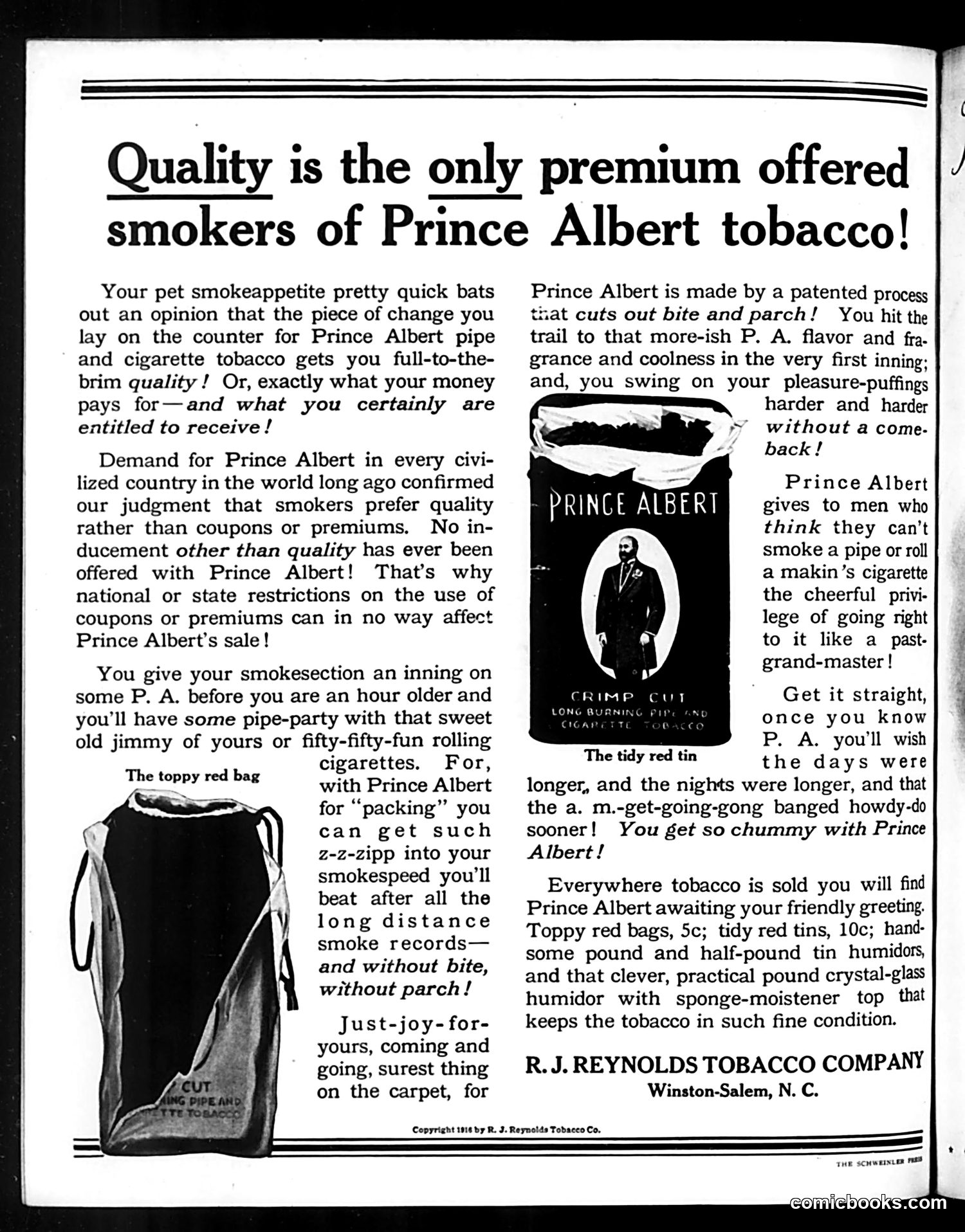
This is a **full-page advertisement**, not satirical content. It promotes Prince Albert tobacco by R.J. Reynolds, emphasizing quality over premiums—a direct marketing claim responding to competitors offering coupons or prizes with purchases. The ad addresses smokers skeptical of value, arguing Prince Albert delivers "full-to-the-brim quality" without gimmicks. It highlights the product's patented process that supposedly eliminates "bite and parch," and features colorful period language ("smokespeed," "smoke records," "chummy"). Visually, it displays the iconic **toppy red bag** and **tidy red tin** packaging, alongside a portrait photograph (unclear if depicting an actual person or branding figure). The copyright date (1916) and *Judge* magazine context suggest this targets the emerging mass-market cigarette audience. The ad's aggressive quality-focus likely counters regulatory restrictions on tobacco premiums—a contemporary political issue—by claiming such restrictions don't affect their sales model.