
Judge, 1916-08-26 · page 17 of 28
Judge — August 26, 1916 — page 17: what you’re looking at
What you’re looking at
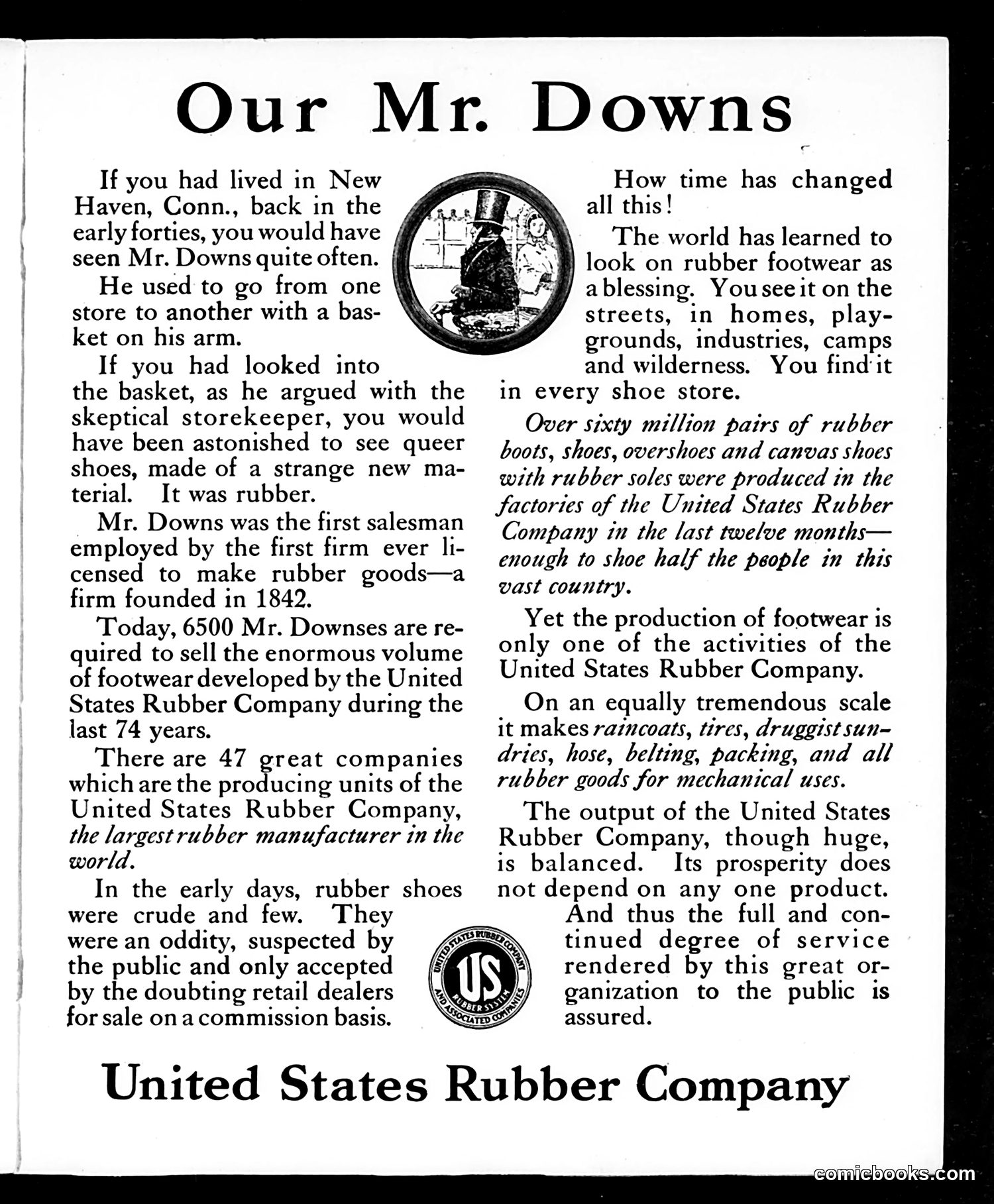
This is **corporate advertising**, not satire. The piece celebrates the United States Rubber Company's growth from a novelty to an industry giant. The narrative centers on "Mr. Downs," the first salesman hired by the original rubber goods firm (founded 1842). He allegedly carried rubber shoes door-to-door in 1840s New Haven, Connecticut, facing skeptical shopkeepers who viewed rubber footwear as a bizarre oddity. The piece uses Downs as a symbol of how far rubber products have come: from suspected novelty to ubiquitous necessity. It boasts that 6,500 modern salesmen now distribute 60+ million pairs annually across streets, homes, playgrounds, and industries. The underlying message: the U.S. Rubber Company transformed public perception and created an entire market. The ad emphasizes the company's scale (47 producing units), diversification (raincoats, tires, belts), and stability—positioning it as economically sound and essential to American life.
📄 Transcribed text from this page (OCR, searchable)
Machine-transcribed from the original scan — historical spelling and the odd misread are preserved.
Our Mr. Downs If you had lived in New Haven, Conn., back in the early forties, you would have | seen Mr. Downs quite often. { He used to go from one store to another with a bas- ket on his arm. If you had looked into the basket, as he argued with the skeptical storekeeper, you would have been astonished to see queer shoes, made of a strange new ma- terial. It was rubber. Mr. Downs was the first salesman employed by the first firm ever li- censed to make rubber goods—a firm founded in 1842. Today, 6500 Mr. Downses are re- quired to sell the enormous volume of footwear developed by the United States Rubber Company during the last 74 years. There are 47 great companies which are the producing units of the United States Rubber Company, the largestrubber manufacturer in the world. In the early days, rubber shoes were crude and few. They were an oddity, suspected by the public and only accepted by the doubting retail dealers for sale on acommission basis. How time has changed all this! The world has learned to look on rubber footwear as ablessing. Youseeit on the streets, in homes, play- grounds, industries, camps and wilderness. You find it in every shoe store. Over sixty million pairs of rubber boots, shoes, overshoes and canvas shoes with rubber soles were produced in the Sactories of the United States Rubber Company in the last twelve months— enough to shoe half the people in this vast country. Yet the production of footwear is only one of the activities of the United States Rubber Company. On an equally tremendous scale it makes raincoats, tires, druggistsun- dries, hose, belting, packing, and all rubber goods for mechanical uses. The output of the United States Rubber Company, though huge, is balanced. Its prosperity does not depend on any one product. And thus the full and con- tinued degree of service rendered by this great or- ganization to the public is assured.