
Judge, 1916-08-26 · page 10 of 28
Judge — August 26, 1916 — page 10: what you’re looking at
What you’re looking at
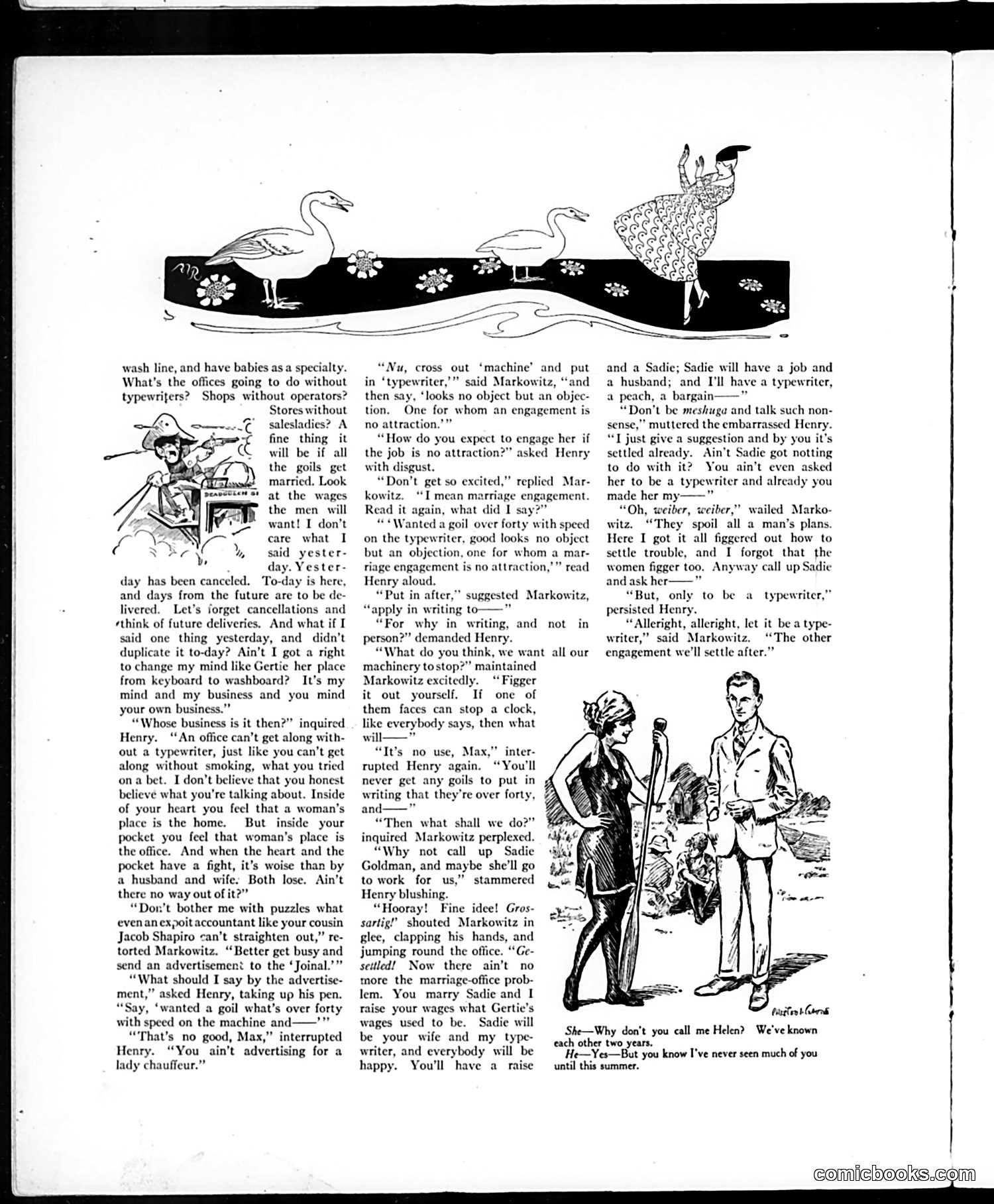
This page satirizes early 20th-century workplace tensions around women's employment. The dialogue between characters Markowitz and Henry concerns typewriter operators—nearly all women then—and fears that if they marry, businesses lose essential workers. The satire works on multiple levels: Henry initially argues women *should* stay home, yet he profits from paying them less than men. When forced to confront this hypocrisy, he blushes. Markowitz's "solution"—Henry marrying his female typist Sadie so she works as both wife *and* unpaid typewriter operator—exposes the absurdity of treating women as interchangeable office machinery. The Yiddish phrases ("Nu," "weiber," "meshuga") indicate the characters are Jewish immigrants, typical for Judge's humor targeting ethnic communities. The cartoon above shows fashionable women, likely mocking contemporary "modern woman" anxieties. The joke ultimately critiques how employers viewed women's labor: replaceable, exploitable, and naturally belonging in domestic rather than professional roles.
📄 Transcribed text from this page (OCR, searchable)
Machine-transcribed from the original scan — historical spelling and the odd misread are preserved.
wash line, and have babies asa specialty. What's the offices going to do without typewriters? Shops without operators? Stores without salesladies? A fine thing it will be if all the goils get married. Look at the wages the men_ will want! I don’t care what I said yester- day. Yester- day has been canceled. To-day is here, and days from the future are to be de- livered. Let's forget cancellations and ‘think of future deliveries, And what if I said one thing yesterday, and didn’t duplicate it to-day? Ain’t I got a right to change my mind like Gertie her place from keyboard to washboard? It’s my mind and my business and you mind your own busine: “Whose business is it then?” inquired Henry. “An office can’t get along with- out a typewriter, just like you can’t get along without smoking, what you tried ona bet. I don’t believe that you honest believe what you're talking about. Inside of your heart you feel that a woman's place is the home. But inside your pocket you feel that woman's place is the office. And when the heart and the pocket have a fight, it’s woise than by a husband and wife. Both lose. Ain’t there no way out of it?” “Don’t bother me with puzzles what even an expoit accountant like your cousin Jacob Shapiro can’t straighten out,” re- torted Markowitz. “Better get busy and send an advertisement to the ‘Joinal.’” “What should I say by the advertise- ed Henry, taking up his pen. y, ted a goil what's over forty with speed on the machine and——’” “That’s no good, Max,” interrupted Henry. “You ain’t advertising for a lady chauffeur.” “Nu, cross out ‘machine’ a said Markowi s no object bu - whom an engagement is tion. no attraction. “How do you expect to engage her if the job is no attraction?” asked Henry with disgust. “Don’t get so excited,” replied Mar- kowitz. Ti engagement. Read ii in, what did I s “Wanted a goil over forty with speed on the typewriter, good looks no object but an objection, one for whom a mar- riage engagement is no attraction,’” read Henry aloud. “Put in after “apply in writing to- For why in writing, and person?” demanded Henry. “What do you think, we want all our machinery tostop?” maintained Markowitz excitedly.“ Figger it out yourself. If one of them faces can stop a clock, like everybody says, then what will " “It’s no use, Max,” inter- rupted Henry again. “You'll never get any goils to put in writing that they're over forty, and——” “Then what shall we do?” inquired Markowitz perplexed. “Why not call up Sadie Goldman, and maybe she'll go to work for us,” stammered Henry blushing. “Hooray! Fine idee! Gros- sartig!’ shouted Markowitz in glee, clapping his hands, and jumping round the office. “Ge- settled! Now there ain’t no more the marriage-office prob- lem. You marry Sadie and I raise your wages what Gertie’s wages used to be. Sadie will be your wife and my. type- writer, and everybody will be happy. You'll have a_ raise * suggested Markowitz, not in and a Sadie; Sadie will have a job and a husband; and I'll have a typewriter, a peach, a bargain——” “Don't be meshuga and talk such non- sense,” muttered the embarrassed Henry. “T just give a suggestion and by you it’s settled al in’t Sadie got notting to do with You ain't even asked her to be a typewriter and already you made her my —” “Oh, weiber, weiber,” wailed Marko- witz. “They spoil all a man’s plans. Here I got it all figgered out how to settle trouble, and I forgot that the women figger too. Anyway call up Sadie and ask her- ot “But, only to be a persisted Henry. “Alleright, alleright, let it be a type- writer,” said Markowitz. “The other engagement we'll settle after.” typewriter,” She—Why don't you call me Helen? We've known each other two years. . le—Yes—But you know I've never seen much of you until this summer. comichooks.