
Judge, 1916-08-26 · page 9 of 28
Judge — August 26, 1916 — page 9: what you’re looking at
What you’re looking at
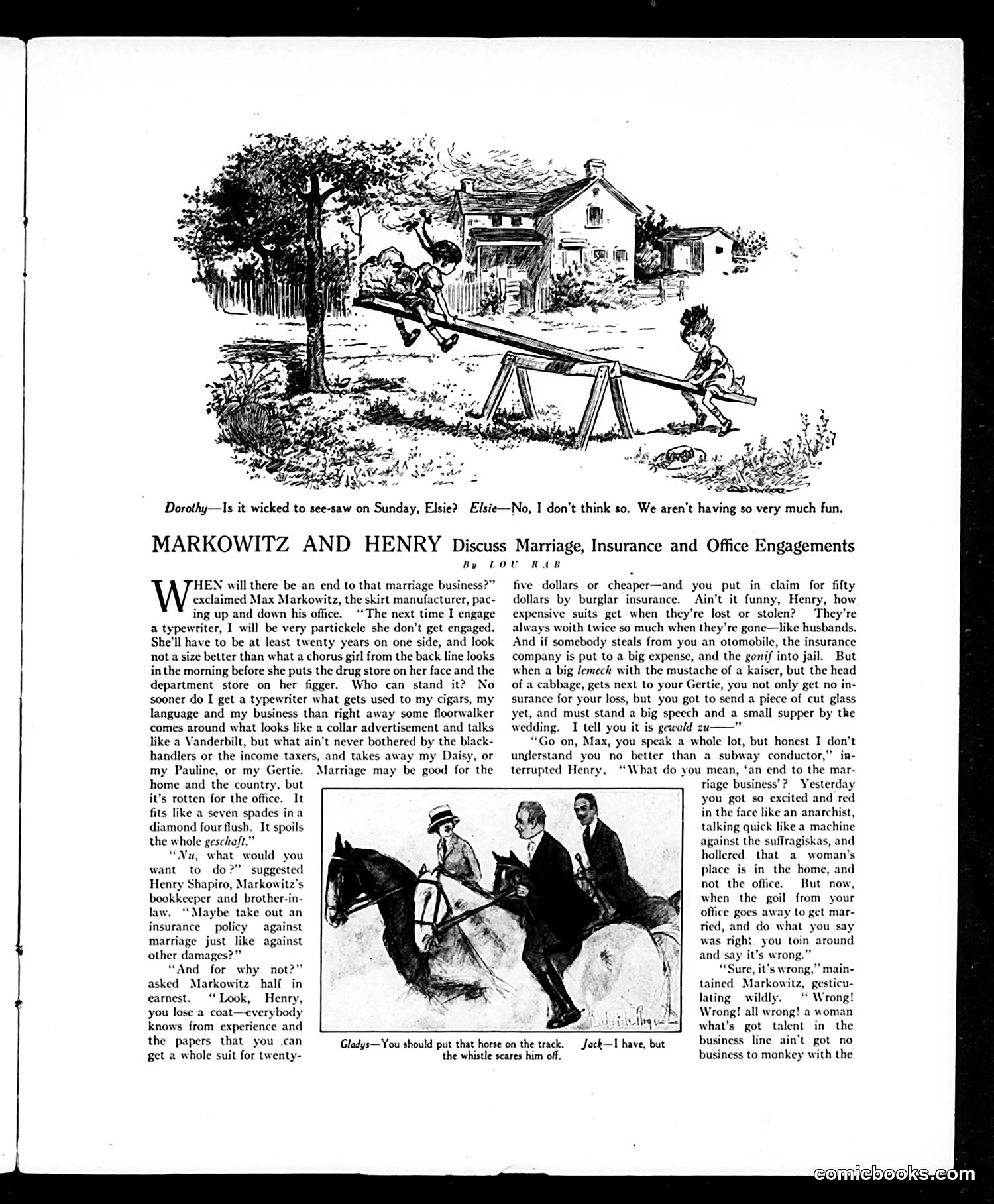
This page from *Judge* magazine contains two distinct pieces of humor: **The Seesaw Cartoon (top):** A simple joke about children on a seesaw. One girl asks if it's "wicked" to seesaw on Sunday (when religious observance traditionally restricted recreational activities). The punchline—"We aren't having so very much fun"—mocks the Puritan work ethic: the girls find the activity so dull it barely counts as enjoyment anyway. **"Markowitz and Henry" (main story):** A satirical dialogue between two Jewish businessmen (identifiable by names and Yiddish expressions like "geschaft" and "gonif") discussing marriage as an uninsurable loss. Markowitz complains that when employees marry, they leave unexpectedly—unlike stolen goods, which insurance covers. He sarcastically suggests "marriage insurance." The satire targets both: (1) turn-of-the-century gender anxieties about women in the workplace, and (2) the immigrant Jewish business community's practical, mercantile approach to life's problems. The humor relies on ethnic dialect and stereotypes common to *Judge's* era.
📄 Transcribed text from this page (OCR, searchable)
Machine-transcribed from the original scan — historical spelling and the odd misread are preserved.
Dorothy—Is it wicked to see-saw on Sunday, Elsie? Elsie—No, I don’t think so. We aren't having so very much fun. MARKOWITZ AND HENRY Discuss Marriage, Insurance and Office Engagements By Lou HEN will there be an end to that marriage business?” exclaimed Max Markowitz, the skirt manufacturer, pac- ing up and down his office. ‘The next time I engage r, I will be very partickele she don’t get engaged. She'll have to be at least twenty years on one side, and look not a size better than what a chorus girl from the back line looks in the morning before she puts the drug store on her face and the department store on her figger. Who can stand it? No sooner do I get a typewriter what gets used to my cigars, my language and my business than right away some floorwalker comes around what looks like a collar advertisement and talks like a Vanderbilt, but what ain’t never bothered by the black- handlers or the income taxers, and takes a’ my Daisy, or my Pauline, or my Gertic. Marriage may be good for the home and the country, but RAB five dollars or cheaper—and you put in claim for fifty dollars by burglar insurance. Ain’t it funny, Henry, how expensive suits get when they're lost or stolen? They're always woith twice so much when they're gone—like husbands. And if somebody steals from you an otomobile, the insurance company is put to a big expense, and the gonif into jail. But when a big /emech with the mustache of a kaiser, but the head of a cabbage, gets next to your Gertie, you not only get no in- surance for your loss, but you got to send a piece of cut glass yet, and must stand a big speech and a small supper by the wedding. I tell you it is gewald zu: ” 30 on, Max, you speak a whole lot, but honest I don't ungerstand you no better than a subway conductor,” in- terrupted Henry. “What do you mean, ‘an end to the mar- riage business’? Yesterday it’s rotten for the office. It fits like a seven spades ina diamond four flush. It spoils the whole geschaft.”” “Nu, what would you want to do?” suggested Henry Shapiro, Markowitz’ bookkeeper and brother-in- law. ‘Maybe take out an insurance policy against marriage just like against other damages?” “And for why not?” asked Markowitz half in earnest. ‘Look, Henry, you lose a coat—everybody knows from experience and the papers that you .can get a whole suit for twenty- Gladys—You should put that horse on the track. the whistle scares him off. you got so excited and red in the face like an anarchist, talking quick like a machine against the suffragiskas, and hollered that a woman's place is in the home, and not the office. But now, when the goil from your office goes away to get mar- ried, and do what you say was right. you toin around and say it’s wrong.” “Sure, it’s wrong,” main- tained Markowitz, gesticu- lating wildly.‘ Wrong! Wrong! all wrong! a woman what’s got talent in the business line ain't got no business to monkey with the Jock—1 have, but