
Judge, 1916-08-26 · page 16 of 28
Judge — August 26, 1916 — page 16: what you’re looking at
What you’re looking at
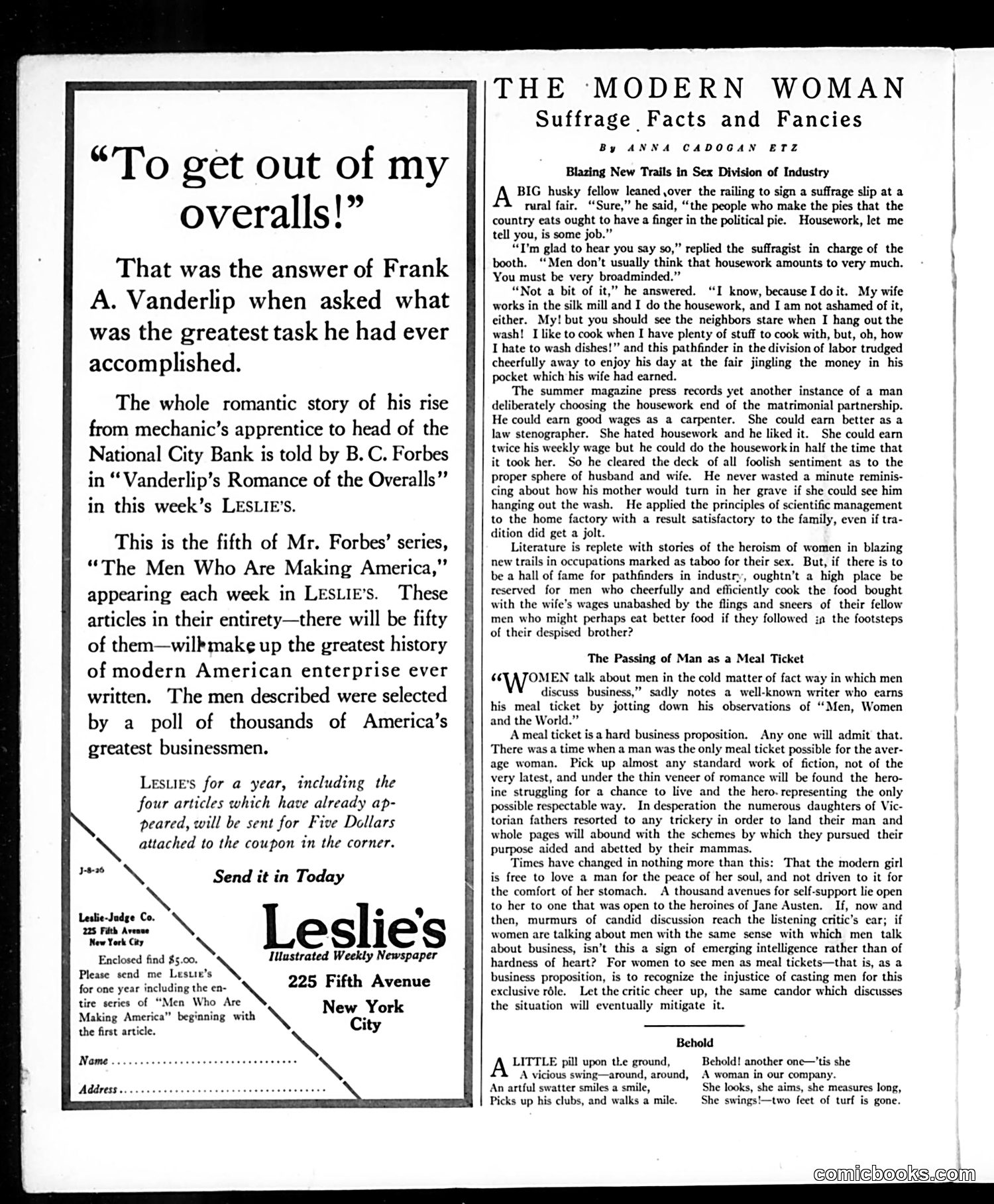
This page contains two distinct sections: **Left Side - Advertisement/Feature:** Promotes B.C. Forbes's series "The Men Who Are Making America" in Leslie's Illustrated Weekly. It profiles Frank A. Vanderlip, who rose from mechanic's apprentice to head of National City Bank. The quote "To get out of my overalls!" represents his greatest achievement—social mobility through hard work. This celebrates American entrepreneurship and the self-made man narrative popular in early 20th-century business journalism. **Right Side - Opinion Column:** Anna Cadogan Etz discusses women's suffrage and changing gender roles in work. She argues that housework deserves political recognition and celebrates men who do domestic labor without shame, citing examples of couples rationally dividing labor (wife earning wages, husband managing household). The piece critiques outdated gender conventions while framing economic efficiency as progressive. Both sections reflect early-1900s debates about women's rights, labor, and traditional gender roles.
📄 Transcribed text from this page (OCR, searchable)
Machine-transcribed from the original scan — historical spelling and the odd misread are preserved.
“To get out of my ” ! overalls That was the answer of Frank A. Vanderlip when asked what was the greatest task he had ever accomplished. The whole romantic story of his rise from mechanic’s apprentice to head of the National City Bank is told by B. C. Forbes in “Vanderlip’s Romance of the Overalls” in this week’s LESLIE'S. This is the fifth of Mr. Forbes’ series, “The Men Who Are Making America,” appearing each week in LESLIE’s. These articles in their entirety—there will be fifty of them—wilbmake up the greatest history of modern American enterprise ever written. The men described were selected by a poll of thousands of America’s greatest businessmen. Lestiz’s for a year, including the four articles which have already ap- peared, will be sent for Five Dollars \ attached to the coupon in the corner. me N Send it in Today pied Leslie's 25 Filth Avene New York City Illustrated Weekly Newspaper Enclosed find $5.00. Please send me Dsce’s \ for one year including the en- \ 225 Fifth Avenue tire series of “Men Who Are Making America” beginning with \ aay York the first article, ity \ THE MODERN WOMAN Suffrage Facts and Fancies By ANNA CADOGAN ETZ Blazing New Trails in Sex Division of Industry A BIG husky fellow leaned ,over the railing to sign a suffrage slip at a rural fair. “Sure,” he said, “the people who make the pies that the country eats ought to have a finger in the political pie. Housework, let me tell you, is some job.” “T'm glad to hear you say so,” replied the suffragist in charge of the booth. “Men don’t usually think that housework amounts to very much. You must be very broadminded.” “Not a bit of it,” he answered. “I know, because I doit. My wife works in the silk mill and I do the housework, and I am not ashamed of it, either. My! but you should see the neighbors stare when I hang out the wash! I like to cook when I have plenty of stuff to cook with, but, oh, how I hate to wash dishes!” and this pathfinder in the division of labor trudged cheerfully away to enjoy his day at the fair jingling the money in his pocket which his wife had earned. The summer magazine press records yet another instance of a man deliberately choosing the housework end of the matrimonial partnership. He could earn good wages as a carpenter. She could earn better as a law stenographer. She hated housework and he liked it. She could earn twice his weekly wage but he could do the housework in half the time that it took her. So he cleared the deck of all foolish sentiment as to the proper sphere of husband and wife. He never wasted a minute reminis- cing about how his mother would turn in her grave if she could see him hanging out the wash. He applied the principles of scientific management to the home factory with a result satisfactory to the family, even if tra- dition did get a jolt. Literature is replete with stories of the heroism of women in blazing new trails in occupations marked as taboo for their sex. But, if there is to be a hall of fame for pathfinders in industry, oughtn’t a high place be reserved for men who cheerfully and efficiently cook the food bought with the wife’s wages unabashed by the flings and sneers of their fellow men who might perhaps eat better food if they followed in the footsteps of their despised brother? The Passing of Man as a Meal Ticket “ OMEN talk about men in the cold matter of fact way in which men discuss business,” sadly notes a well-known writer who earns his meal ticket by jotting down his observations of ‘Men, Women and the World.” A meal ticket is a hard business proposition. Any one will admit that. There was a time when a man was the only meal ticket possible for the aver- age woman. Pick up almost any standard work of fiction, not of the very latest, and under the thin veneer of romance will be found the hero- ine struggling for a chance to live and the hero. representing the only possible respectable way. In desperation the numerous daughters of Vic- torian fathers resorted to any trickery in order to land their man and whole pages will abound with the schemes by which they pursued their purpose aided and abetted by their mammas. Times have changed in nothing more than this: That the modern girl is free to love a man for the peace of her soul, and not driven to it for the comfort of her stomach. A thousand avenues for self-support lie open to her to one that was open to the heroines of Jane Austen. If, now and then, murmurs of candid discussion reach the listening critic’s car; if women are talking about men with the same sense with which men talk about business, isn’t this a sign of emerging intelligence rather than of hardness of heart? For women to see men as meal tickets—that is, as a business proposition, is to recognize the injustice of casting men for this exclusive réle. Let the critic cheer up, the same candor which discusses the situation will eventually mitigate it. Behold A LITTLE pill upon the ground, | Behold! another one—"'tis she A vicious swing—around, around, A woman in our company. She looks, she aims, she measures long, She swings!—two feet of turf is gone. An artful swatter smiles a smile, Picks up his clubs, and walks a mile. comichooks.com