
A complete issue · 28 pages · 1916
Judge — July 15, 1916
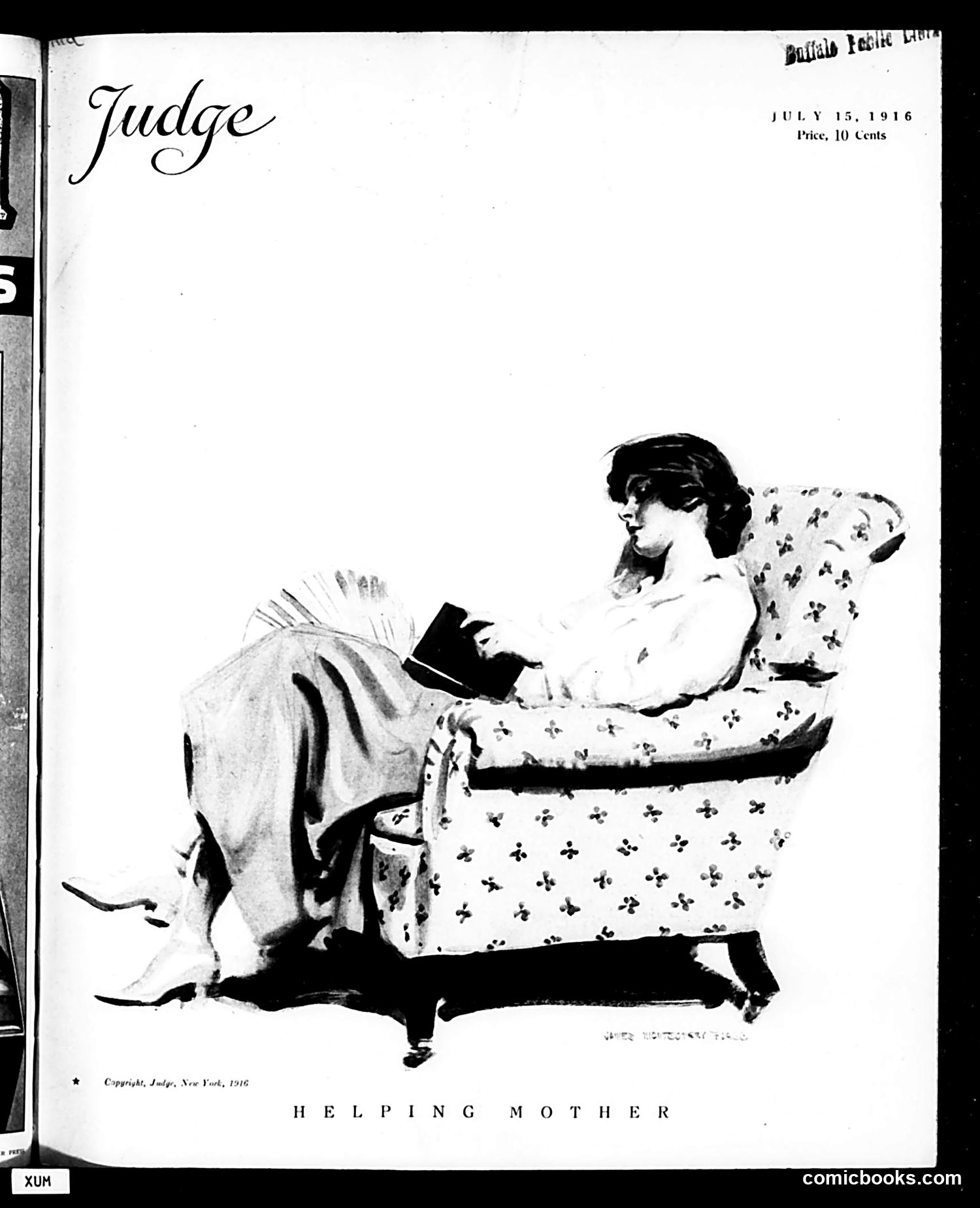
This illustration depicts a woman reclining on a patterned sofa, reading what appears to be a book or magazine while her legs are propped up. The title "Helping Mother" suggests ironic commentary on domestic labor during this era. The satire likely critiques the gap between women's claimed contributions to household work versus actual leisure. In 1916, amid evolving women's roles and emerging suffrage debates, this cartoon probably mocks either: 1. A woman's self-perception of "helping" while relaxing 2. Middle-class women's limited domestic responsibilities compared to working-class mothers 3. The contradiction between feminist rhetoric about women's labor and privileged women's actual activities The humor relies on the visual contradiction between the title's implication of work and the figure's obvious leisure.
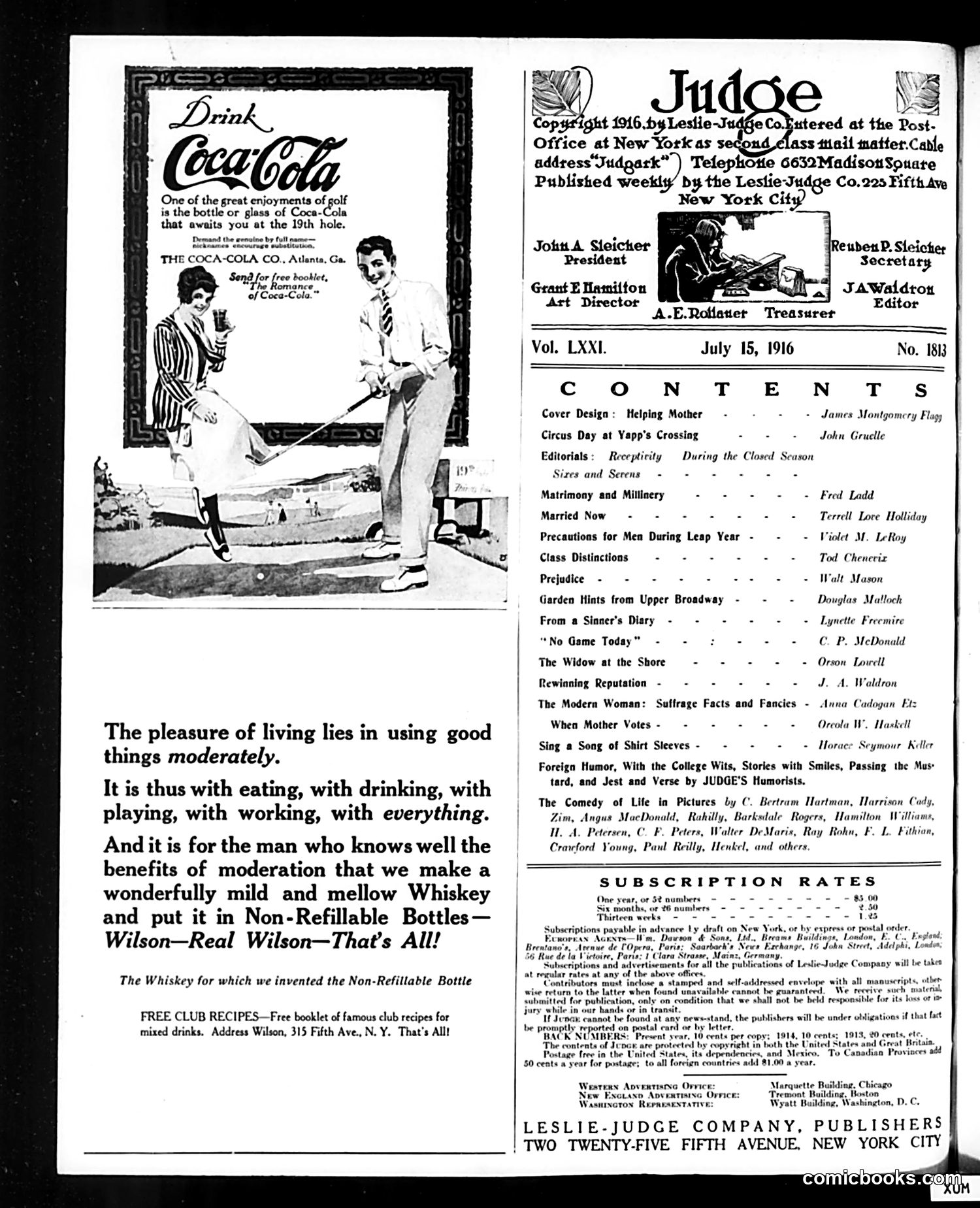
This page contains two unrelated advertisements rather than satirical cartoons. **Left side:** A Coca-Cola ad depicting a couple playing golf, promoting the drink as refreshment at the 19th hole. The ad references "The Romance of Coca-Cola" and is fairly straightforward product marketing. **Right side:** A Wilson whiskey advertisement emphasizing moderation—"The pleasure of living lies in using good things *moderately*." The ad promotes Wilson's "Non-Refillable Bottle" as a mild, mellow whiskey. This likely reflects Progressive Era concerns about alcohol consumption and temperance debates prevalent in 1916 America, with the company positioning their product as responsible drinking for gentlemen. Both ads target upper-class leisure activities and masculine consumption. The magazine itself was published by Leslie-Judge Co. in New York City.
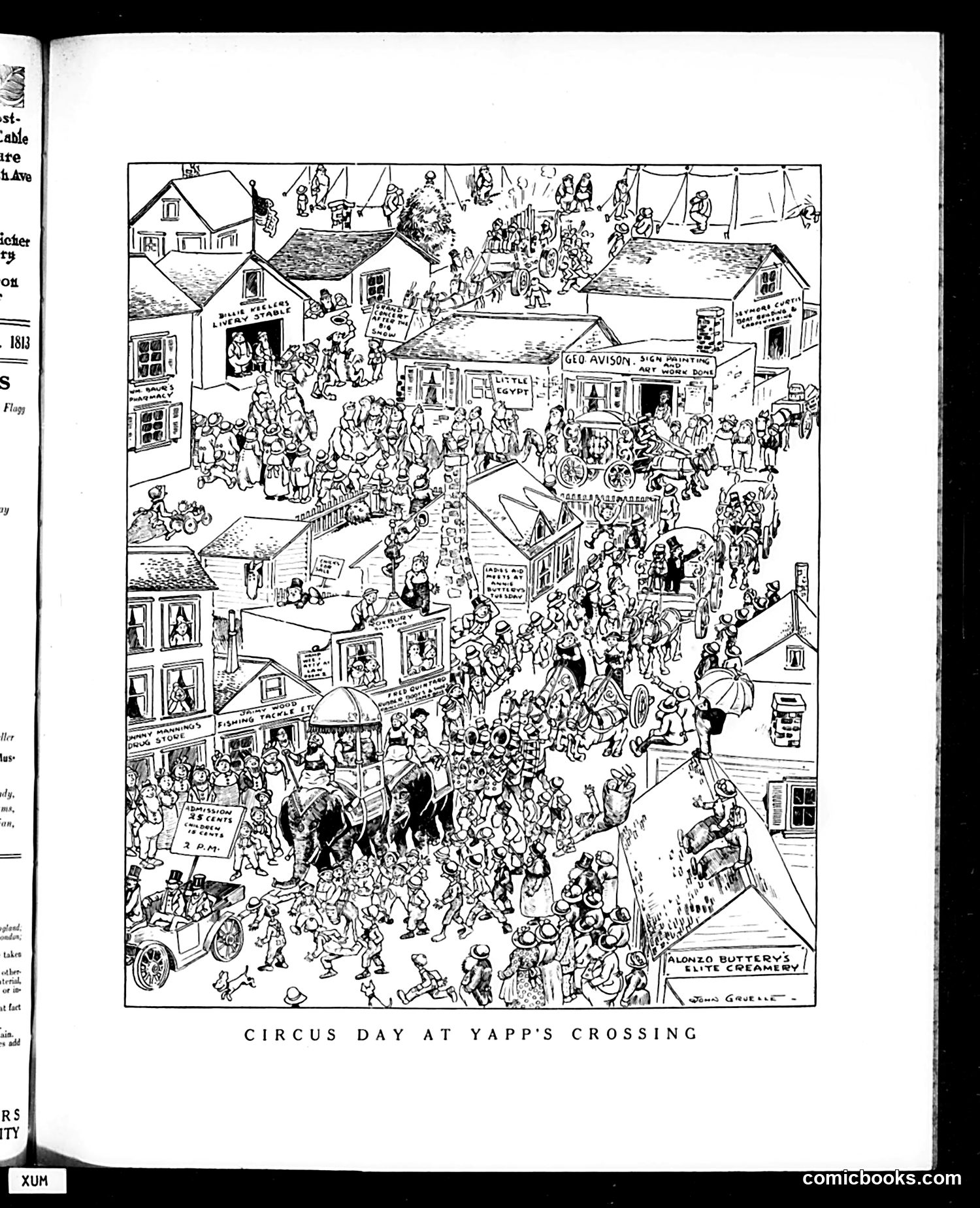
This is a densely populated satirical illustration by John Gruelle depicting a chaotic fair or circus arrival in a small town. The cartoon shows the bustling confusion of a circus coming to "Yapp's Crossing"—likely a fictional rural community. The humor derives from the crowded disorder: street vendors, townspeople, animals, vehicles, and attractions overwhelm the modest buildings and streets. Shop signs visible include references to various businesses and attractions. The illustration captures the excitement and pandemonium surrounding a major entertainment event arriving in provincial America, satirizing both the spectacle-hungry public and the commercial disruption such events caused to quiet communities. The artist's signature and the publication's title appear clearly at the bottom of the composition.
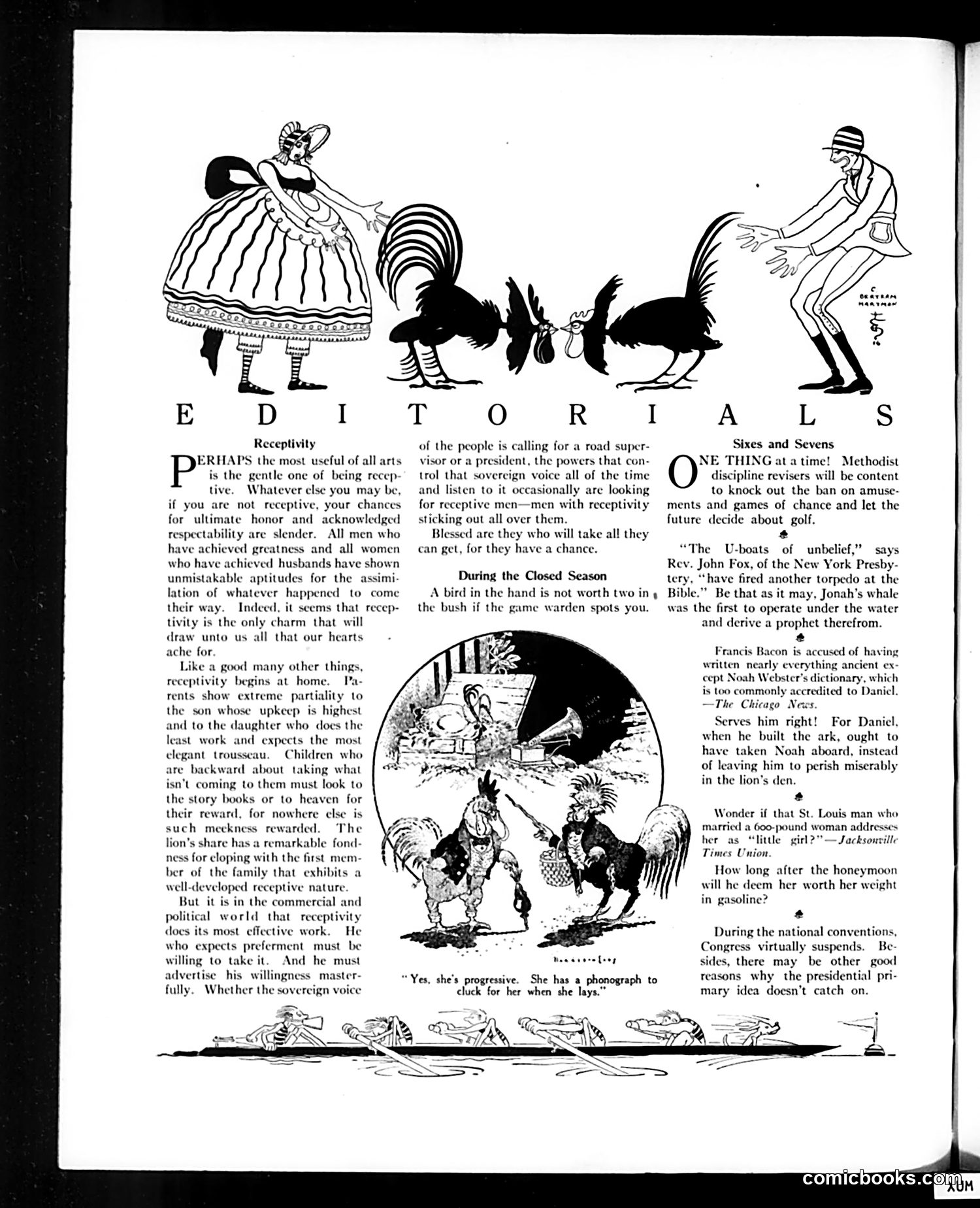
The top cartoon titled "EDITORIALS" uses animal imagery to satirize political receptivity. The figures appear to represent different approaches to leadership: a woman in elaborate dress (possibly symbolizing old-fashioned or aristocratic governance), roosters and birds (likely representing political figures or policies), and a man in modern dress attempting to manage them. The accompanying editorial text argues that receptivity—being willing to listen and take advice—is essential for political leaders. It criticizes those seeking a "road super-visor or president" who won't listen to citizens, suggesting that effective leadership requires openness to public input. The lower illustrations appear to be unrelated humorous anecdotes rather than political commentary.
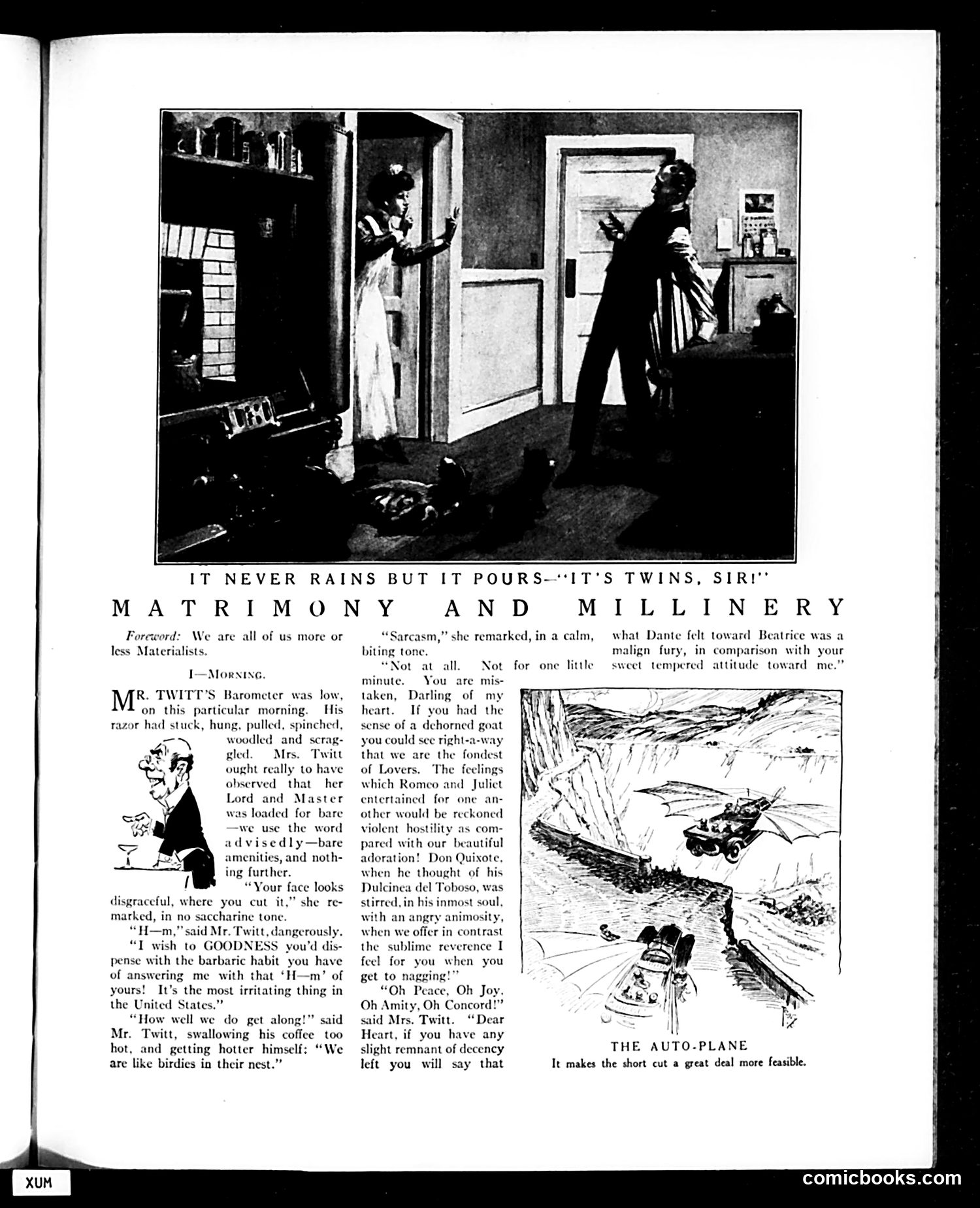
This page satirizes marital discord through Mr. and Mrs. Twitt's morning quarrel. Mr. Twitt's grooming has failed him—his razor is stuck and his appearance is shabby—putting him in a foul mood. Mrs. Twitt responds with biting sarcasm when he criticizes her, comparing his "bare amusement" unfavorably to grand literary loves like Romeo and Juliet, or even Don Quixote's devotion to Dulcinea. The joke targets both spouses: his slovenly negligence and her sharp tongue. The "millinery" reference likely alludes to women's fashion and spending, a common satirical target. The sidebar illustration of an "auto-plane" appears unrelated, possibly advertising. The satire mocks ordinary middle-class married life as mundane and contentious—a stark contrast to romantic ideals.
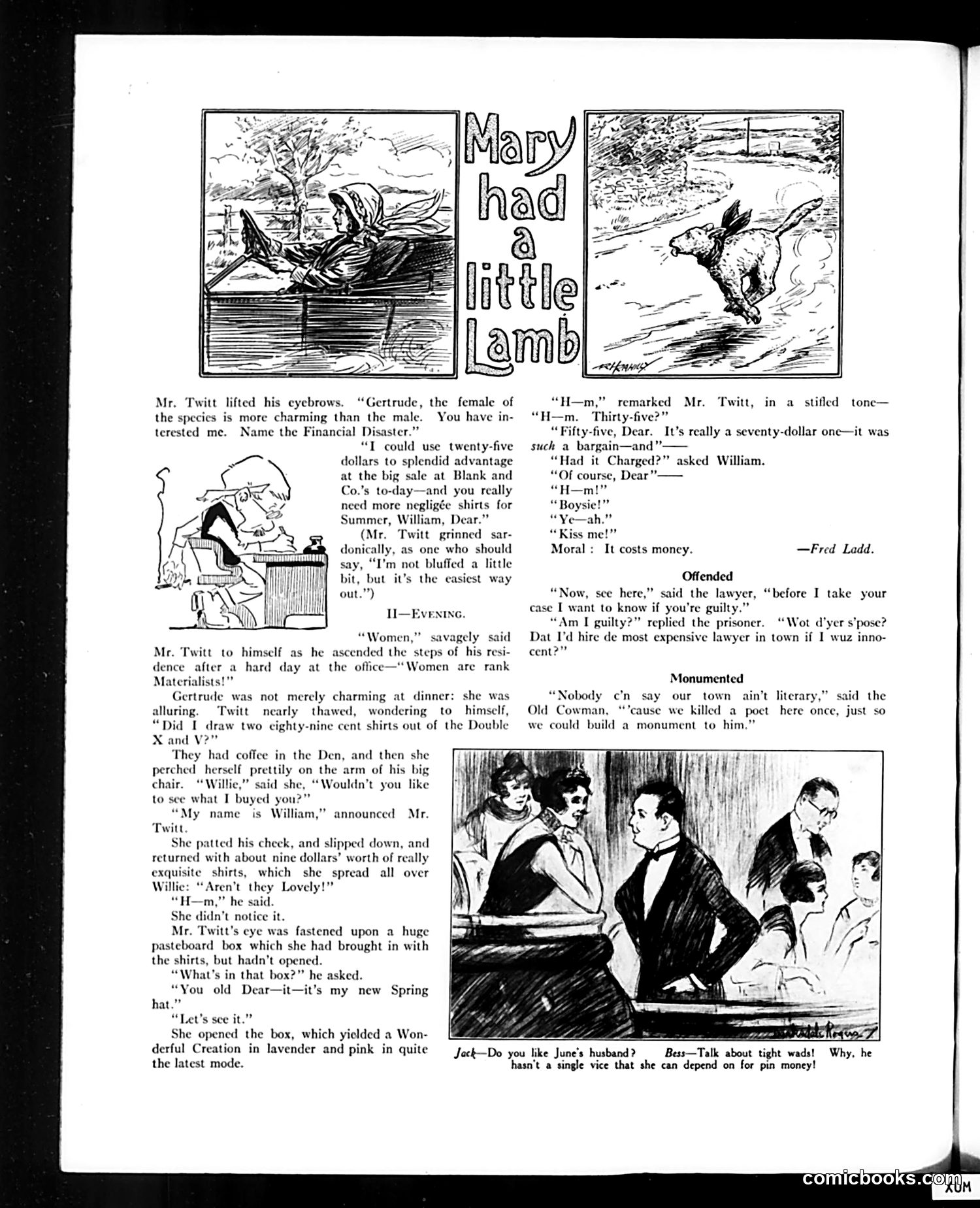
This page from *Judge* satirizes married couples and financial dynamics through several vignettes featuring Mr. and Mrs. Twitt. **Main narrative**: Mr. Twitt, attempting to resist his wife's spending, watches her charm him into accepting her purchases. The satire targets wives as "rank Materialists" who manipulate husbands through affection and expensive purchases (hats, negligée shirts, charged items). The repeated pattern—she requests money, he objects, she charms him—depicts wives as calculatingly materialistic. **Supporting cartoons** mock similar themes: a lawyer questions whether a defendant can afford him (implying guilt), and a small town builds a monument to a dead poet (ironic civic pride). **The final joke** mocks miserly husbands who provide no spending money. The satire reflects early-20th-century anxieties about women's consumer power and marital control, presenting wives as manipulative spenders and husbands as reluctant financial providers. It's gender-stereotyping humor typical of the era's men's magazines.
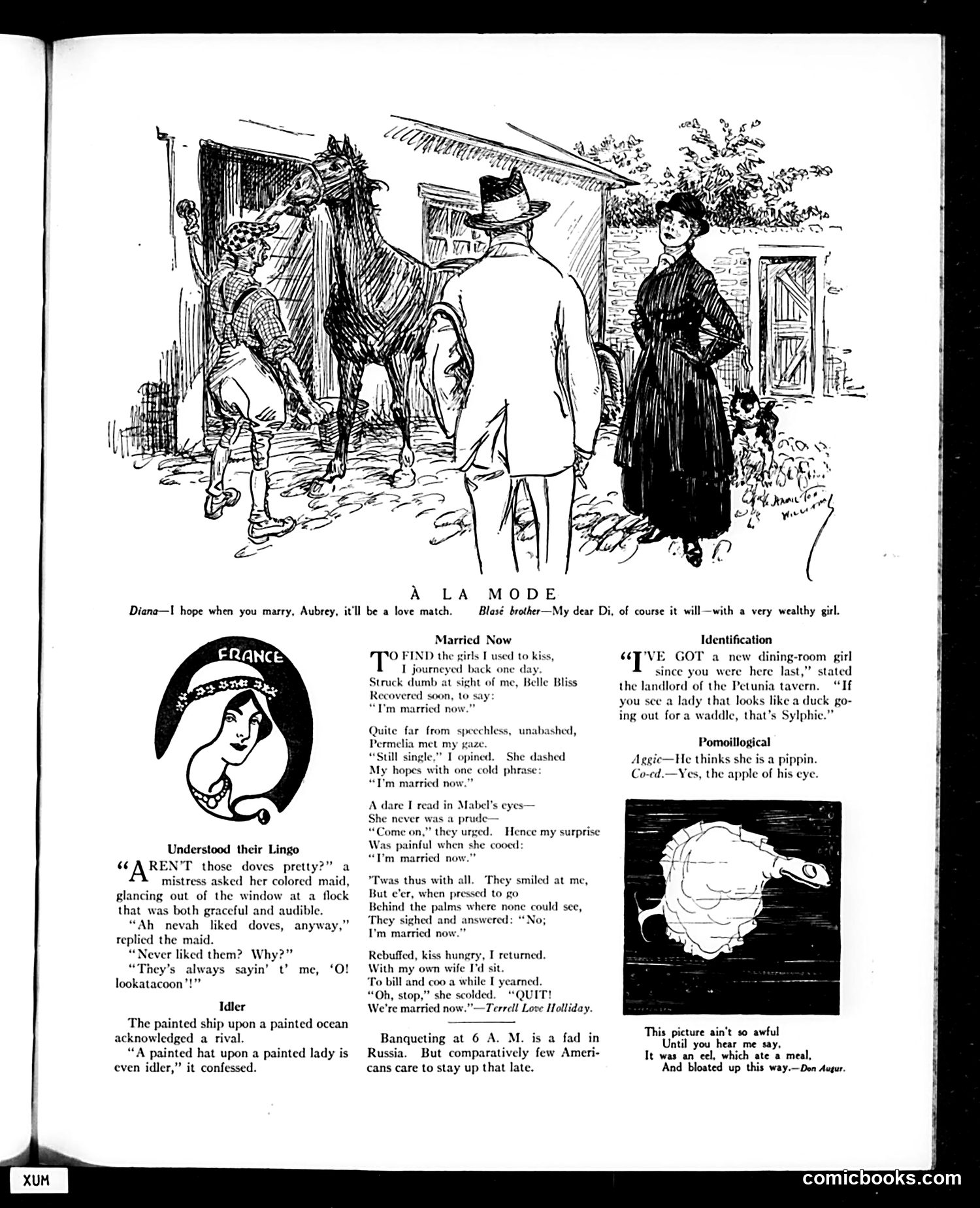
This Judge magazine page contains several satirical pieces reflecting early 20th-century attitudes: **"A La Mode" (top cartoon):** A wealthy woman hopes her son marries for love rather than money—satirizing how marriage among the upper classes was often transactional. **"Understood their Lingo":** A racist joke playing on a maid's supposed misunderstanding of the word "coon" (a raccoon). The humor relies on ethnic stereotyping common to the era. **"Married Now":** A poem about a man's romantic nostalgia—he visits old flames only to discover they're all married, then returns home where even his own wife refuses his affections. The joke mocks his disappointment. **"Idler" and other brief quips:** Miscellaneous witticisms about fashion and social behavior. **"Identification" and "Pomoilogical":** Brief comedic observations about tavern life and romantic interest. The page's humor depends heavily on period stereotypes, gender roles, and social class assumptions that would be considered offensive today.
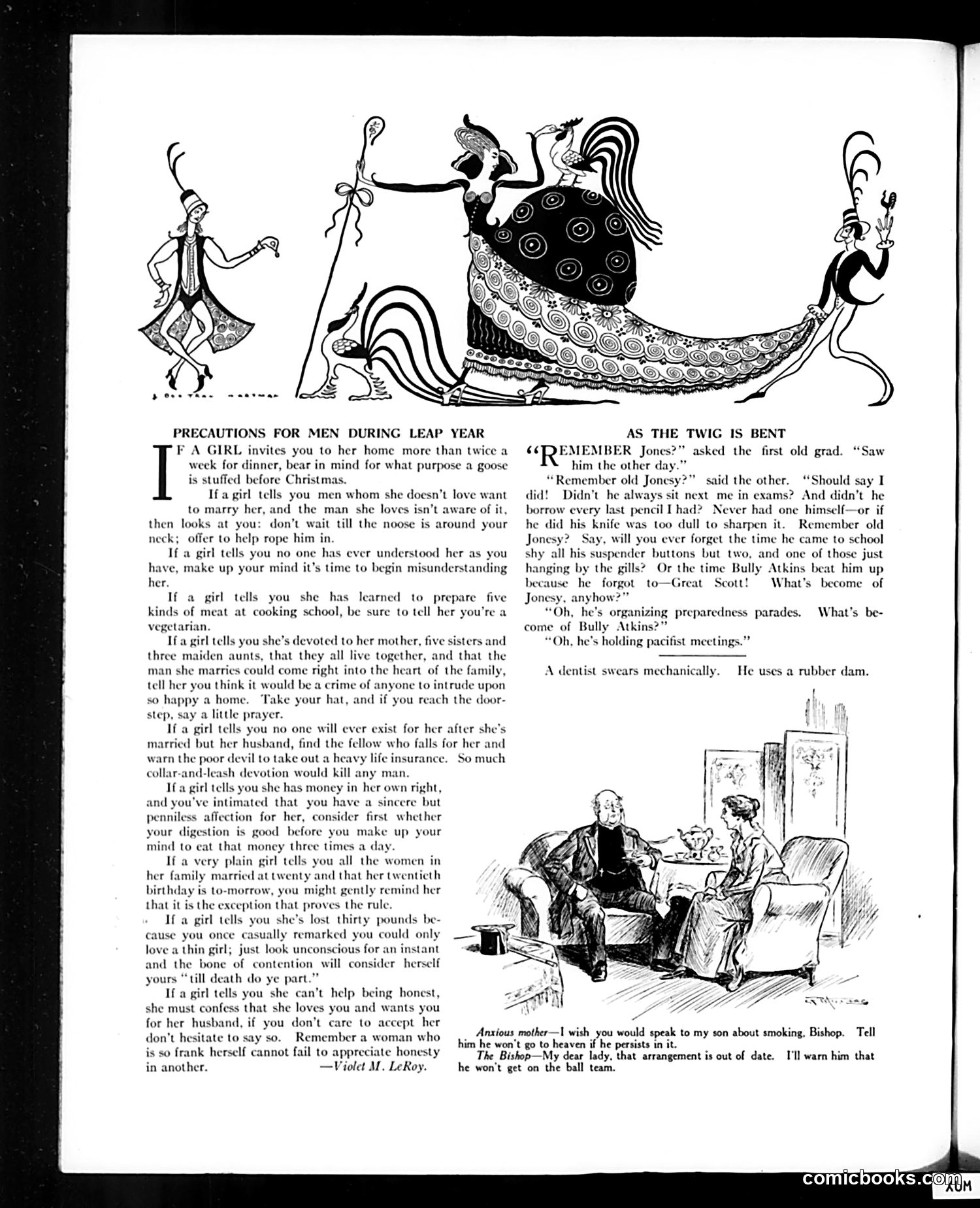
This page contains satirical advice targeting men during leap year—when tradition held that women could propose to men. The top section offers tongue-in-cheek "precautions" warning men about female manipulation tactics: girls who cook, claim devotion, or mention their marriageability are depicted as matrimonial traps. The humor relies on portraying women as scheming and duplicitous. The "As the Twig Is Bent" cartoon contrasts two former schoolmates: the troublemaking "Jonesy" (who borrowed pencils, was disheveled, and got beaten up) has become a pacifist organizer, while the bully "Bully Atkins" now organizes "preparedness parades"—military readiness campaigns. This satirizes how World War I-era political positions seemed to reverse traditional character expectations. The dentist and bishop jokes are separate, unrelated quips. The overall tone reflects early 1900s attitudes toward women, courtship, and emerging military/pacifist debates.
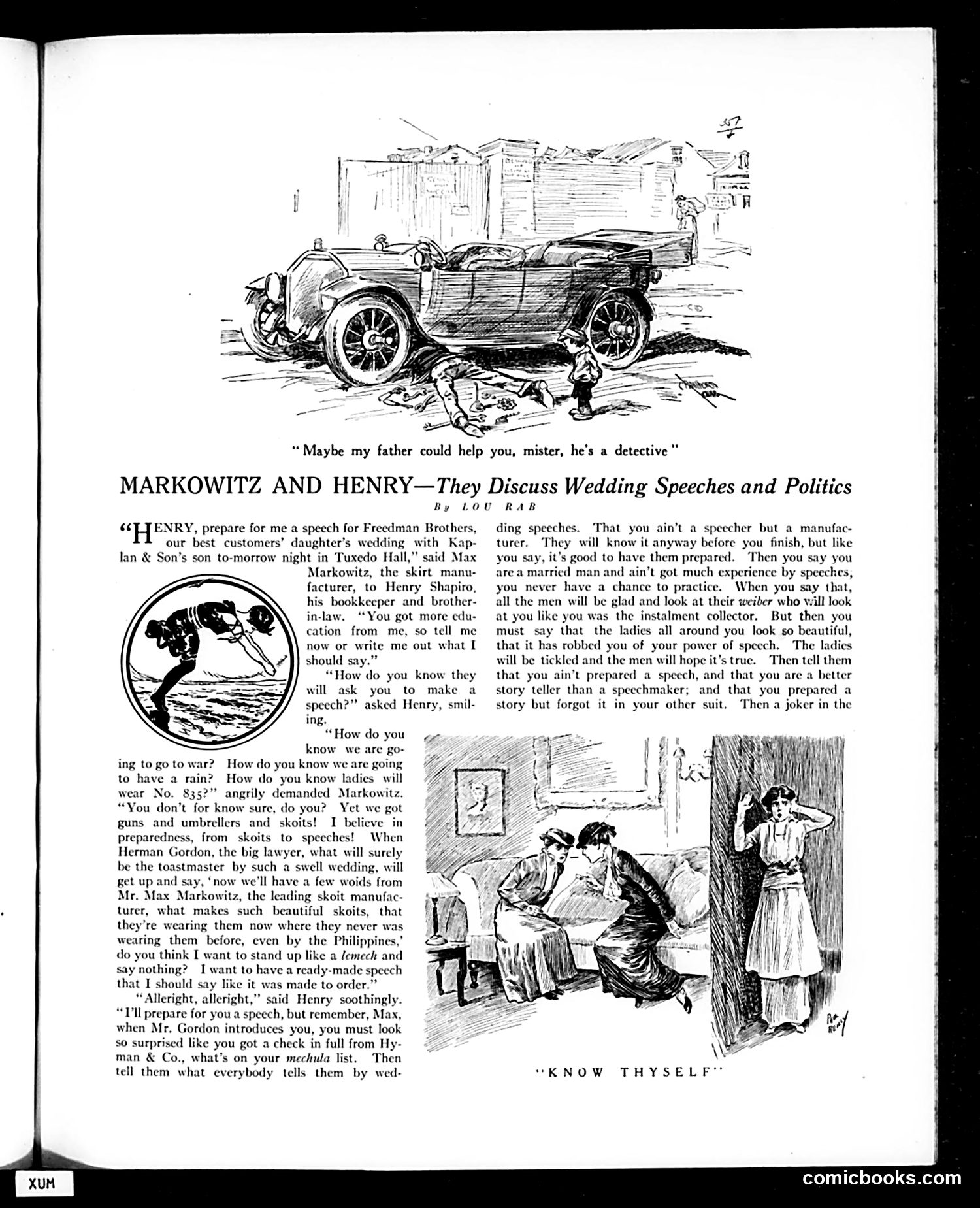
This page satirizes early 20th-century Jewish-American immigrant culture through two Jewish characters—Max Markowitz (a skirt manufacturer) and Henry Shapiro (his bookkeeper brother-in-law)—discussing wedding speech etiquette. The humor derives from their Yiddish-influenced English ("skoits" for skirts, "weiber" for women, "mechula list") and Max's anxious, over-prepared personality. He conflates trivial concerns (whether ladies will wear a particular skirt style) with major unknowns (war, rain), using this to justify obsessive speech preparation. Henry's advice mocks conventional wedding speech clichés: claiming you're "not a speaker," complimenting the ladies' beauty to "rob you of speech," and pretending you forgot your prepared remarks while claiming spontaneity. The accompanying cartoon about a detective joke provides comic relief but appears disconnected from the main narrative. The satire gently ridicules both immigrant anxiety about social propriety and the hollowness of wedding speech conventions.
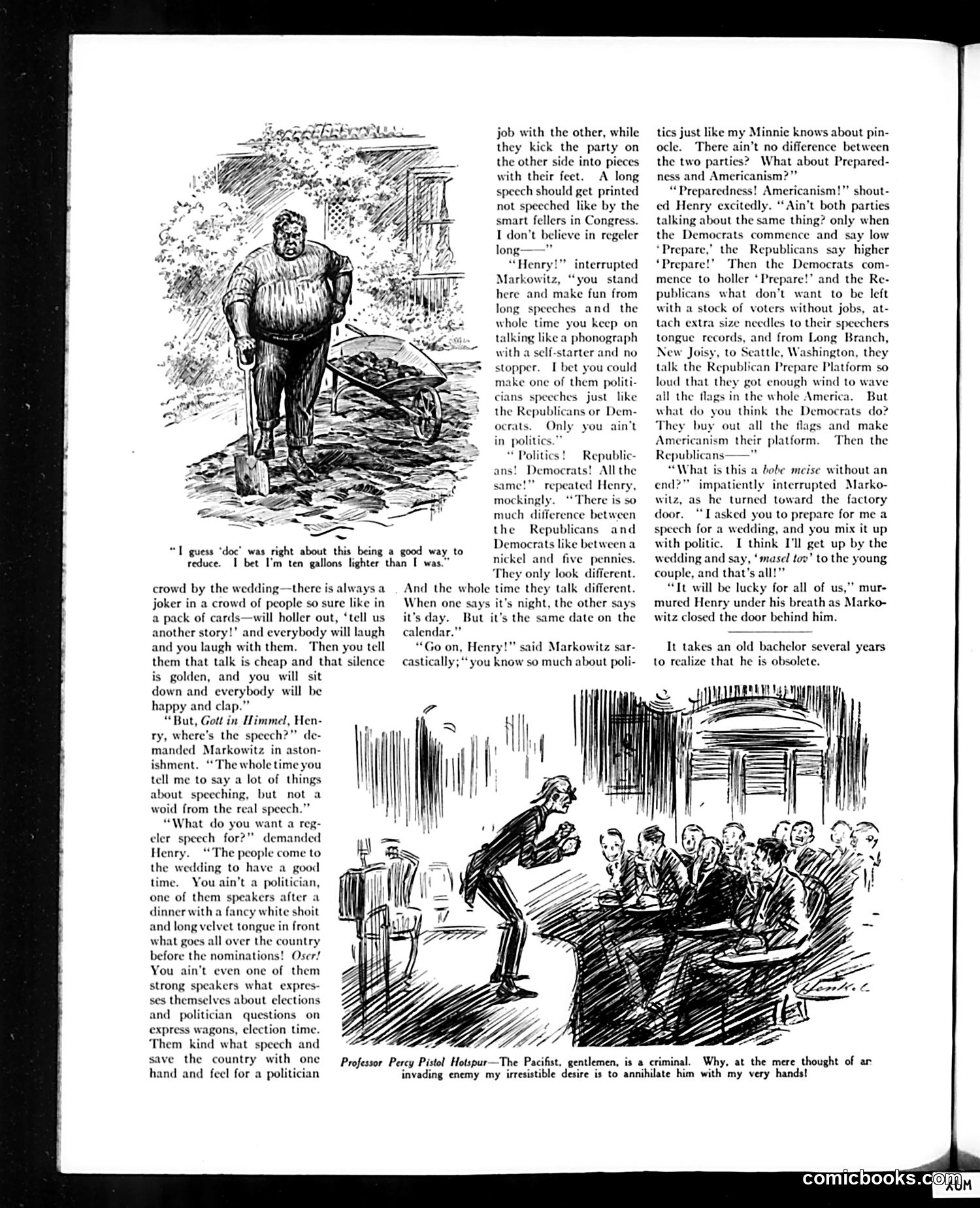
This page satirizes American political speech-making through dialogue between Henry (an immigrant) and Markowitz, who asks Henry to write a wedding speech. Henry mocks politicians' verbose, meaningless rhetoric—comparing Republicans and Democrats as indistinguishable (like "a nickel and five pennies"). He ridicules how both parties use identical tactics: one says "night," the other "day," but it's the same date. Both employ flag-waving patriotism and talk endlessly about "Preparedness" and "Americanism" while disagreeing only theatrically. The satire targets **early 20th-century political posturing**, particularly regarding preparedness debates (likely WWI-era military readiness). Henry's Yiddish-inflected English reinforces the immigrant perspective critiquing American political hypocrisy. The lower cartoon appears to mock a "pacifist" professor, contrasting peaceful rhetoric with violent impulses. **Point**: American politicians are interchangeable frauds who obscure identical positions with bombastic, lengthy speeches and patriotic window-dressing.
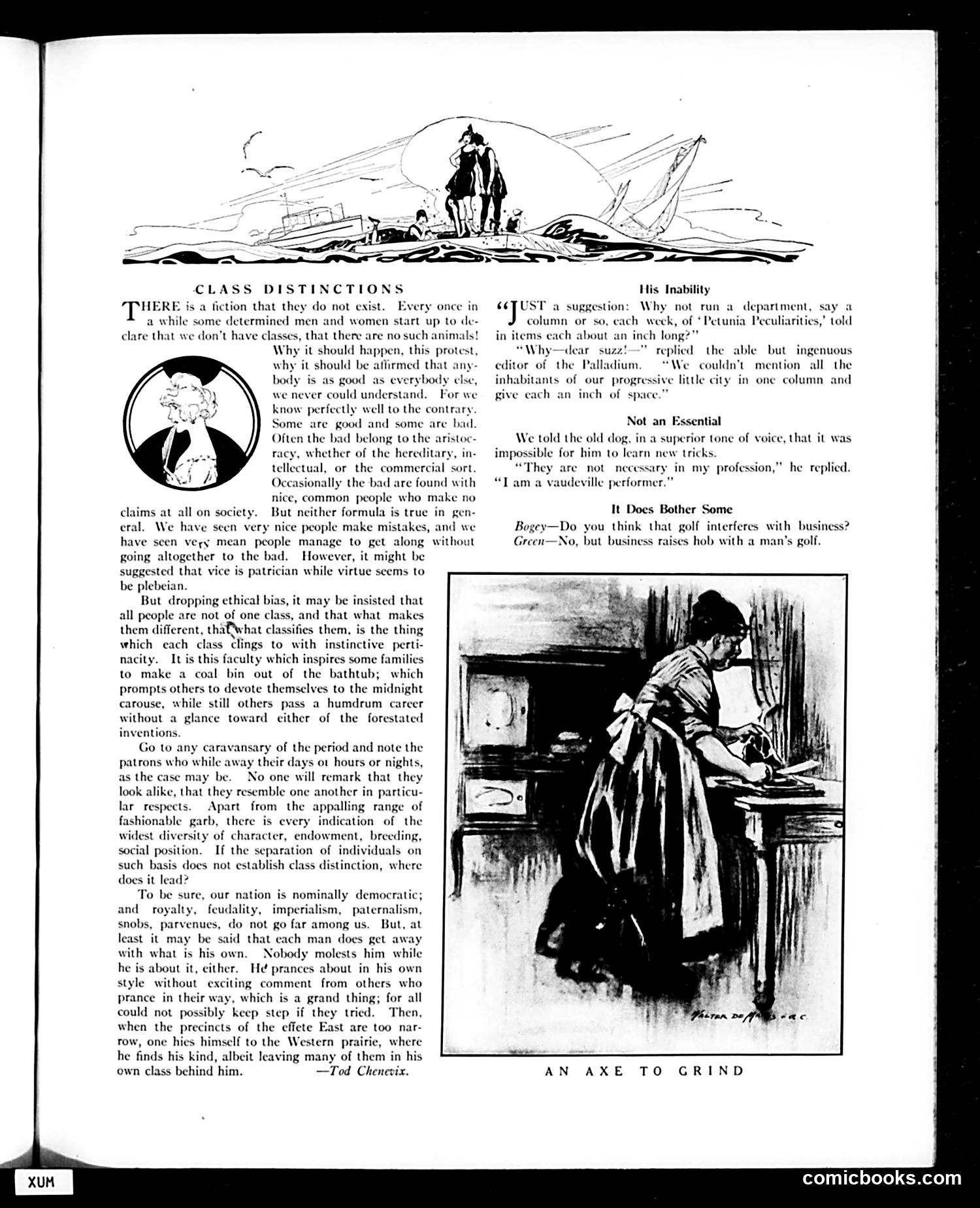
This page from *Judge* satirizes American claims of classlessness. The main article, attributed to Tod Chenevix, argues that social classes *do* exist in America despite democratic ideals—not based on heredity alone, but on what each class "clings to with instinctive pertinacity" (their values and behaviors). The piece observes that people of different classes are visibly distinguishable by character, breeding, and deportment, not just clothing. The humor lies in the contradiction: Americans deny class distinctions while clearly maintaining them. Chenevix notes that when the "effete East" becomes too crowded, people migrate West seeking "their kind"—proving class persists even in supposedly egalitarian America. The smaller comic bits below are unrelated humor pieces about newspaper suggestions, dog training, and golf interfering with business—filler content typical of satirical magazines.
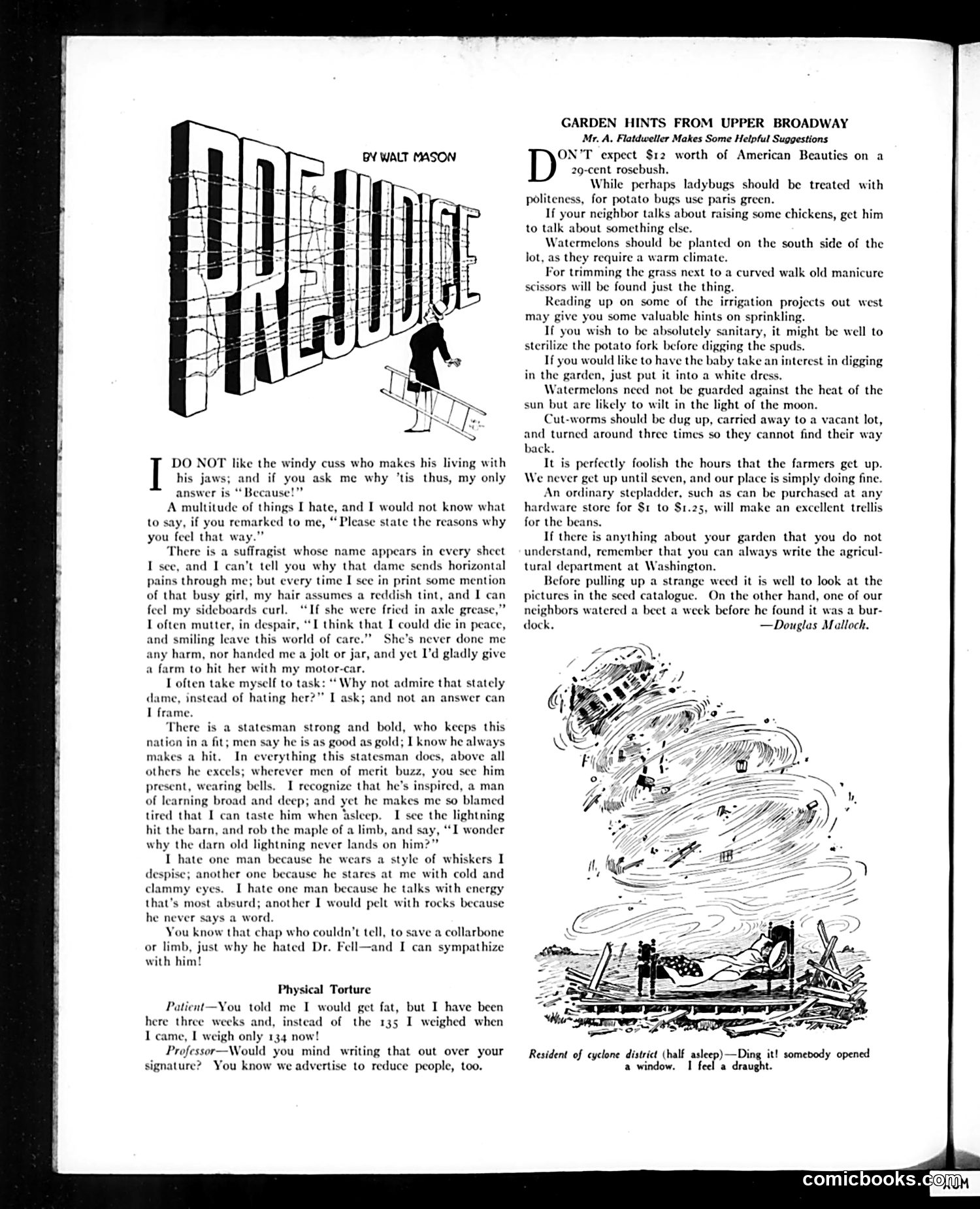
This Judge magazine page contains two satirical pieces: **"Prejudice" by Walt Mason** (left): A humorous poem about irrational hatred. Mason lists people he dislikes—a suffragist, a successful politician, various men with annoying habits—without being able to explain *why*. He references the famous phrase "I hate Dr. Fell" (from a classic poem about inexplicable dislike). The satire mocks how people hold strong opinions based purely on personality quirks or appearance rather than reason. The "Physical Torture" section at bottom is a separate, brief joke about a weight-loss clinic advertising false results. **"Garden Hints from Upper Broadway"** (right): Satirizes urban apartment-dwellers ("flatdwellers") pretending to be gardeners. The absurd advice—expecting expensive roses from cheap seeds, raising babies in white dresses near gardens, watermelons wilting in moonlight, using stepladders as bean trellises—mocks city people's ignorance of actual farming while offering pseudo-sophisticated gardening tips. Both pieces ridicule pretension and unfounded opinions common in early 20th-century American society.
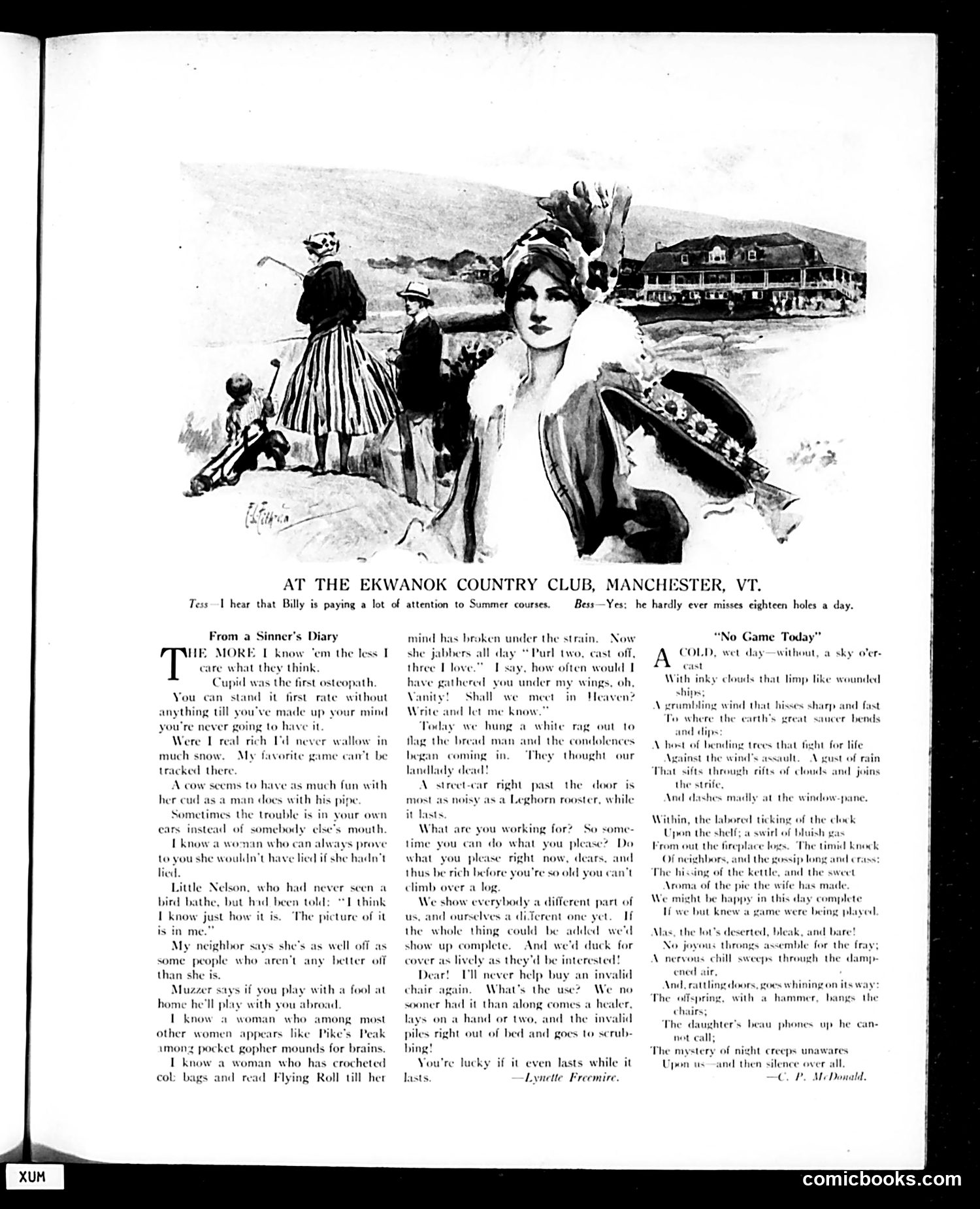
This page from Judge contains two distinct pieces of social commentary typical of early 20th-century satirical magazines. **"At the Ekwanok Country Club"** is a single-panel cartoon depicting wealthy leisure activities at an exclusive Vermont golf club. The illustration shows fashionably dressed women and men in an affluent setting, with the caption suggesting Billy is devoting attention to "Summer courses"—likely a euphemistic joke about romantic pursuits among the idle rich during vacation season. **"From a Sinner's Diary"** is a column of aphoristic observations about human nature and relationships, presented as cynical wisdom. It mocks pretension, vanity, and self-deception among various character types (gossiping women, self-important neighbors, etc.). **"No Game Today"** is a melancholic poem about a rainy day preventing golf, contrasting the gloomy weather and empty golf course with cozy domestic comforts inside. Together, these pieces satirize upper-class leisure culture, romantic entanglements, and human folly—typical Judge fare mocking wealthy Americans' empty pursuits and transparent vanities.
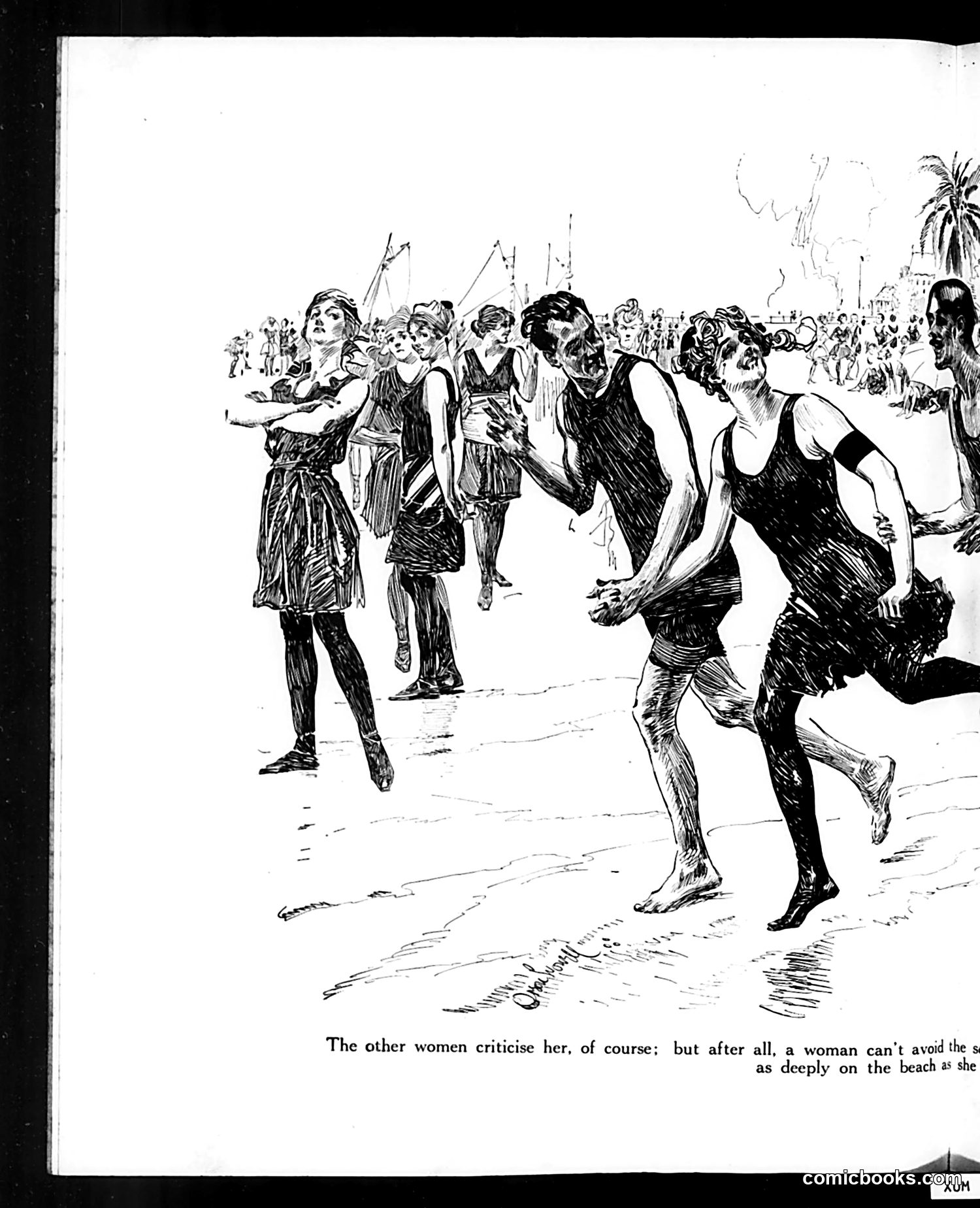
This illustration satirizes early 20th-century beach culture and women's fashion norms. The cartoon depicts women in swimming attire at a public beach, with the visible caption suggesting social criticism of a woman's appearance or behavior. The satire targets the tension between **social propriety and practical necessity**: the incomplete text indicates that women were judged harshly for wearing revealing swimwear, yet swimming itself required such clothing. The "other women" mentioned in the caption would criticize a woman's exposed legs or form, despite the unavoidable nature of beach dress. This reflects **period anxieties about female bodies and modesty** during an era when women's swimwear was becoming less restrictive but remained controversial. The cartoon mocks the hypocrisy of society—women couldn't swim in full Victorian dress, yet faced censure for the practical alternative.
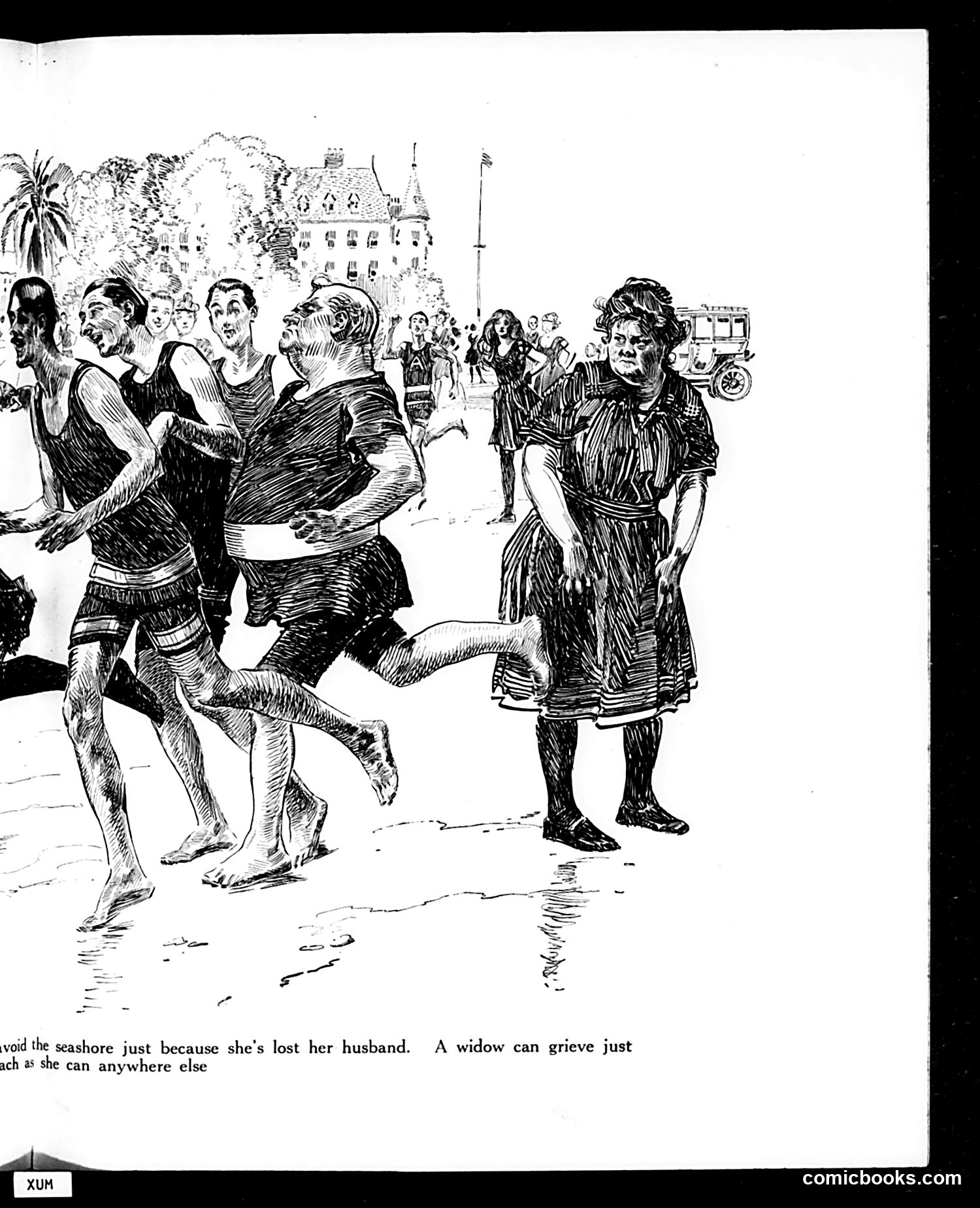
This appears to be a satirical illustration commenting on Victorian social conventions regarding widow mourning practices. The cartoon depicts a widow (right, in dark dress) at the seaside, while men in swimwear appear distressed or fleeing the beach. The caption argues that widows shouldn't avoid public spaces like beaches due to grief—they can mourn "just as much as she can anywhere else." The satire likely mocks rigid social etiquette that required bereaved women to withdraw from public life or restrict their movements. The men's exaggerated reactions suggest the cartoon is satirizing both excessive propriety and perhaps discomfort with widows reclaiming public spaces. This reflects early-to-mid-20th century debates about women's social freedom and the relaxation of strict mourning protocols. The specific date and publication issue remain unclear from this page alone.
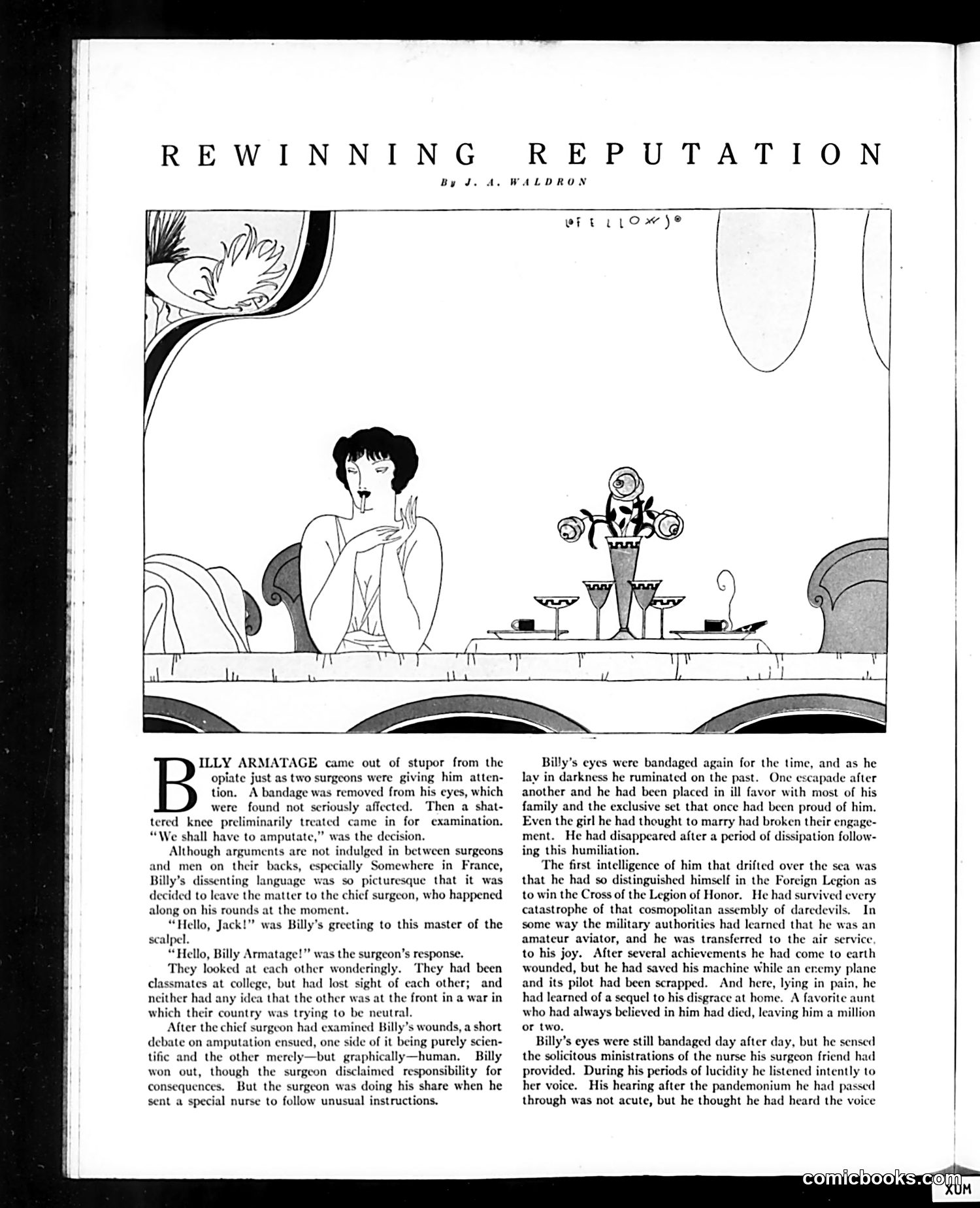
This story follows Billy Armatage, a wealthy young man who fell into disgrace—apparently through dissipation and broken engagements—and disappeared. He resurfaces as a distinguished soldier in the Foreign Legion, earning the Cross of the Legion of Honor, then becomes a military aviator. After being wounded in combat, he's hospitalized with bandaged eyes. The narrative suggests redemption through military service: Billy has redeemed his tarnished reputation through courage and sacrifice. The illustration shows him being cared for by a nurse (likely his childhood friend, based on the story's romantic arc), implying further personal restoration awaits. This reflects early-20th-century American values: that military service could restore honor to a disgraced gentleman, and that war provided moral redemption. The story appeared in *Judge* during or shortly after America's involvement in WWI.
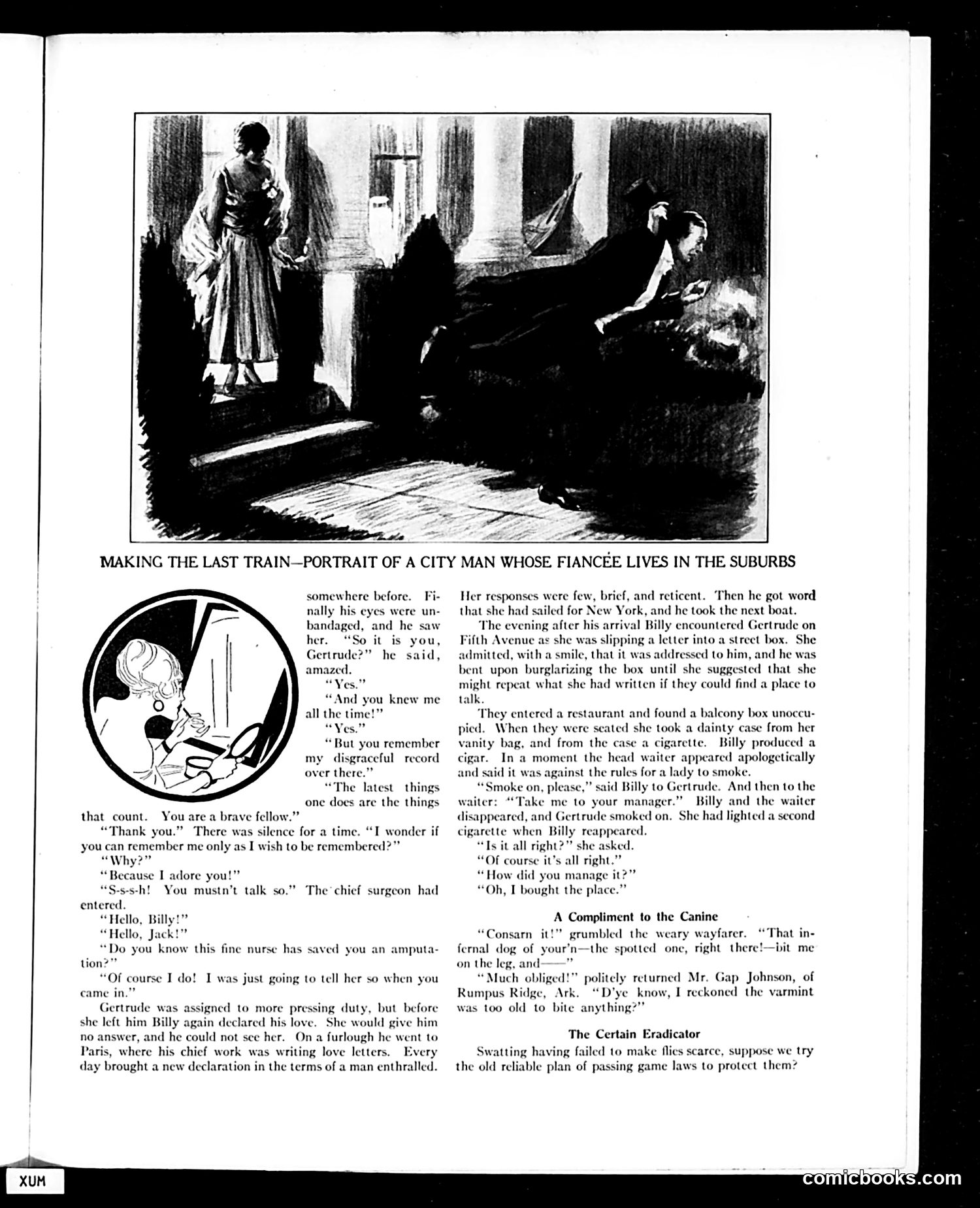
This page contains a romantic short story illustrated with a sketch, plus two brief humorous items. **Main Story: "Making the Last Train"** The narrative depicts a wounded WWI soldier (Billy) who falls in love with his nurse (Gertrude) while recovering. After she returns to New York, he pursues her relentlessly through love letters from Paris. When they reunite in a restaurant, a waiter objects to her smoking. Billy's solution is characteristically extravagant: he buys the entire restaurant to allow her to smoke. The title's reference to "making the last train" suggests the urgency of their romance—city dwellers rushing to reach suburban fiancées. **Minor Items** "A Compliment to the Canine" is a brief rural joke about an old dog biting someone. "The Certain Eradicator" offers gentle satire about game laws, suggesting that protecting flies through legislation is as absurd as protecting game animals. The content reflects early-20th-century attitudes: romantic excess, gender dynamics around smoking, and class-inflected rural humor.
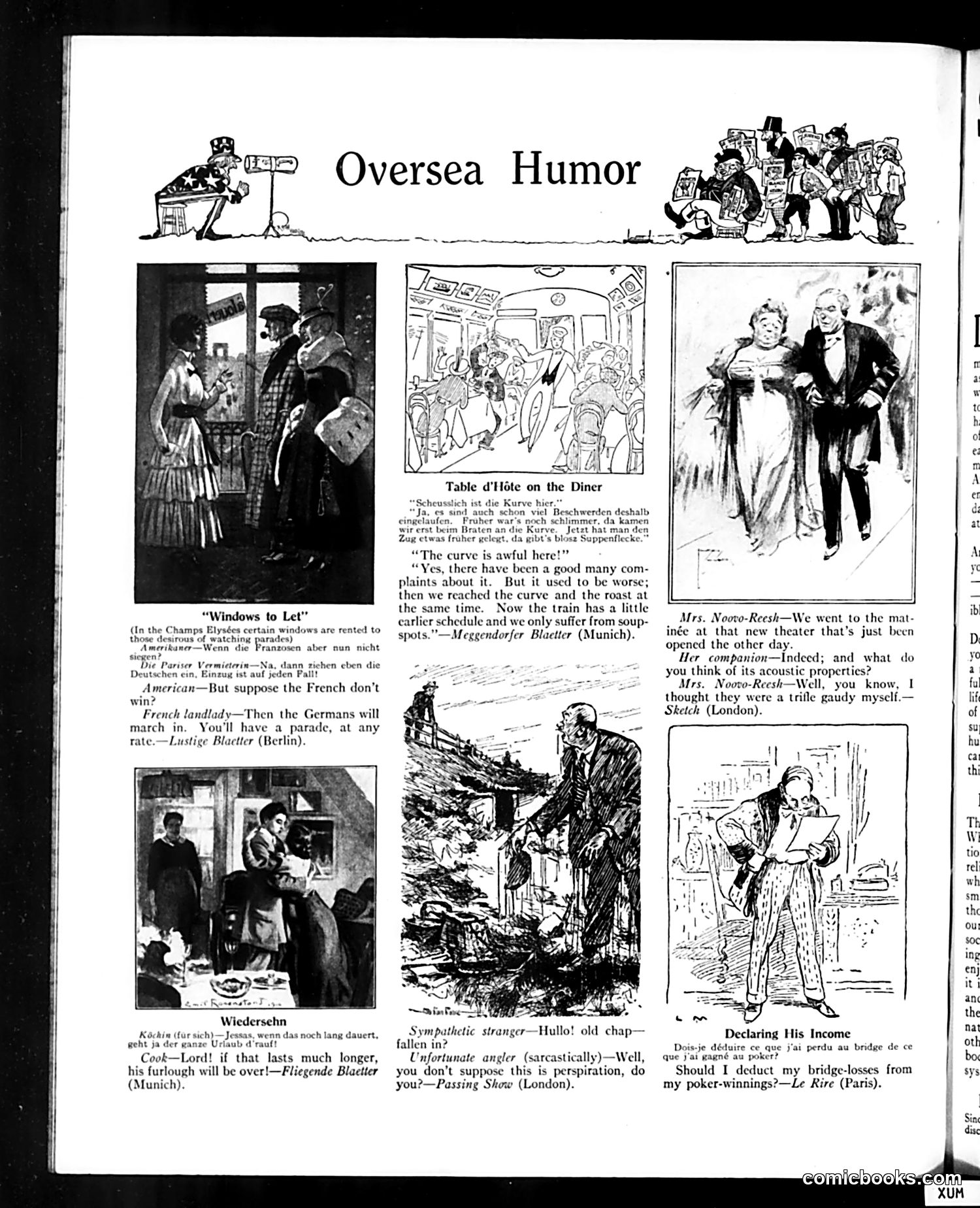
This page collects humorous cartoons and jokes from European publications during World War I, translated for American readers. The content reflects wartime anxieties and daily life: **"Windows to Let"** depicts French landlady humor about German invasion fears—if France loses, Germans will occupy Paris. **"Table d'Hôte on the Diner"** shows restaurant complaints about train food quality, a common travel grievance. **"Wiedersehn"** (German: "Reunion") features a cook worried his furlough will end before finishing a meal—military leave anxiety. **"Sympathetic Stranger"** depicts an angler who's fallen in water, making an awkward joke about perspiration. **"Declaring His Income"** is a French tax humor cartoon about a gambler deducting bridge losses from poker winnings. The page demonstrates how Judge magazine presented international humor to American audiences, offering light relief from war reporting while revealing common civilian concerns: invasion fears, food shortages, military service, and financial worries.
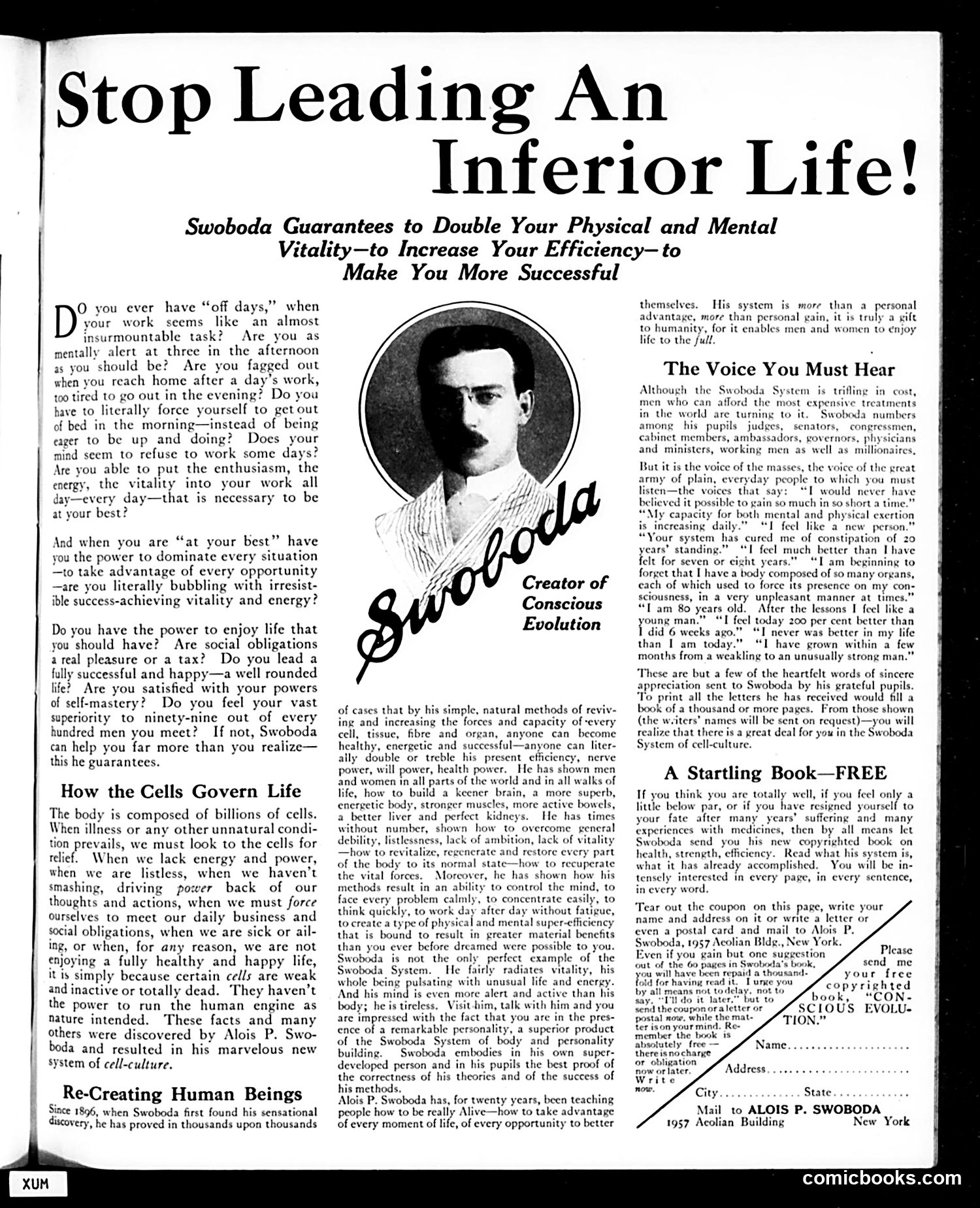
This is primarily **advertising content**, not satire or political commentary. The page promotes Alois P. Swoboda's "Conscious Evolution" system—a pseudoscientific self-help program popular in the early 20th century. The appeal targets common anxieties: fatigue, lack of ambition, social inadequacy. Swoboda claims his "cell-culture" methods can double vitality and efficiency by supposedly revitalizing the body's cells through natural means. This represents a historical wellness trend combining vague biology ("billions of cells") with motivational language. The "free book" coupon at bottom was typical direct-response advertising of the era. For modern readers: This exemplifies pre-FDA era health claims lacking scientific basis—similar to today's unproven supplements, but presented with pseudo-scientific authority. The underlying anxiety about productivity and social success remains remarkably contemporary, though the proposed remedy (cellular rejuvenation) reflects outdated biological understanding.
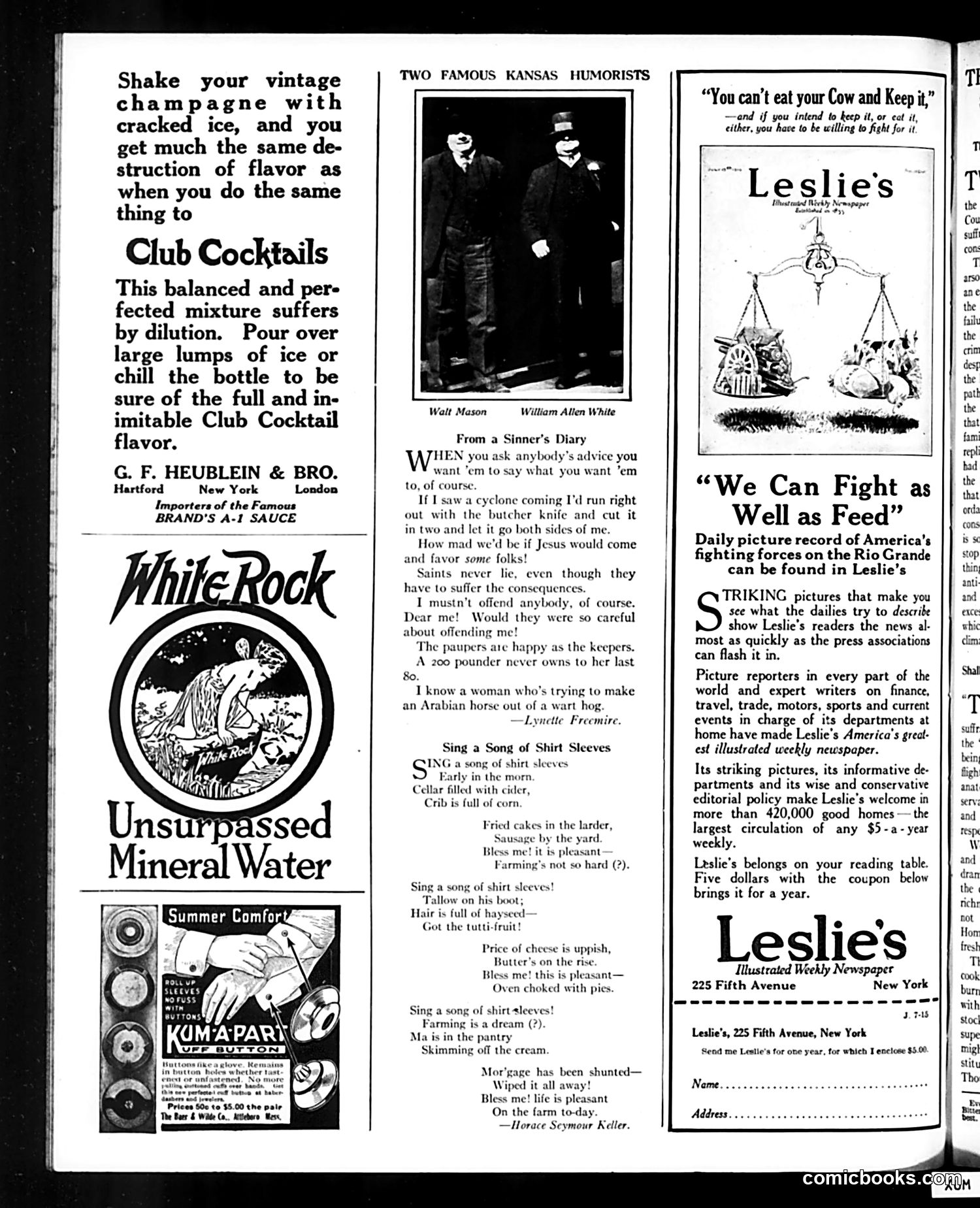
This page is primarily **advertising and promotional content** rather than political satire. The main visual element shows **Walt Mason and William Allen White**, identified as "Two Famous Kansas Humorists." The accompanying text, "From a Sinner's Diary," presents their humorous observations about human nature—hypocrisy, self-interest, and farm life. White and Mason were genuine public figures known for satirical rural commentary. The page otherwise consists of product advertisements (Club Cocktails, White Rock mineral water, Kum-a-Part) and a substantial promotion for **Leslie's Illustrated Weekly Newspaper**, emphasizing its coverage of "America's fighting forces on the Rio Grande"—likely referring to the Mexican border conflicts of the 1910s-1920s. The advertisement sells Leslie's as a timely news source with superior photography and reporting. There is no discernible political cartoon or unified satirical message; this appears to be a standard magazine issue mixing editorial content with advertising revenue.
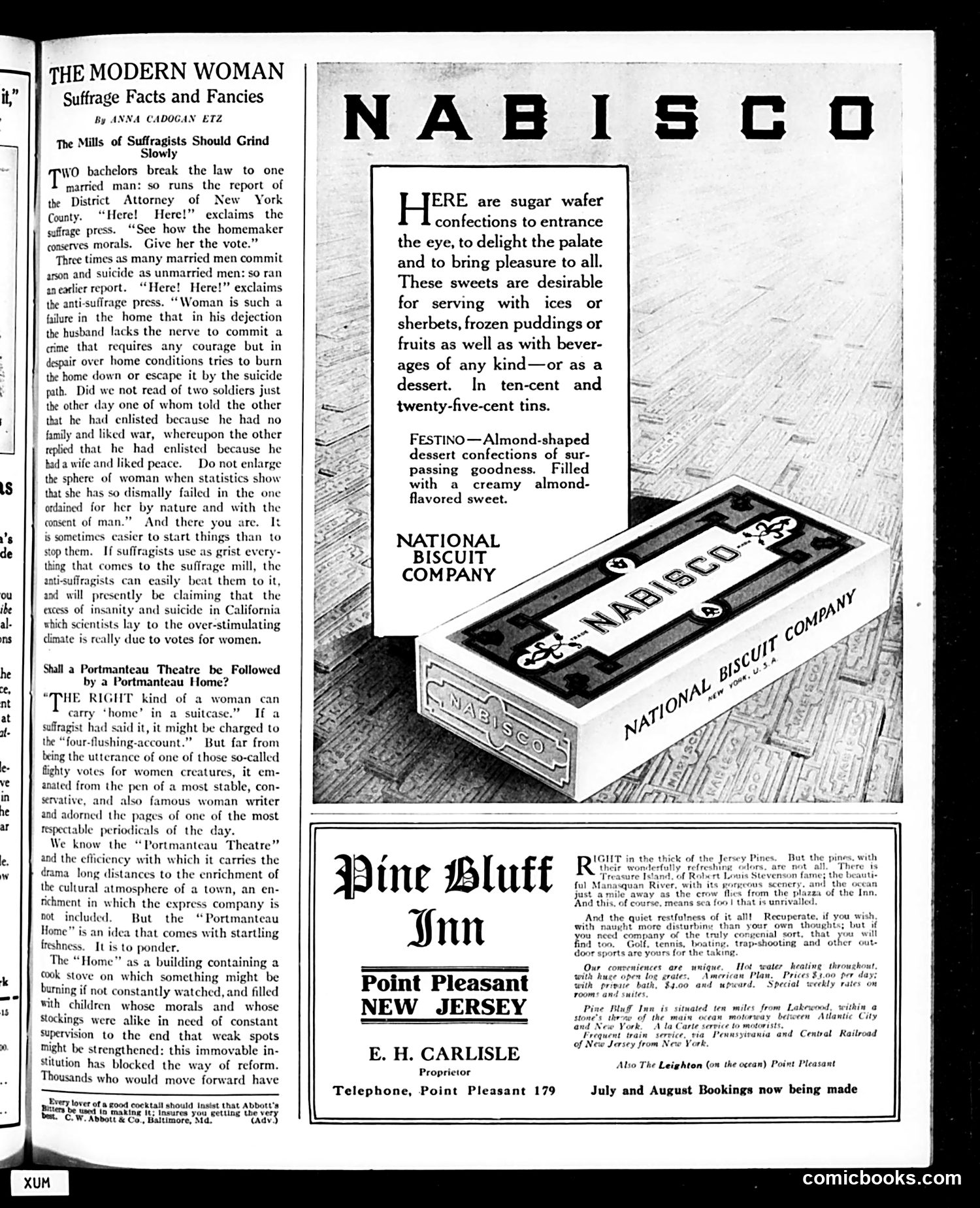
This page satirizes the suffrage debate through conflicting statistical arguments. Cadogan mocks **both sides** of the women's voting rights controversy for selectively weaponizing crime data. The satire works like this: Anti-suffragists cite statistics showing married men commit more arson and suicide, claiming this proves women's domestic failure drives men to desperation. Suffragists counter with data showing bachelors break laws more often, suggesting married women's moral influence reduces male criminality. Cadogan's point is that **both arguments are absurd**—each side cherry-picks convenient statistics while ignoring contradictory data. She suggests suffragists and anti-suffragists will keep escalating ridiculous claims (even blaming women's votes for California's high insanity rates). The second section critiques the "portable home" concept, arguing that women's domestic obligations—cooking, childcare supervision—have historically prevented reform participation. The page also contains unrelated advertisements for Nabisco confections and Pine Bluff Inn, typical of Judge magazine's commercial content.
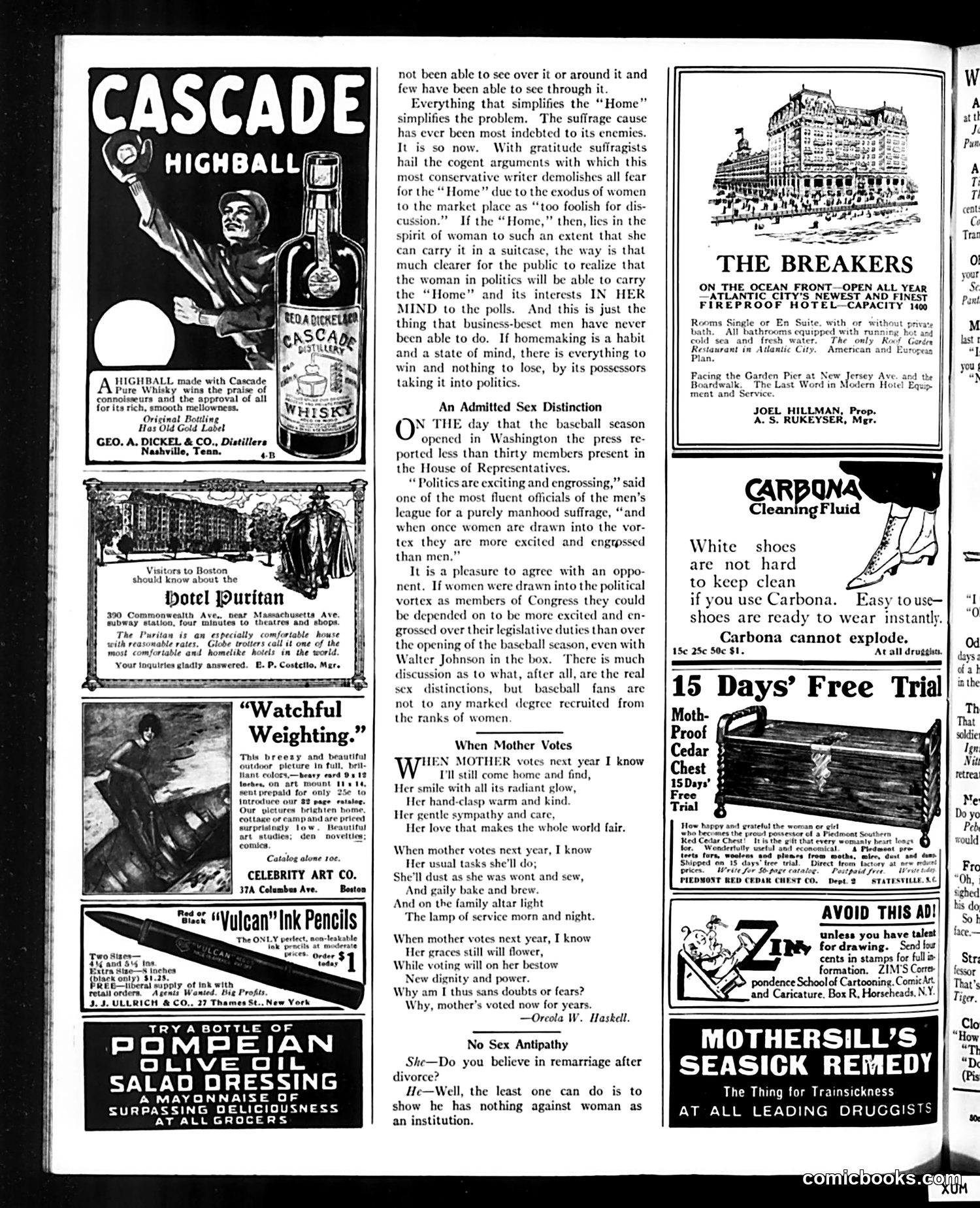
This page is primarily **advertising with one substantive editorial piece** on women's suffrage. The main text argues that women's participation in politics need not threaten the "Home." It uses a clever rhetorical turnabout: if conservatives claim homemaking is merely a "habit and state of mind," then women can carry those values *mentally* into the political sphere—just as men carry business interests to the polls. The piece sardonically notes that when baseball season opened in Washington, fewer than 30 Representatives attended, proving men abandon duty for sports. By contrast, it predicts women in Congress would prioritize legislative duties over baseball games, suggesting they'd be *more* responsible politicians than men. The satire targets male arguments against suffrage by accepting their premises and demonstrating the logical conclusions undermine their position. The page otherwise contains period advertisements for whisky, hotels, shoes, cleaning fluid, and other consumer goods—typical Judge content mixing editorial commentary with commercial messaging.
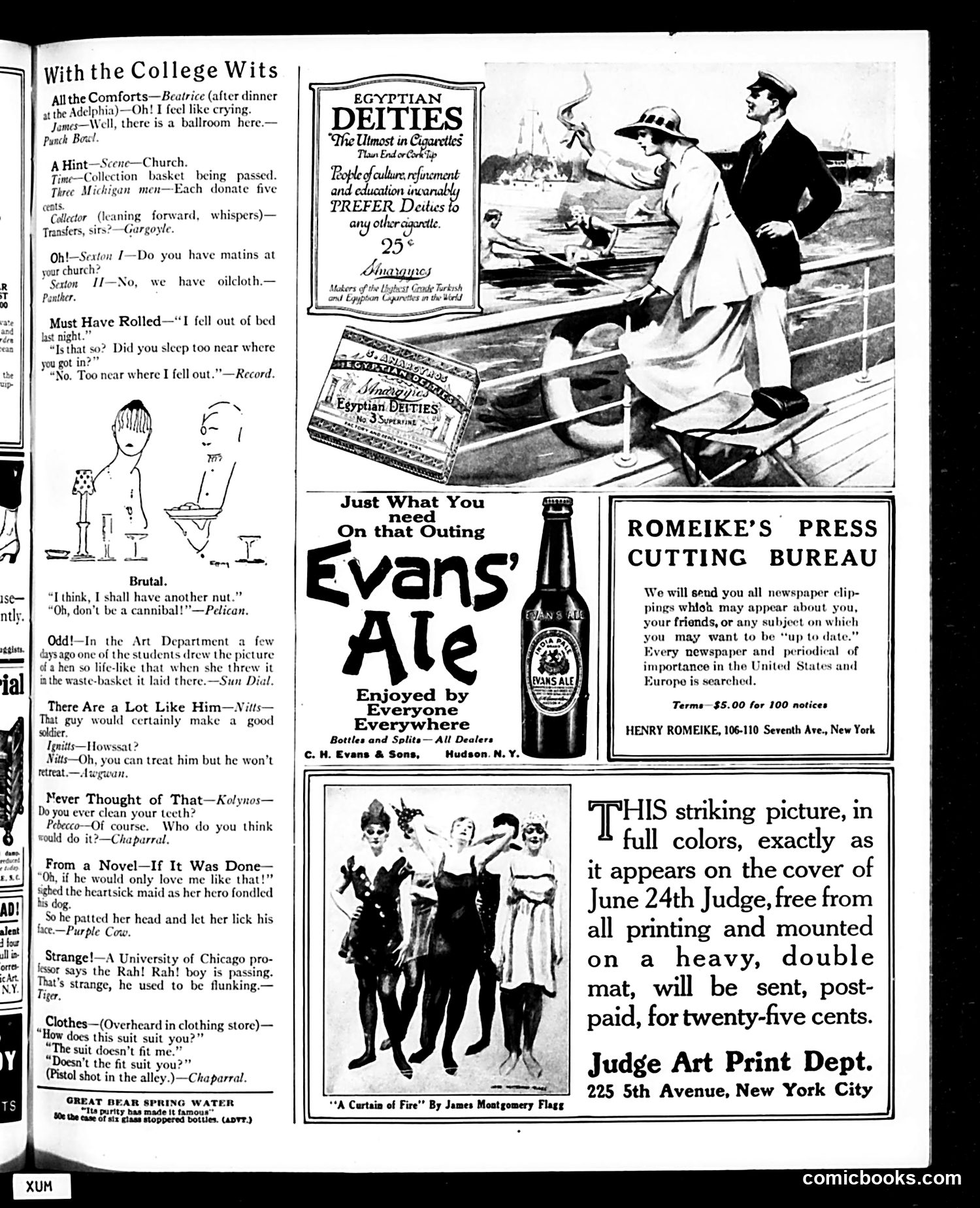
This page from the satirical magazine *Judge* contains primarily **humor columns and advertisements** rather than political cartoons. **"With the College Wits"** section presents brief jokes about college life and social situations—including humor about church services, falling from bed, and art class mishaps. The humor targets college students and educated urbanites through wordplay and absurdist situations. The advertisements showcase **period consumer goods**: Egyptian Deities cigarettes, Evans' Ale, and services like Romeike's Press Cutting Bureau (a clipping service for tracking media mentions—essentially an early version of modern press monitoring). **Key context for modern readers**: This reflects 1910s-1920s America when: - College humor magazines were popular forms of satirical entertainment - Brand advertising emphasized elegance and culture - Personal clipping services were viable businesses before digital media The "College Wits" humor assumes readers recognize college life tropes and appreciate gentle, verbal jokes rather than visual satire. The page is primarily **entertainment and advertising** rather than social commentary.
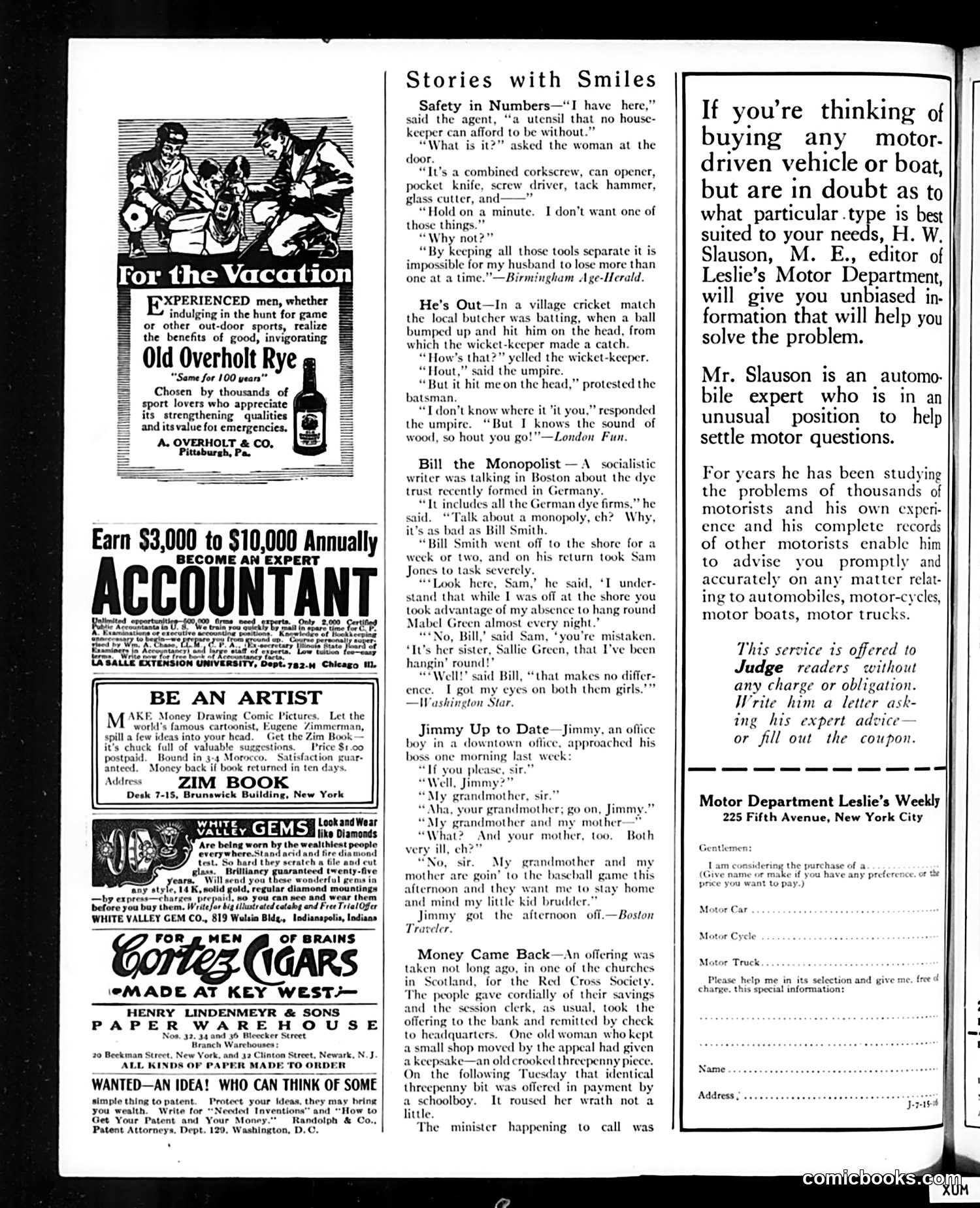
This page is primarily **advertisements and light humorous anecdotes** rather than political satire. The "Stories with Smiles" section contains three brief jokes: 1. **"Safety in Numbers"** mocks a salesman's pitch for a multi-tool by having a housewife prefer her husband to lose tools one at a time rather than all together. 2. **"He's Out"** is a cricket humor piece where an umpire dismisses a batsman despite the ball hitting his head, claiming he can't locate where it came from—absurdist humor about bureaucratic logic. 3. **"Bill the Monopolist"** makes a contemporary reference to a recent German dye trust monopoly, comparing it to a man named "Bill Smith" who monopolizes women's attention. This reflects early 1900s concern about industrial monopolies. The remainder comprises typical period advertisements for accountancy courses, art instruction, diamond rings, cigars, and patent services—common Judge magazine content. No political figures or specific satirical targets are identifiable beyond generic critiques of monopolies and bureaucracy.
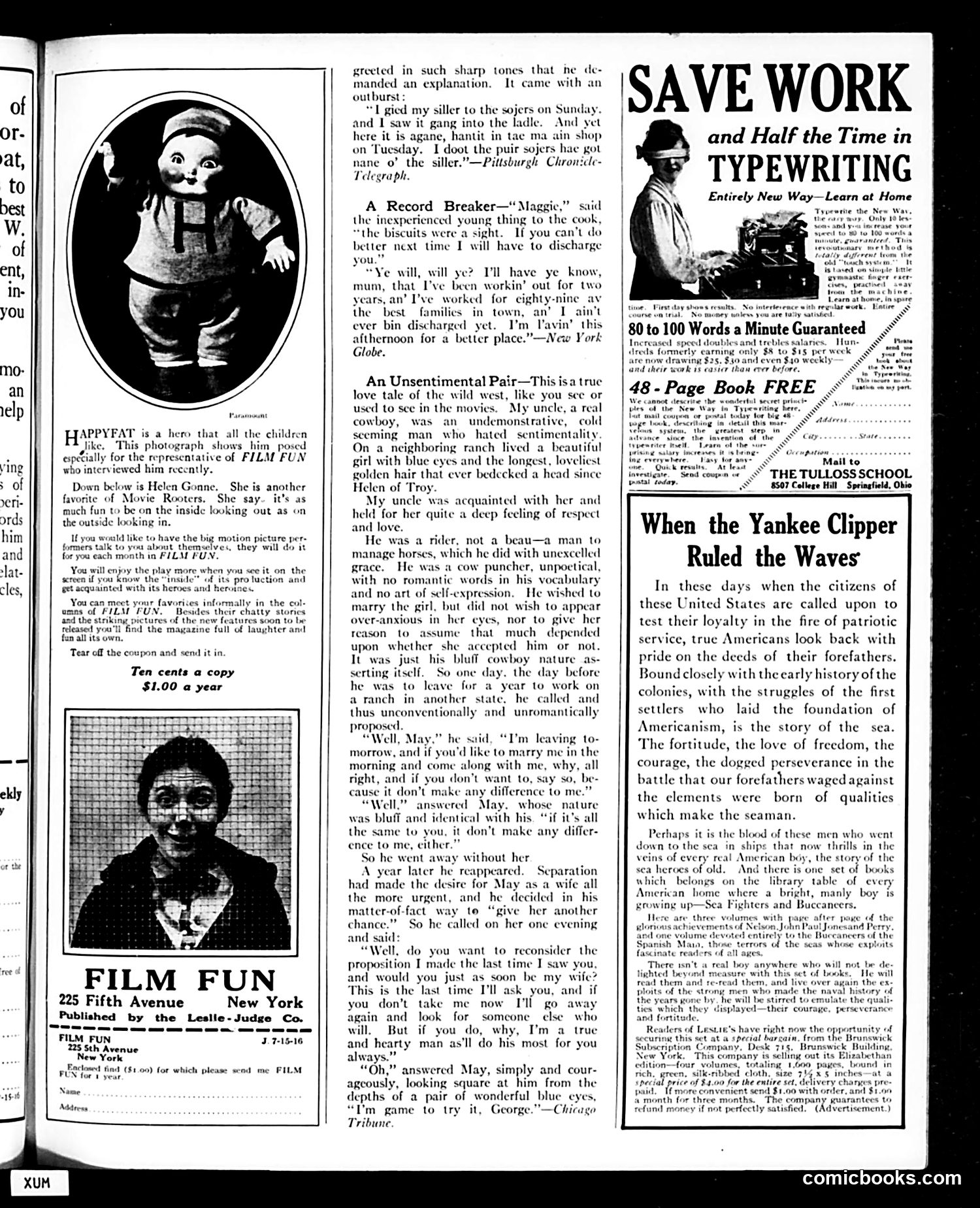
This page primarily contains **advertisements and fiction** rather than political cartoons. The main content includes: - **"Film Fun" magazine advertisement** featuring photos of movie personalities ("Happyfat" and actress Helen Gonne), promoting a film industry publication - **A typewriter training course ad** ("Save Work and Half the Time in Typewriting") - **Three humorous short stories** with Irish/Scottish dialect humor typical of early 20th-century American magazines: - A Scottish soldier's mother complaining her silver returned to her shop (possibly a WWI-era reference) - A cook boasting of employment tenure - An extended "unsentimental pair" love story set in the American West, featuring a laconic cowboy proposing in blunt, emotionless language The satire targets pretension—mocking sentimentality and celebrating plain-spoken, practical attitudes. The cowboy story emphasizes rugged individualism typical of period Western mythology. **No clear political cartoons appear on this page.** The content is primarily commercial and entertainment-focused.
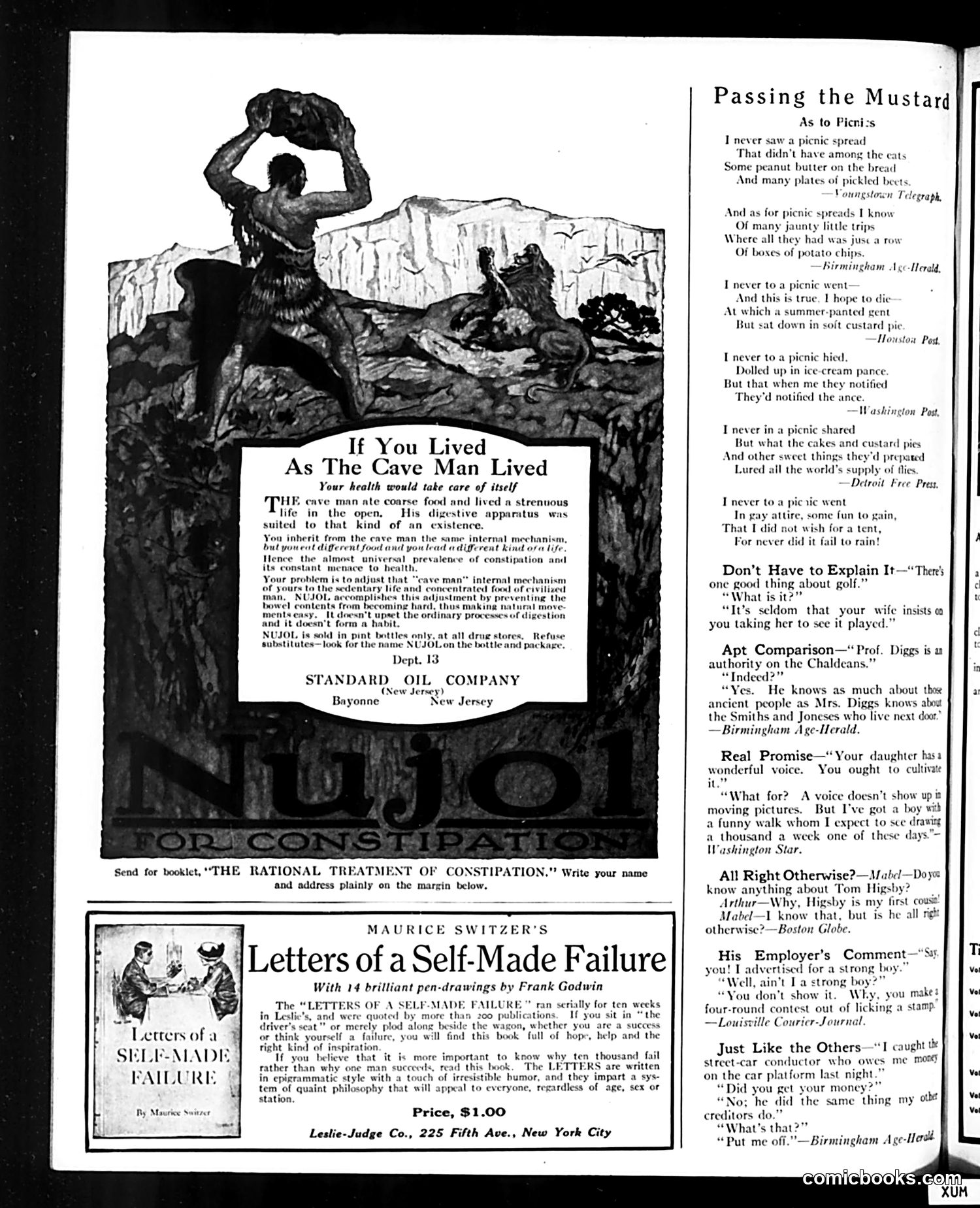
This page is primarily **advertising and book promotion** rather than political satire. The main illustrated advertisement (top left) promotes Nujol laxative oil using pseudoscientific "cave man" logic: modern humans inherit digestive systems from cave ancestors who ate coarse food and lived outdoors, so constipation results from our refined modern diet. The remedy is Nujol, claimed to work naturally without forming habits. Below that is an advertisement for Maurice Switzer's book *Letters of a Self-Made Failure*, described as humorous inspirational literature about success and failure. The right column contains "Passing the Mustard"—a collection of **humorous short anecdotes about picnics** reprinted from various newspapers. These are joke submissions describing mishaps at picnics: custard pie accidents, ants at ice cream, unexpected rain, and unwanted flies. These are light, domestic humor pieces rather than political commentary. The bottom section contains brief joke exchanges on various topics (golf, voice training, acquaintances), typical of Judge's filler content.
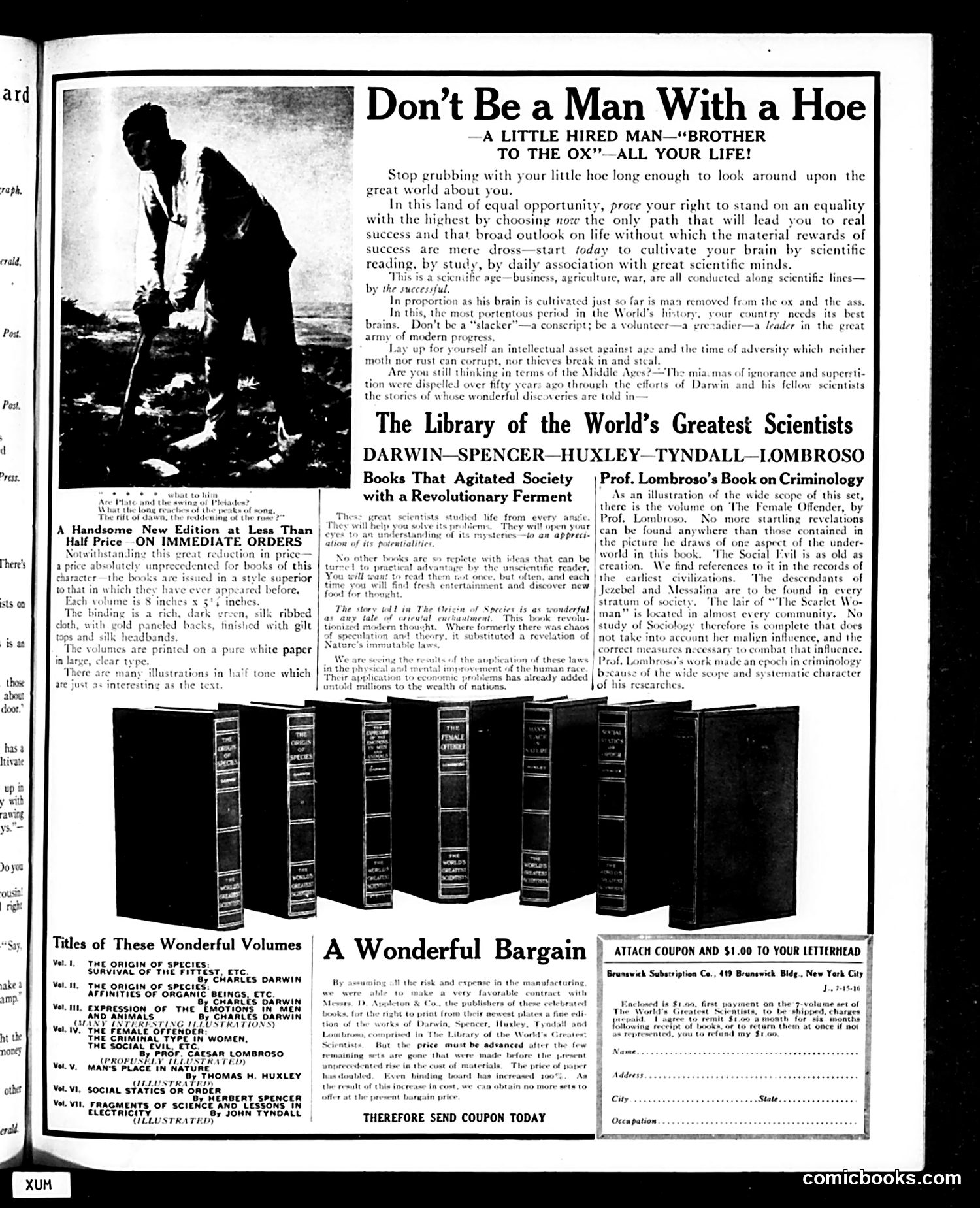
This page combines satire with advertising for a book series. The headline references Millet's famous painting of rural poverty, using it as a cautionary image: don't remain an ignorant laborer your whole life. The satirical message targets working-class men, urging them to pursue scientific self-education rather than accept manual labor as their lot. It appeals to Progressive-era faith in science and self-improvement, name-checking Darwin, Spencer, and Huxley—evolutionary theorists whose work had become cultural touchstones for modernity and progress. The advertisement sells a seven-volume set of "The Library of the World's Greatest Scientists" at reduced price, positioning scientific literacy as the path to social mobility and success. One volume on Prof. Lombroso's criminology is highlighted, showing the set's range. The tone assumes readers are working-class men capable of transformation through reading—a characteristic Progressive belief that education and science could overcome class barriers and create a more rational society.
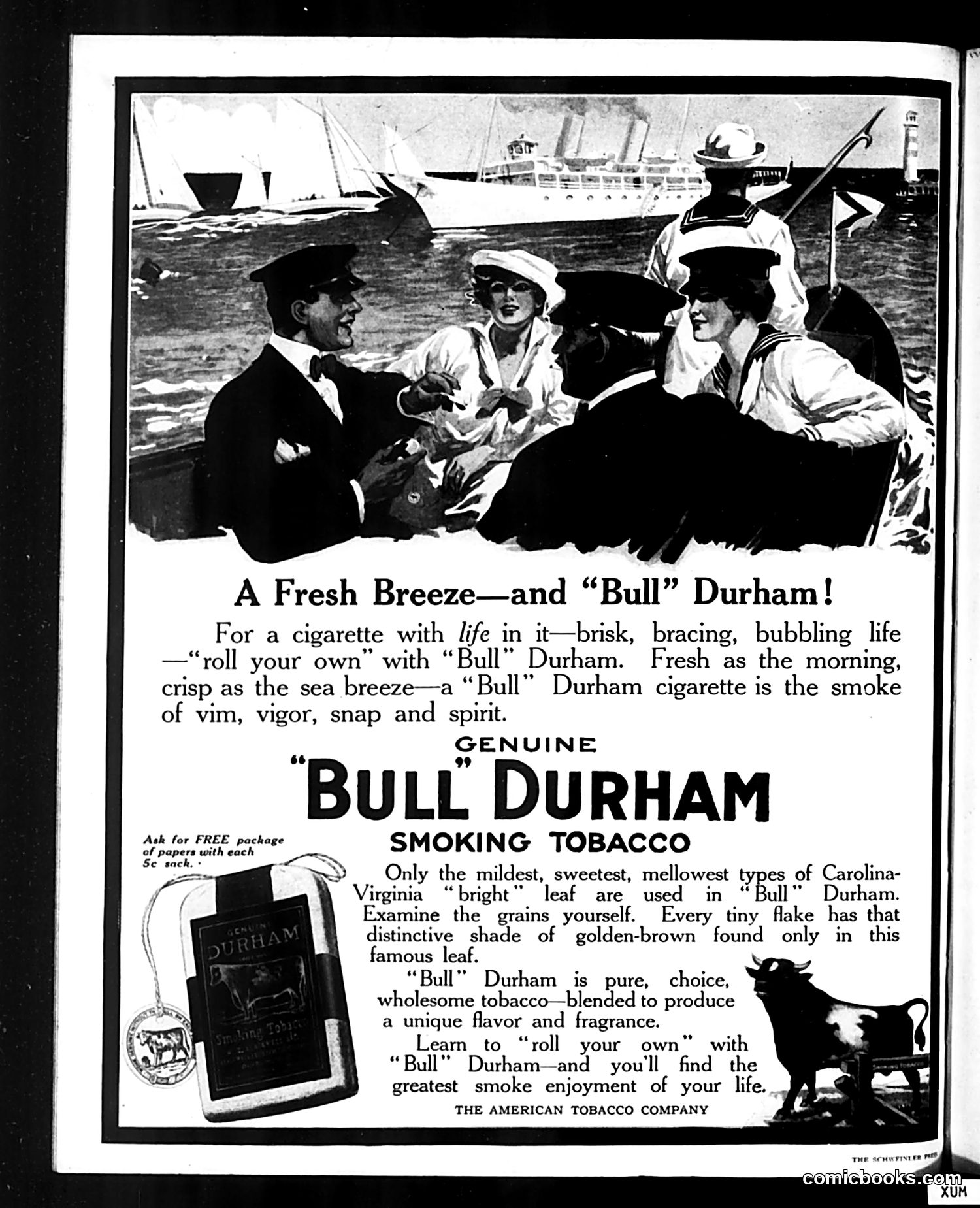
This is a **full-page advertisement**, not satire or political commentary. It promotes "Bull" Durham smoking tobacco, a popular roll-your-own cigarette brand manufactured by The American Tobacco Company. The image shows well-dressed passengers on what appears to be a ship or ocean liner, positioned to suggest leisure, sophistication, and social status. The "fresh breeze" setting connects the product to vitality and open-air pleasure. The ad emphasizes that Bull Durham uses premium Carolina-Virginia tobacco leaf and encourages consumers to "roll your own" cigarettes. It stresses purity, quality, and distinctive flavor. **For modern readers**: This represents pre-regulation tobacco advertising, when companies could freely associate smoking with health, vigor, pleasure, and social refinement—claims now recognized as false and prohibited. The aspirational imagery and lifestyle branding were standard marketing tactics of this era (early-to-mid 20th century).