
Judge, 1916-07-15 · page 17 of 28
Judge — July 15, 1916 — page 17: what you’re looking at
What you’re looking at
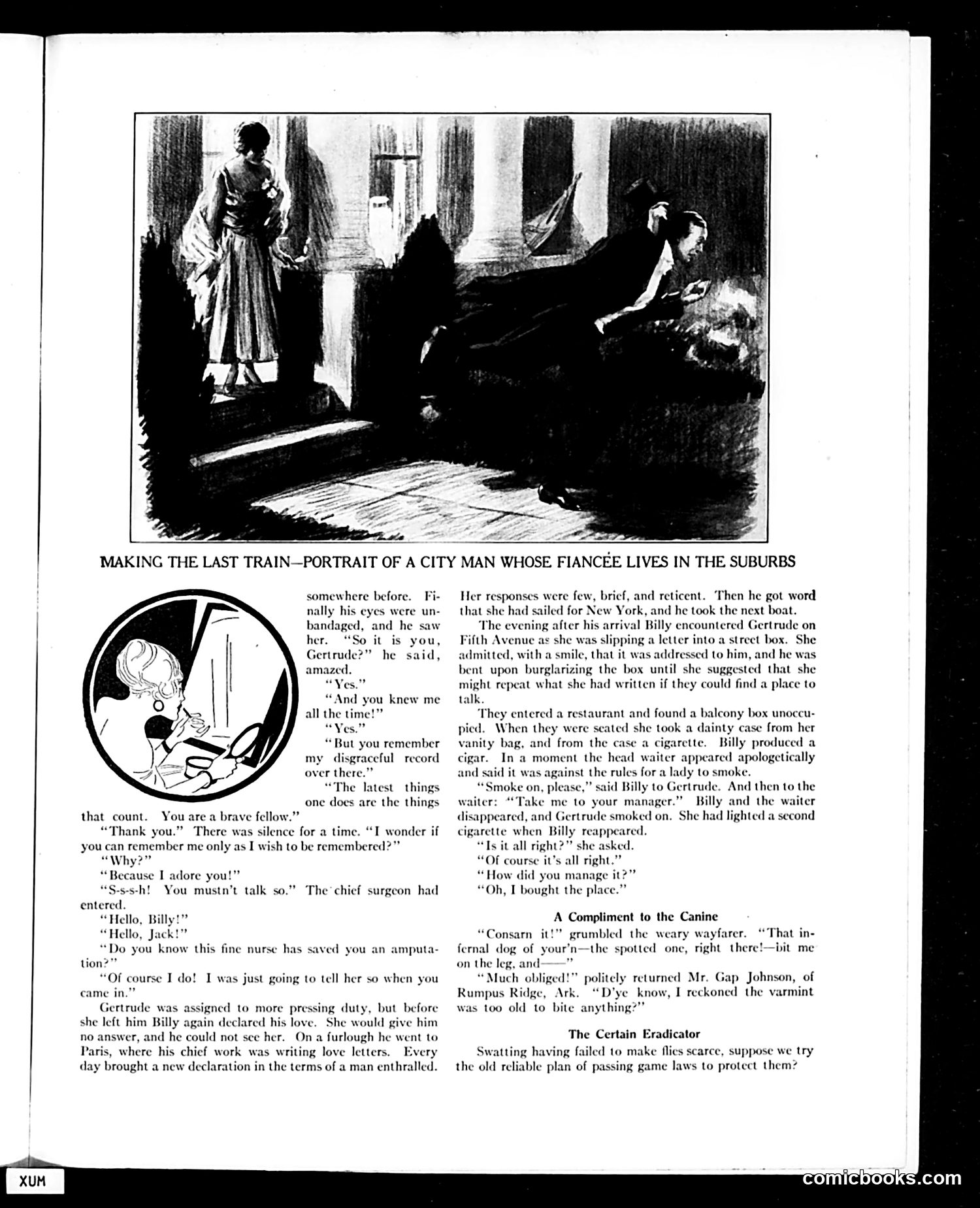
This page contains a romantic short story illustrated with a sketch, plus two brief humorous items. **Main Story: "Making the Last Train"** The narrative depicts a wounded WWI soldier (Billy) who falls in love with his nurse (Gertrude) while recovering. After she returns to New York, he pursues her relentlessly through love letters from Paris. When they reunite in a restaurant, a waiter objects to her smoking. Billy's solution is characteristically extravagant: he buys the entire restaurant to allow her to smoke. The title's reference to "making the last train" suggests the urgency of their romance—city dwellers rushing to reach suburban fiancées. **Minor Items** "A Compliment to the Canine" is a brief rural joke about an old dog biting someone. "The Certain Eradicator" offers gentle satire about game laws, suggesting that protecting flies through legislation is as absurd as protecting game animals. The content reflects early-20th-century attitudes: romantic excess, gender dynamics around smoking, and class-inflected rural humor.
📄 Transcribed text from this page (OCR, searchable)
Machine-transcribed from the original scan — historical spelling and the odd misread are preserved.
MAKING THE LAST TRAIN—PORTRAIT OF A CITY MAN WHOSE FIANCEE LIVES IN THE SUBURBS somewhere before. Fi- nally his ¢ bandaged, and he her. “So it is you, Gertrude?” he said, you knew me all the time!” “Ves.” “But you remember my disgraceful record over there. “The latest things one does are the things that count. You are fellow.” “Thank you.” There was silence for a time. “I wonder if you can remember me only as I wish to be remembered?” “Why?” “Because I adore you!” h! You mustn't talk so.” The chief surgeon had entered. “Hello, Billy!” “Hello, Jack! “Do you know this fine nurse has saved you an amputa- tion?” “Of course I do! I was just going to tell her so when you came in.” rtrude was assigned to more pressing duty, but before she left him Billy in declared his love. She would give him no answer, and he could not sce her. On a furlough he went to Paris, where his chief work was writing love letters. cry day brought a new declaration in the terms of a man enthralled. Her responses were few, brief, and reticent. Then he got word that she had sailed for New York, and he took the next boat. The evening after h rrival Billy encountered Gertrude on Fifth Avenue as she was slipping a letter into a street box. She admitted, with a smile, that it was addressed to him, and he was bent upon burglarizing the box until she suggested that she might repeat what she had written if they could find a place to talk. ‘They entered a restaurant and found a balcony box unoccu- pied. When they were seated she took a dainty case from her vanity bag, and from the case a cigarette. Billy produced a cigar. In a moment the head waiter appeared apologetically and said it was against the rules for a lady to smoke. “Smoke on, please,” said Billy to Gertrude. And then to the waiter: ke me to your manager.” Billy and the waiter disappeared, and Gertrude smoked on. She had lighted a second cigarette when Billy reappeared. “Is it all right?” she asked. “OF course it’s all right.” “How did you mani “Oh, I bought the place. A Compliment to the Canine “Consarn it!” grumbled the weary wa fernal dog of your’n—the spotted one, right there on the leg, and “Much obliged!” politely returned Mr. Gap Johnson, of Rumpus Ridge, Ark. “Dye know, I reckoned the varmint was too old to bite anything?” The Certain Eradicator Swatting having failed to make flies scarce, suppose we try the old reliable plan of passing game laws to protect them?