
Judge, 1916-07-15 · page 11 of 28
Judge — July 15, 1916 — page 11: what you’re looking at
What you’re looking at
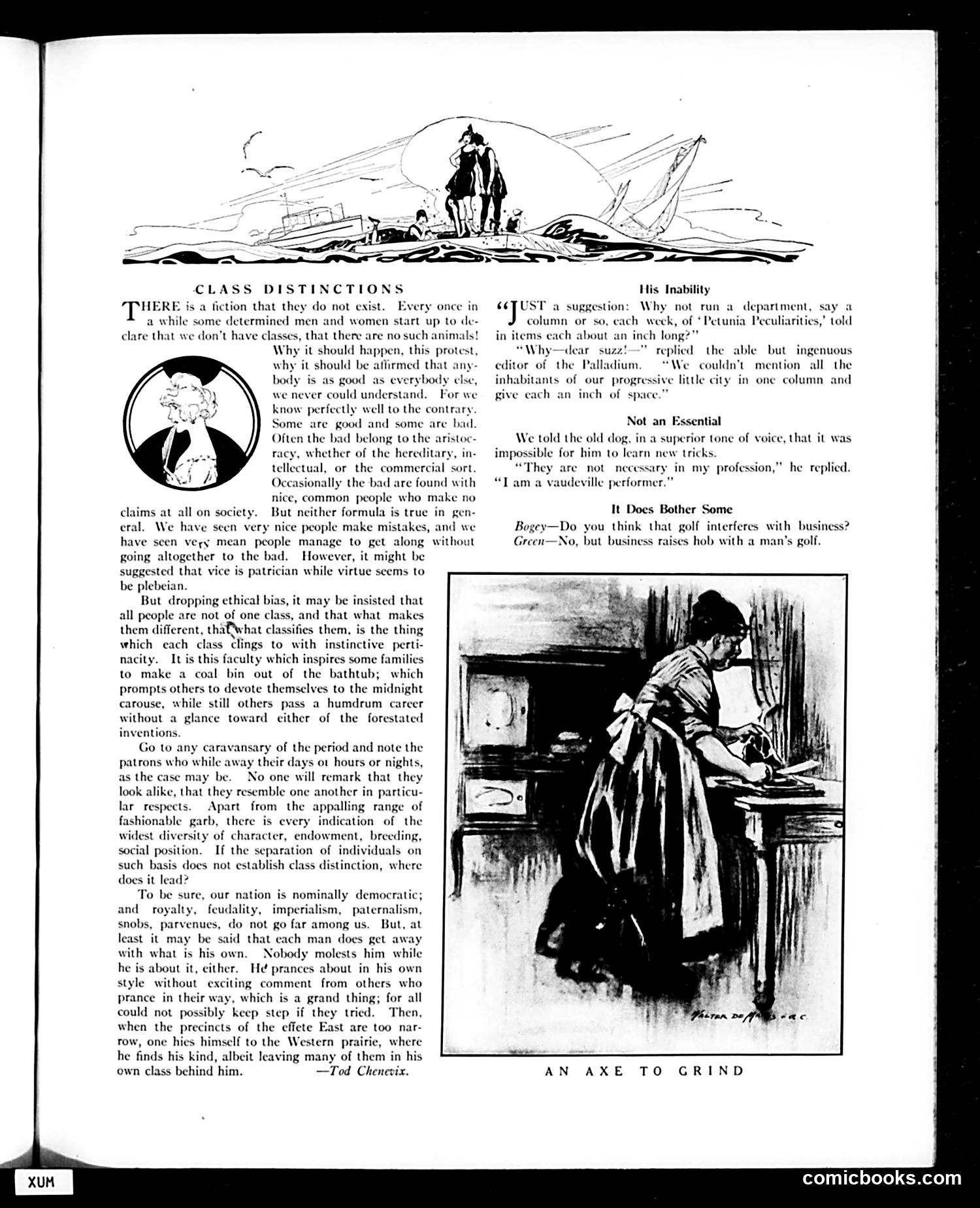
This page from *Judge* satirizes American claims of classlessness. The main article, attributed to Tod Chenevix, argues that social classes *do* exist in America despite democratic ideals—not based on heredity alone, but on what each class "clings to with instinctive pertinacity" (their values and behaviors). The piece observes that people of different classes are visibly distinguishable by character, breeding, and deportment, not just clothing. The humor lies in the contradiction: Americans deny class distinctions while clearly maintaining them. Chenevix notes that when the "effete East" becomes too crowded, people migrate West seeking "their kind"—proving class persists even in supposedly egalitarian America. The smaller comic bits below are unrelated humor pieces about newspaper suggestions, dog training, and golf interfering with business—filler content typical of satirical magazines.
📄 Transcribed text from this page (OCR, searchable)
Machine-transcribed from the original scan — historical spelling and the odd misread are preserved.
S DISTINCTIONS HERE is a fiction that they a while some determined men and women start up to de- clare that we don’t have classes, that there are no such animals! Why it should happen, this protest, why it should be aflirmed that any- body is as good as everybody we never could understand. For we know perfectly well to the contrary. Some are good and some are bad Often the bad belong to the aristoc- racy, whether of the hereditary, in- tellectual, or the commercial sort. Occasionally the bad are found with nice, common people who make no claims at all on society. But neither formula is true in gen- eral. We have seen very nice people make mistakes, and we hi ‘en Very Mean people manage to get along without going altogether to the bad. However, it might be suggested that vice is patrician while virtue seems to be plebeian. But dropping ethical bias, it may be insisted that all people are not of one class, and that what makes them different, thafWwhat classifies them, is the thing which cach class clings to with instinctive perti- nacity. It is this faculty which inspires some families to make a coal bin out of the bathtub; which prompts others to devote themselves to the midnight carouse, while still others pass a humdrum carcer without a glance toward either of the forestated inventions to any do not exist. Every once in else, ‘aravansary of the period and note the patrons who while away their days ot hours or nights, as the case may be. No one will remark that they look alike, that they resemble one another in particu- lar respects. Apart from the appalling range of fashionable garb, there is every indication of the widest diversity of character, endowment, breeding, social position. If the separation of individuals on such basis does not establish class distinction, where does it lead? To be sure, our nation is nominally democratic; and royalty, feudality, imperialism, paternalism, snobs, parvenues, do not go far among us. But, at least it may be said that each man does get ay with what is his own. Nobody molests him while he is about it, cither. He prances about in his own style without exciting comment from others who prance in their way, which is a grand thing; for all could not possibly keep step if they tried. Then, when the precincts of the effete East are too nar- row, one hies himself to the Western prairie, where he finds his kind, albeit leaving many of them in his own class behind him. —Tod Chenevix. His Inability 66TUST a suggestion: Why not run a department, column or so, cach week, of ‘Petunia Peculiarities,’ told in items each about an inch long?” *Why—dear suzz!—" replied the able but ingenuous editor of the Palladium. “We couldn't’ mention all the inhabitants of our progressive little city in one column and give cach an inch of space Not an Essential We told the old dog, in a superior tone of voice, that it was impossible for him to learn new tricks. “They are not necessary in my profession,” he replied. “Tam a vaudeville performer.” It Does Bother Some Bogey—Do you think that golf interferes with business? Green—No, but business raises hob with a man’s golf. AN AXE TO GRIND comicbooks.com