
Judge, 1916-07-15 · page 6 of 28
Judge — July 15, 1916 — page 6: what you’re looking at
What you’re looking at
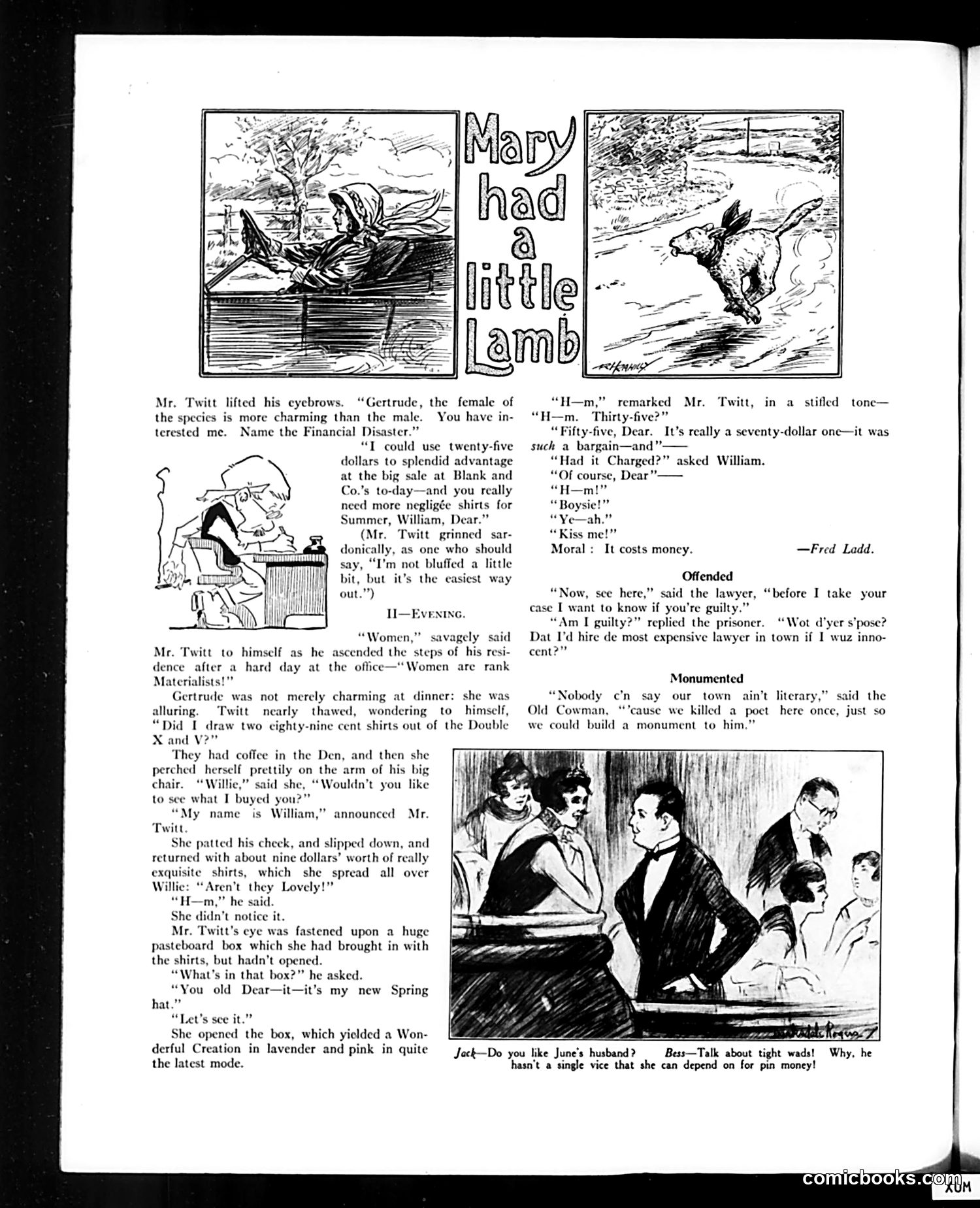
This page from *Judge* satirizes married couples and financial dynamics through several vignettes featuring Mr. and Mrs. Twitt. **Main narrative**: Mr. Twitt, attempting to resist his wife's spending, watches her charm him into accepting her purchases. The satire targets wives as "rank Materialists" who manipulate husbands through affection and expensive purchases (hats, negligée shirts, charged items). The repeated pattern—she requests money, he objects, she charms him—depicts wives as calculatingly materialistic. **Supporting cartoons** mock similar themes: a lawyer questions whether a defendant can afford him (implying guilt), and a small town builds a monument to a dead poet (ironic civic pride). **The final joke** mocks miserly husbands who provide no spending money. The satire reflects early-20th-century anxieties about women's consumer power and marital control, presenting wives as manipulative spenders and husbands as reluctant financial providers. It's gender-stereotyping humor typical of the era's men's magazines.
📄 Transcribed text from this page (OCR, searchable)
Machine-transcribed from the original scan — historical spelling and the odd misread are preserved.
“Gertrude, the female of Mr. Twitt lifted his eyebrows. You have in- the species is more charming than the ma terested me. Name the Financial Disaster. “T could use twenty-five dollars to splendid advantage at the big sale at Blank and Co.’s to-day—and you really need more negligée shirts for Summer, William, Dear. Twitt grinned sar- donically, as one who should say, “I’m not bluffed a little bit, but it’s the easiest way out.””) II—Eveninc. “Women,” savagely said Mr. Twitt to himself as he ascended the steps of his resi- dence after a hard day at the office—*Women are rank Matcrialists!"”” Gertrude was not merely charming at dinner: she was alluring. Twitt nearly thawed, wondering to himself, “Did I draw two cighty-nine cent shirts out of the Double X and V?" stifled tone— remarked Mr. Twitt, in a Thirty-five?” “Fifty-five, Dear. It’s really a seventy-dollar onc—it was such a bargain—and”- “Had it Charged?” asked William. “Of course, Dear” —— “H—m!” “Bo: “Kiss me!” Moral : It costs moncy. Offended “Now, see here,” said the lawyer, “before I take your case I want to know if you're guilty.” “Am I guilty?” replied the prisoner. ‘Wot d’yer s’pose? Dat I'd hire de most expensive lawyer in town if I wuz inno- cent?” —Fred Ladd. Monumented “Nobody c’n say our town Old Cowman, “cause we killed we could build a monument to him, ain't literary,” said the a poct here once, just so They had coffee in the Den, and then she perched herself prettily on thi m of his big chair. “Willie,” said she, ‘“Wouldn’t you like to see what I buyed you?” “My name is William,” announced Twitt She patted his cheek, and slipped down, and returned with about nine dollars’ worth of really shirts, which she spread all over Lovely!” Mr. She didn’t noti Mr. Twitt’s fastened upon a huge pasteboard box which she had brought in with the shirts, but hadn't opene “What's in that box?” ed. “You old Dear—it—it’s my new Spring hat.” “Let's see it.” She opened the box, which yielded a Won- derful Creation in lavender and pink in quite the latest mode. Jock—Do you like June's husband? hasn't a single vice that she can depend on for pin money! Bess—Talk about tight wads! Why, he