
A complete issue · 28 pages · 1915
Judge — November 13, 1915
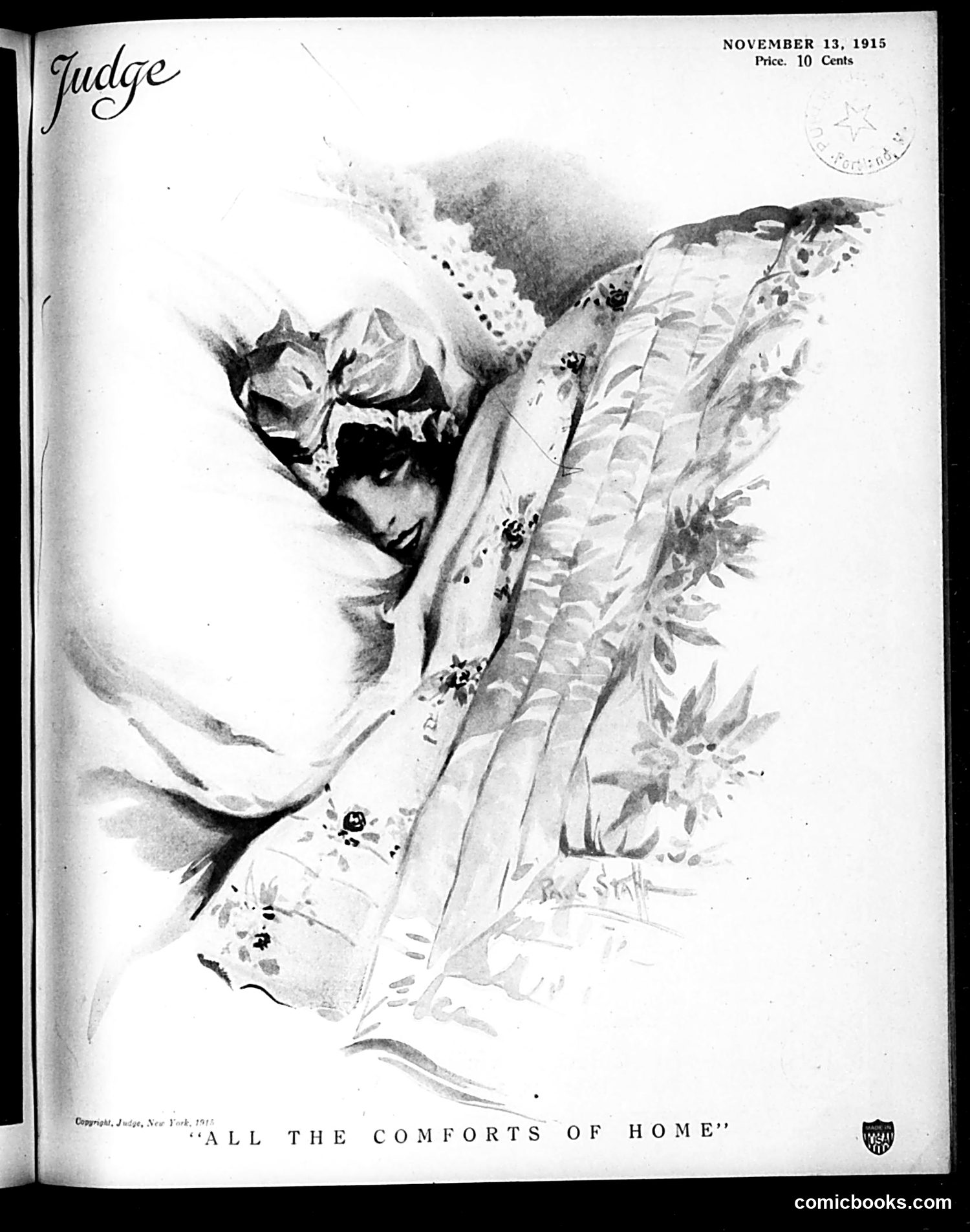
This November 1915 Judge magazine cover depicts a woman in elaborate dress reclining luxuriously among cushions and fine fabrics, surrounded by decorative flowers. The title "All the Comforts of Home" appears ironic—the figure appears to be in an idealized, fantastical domestic space rather than an actual home. Given the 1915 date and Judge's satirical nature, this likely critiques either: wealthy women's excessive leisure and comfort, or conversely, nostalgia for home comforts during wartime (World War I was ongoing). The elaborate illustration style and romanticized presentation suggest the satire targets the contrast between idealized domestic fantasy and reality. The specific social commentary remains somewhat unclear without additional context from the issue's articles.
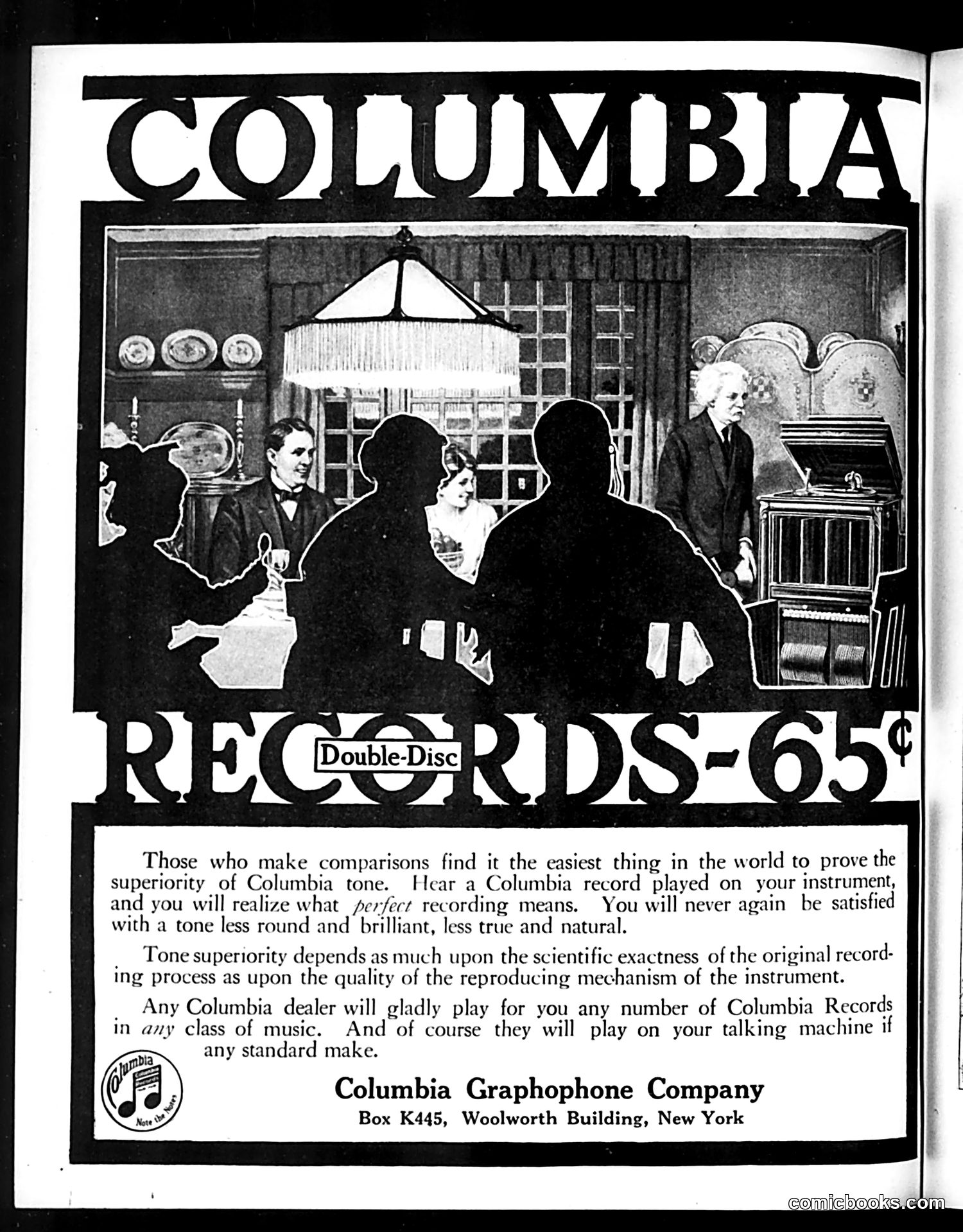
This page is primarily a **Columbia Records advertisement**, not political satire. The illustrated scene shows people in a formal parlor listening to a phonograph, demonstrating the superior sound quality of Columbia double-disc records (priced at 65 cents). The ad's rhetorical strategy appeals to consumers through comparison: hearing a Columbia record will make you realize "perfect recording means" and dissatisfy you with inferior competitors' tone quality. It emphasizes both the scientific recording process and the reproducing mechanism's importance. The text promises Columbia dealers will play any record on customers' machines to prove superiority—a direct challenge to competitors' products. The company address (Box K445, Woolworth Building, New York) anchors this as period advertising, not editorial content.
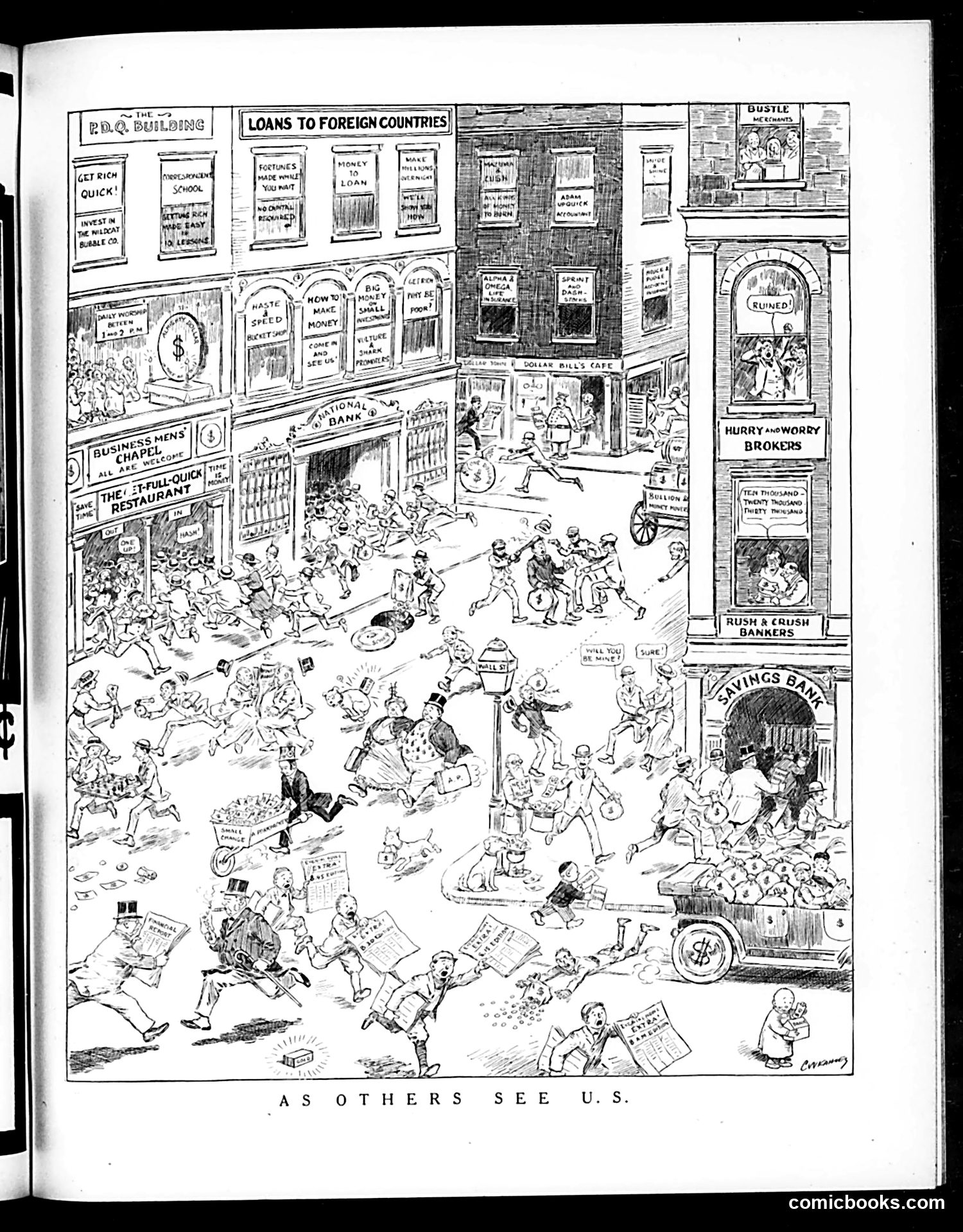
This satirical cartoon depicts America through a foreign perspective, showing chaos and financial disorder. The central street scene portrays frenzied activity around various banking and financial establishments ("National Bank," "Savings Bank," "Rush & Crush Bankers," "Hurry and Worry Brokers"). The storefronts labeled "Loans to Foreign Countries" suggest American lending practices abroad, while the chaotic street—crowded with running figures, scattered money, and general mayhem—satirizes the American financial system as seen by outsiders. The cartoon critiques American capitalism as hectic, money-obsessed, and destabilizing. The title indicates Judge magazine's intent to show how foreigners perceive American economic life: frantic, unstable, and driven by reckless financial speculation rather than order or stability.
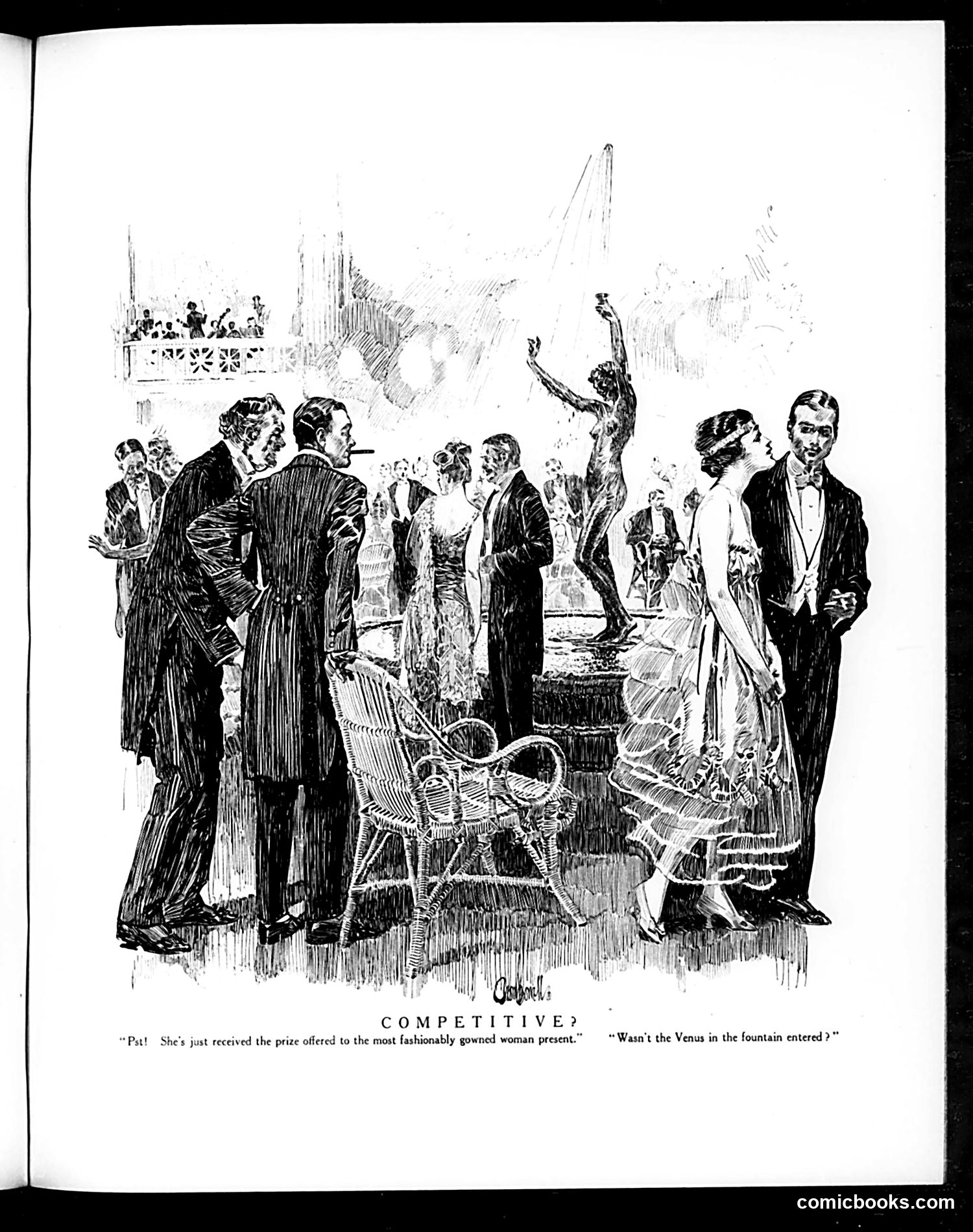
This cartoon satirizes early 20th-century high society's competitive nature regarding fashion and status. The scene depicts an elegant social gathering where a woman has just won a prize for being "the most fashionably gowned woman present." The humor lies in the contradiction posed by the caption: one man notes she's won the fashion prize, while another sarcastically asks if "the Venus in the fountain" was entered in the competition. This implies the statue—representing classical beauty and artistic perfection—should logically have competed if fashion competitions are truly about aesthetic excellence. The cartoon mocks how shallow and arbitrary these society competitions appear, suggesting that if genuine beauty were the standard, an actual work of art would outshine any fashionable guest.
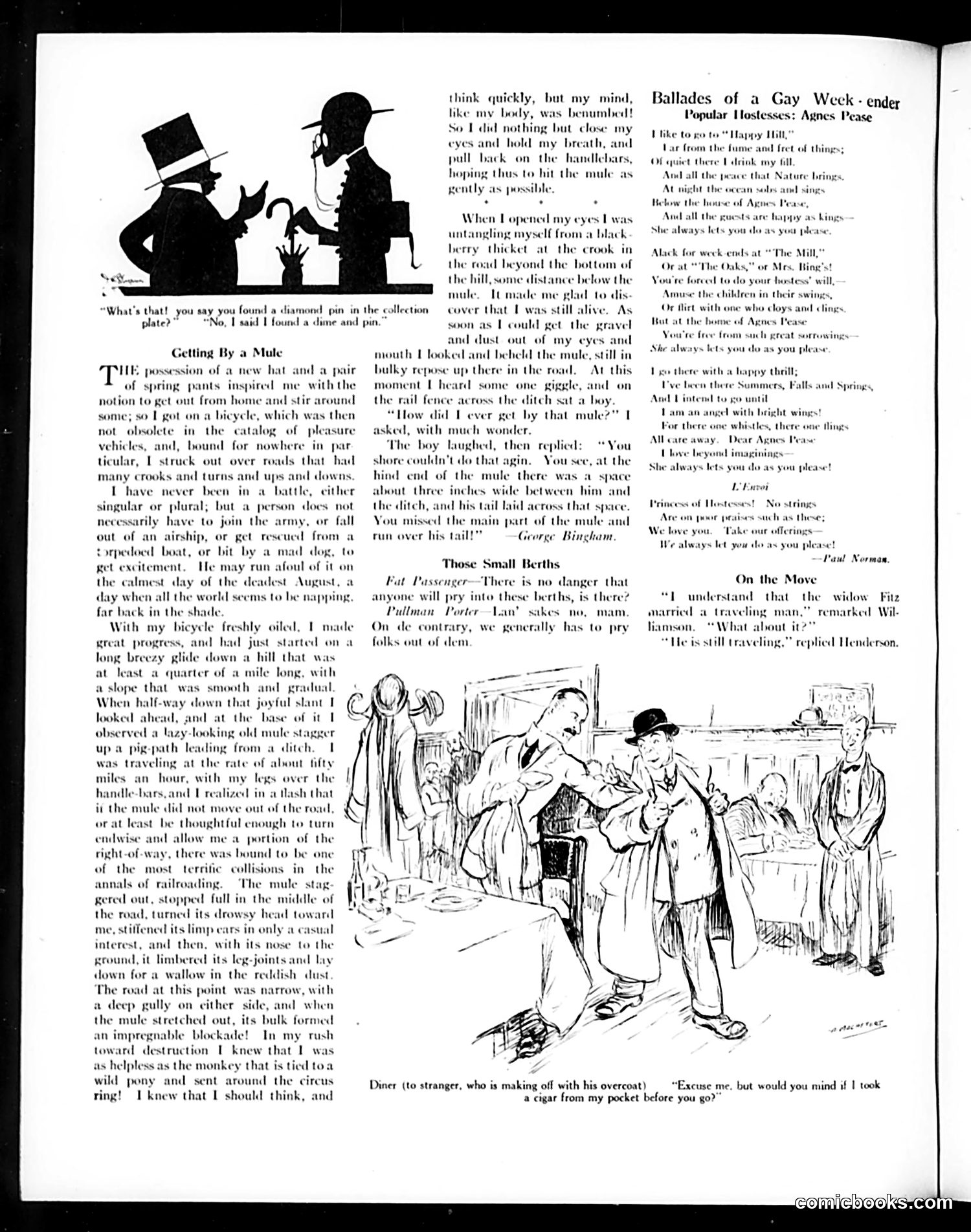
This page from *Judge* magazine contains three separate pieces of humor: 1. **"Getting By a Mule"**: A humorous autobiographical story about a cyclist nearly colliding with a stubborn mule blocking a narrow road. The joke: the rider barely survives by passing between the mule's body and a ditch, missing the main body but running over its tail. It's rustic, early-20th-century American humor about rural hazards. 2. **"Those Small Berths"**: A brief joke contrasting passenger expectations (privacy in train berths) with a porter's reality—he must constantly evict people from sleeping berths, so privacy isn't the issue. 3. **"On the Move"**: A sketch showing travelers, with a diner asking a stranger not to steal his overcoat while making off with it himself—ironic social commentary on theft among supposedly respectable people. The **"Ballades of a Gay Week-ender"** is poetry about weekend leisure. None of these pieces contain obvious political satire; they're gentle social humor reflecting early-20th-century American life.
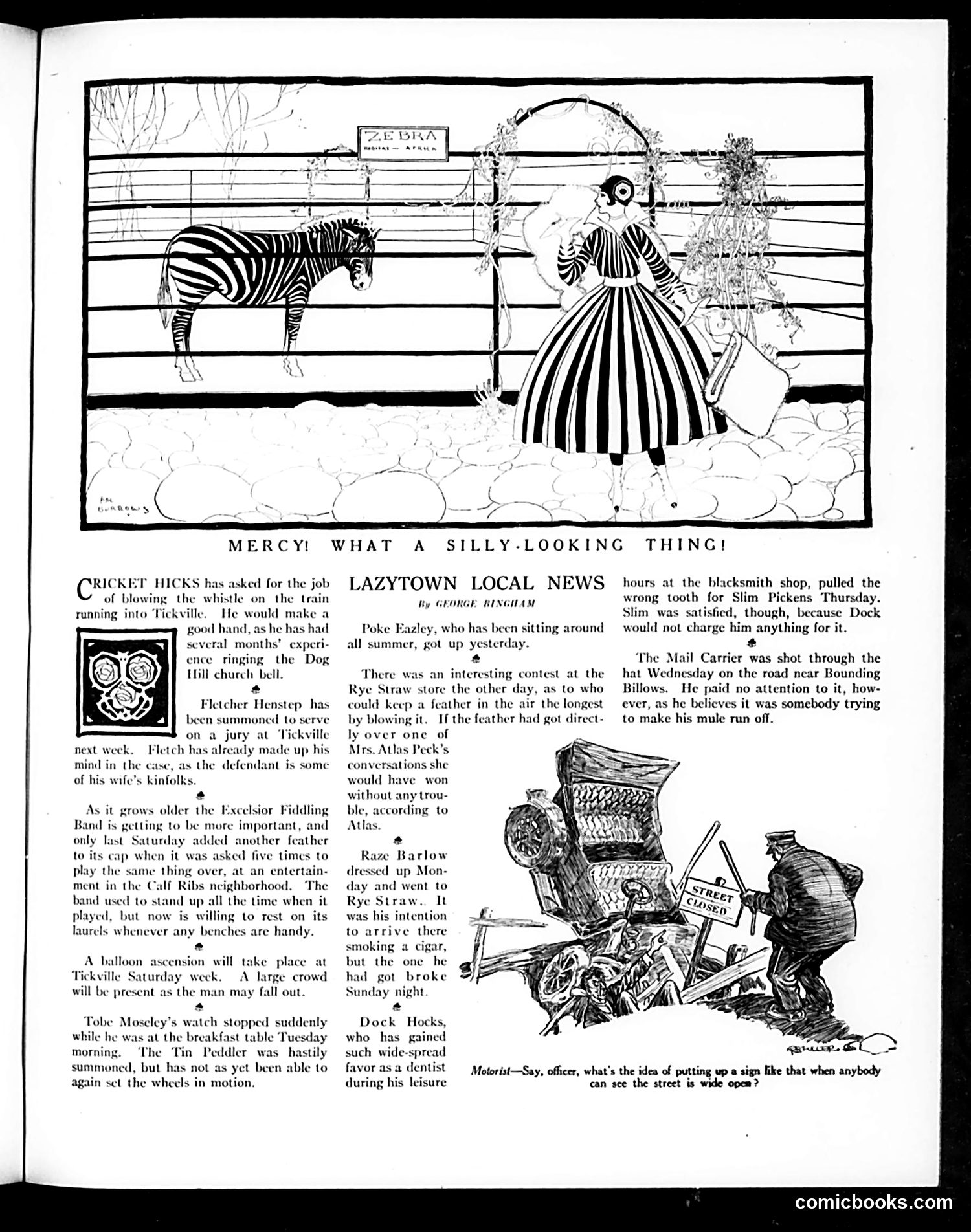
The top cartoon depicts a woman in 1920s attire encountering a zebra at a fence, captioned "Mercy! What a Silly-Looking Thing!" The joke appears to be the woman's reaction to the exotic animal—either she finds it absurd, or there's irony in her own elaborate striped dress resembling the zebra's pattern. The page consists primarily of "Lazytown Local News," humorous small-town gossip items about fictional residents (Poke Eazley, Raze Barlow, Dock Hocks, etc.) and their mundane or absurd doings—a tooth extraction, a stopped watch, a feather-floating contest. The bottom cartoon shows a motorist questioning a police officer about a street-width sign, suggesting the sign is unnecessary since the street's width is obvious—satirizing bureaucratic over-regulation and pointless signage. Overall, the page mocks small-town life, rural characters, and governmental inefficiency through lighthearted humor typical of Judge magazine's satirical approach.
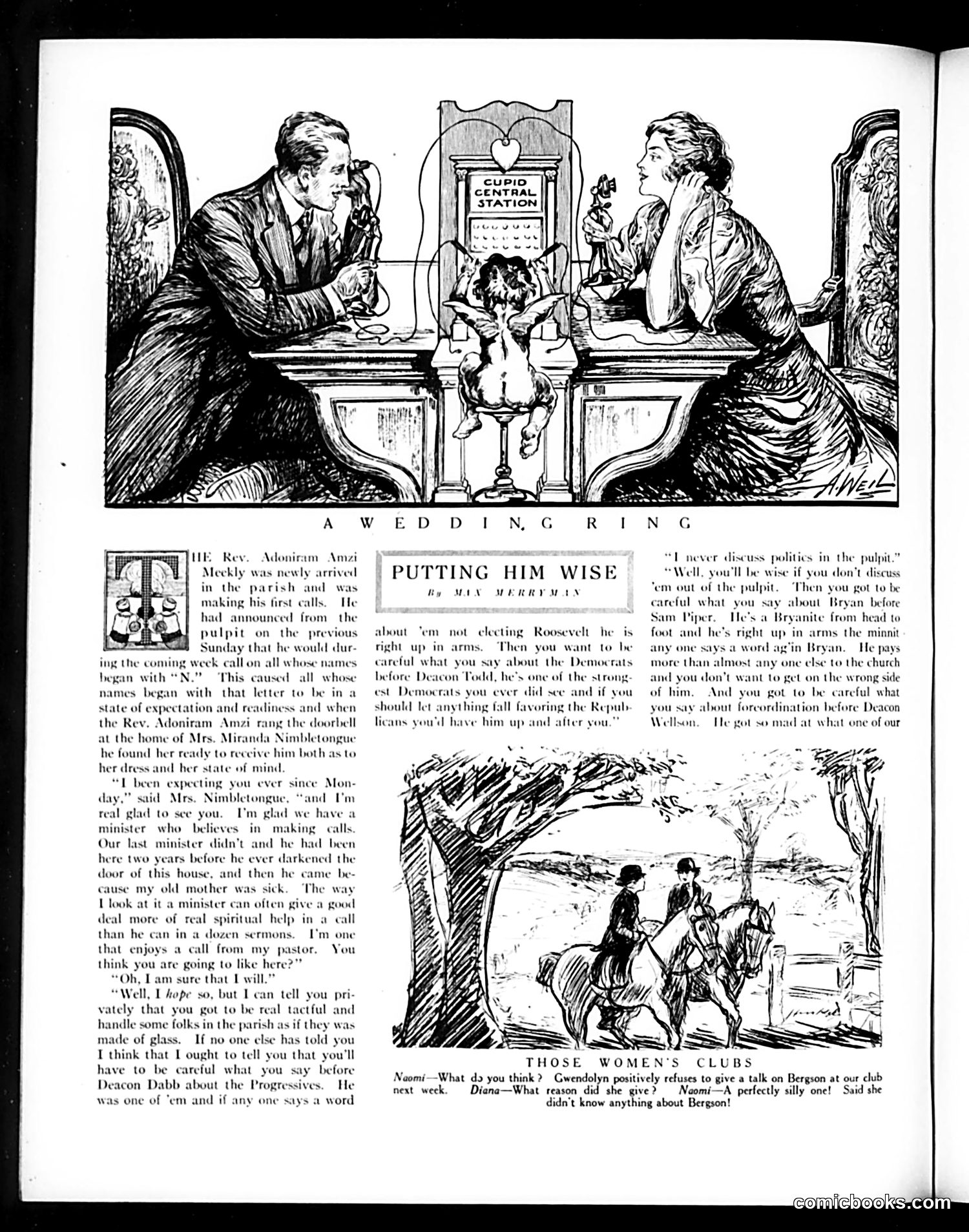
This page contains two satirical pieces from *Judge* magazine: **Top cartoon ("A Wedding Ring"):** A humorous illustration shows a couple at "Cupid Central Station" with Cupid as a small child between them, suggesting marriage as a transportation hub or matchmaking service—poking fun at romantic bureaucracy. **Main article ("Putting Him Wise"):** A new minister arrives to make parish calls. A parishioner (Mrs. Nimbletongue) warns him to avoid discussing politics in private conversations, naming specific parishioners with strong political allegiances—some supporting Roosevelt/Republicans, others supporting Bryan/Democrats. The joke satirizes small-town religious hypocrisy: the minister must stay silent on major issues to avoid offending wealthy donors, undermining his moral authority. **Bottom cartoon ("Those Women's Clubs"):** A brief society joke where one woman refuses to give a lecture on philosopher Henri Bergson, claiming ignorance—likely mocking pretentious women's clubs that discuss fashionable intellectual topics they don't understand. The page satirizes both ecclesiastical politics and educated-class pretension.
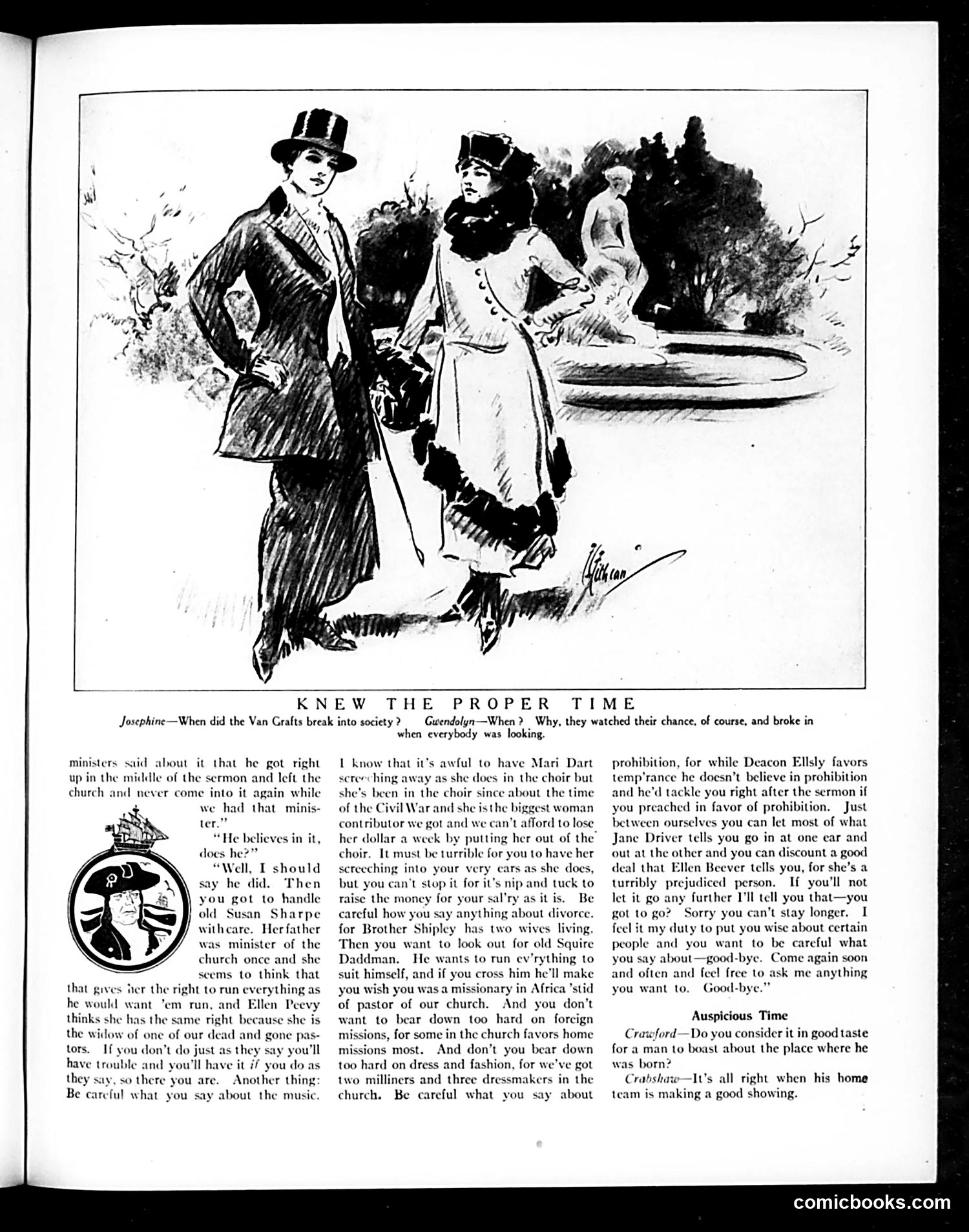
This page satirizes small-town church politics and hypocrisy. The cartoon depicts a woman ("Josephine") being warned by another about the Van Grafts' recent entry into "society"—they broke in during a moment when "everybody was looking," suggesting they seized an opportune (if not entirely proper) moment to gain social status. The lengthy text below presents a gossipy church member listing all the constraints on a minister's conduct: he must appease wealthy choir members (Mari Dart), avoid mentioning divorce (Brother Shipley has two living wives), avoid offending rich patrons (Squire Daddman), and navigate contradictory factions on prohibition and missions. The satire mocks how small-town church authority is actually held by powerful parishioners—not the minister—and how social respectability is fragile, hypocritical, and dependent on money and influence rather than genuine principle.
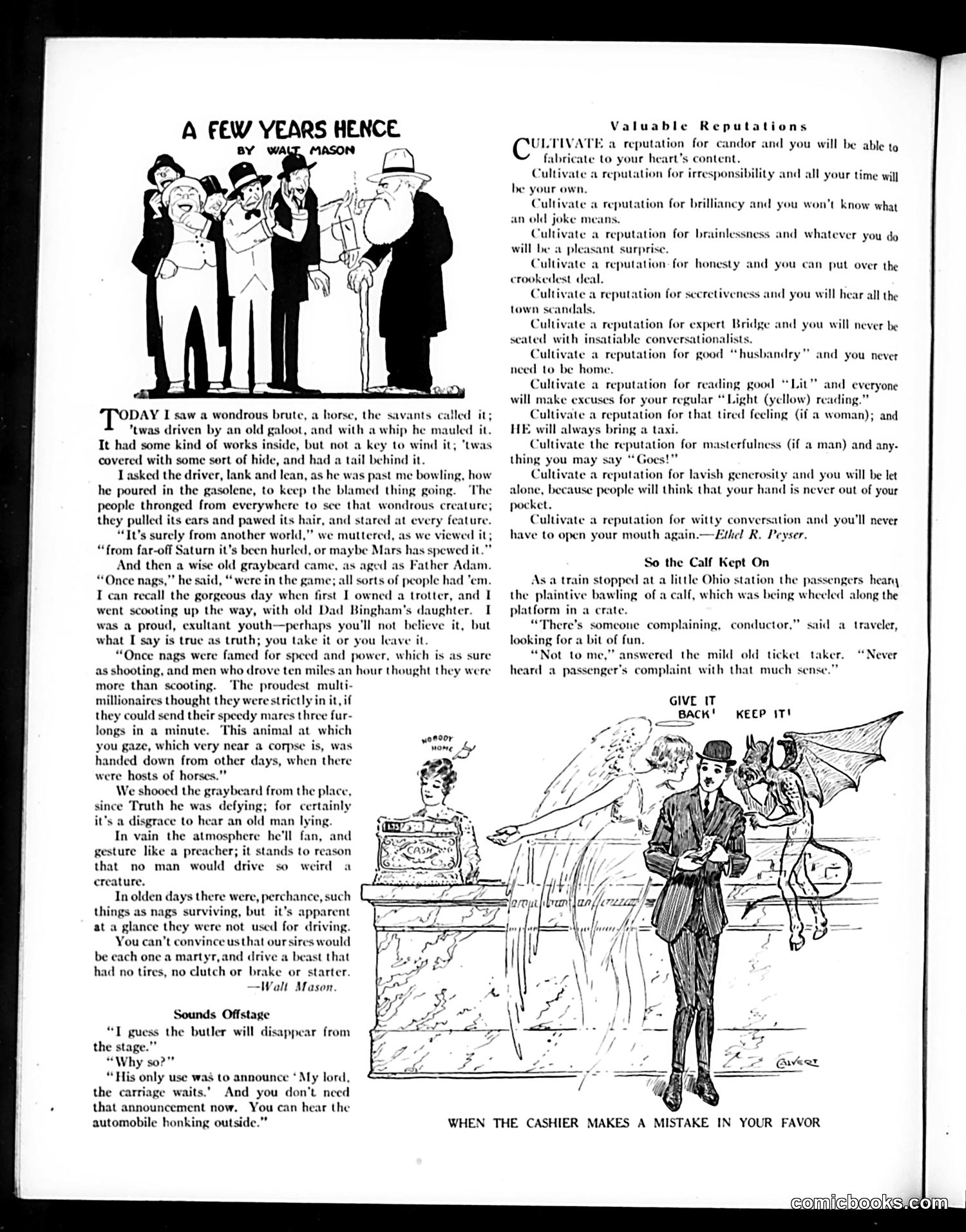
This page satirizes early automotive technology by imagining a future where horses have become extinct curiosities. Walt Mason's poem depicts an old man nostalgically recalling when horses were common and fast (ten miles an hour was considered impressive). The story's humor lies in the dramatic role-reversal: what once seemed normal now appears bizarre and incomprehensible. The cartoon below shows travelers bemused by a calf's complaint, with a conductor dismissing it — a parallel joke about changing communication norms in the modern age. The "Valuable Reputations" column offers cynical life advice: cultivating false impressions (appearing honest while being dishonest, appearing learned while being ignorant) yields social advantage. The page reflects Judge magazine's satirical commentary on rapid technological and social change in early 20th-century America, particularly the automobile's disruption of traditional transportation and social structures.
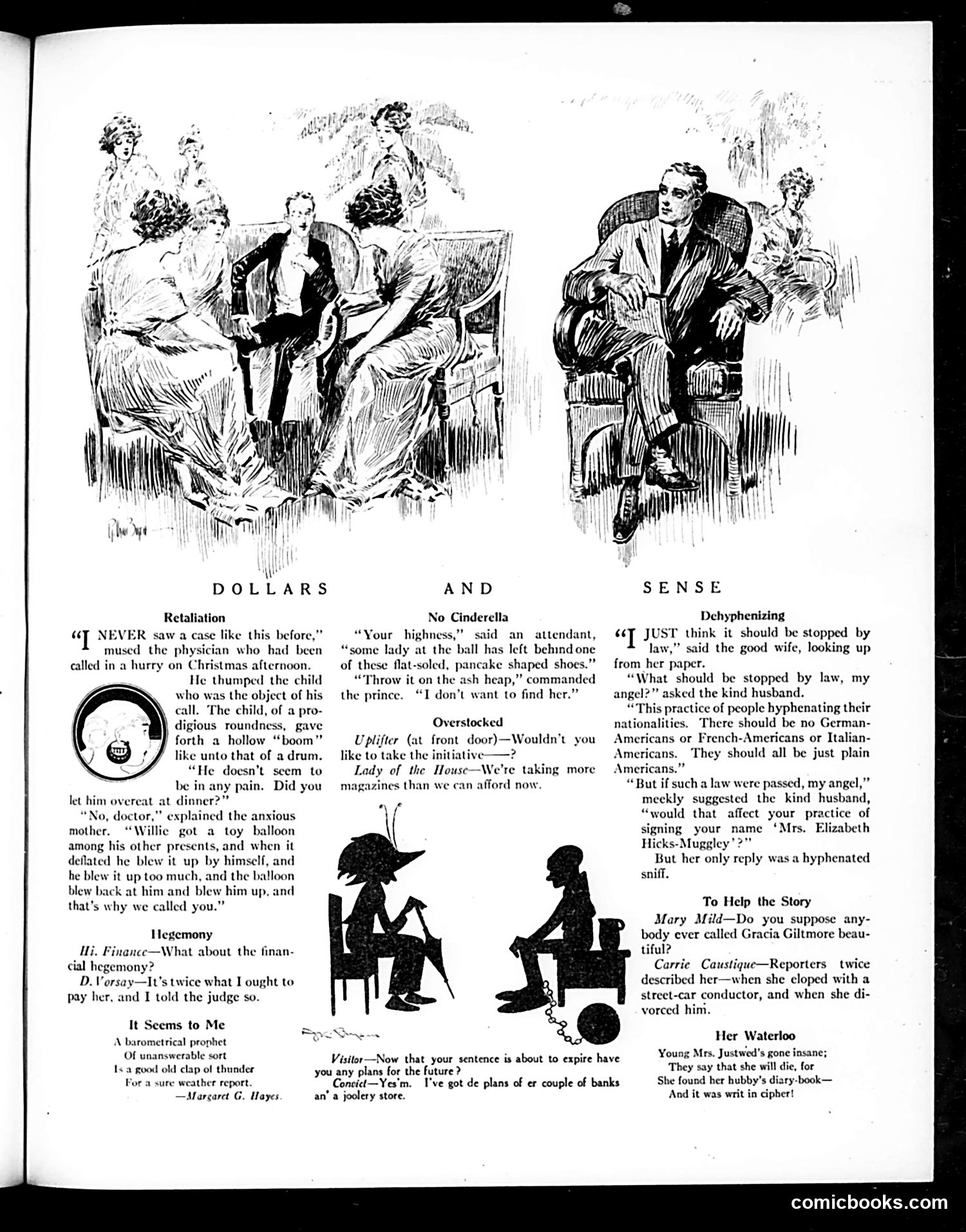
This page collects humorous short stories satirizing middle-class American life and social pretensions. **Key pieces:** - **"Retaliation"**: A child swallows a toy balloon he inflated himself—slapstick humor about parental negligence. - **"Dehyphenizing"**: Satirizes ethnic hyphenation (German-American, etc.) as un-American, yet the "good wife" ironically signs herself "Mrs. Elizabeth Hicks-Muggley"—mocking social hypocrisy about assimilation while maintaining class markers. - **"No Cinderella"**: Dark joke inverting the fairy tale; a prince discards a woman's shoe rather than seeking her, rejecting romantic convention. - **"Overstock"**: Gentle mockery of "uplifters" (social reformers) pestering housewives with causes when they're already overwhelmed. - **"Concict"** (sic): Prison humor about post-release plans involving bank robbery. The page reflects early-20th-century anxieties about immigration, assimilation, and middle-class pretension while mocking reformist movements.
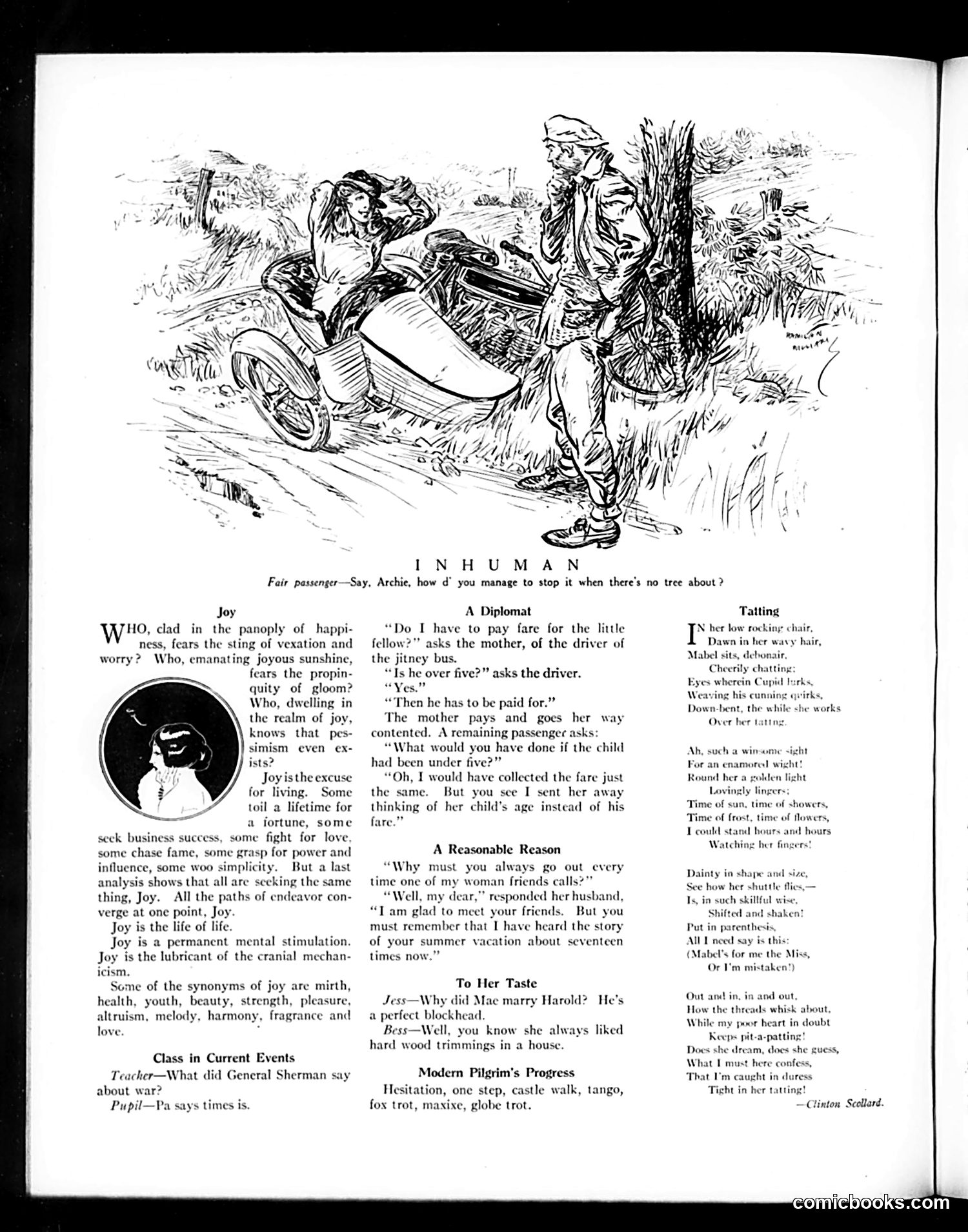
This page contains multiple short humorous pieces typical of Judge's satirical format: **Top cartoon ("Inhuman")**: Shows a man and woman in a motorcar that has crashed into a tree. The caption jokes about stopping the vehicle without a tree—implying the only way to stop their reckless driving is collision. This satirizes early automobile culture and dangerous driving habits of the era. **Text pieces below** include: - **"Joy"**: Philosophical essay defending leisure and happiness as life's legitimate purpose - **"A Diplomat"**: Anecdote mocking diplomatic evasiveness through a bus driver who misleads a passenger about child fares - **"Class in Current Events"**: Brief classroom joke where a student conflates his father's opinion with General Sherman's famous war quote - **"To Her Taste"**: Joke playing on a woman marrying a "blockhead" who likes "hard wood trimmings"—a pun on interior decoration preferences **"Tatting"**: A sentimental poem by Clinton Scollard about watching a woman do lacework (tatting), expressing romantic longing through extended metaphor. The page reflects early 20th-century American humor: automobiles, gender dynamics, and romantic sentiment.
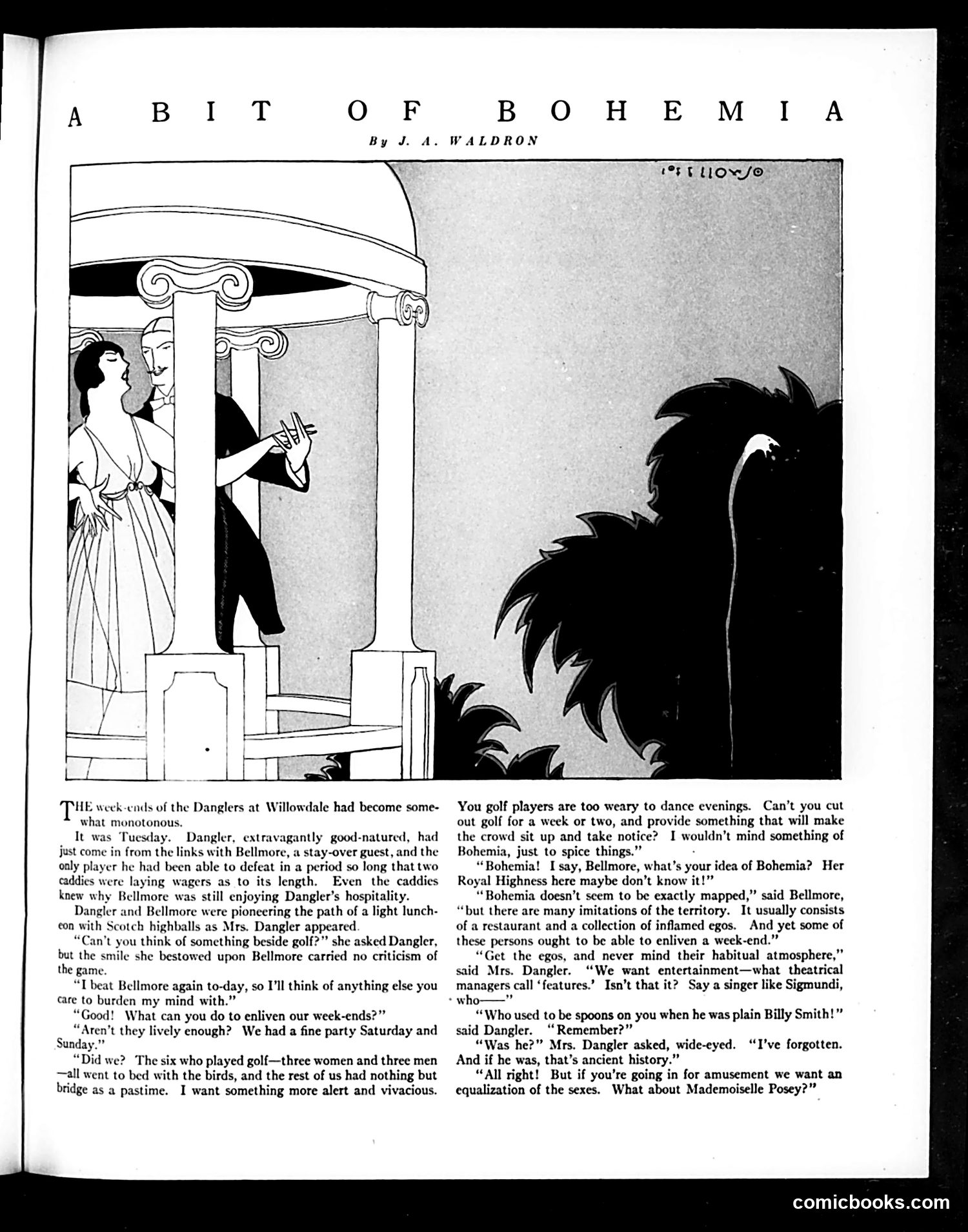
This is a humorous domestic story illustrated in Judge magazine. Mr. Dangler complains that weekend entertaining at his estate, Willowdale, has become tedious—golf and bridge dominate. His wife wants something more exciting: "Bohemia," meaning bohemian entertainment with artistic flair. The satire targets upper-class leisure culture. Mrs. Dangler dismisses typical weekend activities as dull and wants theatrical "features"—performers who can enliven gatherings. The story mocks both the golf-obsessed wealthy and their attempts to appear cultured by importing bohemian entertainment. The references to "Sigmundi" (apparently a singer, possibly Billy Smith's stage name) and "Mademoiselle Posey" suggest bohemian performers available for hire. The cartoon satirizes how the wealthy understood "Bohemia" not as genuine artistic life, but as a purchasable commodity—exotic entertainment packaged for their amusement.
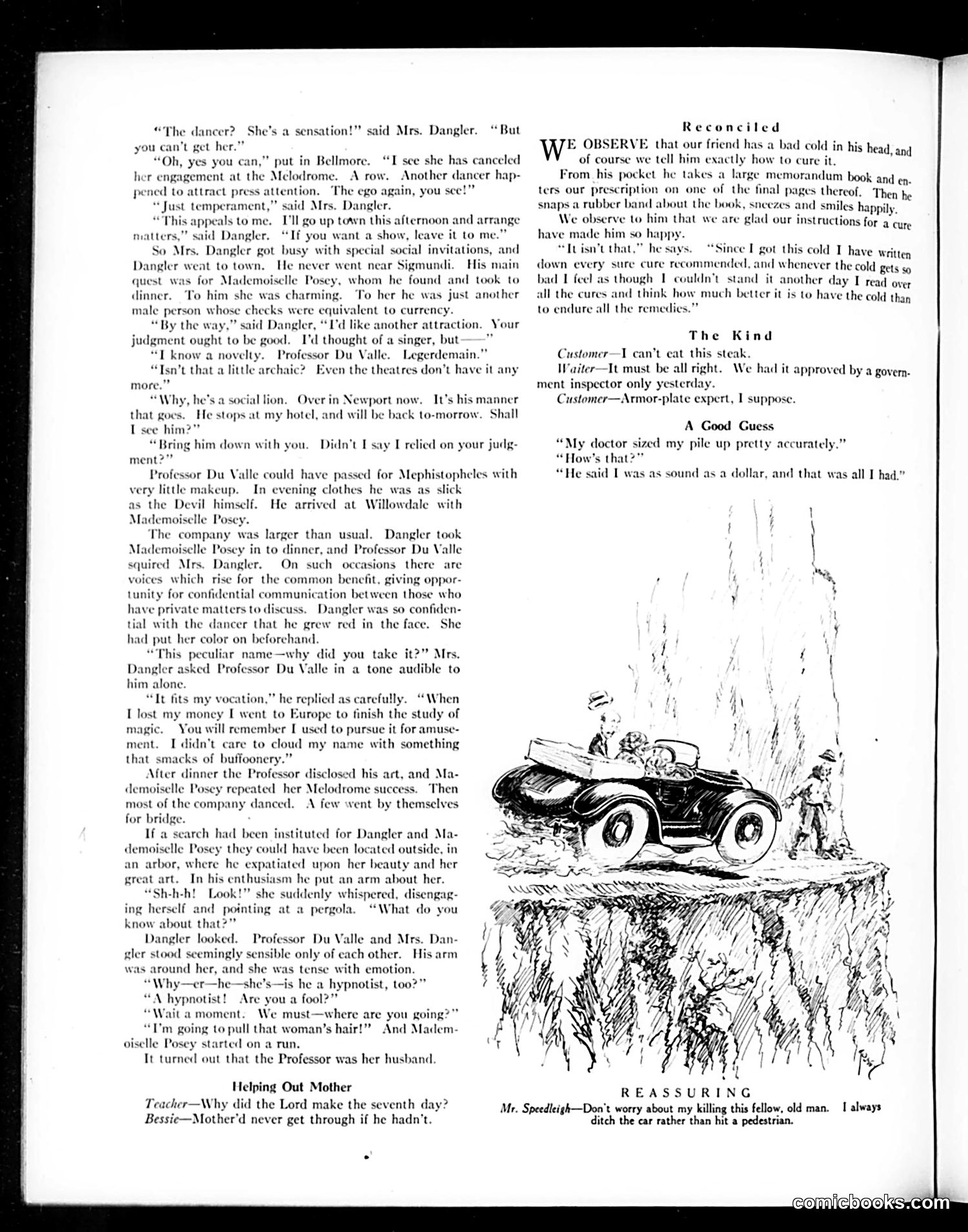
This page contains three satirical pieces typical of early-20th-century Judge magazine humor: **Main Story**: "The Dangler" narrative mocks wealthy social climbers. Mr. Dangler arranges an elaborate dinner party to impress his wife with a "novelty" entertainer—Professor Du Valle, a magician presented as fashionable society entertainment. The satire exposes how the wealthy chase novelty and social status. The plot twist—Professor Du Valle is actually Mademoiselle Posey's estranged husband, leading to comic jealousy—ridicules both the superficiality of high society and infidelity among the supposedly refined classes. **"Reassuring" Cartoon**: Shows a reckless driver unconcerned about hitting pedestrians, joking he'd "rather ditch the car than hit a pedestrian"—dark satire about early automobile culture's cavalier attitude toward public safety. **"Helping Out Mother"**: A brief joke where a child explains God made the seventh day so mothers could rest—gentle domestic humor mocking endless housework. The page satirizes social pretension, marital discord among the wealthy, and modern hazards.
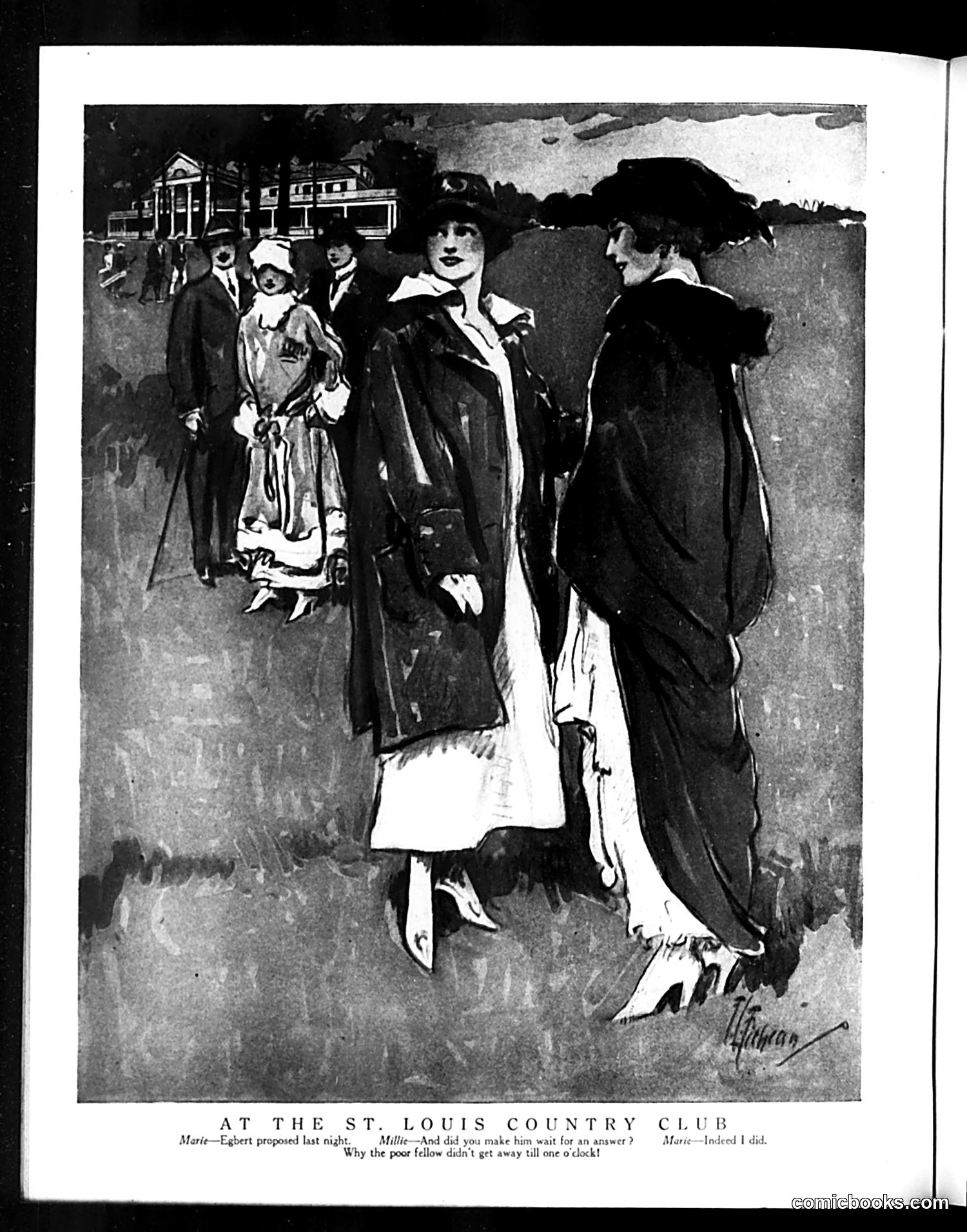
This is a social satire about courtship customs in the early 20th century. The joke hinges on the expectation that when a man proposes marriage, a woman should play "hard to get" by delaying her answer—a coy tactic considered proper feminine behavior at the time. The humor comes from Marie's extreme interpretation: she didn't just delay briefly, but made Egbert wait so long he couldn't leave until 1 a.m. The cartoon mocks both the artificiality of these dating games and the inconvenience they create. The St. Louis Country Club setting emphasizes this is about upper-class social conventions. The illustrated figures show well-dressed club members witnessing this domestic drama, suggesting the audience for such relationship performance was the broader social circle.
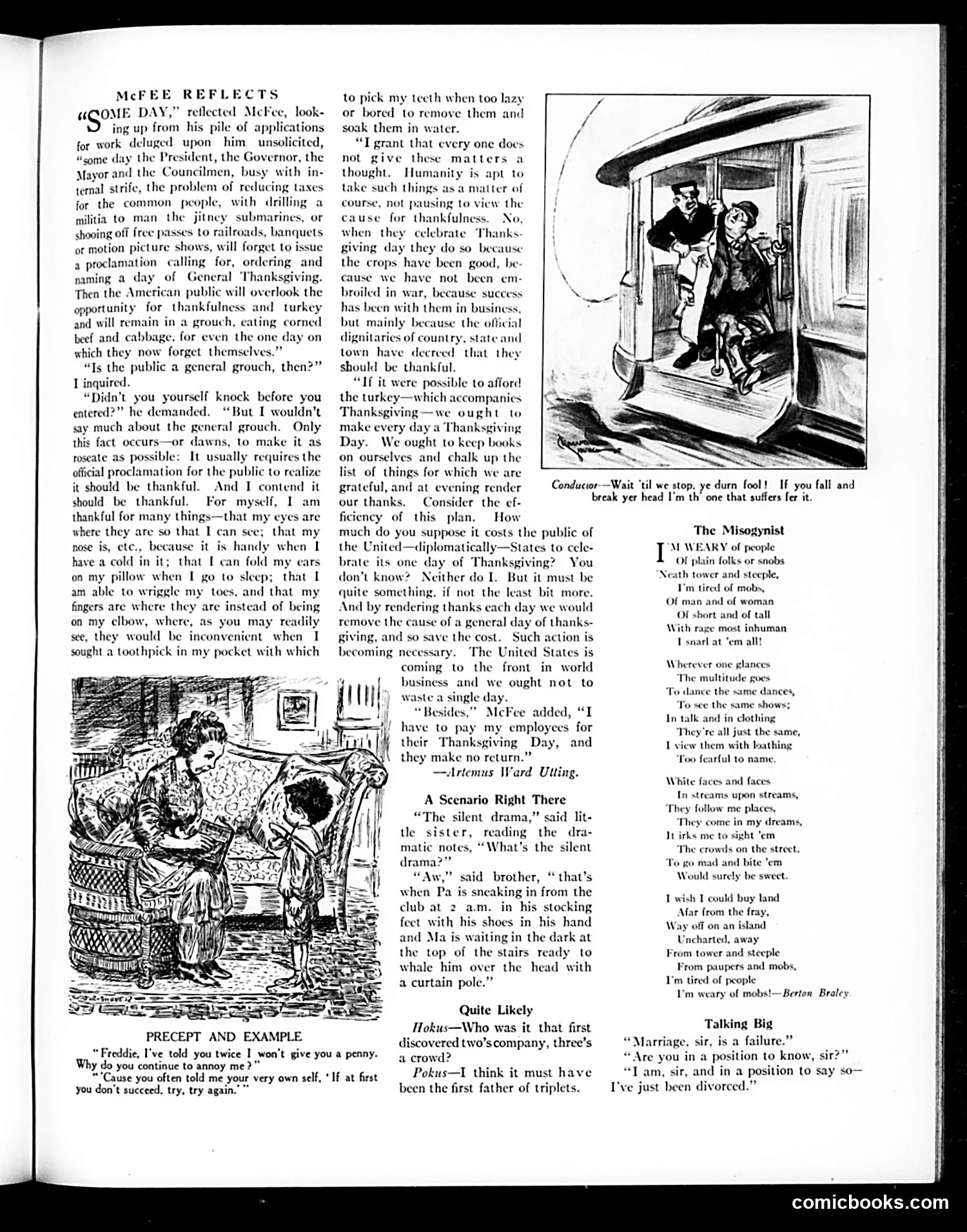
This page satirizes American attitudes toward Thanksgiving through McFee's cynical monologue. McFee mocks how citizens require *official government proclamation* to feel thankful—suggesting Americans are naturally ungrateful and need bureaucratic permission to appreciate their blessings. His absurdist examples (being grateful eyes are in the right place, fingers not on elbows) underscore the ridiculousness of needing official holidays for gratitude. The satire targets both government inefficiency and public apathy. McFee proposes daily personal thanksgiving rather than costly state celebrations, framing gratitude as a pragmatic cost-saving measure for the nation's budget—a dig at government waste during presumably post-WWI fiscal concerns. The page's other humor pieces are unrelated: "Precept and Example" jokes about parental hypocrisy; "A Scenario Right There" and others offer light domestic comedy typical of the era's satirical magazine format.
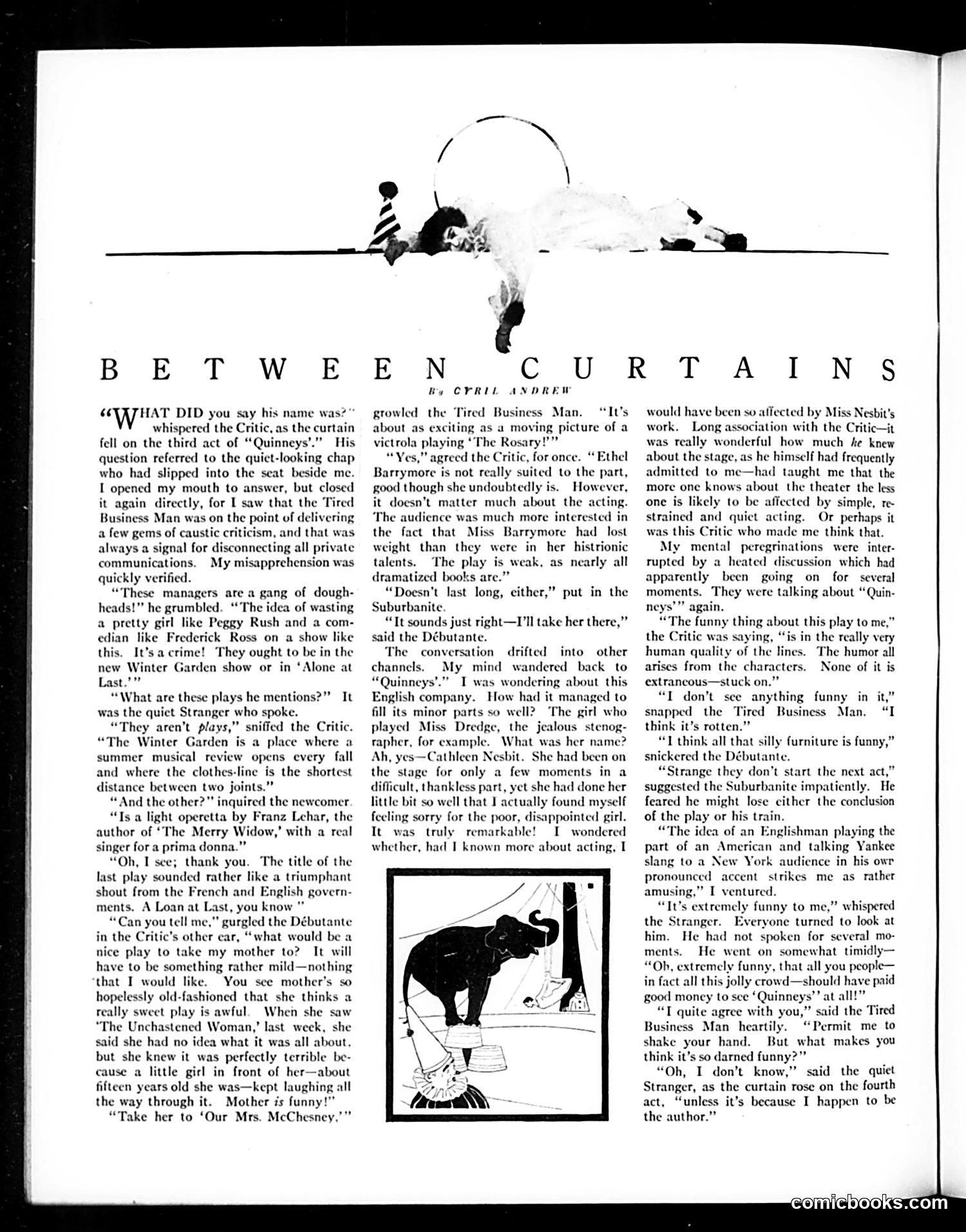
This theater criticism piece satirizes Broadway insiders and their pretensions. A "Tired Business Man" and a "Critic" discuss current plays with varying competence. The Critic dismisses "Quinneys'" despite praising certain performers, while praising spectacle-heavy shows like "Winter Garden." He condescends about acting quality, claiming knowledge affects appreciation. The Tired Business Man and Suburbanite offer blunt, commercial opinions. The narrator notes that young actress Cathleen Nesbit impressed him through subtle, restrained acting—yet worries his exposure to the Critic's cynicism has made him question whether emotional authenticity matters in theater. The cartoon (showing a dog) appears to illustrate one of the plays discussed. The satire targets theatrical snobbery, the gap between critical and popular taste, and how exposure to jaded opinions corrupts genuine emotional response to art.
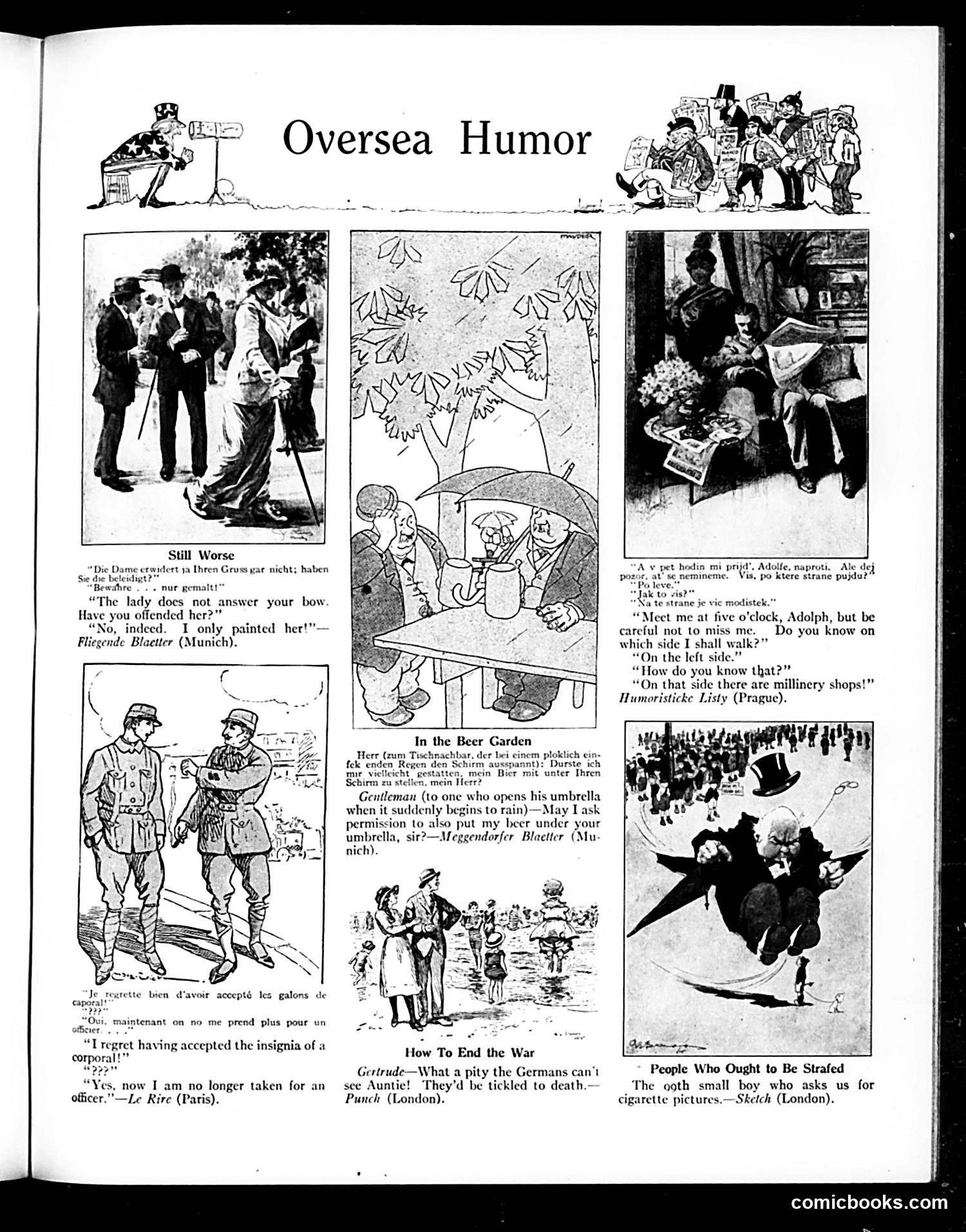
This Judge magazine page collects humorous cartoons and jokes from European publications during World War I, translated for American readers. The content showcases international wartime humor: **"Still Worse"** depicts a soldier who offended a lady by painting her portrait rather than bowing properly—satirizing military awkwardness. **"In the Beer Garden"** shows a gentleman asking to shelter his beer under another man's umbrella during rain—poking fun at German formality and beer culture. **"How To End the War"** references German aunt-visiting, suggesting Germans would surrender if they saw their relatives. **"People Who Ought to Be Strafed"** mocks children who collect cigarette pictures, a popular contemporary pastime. The page demonstrates how Allied nations used humor to mock enemy cultures while entertaining troops. The cartoons employ gentle ridicule rather than propaganda, reflecting period attitudes toward Germans and highlighting cultural differences during the conflict.
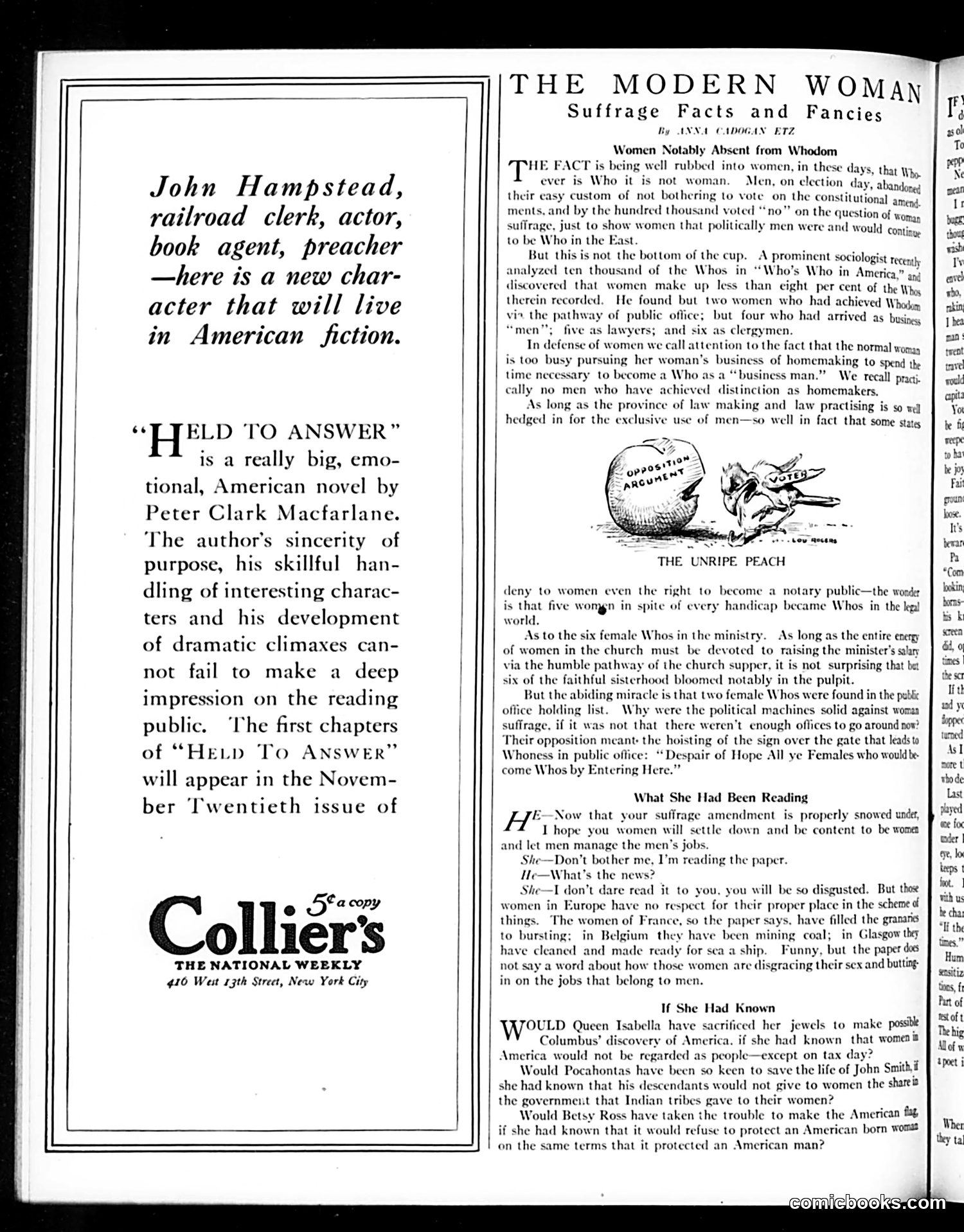
This page contains satirical commentary on women's suffrage and employment, circa early 20th century. The left side advertises a novel called "Held to Answer" by Peter Clark Macfarlane in *Collier's* magazine. The right side features "The Modern Woman: Suffrage Facts and Fancies" by Anna Cadogan Utz. A small cartoon titled "The Unripe Peach" depicts women's suffrage as an unripe fruit being struck—suggesting the suffrage movement is premature or flawed. The text sarcastically defends women's absence from "Who's Who," arguing that homemaking demands prevent women from achieving public distinction like men. It mocks the logic that women shouldn't expect political office when they're too busy with domestic duties—yet men achieve prominence without homemaking roles. Lower sections present dialogue mocking men's objections to women working, while highlighting women's wartime labor in Europe (France, Belgium, Glasgow). The final section uses historical irony: would Queen Isabella have sacrificed her jewels for Columbus's discovery if she'd known American women wouldn't be treated as full people? The satire critiques both gender discrimination and anti-suffrage arguments.
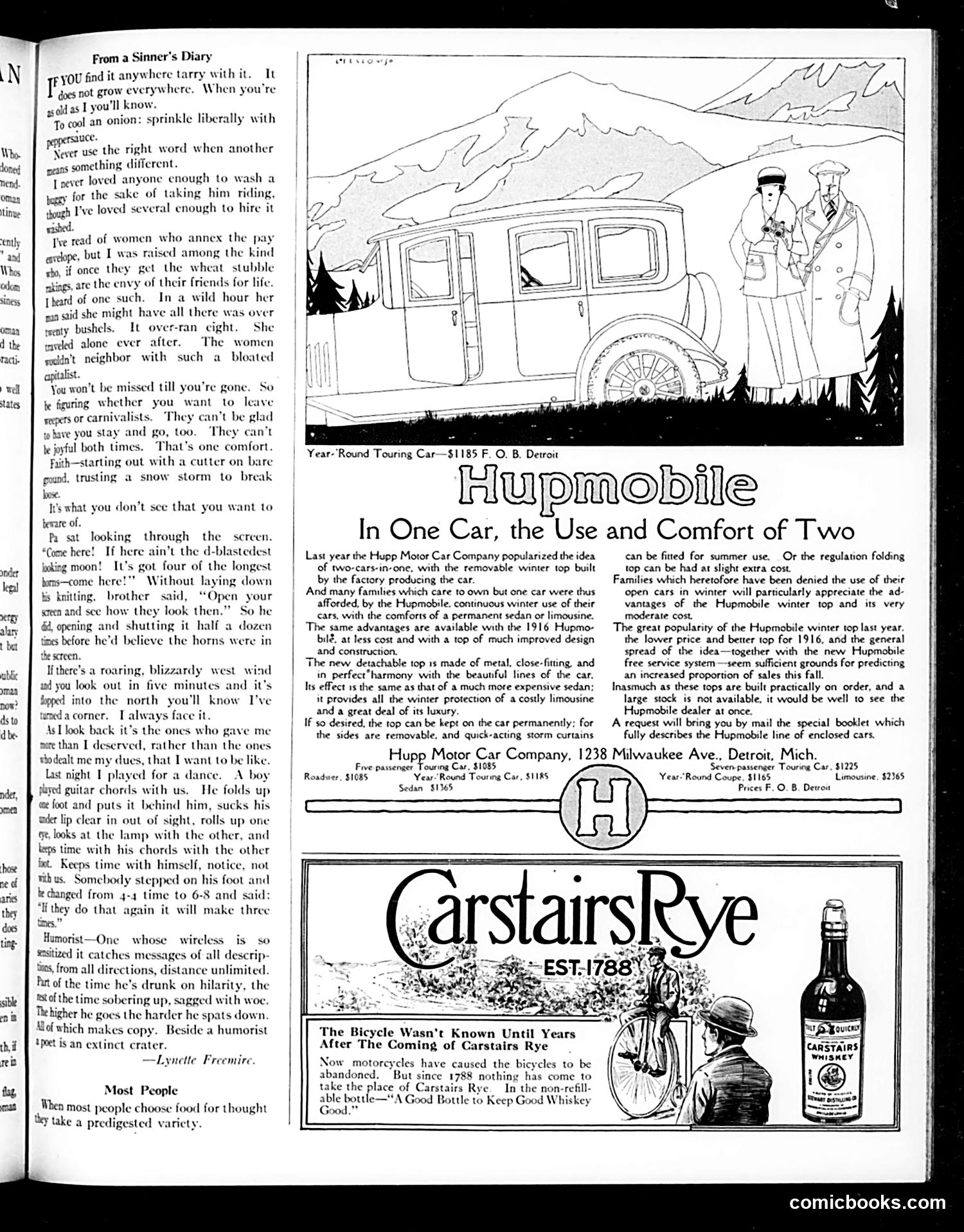
This page contains primarily **advertisements** rather than political satire. The main content includes: **Hupmobile Car Ad**: Promotes a 1916 automobile with an innovative removable winter top, marketed as providing "two cars in one"—combining sedan comfort in winter with open-air driving capability. This reflects early 1900s automotive technology and consumer concerns about seasonal vehicle use. **Carstairs Rye Whiskey Ad**: A brief, humorous advertisement suggesting whiskey replaced bicycles as transportation after its introduction in 1788, with the slogan "A Good Bottle to Keep Good Whiskey Good." **"From a Sinner's Diary"**: A serialized essay on the left column discussing rural life, relationships, and human nature—appears to be fiction or memoir rather than satire. The page demonstrates how Judge integrated commercial advertising with editorial content. No specific political figures or events are caricatured here; instead, this represents typical early-20th-century magazine format blending consumer goods promotion with lifestyle commentary.
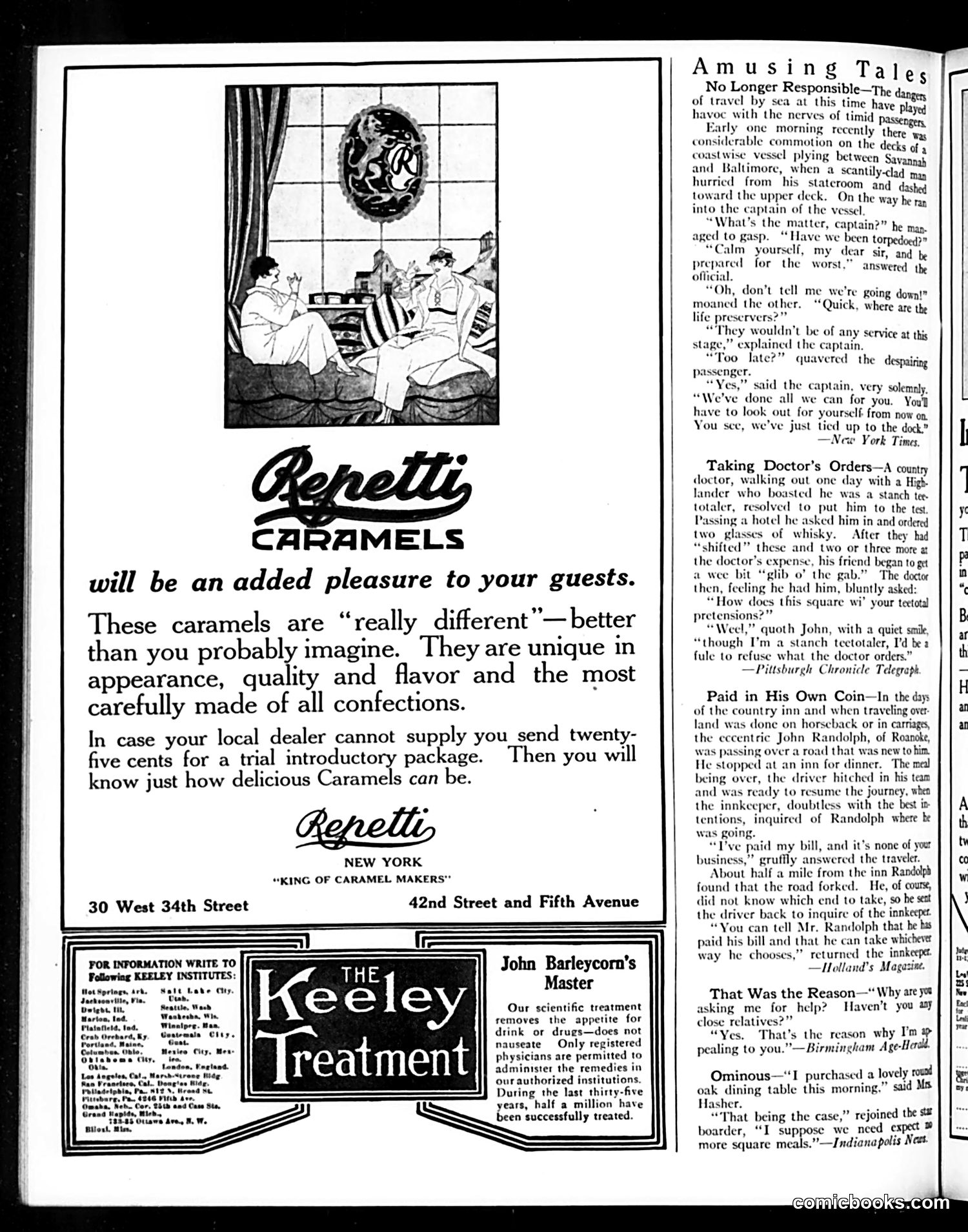
This page is primarily **advertisements and humorous short stories**, not political cartoons. The main advertisement features **Benetti Caramels**, positioning them as premium confections for entertaining guests. Below that, "The Keeley Treatment" advertises a medical cure for alcoholism and drug addiction—a real institution that operated in the late 19th/early 20th century. The right column contains "Amusing Tales"—brief comedic anecdotes typical of Judge magazine's humor: - A panicked ship passenger mistakes being docked at port for a torpedo attack - A Scottish teetotaler justifies drinking whisky by claiming "the doctor ordered it" - John Randolph (historical Virginia politician) snaps at an innkeeper who inquires about his destination - A boarding house joke about a new dining table predicting worse meals These stories rely on **period stereotypes** (Scottish accents, social hierarchies) and gentle ironies about human nature rather than political satire. The humor is domestic and character-driven rather than topical.
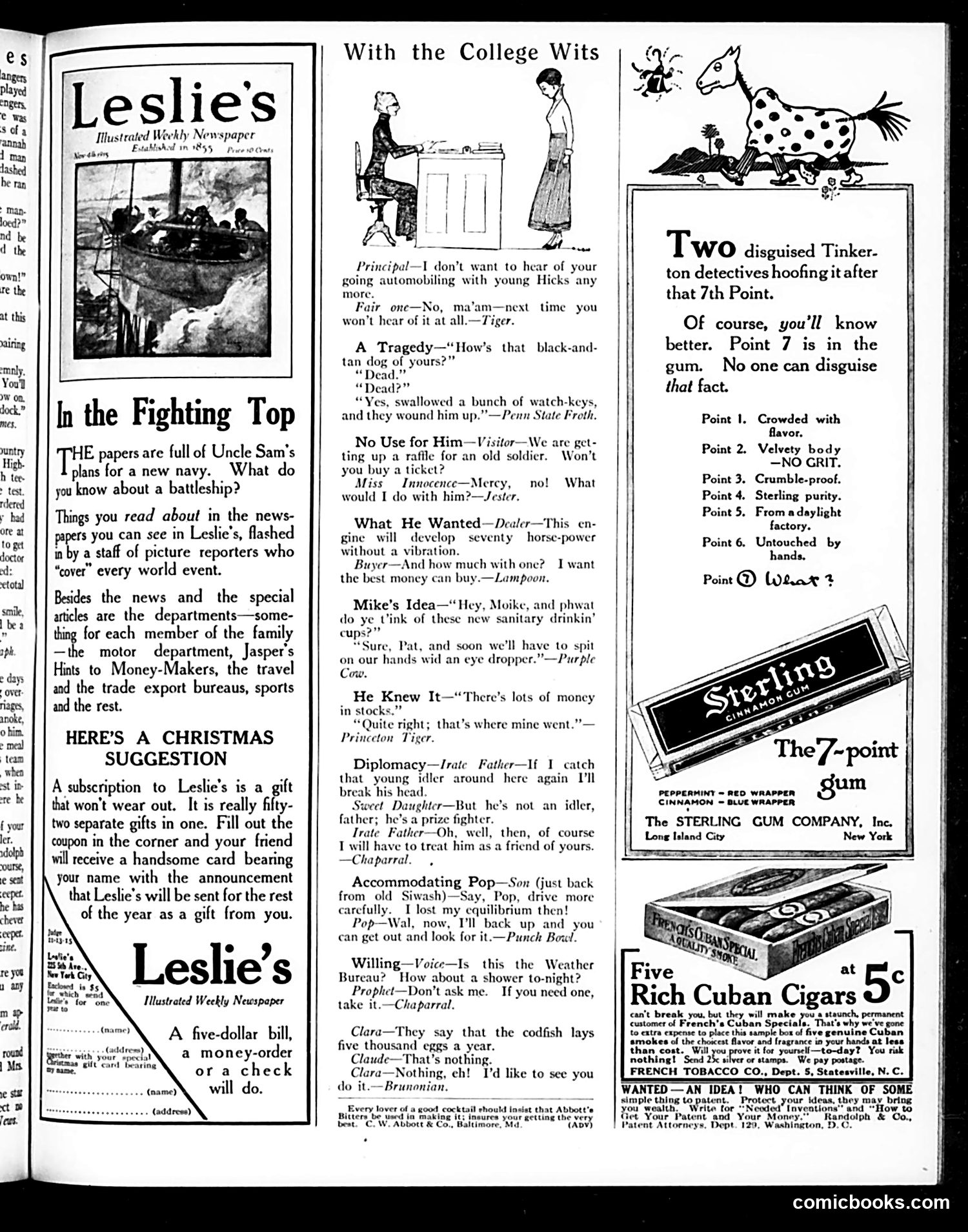
This page is primarily **advertising and promotional content** for Leslie's Illustrated Weekly Newspaper, with a secondary section of college humor jokes. The main feature advertises Leslie's as a gift subscription, emphasizing its coverage of contemporary events (particularly naval/military matters—"Uncle Sam's plans for a new navy") through picture reporters who "cover" world events. This positions Leslie's as modern, comprehensive journalism for family reading. The "With the College Wits" section reproduces brief jokes from various college humor publications (Penn State Froth, Jester, Lampoon, etc.)—typical period collegiate humor involving principals disapproving of dating, soldiers, marriage proposals, and Irish dialect humor. The right side features advertisements for Sterling Gum (emphasizing its "7-point" purity standards) and French's Cuban Cigars. The page reflects early-20th-century magazine culture: lightweight satirical content mixed with advertising, and college humor as popular entertainment.
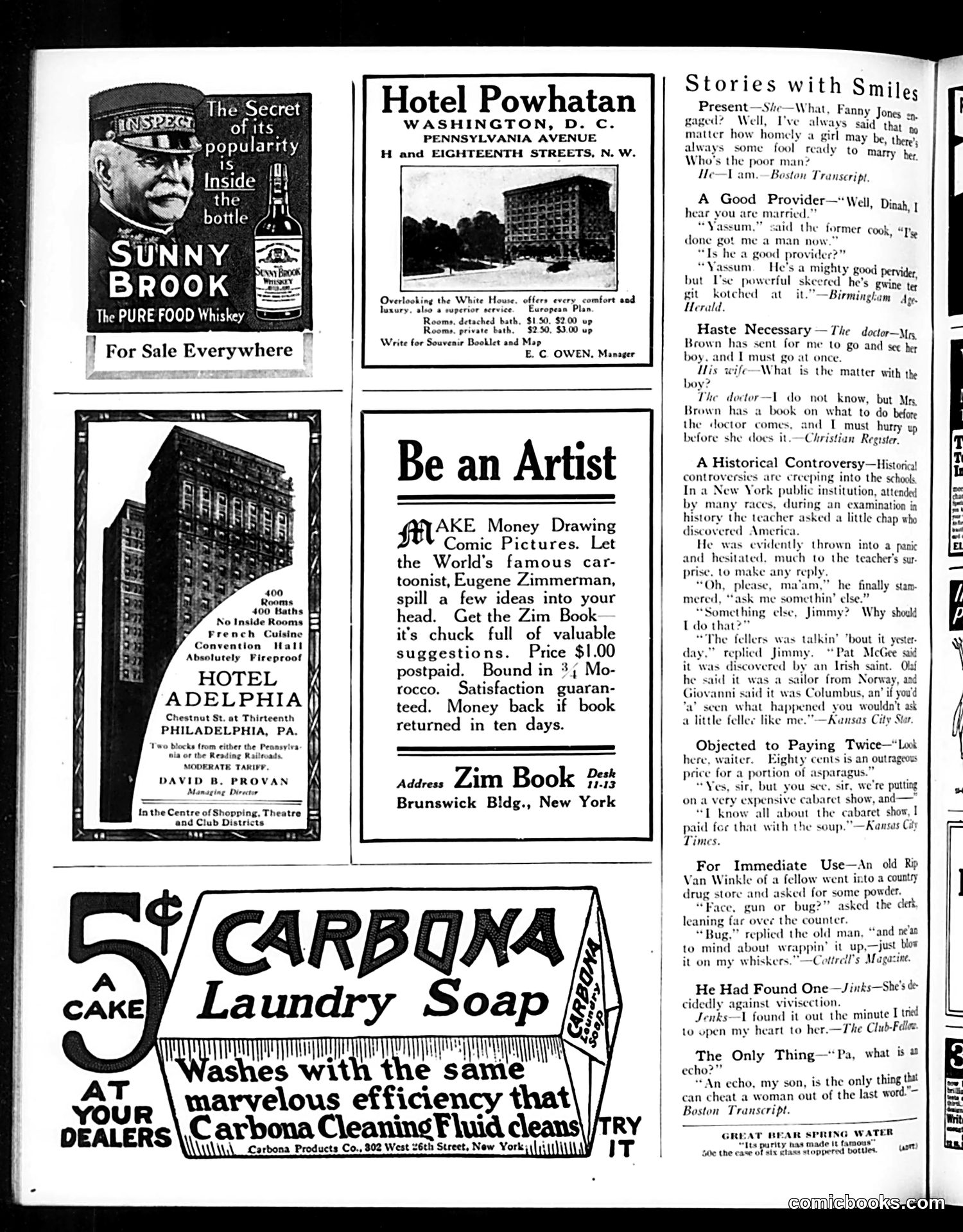
This page is primarily **advertisements and light humor columns**, not political cartoons. The ads promote hotels (Powhatan in Washington D.C., Adelphia in Philadelphia), Sunny Brook whiskey, Carbona laundry soap, and a drawing instruction book by cartoonist Eugene Zimmerman. The right side contains "Stories with Smiles"—short, domesticated jokes typical of early 20th-century magazines. These feature working-class characters (a cook named Dinah, immigrant schoolchildren) and play on period stereotypes. The humor relies on dialect, misunderstandings about "discovery" of America, and tired tropes about nagging wives and courtship. **Nothing here is overtly political.** The content reflects mainstream American attitudes of its era: casual racial humor, gender stereotypes, and genteel domesticity presented as entertainment for magazine readers. The "historical controversy" joke subtly mocks immigrant and working-class perspectives on American history.
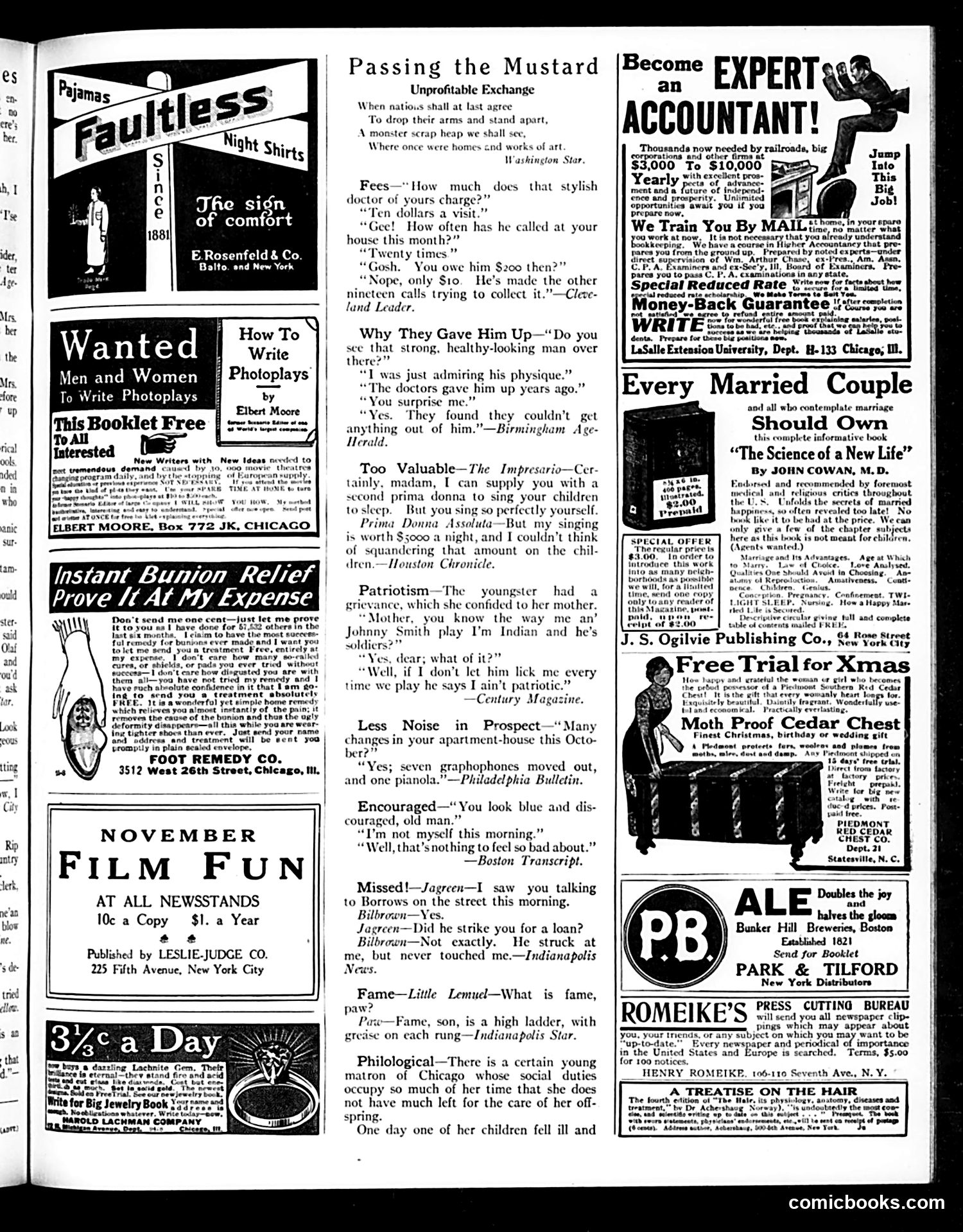
This page is primarily **advertisements and humorous short anecdotes** rather than political cartoons. The content reflects early 20th-century American commercial culture and domestic humor. **Key elements:** The advertisements promote correspondence courses (accountancy, photoplay writing), patent remedies (bunion relief, foot treatment), and consumer goods—typical of the era's direct-mail marketing economy. The humor pieces are brief, genteel jokes about marriage, doctors, patriotic children's play, and social pretension. The "Passing the Mustard" column features scenarios like a doctor's unpaid house calls, a prima donna too valuable to sing her own children to sleep, and a child conflating patriotism with accepting punishment. These jokes target **middle-class anxieties**: medical debt, social climbing, professional vanity, and child-rearing. The humor is gentle satire of everyday manners rather than biting political commentary. The page shows how *Judge* mixed satirical content with commercial advertising to reach aspirational readers seeking self-improvement and entertainment.
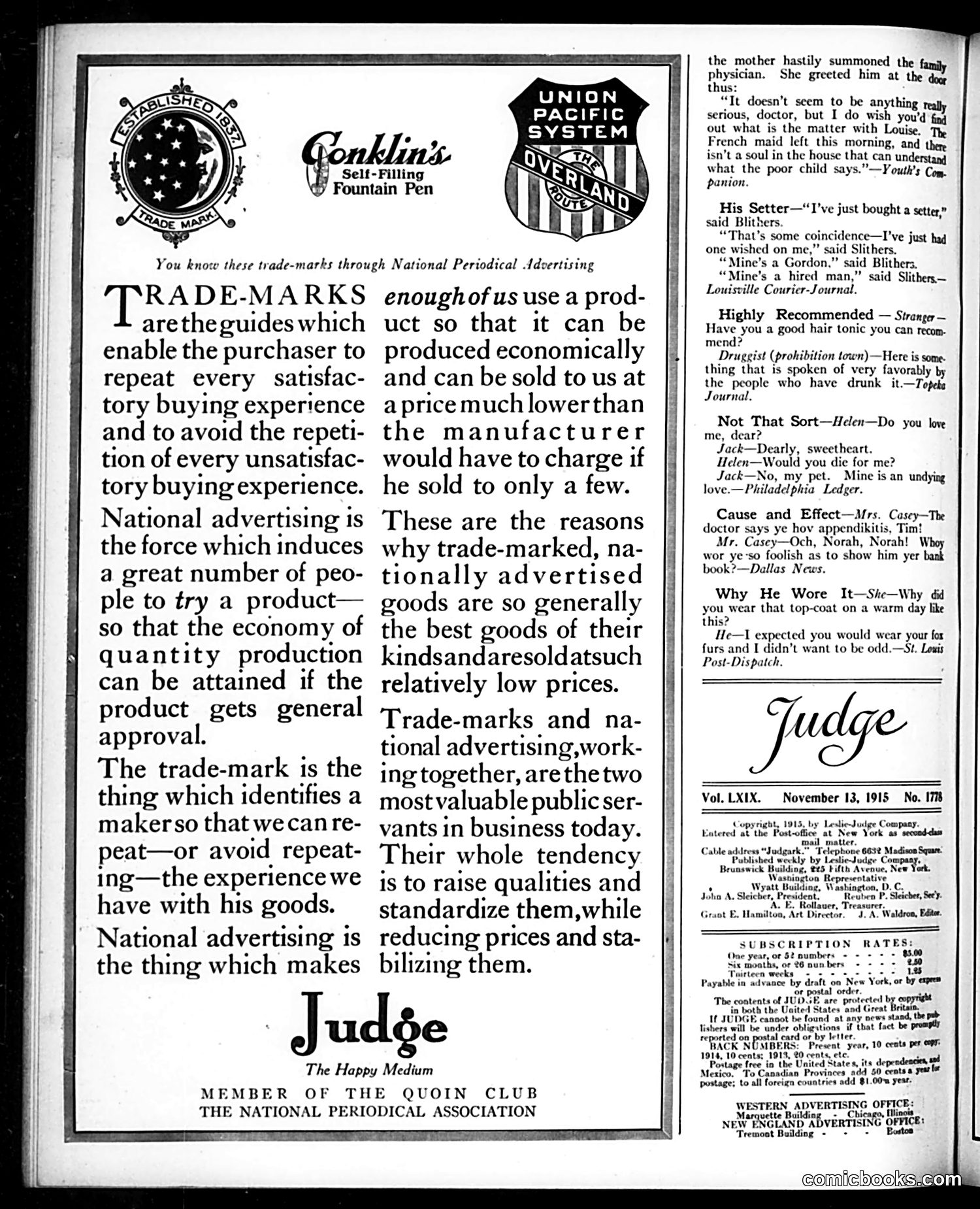
This page is primarily **advertising and editorial content**, not a political cartoon. The main feature is a full-page advertisement for Judge magazine itself, arguing that trade-marks and national advertising are "the two most valuable public servants in business today" because they enable mass production, standardization, and lower prices. The right column contains several brief **humor snippets** typical of Judge's format: - A mother calling a doctor because the French maid left and no one understands the child - A joke about buying "setters" (dogs vs. a hired man) - Drug store humor about prohibition-era "hair tonic" - Romantic comedy exchanges - Irish immigrant humor about bank books These are generic joke items with no specific political reference. The page represents Judge's standard mid-1910s content: pro-business advocacy mixed with light domestic and ethnic humor. No identifiable public figures appear.
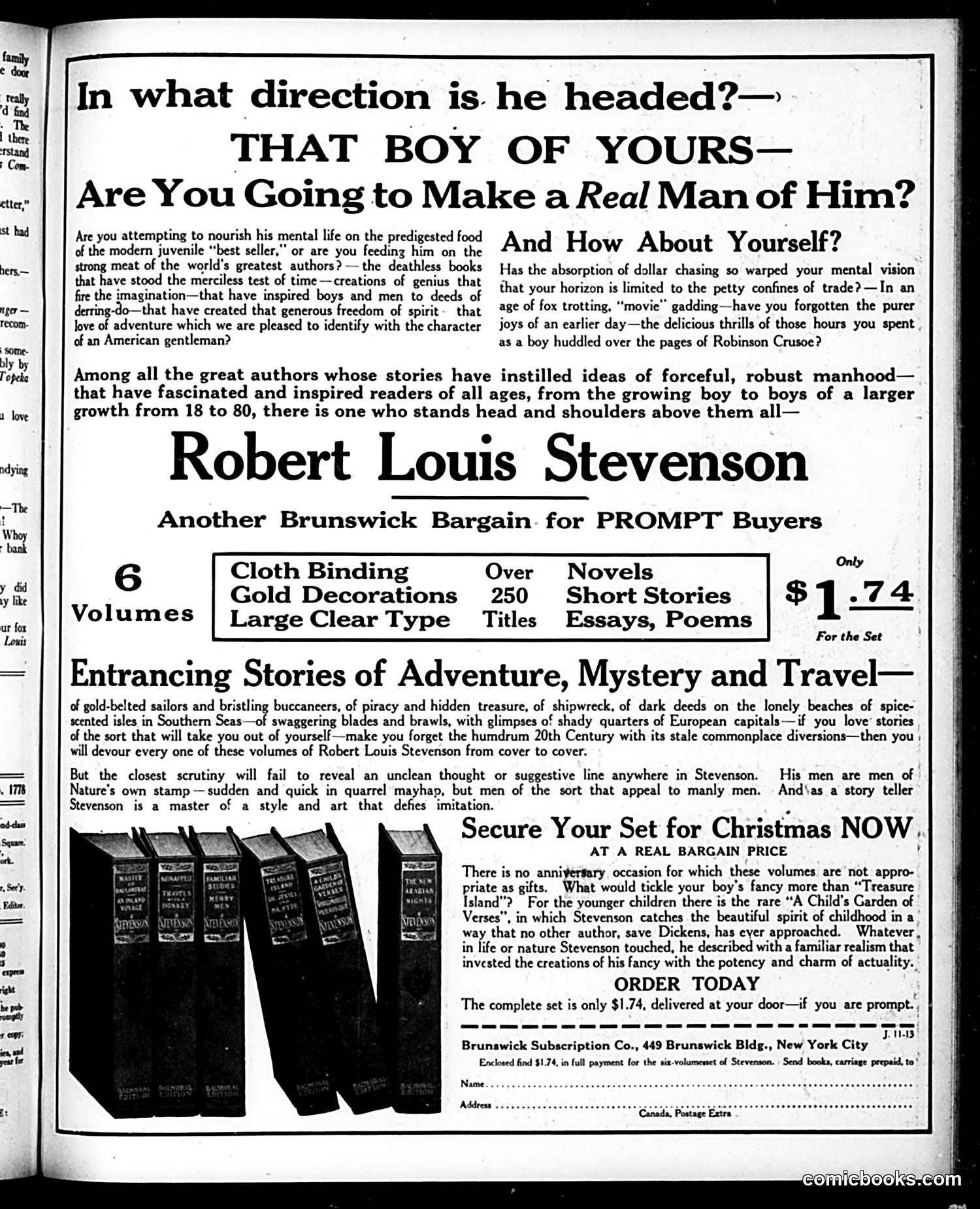
This is primarily a **book advertisement**, not a cartoon, though it opens with rhetorical questions that frame a social critique. The ad uses a moral anxiety pitch common to early 20th-century parenting discourse: it warns that modern boys are being corrupted by cheap "juvenile best sellers" and that parents themselves have abandoned literary culture for materialism ("dollar chasing") and frivolous entertainment ("fox trotting, 'movie' gadding"). The text contrasts this against the wholesome adventure classics of **Robert Louis Stevenson** (*Treasure Island*, *Robinson Crusoe*, etc.), presented as building "forceful, robust manhood" and preserving "the character of an American gentleman." The subtext reflects anxiety about **modernization**—movies, consumerism, and changing leisure culture—threatening traditional masculine values. Stevenson's works are marketed as moral correctives: they contain adventure and danger but no "unclean thought," making them safe vessels for proper masculine development. The advertisement targets affluent parents during the Christmas season, offering a discounted six-volume set for $1.74 as a gift solution.
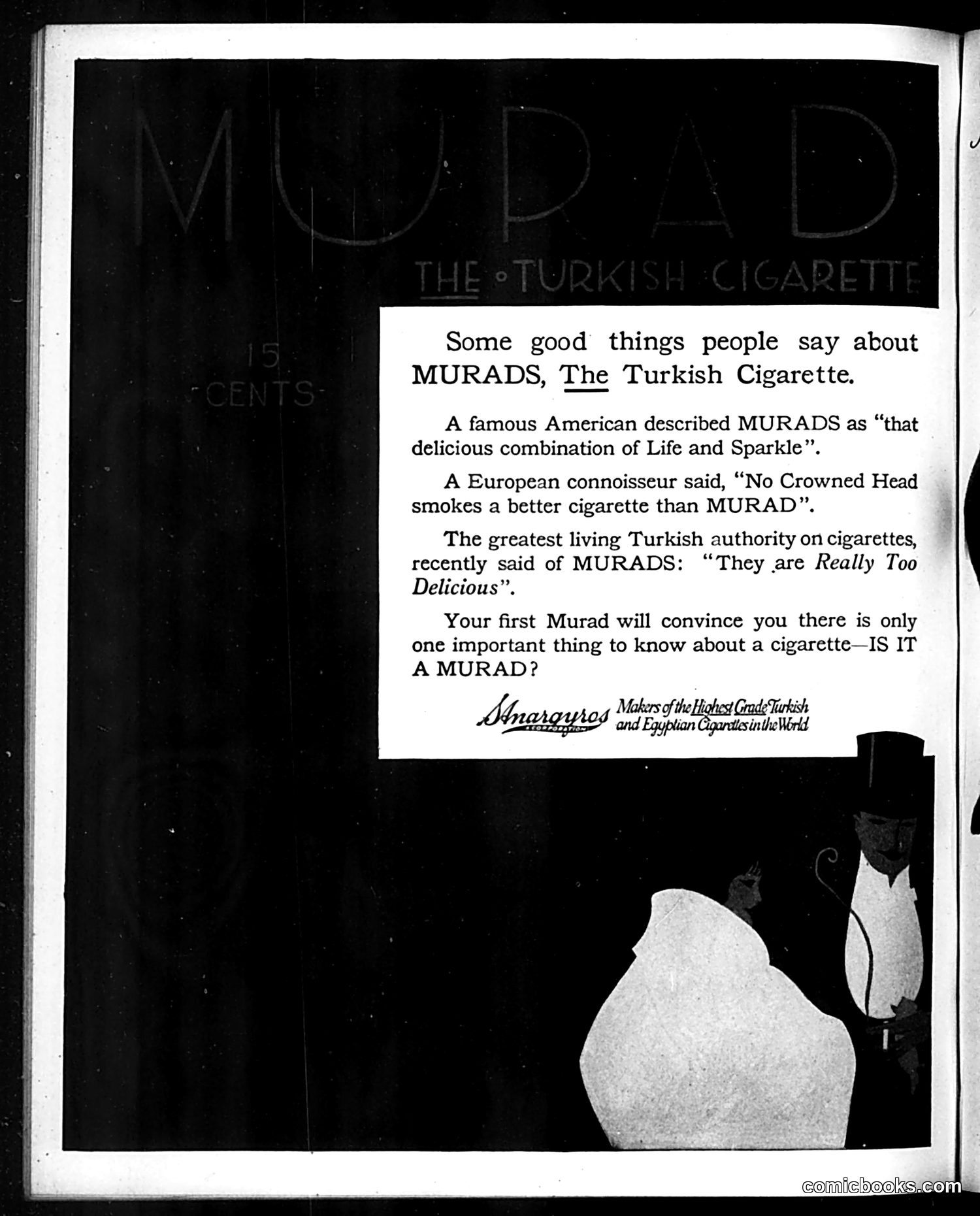
This is primarily a **cigarette advertisement**, not editorial satire or political commentary. It appears in Judge magazine promoting Murads, Turkish cigarettes priced at 15 cents. The ad uses testimonial marketing common in early 20th-century advertising: flattering quotes from unnamed "famous Americans," "European connoisseurs," and supposed "Turkish authorities" endorsing the product's quality. The imagery below (a stylized figure in formal dress with a top hat) evokes the luxury and sophistication the brand is attempting to associate with Turkish cigarettes. There is **no discernible political or social satire** here—this is straightforward product promotion leveraging exoticism and appeals to refinement. The comedic or satirical value Judge readers might have found likely relates to the overwrought language ("Really Too Delicious") rather than any deeper commentary.