
Judge, 1915-11-13 · page 20 of 28
Judge — November 13, 1915 — page 20: what you’re looking at
What you’re looking at
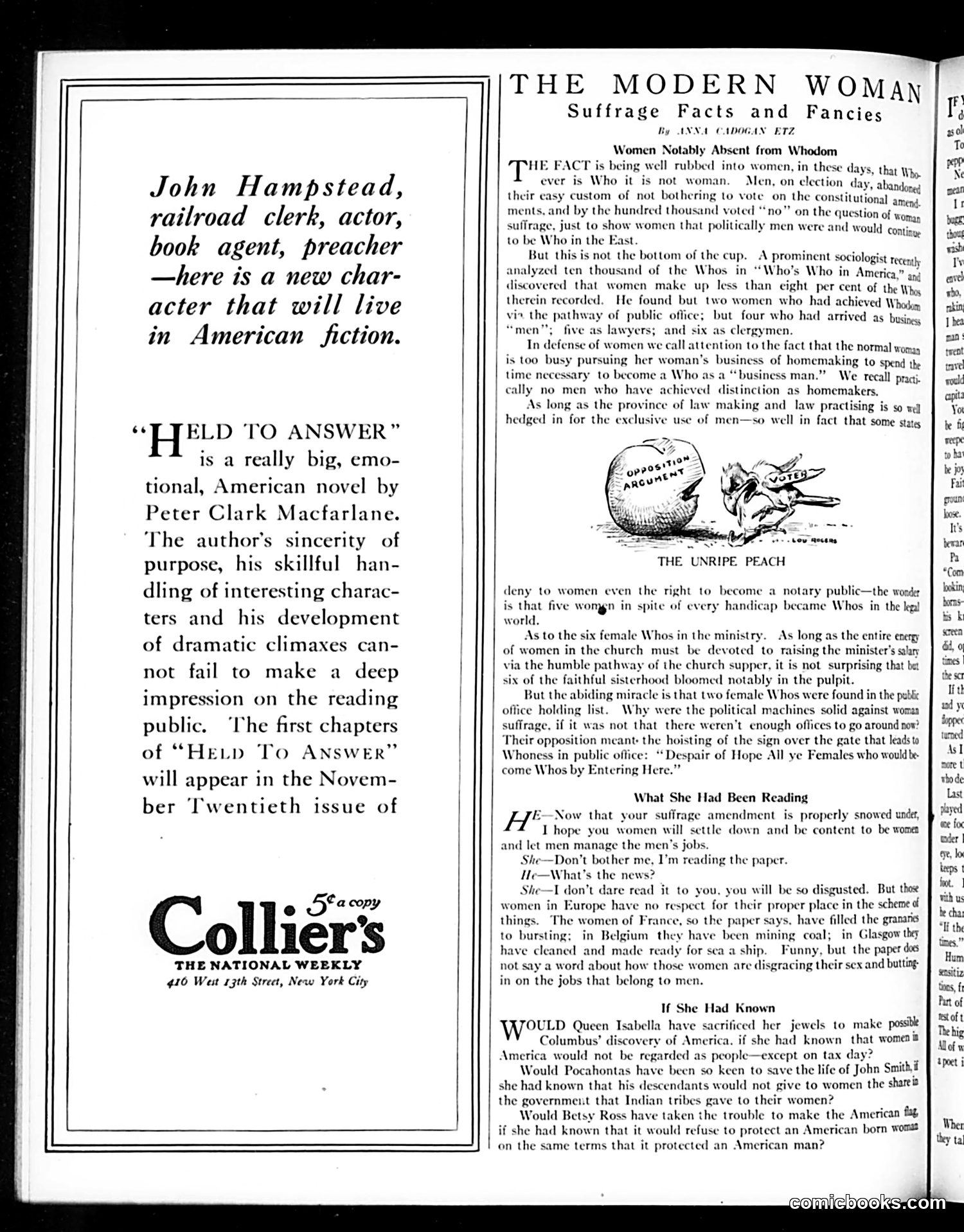
This page contains satirical commentary on women's suffrage and employment, circa early 20th century. The left side advertises a novel called "Held to Answer" by Peter Clark Macfarlane in *Collier's* magazine. The right side features "The Modern Woman: Suffrage Facts and Fancies" by Anna Cadogan Utz. A small cartoon titled "The Unripe Peach" depicts women's suffrage as an unripe fruit being struck—suggesting the suffrage movement is premature or flawed. The text sarcastically defends women's absence from "Who's Who," arguing that homemaking demands prevent women from achieving public distinction like men. It mocks the logic that women shouldn't expect political office when they're too busy with domestic duties—yet men achieve prominence without homemaking roles. Lower sections present dialogue mocking men's objections to women working, while highlighting women's wartime labor in Europe (France, Belgium, Glasgow). The final section uses historical irony: would Queen Isabella have sacrificed her jewels for Columbus's discovery if she'd known American women wouldn't be treated as full people? The satire critiques both gender discrimination and anti-suffrage arguments.
📄 Transcribed text from this page (OCR, searchable)
Machine-transcribed from the original scan — historical spelling and the odd misread are preserved.
John Hampstead, railroad clerk, actor, book agent, preacher —here is a new char- acter that will live in American fiction. ss ELD TO ANSWER” is a really big, emo- tional, American novel by Peter Clark Macfarlane. The author's sincerity of purpose, his skillful han- dling of interesting charac- ters and his development of dramatic climaxes can- not fail to make a deep impression on the reading public. ‘The first chapters of “HELp To ANSWER” will appear in the Novem- ber Twentieth issue of C4 @ ary oilier's THE NATIONAL WEEKLY G16 West 13th Street, New York City THE MODERN WOMay Suffrage Facts and Fancies By ANNA CADOGAN ETZ Women Notably Absent from Whodom ACT is being well rubbed into women, in these days, that if is Who it is not woman. Men, on election day, abandons y custom of not bothering to vote on the constitutional ime nd by the hundred thousand voted “no” on the question of wen, just to show women that politically men were and would conte to be Who in the East. = But this is not the bottom of the cup. A prominent sociologist ree thy analyzed ten thousand of the Whos in “Who's Who in America,” an: discovered that women make up less than eight per cent of the Whe therein recorded. He found but two women who had achieved Whole vin the pathway of public office; but four who had arrived as busines “men”; five lawyers; and six as clergymen. In defense of women we c: ttention to the fact that the normal womsy is too busy pursuing her woman’s business of homemaking to spend the time necessary’ to become a Who as a “business man.” We recall praai. cally no men who have achieved distinction as homemakers, As long as the province of law making and law practising is so we | hedged in for the exclusive use of men—so well in fact that some stats =~ NG THE UNRIPE PEACH deny to women even the right to become a notary public—the wonder is that five womgn in spite of every handicap became Whos in the legl world. As to the six female Whos in the ministry. As long as the entire energy of women in the church must be devoted to raising the minister's salary via the humble pathway of the church supper, it is not surprising that bet six of the faithful sisterhood bloomed notably in the pulpit. But the abiding miracle is that two female Whos were found in the public | office holding list. Why were the political machines solid against woma suffrage, if it was not that there weren't enough offices to go around now? Their opposition meant the hoisting of the sign over the gate that leads to Whoness in public office: “Despair of Hope All ye Females who would be come Whos by Entering Here.” What She Had Been Reading Ht" Now that your suffrage amendment is properly snowed under, LT hope you women will settle down and be content to be wome and let men manage the men’s jobs. She—Don't bother me, I’m reading the paper. He—What’s the news? She—I don’t dare read it to you, you will be so disgusted. But thos women in Europe have no respect for their proper place in the scheme things. The women of France, so the paper says, have filled the granans to bursting: in Belgium they have been mining coal; in Glasgow they have cleaned and made ready seaa ship. Funny, but the paper des not say a word about how those women are disgracing their sex and butting: in on the jobs that belong to men. If She Had Known OULD Queen Isabe crificed her jewels to make possible Columbus’ disco f if she had known that women ® America would not be regarded as people—except on tax day? Would Pocahontas have been so keen to save the life of John Smith she had known that his descendants would not give to women the share® the government that Indian tribes gave to their women? Would Betsy Ross have taken the trouble to make the American 3% | if she had known that it would refuse to protect an American born wom? on the same terms that it protected an American man?