
Judge, 1915-11-13 · page 17 of 28
Judge — November 13, 1915 — page 17: what you’re looking at
What you’re looking at
This page satirizes American attitudes toward Thanksgiving through McFee's cynical monologue. McFee mocks how citizens require *official government proclamation* to feel thankful—suggesting Americans are naturally ungrateful and need bureaucratic permission to appreciate their blessings. His absurdist examples (being grateful eyes are in the right place, fingers not on elbows) underscore the ridiculousness of needing official holidays for gratitude. The satire targets both government inefficiency and public apathy. McFee proposes daily personal thanksgiving rather than costly state celebrations, framing gratitude as a pragmatic cost-saving measure for the nation's budget—a dig at government waste during presumably post-WWI fiscal concerns. The page's other humor pieces are unrelated: "Precept and Example" jokes about parental hypocrisy; "A Scenario Right There" and others offer light domestic comedy typical of the era's satirical magazine format.
📄 Transcribed text from this page (OCR, searchable)
Machine-transcribed from the original scan — historical spelling and the odd misread are preserved.
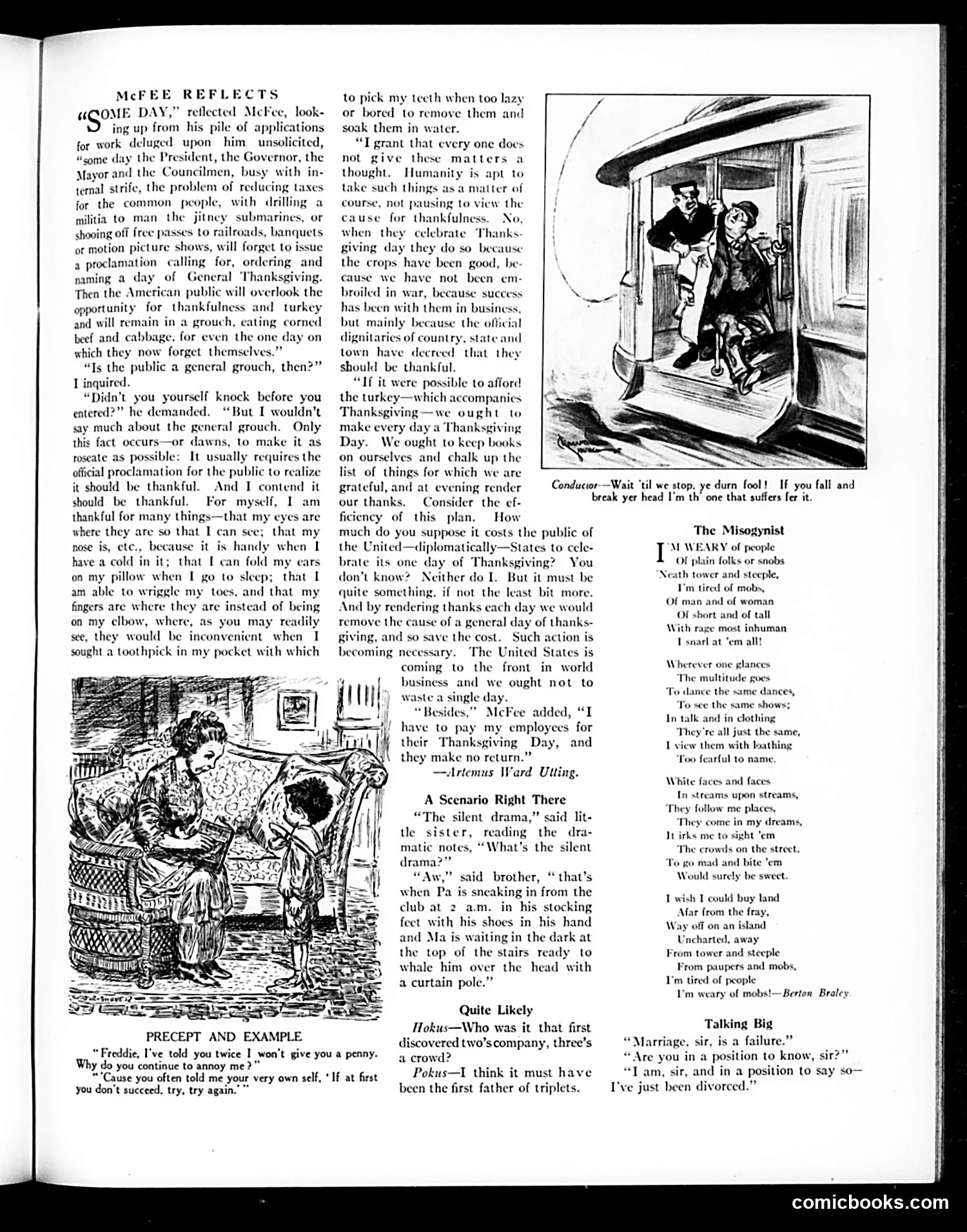
McFEE REFLECTS «QOME DAY,” reflected Me ing up from his pile of applications for work deluged upon him unsolicited, “some day the President, the Governor, the Mayor and the Councilmen, busy with in- ternal strife, the problem of ducing taxes for the common people, with drilling a militia to man the jitney submarines, or shooing off free passes to railroads, banquets or motion picture shows, will forget to issue a proclamation cal for, ordering and naming a day of Gencral Thanksgiving. Then the American public will overlook the opportunity for thankfulness and turkey and will remain in a grouch, cating corned beef and cabbage, for even the one day on which they now forget themselves.”” “Is the public a general grouch, then?” I inquired. “Didn't you yourself knock before you entered?” he demanded. ‘But I wouldn’t say much about the general grouch. Only this fact occurs—or dawns, to make it as roseate as possible: It usually requires the official procl ion for the public to realize it should be thankful. And I contend it should be thankful. For myself, I am thankful for many things—that my eyes are where they are so » that T can see; that my andy when I have a cold in it; I can fold my cars on my pillow when I go to sleep; that I am able to wriggle my toes, and that my fingers are where they are instead of being on my elbow, where, as you may readily see, they would be inconvenient when I sought a toothpick in my pocket with which PRECEPT AND EXAMPLE “Freddie, I've told you twice I won't give you a penny. y do you continue to annoy me?” "Cause you often told me your very own self, * you don’t succeed, try, try again.” ” to pick my teeth when too lazy or bored to remove them and soak them in water. “T grant that every one does not give these matters a thought. Humanity is apt to take such things as a matter of course, not pausing to view the cause for thankfulness. No, when they celebrate ‘Thanks- giving day they do so because the crops have been good, be- cause we have not been em- broiled in war, because success has been with them in business, but mainly because the official dij tries of country, state and town have decreed that they should be thankful. “If it were possible to afford the turkey—which accompanies Thanksgiving —we ought to make every day a Thanksgiving Day. We ought to keep books on ourselves and chalk up the list of things for which we are grateful, and at evening render our thanks. Consider the ef- ficiency of this plan. How much do you suppose it costs the public of the United—diplomatically—States to cele- brate its one day of Thanksgiving? You don’t know? Neither do I. But it must be quite something. if not the least bit more. And by rendering thanks each day we would remove the cause of a general day of thanks- ing, and so save the cost. Such action is becoming necessary. The United States is coming to the front in world s and we ought not to ce added, “TI y my employees for their Thanksgiving Day, and they make no return.” —Artemus Ward Utling. A Scenario Right There “The silent drama,” said lit- tle sister, reading the dra- matic notes, “What's the silent drama?” “Aw,” said brother, “ that’s when Pa is sneaking in from the club at a.m. in his stocking feet with his shoes in his hand and Ma is waiting in the dark at the top of the stairs ready to whale him over the head with a curtain pole.” Quite Likely Hokus—Who was it that first discovered two’s company, three’s a crowd? Pokus—I think it must have If at first ; been the first father of triplets. Conducior—Wait break yer head I'm th’ one that suffers fer it. I we stop, ye durn fool! If you fall and The Misogynist M WEARY of people OF plain folks or snobs wer and steeple, I'm tired of mobs, Of man and of woma nd of tall most inhuman nce the same dances, see the same shows; In talk and in dothing They're all just the same, I view them with loathing Too fearful to name. White faces and faces In streams upon streams, yw me places, ¢ in my dreams, It irks me to sight ‘em he crowds on the street, ‘To go mad and bite ‘em Would surely be sweet. 1 wish I could buy land Mar from the fray, Way off on an island Uncharted, away From tower and steeple From paupers and mobs, I'm tired of people I'm weary of mobs!—Berton Braley Talking Big ir, is a failure.” “Are you ina position to know, sir? and in a position to say so— I've just been divorced.” comicbooks.com