
Judge, 1915-11-13 · page 18 of 28
Judge — November 13, 1915 — page 18: what you’re looking at
What you’re looking at
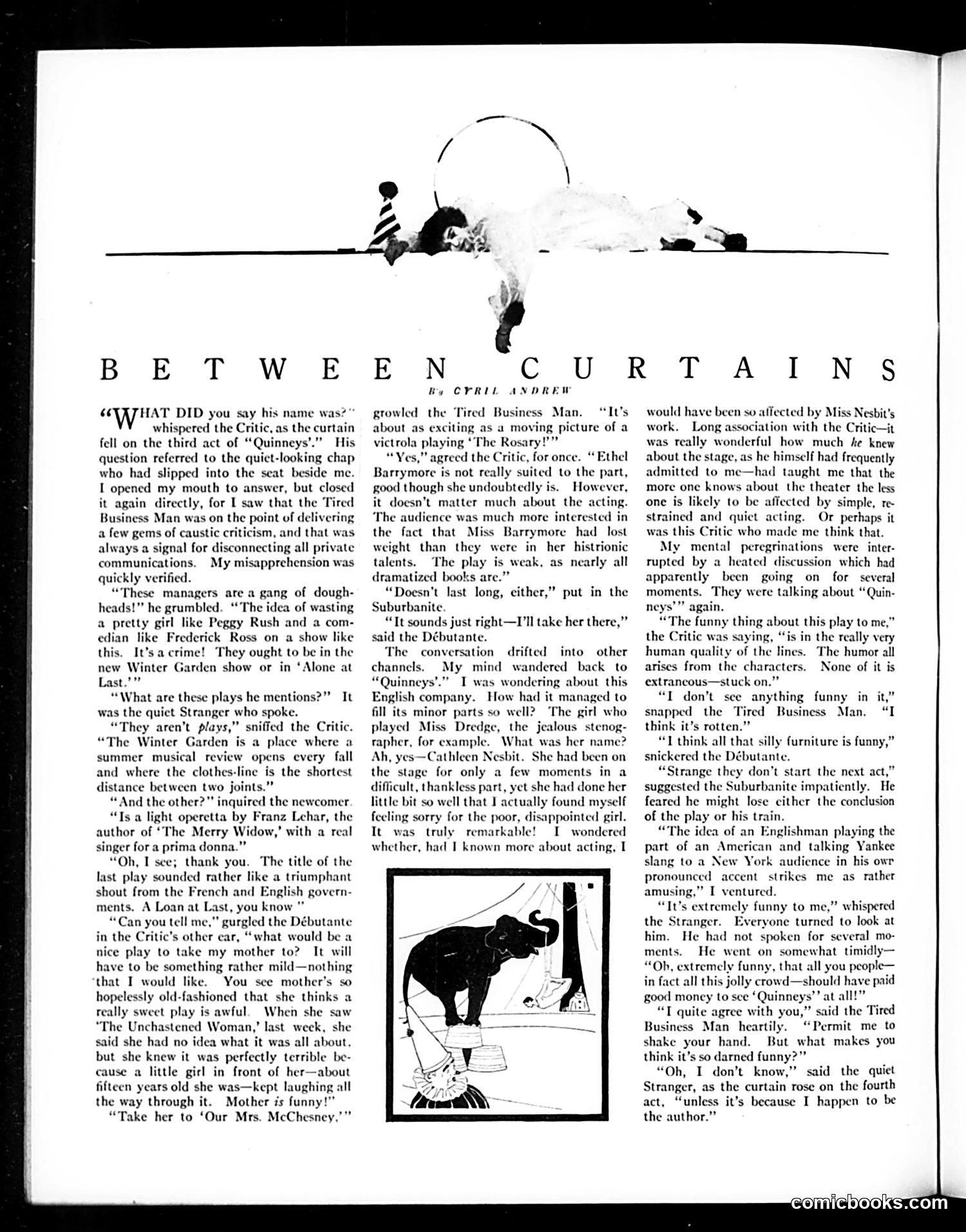
This theater criticism piece satirizes Broadway insiders and their pretensions. A "Tired Business Man" and a "Critic" discuss current plays with varying competence. The Critic dismisses "Quinneys'" despite praising certain performers, while praising spectacle-heavy shows like "Winter Garden." He condescends about acting quality, claiming knowledge affects appreciation. The Tired Business Man and Suburbanite offer blunt, commercial opinions. The narrator notes that young actress Cathleen Nesbit impressed him through subtle, restrained acting—yet worries his exposure to the Critic's cynicism has made him question whether emotional authenticity matters in theater. The cartoon (showing a dog) appears to illustrate one of the plays discussed. The satire targets theatrical snobbery, the gap between critical and popular taste, and how exposure to jaded opinions corrupts genuine emotional response to art.
📄 Transcribed text from this page (OCR, searchable)
Machine-transcribed from the original scan — historical spelling and the odd misread are preserved.
B E T W E coat DID you say his name was?” whispered the Critic, as the curtain fell on the third act of “Quinneys’.”” His question referred to the quict-looking chap who had slipped into the seat beside me. I opened my mouth to answer, but cl it again directly, for L saw that the Tired Business Man was on the point of delivering a few gems of caustic criticism, and that was always a signal for disconnecting all private communications. My misapprehension was quickly verified. “These managers are a gang of dough- heads!" he grumbled. ‘The idea of wasting a pretty girl like Peggy Rush and a com- edian like Frederick Ross on a show like this. It’sacrime! They ought to be in the new Winter Garden show or in ‘Alone at Last.’”” “What are the: ¢ plays he mentions?” It was the quiet Stranger who spoke. “They aren't plays,” sniffed the Critic. “The Winter Garden is a place where a summer musical review opens every fall and where the clothes-line is the shortest distance between two joints. “And the other?" inquired the newcomer “Ts a light operetta by Franz Lehar, the author of ‘The Merry Widow,’ with a real singer for a prima donna.” “Oh, I sce; thank you. The title of the last play sounded rather like a triumphant shout from the French and English govern- ments. A Loan at Last, you know “Can you tell me,” gurgled the Débutante in the Critic’s other ear, “what would be a nice play to take my mother to? It will have to be something rather mild—nothing that I would lik You see mother’s so hopelessly old-fashioned that she thinks a really sweet play is awful. When she saw ‘The Unchastened Woman,’ last week, she said she had no idea what it was all about. but she knew it was perfectly terrible be- cause a little girl in front of her—about fifteen years old she was—kept laughing all the way through it. Mother is funny “Take her to ‘Our Mrs. McChesney,’” E N By CYRIL ANDREW growled the Tired Business Man. “It’s about as exciting as a moving picture of a victrola playing ‘The Rosary!” “Yes,” agreed the Critic, for once. “ Ethel Barrymore is not really suited to the part, good though she undoubtedly is. However, it doesn’t matter much about the acting. The audience was much more interested in the fact that Miss Barrymore had_ lost weight than they were in her histrionic talents. The play is weak, as nearly all dramatized books are.” “Doesn't last long, either,” put in the Suburbanite. “Tt sounds just right—I’ll take her there,” said the Débutante. The conversation drifted into other channels. My mind wandered back to Quinneys’.” I was wondering about this English company. How had it managed to fill its minor parts so well? The girl who played Miss Dredge, the jealous stenog- rapher, for example. What was her name? Ah, yes—Cathleen Nesbit. She had been on the stage for only a few moments in a difficult, thankless part, yet she had done her little bit so well that I actually found myself feeling sorry for the poor, disappointed girl. Tt was truly remarkable! I wondered whether, had I known more about acting, I C U RT A IN § would have been so afiected by Miss Nesbit's work. Long association with the Critic—it was really wonderful how much he knew about the stage, as he himself had frequently admitted to me—had taught me that the more one knows about the theater the less one is likely to be affected by simple, re strained and quict acting. Or perhaps it was this Critic who made me think that. My mental peregrinations were inter- rupted by a heated discussion which had apparently been going on for several moments. They were talking about “Quin- neys’” again. “The funny thing about this play to me,” the Critic v aying, “is in the really very human quality of the lines. The humor all arises from the characters. None of it is extrancous—stuck on.”” “T don’t see anything funny in it,” snapped the ed Business Man. “I think it’s rotten.” “TL think all that silly furniture is funny,” snickered the Débutante. “Strange they don’t start the next act,” suggested the Suburbanite impatiently. He feared he might lose cither the conclusion of the play or his train. “The idea of an Englishman playing the part of an American and talking Yankee slang to a New York audience in his owr pronounced accent strikes me as rather .” 1 ventured. xtremely funny to me,” whispered ranger. Everyone turned to look at He had not spoken for several mo- ments. He went on somewhat timidly— “Oh, extremely funny, that all you people— in fact all this jolly crowd—should have paid good money to see ‘Quinneys’’ at all!” “T quite agree with you,” said the Tired Business Man heartily. “Permit me to shake your hand. But what makes you think it’s so darned funny?” “Oh, I don’t know,” said the quiet Stranger, as the curtain rose on the fourth act, “unless it’s because I happen to be the author.”