
A complete issue · 28 pages · 1915
Judge — November 6, 1915
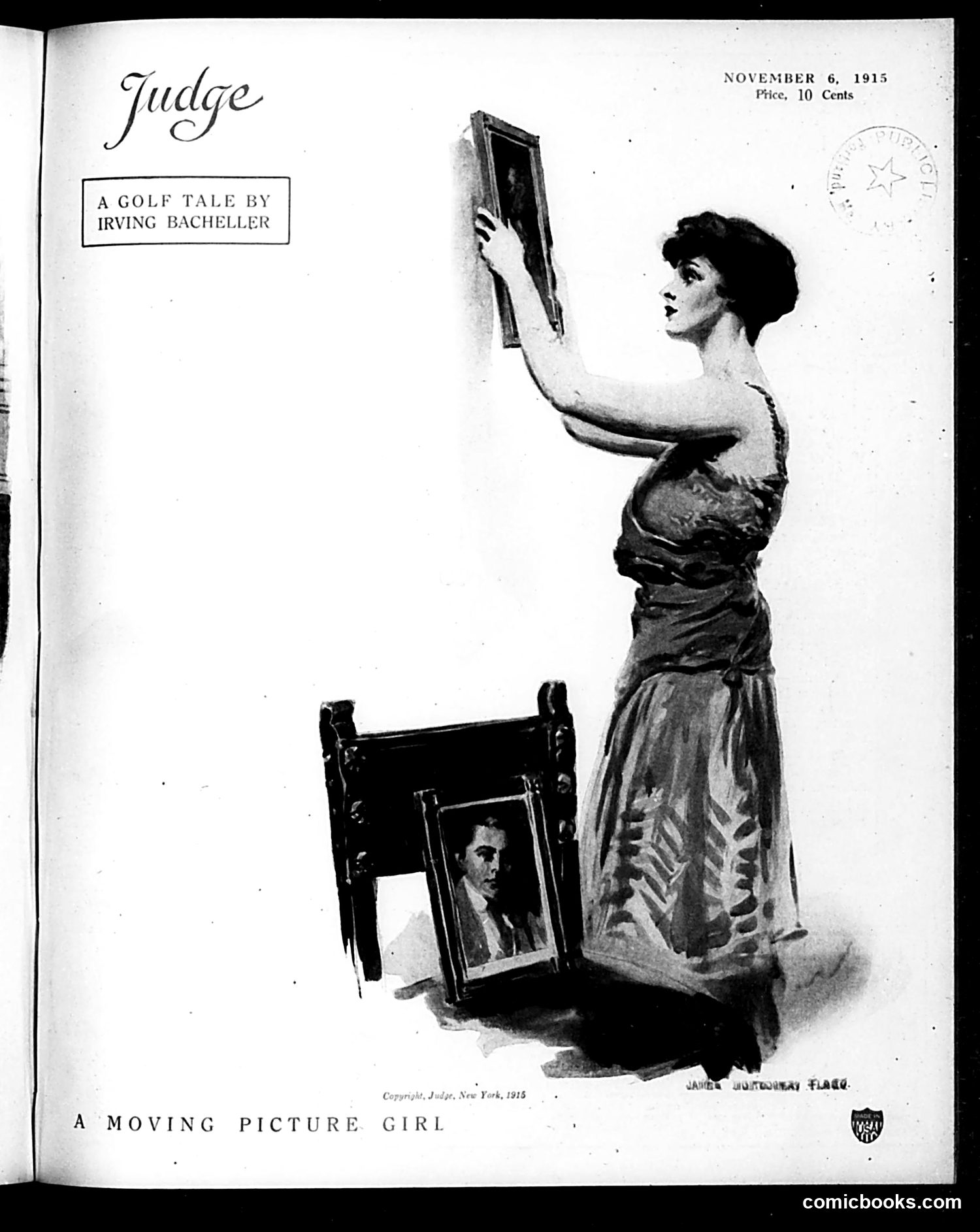
This is a satirical illustration accompanying "A Golf Tale by Irving Bacheller." The cartoon depicts a woman in early 1910s attire holding up a mirror or reflective surface, with a man's face visible in the reflection below. The title "A Moving Picture Girl" is a pun referencing the emerging film industry. The satire likely mocks either: (1) vanity and narcissism associated with cinema actresses, or (2) the theatrical nature of "moving picture" performers who constantly display themselves. The play on "moving picture" (cinema) versus the literal image of a woman displaying/moving a picture suggests commentary on performance and artifice in early Hollywood culture, which was then a new and somewhat frivolous entertainment form by traditional standards.
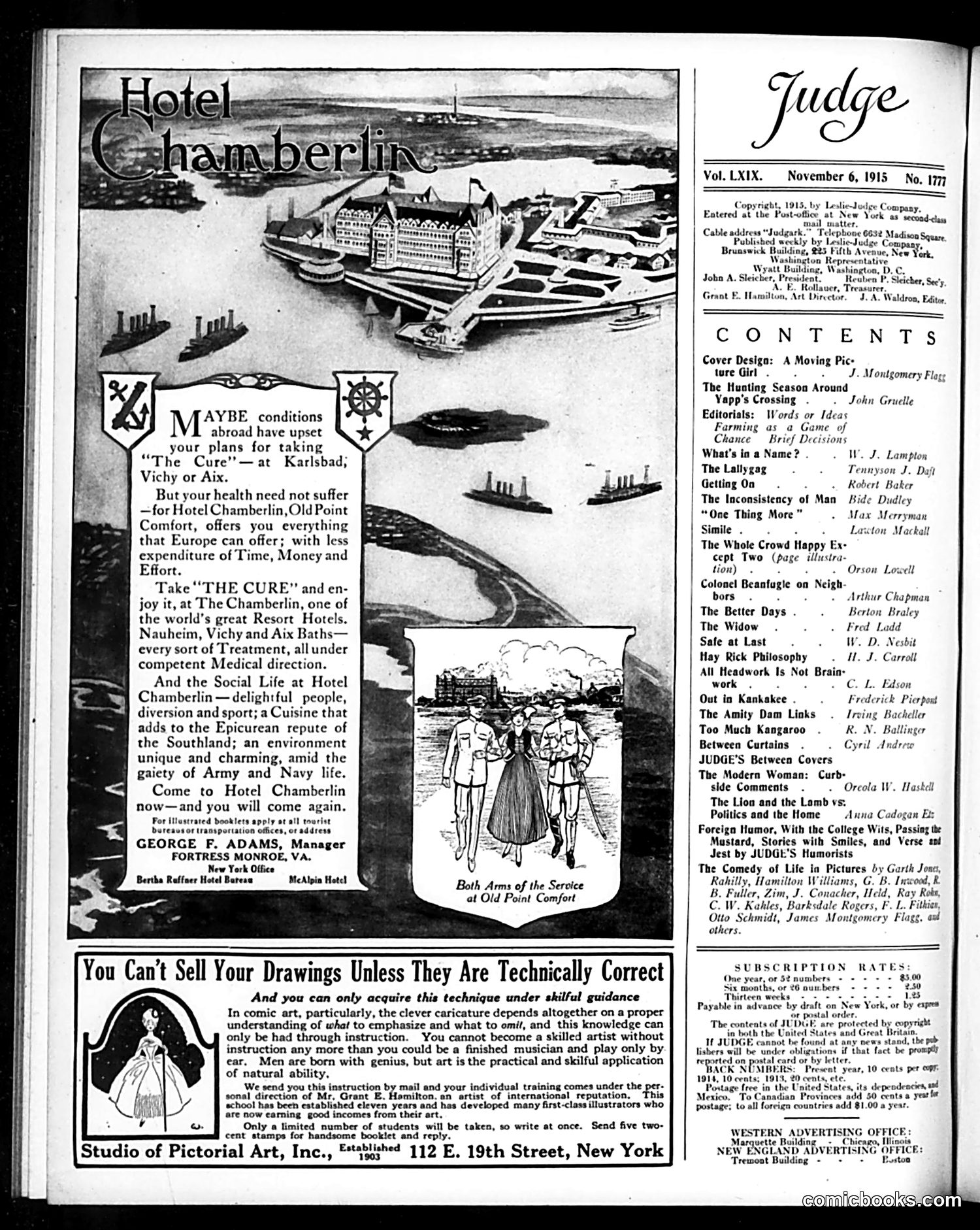
This page is primarily **advertising and editorial content** rather than political satire. The main advertisement promotes Hotel Chamberlin at Old Point Comfort, Virginia, marketing it as a luxurious resort destination offering European-style treatment and amenities. Below that is an advertisement for the "Studio of Pictorial Art, Inc." offering instruction in comic art and caricature, emphasizing that technical skill requires professional guidance—not natural talent alone. The right side contains the magazine's table of contents listing various articles and illustrations for that week's issue. There is **no significant political cartoon or social satire** visible on this particular page—it functions primarily as a commercial and organizational guide for readers rather than commentary on current events or political issues.
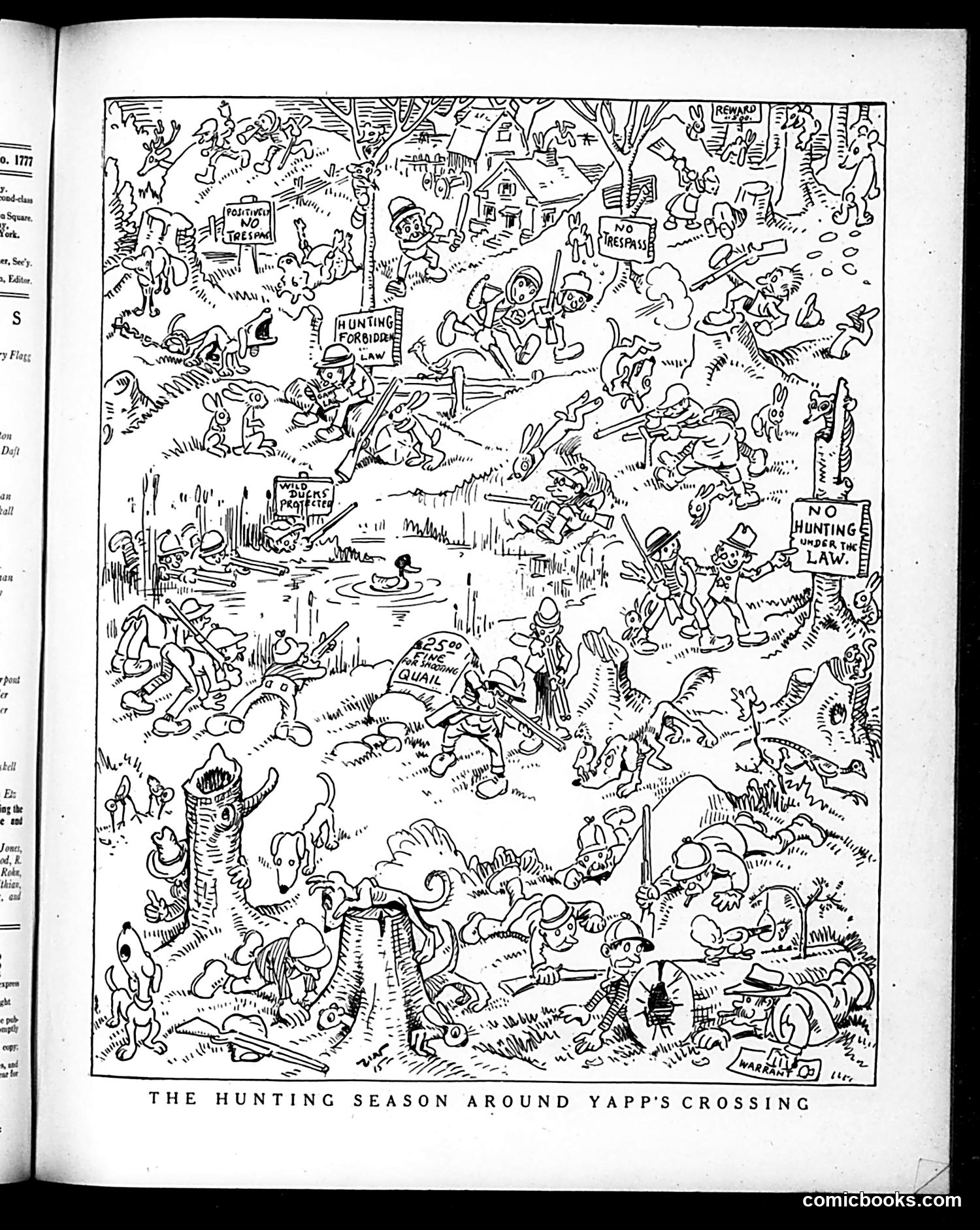
This cartoon satirizes hunting regulations and enforcement around "Yapp's Crossing," a location apparently known for hunting violations. The scene depicts numerous hunters violating game laws—signs reading "Hunting Forbidden," "No Trespassing," and "No Hunting Under the Law" are prominently displayed and ignored throughout the chaotic landscape. The satire targets both poachers disregarding regulations and presumably the difficulty of enforcing wildlife laws. Various hunters are shown with game (including a quail), traps, and weapons, seemingly engaged in illegal activities despite visible warning signs. The cartoon appears to critique either lax enforcement of hunting laws or the widespread defiance of game protection regulations during this period. The humor derives from the brazen, open violation of posted restrictions.
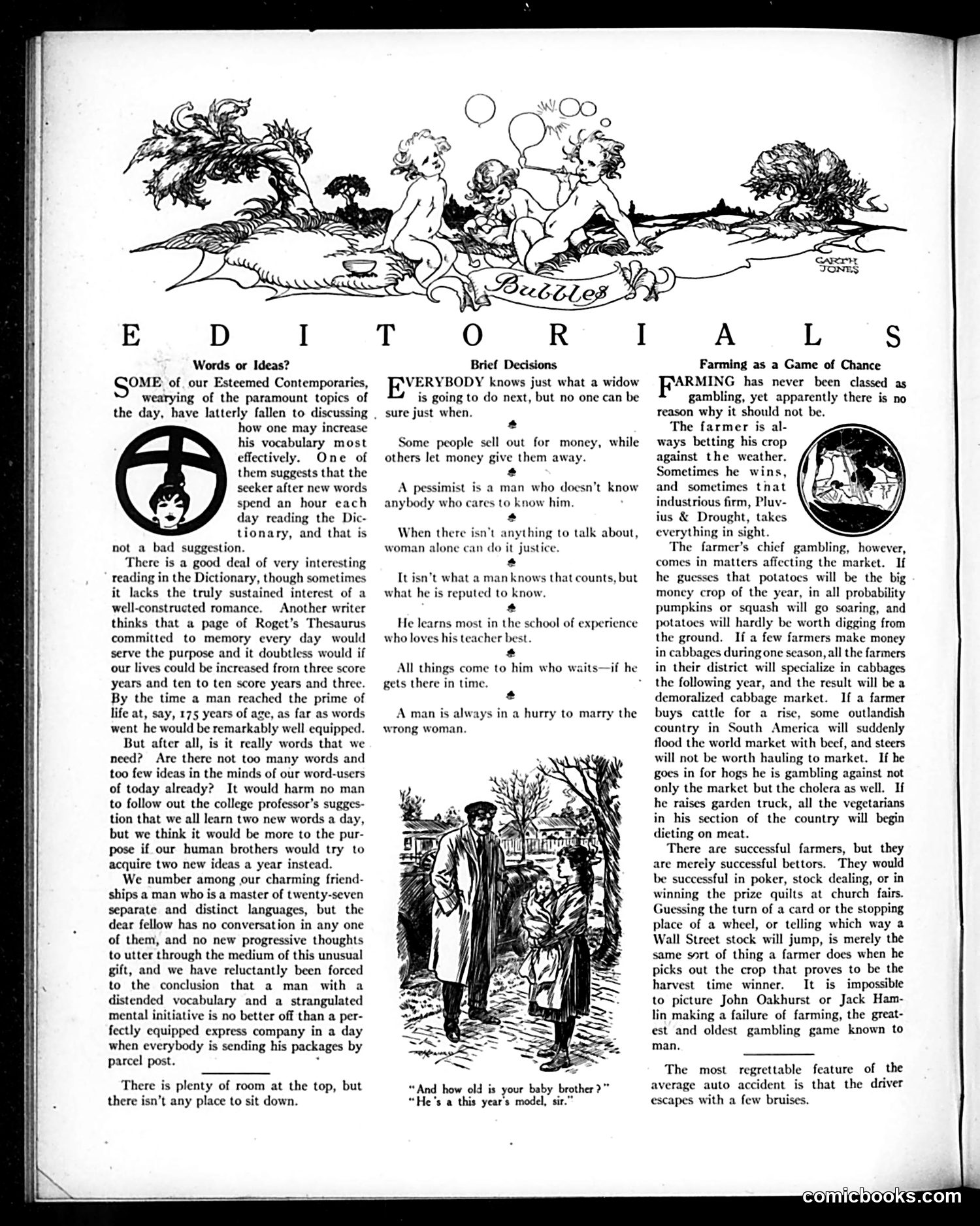
This page contains three distinct editorial pieces from *Judge* magazine. The left column discusses vocabulary expansion and intellectual pursuits. The center section offers brief philosophical observations ("A pessimist is a man who doesn't know anybody who cares to know him"). The right column, titled "Farming as a Game of Chance," satirizes agricultural economics by comparing farming to gambling. The author argues that farming involves uncontrollable variables (weather, market prices) similar to poker or stock speculation, making success largely dependent on luck rather than skill. The accompanying illustration shows a farmer, reinforcing the rural subject matter. The satire critiques how farmers cannot reliably control outcomes despite effort—crop failures, market fluctuations, and disease create unpredictable results indistinguishable from pure chance.
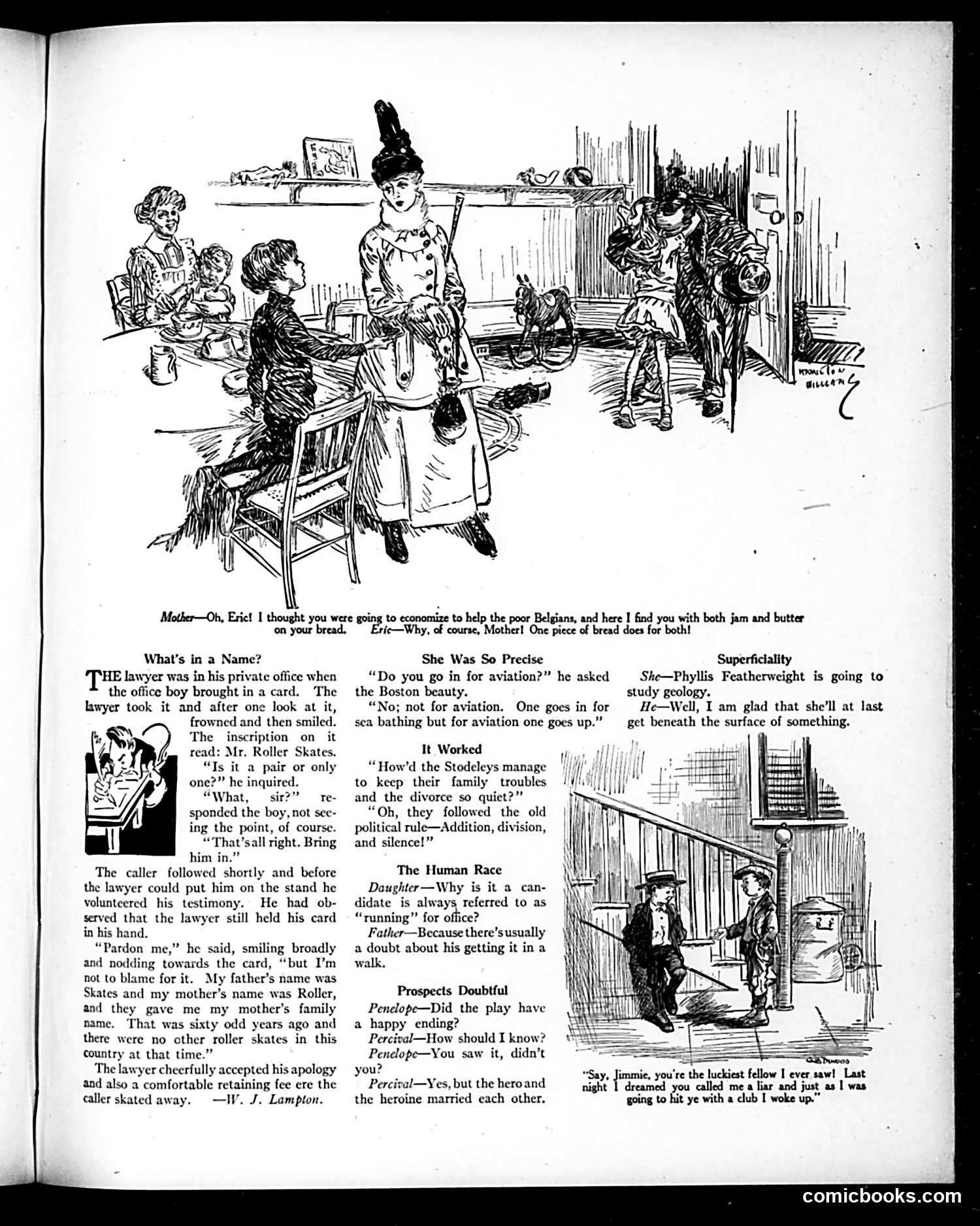
This page contains several brief humorous anecdotes typical of early 20th-century satirical magazines. The top illustration depicts a domestic scene where a woman (labeled "Mother") is caught with jam and butter on bread meant for poor Belgians—likely referencing WWI Belgian relief efforts. The joke satirizes hypocrisy: charitable intentions undermined by personal indulgence. The lower section contains joke columns with titles like "What's in a Name?" and "She Was So Precise." These are light social humor pieces about naming conventions, aviation terminology, and marital disputes—representative of Judge's mix of domestic and topical comedy. The illustration of two men on stairs appears unrelated to visible text, suggesting it accompanies an anecdote not fully captured in the OCR. Overall, the page reflects early 20th-century American middle-class humor and social commentary.
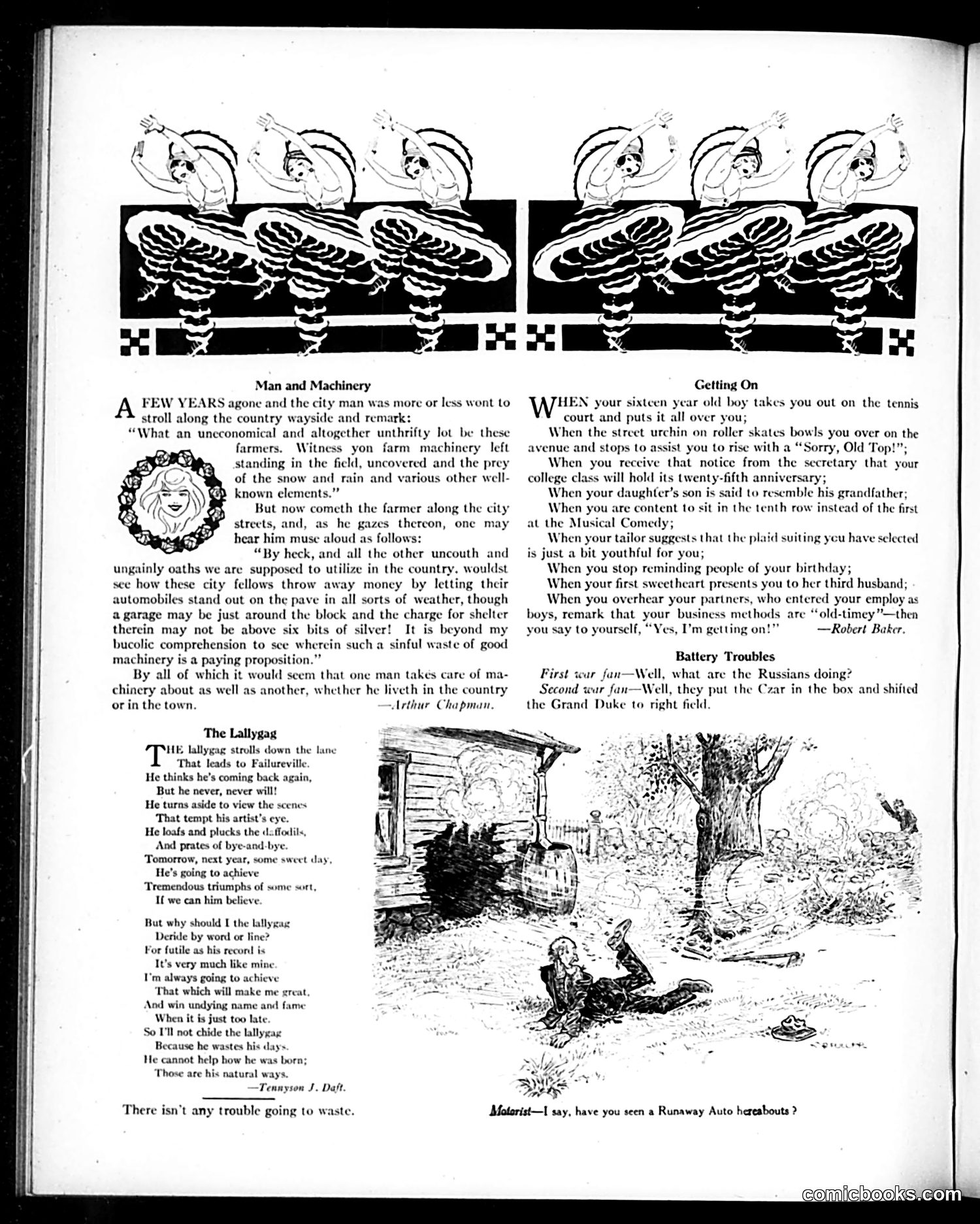
This page contains three pieces of social satire from early 20th-century America: **"Man and Machinery"** satirizes human nature's inconsistency. The piece observes that farmers once criticized city dwellers for leaving farm equipment exposed to weather, yet now those same farmers criticize city people for leaving automobiles ungaraged. The joke is that people everywhere are equally careless with machinery—hypocrisy is universal. **"The Lallygag"** mocks procrastination and daydreaming. The "lallygag" represents someone perpetually postponing achievement, chasing artistic inspiration while headed toward "Failureville." The poet admits his own hypocrisy: he too constantly defers his ambitions "until too late." **"Getting On"** lists humorous signs of aging—being beaten at tennis by teenagers, being knocked over by roller skaters, receiving class reunion notices, watching younger employees, etc. It's a lighthearted catalog of mortality's indignities. **"Battery Troubles"** appears to be a brief joke about World War I (likely pre-U.S. entry), using baseball terminology to mock Russian military positioning—mixing the Czar and Grand Duke around like players, treating warfare as a game.
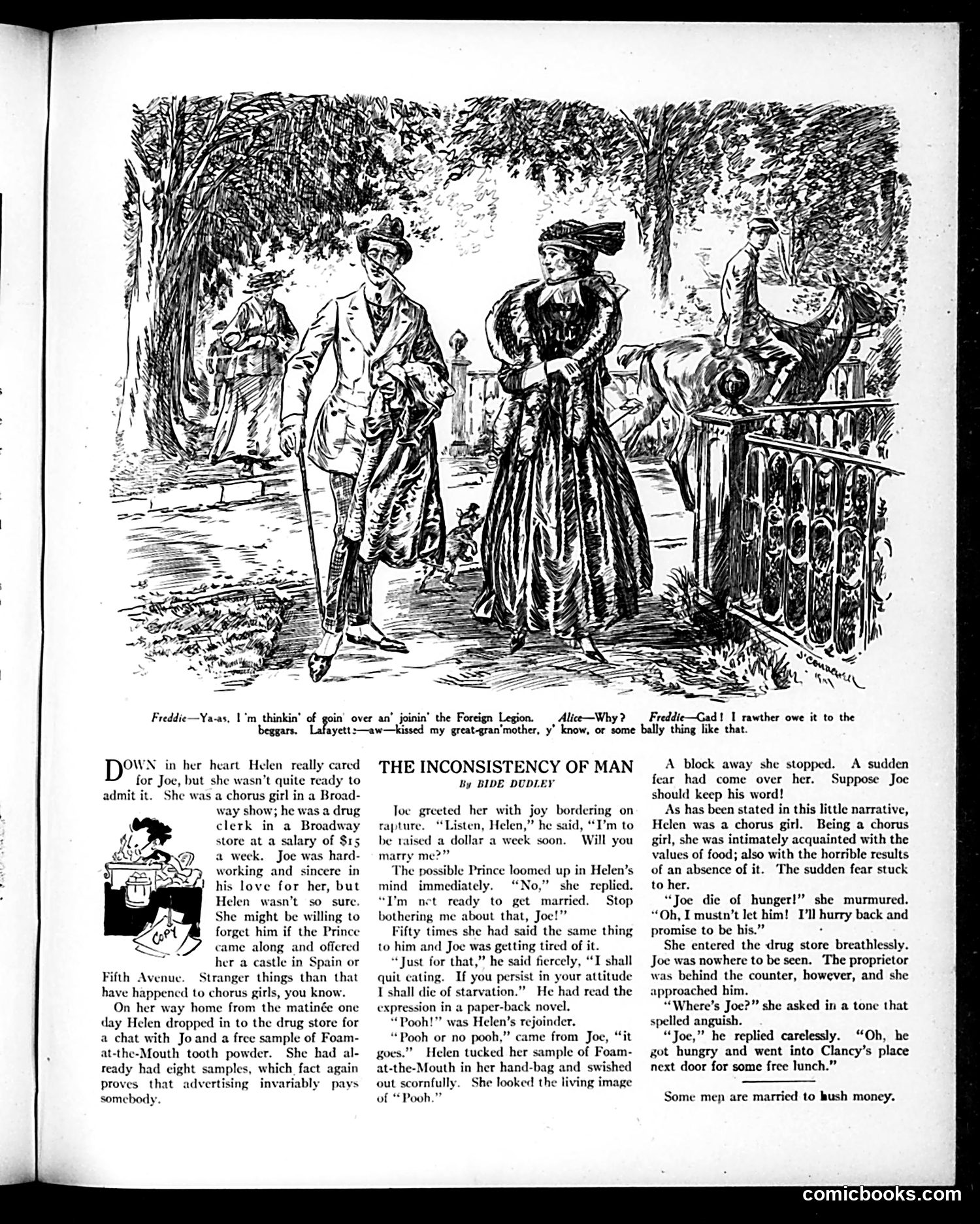
This story satirizes the contradictions between romantic idealism and practical reality. Helen, a chorus girl, rejects Joe's marriage proposal despite his wage increase, hoping for a wealthier suitor (the "Prince" with a castle). When Joe threatens to starve himself over her refusal, Helen panics—not from love, but from understanding (as a chorus girl familiar with hunger) the real consequences of starvation. The punchline mocks both characters: Joe's dramatic threat proves hollow when he immediately eats at a nearby lunch counter, exposing his theatrical posturing. Helen's sudden devotion reveals she values food security over affection. The cartoon at top likely continues this theme of male inconsistency or romantic pretense. The satire targets working-class romantic conventions and the gap between emotional declarations and actual behavior.
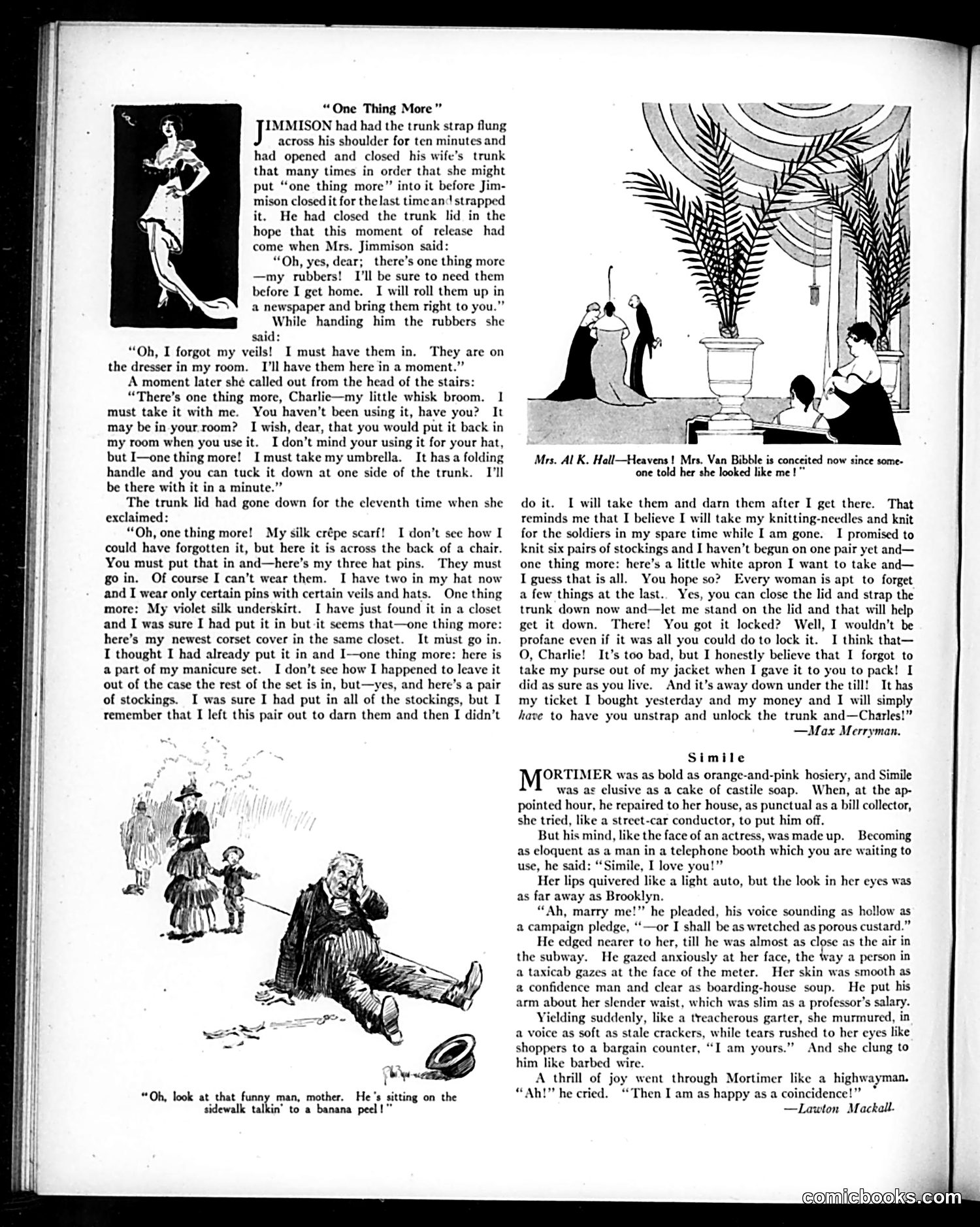
This page contains two unrelated satirical pieces typical of Judge magazine's humor. **"One Thing More"** (main story by Max Merryman): A domestic comedy about a husband attempting to close his wife's traveling trunk while she repeatedly interrupts with additional items to pack. The satire targets the stereotypical absent-minded, indecisive wife who cannot stop adding "one more thing"—rubbers, veils, a whisk broom, umbrella, scarf, hat pins, undergarments, manicure set, stockings, knitting needles, and finally her purse. The humor derives from the exaggerated, seemingly endless nature of female packing anxiety and the husband's patient (then fraying) tolerance. This reflects early-20th-century gender stereotypes about women's disorganization. **"Simile"** (by Landon Mackall, bottom): A brief romantic comedy comparing Mortimer's boldness to "orange-and-pink hosiery" and a woman's elusiveness to "castile soap"—absurdist similes that undercut romantic sincerity through deliberately nonsensical comparisons. The page includes period illustrations and a street scene cartoon caption about a "funny man" on a sidewalk.
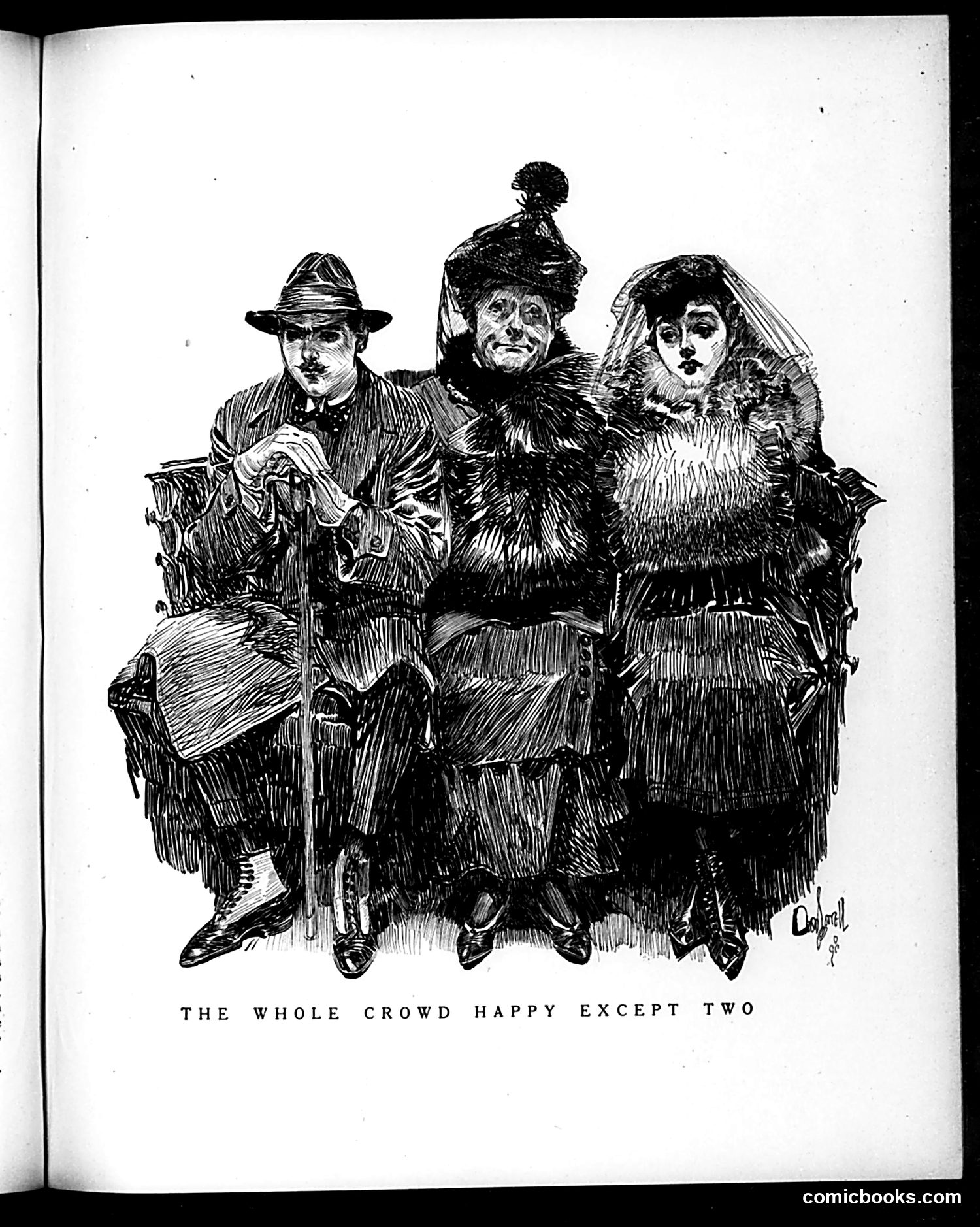
This political cartoon depicts three figures seated together, captioned "THE WHOLE CROWD HAPPY EXCEPT TWO." The artwork is a pen-and-ink sketch in the style typical of early 20th-century satirical magazine illustration. The caption suggests commentary on a group or collective situation where most people are satisfied but two individuals remain discontent. Without additional context about the specific Judge issue date, I cannot identify which particular political figures or events are referenced. The formal dress and period styling suggest this addresses a contemporary political or social issue from when Judge was published, but determining the exact figures, offices, or controversy requires knowledge of the publication date and historical context not provided here.
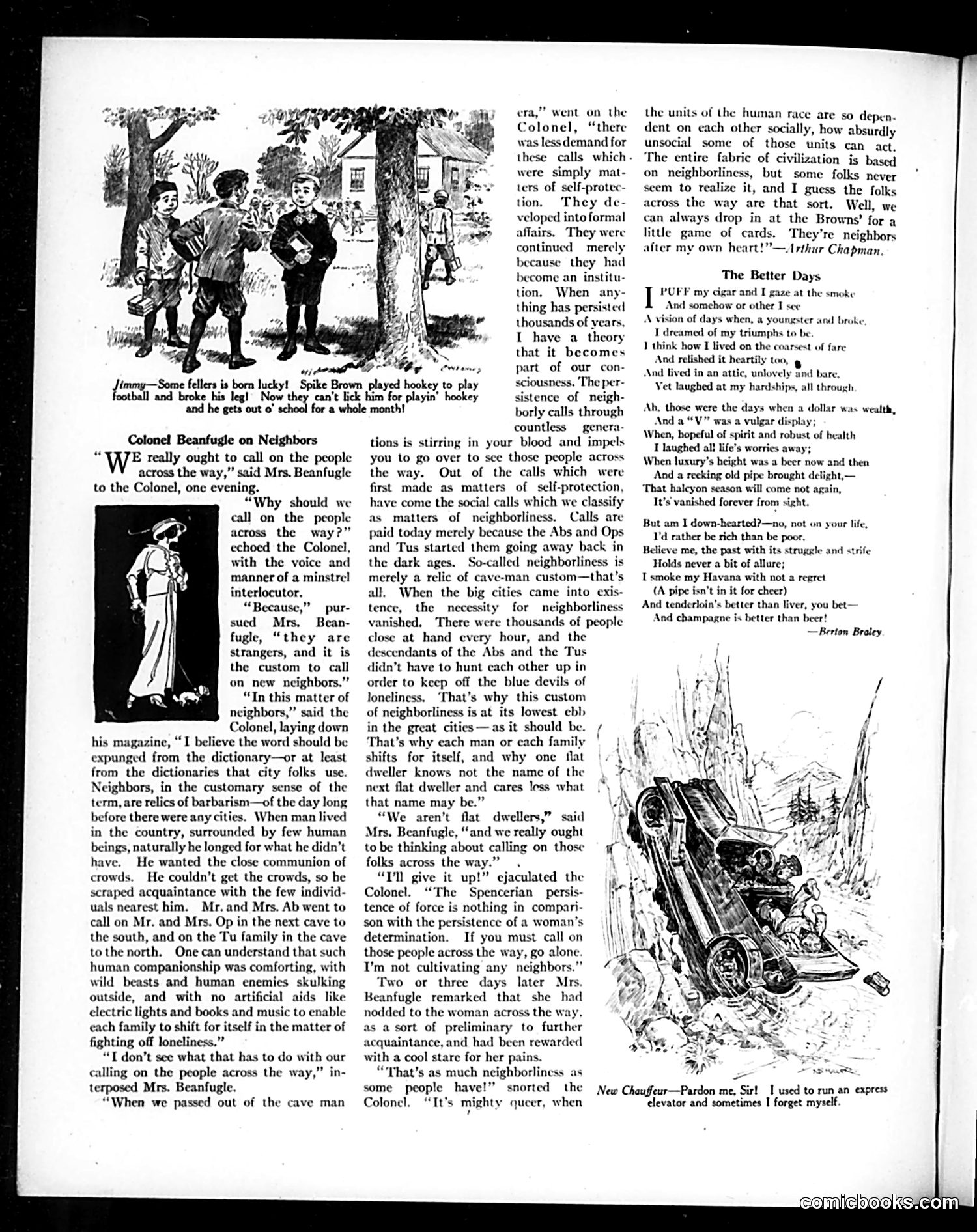
This satirical piece mocks urban social pretension through Colonel Beanfugle's pseudo-intellectual resistance to calling on neighbors. The Colonel delivers a faux-scholarly argument that neighborliness is an outdated "cave-man custom" rendered unnecessary by modern city life, where crowds provide sufficient companionship. He invokes "Spencerian persistence" (likely referencing Herbert Spencer's social Darwinism) to justify his anti-social stance. The satire targets two things: the Colonel's pompous use of evolutionary theory to rationalize rudeness, and the urban trend of social isolation despite—or because of—density. His wife ultimately wins through sheer determination, and the story hints that neighborly courtesy may have merit after all. The cartoon critiques how modern philosophy was weaponized to justify declining civic engagement.
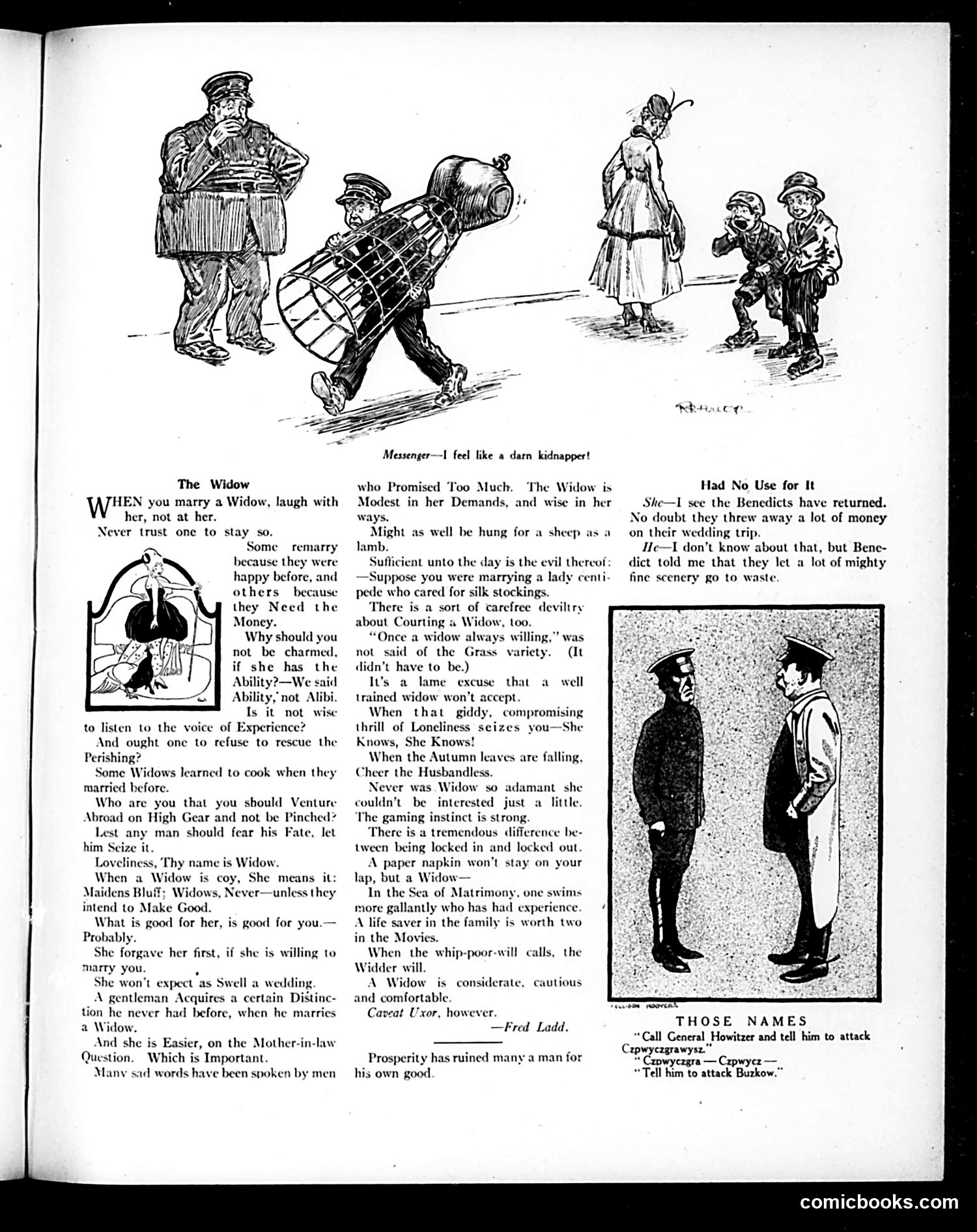
This *Judge* magazine page contains satirical commentary on widows as marriage prospects. The main article humorously lists contradictory "advice" about marrying widows—suggesting they're desirable (experienced, practical, less demanding) while undermining each point with cynical observations (they remarry for money, aren't truly coy, etc.). The tone mocks both widows and men foolish enough to pursue them. The top cartoon depicts a messenger literally "kidnapping" a woman, visual wordplay on the anxiety men felt about commitment to widows, who were viewed with simultaneous attraction and suspicion. The bottom section, "Those Names," appears to mock Eastern European or Russian names as unpronounceable—a common ethnic stereotype of the era, likely commenting on immigration tensions. The "Had No Use for It" anecdote is a light domestic joke about newlyweds wasting money on honeymoons. Overall, the page reflects early 20th-century attitudes toward widows as marriage material and casual xenophobia.
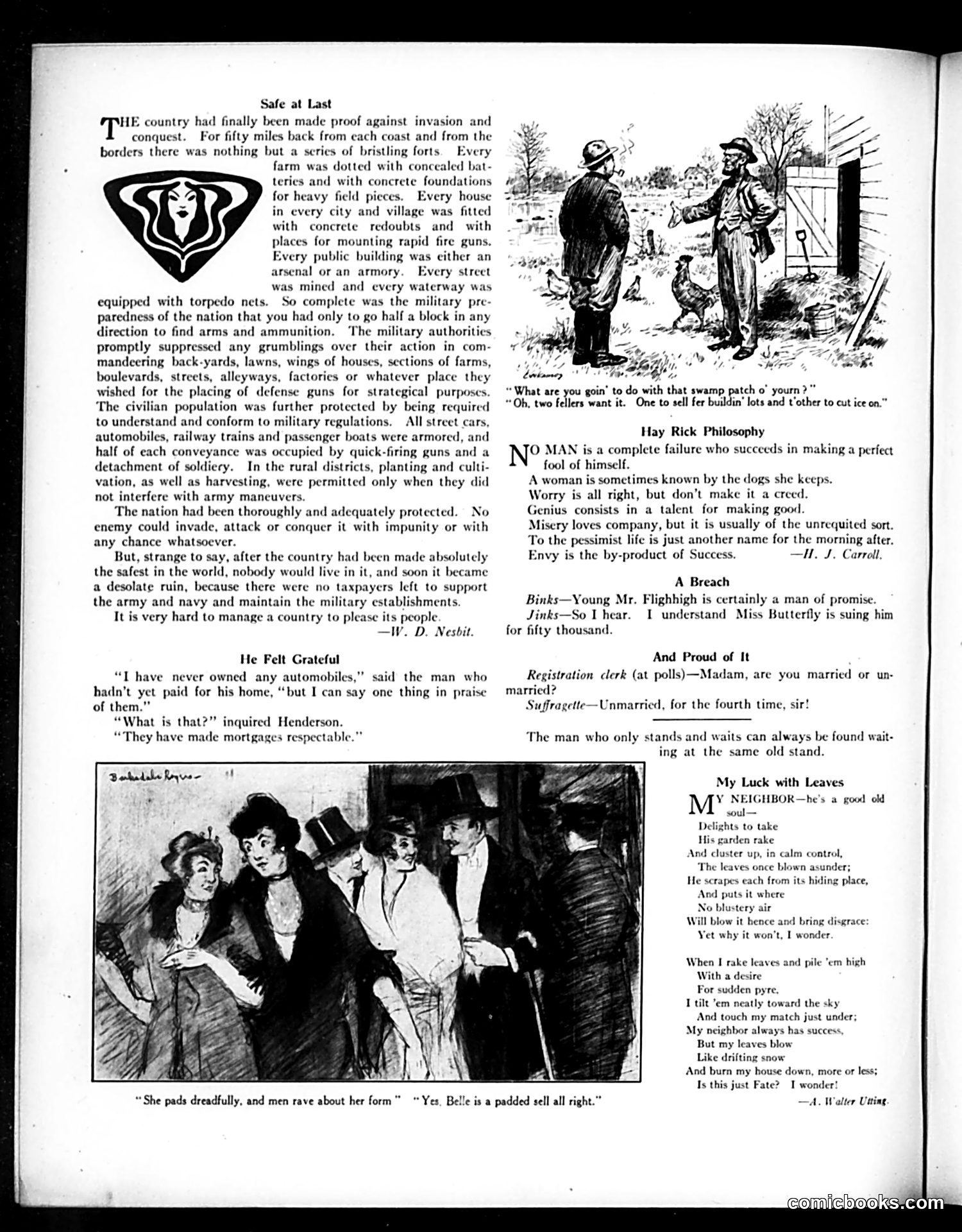
This page contains **anti-militarism satire** criticizing excessive military buildup and preparedness. The lead story describes a nation fortifying every inch of territory—farms, homes, streets, waterways—with guns, forts, and defenses. The satire's point: this obsessive militarization succeeds perfectly at protection but *destroys the nation anyway* because taxpayers flee, leaving no one to fund or inhabit the fortified country. It becomes "a desolate ruin." This likely reflects early 20th-century American anxiety about **military expansion and war preparation**, possibly referencing pre-World War I debates about standing armies and fortifications. The message critiques the paradox: military "safety" can paradoxically make life unlivable. The page's other items are lighter satirical quips about automobiles, marriage, and suffragettes, typical of Judge's miscellaneous humor content.
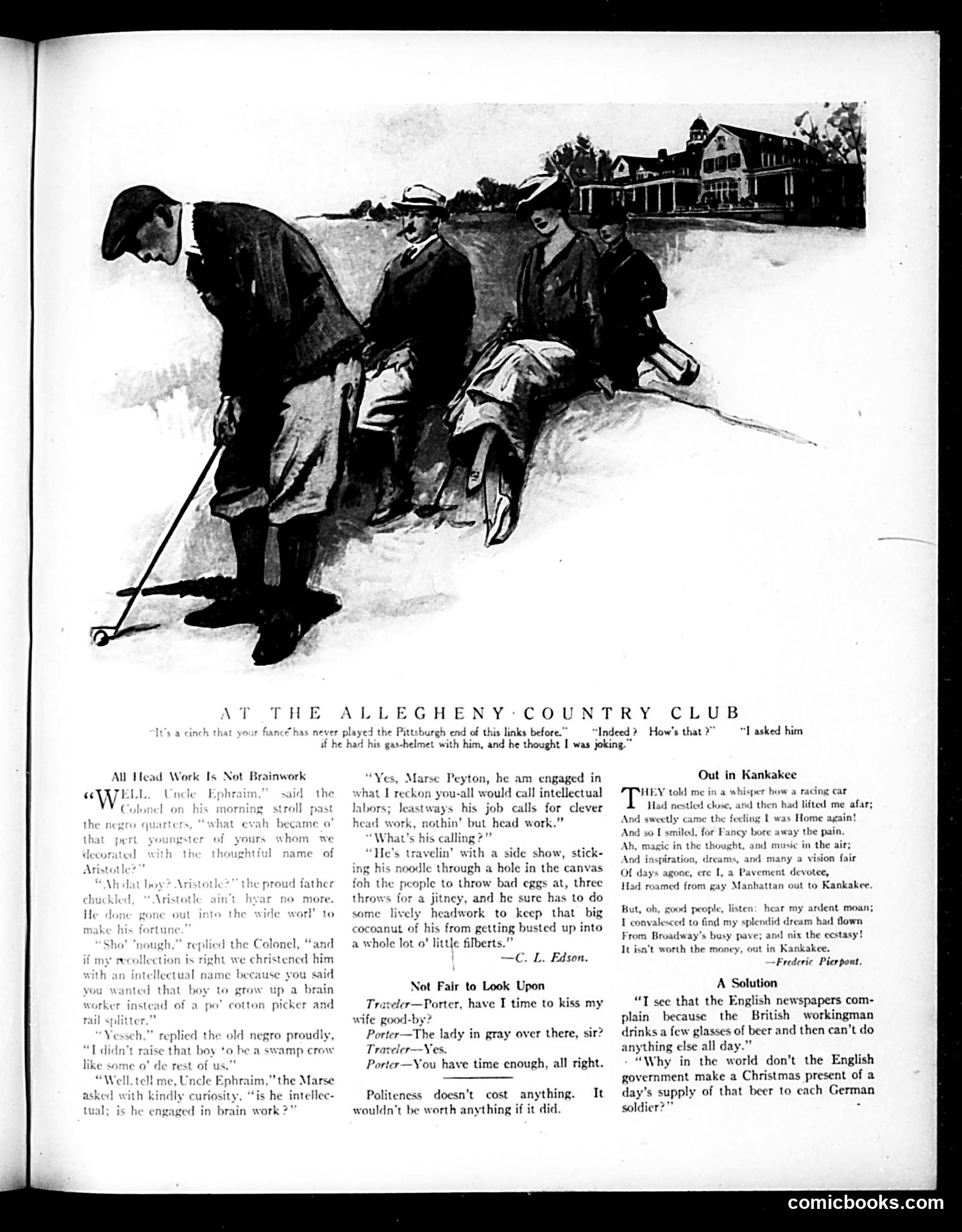
This page from *Judge* magazine contains multiple satirical pieces. The main illustration depicts gentlemen at an Allegheny Country Club discussing whether intellectual work requires actual brainwork—a commentary on class pretensions. The dialogue between "Uncle Ephraim" and Colonel Peyton satirizes Southern aristocratic attitudes toward Black labor. When asked if his hired man does "intellectual" work, the Colonel describes managing a jitney (small taxi service) that requires "head work" to avoid getting his "coconut...busted up"—crude humor equating mental labor with physical danger. Other pieces mock social conventions: a porter's quip about an unattractive woman, nostalgic verse about leaving Manhattan for Kankakee, and a dark joke suggesting Germans soldiers would benefit from daily beer rations like British workers consume. The overall tone is cynical about class distinctions, racial hierarchies, and working-class habits—typical of *Judge's* satirical approach to early 20th-century American social life.
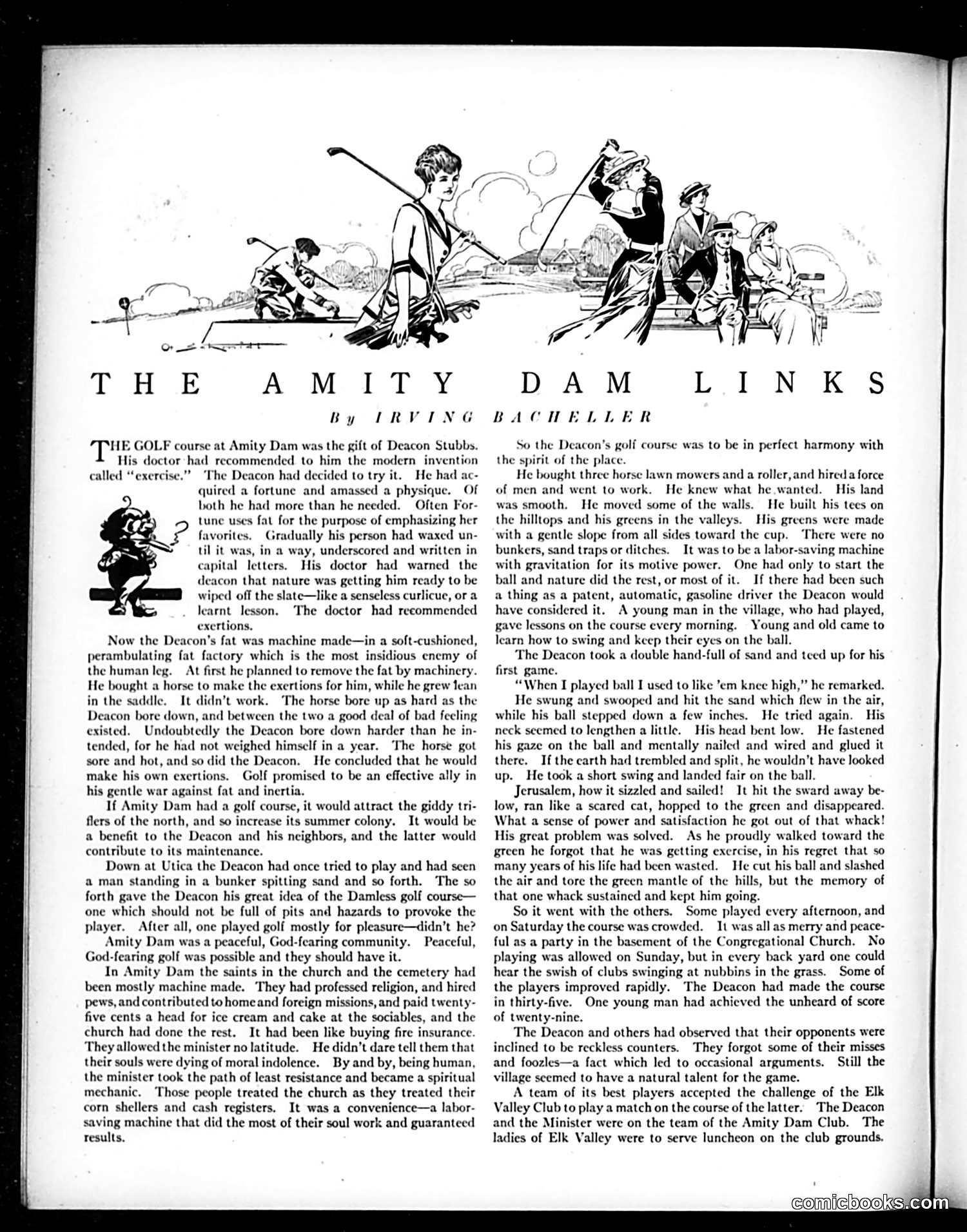
This is a satirical story (not a political cartoon) about a wealthy Deacon who builds a deliberately effortless golf course reflecting his community's shallow spirituality. **The satire:** The story mocks small-town hypocrisy—specifically Amity Dam's mechanical approach to both religion and leisure. The Deacon and his neighbors treat church like a "labor-saving machine," buying their way into respectability through donations rather than genuine moral effort. The golf course he designs—removing all challenges, hazards, and difficulty—mirrors this philosophy: spiritual and recreational life without genuine exertion or character-building. **The joke:** A golf course without bunkers, sand traps, or obstacles is pointless. Similarly, a faith community avoiding moral difficulty becomes spiritually hollow. The Deacon's desire to automate even recreation (mentioning a "gasoline driver") emphasizes how mechanized and soulless their existence has become. This reflects early-20th-century *Judge* magazine's critique of American materialism and commercialized religion.
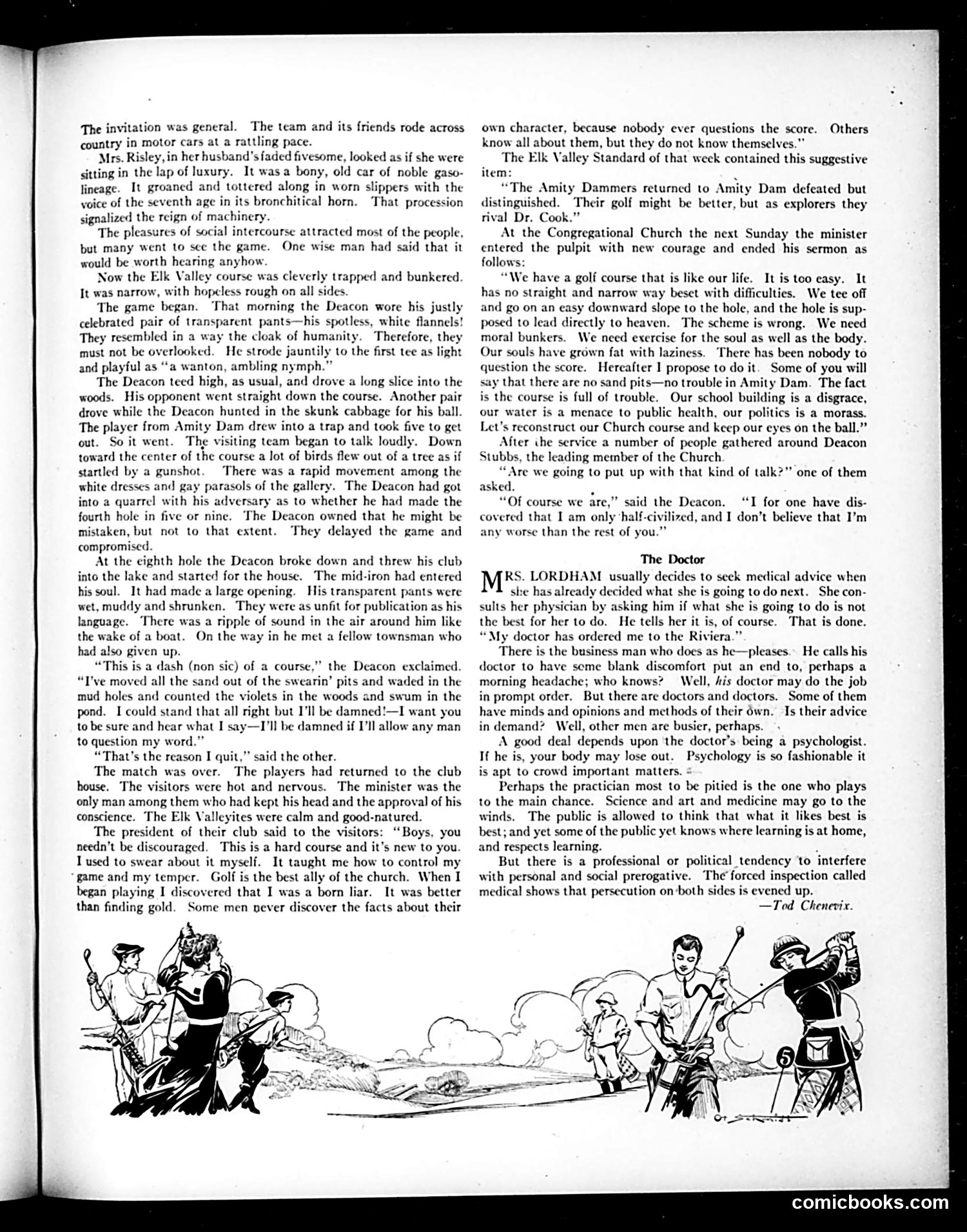
This satirical story mocks the moral pretensions of golf culture and small-town respectability. The humor centers on the **Deacon**—a pillar of his church community—whose carefully maintained public image (symbolized by his pristine white flannel pants) literally disintegrates during a golf match. As he loses, he descends into profanity and rage, revealing his true character. The satire's point: golf supposedly builds moral character (the club president claims it's "the best ally of the church"), yet it actually exposes human hypocrisy and dishonesty. The Deacon learns "I was a born liar" through golf—a supposedly civilizing sport that instead reveals base nature. The visiting team from "Amity Dam" are humorously compared to Dr. Cook (an Arctic explorer involved in a 1909 priority dispute), suggesting their exploration of the Elk Valley course rivals geographic discovery—mocking their incompetence. The cartoon illustration shows golfers in period dress; the satire ridicules both golf's pretended gentility and the self-deception of respectable society.
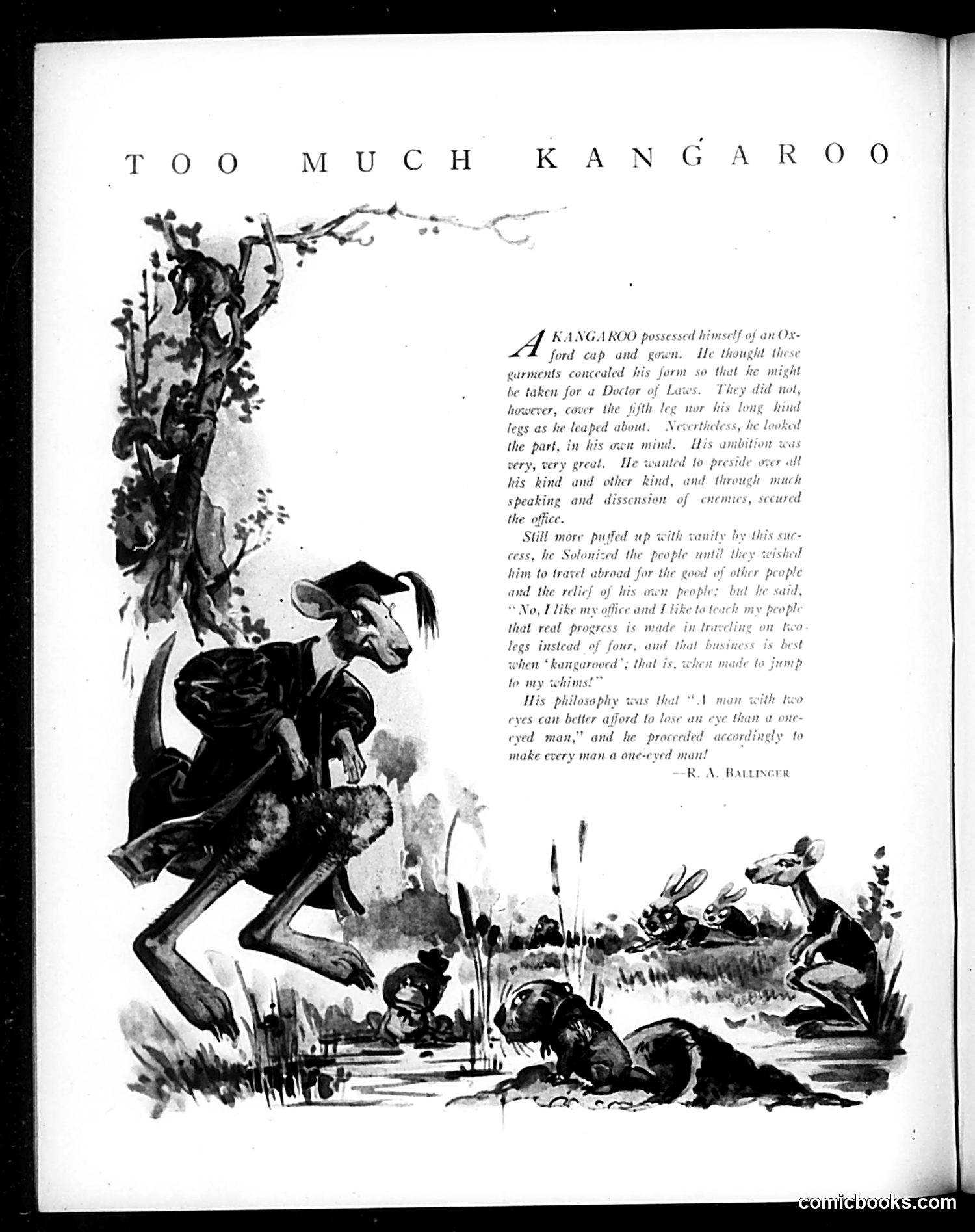
This satirical piece by R.A. Ballinger depicts a kangaroo dressed in academic regalia (Oxford cap and gown), attempting to pass as a Doctor of Laws. The cartoon ridicules someone—likely a political figure of the era—whose pretensions to respectability and legitimacy are absurdly transparent. The satire works on multiple levels: the kangaroo's disguise foolishly fails to hide his true nature (his "fifth leg" or kangaroo characteristics remain visible); his vanity drives him to seek power and prestige; and his absurd philosophy—that "a man with two eyes can better afford to lose an eye than a one-eyed man"—exemplifies foolish reasoning. The text suggests criticism of someone in office who refuses to travel for public good, preferring to remain in power through questionable means. The "Kangarooed" reference appears to reference jumping to conclusions or erratic decision-making. Without specific dating or context, the exact political target remains unclear.
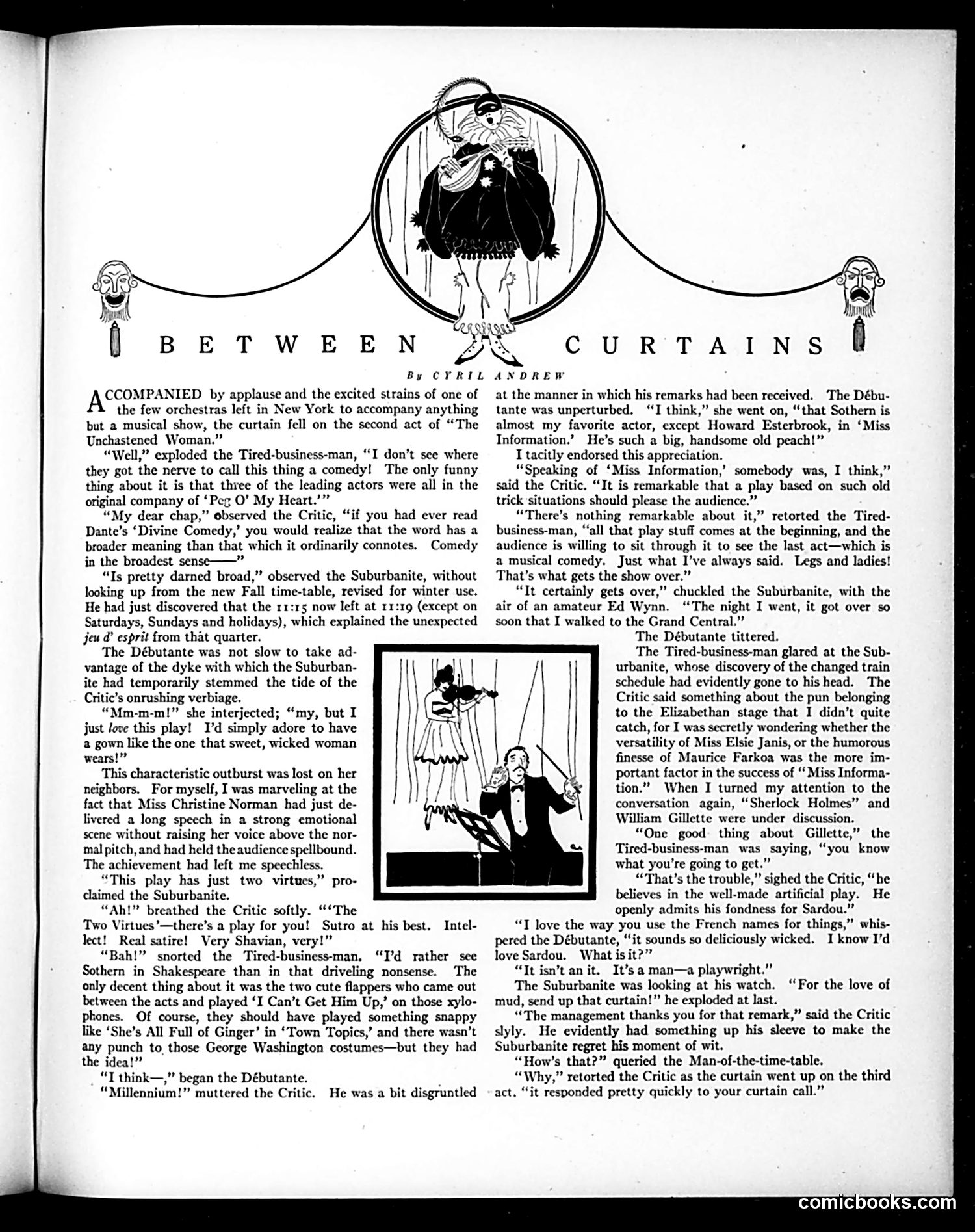
This page contains a theater criticism essay with an embedded illustration showing a man in formal attire speaking with a woman in a dress, apparently backstage or in a theater setting. The text discusses a musical comedy called "The Unchastened Woman," where the critic and various theater-goers debate its merits. A "Tired-business-man" character defends the show's appeal (legs, ladies, and entertainment), while a "Suburbanite" and "Débutante" offer contrasting perspectives. The "Critic" argues about theatrical standards and the play's artistic merit. The satire appears to target the divide between highbrow theatrical criticism and popular entertainment tastes—specifically whether theater should prioritize artistic substance or simple audience pleasure. The exchanges mock pretentiousness on both sides of this debate.
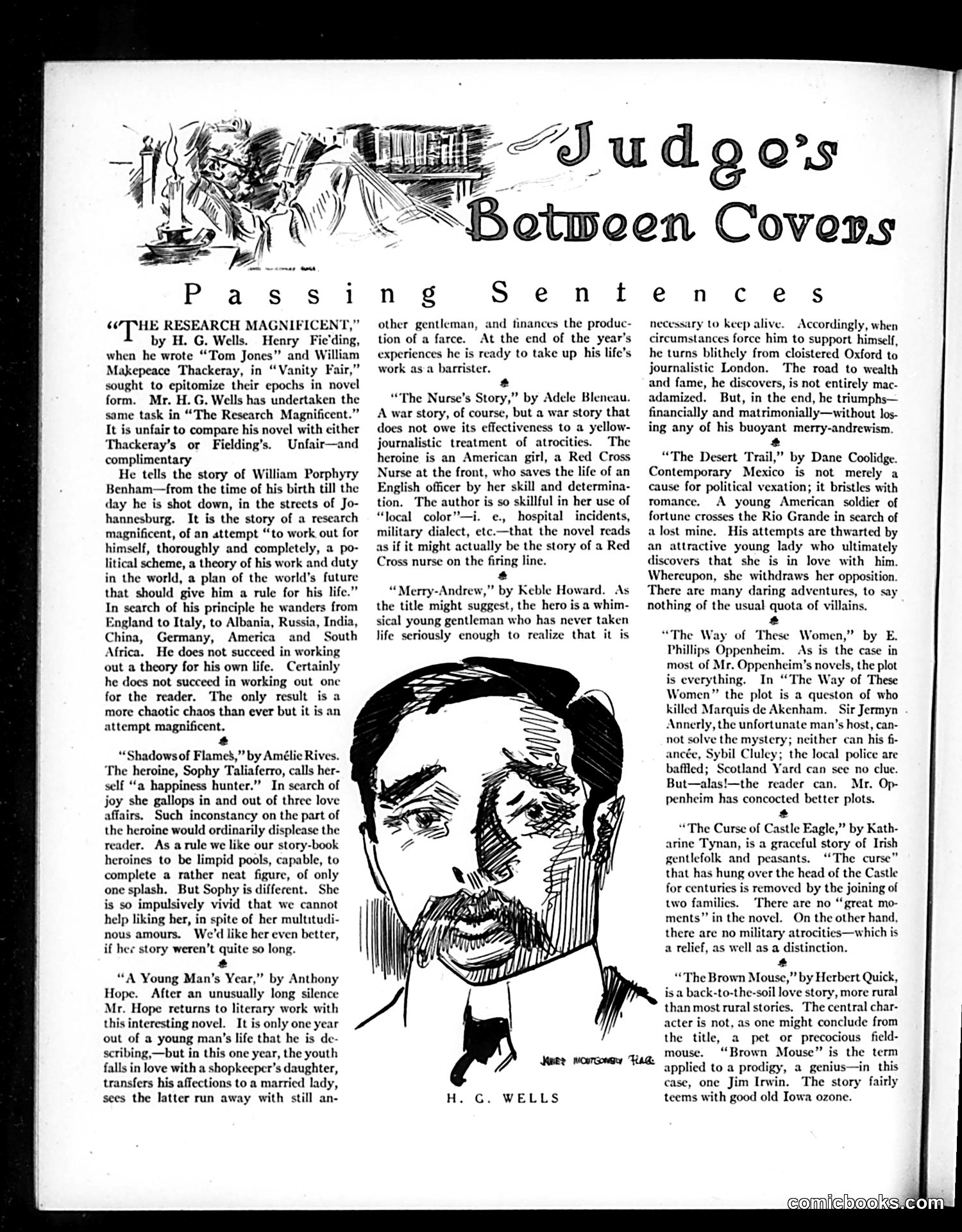
This page presents literary reviews from *Judge*, an American satirical magazine. The central illustration is a portrait sketch of **H.G. Wells**, whose novel *The Research Magnificent* receives the lead review. The reviews themselves are straightforward literary criticism rather than satire—evaluating contemporary fiction by Wells, Amélie Rives, Anthony Hope, Adele Bleneau, Keble Howard, Dane Coolidge, E. Phillips Oppenheim, and Katharine Tynan. The critics assess plots, character development, and writing quality with measured commentary. The satire lies in the *framing*: Judge positions serious literary discussion alongside commercial book reviews, implying gentle mockery of both pretentious literary ambition and popular fiction conventions. References to Wells's wandering protagonist seeking life's meaning, or to the heroine who cannot maintain romantic focus, subtly ridicule philosophical pretension and romantic melodrama respectively. This represents Judge's characteristic blend of cultural criticism with entertainment—treating literature as a subject worthy of satirical attention.
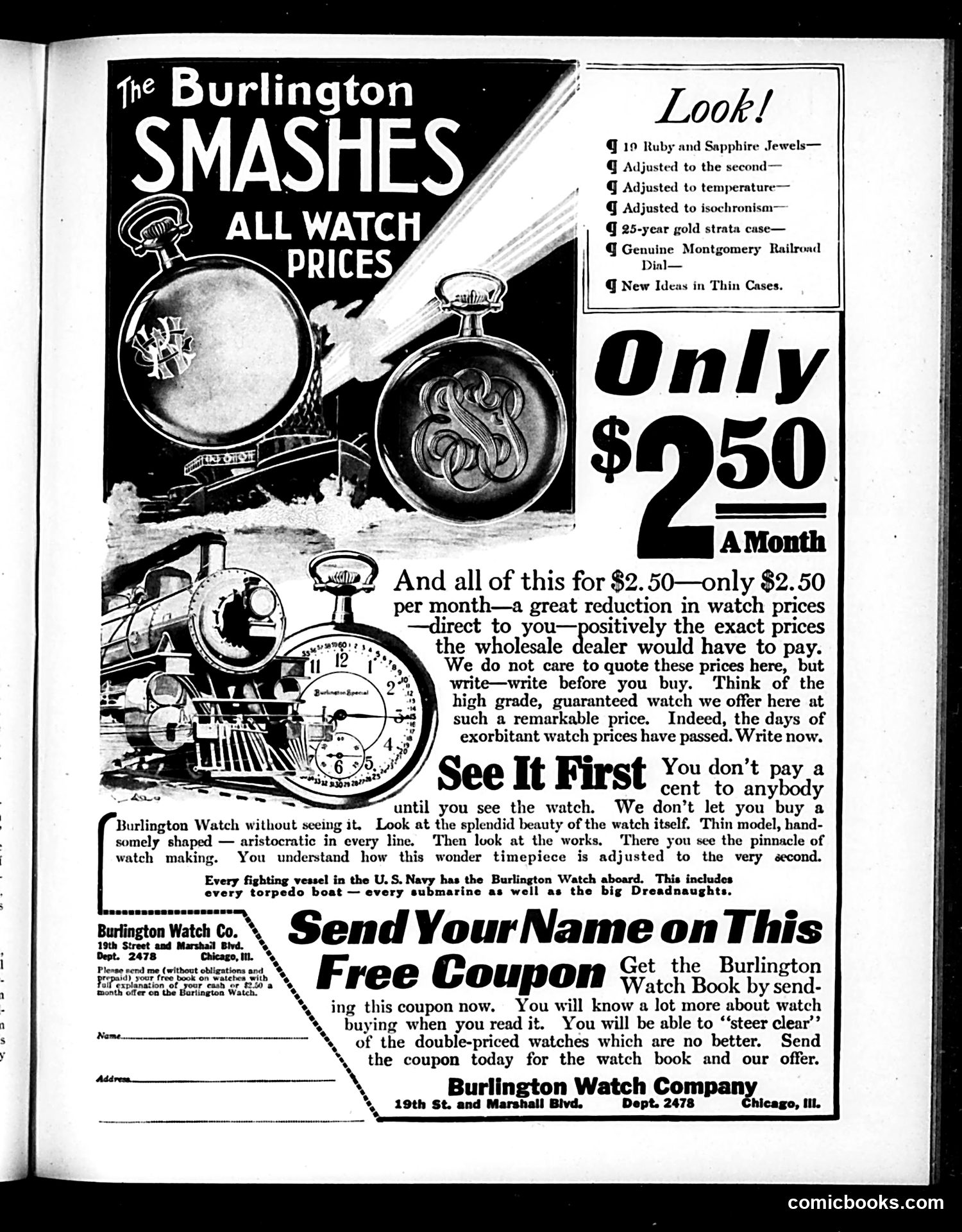
This page is **not a cartoon or satire**—it's a straightforward mail-order advertisement for Burlington watches, likely from the early 1900s. The ad promotes affordable watches ($2.50/month) with luxury features: ruby and sapphire jewels, precision adjustments, gold cases, and genuine railroad dials. It emphasizes that these wholesale prices undercut traditional retail markups. The "See It First" guarantee lets customers examine the watch before payment. The imagery—pocket watches and a locomotive—reinforces reliability and precision timing, essential selling points when railroads and industry demanded accurate timekeeping. The claim that "every fighting vessel in the U.S. Navy has the Burlington Watch aboard" serves as a prestige endorsement. A coupon offers a free watch book to encourage inquiries. This represents typical mail-order marketing of the era, targeting middle-class buyers seeking quality at reduced prices by eliminating retail intermediaries.
This page from *Judge* magazine addresses **women's suffrage**—a major American political debate of the 1910s-1920s. **"The Modern Woman" poem** satirizes a man attempting to escape discussion of women's voting rights. No matter where he flees—newspapers, magazines, streets, beaches, nature—he encounters suffrage advocates. The joke: women's political activism is now *inescapable*, forcing even resistant men to confront the issue. The punchline—he dies to escape—exaggerates male anxiety about women's increasing public voice. **"Colorado Testimony"** shifts tone, presenting a genuine pro-suffrage argument from a Denver probation officer. He testifies that women voters in Colorado (which had granted suffrage) conduct themselves "sweetly" and "womanly" while improving civic conditions. The testimony addresses anti-suffrage fears: that voting women would lose femininity or prove politically incompetent. **"The Wail of the Taxpayer"** counters the economic argument against suffrage by citing tax-rate *decreases* in western states after women gained voting rights—factual evidence debunking fears that female voters would raise taxes. The page advocates cautiously for women's suffrage through satire, testimony, and statistics.
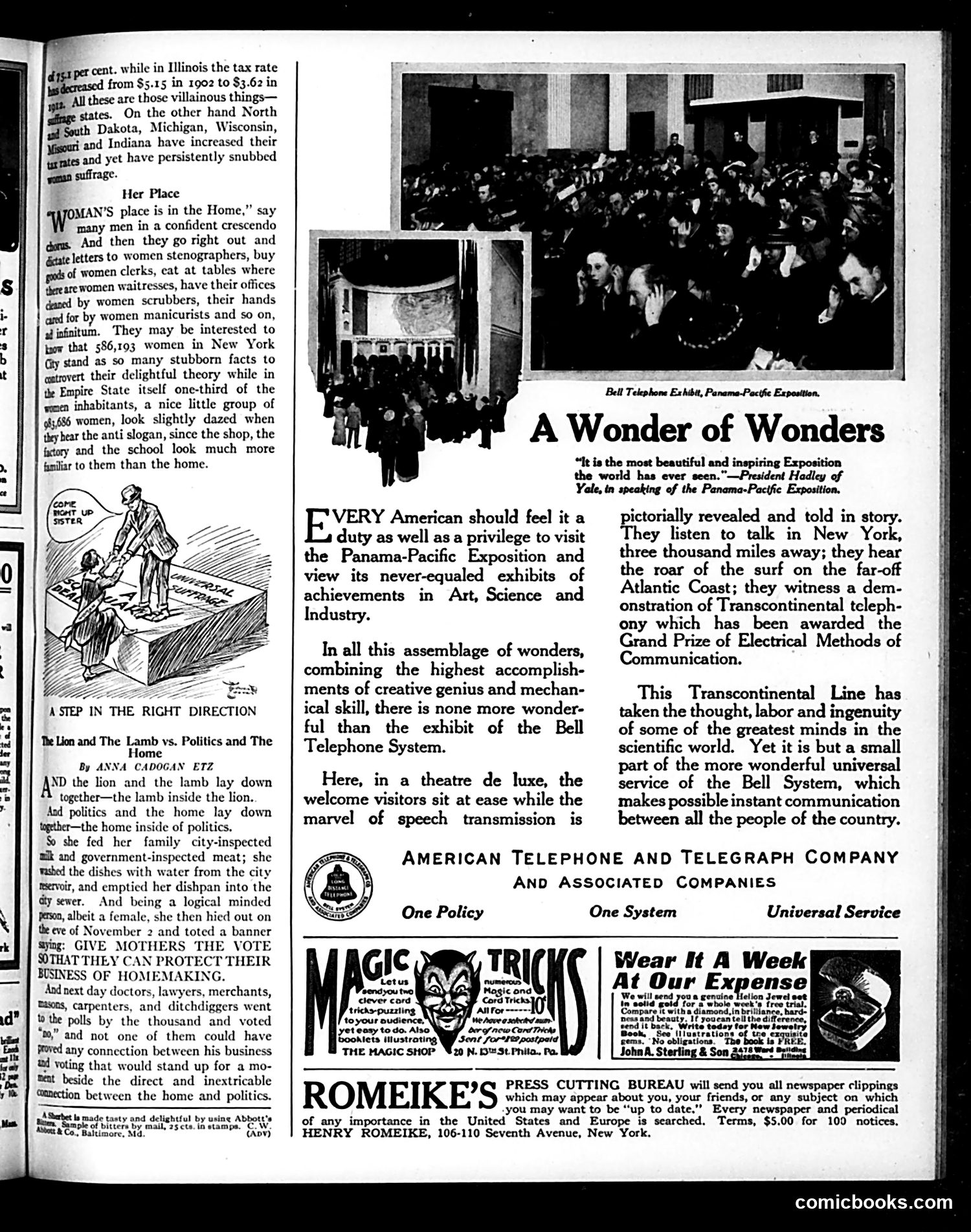
This Judge magazine page contains two distinct pieces of satire about women's roles and rights in early 20th-century America. **"Her Place"** mocks men who claim "a woman's place is in the home" while simultaneously relying on women workers as stenographers, clerks, waitresses, and manicurists. The piece cites statistics showing 586,193 working women in New York City alone, exposing the hypocrisy of confining women to domestic roles while benefiting from their labor. **"A Step in the Right Direction"** satirizes the disconnect between voting rights and actual political power. It describes a woman who, recognizing that city services (inspected milk, city water, sewers) directly affect homemaking, votes with the banner "GIVE MOTHERS THE VOTE SO THAT THEY CAN PROTECT THEIR BUSINESS OF HOMEMAKING"—only to watch male voters deny the logical connection between women's domestic responsibilities and their need for political representation. Both pieces argue for women's suffrage by highlighting women's essential economic and social roles that men hypocritically depend upon while denying them political voice.
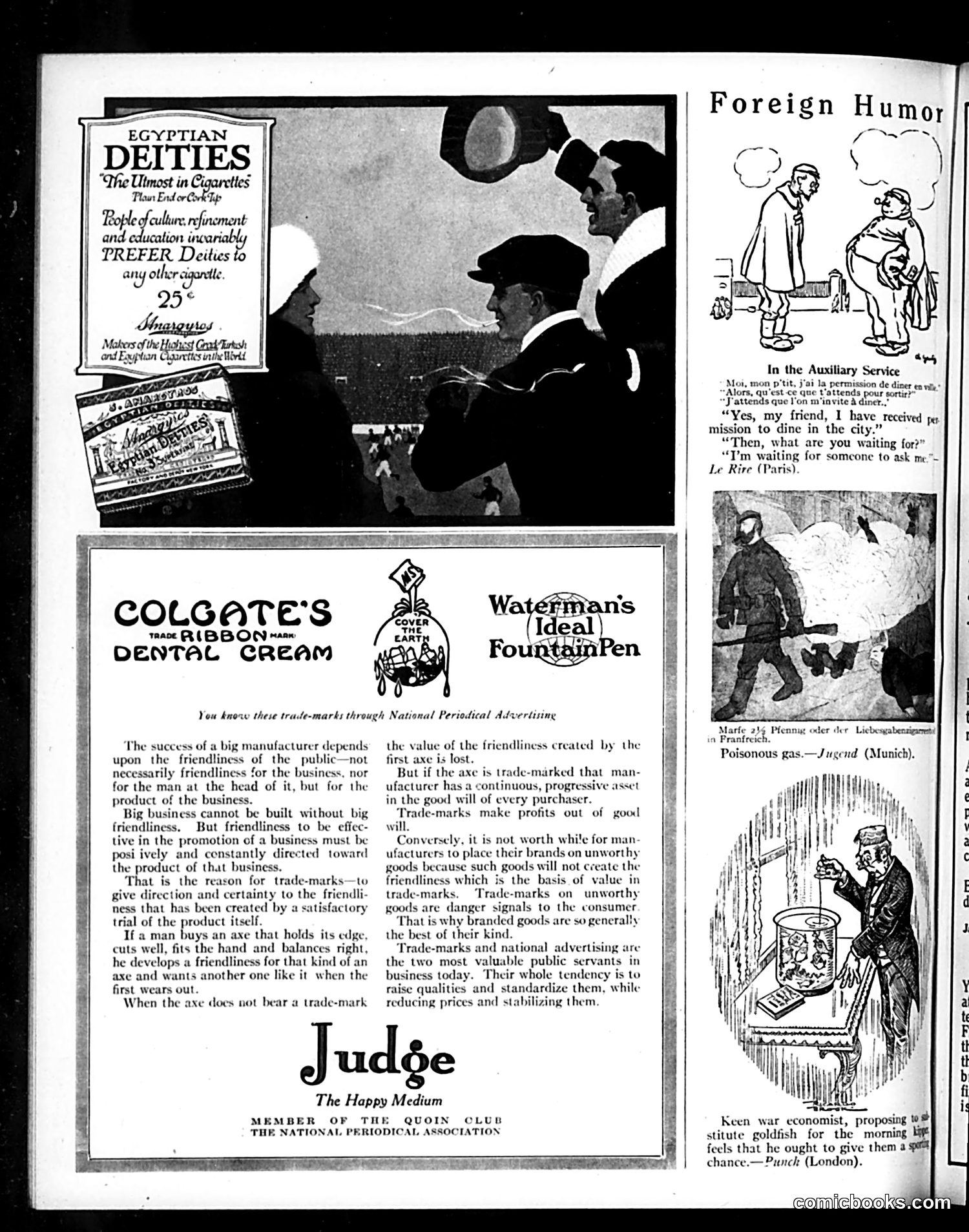
This page is primarily **advertising and editorial content** rather than political satire. The top features ads for **Egyptian Deities cigarettes** and **Colgate's Ribbon Dental Cream**, followed by a lengthy essay on trademarks and brand loyalty—arguing that manufacturer success depends on building consumer "friendliness" through reliable branded products. The right side contains **"Foreign Humor"**—reprinted jokes from European satirical magazines. Two are visible: 1. A French piece (*Le Rire*) about military auxiliary service, where a soldier waits for an invitation to dine in the city rather than accepting permission to go. 2. A British piece (*Punch*) about wartime economy, where someone proposes substituting goldfish for morning eggs—an apparent rationing jest. These translated jokes require no specific political context beyond understanding WWI-era austerity measures. The page demonstrates how American magazines recycled European humor for domestic audiences, with minimal editorial commentary.
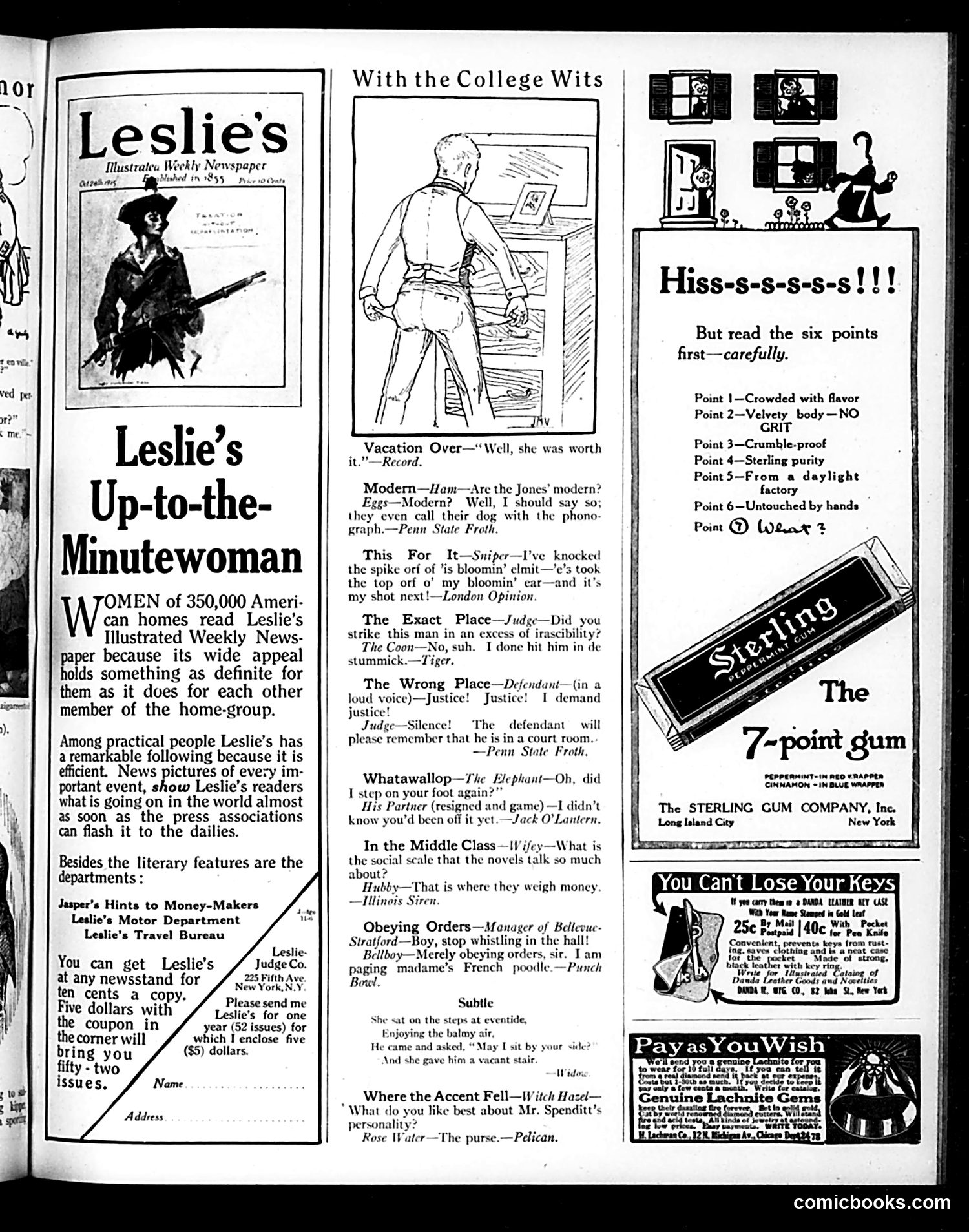
This page is primarily **advertising and promotional content** rather than political satire. The left side features a Leslie's Illustrated Weekly Newspaper advertisement promoting itself as "Up-to-the-Minute Woman"—targeting the 350,000 American homes (particularly women) who read it for efficient, timely news coverage and practical content. It's a circulation-building pitch emphasizing speed and broad appeal. The center contains **"With the College Wits,"** a collection of jokes from college humor magazines. These brief, mild gags joke about modern life (phonographs, court proceedings, social class defined by wealth) with no apparent political agenda—typical college humor of the era. The right side features advertisements for **Sterling Gum** and key holders, using humorous copy to sell products. Overall, this is a **typical early 20th-century magazine page** mixing light humor with commercial content—not a vehicle for political commentary.
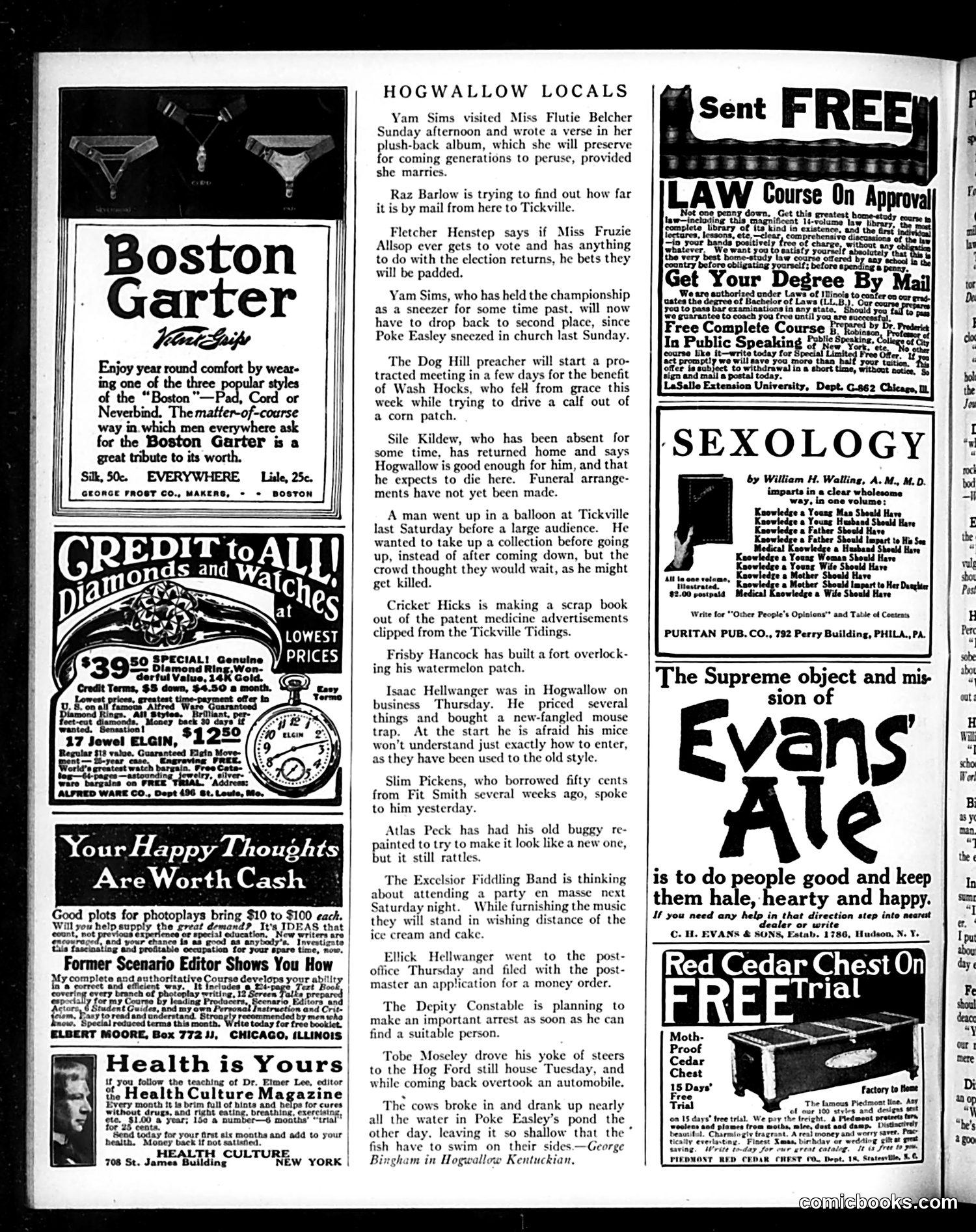
This page is primarily **advertising and humor filler**, not political satire. The main content includes: **"Hogwallow Locals"** — A humorous rural gossip column featuring fictional small-town characters and absurdist jokes (a man in a balloon collecting money before falling; someone filing for a money order as "news"). This is lighthearted Americana humor targeting urban readers amused by rural simplicity. **Advertisements** dominate: Boston Garters (hosiery), jewelry, correspondence courses (law degrees, screenwriting, health culture), and patent medicines—typical early 20th-century magazine ads. The **Evans Ale advertisement** uses "hale, hearty and happy" as branding, common beer marketing of the era. **No political cartoons or caricatures appear on this page.** The humor is domestic and apolitical—small-town life rendered as quaint and silly for urban audiences. This represents Judge's lighter content, separate from its satirical political tradition.
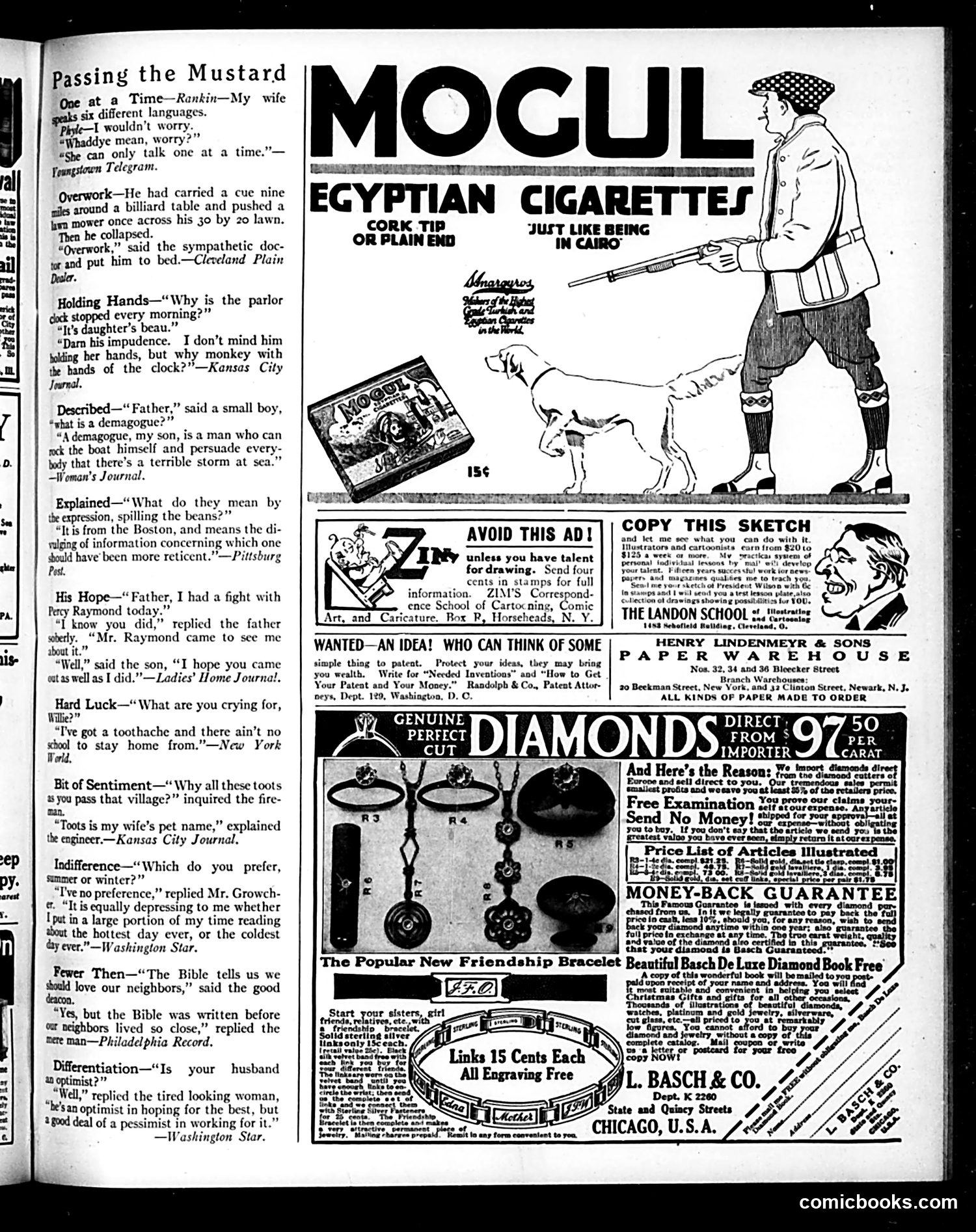
This page is primarily **advertising and humor shorts**, not political commentary. The left column contains brief jokes from various newspapers—mostly domestic humor about wives, marriage, work, and courtship popular in early 20th-century publications. Examples include a joke about a wife speaking six languages but talking one at a time, and a father questioning why the parlor clock stops when his daughter's boyfriend visits. The right side features **commercial advertisements**: Mogul Egyptian cigarettes (with an illustration of a man and dog), diamond rings from an importer, a correspondence school for cartooning, patent attorney services, and paper warehouse ads. The Mogul cigarette ad's tagline "Just Like Being in Cairo" reflects the period's casual Orientalism. The "Copy This Sketch" feature appears to be a reader submission opportunity or drawing exercise. This is a typical Judge magazine page from approximately the 1910s-1920s—mixing light social satire in short-joke format with period advertisements. The humor targets no specific political figures or events, focusing instead on universal domestic situations relatable to middle-class readers.
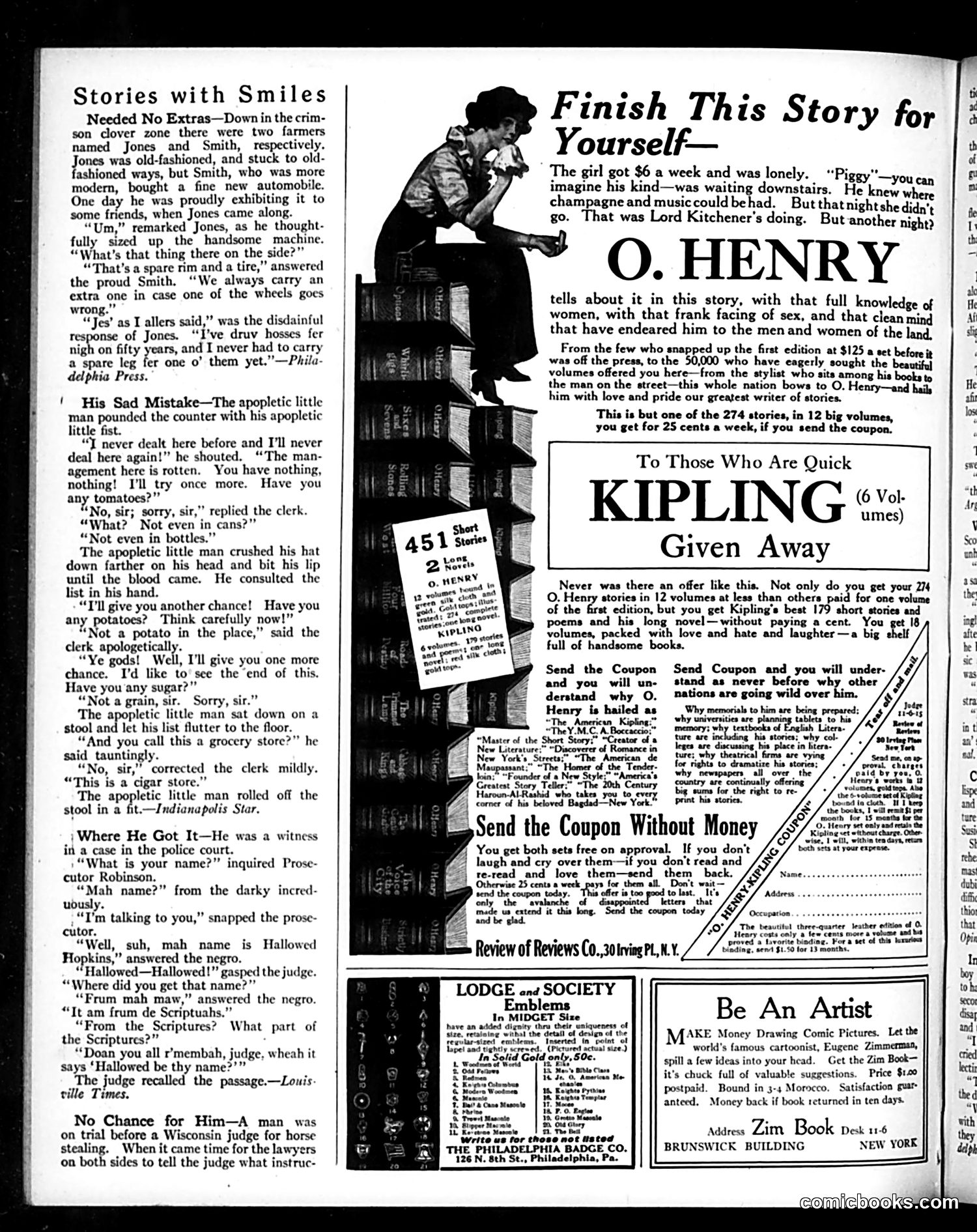
This page is primarily **advertising and light humor stories**, not political satire. The left column contains three comedic anecdotes: a farmer mocking an automobile owner's spare tire (contrasting old vs. modern ways), a man angry at a cigar store he mistook for a grocery, and a courtroom exchange with a Black witness about his biblical name "Hallowed Hopkins." The right side advertises **O. Henry and Kipling book collections** being offered cheaply (25 cents weekly). The O. Henry promotion emphasizes his knowledge of "women" and "frank facing of sex"—marketing his stories as sophisticated and adult-oriented. **Social context**: The page reflects early 1900s attitudes—rural/urban modernization tensions, casual racism in the courtroom anecdote (using dialect for comic effect), and commercialization of literature through affordable collected editions competing with each other. The "Finish This Story Yourself" section invokes Lord Kitchener (British military figure, recognizable to American readers of that era) as a plot device, but the narrative context is unclear from this excerpt alone.
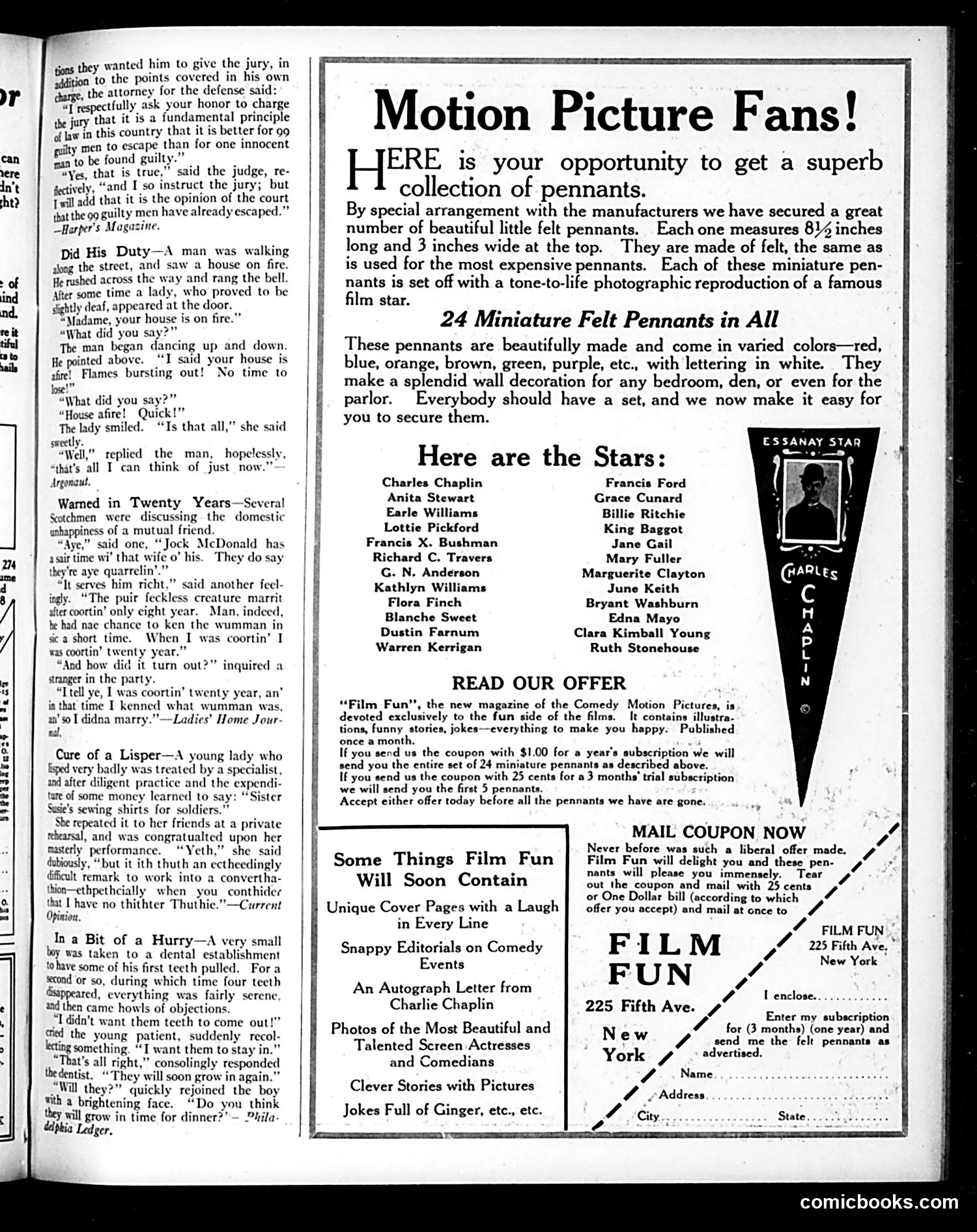
This page is primarily a **magazine advertisement** rather than political satire. It's promoting "Film Fun," a comedy magazine, and offering collectible felt pennants featuring silent film stars of the era (circa 1910s). The small anecdotes scattered around the margins are typical **humorous filler content** common in Judge magazine—brief jokes about everyday situations (a man warning a deaf woman about her burning house, Scottish courtship stories, etc.). These aren't political cartoons but rather light domestic humor meant to entertain readers. The real content is the **advertisement for miniature felt pennants** featuring famous movie stars like Charlie Chaplin, Billie Ritchie, and others. The appeal to "Motion Picture Fans!" reflects the growing celebrity culture and film industry popularity of the period. This represents early **movie merchandising**—capitalizing on fans' desire to collect memorabilia of their favorite actors. The page demonstrates how magazines monetized their audiences through tie-in products.
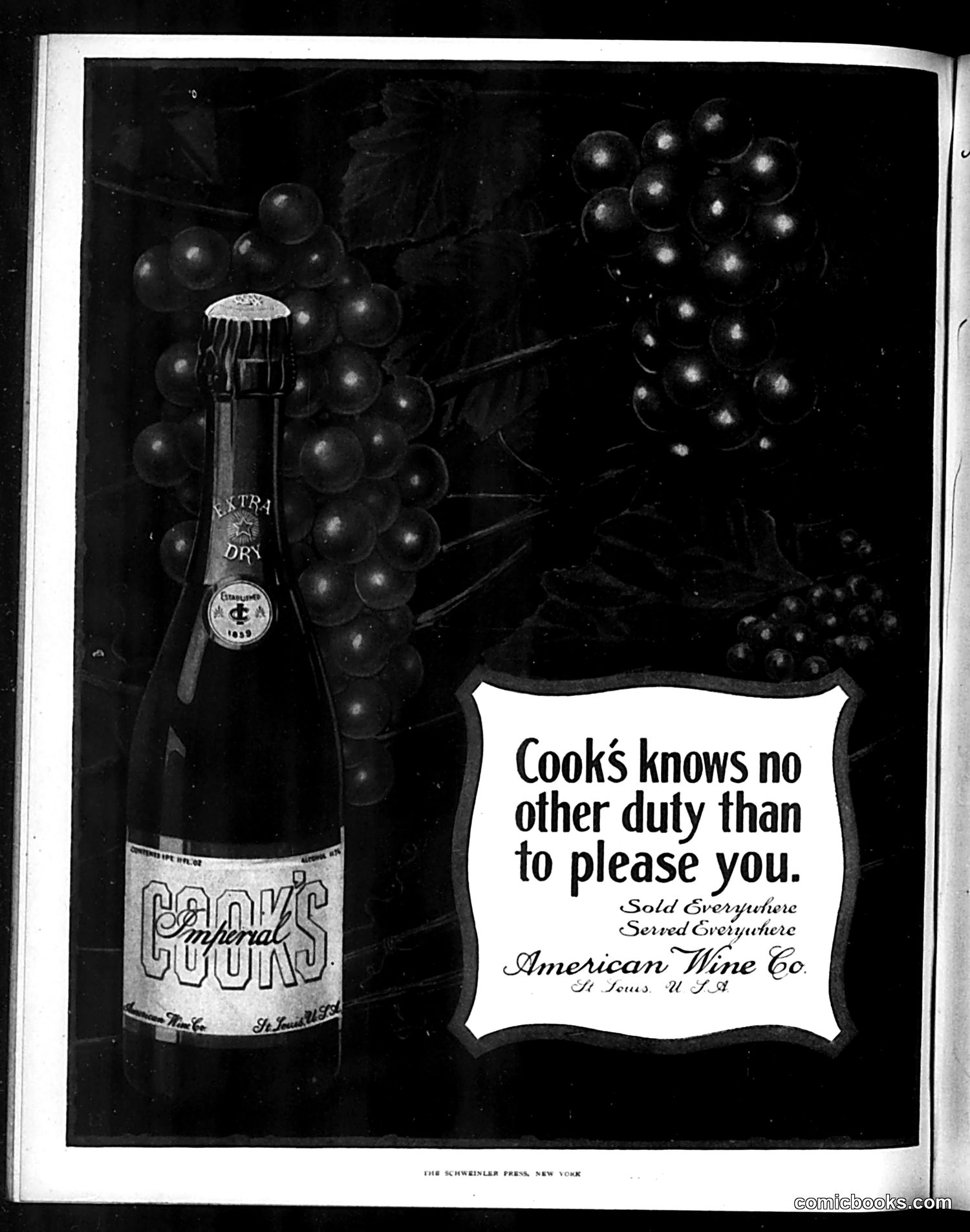
This is a **wine advertisement**, not political satire. It promotes Cook's Imperial champagne, manufactured by American Wine Co. in St. Louis, U.S.A. The ad features a bottle of Cook's champagne surrounded by grape clusters, with the slogan "Cook's knows no other duty than to please you." The phrase "Sold Everywhere / Served Everywhere" emphasizes the product's widespread availability. This appears in *Judge* magazine, which mixed satirical content with advertising. The ad reflects early 20th-century American wine marketing, promoting domestic champagne production—notable because Prohibition (1920-1933) later made such advertising impossible. The elegant presentation with grapes and fine typography targets affluent consumers seeking quality American wines.