
Judge, 1915-11-06 · page 8 of 28
Judge — November 6, 1915 — page 8: what you’re looking at
What you’re looking at
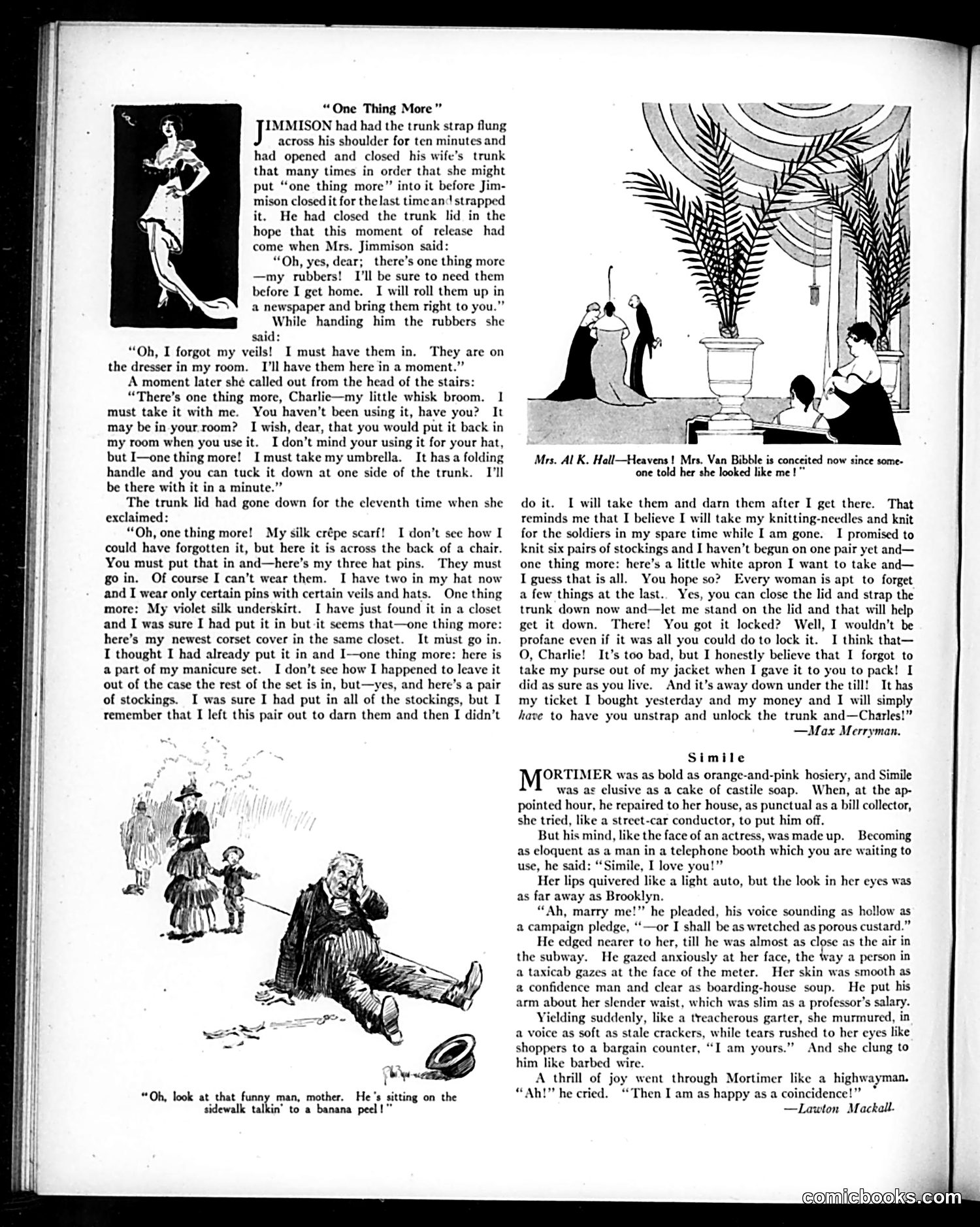
This page contains two unrelated satirical pieces typical of Judge magazine's humor. **"One Thing More"** (main story by Max Merryman): A domestic comedy about a husband attempting to close his wife's traveling trunk while she repeatedly interrupts with additional items to pack. The satire targets the stereotypical absent-minded, indecisive wife who cannot stop adding "one more thing"—rubbers, veils, a whisk broom, umbrella, scarf, hat pins, undergarments, manicure set, stockings, knitting needles, and finally her purse. The humor derives from the exaggerated, seemingly endless nature of female packing anxiety and the husband's patient (then fraying) tolerance. This reflects early-20th-century gender stereotypes about women's disorganization. **"Simile"** (by Landon Mackall, bottom): A brief romantic comedy comparing Mortimer's boldness to "orange-and-pink hosiery" and a woman's elusiveness to "castile soap"—absurdist similes that undercut romantic sincerity through deliberately nonsensical comparisons. The page includes period illustrations and a street scene cartoon caption about a "funny man" on a sidewalk.
📄 Transcribed text from this page (OCR, searchable)
Machine-transcribed from the original scan — historical spelling and the odd misread are preserved.
“One Thing More” IMMISON had had the trunk strap flung across his shoulder for ten minutes and had opened and closed his wife’s trunk that many times in order that she might put “one thing more” into it before Jim- mison closed it for the last timcand strapped it. He had closed the trunk lid in the hope that this moment of release had come when Mrs. Jimmison sai “Oh, yes, dear; there’s one thing more —my rubbers! I'll be sure to need them before I get home. I will roll them up in a newspaper and bring them right to you.” While handing him the rubbers she said: “Oh, I forgot my veils! I must have them in. They are on the dresser in my room. I'll have them here in a moment.” A moment later she called out from the head of the stairs: “There’s one thing more, Charlie—my little whisk broom. I must take it with me. You haven’t been using it, have you? It may be in your room? I wish, dear, that you would put it back in my room when you use it. I don’t mind your using it for your hat, but I—one thing more! I must take my umbrella. It has a folding handle and you can tuck it down at one side of the trunk. I'll be there with it in a minute.” The trunk lid had gone down for the eleventh time when she exclaimed: “Oh, one thing more! My silk crépe scarf! I don’t see how I could have forgotten it, but here it is across the back of a chair. You must put that in and—here’s my three hat pins. They must go in. Of course I can’t wear them. I have two in my hat now and I wear only certain pins with certain veils and hats. One thing more: My violet silk underskirt. I have just found it in a closet and I was sure I had put it in but it seems that—one thing more: here’s my newest corset cover in the same closet. It must go in. I thought I had already put it in and I—one thing more: here is a part of my manicure set. I don’t see how I happened to leave it out of the case the rest of the set is in, but—yes, and here’s a pair of stockings. I was sure I had put in all of the stockings, but I remember that I left this pair out to darn them and then I didn’t ‘2 “Oh, look at that funny man, mother. He's sitting on the sidewalk talkin’ to a banana peel!” Mrs. Al K. Hall—Heavens! Mrs. Van Bibble is conceited now since some- one told her she looked like me!” do it. I will take them and darn them after I get there. That reminds me that I believe I will take my knitting-needles and knit for the soldiers in my spare time while I am gone. I promised to knit six pairs of stockings and I haven’t begun on one pair yet and— one thing more: here’s a little white apron I want to take and— I guess that is all. You hope so? Every woman is apt to forget a few things at the last.. Yes, you can close the lid and strap the trunk down now and—lIet me stand on the lid and that will help get it down. There! You got it locked? Well, I wouldn’t be profane even if it was all you could do to lock it. I think that— O, Charlie! It’s too bad, but I honestly believe that I forgot to take my purse out of my jacket when I gave it to you to pack! I did as sure as you live. And it’s away down under the till! It has my ticket I bought yesterday and my money and I will simply have to have you unstrap and unlock the trunk and—Charles!” —Max Merryman. Simile MORTIMER was as bold as orange-and-pink hosiery, and Simile was as clusive as a cake of castile soap. When, at the ap- pointed hour, he repaired to her house, as punctual as a bill collector, she tried, like a street-car conductor, to put him off. But his mind, like the face of an actress, was made up. Becoming as eloquent as a man in a telephone booth which you are waiting to use, he said: “Simile, I love you!” Her lips quivered like a light auto, but the look in her eyes was as far away as Brooklyn. “Ah, marry me!” he pleaded, his voice sounding as hollow as a campaign pledge, “‘—or I shall be as wretched as porous custard.” He edged nearer to her, till he was almost as close as the air in the subway. He gazed anxiously at her face, the way a person in a taxicab gazes at the face of the meter. Her skin was smooth as a confidence man and clear as boarding-house soup. He put his arm about her slender waist, which was slim as a professor’s salary. Yielding suddenly, like a treacherous garter, she murmured, in a voice as soft as stale crackers, while tears rushed to her eyes like shoppers to a bargain counter, “I am yours.”” And she clung to him like barbed wire. A thrill of joy went through Mortimer like a highwayman, “Ah!” he cried. “Then I am as happy as a coincidence!” * —Lawton Mackall.