
Judge, 1915-11-06 · page 15 of 28
Judge — November 6, 1915 — page 15: what you’re looking at
What you’re looking at
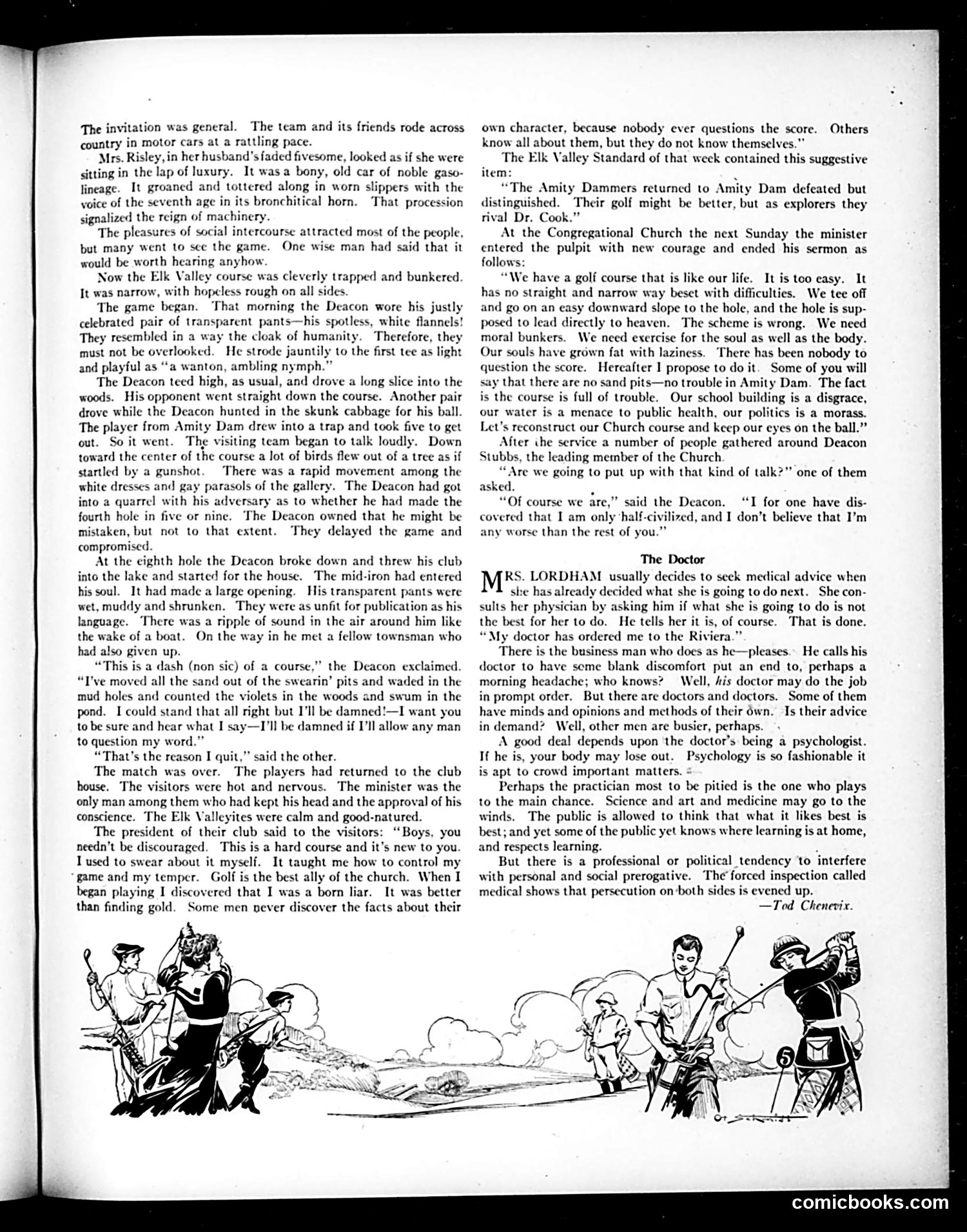
This satirical story mocks the moral pretensions of golf culture and small-town respectability. The humor centers on the **Deacon**—a pillar of his church community—whose carefully maintained public image (symbolized by his pristine white flannel pants) literally disintegrates during a golf match. As he loses, he descends into profanity and rage, revealing his true character. The satire's point: golf supposedly builds moral character (the club president claims it's "the best ally of the church"), yet it actually exposes human hypocrisy and dishonesty. The Deacon learns "I was a born liar" through golf—a supposedly civilizing sport that instead reveals base nature. The visiting team from "Amity Dam" are humorously compared to Dr. Cook (an Arctic explorer involved in a 1909 priority dispute), suggesting their exploration of the Elk Valley course rivals geographic discovery—mocking their incompetence. The cartoon illustration shows golfers in period dress; the satire ridicules both golf's pretended gentility and the self-deception of respectable society.
📄 Transcribed text from this page (OCR, searchable)
Machine-transcribed from the original scan — historical spelling and the odd misread are preserved.
The invitation was general. The team and its friends rode across country in motor cars at a rattling pace. Mrs. Risley, in her husband's faded fivesome, looked as if she were sitting in the lap of luxury. It was a bony, old car of noble gaso- lineage. It groaned and tottered along in worn slippers with the voice of the seventh age in its bronchitical horn. That procession signalized the reign of machinery. The pleasures of social intercourse attracted most of the people, but many went to sce the game. One wise man had said that it would be worth hearing anyhow. Now the Elk Valley course was cleverly trapped and bunkered. It was narrow, with hopeless rough on all sides. The game began. That morning the Deacon wore his justly celebrated pair of transparent pants—his spotless, white flannels! They resembled in a way the cloak of humanity. Therefore, they must not be overlooked. He strode jauntily to the first tee as light and playful as “a wanton, ambling nymph.” The Deacon teed high, as usual, and drove a long slice into the woods. His opponent went straight down the course. Another pair drove while the Deacon hunted in the skunk cabbage for his ball. The player from Amity Dam drew into a trap and took five to get out. So it went. The visiting team began to talk loudly. Down toward the center of the course a lot of birds flew out of a tree as if startled by a gunshot. There was a rapid movement among the white dresses and gay parasols of the gallery. The Deacon had got into a quarrel with his adversary as to whether he had made the fourth hole in five or nine. The Deacon owned that he might be mistaken, but not to that extent. They delayed the game and compromised. At the eighth hole the Deacon broke down and threw his club into the lake and started for the house. The mid-iron had entered his soul. It had made a large opening. His transparent pants were wet, muddy and shrunken. They were as unfit for publication as his language. There was a ripple of sound in the air around him like the wake of a boat. On the way in he met a fellow townsman who had also given up. “This is a dash (non sic) of a course,”’ the Deacon exclaimed. “I've moved all the sand out of the swearin’ pits and waded in the mud holes and counted the violets in the woods and swum in the pond. I could stand that all right but I'll be damned!—I want you to be sure and hear what I say—I'll be damned if I'll allow any man to question my word.” “That’s the reason I quit,”’ said the other. The match was over. The players had returned to the club house. The visitors were hot and nervous. The minister was the only man among them who had kept his head and the approval of his conscience. The Elk Valleyites were calm and good-natured. The president of their club said to the visitors: “Boys, you needn't be discouraged. This is a hard course and it’s new to you used to swear about it myself. It taught me how to control my game and my temper. Golf is the best ally of the church. When I began playing I discovered that I was a born liar. It was better than finding gold. Some men never discover the facts about their own character, because nobody ever questions the score. Others know all about them, but they do not know themselves.”’ The Elk Valley Standard of that week contained this suggestive item: “The Amity Dammers returned to Amity Dam defeated but distinguished. Their golf might be better, but as explorers they rival Dr. Cook.” At the Congregational Church the next Sunday the minister entered the pulpit with new courage and ended his sermon as follows: “We have a golf course that is like our life. It is too easy. It has no straight and narrow way beset with difficulties. We tee off and go on an easy downward slope to the hole, and the hole is sup- posed to lead directly to heaven. The scheme is wrong. We need moral bunkers. We need exercise for the soul as well as the body. Our souls have grown fat with laziness. There has been nobody to question the score. Hereafter I propose to do it. Some of you will say that there are no sand pits—no trouble in Amity Dam. The fact is the course is full of trouble. Our school building is a disgrace, our water is a menace to public health, our politics is a morass. Let's reconstruct our Church course and keep our eyes on the ball.” After che service a number of people gathered around Deacon Stubbs, the leading member of the Church. “Are we going to put up with that kind of talk?” one of them asked . Of course we are,” said the Deacon. ‘‘I for one have dis- covered that I am only half-civilized, and I don’t believe that I’m any worse than the rest of you.”” The Doctor M®*: LORDHAM usually decides to seck medical advice when she has already decided what she is going to do next. She con- sults her physician by asking him if what she is going to do is not the best for her to do. He tells her it is, of course. That is done. “My doctor has ordered me to the Riviera.” There is the business man who does as he—pleases. He calls his doctor to have seme blank discomfort put an end to, perhaps a morning headache; who know Well, his doctor may do the job in prompt order. But there are doctors and doctors. Some of them have minds and opinions and methods of their dwn. Is their advice in demand? Well, other men are busier, perhaps. A good deal depends upon ‘the doctor’s being a psychologist. If he is, your body may lose out. Psychology is so fashionable it is apt to crowd important matters. Perhaps the practician most to be pitied is the one who plays to the main chance. Science and art and medicine may go to the winds. The public is allowed to think that what it likes best is best; and yet some of the public yet knows where learning is at home, and respects learning. : But there is a professional or political tendency ‘to interfere with personal and social prerogative. The forced inspection called medical shows that persecution on-both sides is evened up. —Tod Chenevix. comicbooks.com