
Judge, 1915-11-06 · page 6 of 28
Judge — November 6, 1915 — page 6: what you’re looking at
What you’re looking at
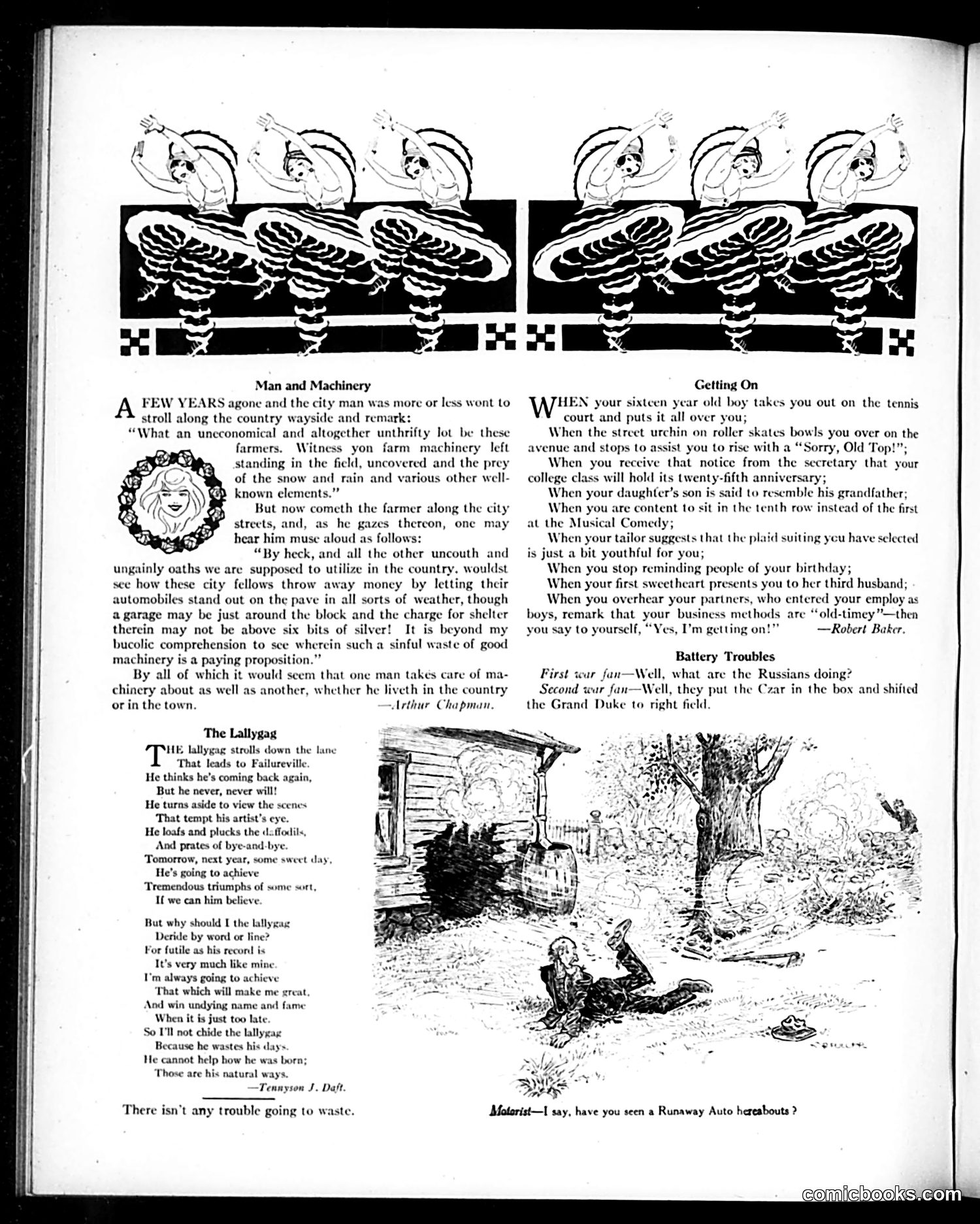
This page contains three pieces of social satire from early 20th-century America: **"Man and Machinery"** satirizes human nature's inconsistency. The piece observes that farmers once criticized city dwellers for leaving farm equipment exposed to weather, yet now those same farmers criticize city people for leaving automobiles ungaraged. The joke is that people everywhere are equally careless with machinery—hypocrisy is universal. **"The Lallygag"** mocks procrastination and daydreaming. The "lallygag" represents someone perpetually postponing achievement, chasing artistic inspiration while headed toward "Failureville." The poet admits his own hypocrisy: he too constantly defers his ambitions "until too late." **"Getting On"** lists humorous signs of aging—being beaten at tennis by teenagers, being knocked over by roller skaters, receiving class reunion notices, watching younger employees, etc. It's a lighthearted catalog of mortality's indignities. **"Battery Troubles"** appears to be a brief joke about World War I (likely pre-U.S. entry), using baseball terminology to mock Russian military positioning—mixing the Czar and Grand Duke around like players, treating warfare as a game.
📄 Transcribed text from this page (OCR, searchable)
Machine-transcribed from the original scan — historical spelling and the odd misread are preserved.
Man and Machinery FEW YEARS agone and the man was more or less went to stroll along the country wayside and remark: “What an uncconomical and altogether unthrifty lot be these farmers. Witness yon farm machinery left standing in the field, uncovered and the prey of the snow and rain and various other well- known elements.” But now cometh the farmer along the city streets, and, as he gazes thereon, one may hear him muse aloud as follows: “By heck, and all the other uncouth and ungainly oaths we are supposed to utilize in the country, wouldst see how these city fellows throw away moncy by letting their automobiles stand out on the pave in all sorts of weather, though a garage may be just around the block and the charge for shelter therein may not be above six bits of silver! It is beyond my bucolic comprehension to see wherein such a sinful waste of good machinery is a paying proposition.” By all of which it would seem that one man takes care of ma- chincry about as well as another, whether he liveth in the country or in the town. Arthur Chapman, The Lallygag HE lallygag strolls down the lane That leads to Failureville. He thinks he’s coming back again, But he never, never will! He turns aside to view the scenes ‘That tempt his artist's eye. He loafs and plucks the daffodils, And prates of bye-and-bye. Tomorrow, next y some sweet day, He's going to achieve Tremendous triumphs of some sort, If we can him believe. But why should [ the lallygag Deride by word ot line? For futile as his recon is It's very much like mine I'm always going to achieve That which will make me great And win undying name and fame When it is just too late So I'll not chide the lallygaye Because he wastes his days He cannot help how he was born; Those are his natural ways. -Tennyson J. Daft. There isn’t any trouble going to waste. Getting On ur sixtcen year old boy takes you out on the tennis court and puts it all over you; When the street urchin on roller skates bowls you over on the avenue and stops to assist you to rise with a “Sorry, Old Top!”; When you receive that notice from the secretary that your college class will hold its twenty-fifth anniversary; When your daughter’s son is said to resemble his grandfather; When you are content to sit in the tenth row instead of the first at the Musical Comedy; When your tailor suggests that the plaid suiting yeu have selected is just a bit youthful for you; When you stop reminding people of your birthday; When your first sweetheart presents you to her third husband; When you overhear your partners, who entered your employ as boys, remark that your business methods are “old-timey”’—then you say to yourself, “Yes, I'm getting on!” —Robert Baker. Battery Troubles First war fan—Well, what are the Russians doing? Second war fan—Well, they put the Czar in the box and shifted the Grand Duke to right field.