
Judge, 1915-11-06 · page 12 of 28
Judge — November 6, 1915 — page 12: what you’re looking at
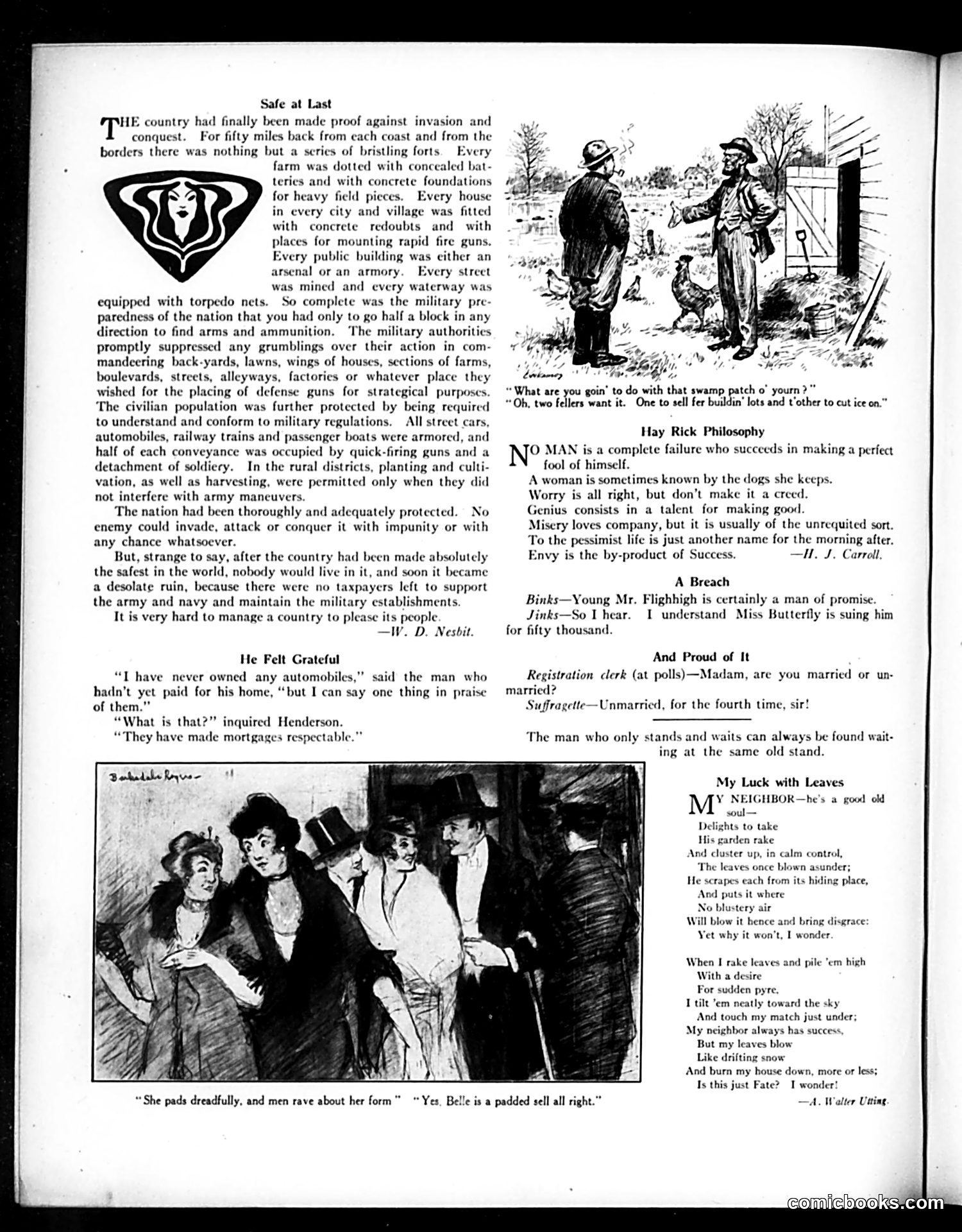
What you’re looking at
This page contains **anti-militarism satire** criticizing excessive military buildup and preparedness. The lead story describes a nation fortifying every inch of territory—farms, homes, streets, waterways—with guns, forts, and defenses. The satire's point: this obsessive militarization succeeds perfectly at protection but *destroys the nation anyway* because taxpayers flee, leaving no one to fund or inhabit the fortified country. It becomes "a desolate ruin." This likely reflects early 20th-century American anxiety about **military expansion and war preparation**, possibly referencing pre-World War I debates about standing armies and fortifications. The message critiques the paradox: military "safety" can paradoxically make life unlivable. The page's other items are lighter satirical quips about automobiles, marriage, and suffragettes, typical of Judge's miscellaneous humor content.
📄 Transcribed text from this page (OCR, searchable)
Machine-transcribed from the original scan — historical spelling and the odd misread are preserved.
Safe at Last HE country had finally been made proof against invasion and conquest. For fifty miles back from each coast and from the borders there was nothing but a scries of bristling forts. Every farm was dotted with concealed bat- terics and with concrete foundations for heavy field pieces. Every house in every city and village was fitted with concrete redoubts and with places for mounting rapid fire guns. Every public building was either an arsenal or an armory. Every street was mined and every waterway was equipped with torpedo nets. So complete was the military pre- paredness of the nation that you had only to go half a block in any direction to find arms and ammunition. ‘The military authorities promptly suppressed any grumblings over their action in com- mandeering back-yards, ings of houses, sections of farms, boulevards, streets, alley’ . factories or whatever place they wished for the placing of defense guns for strategical purposes. The civilian population was further protected by being required to understand and conform to military regulations. All street cars, automobiles, railway trains and passenger boats were armored, and half of each conveyance was occupied by quick-firing guns and a detachment of soldiery. In the rural districts, planting and culti- vation, as well as harvesting, were permitted only when they did not interfere with army maneuvers. The nation had been thoroughly and adequately protected. No enemy could invade, attack or conquer it with impunity or with any chance whatsoever. But, strange to say, after the country had been made absolutely the safest in the world, nobody would live in it, and soon it became a desolate ruin, because there were no taxpayers left to support the army and navy and maintain the military establishments. It is very hard to manage a country to please its people. —W. D. Nesbit. He Felt Grateful “LT have never owned any automobile said the man who hadn't yet paid for his home, “but I can say one thing in praise of them.” “What is that?” inquired Henderson. “They have made mortgages respectable.” “She pads dreadfully, and men rave about her form” “Yes, Belle is a padded sell all right.” —A. “What are you goin’ to do with that swamp patch o' yourn ?” * Oh, two fellers want it. One to sell fer buildin’ lots and t’other to cut ice on.” Hay Rick Philosophy ‘O MAN is a complete failure who succeeds in making a perfect fool of himself. A woman is sometimes known by the dogs she keeps. Worry is all right, but don’t make it a creed. Genius consists in a talent for making good. Misery loves company, but it is usually of the unrequited sort. To the pessimist life is just another name for the morning after. Envy is the by-product of Success. —H. J. Carroll. A Breach Binks—Young Mr. Flighhigh is certainly a man of promise. Jinks—So I hear. I understand Miss Butterfly is suing him for fifty thousand. And Proud of It Registration clerk (at polls)—Madam, are you married or un- married? Suffragette—Unmarried, for the fourth time, sir! ‘The man who only stands and waits can always be found wait- ing at the same old stand. My Luck with Leaves Y NEIGHBOR—he’s a good old soul— Delights to take His garden rake And cluster up, in calm control, The leaves once blown asunder; He scrapes each from its hiding place, And puts it where No blustery air Will blow it hence and bring disgrace: Yet why it won't, L wonder. When I rake leaves and pile ‘em high With a desire For sudden pyre. I tilt ‘em neatly toward the sky And touch my match just under; My neighbor always has success But my leaves blow Like drifting snow And burn my house down, more or less; Is this just Fate? I wonder! Walter U