
Judge, 1915-11-06 · page 22 of 28
Judge — November 6, 1915 — page 22: what you’re looking at
What you’re looking at
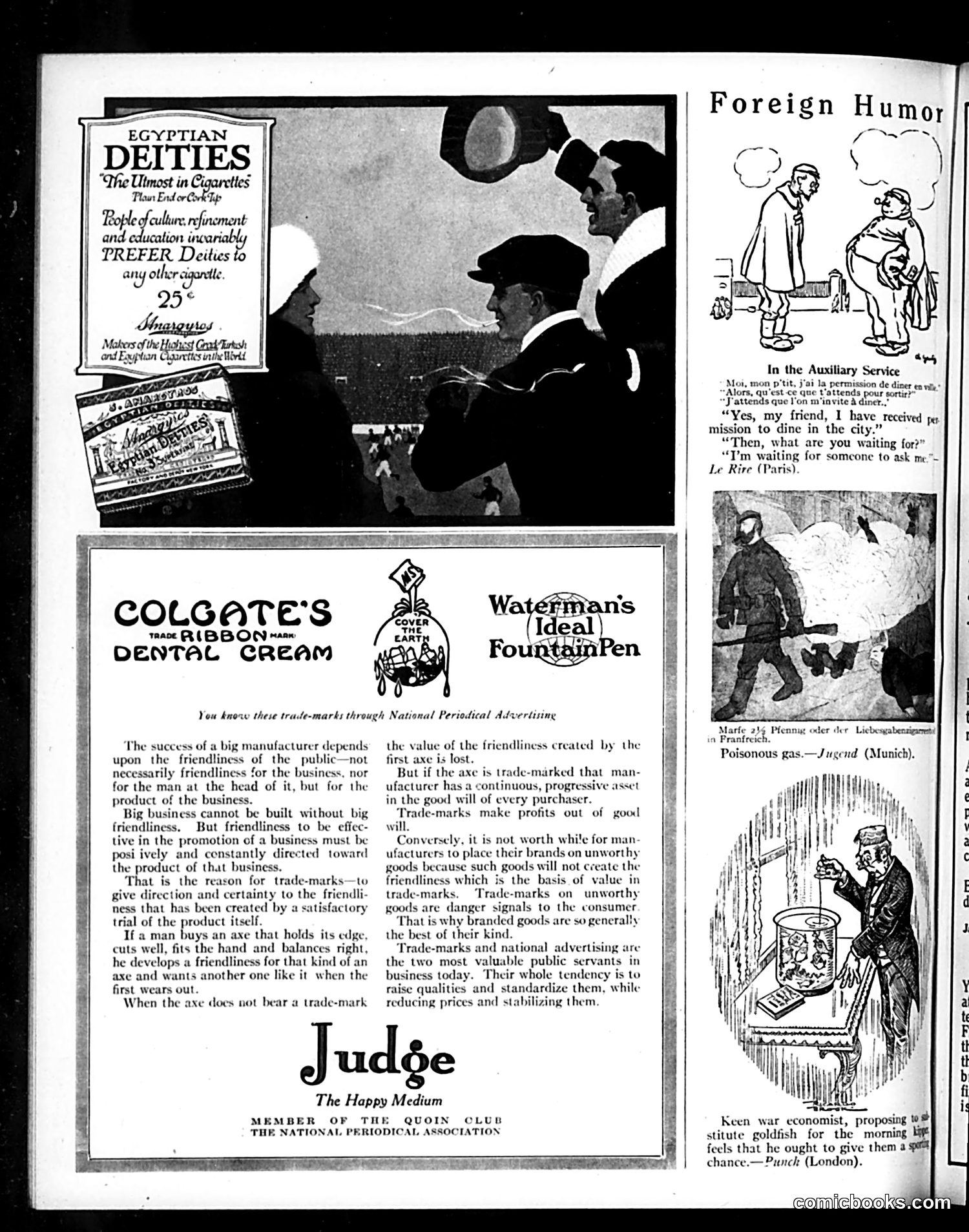
This page is primarily **advertising and editorial content** rather than political satire. The top features ads for **Egyptian Deities cigarettes** and **Colgate's Ribbon Dental Cream**, followed by a lengthy essay on trademarks and brand loyalty—arguing that manufacturer success depends on building consumer "friendliness" through reliable branded products. The right side contains **"Foreign Humor"**—reprinted jokes from European satirical magazines. Two are visible: 1. A French piece (*Le Rire*) about military auxiliary service, where a soldier waits for an invitation to dine in the city rather than accepting permission to go. 2. A British piece (*Punch*) about wartime economy, where someone proposes substituting goldfish for morning eggs—an apparent rationing jest. These translated jokes require no specific political context beyond understanding WWI-era austerity measures. The page demonstrates how American magazines recycled European humor for domestic audiences, with minimal editorial commentary.
📄 Transcribed text from this page (OCR, searchable)
Machine-transcribed from the original scan — historical spelling and the odd misread are preserved.
=—— EG YP TIAN | DEITIES “The Utmost in Cigarettes Plas Eniter Cok py | Bople culture, refincment and education incariabl, PREFER Deities to any other ciganatte COLGATE'S tare RIBBON see DENTAL CREAM You know these trade-marks through National Periodical Advertising The success of a big manufacturer depends upon the friendliness of the public—not friendliness for the business, nor nat the head of it, but for the of the business. ness cannot be built without big friendliness. But friendliness to be effec- tive in the promotion of a business must be si ively and constantly directed toward the product of that business. That is the reason for trade-marks—to ection and certainty to the friendli- that has been created by a satisfactory trial of the product itself. If a man buys an axe that holds its edge, cuts well, fits the hand and balances right, he develops a friendliness for that kind of an axe and wants another one like it_ when the first wears out. When the axe does not bear a trade-mark the value of the friendliness created by the first axe is lost. But if the axe is trade-marked that man- ufacturer has a continuous, progressive asset in the good will of every purchaser. Trade-marks make profits out of good will. Conversely, it is not worth while for man ufacturers to place their brands on unworthy goods beca LUSe such goods will not create the which is the basis of value in -marks on unworthy ‘That is why branded goods are so generally the best of their kind. ‘Trade-mark: d national advertising are the two most va s i business today. Their whole tendency is to i and standardize them, while reducing prices and stabilizing them J udée The Happy Medium MEMBER OF THE QUOIN CLUB THE NATIONAL PERIODICAL ASSOCIATION 2 RTT ORL I I" In the Auxiliary Service n p'tit, j'ai la permission de diner rest-ce que t'attends pour sort? “fiattiadls queton m'iavite hddoer.* “Yes, my friend, 1 have received per mission’ to dine in the city.” “Then, what are you waiting for?” “Tm waiting for someone to ask me.”- Le Rire (Paris). stitute © gold h for the morning feels that he ought to give them a $0 chance.— Punch (London). sp oct cians a