
Judge, 1915-11-06 · page 5 of 28
Judge — November 6, 1915 — page 5: what you’re looking at
What you’re looking at
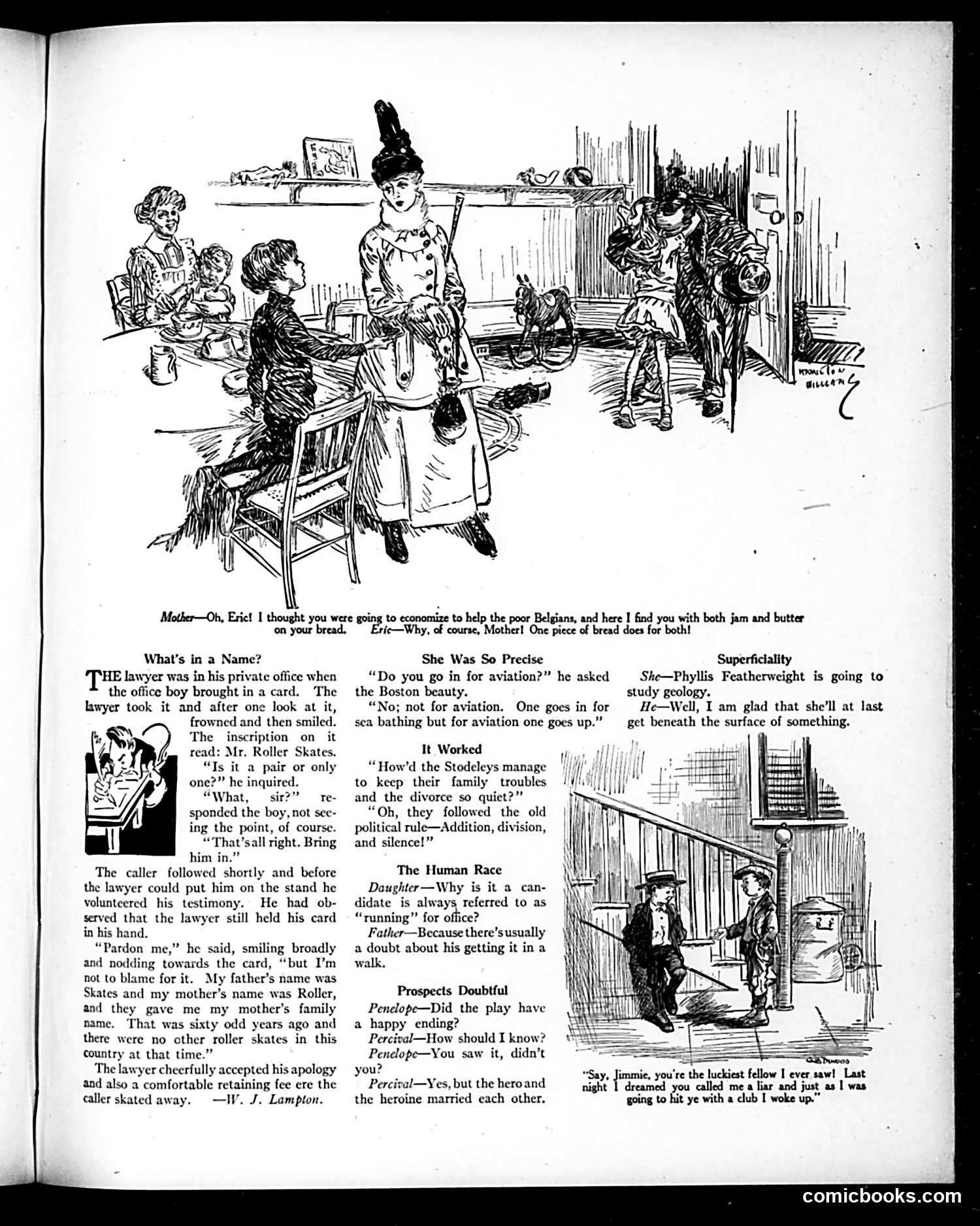
This page contains several brief humorous anecdotes typical of early 20th-century satirical magazines. The top illustration depicts a domestic scene where a woman (labeled "Mother") is caught with jam and butter on bread meant for poor Belgians—likely referencing WWI Belgian relief efforts. The joke satirizes hypocrisy: charitable intentions undermined by personal indulgence. The lower section contains joke columns with titles like "What's in a Name?" and "She Was So Precise." These are light social humor pieces about naming conventions, aviation terminology, and marital disputes—representative of Judge's mix of domestic and topical comedy. The illustration of two men on stairs appears unrelated to visible text, suggesting it accompanies an anecdote not fully captured in the OCR. Overall, the page reflects early 20th-century American middle-class humor and social commentary.
📄 Transcribed text from this page (OCR, searchable)
Machine-transcribed from the original scan — historical spelling and the odd misread are preserved.
Mother—Oh, Eric! 1 thought you were going to economize to help the oor Belgians, and here | find you with both jam and butter on your bread. ic—Why, of course, Mother! One piece of bread does for both! She Was So Precise “Do you go in for aviation?” he asked the Boston beauty. “No; not for aviation. One goes in for sea bathing but for aviation one goes up.” What’s in a Name? THE lawyer was in his private office when the office boy brought in a card. The lawyer took it and after one look at it, frowned and then smiled. Superficiality She—Phyllis Featherweight is going to study geology. He—Well, I am glad that she’ll at last get beneath the surface of something. The inscription on it read: Mr. Roller Skates. “Ts it a pair or only one?” he inquired. “What, sir?” —re- sponded the boy, not see- ing the point, of course. “That’sall right. Bring him in.” The caller followed shortly and before the lawyer could put him on the stand he volunteered his testimony. He had ob- served that the lawyer still held his card in his hand. “Pardon me,” he said, smiling broadly and nodding towards the card, “but I’m not to blame for it. My father’s name was Skates and my mother’s name was Roller, and they gave me my mother’s family name. That was sixty odd years ago and there were no other roller skates in this country at that time.” The lawyer cheerfully accepted his apology and also a comfortable retaining fee ere the caller skated away. —IV. J. Lampton. It Worked “How'd the Stodeleys manage to keep their family troubles and the divorce so quiet?” “Oh, they followed the old political rule—Addition, division, and silence!” The Human Race Daughter—Why is it a can- didate is always referred to as “running” for office? Father—Because there’s usually a doubt about his getting it in a walk, Prospects Doubtful Penelope—Did the play have a happy ending? Percival—How should I know? Penelope—You saw it, didn’t you? Percival—Yes, but the hero and the heroine married each other. “Say, night i jimmie, you're the luckiest fellow I ever saw! Last dreamed you jed me a liar and just as I was going to hit ye with a club I woke up.” comicbooks.com