
Judge, 1915-11-06 · page 10 of 28
Judge — November 6, 1915 — page 10: what you’re looking at
What you’re looking at
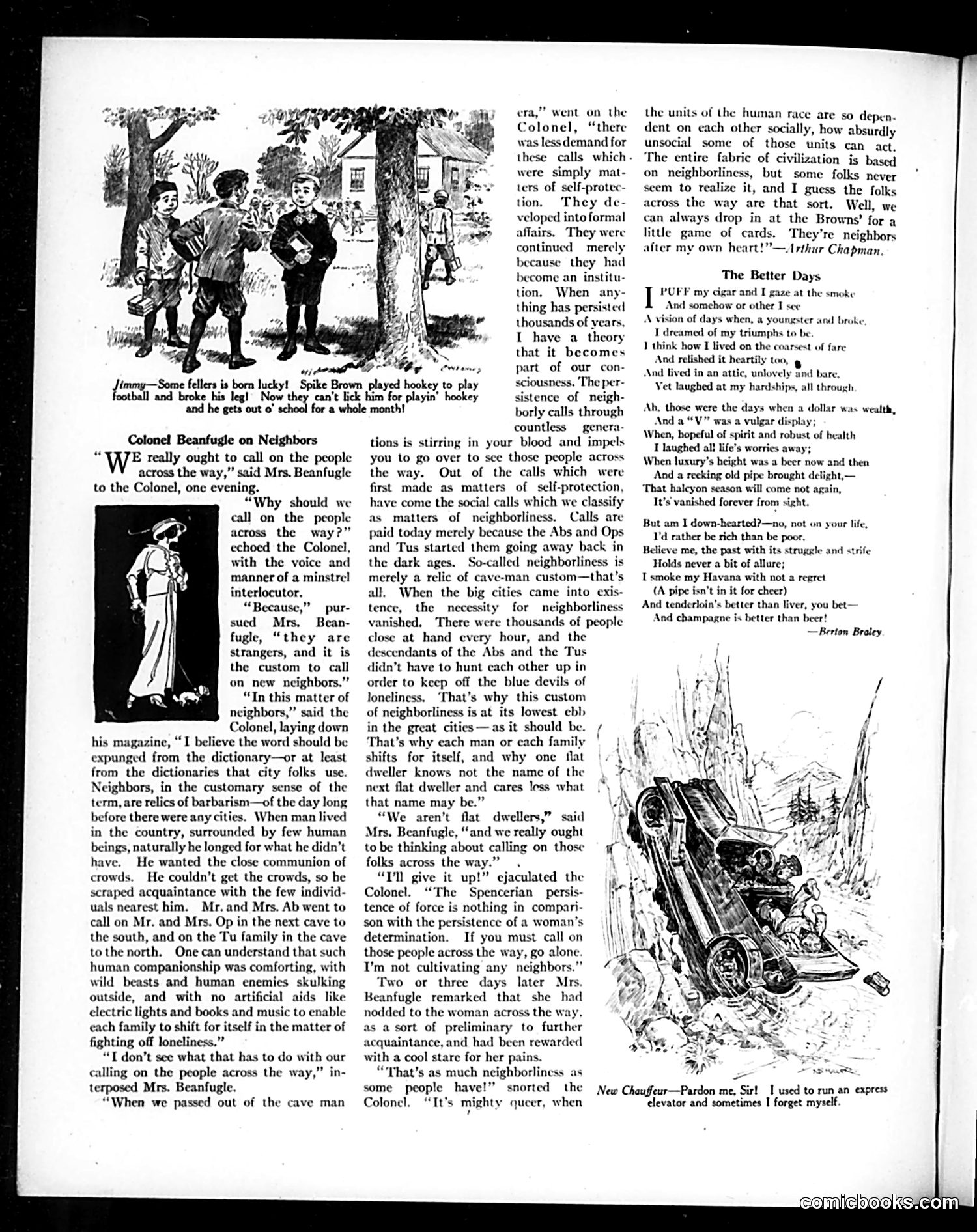
This satirical piece mocks urban social pretension through Colonel Beanfugle's pseudo-intellectual resistance to calling on neighbors. The Colonel delivers a faux-scholarly argument that neighborliness is an outdated "cave-man custom" rendered unnecessary by modern city life, where crowds provide sufficient companionship. He invokes "Spencerian persistence" (likely referencing Herbert Spencer's social Darwinism) to justify his anti-social stance. The satire targets two things: the Colonel's pompous use of evolutionary theory to rationalize rudeness, and the urban trend of social isolation despite—or because of—density. His wife ultimately wins through sheer determination, and the story hints that neighborly courtesy may have merit after all. The cartoon critiques how modern philosophy was weaponized to justify declining civic engagement.
📄 Transcribed text from this page (OCR, searchable)
Machine-transcribed from the original scan — historical spelling and the odd misread are preserved.
[eee Soe fellers is born lucky! Spike Brown oop led tet to play football and broke jis leg! Now they can’t he gets out 0” ph vs fey me ler Colonel Beanfugle on Neighbors bY WE. Teally ought to call on the people across the way,” said Mrs. Beanfugle to the Colonel, one evening. “Why should we call on the people across the way?” echoed the Colonel, with the voice and manner of a minstrel interlocutor. “Because,” pur- sued Mrs. Bean- fugle, “they are strangers, and it is the custom to call on new neighbors.”’ “In this matter of neighbors,” said the Colonel, laying down his magazine, “I believe the word should be expunged from the dictionary—or at least from the dictionaries that city folks use. Neighbors, in the customary sense of the term, are relics of barbarism—of the day long before there were any cities. When man lived in the country, surrounded by few human beings, naturally he longed for what he didn’t ha He wanted the close communion of crowds. He couldn’t get the crowds, so he scraped acquaintance with the few individ- uals nearest him. Mr. and Mrs. Ab went to call on Mr. and Mrs. Op in the next cave to the south, and on the Tu family in the cave tothe north. One can understand that such human companionship was comforting, with wild beasts and human enemies skulking outside, and with no artificial aids like electric lights and books and music to enable each family to shift for itself in the matter of fighting off loneliness.” “T don’t see what that has to do with our calling on the people across the way,” in- terposed Mrs. Beanfugle. “When we passed out of the cave man era,” went on the Colonel, “there was less demand for these were simply mat- ters of self-protec- tion. They de- veloped into formal affairs. They were continued merely because they had become an institu- tion. When any- thing has persisted thousands of years, I have a_ theory that it becomes part of our con- sciousness. The per- sistence of neigh- borly calls through countless genera- tions is stirring in your blood and impels you to go over to sce those people across the way. Out of the calls which were first. made as matters of self-protection, have come the social calls which we classify as matters of neighborliness. Calls are paid today merely because the Abs and Ops and Tus started them going away back in the dark ages. So-called neighborliness is merely a relic of cave-man custom—that’s all. When the big cities came into tence, the necessity for neighborliness vanished. There were thousands of people close at hand every hour, and the descendants of the Abs and the Tus didn’t have to hunt cach other up in order to keep off the blue devils of loneliness. ‘That’s why this custom of neighborliness is at its lowest ebb in the great cities —as it should be. That’s why each man or cach family shifts for itself, and why one flat dweller knows not the name of the next flat dweller and cares less what that name may be.” “We aren’t flat dwellers,” said Mrs. Beanfugle, “and we really ought to be thinking about calling on those folks across the way.” . “T'll give it up!” ejaculated the Colonel. “The Spencerian _persis- tence of force is nothing in compari- son with the persistence of a woman’s determination. If you must call on those people across the way, go alone. I’m not cultivating any neighbors.” Two or three days later Mrs. Beanfugle remarked that she had nodded to the woman across the way, a sort of preliminary to further acquaintance, and had been rewarded with a cool stare for her pains. “That’s as much neighborliness as some 1”? snorted the people have! Colonel. “It's mighty queer, when for playin’ hookey calls which - New Chauffeur—Pardon me, Sir! the units of the human race are so depen- dent on cach other socially, how absurdly unsocial some of those units can act. ‘The entire fabric of civilization is based on neighborliness, but some folks never seem to realize it, and I guess the folks across the way are that sort. Well, we can always drop in at the Browns’ for a litle game of cards. They’re neighbors after my own heart!”—Arthur Chapman, The Better Days PUFF my cigar and I gaze at the smoke And somehow or other I see <\ vision of days when, a youngster and broke I dreamed of my triumphs to be 1 think how I lived on the coarsest of fare And relished it heartily too, g <\nd lived in an attic, unlov Yet laughed at my hards! 1 bare, MH through, Ps, Ah, those were the days w And a “V” was a vulgar When, hopeful of spirit and robust of health I laughed all life’s worries away; When luxury’s height was a beer now and then And a recking old pipe brought delight,— That halcyon season will come not again, It’s vanished forever from sight. But am I down-hearted?—no, not on your life, Vd rather be rich than be poor. Believe me, the past with its struggle and strife Holds never a bit of allure; I smoke my Havana with not a regret (A pipe isn’t in it for cheer) And tenderloin’s better than liver, you bet— And champagne is better than beer! —Berton Braley en a dollar was wealth, | used to run an express elevator and sometimes I forget myself.