
Judge, 1915-11-06 · page 4 of 28
Judge — November 6, 1915 — page 4: what you’re looking at
What you’re looking at
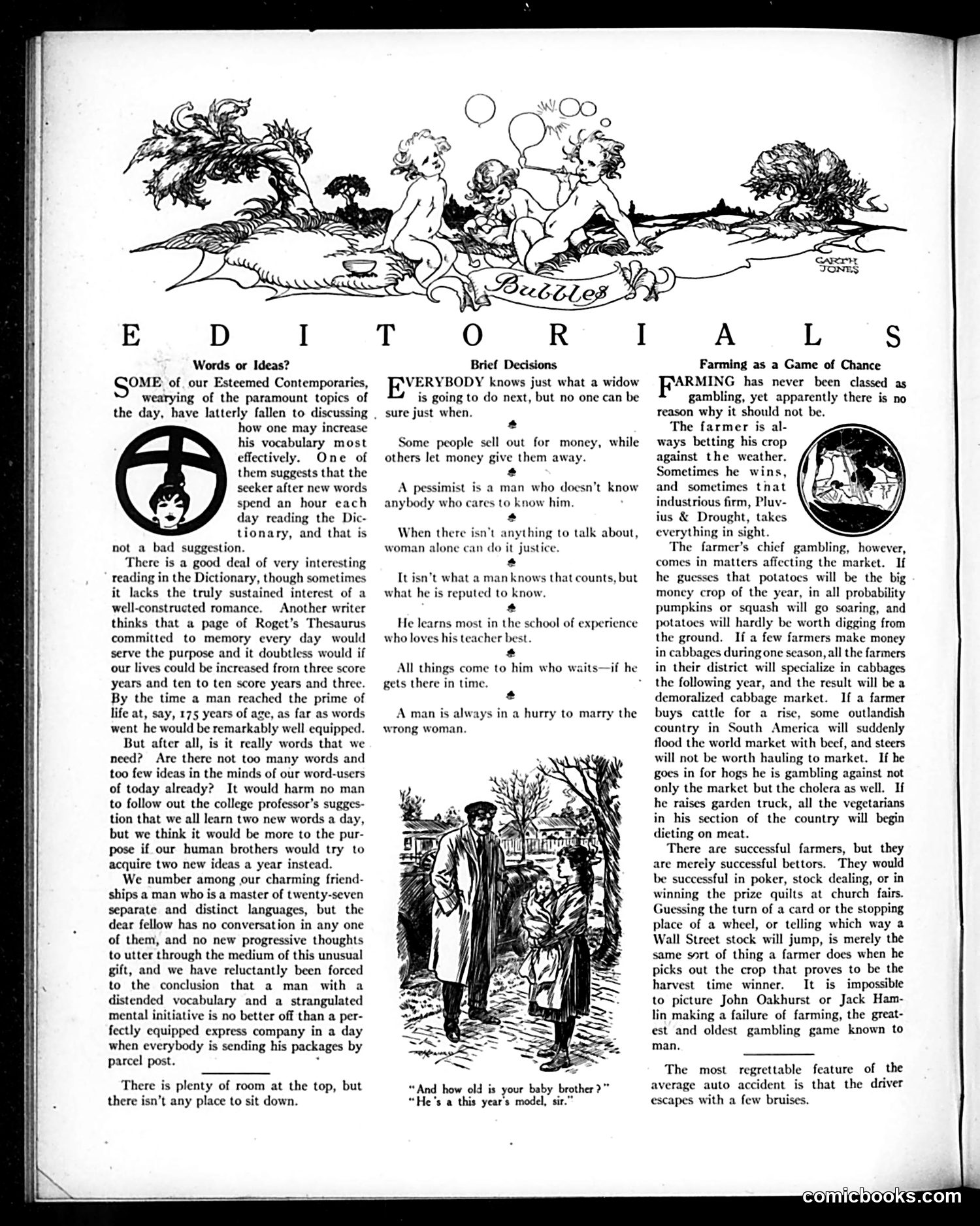
This page contains three distinct editorial pieces from *Judge* magazine. The left column discusses vocabulary expansion and intellectual pursuits. The center section offers brief philosophical observations ("A pessimist is a man who doesn't know anybody who cares to know him"). The right column, titled "Farming as a Game of Chance," satirizes agricultural economics by comparing farming to gambling. The author argues that farming involves uncontrollable variables (weather, market prices) similar to poker or stock speculation, making success largely dependent on luck rather than skill. The accompanying illustration shows a farmer, reinforcing the rural subject matter. The satire critiques how farmers cannot reliably control outcomes despite effort—crop failures, market fluctuations, and disease create unpredictable results indistinguishable from pure chance.
📄 Transcribed text from this page (OCR, searchable)
Machine-transcribed from the original scan — historical spelling and the odd misread are preserved.
SoME of. our Esteemed Contemporaries, wearying of the paramount topics of the day, have latterly fallen to discussing how one may increase his vocabulary most effectively. One of them suggests that the seeker after new words spend an hour each day reading the Dic- tionary, and that is not a bad suggestion. There is a good deal of very interesting reading in the Dictionary, though sometimes it lacks the truly sustained interest of a well-constructed romance. Another writer thinks that a page of Roget’s Thesaurus committed to memory every day would serve the purpose and it doubtless would if our lives could be increased from three score years and ten to ten score years and three. By the time a man reached the prime of life at, say, 175 years of age, as far as words went he would be remarkably well equipped. But after all, is it really words that we need? Are there not too many words and too few ideas in the minds of our word-users of today already? It would harm no man to follow out the college professor’s sugges- tion that we all learn two new words a day, but we think it would be more to the pur- pose if our human brothers would try to acquire two new ideas a year instead. We number among our charming friend- ships a man who is a master of twenty-seven separate and distinct languages, but the dear fellow has no conversation in any one of them, and no new progressive thoughts to utter through the medium of this unusual gift, and we have reluctantly been forced to the conclusion that a man with a distended vocabulary and a strangulated mental initiative is no better off than a per- fectly equipped express company in a day when everybody is sending his packages by parcel post. . There is plenty of room at the top, but there isn’t any place to sit down. EVERYBODY knows just what a widow is going to do next, but no one can be sure just when. Some people sell out for money, while others let money give them away. A pessimist is a man who doesn’t know anybody who cares to know him. 2 When there isn’t anything to talk about, woman alone can do it justice. & It isn’t what a man knows that counts, but what he is reputed to know. 2 He learns most in the school of experience who loves his teacher best. # All things come to him who waits—if he gets there in time. A man is always in a hurry to marry the wrong woman. “And how old is your baby brother?” “He's a this year's model, sir.” S) Farming as a Game of Chance ‘ARMING has never been classed as gambling, yet apparently there is no reason why it should not be. The farmer is al- ways betting his crop against the weather. Sometimes he wins, and sometimes that industrious firm, Pluv- ius & Drought, takes everything in sight. The farmer’s chief gambling, however, comes in matters affecting the market. If he guesses that potatoes will be the big rop of the year, in all probability s or squash will go soaring, and potatoes will hardly be worth digging from the ground. If a few farmers make money in cabbages during one season, all the farmers in their district will specialize in cabbages the following year, and the result will be a demoralized cabbage market. If a farmer buys cattle for a rise, some outlandish country in South America will suddenly flood the world market with beef, and steers will not be worth hauling to market. If he goes in for hogs he is gambling against not only the market but the cholera as well. If he raises garden truck, all the vegetarians in his section of the country will begin dieting on meat. There are successful farmers, but they are merely successful bettors. They would be successful in poker, stock dealing, or in winning the prize quilts at church fairs. Guessing the turn of a card or the stopping place of a wheel, or telling which way a Wall Street stock will jump, is merely the same sort of thing a farmer does when he picks out the crop that proves to be the harvest time winner. It is impossible to picture John Oakhurst or Jack Ham- lin making a failure of farming, the great- est and oldest gambling game known to man. The most regrettable feature of the average auto accident is that the driver escapes with a few bruises.