
Judge, 1915-11-06 · page 18 of 28
Judge — November 6, 1915 — page 18: what you’re looking at
What you’re looking at
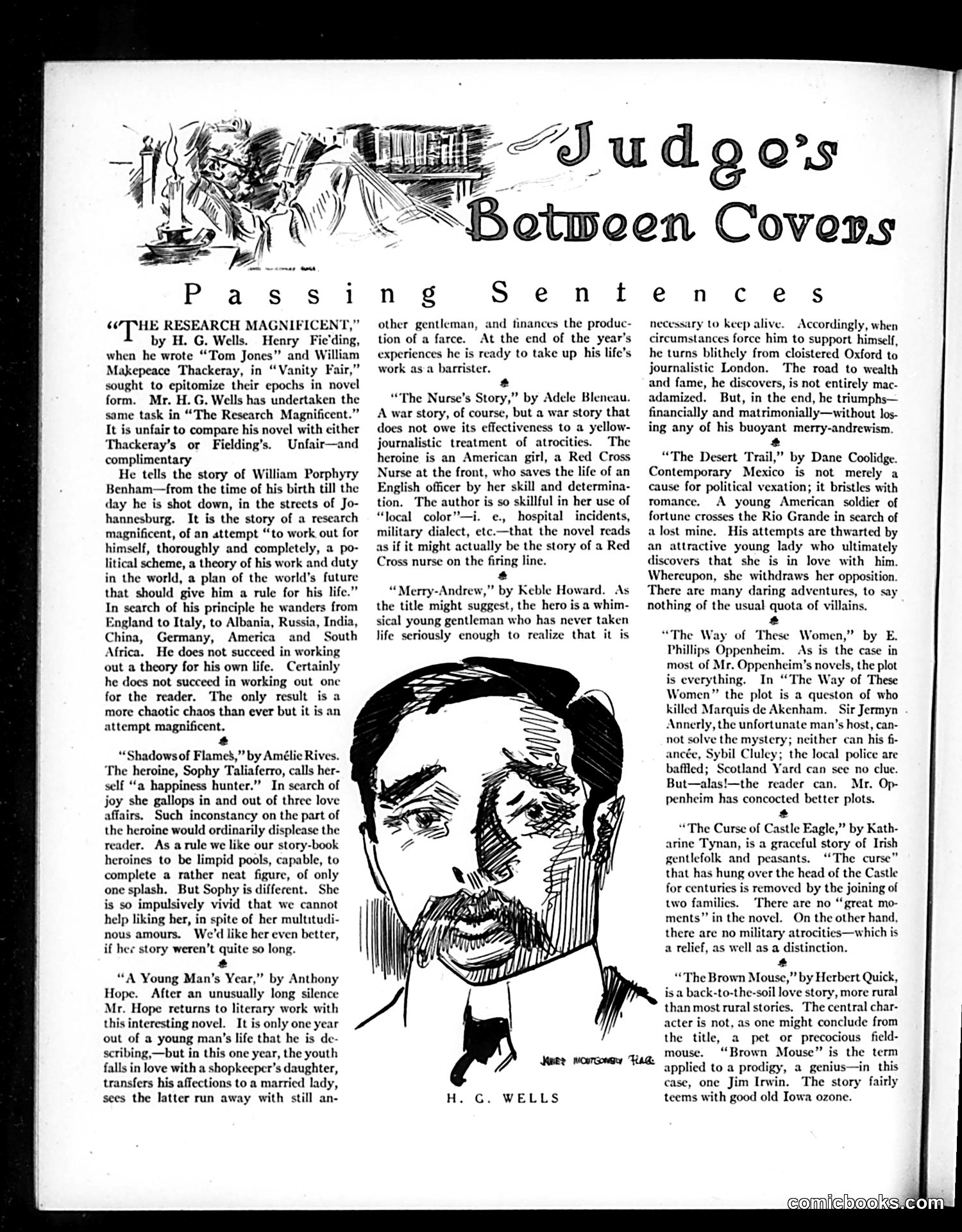
This page presents literary reviews from *Judge*, an American satirical magazine. The central illustration is a portrait sketch of **H.G. Wells**, whose novel *The Research Magnificent* receives the lead review. The reviews themselves are straightforward literary criticism rather than satire—evaluating contemporary fiction by Wells, Amélie Rives, Anthony Hope, Adele Bleneau, Keble Howard, Dane Coolidge, E. Phillips Oppenheim, and Katharine Tynan. The critics assess plots, character development, and writing quality with measured commentary. The satire lies in the *framing*: Judge positions serious literary discussion alongside commercial book reviews, implying gentle mockery of both pretentious literary ambition and popular fiction conventions. References to Wells's wandering protagonist seeking life's meaning, or to the heroine who cannot maintain romantic focus, subtly ridicule philosophical pretension and romantic melodrama respectively. This represents Judge's characteristic blend of cultural criticism with entertainment—treating literature as a subject worthy of satirical attention.
📄 Transcribed text from this page (OCR, searchable)
Machine-transcribed from the original scan — historical spelling and the odd misread are preserved.
s s i 6¢7 THE RESEARCH MAGNIFICENT,” by H. G. Wells. Henry Fie'ding, when he wrote “Tom Jones” and William Makepeace Thackeray, in “Vanity Fair,” sought to epitomize their epochs in novel form. Mr. H. G. Wells has undertaken the same task in “The Research Magnificent.” It is unfair to compare his novel with either Thackeray’s or Fielding’s. Unfair—and complimentary He tells the story of William Porphyry Benham—from the time of his birth till the day he is shot down, in the strects of Jo- hannesburg. It is the story of a research magnificent, of an attempt “to work out for himself, thoroughly and completely, a po- litical scheme, a theory of his work and duty in the world, a plan of the world’s future that should give him a rule for his life.” In search of his principle he wanders from England to Italy, to Albania, Russia, India, China, Germany, America and South Africa. He does not succeed in working out a theory for his own life. Certainly he does not succeed in working out one for the reader. The only result is a more chaotic chaos than ever but it is an attempt magnificent. # “Shadows of Flame$,” by Amélie Rives. The heroine, Sophy Taliaferro, calls her- self ‘a happiness hunter.” In search of joy she gallops in and out of three love affairs. Such inconstancy on the part of the heroine would ordinarily displease the reader. As a rule we like our story-book heroines to be limpid pools, capable, to complete a rather neat figure, of only one splash. But Sophy is different. She is so impulsively vivid that we cannot help liking her, in spite of her multitudi- nous amours. We'd like her even better, if hee story weren’t quite so long. 2 “A Young Man's Year,” by Anthony Hope. After an unusually long silence Mr. Hope returns to literary work with this interesting novel. It is only one year out of a young man’s life that he is de- scribing,—but in this one year, the youth falls in love with a shopkeeper’s daughter, transfers his affections to a married lady, sees the latter run away with still an- n g Sent other gentleman, and finances the produc- tion of a farce. At the end of the year’s experiences he is ready to take up his life’s work as a barrister. 2 “The Nurse’s Story,” by Adele Bleneau. A war story, of course, but a war story that does not owe its effectiveness to a yellow- journalistic treatment of atrocities. The heroine is an American girl, a Red Cross Nurse at the front, who saves the life of an English officer by her skill and determina- tion. The author is so skillful in her use of “local color’—i. ¢., hospital incidents, military dialect, etc.—that the novel reads as if it might actually be the story of a Red Cross nurse on the firing line. e “ Merry-Andrew,” by Keble Howard. As the title might suggest, the hero is a whim- sical young gentleman who has never taken life seriously enough to realize that it is —Judgo's “Between Covers e nceé$§ necessary to keep alive. Accordingly, when circumstances force him to support himself, he turns blithely from cloistered Oxford to journalistic London. The road to wealth and fame, he discove: not entirely mac- adamized. But, in t nd, he triumphs— financially and matrimonially—without los- ing any of his buoyant merry-andrewism, 2 “The Desert Trail,” by Dane Coolidge. Contemporary Mexico is not merely a cause for political vexation; it bristles with romance. A young American soldier of fortune crosses the Rio Grande in search of a lost mine. His attempts are thwarted by an attractive young lady who ultimately discovers that she is in love with him. Whereupon, she withdraws her opposition. There are many daring adventures, to say nothing of the usual quota of villains. 2 “The Way of These Women,” by E. Phillips Oppenheim. As is the case in most of Mr. Oppenheim’s novels, the plot i rything. In “The Way of These Women” the plot is a queston of who killed Marquis de Akenham. Sir Jermyn Annerly, the unfortunate man’s host, can- not solve the mystery; neither can his fi- ybil Cluley; the local police are baffled; Scotland Yard can see no clue. But—alas!—the reader can. Mr. Op- penhcim has concocted better plots. 2 “The Curse of Castle Eagle,” by Kath- arine Tynan, is a graceful story of Irish gentlefolk and peasants. ‘The curse” that has hung over the head of the Castle for centuries is removed by the joining of two familics. ‘There are no “great mo- ments” in the novel. On the other hand, there are no military atrocities—which is a relief, as well as a distinction. # “The Brown Mouse,” by Herbert Quick, is a back-to-the-soil love story, more rural than most rural stories. The central char- acter is not, as one might conclude from the title, a pet or precocious field- . mouse. “Brown Mouse” is the term applied to a prodigy, a genius—in_ this case, one Jim Irwin. The story fairly teems with good old Iowa ozone.