
A complete issue · 28 pages · 1915
Judge — August 14, 1915
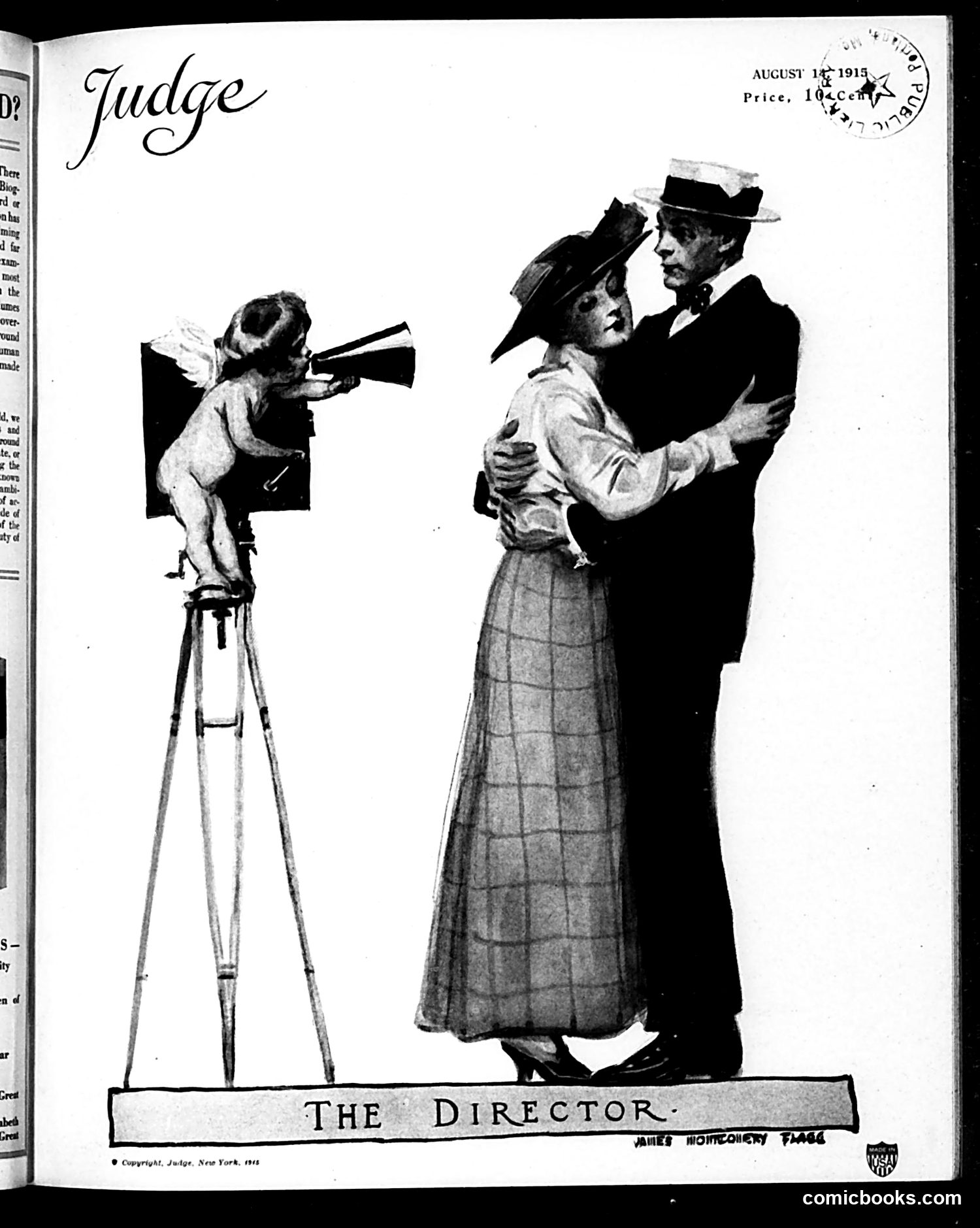
This cartoon satirizes film director James Montgomery Flagg through visual pun. On the left, a cherub (Cupid) operates a movie camera on a tripod, aiming at a couple on the right—a man and woman in romantic embrace. The title "The Director" plays on the double meaning: Flagg was an actual film director, but the joke suggests that *Cupid* (the mythological "director" of love and romance) is the true director of romantic scenes. The satire likely mocks either Flagg's directorial style or the artificial, staged nature of romantic scenes in early cinema. The composition humorously positions divine intervention as literally "directing" human romance, reducing genuine emotion to mere theatrical performance. This reflects early 20th-century skepticism about cinema's authenticity.
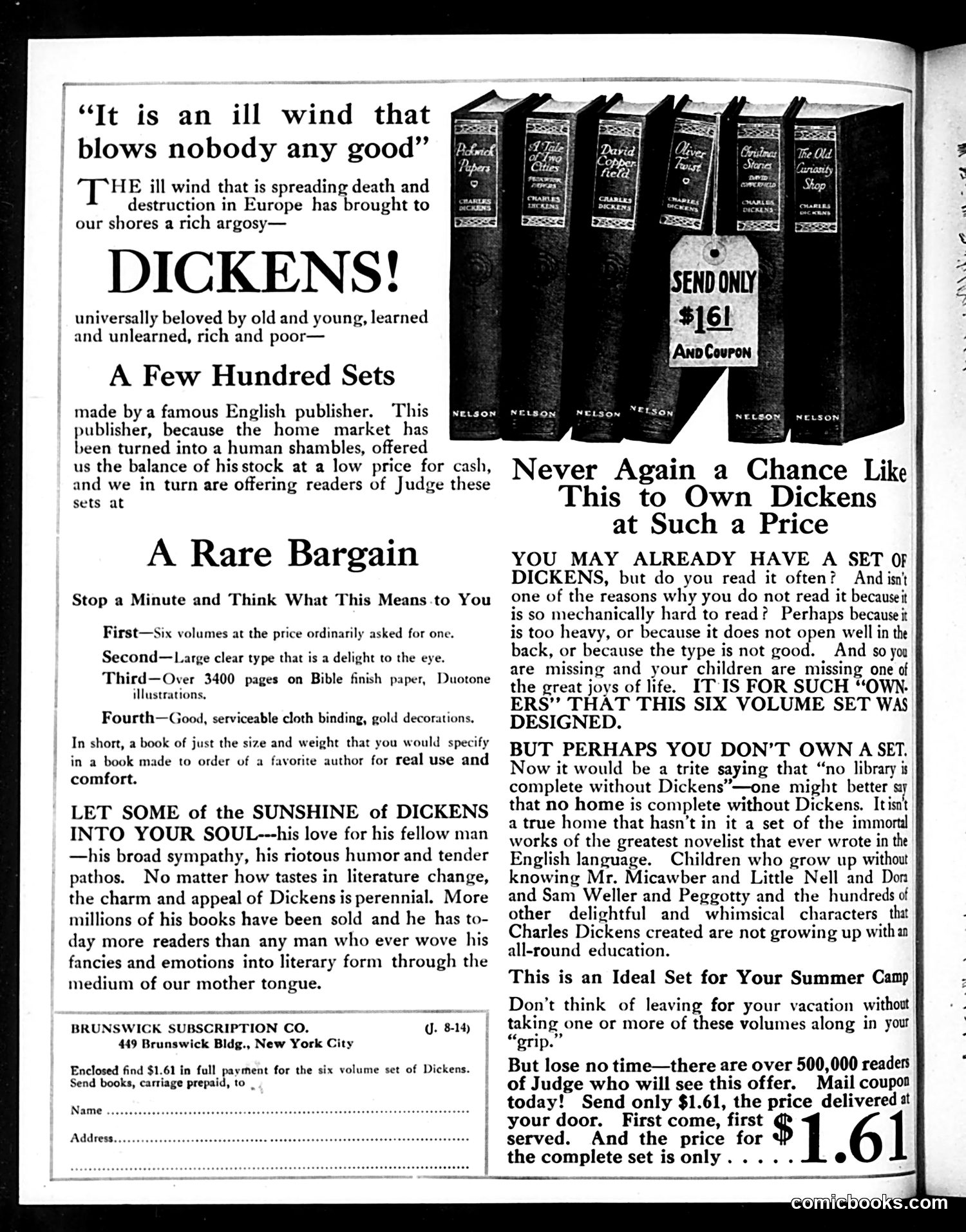
This page is primarily a **commercial advertisement**, not a political cartoon. It's a direct-mail marketing piece from the Brunswick Subscription Company selling a six-volume set of Charles Dickens novels. The ad opens with the phrase "It is an ill wind that blows nobody any good," referencing **World War I in Europe** ("the ill wind that is spreading death and destruction in Europe"). The pitch argues that while the war devastates Europe, it has created an opportunity: a famous English publisher is liquidating stock at bargain prices, allowing Americans to purchase a complete Dickens set for just $1.61. The advertisement emphasizes the set's quality (clear type, good binding, 3,400 pages) and appeals to middle-class readers by suggesting Dickens provides moral education for children and is essential for any complete home library.
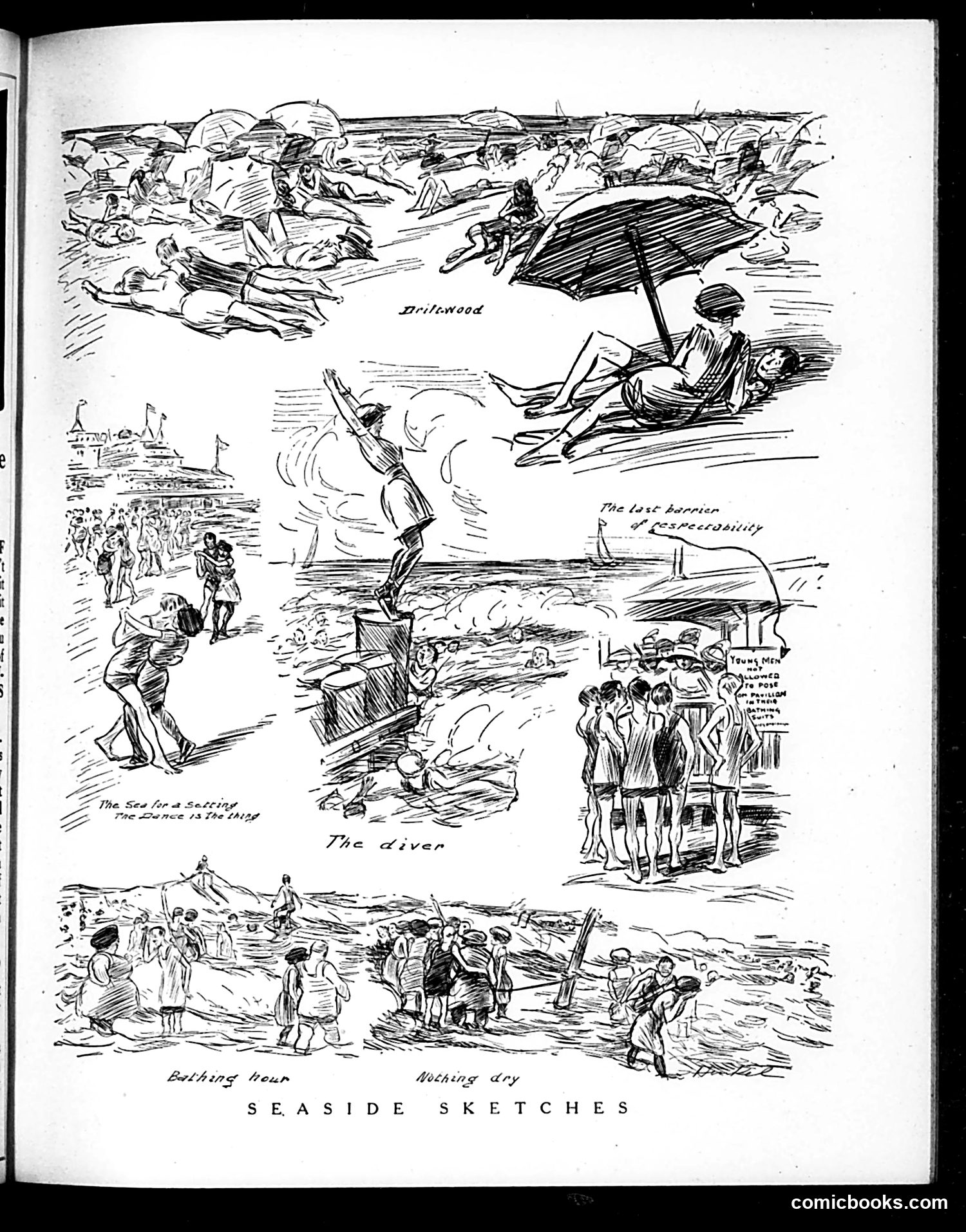
This page from *Judge* magazine presents humorous vignettes of British seaside resort life, labeled "Seaside Sketches." The sketches depict various beach activities and social situations: - **"Driftwood"** shows crowded beach conditions - **"The Sea is a Soothing Place is the Thing"** depicts swimming - **"The diver"** shows diving activities - **"The lost bargain of respectability"** appears to satirize social pretension - **"Bathing Hour" and "Nothing dry"** illustrate typical beach scenes The humor targets Victorian-era British beach culture—the formality of dress, social hierarchies maintained even at leisure, and the gap between genteel expectations and seaside reality. The sketches mock both the pretensions of middle-class beachgoers and the actual chaos and undignified nature of seaside bathing during this period.
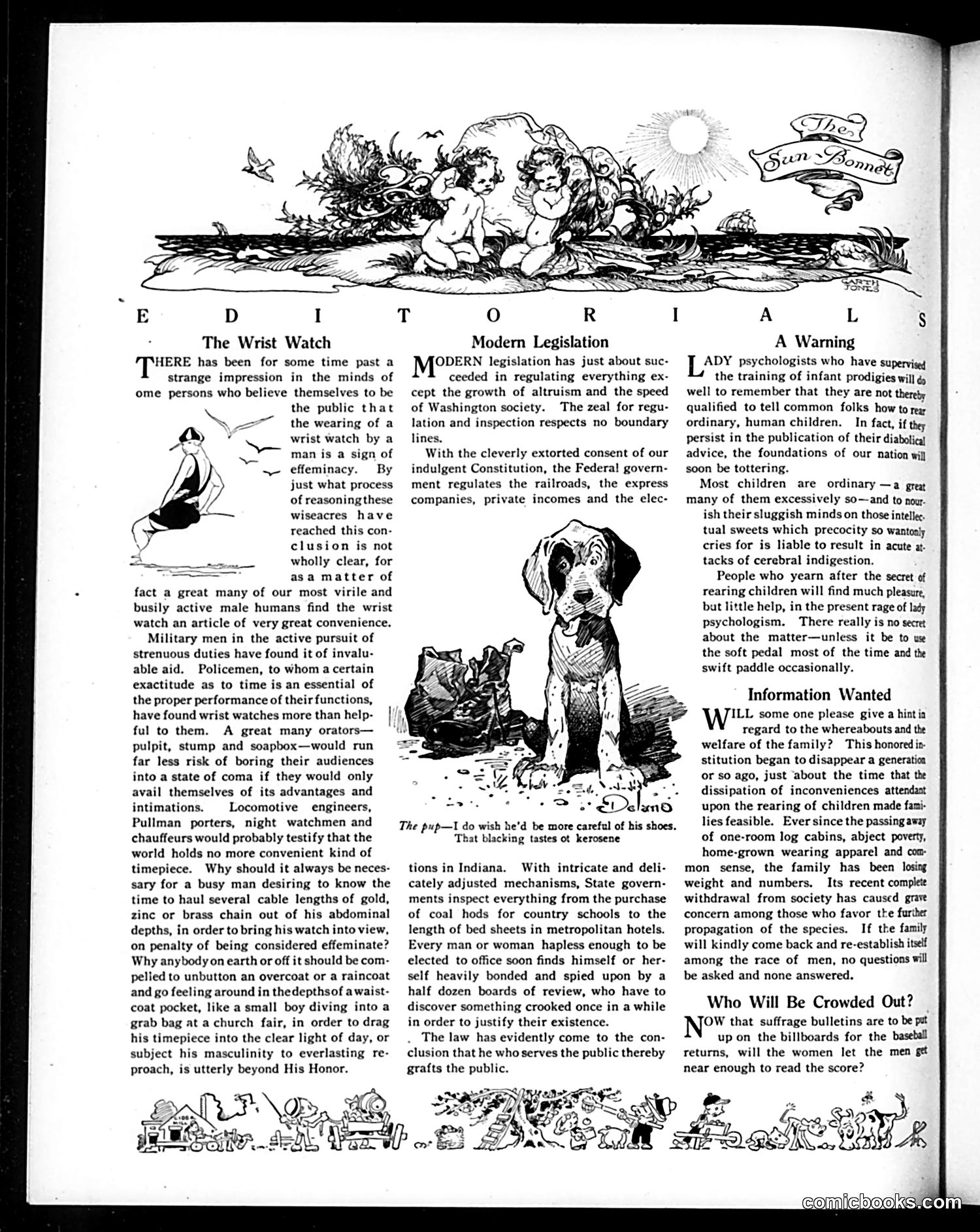
This page contains three separate satirical pieces: **"The Wrist Watch"** mocks the notion that wearing a wrist watch signals efficiency—a relatively new fashion at the time. The satire suggests this is pretentious affectation; military men, policemen, and railroad workers actually find them useful, but fashionable men adopt them merely for appearance. **"Modern Legislation"** criticizes federal government overreach in regulating railroads, express companies, and private income through inspection. The satire suggests well-intentioned regulation has become excessive and invasive. **"A Warning"** cautions against psychological child-rearing advice that encourages intellectual development over normal play, arguing such pressure causes digestive problems. **"Who Will Be Crowded Out?"** references suffrage billboard advertising, humorously asking whether women voters will crowd out male attendance at baseball games.
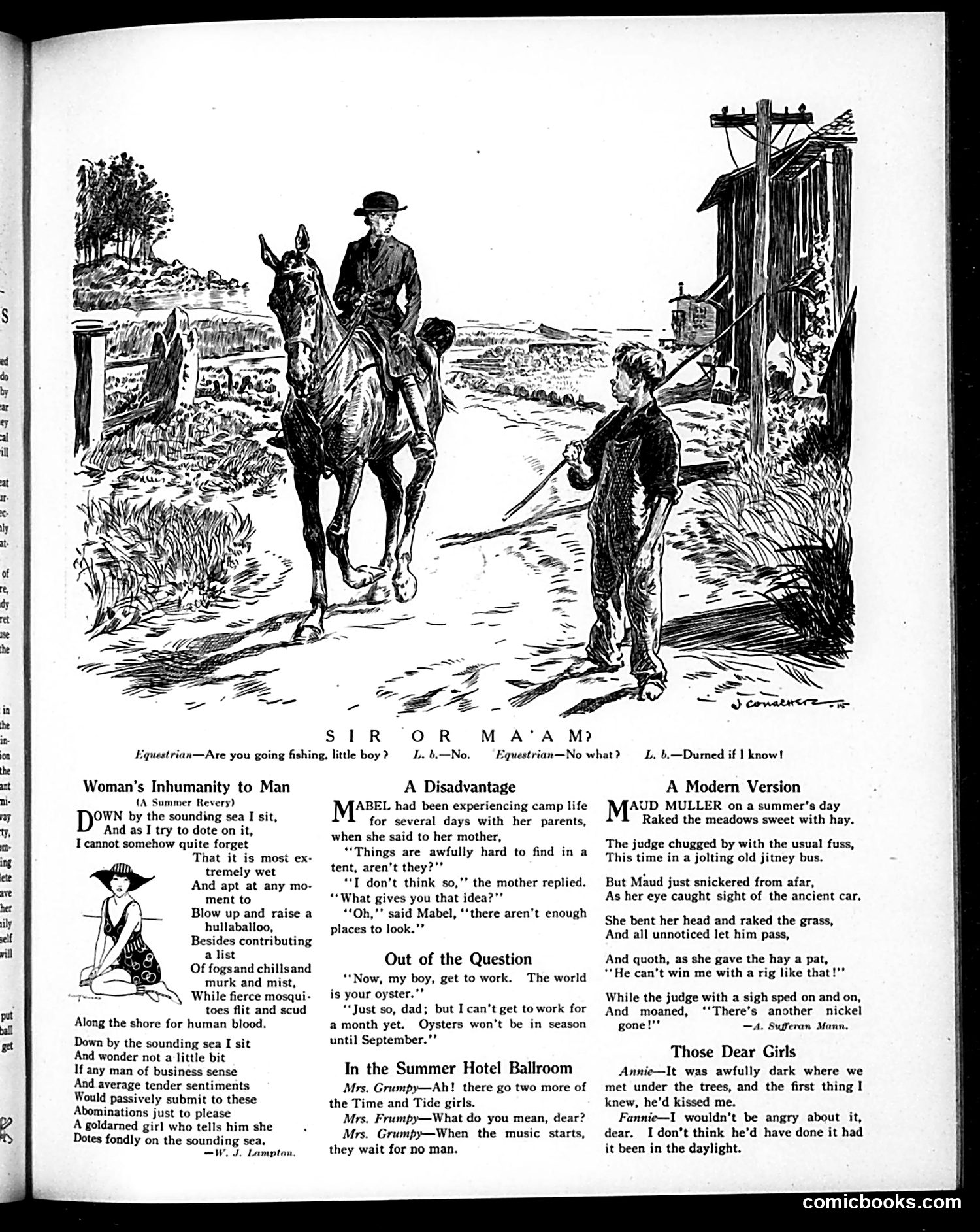
The main cartoon depicts an equestrian encounter with the caption "SIR OR MA'AM?" A woman on horseback meets a young boy on a country road. The joke plays on the figure's ambiguous appearance—the rider's short hair and masculine clothing make the boy uncertain of the person's gender, prompting his confused question. This satirizes the "New Woman" movement of the early 20th century. Women adopting practical clothing (riding habits, short hair) for sports and independence challenged Victorian gender norms. The cartoon mocks this gender ambiguity as socially confusing, reflecting conservative anxieties about changing women's roles. The surrounding text pieces humorously address related social issues about courtship, female independence, and generational conflict—all common satirical targets in Judge during this progressive era.
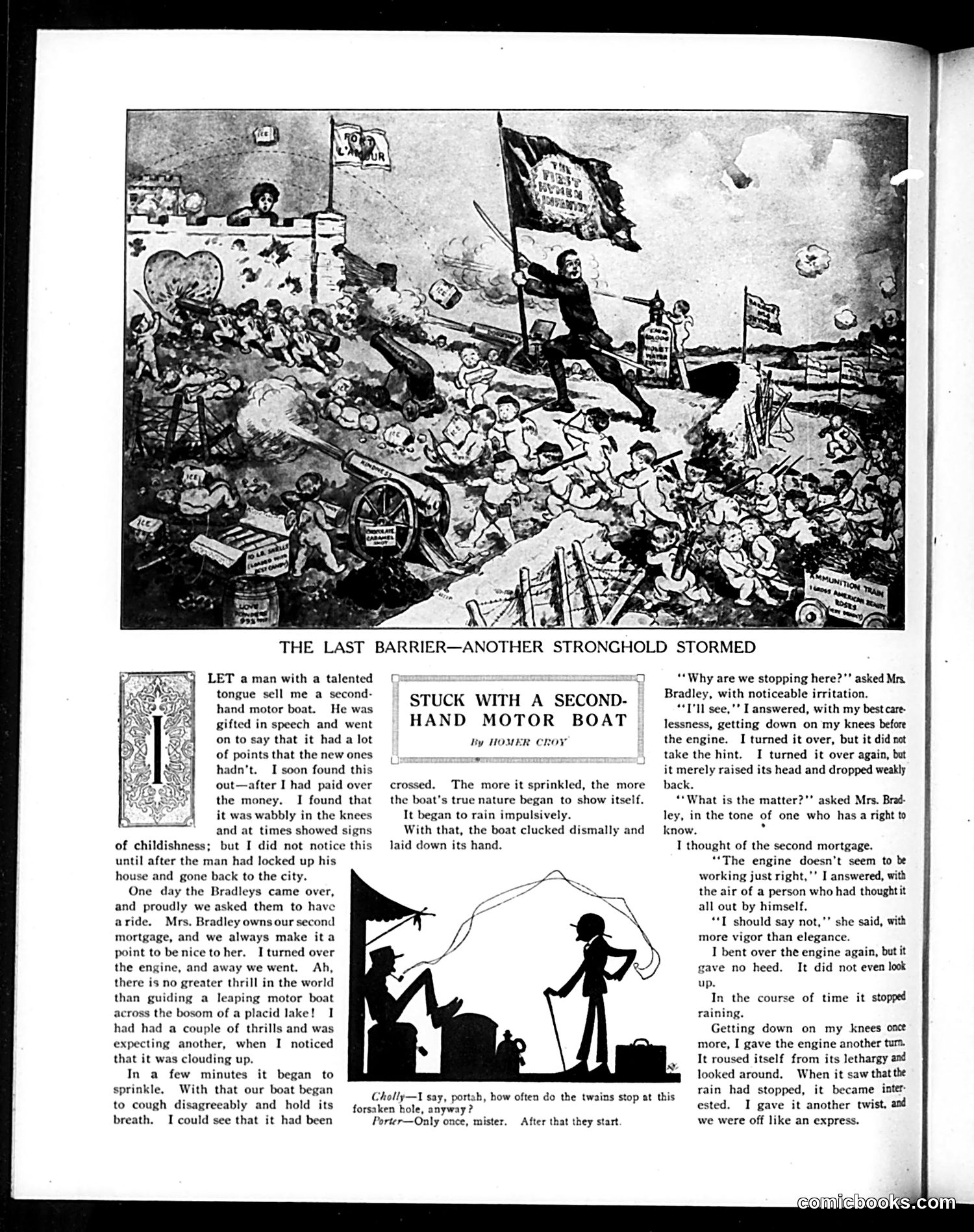
This is a humorous short story satirizing the experience of buying a used motor boat—a consumer complaint that would have resonated with early 20th-century readers newly acquiring mechanical goods. The narrator buys a secondhand boat from a smooth-talking salesman, only to discover it's unreliable and temperamental. When entertaining the Bradleys (who hold his mortgage), the engine fails during rain, creating social embarrassment and financial anxiety. The boat is anthropomorphized as stubborn and moody—it "coughs," "holds its breath," and only cooperates when conditions suit it. The satire targets both gullible consumers and unreliable machinery of the era. The joke hinges on the narrator's powerlessness: he can't fix it, can't impress his creditors, and must literally beg the engine to cooperate. It reflects anxieties about modern technology's unpredictability and the social humiliation of mechanical failure.
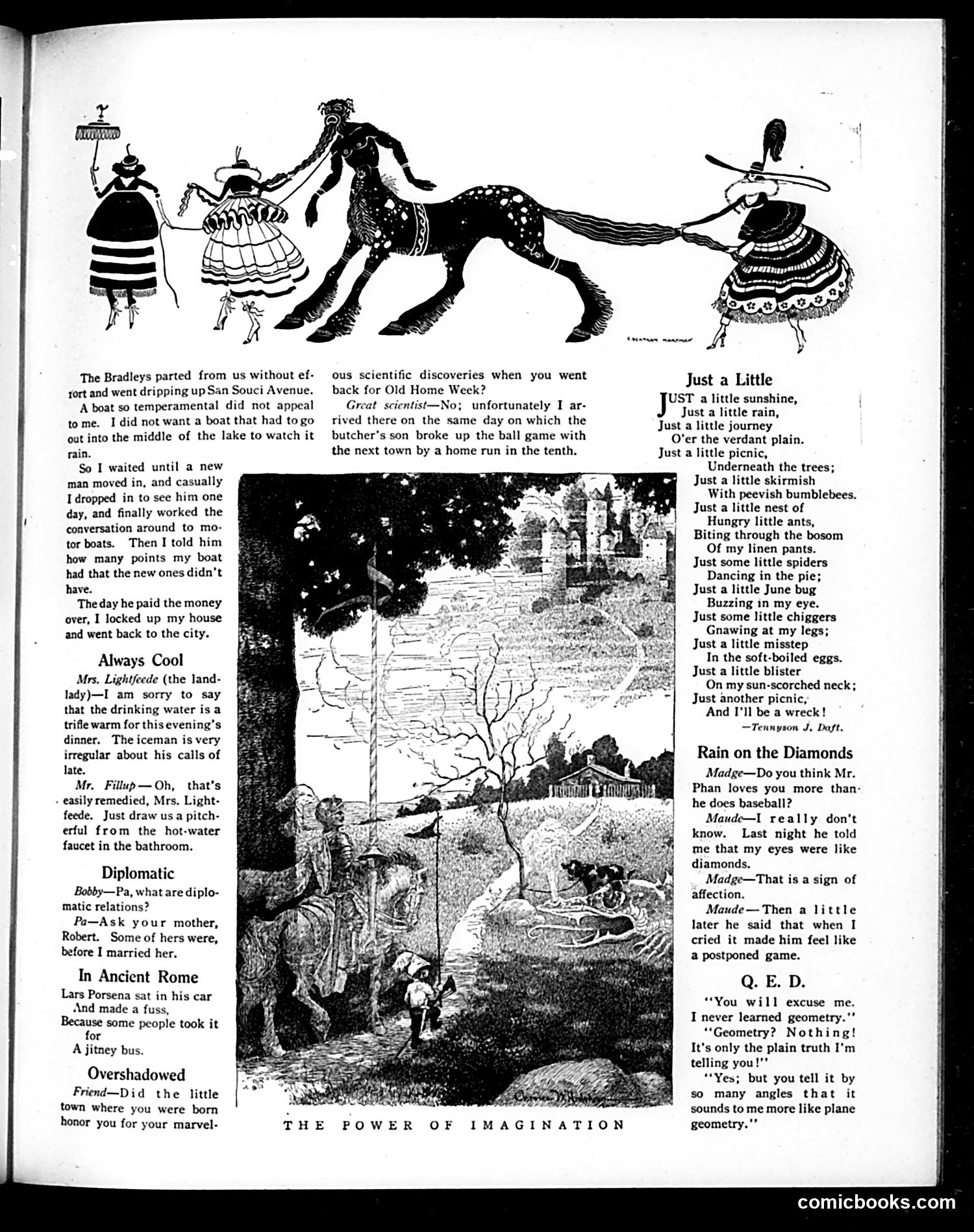
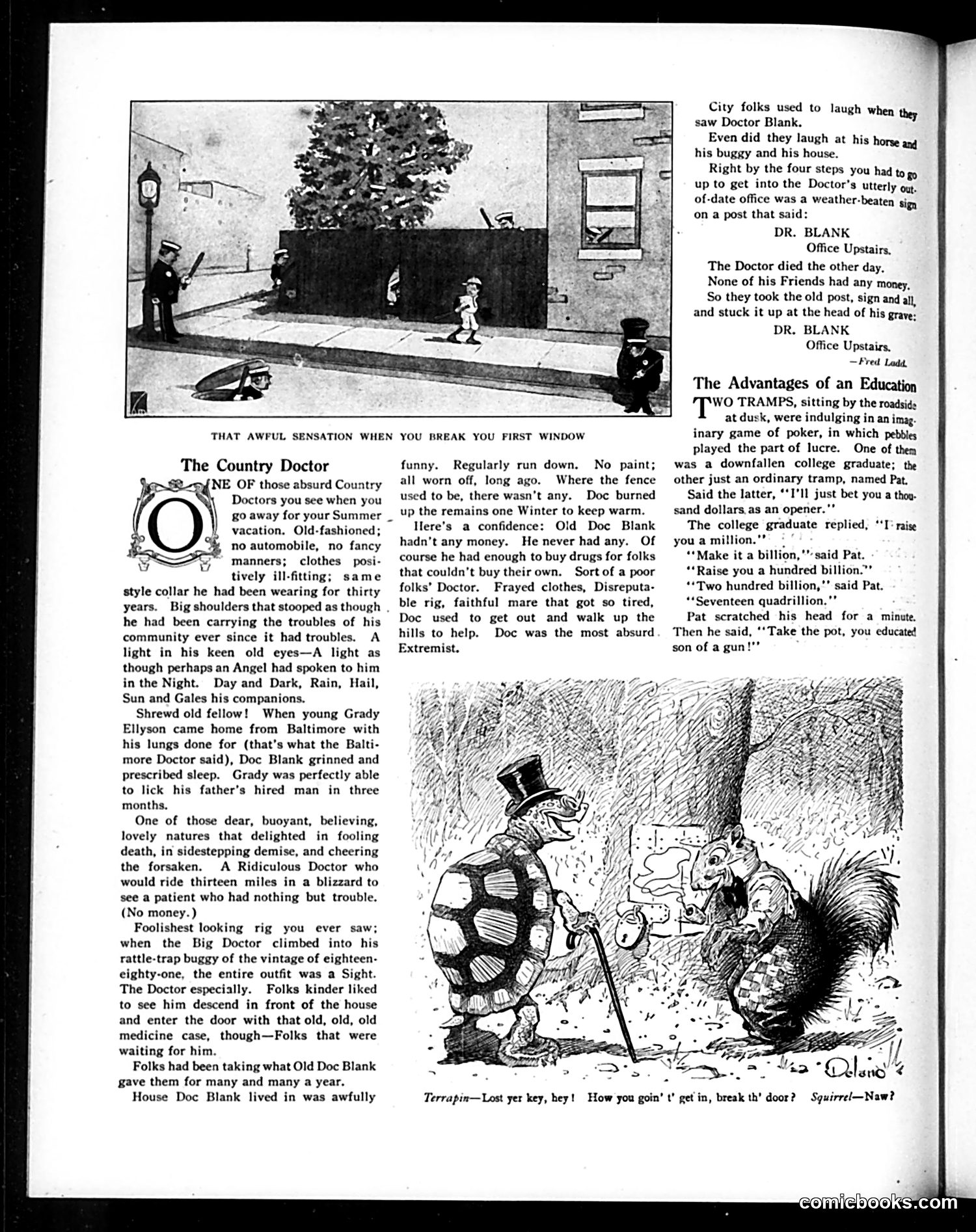
This page contains two satirical pieces typical of Judge magazine's social commentary. **"The Country Doctor"** is a sentimental portrait of an old-fashioned rural physician—poor, shabby, driving an ancient buggy, yet deeply dedicated to his patients regardless of their ability to pay. The satire targets urban contempt for rural life: city folks laugh at Doc Blank's appearance and decrepit practice, yet he embodies genuine virtue through selflessness and compassion. The final detail—his grave marker uses his old office sign—elevates his humble, "ridiculous" dedication into something noble and enduring. **"The Advantages of an Education"** mocks educated pretension through a poker game between a college graduate and an ordinary tramp. Despite his education, the graduate can only imagine increasingly abstract sums ("billion," "quadrillion"), while the practical tramp concedes victory, implying that excessive intellectualism divorced from common sense is worthless. Both pieces critique the era's class assumptions: one defends rural simplicity against urban mockery; the other deflates intellectual superiority.
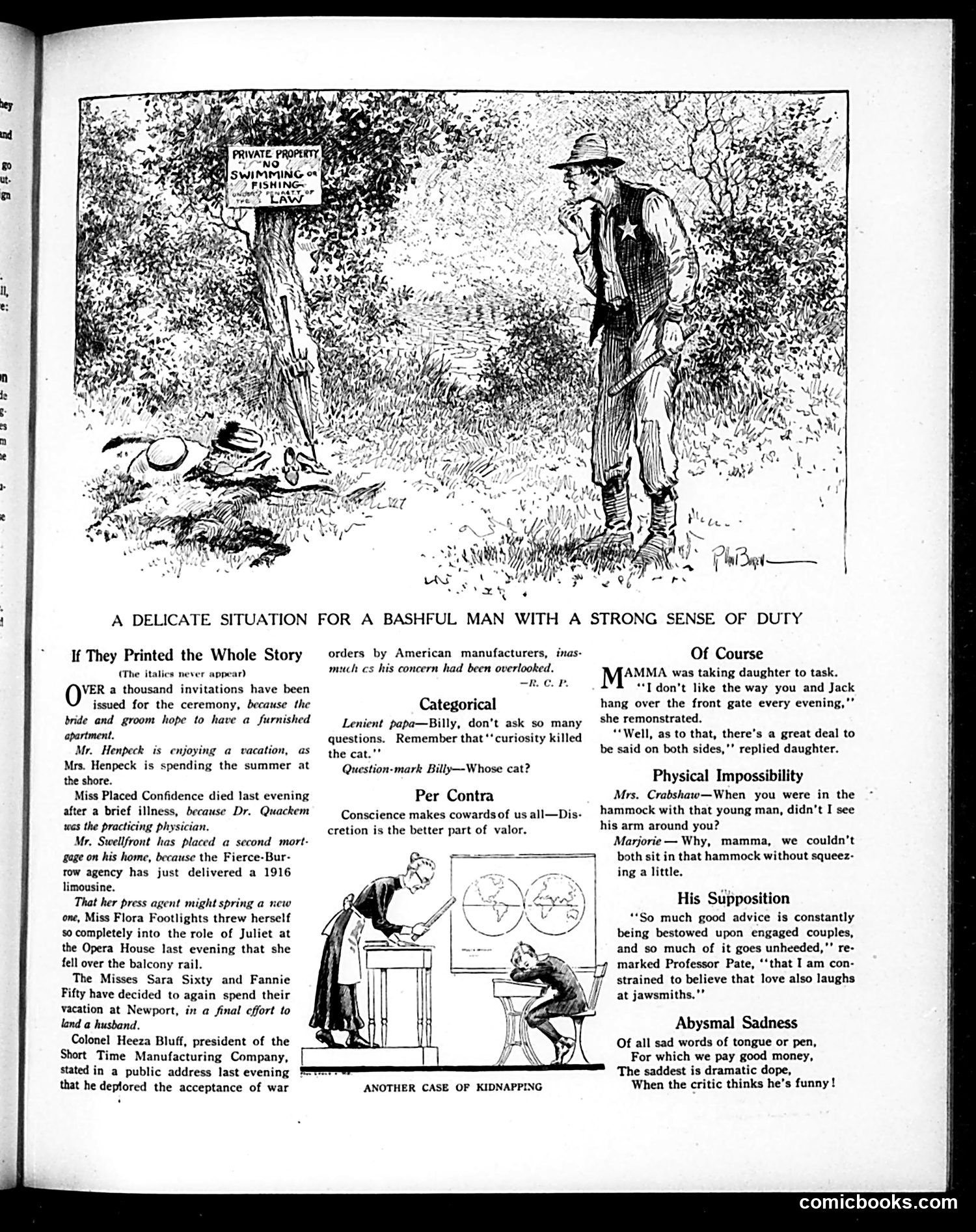
This Judge magazine page contains satirical short humor pieces typical of early 20th-century American comedy. The main cartoon depicts a bashful man confronted by a "Private Property—No Swimming or Fishing by Law" sign, humorously capturing awkwardness around enforced social boundaries. The text sections below use deadpan, ironic humor: they present situations where stated reasons mask real motivations. For example, "Miss Placed Confidence died...because Dr. Quackem was the practicing physician" darkly jokes about quack doctors, while "Colonel Heeza Bluff deplored war orders...inas-much as his concern had been overlooked" satirizes hypocritical pacifism motivated by lost business. The smaller pieces mock common romantic and domestic scenarios—overbearing mothers, awkward courtship, unsolicited marriage advice—with punny or paradoxical humor ("Physical Impossibility," "His Supposition"). The tone is cynical about human nature: people claim noble motives while pursuing selfish interests.
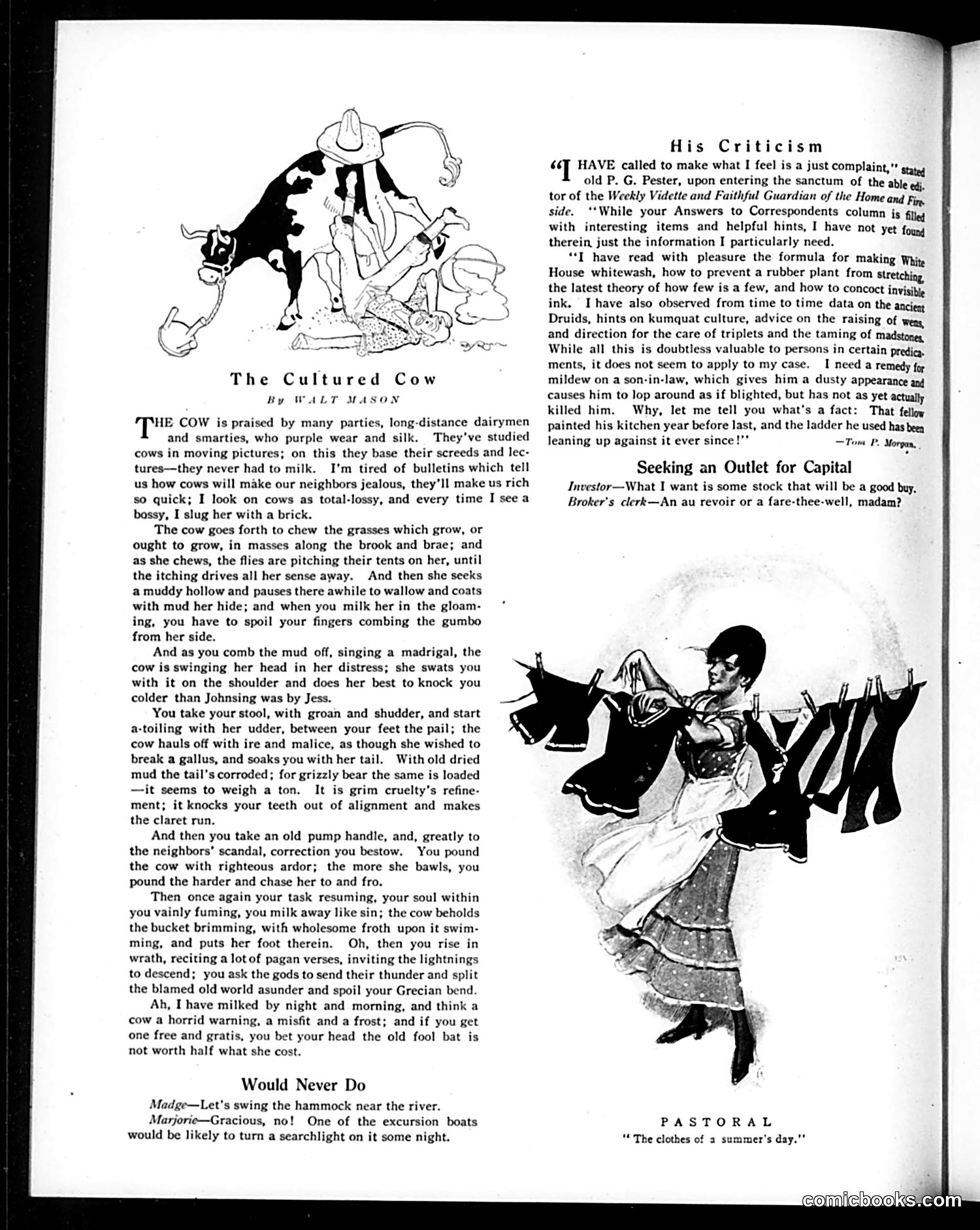
This page contains satirical commentary typical of early 20th-century Judge magazine. **"The Cultured Cow"** by Walt Mason is a humorous poem mocking both cows and pretentious agricultural advice. Mason sarcastically catalogs the frustrations of dairy farming—mud, flies, aggressive animals—while simultaneously poking fun at advice columns that discuss irrelevant topics like "kumquat culture" and "ancient Druids" instead of practical problems. **"His Criticism"** depicts a reader complaining to an advice columnist about needing help with a "son-in-law" problem—a lazy relative who painted the kitchen poorly and won't improve. The satire targets both unhelpful advice columns and family dysfunction. **"Pastoral"** (illustration) shows a woman hanging laundry, captioned "The clothes of a summer's day"—likely gentle humor about domestic life. **"Seeking an Outlet for Capital"** is a brief joke about stock investment where a broker dismisses an investor with farewell French phrases, suggesting his stock advice is worthless. The overall tone mixes rural/domestic frustrations with gentle mockery of contemporary American life and advice culture.
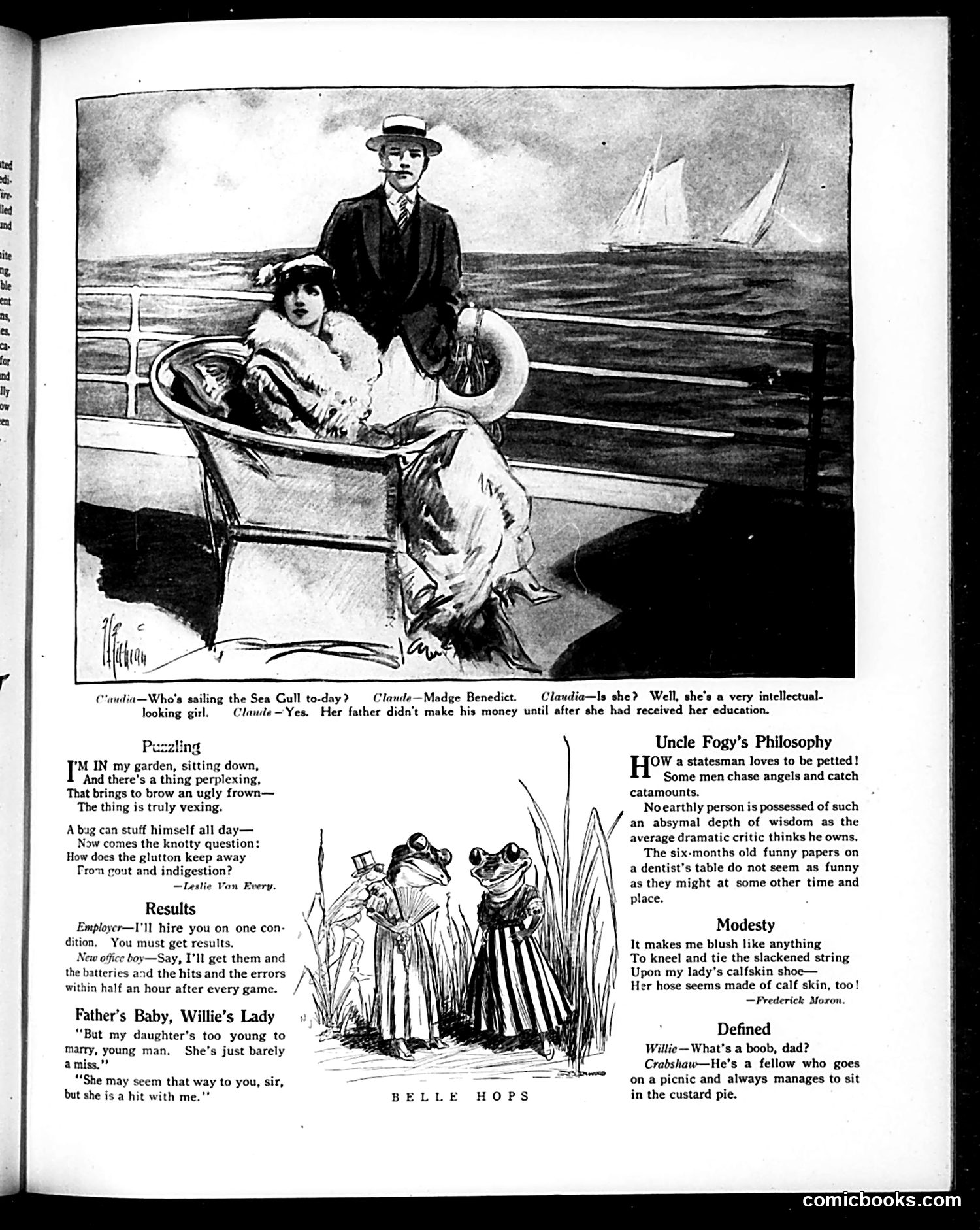
This page from *Judge* contains several brief satirical pieces typical of early 20th-century American humor magazines. **Top cartoon**: A society joke about class and education. A man inquires about a woman sailing a boat, learning she's "intellectual-looking." The punchline mocks new money—her father only became wealthy *after* she received her education, implying self-made businessmen typically lack refinement and education themselves. It's gentle satire of the nouveau riche. **Text sections**: Various short humorous pieces including: - "Puzzling": A naturalist's joke about bugs and digestion - "Results": An office boy's misunderstanding of "results" (mixing sports scores with work) - "Father's Baby, Willie's Lady": Wordplay on a daughter being "barely a miss" (unmarriageable) versus popular with suitors - "Uncle Fogy's Philosophy": Cynical observations about statesmen, critics, and old newspapers - "Belle Hops" (illustration): Anthropomorphized frogs in formal wear—whimsical rather than satirical The humor relies on puns, mild social commentary, and absurdist observations—typical of *Judge's* family-friendly satirical approach.
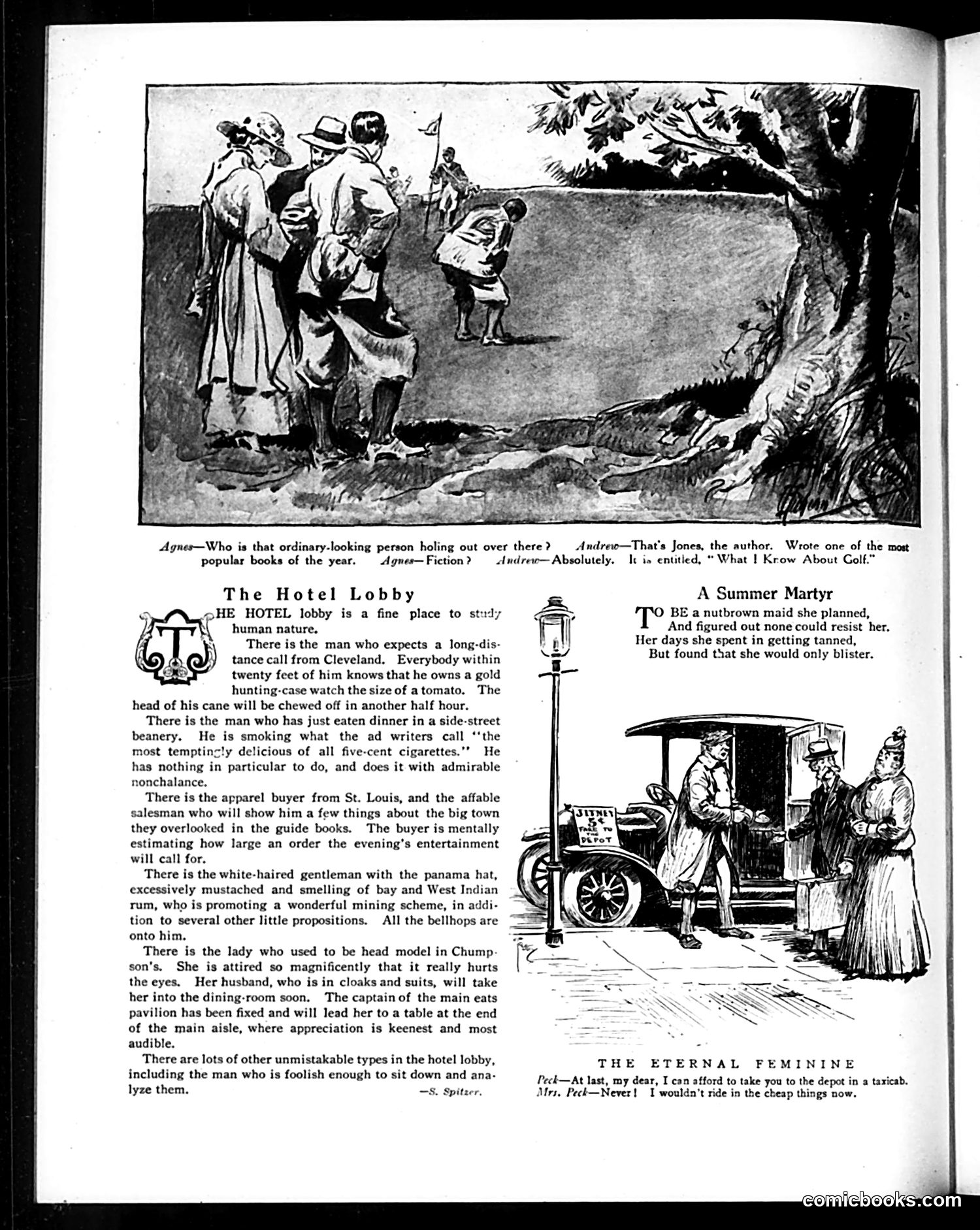
This page contains three satirical pieces typical of early-20th-century Judge magazine humor. **"The Hotel Lobby"** catalogs recognizable social types found in hotel lobbies—the self-important businessman with his ostentatious watch, the cheap salesman, the mining-scheme promoter, the glamorously dressed woman eager for public admiration. The satire mocks both the pretentious guests and the author himself for analyzing them. By S. Spitzer. **Top cartoon**: Agnes and Andrew observe an "ordinary-looking person" golfing. Andrew identifies him as "Jones, the author" of a bestselling book about golf. The joke: despite writing popular instructional content, Jones appears incompetent at the actual activity—satire of how-to authors lacking genuine expertise. **"A Summer Martyr"**: A woman attempts to tan but only sunburns, mocking the Edwardian beauty ideal of tanned skin (then fashionable and laboriously pursued). **"The Eternal Feminine"**: Peck offers his wife a taxicab ride; she refuses because taxis are "cheap things"—satirizing feminine materialism and status consciousness.
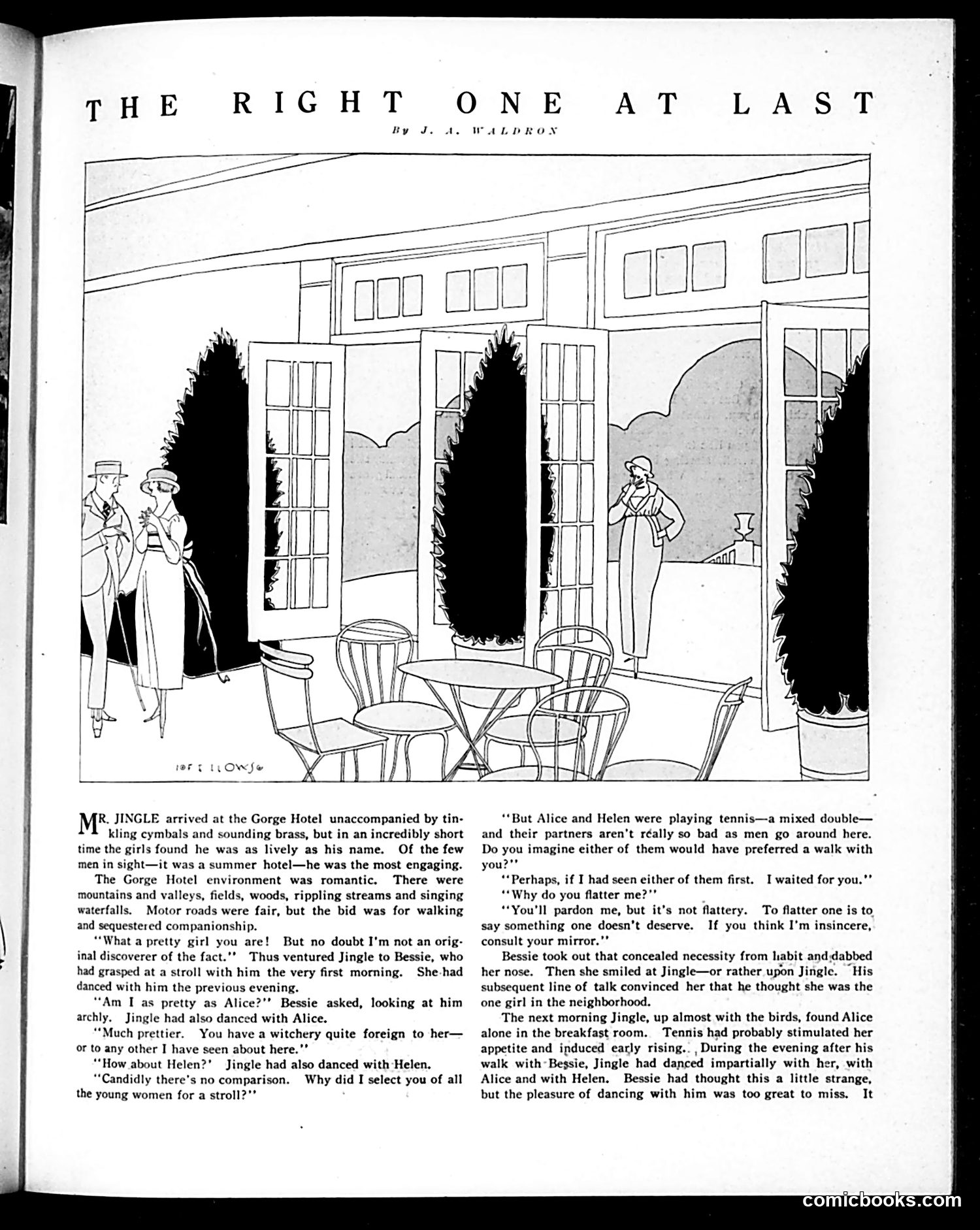
This is a satirical short story by J.A. Waldron about a charming opportunist named Mr. Jingle at a summer resort hotel. The satire targets a recognizable male type: the smooth operator who flatters multiple women simultaneously while claiming each is uniquely special. The humor lies in exposing his transparent duplicity. Jingle tells Bessie she's prettier than Alice and Helen, that she has "witchery" others lack, and implies he chose her companionship deliberately—when in fact he danced with all three women the previous evening and simply walked with Bessie because the others were occupied. The illustration shows him in an upscale hotel setting, surrounded by eager young women. The satire critiques both male dishonesty and female gullibility: Bessie believes his flattery despite obvious contradictions, finding his attention irresistible enough to overlook his insincerity. This reflects early-20th-century anxieties about courtship dynamics and gender relations at leisure resorts, where unchaperoned interaction between men and women was newly commonplace.
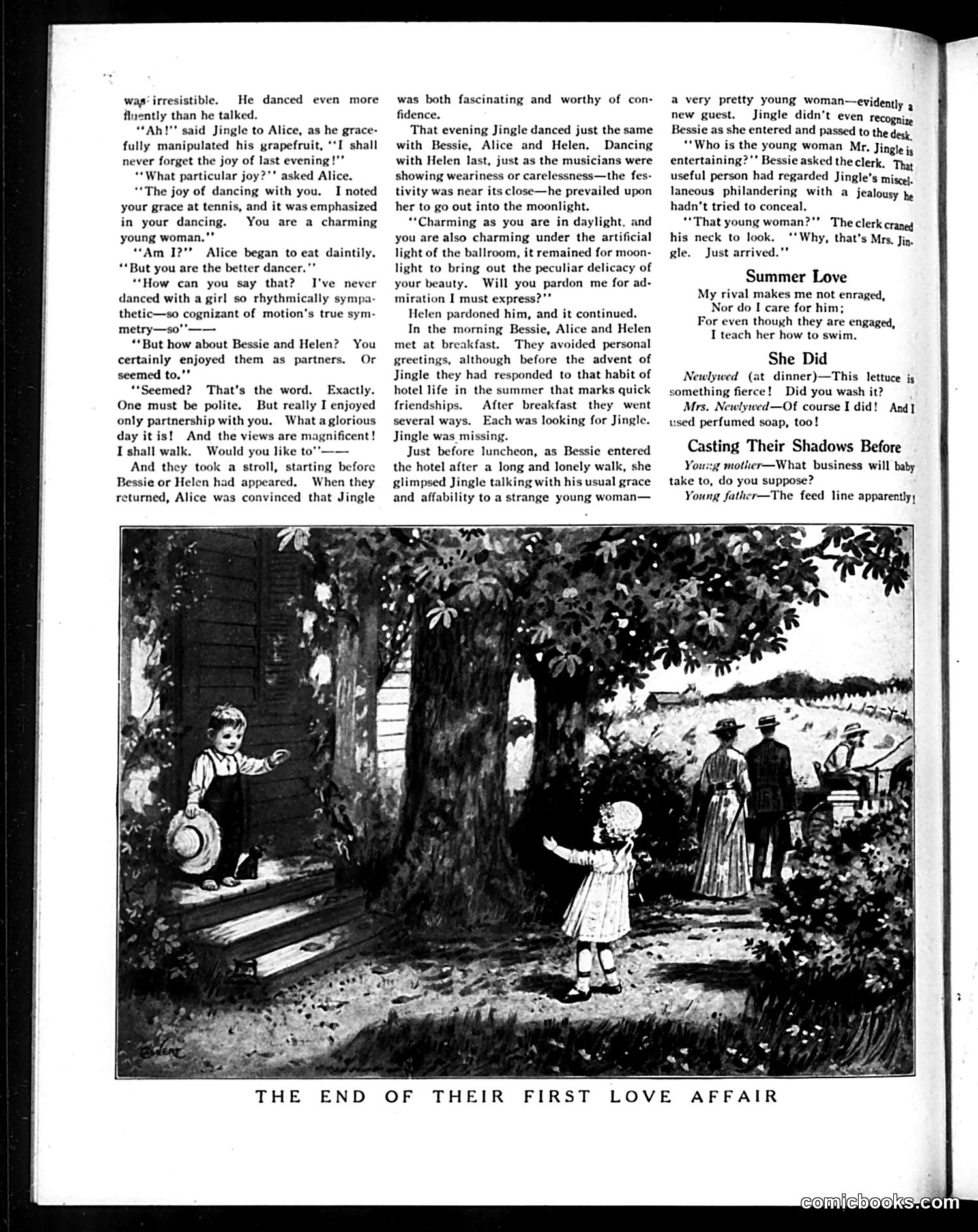
This is a satirical story about a charming seducer named Jingle who operates at a summer resort hotel. The narrative mocks the superficiality of romantic flirtation and masculine manipulation. Jingle employs identical flattery on three women—Alice, Bessie, and Helen—praising each as uniquely special dancers and beauties. He isolates each girl with private moments and poetic compliments, convincing each she's his true interest. The joke is exposed when all three realize they've been played identically. The illustration shows the moment of revelation: the women have discovered Jingle is already married to yet another woman, arriving at the hotel. His serial seduction ends abruptly. The satire targets both the gullible romanticism of young women and the duplicitous charm of unscrupulous men who exploit it. The accompanying jokes ("She Did," "Casting Their Shadows") extend the theme of domestic disappointment and marital disillusionment.
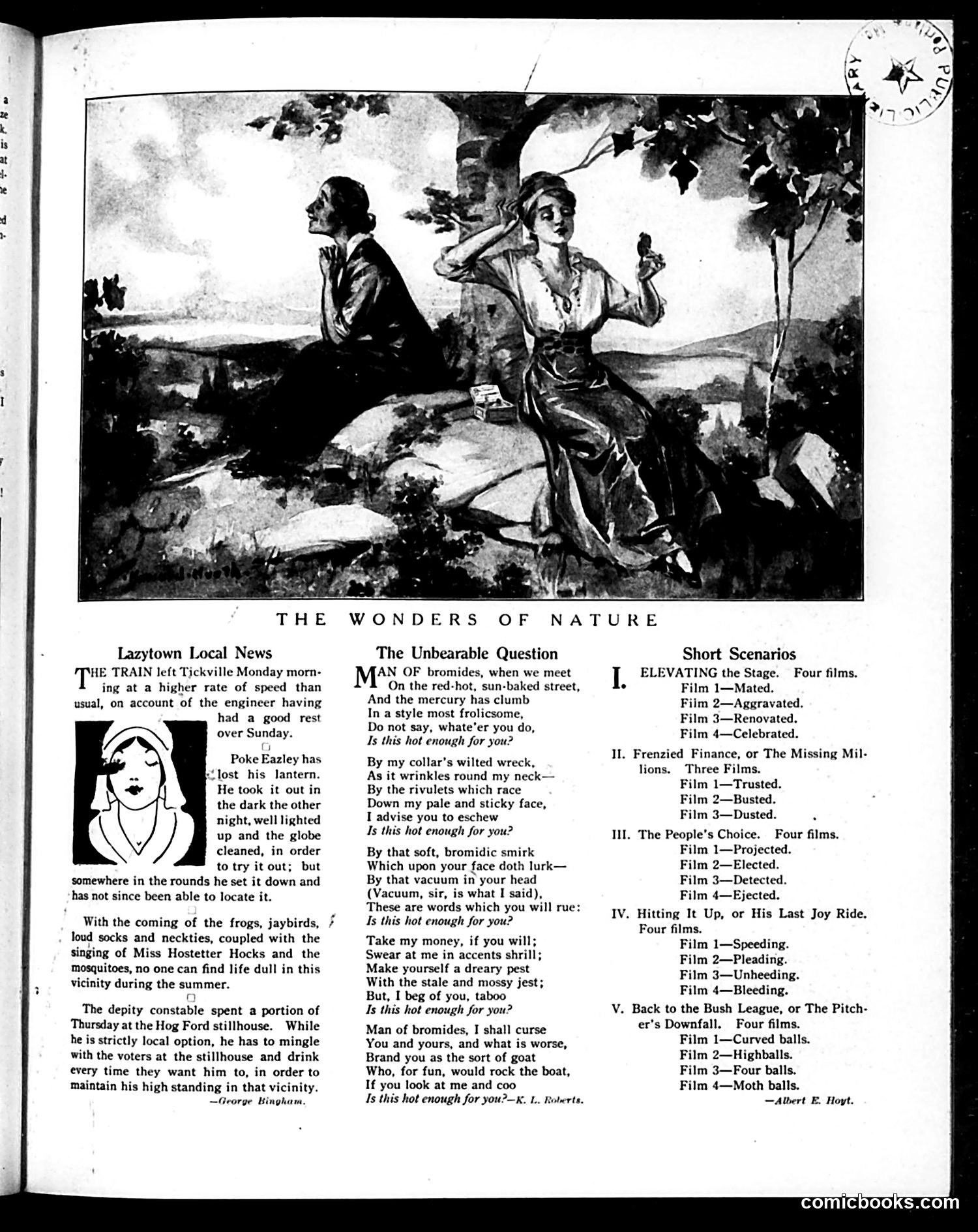
This page from *Judge* magazine combines rural humor, summer heat complaints, and early cinema satire. **"Lazytown Local News"** mocks small-town life through absurd anecdotes: a train running faster because the engineer rested, a constable attending illegal stills despite "local option" (Prohibition sentiment), and Poke Eazley losing his lantern. The humor targets rural simplicity and hypocrisy. **"The Unbearable Question"** satirizes the annoying summer bromide—"Is this hot enough for you?"—a cliché greeting during heat waves. The poem escalates from exasperation to mock-curses, capturing shared social frustration with predictable small talk. **"Short Scenarios"** parodies silent film titles through alliterative wordplay (e.g., "Mated/Aggravated/Renovated/Celebrated"). These mock both cinema's melodramatic conventions and the era's obsession with moving pictures as entertainment. The illustration shows a romantic pastoral scene, likely contrasting the idealized nature imagery in the title with the mundane, irritating realities described below.
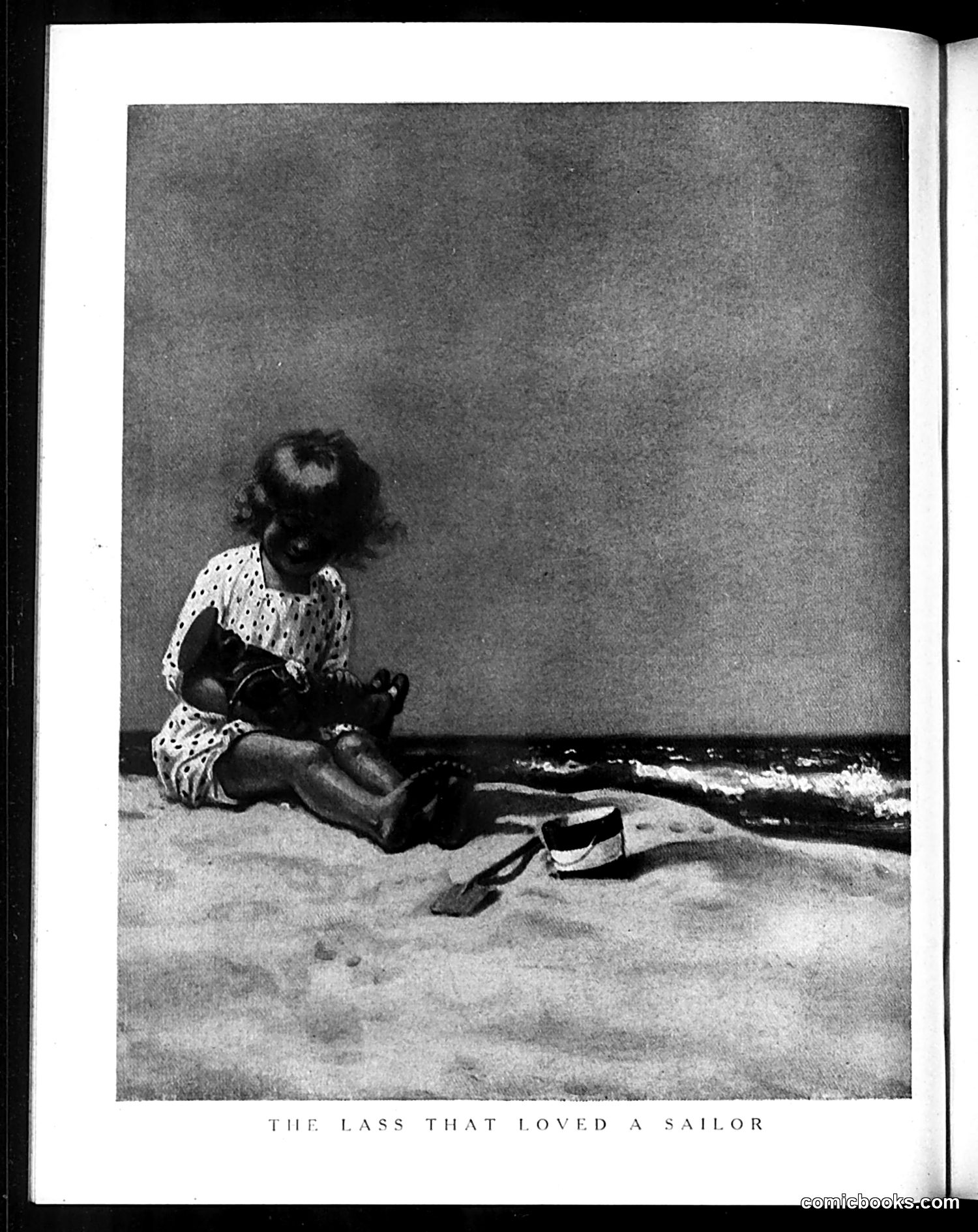
This appears to be an illustration rather than a political cartoon. It shows a woman sitting alone on a beach, gazing at the ocean with what seems to be romantic longing. A sailor's cap lies in the sand beside her. The caption—"The Lass That Loved a Sailor"—references a famous 18th-century British song of that title, which tells of a woman's romantic attachment to a sailor. The image likely plays on sentimental themes common to the era: female pining for an absent lover, the romance of the sea, and melodramatic devotion. Without additional context about the publication date, it's unclear whether this is satirizing sentimental fiction, commenting on wartime separations, or simply illustrating a popular cultural reference for nostalgic effect.
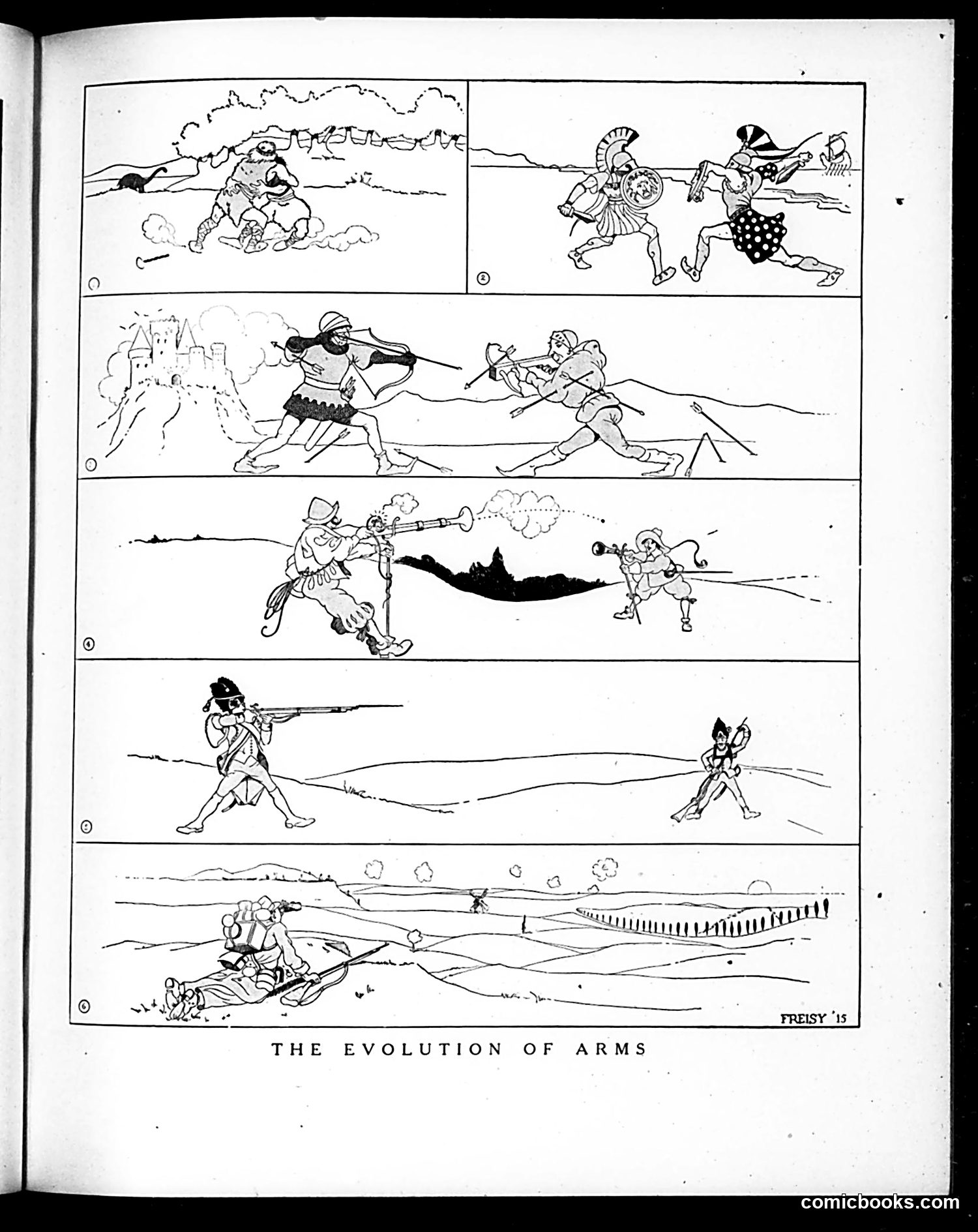
This satirical cartoon from *Judge* magazine depicts the historical progression of military weapons and warfare tactics across six panels. It progresses from primitive club-wielding figures through increasingly sophisticated weaponry: armed warriors with shields and spears, soldiers with early firearms and cannons, riflemen in combat stance, and finally modern artillery and fortified positions with what appears to be a machine gun emplacement. The satire critiques the escalating arms race and militarization of warfare—showing how human conflict has become progressively more deadly and technologically complex. Rather than celebrating technological advancement, the cartoon appears to mock the futility of perpetual weapons development, suggesting that despite centuries of "evolution," warfare fundamentally remains the same destructive enterprise, merely with more efficient killing methods. This reflects early 20th-century anxieties about industrial-scale warfare.
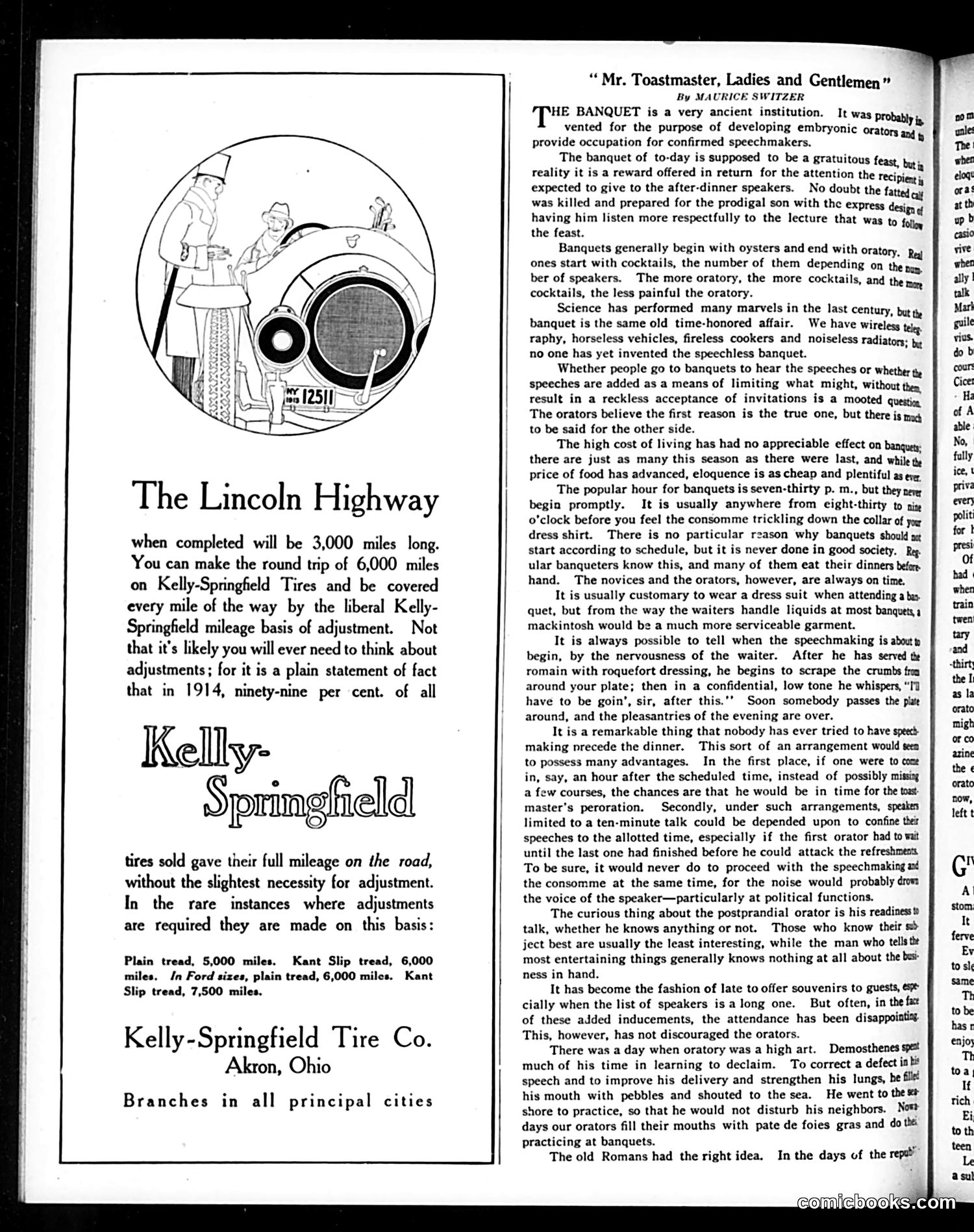
This page contains two distinct elements: **Left side:** A Kelly-Springfield Tire advertisement disguised as editorial content about the Lincoln Highway (a major 1910s-1920s infrastructure project). The cartoon shows a car on a highway. The ad claims their tires require no adjustments and boasts that 99% of tires sold in 1914 needed no repairs—typical exaggerated advertising rhetoric. **Right side:** Maurice Switzer's satirical essay "Mr. Toastmaster, Ladies and Gentlemen" mocking the formality and tedium of formal banquets. The satire targets: - The pretense that banquets are "free" meals (they're payment for enduring speeches) - Excessive cocktails served to make speeches "less painful" - The contradiction that no one has invented "speechless banquets" despite other modern innovations - Social awkwardness: late starts, formal dress unsuitable for dining, nervous waiters The humor relies on the gap between banquets' supposed dignity and their actual dysfunction—a common Jazz Age complaint about stuffy institutions.

This page combines political satire with product advertising, typical of Judge's format. **The Main Article** ("Rich Richard's Philosophy") is satirical commentary on American society. It contrasts ancient Rome—where eloquent orators were sent to dangerous military posts to keep them from power—with modern America, where talented speakers are protected and elevated to cabinet positions based on politics rather than merit. The author laments that America once produced great statesmen (Madison, John Quincy Adams, W.H. Harrison) who started young, but now newspapers and magazines have displaced the "boy orator," leaving them only for banquets. The "Rich Richard" aphorisms that follow are cynical jabs at wealth inequality and power dynamics (millionaires have no advantage at bad plays; eight-hour laws help the rich by allowing them to work sixteen hours). **The Advertisement** for Karo corn syrup is unrelated to the satire—a standard commercial placement in the magazine. The page exemplifies Judge's blend of sharp social criticism with commercial content.
This page is primarily **advertising** for luxury hotels and scotch whisky, with a serialized short story ("Introducing the New Boarder") as the main content. **The Story's Humor:** The piece satirizes a garrulous boarding house landlady who constantly **mangles her tenants' names** while introducing a new boarder to other residents. She confuses "McCabe" with "Robinson," forgets whether another tenant is "Anderson" or "Elberson," and struggles to remember "Miss Robertson's" first name—despite insisting the woman loves having everyone use her first name. **The Social Satire:** This mocks the pretentious sociability and poor memory of boarding house keepers, while also gently poking fun at deaf residents and the awkwardness of forced introductions among strangers. The joke relies on early 20th-century readers' familiarity with shared boarding house life, where eccentric landladies often wielded considerable social authority. The humor is gentle, domestic comedy—not political satire.
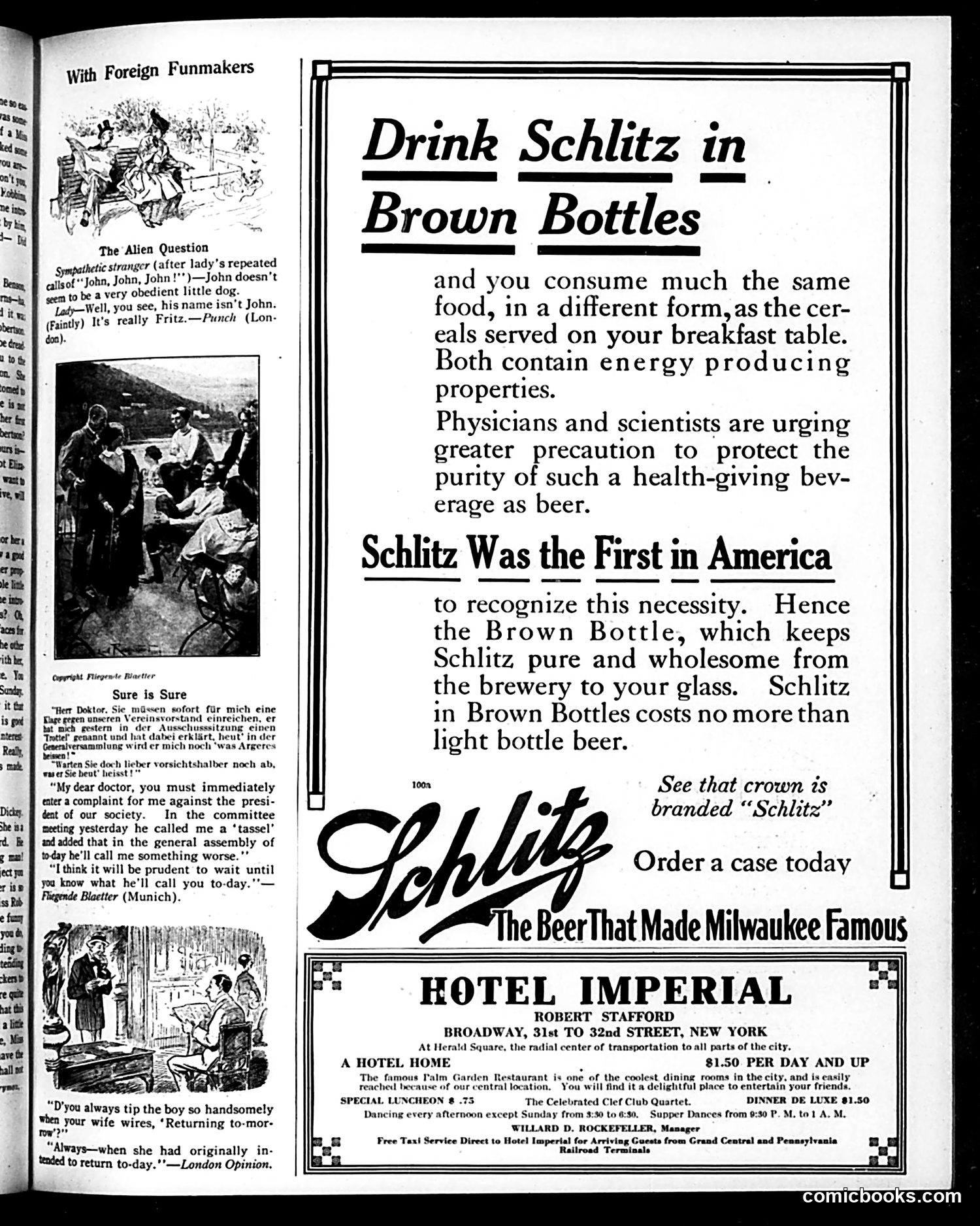
This page mixes satirical cartoons with advertising. The left side contains three brief comics from international sources, all playing on linguistic confusion and misunderstanding—a common satire theme. "The Alien Question" jokes about a dog named "Fritz" (a German name) being mistaken for "John," likely referencing anti-German sentiment during or after WWI when German names were viewed suspiciously in America. The dominant right side is a Schlitz beer advertisement claiming health benefits and purity. Notably, it emphasizes the brown bottle protects beer from contamination—a marketing pitch positioning the product as scientifically superior. This appears pre-Prohibition (before 1920), when beer was still legally marketed with quasi-medicinal health claims. The Hotel Imperial advertisement at bottom promotes dining and entertainment in New York. **Context for modern readers**: This reflects early 20th-century American attitudes toward German immigrants, while demonstrating how alcohol was once advertised with pseudoscientific health language now recognized as false advertising.
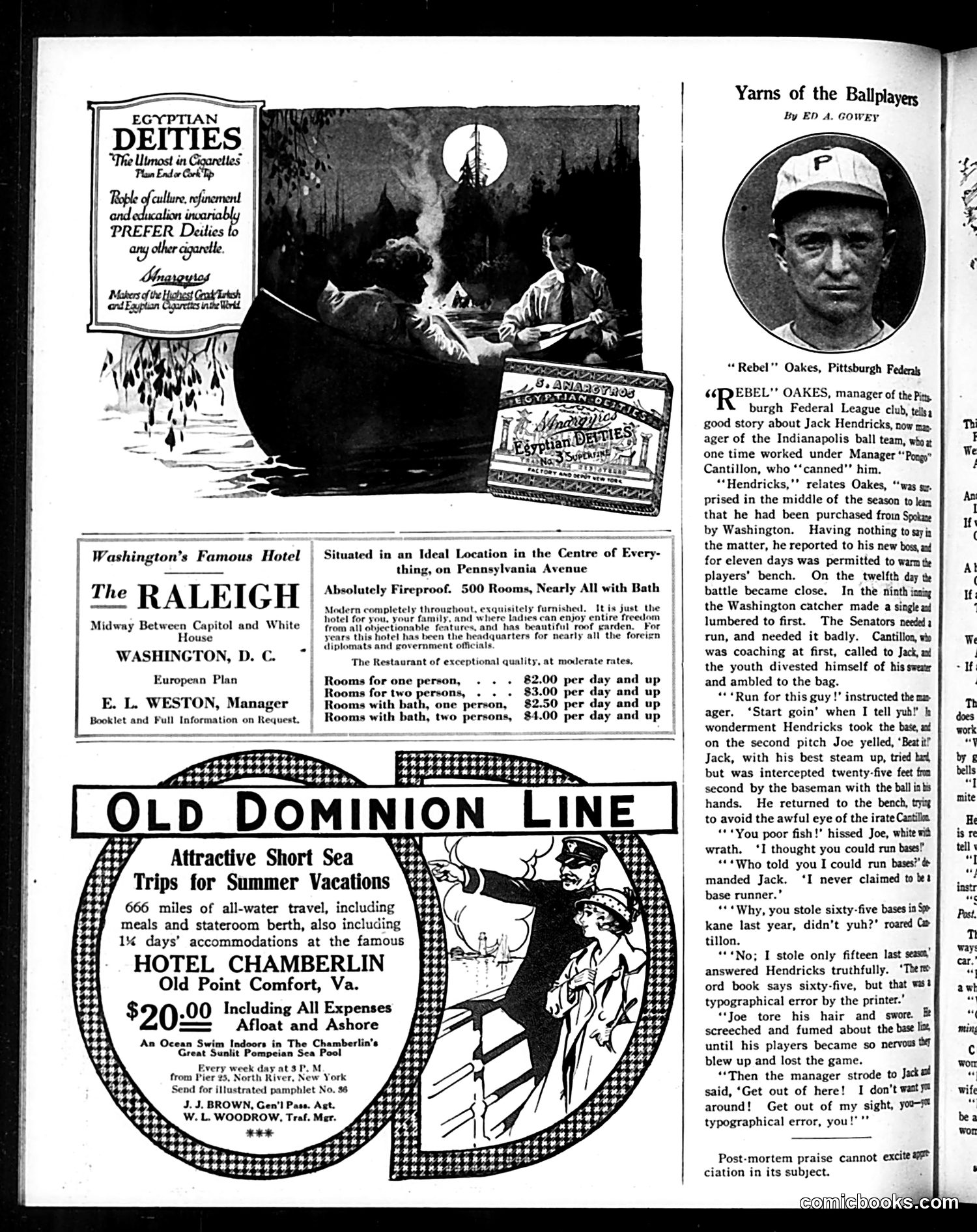
This page is primarily **advertising and sports anecdote**, not political satire. The "Egyptian Deities" cigarette ad (top left) uses pseudo-religious imagery—depicting Egyptian priests around a moon—to market luxury cigarettes, exploiting contemporary fascination with ancient Egypt. The main content is **"Yarns of the Ballplayers"** by Ed A. Gowey, a humorous sports story about "Rebel" Oakes (Pittsburgh Federals manager) recounting an anecdote about Jack Hendricks, a ballplayer. The joke: Hendricks is ordered to run bases during a crucial game but is caught out; when criticized for poor running, he disputes the manager's claim that he stole 65 bases in Spokane—claiming it was only 15, and the higher number was a "typographical error by the printer." The humor relies on the absurdity of blaming a printed error for inflated statistics. The remaining ads promote Washington D.C. hotels and steamship vacations—typical period advertising with no satirical content.
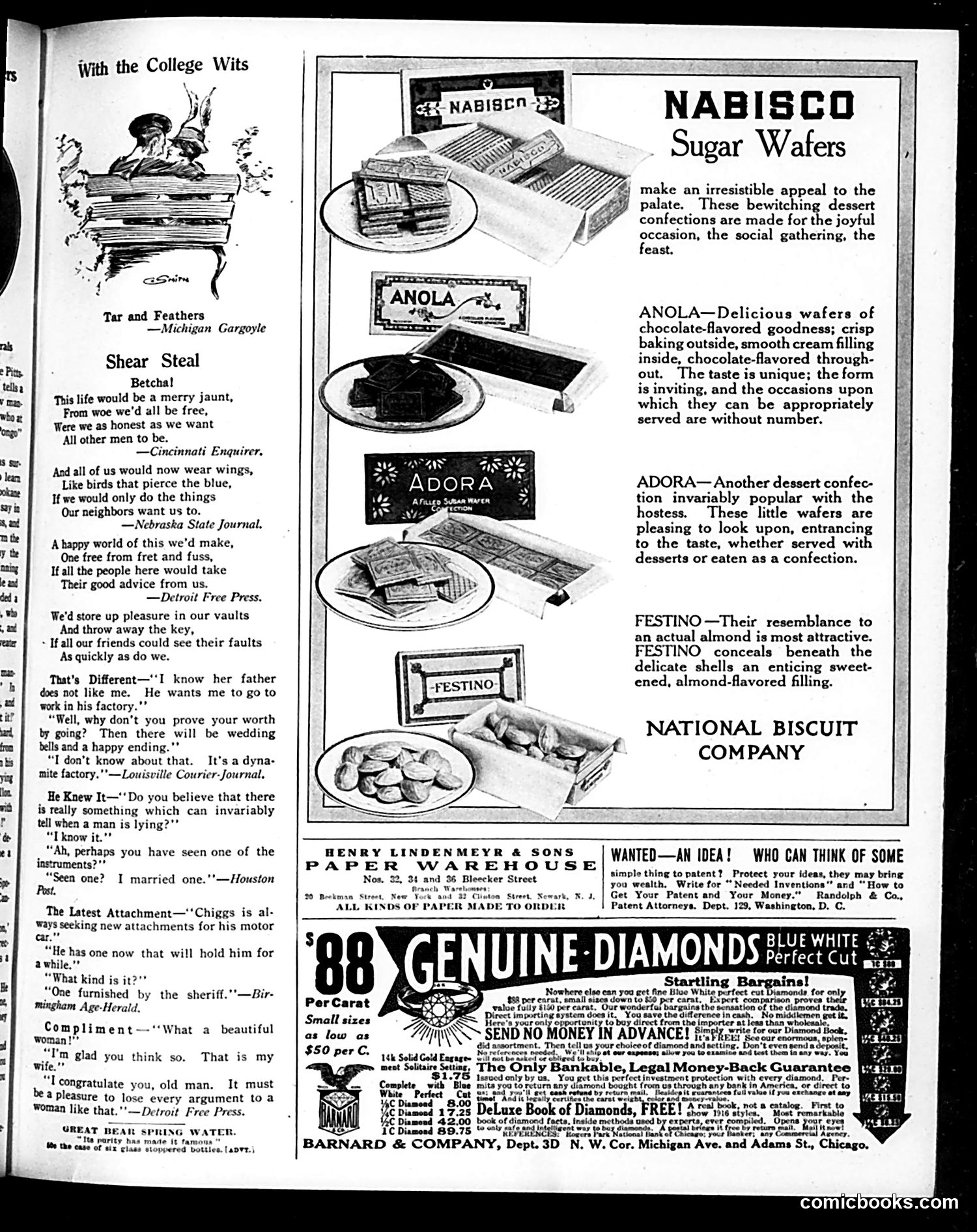
This page primarily consists of **humorous quotations** and **advertisements** rather than political cartoons. ## The Humor Section ("With the College Wits") The left column reprints witty one-liners from college humor magazines and newspapers. These are gentle social satire about **human hypocrisy**—specifically, how people readily judge others while ignoring their own faults. Examples include quips about wishing others would be honest, or congratulating a man for "losing every argument to a woman like that." The humor is mild and relies on observational comedy about domestic life and morality rather than political critique. ## The Advertisements The right side features **product advertisements**: Nabisco sugar wafers (Anola, Adora, Festino brands), a diamond company promoting mail-order rings with a "money-back guarantee," and a patent-idea service. These are standard period advertising. ## Summary This is not a satirical editorial page but rather a **humor and advertising section**—typical filler content for a magazine like Judge, which mixed political cartoons (elsewhere in the issue) with lighter entertainment and commercial content.
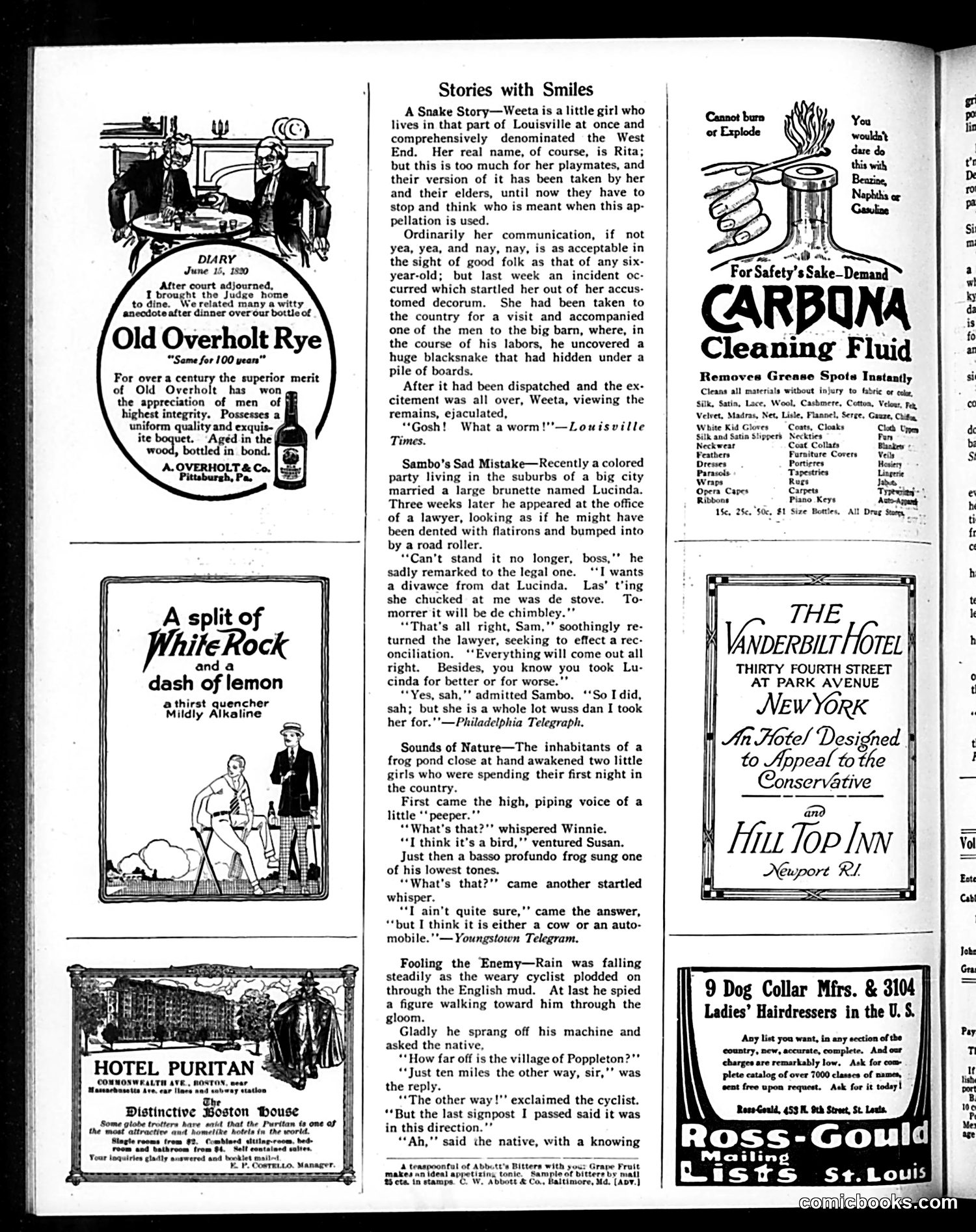
This page is primarily **advertising and light humor**, not political satire. The content consists of: **"Stories with Smiles"** — Four brief, gentle anecdotes: - A child misidentifies a dead snake as a "worm" - A newly married Black man seeks divorce, complaining his wife is "wuss" than expected - Two girls mistake frog sounds for a cow or automobile - A cyclist is misdirected by a villager These are mild, domestic jokes relying on misunderstanding and wordplay—typical early-20th-century magazine filler. The racial stereotype in "Sambo's Sad Mistake" reflects period attitudes but carries no pointed satire. **Advertisements** dominate: Old Overholt Rye, White Rock beverages, hotels (Vanderbilt, Puritan, Hill Top Inn), Carbona cleaning fluid, and mailing lists. There is **no political cartoon or satirical commentary** visible on this page. It represents Judge's lighter editorial content alongside commercial promotions.
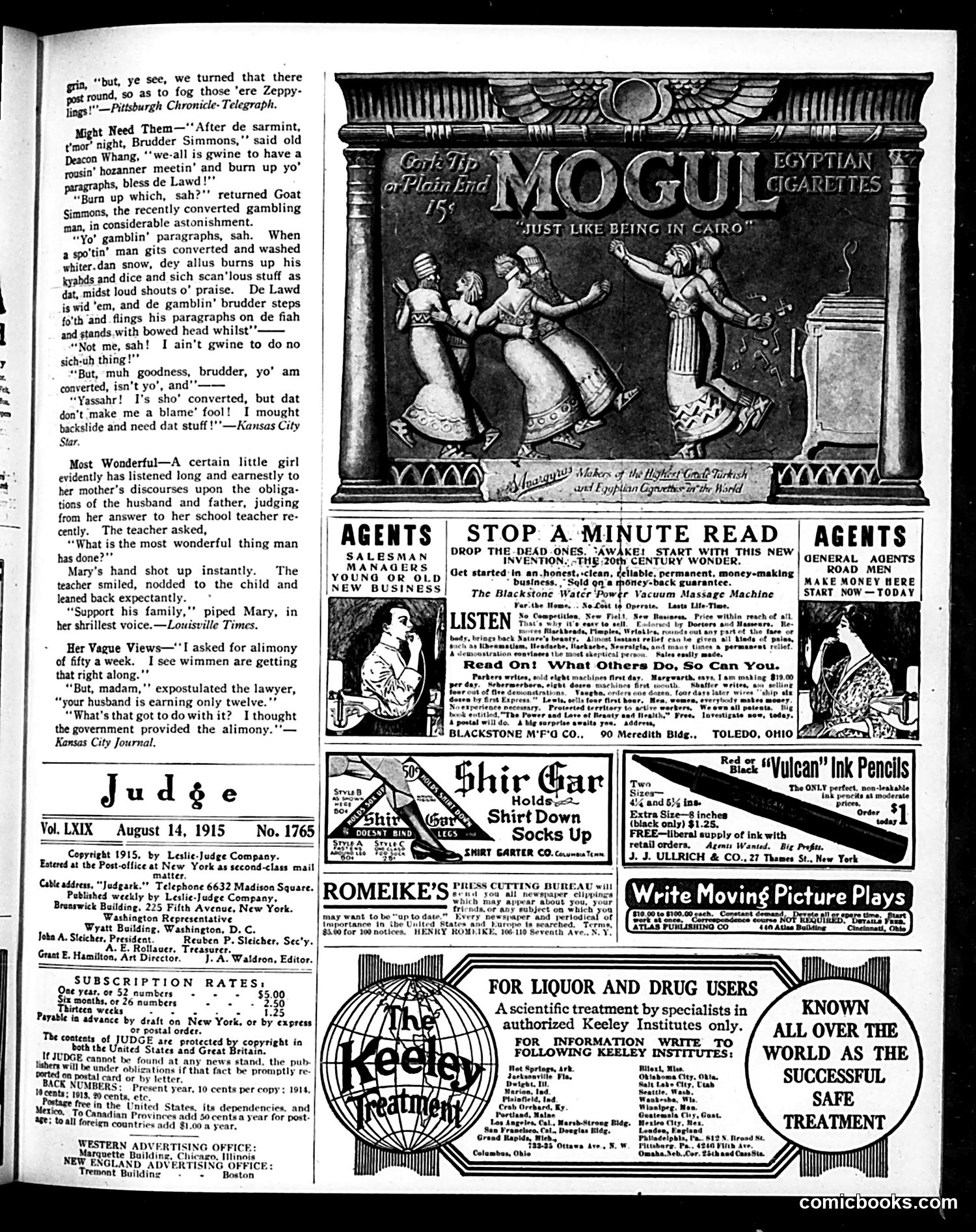
This page contains three brief humorous anecdotes typical of Judge's satirical humor: **"Might Need Them"** mocks religious conversion among gamblers, specifically African American dialect humor. A newly "converted" gambling man resists burning his gambling materials, reasoning he might backslide and need them again—satirizing the shallow nature of sudden religious conversion. **"Most Wonderful"** presents a child's innocent answer to what humanity's greatest achievement is: "Support his family." The joke critiques men's actual performance of this duty, suggesting many fail at this basic obligation. **"Her Vague Views"** ridicules a woman's ignorance about alimony law. She demands fifty dollars weekly alimony from a husband earning only twelve, apparently believing the government subsidizes alimony—mocking both women's legal understanding and the recent trend of alimony awards. The page is otherwise dominated by period advertisements (cigarettes, medical devices, business opportunities), typical for Judge's format.
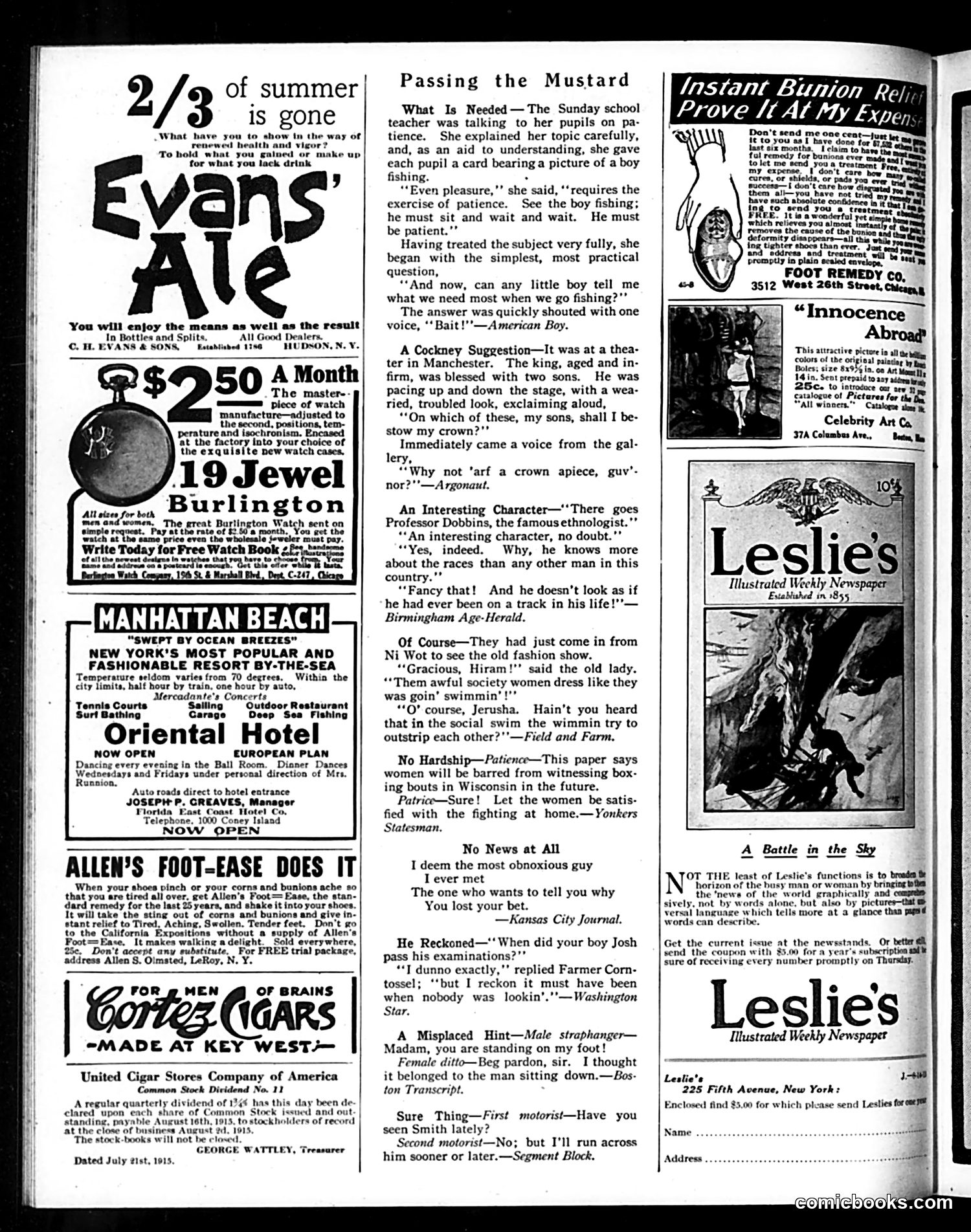
This page is primarily **advertising and humorous anecdotes**, not political satire. The main content includes: **Advertisements**: Evans' Ale, Burlington watches, Manhattan Beach resort, Allen's Foot-Ease (foot powder), Cortez Cigars, and Leslie's Illustrated Weekly dominate the page. **Humorous Short Jokes** ("Passing the Mustard" section): - A Sunday school teacher explains patience to pupils using a fishing analogy; a child hilariously answers "Bait!" instead of "patience" - A cockney theater-goer suggests the king split his crown three ways as currency - Wordplay about Professor Dobbins knowing about "races"—the audience expects athletic track racing, but he studies ethnology (racial characteristics) **Context for modern readers**: These gentle, pun-based jokes relied on double meanings and innocent misunderstandings. The ethnology reference reflects early-1900s pseudo-scientific race studies, now recognized as discredited. The humor style is family-friendly rather than edgy political commentary.
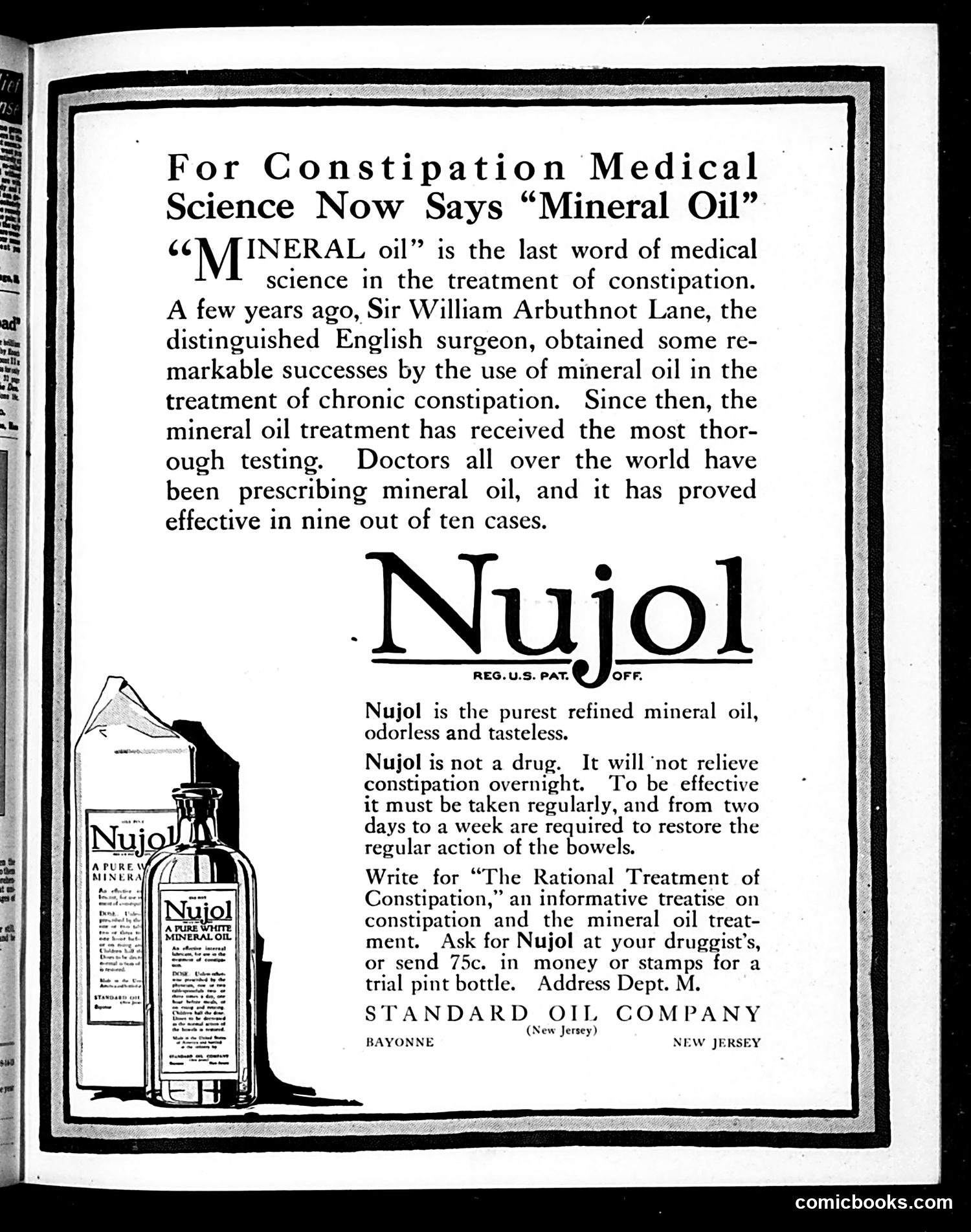
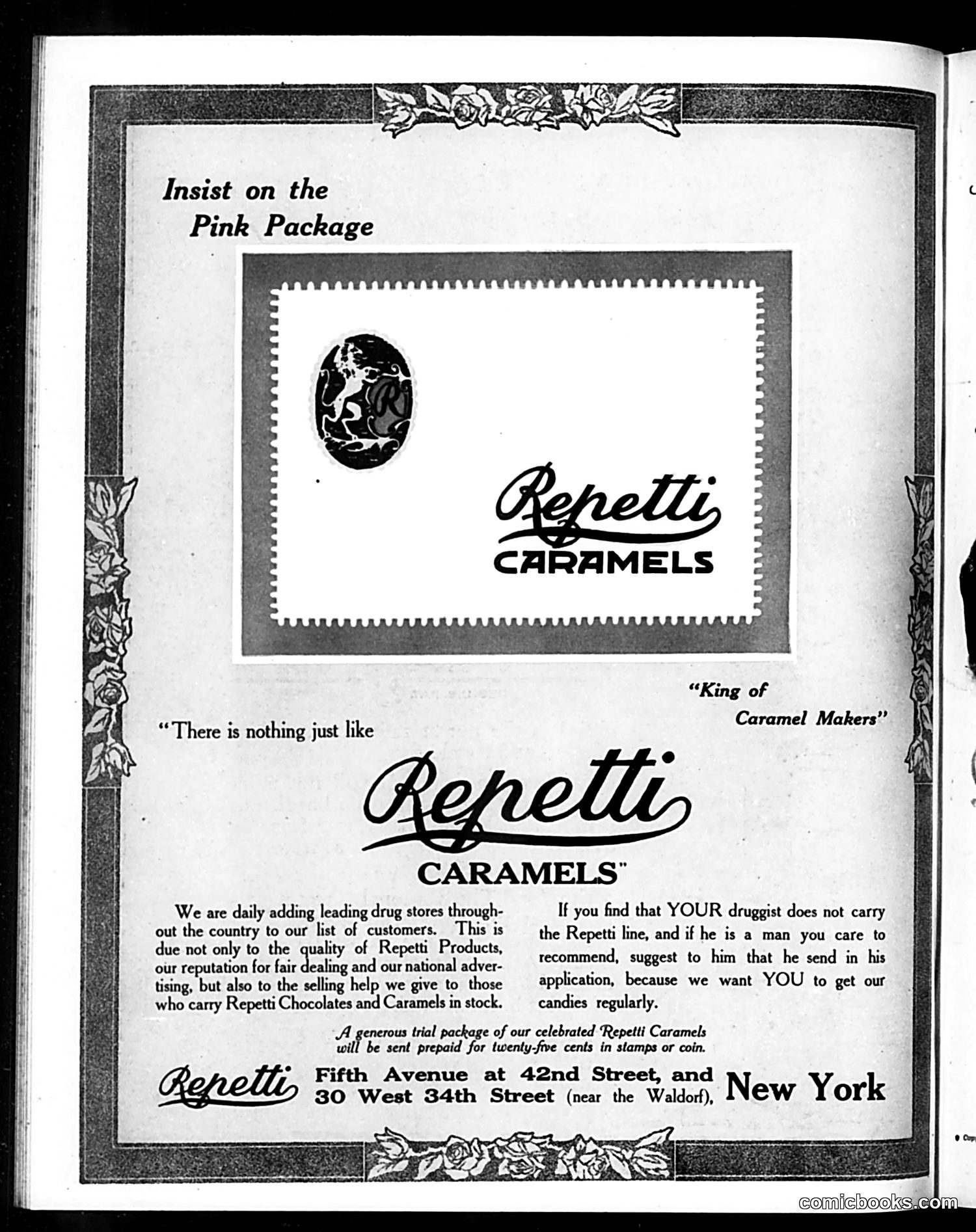
This is primarily a **product advertisement**, not political satire. It promotes Repetti Caramels, a candy brand sold in New York drugstores (note the early 20th-century practice of selling confections in pharmacies). The "pink package" branding strategy is the focus. The ad emphasizes: 1. **Distribution expansion**: Repetti is recruiting drugstores nationwide as retailers 2. **Quality messaging**: Positioning as "King of Caramel Makers" 3. **Consumer activism**: Encouraging customers to pressure their local druggist to stock the line if unavailable 4. **Direct marketing**: Offering a trial package for 25 cents The decorative floral borders and elegant typography reflect period advertising aesthetics. There is **no political cartoon or satire here**—Judge magazine apparently sold advertising space to commercial products alongside its editorial content, as was common in early 20th-century publications.