
Judge, 1915-08-14 · page 18 of 28
Judge — August 14, 1915 — page 18: what you’re looking at
What you’re looking at
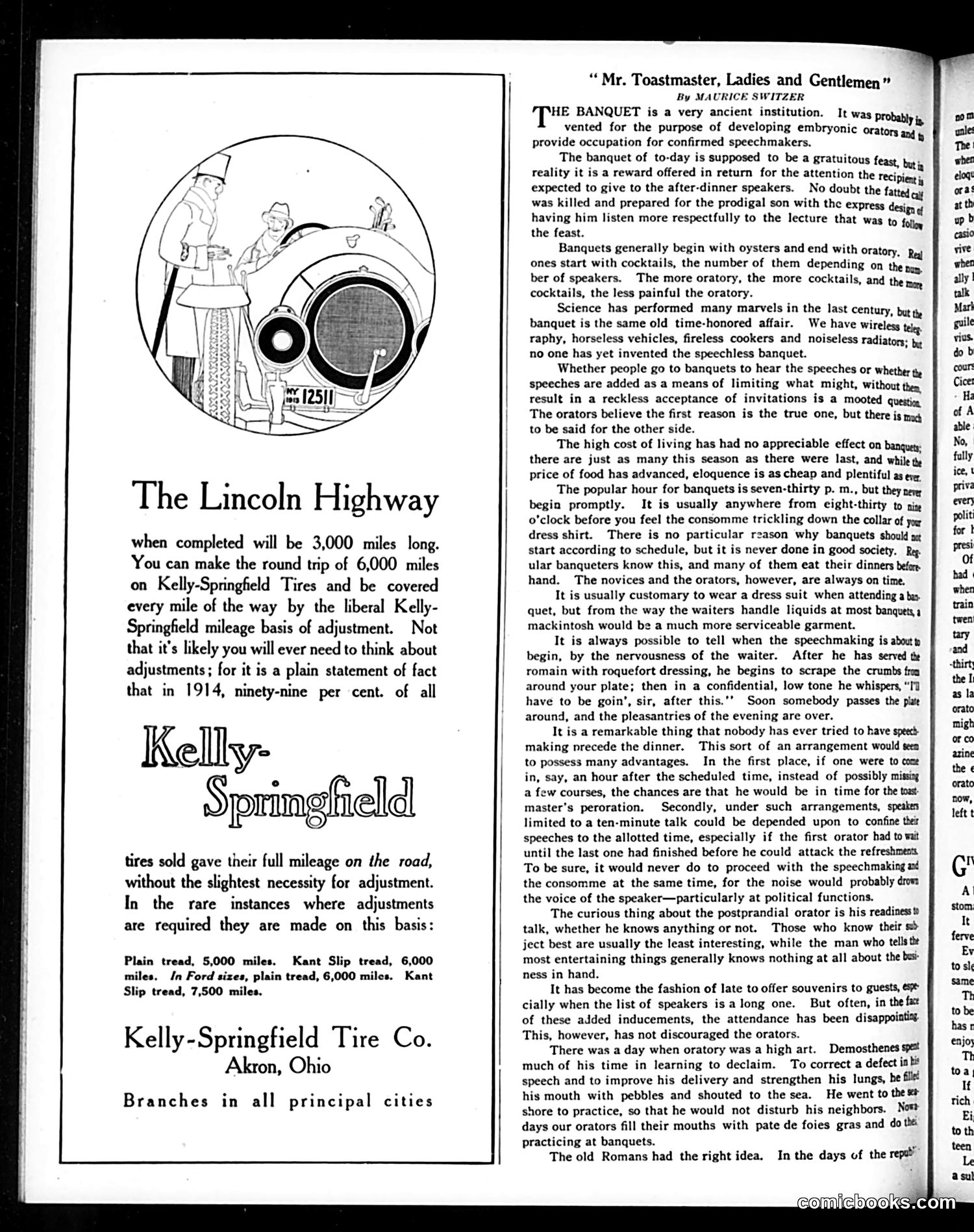
This page contains two distinct elements: **Left side:** A Kelly-Springfield Tire advertisement disguised as editorial content about the Lincoln Highway (a major 1910s-1920s infrastructure project). The cartoon shows a car on a highway. The ad claims their tires require no adjustments and boasts that 99% of tires sold in 1914 needed no repairs—typical exaggerated advertising rhetoric. **Right side:** Maurice Switzer's satirical essay "Mr. Toastmaster, Ladies and Gentlemen" mocking the formality and tedium of formal banquets. The satire targets: - The pretense that banquets are "free" meals (they're payment for enduring speeches) - Excessive cocktails served to make speeches "less painful" - The contradiction that no one has invented "speechless banquets" despite other modern innovations - Social awkwardness: late starts, formal dress unsuitable for dining, nervous waiters The humor relies on the gap between banquets' supposed dignity and their actual dysfunction—a common Jazz Age complaint about stuffy institutions.
📄 Transcribed text from this page (OCR, searchable)
Machine-transcribed from the original scan — historical spelling and the odd misread are preserved.
The Lincoln Highway when completed will be 3,000 miles long. You can make the round trip of 6,000 miles on Kelly-Springfield Tires and be covered every mile of the way by the liberal Kelly- Springfield mileage basis of adjustment. Not that it’s likely you will ever need to think about adjustments ; for it is a plain statement of fact that in 1914, ninety-nine per cent. of all Kellly- Springfield tires sold gave their full mileage on the road, without the slightest necessity for adjustment. In the rare instances where adjustments are required they are made on this basis: Plain tread, 5,000 miles. Kant Slip tread, 6,000 miles, /n Ford sizes, plain tread, 6,000 miles. Kant Slip tread, 7,500 miles. Kelly-Springfield Tire Co. Akron, Ohio Branches in all principal cities “Mr. Toastmaster, Ladies and Gentlemen” By MAURICE SWITZER HE BANQUET is a very ancient institution. It was vented for the purpose of developing embryonic Orators ang provide occupation for confirmed speechmakers. L) The banquet of to-day is supposed to be a gratuitous feast, but j reality it is a reward offered in return for the attention the recipiens expected to give to the after-dinner speakers. No doubt the fatted cat was killed and prepared for the prodigal son with the express design of having him listen more respectfully to the lecture that was to foligy the feast. Banquets generally begin with oysters and end with Oratory. Reg ones start with cocktails, the number of them depending on the na. ber of speakers. The more oratory, the more cocktails, and the mor cocktails, the less painful the oratory. Science has performed many marvels in the last Century, but th banquet is the same old time-honored affair. We have wireless tee. raphy, horseless vehicles, fireless cookers and noiseless radiators; bet no one has yet invented the speechless banquet. Whether people go to banquets to hear the speeches or whether thy speeches are added as a means of limiting what might, without then, result in a reckless acceptance of invitations is a mooted questi. The orators believe the first reason is the true one, but there is mq to be said for the other side. The high cost of living has had no appreciable effect on banquets; there are just as many this season as there were last, and while ty price of food has advanced, eloquence is as cheap and plentiful as eve, The popular hour for banquets is seven-thirty p. m., but they nerr begin promptly. It is usually anywhere from eight-thirty to nix o'clock before you feel the consomme trickling down the collar of yor dress shirt. There is no particular reason why banquets should og start according to schedule, but it is never done in good society. Reg. ular banqueters know this, and many of them eat their dinners befor. hand. The novices and the orators, however, are always on time. It is usually customary to wear a dress suit when attending abu quet, but from the way the waiters handle liquids at most banquets a mackintosh would be a much more serviceable garment. It is always possible to tell when the speechmaking is about» begin, by the nervousness of the waiter. After he has served te romain with roquefort dressing, he begins to scrape the crumbs fra around your plate; then in a confidential, low tone he whispers, “I'l have to be goin’, sir, after this.'"" Soon somebody passes the plate around, and the pleasantries of the evening are over. It is a remarkable thing that nobody has ever tried to have speech making precede the dinner. This sort of an arrangement would sea to possess many advantages. In the first place, if one were to com in, say, an hour after the scheduled time, instead of possibly missing a few courses, the chances are that he would be in time for the toa: master's peroration. Secondly, under such arrangements, speakes limited to a ten-minute talk could be depended upon to confine ther speeches to the allotted time, especially if the first orator had to wait until the last one had finished before he could attack the refreshments To be sure, it would never do to proceed with the speechmaking a the consomme at the same time, for the noise would probably drow the voice of the speaker—particularly at political functions. The curious thing about the postprandial orator is his readiness ® talk, whether he knows anything or not. Those who know their s> ject best are usually the least interesting, while the man who tells te most entertaining things generally knows nothing at all about the be: ness in hand. It has become the fashion of late to offer souvenirs to guests, 67 cially when the list of speakers is along one. But often, in the fax of these added inducements, the attendance has been disappointisg This, however, has not discouraged the orators. There was a day when oratory was a high art. Demosthenes 9 much of his time in learning to declaim. To correct a defect int speech and to improve his delivery and strengthen his lungs, be file his mouth with pebbles and shouted to the sea. He went to the #t shore to practice, so that he would not disturb his neighbors. Now days our orators fill their mouths with pate de foies gras and do the practicing at banquets. e The old Romans had the right idea. In the days of the repo