
A complete issue · 24 pages · 1913
Judge — February 15, 1913
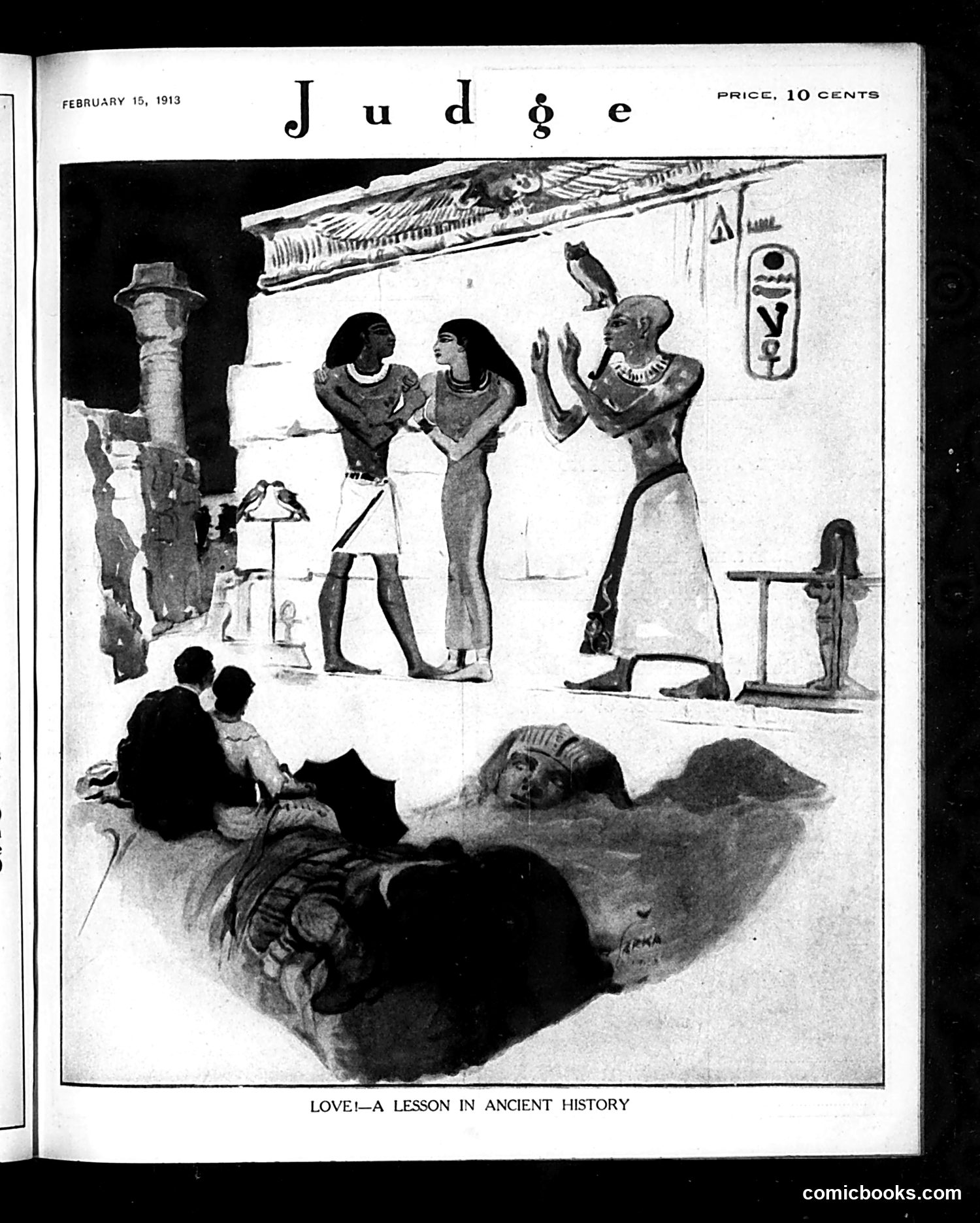
This satirical illustration from *Judge* magazine (February 15, 1913) uses Egyptian imagery to comment on romantic relationships and courtship customs. The upper panel depicts ancient Egyptian figures in a tomb or palace setting, while the lower panel shows modern observers—a couple—viewing this historical scene. The satire appears to be comparing ancient Egyptian romance and domestic life to contemporary American courtship. By framing modern love through the lens of "ancient history," the cartoon suggests that fundamental romantic dynamics between men and women remain unchanged across millennia, despite surface differences in culture and time period. The title indicates this is meant as humorous social commentary on timeless human nature.
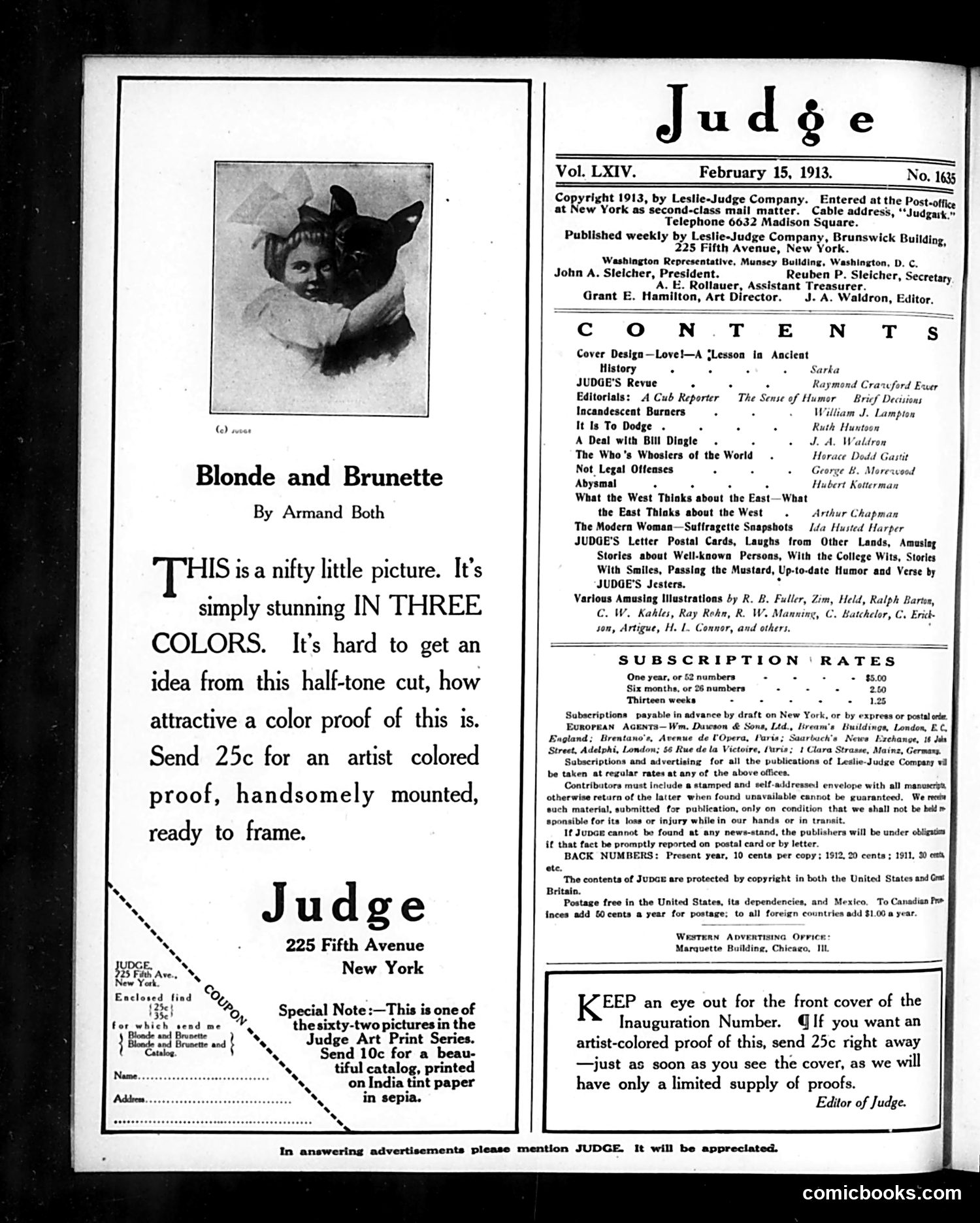
This page is primarily an advertisement for Judge magazine's art print series. The illustration shows a woman's face in profile, rendered as a half-tone image. The advertisement emphasizes that an artist-colored proof version is available for 25 cents, "handsome mounted, ready to frame." The accompanying text highlights the appeal of color proofs, noting this picture is "simply stunning IN THREE COLORS" and claims it's difficult to appreciate the attractiveness from the black-and-white reproduction shown. This appears to be a straightforward commercial promotion rather than political satire—typical of Judge's practice of advertising collectible art prints to readers. The "Blonde and Brunette" title likely simply refers to the feminine subject matter.
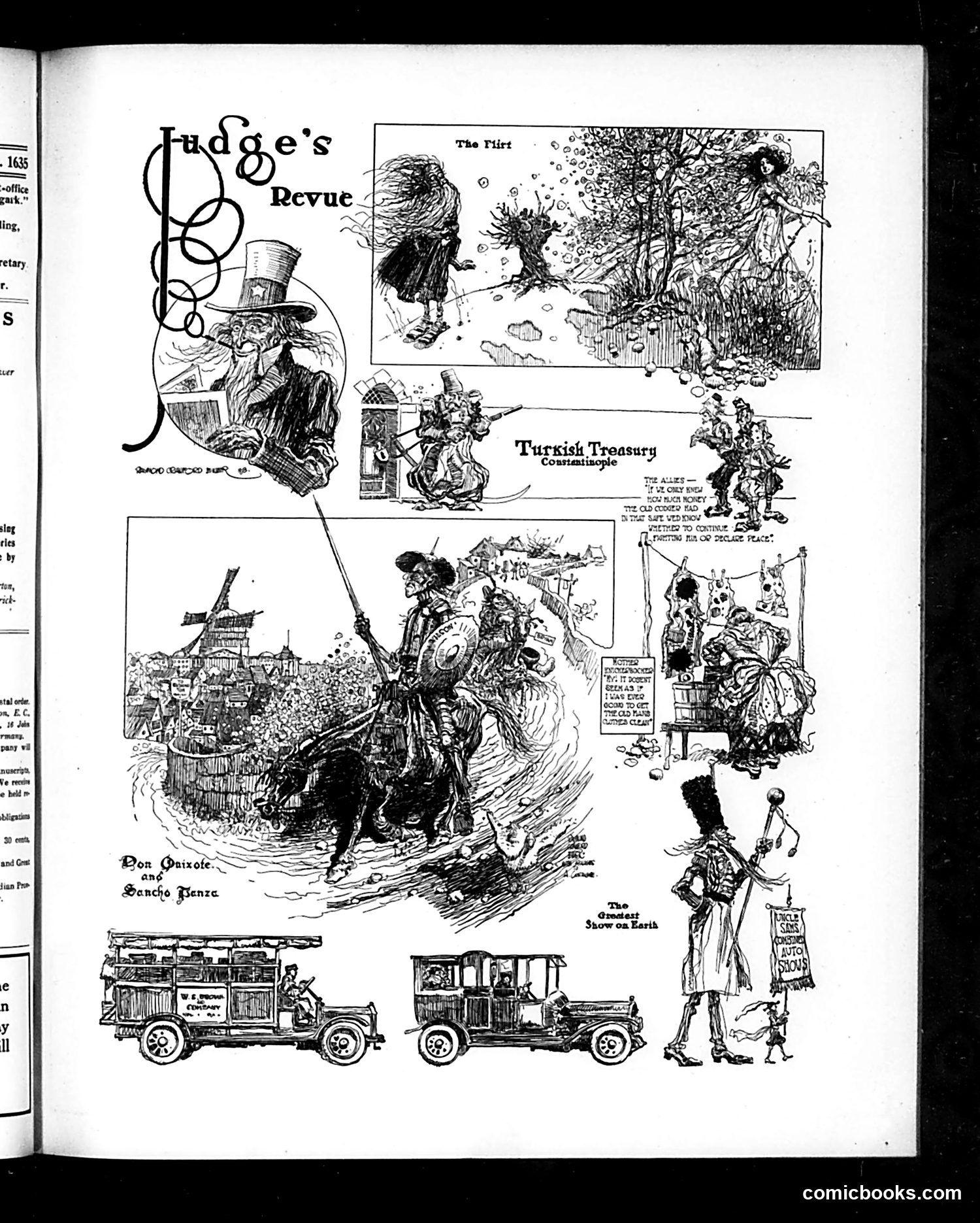
This page features multiple satirical cartoons and illustrations characteristic of Judge magazine's political humor. The central image "Don Quixote and Sancho Pienza" appears to mock idealistic or quixotic political/social figures tilting at windmills—a classical reference to futile crusades. Other titled sections include "The Flirt," "Turkish Treasury," and "The Grandest Show on Earth," suggesting social commentary on various topics from romance to international affairs (possibly Ottoman Empire references, given the "Turkish Treasury" title). The bottom illustrations show period automobiles, likely satirizing modern transportation or commercial life. The overall style employs exaggerated caricatures and allegorical references typical of early 20th-century American political satire, though specific targets remain unclear without additional historical context.
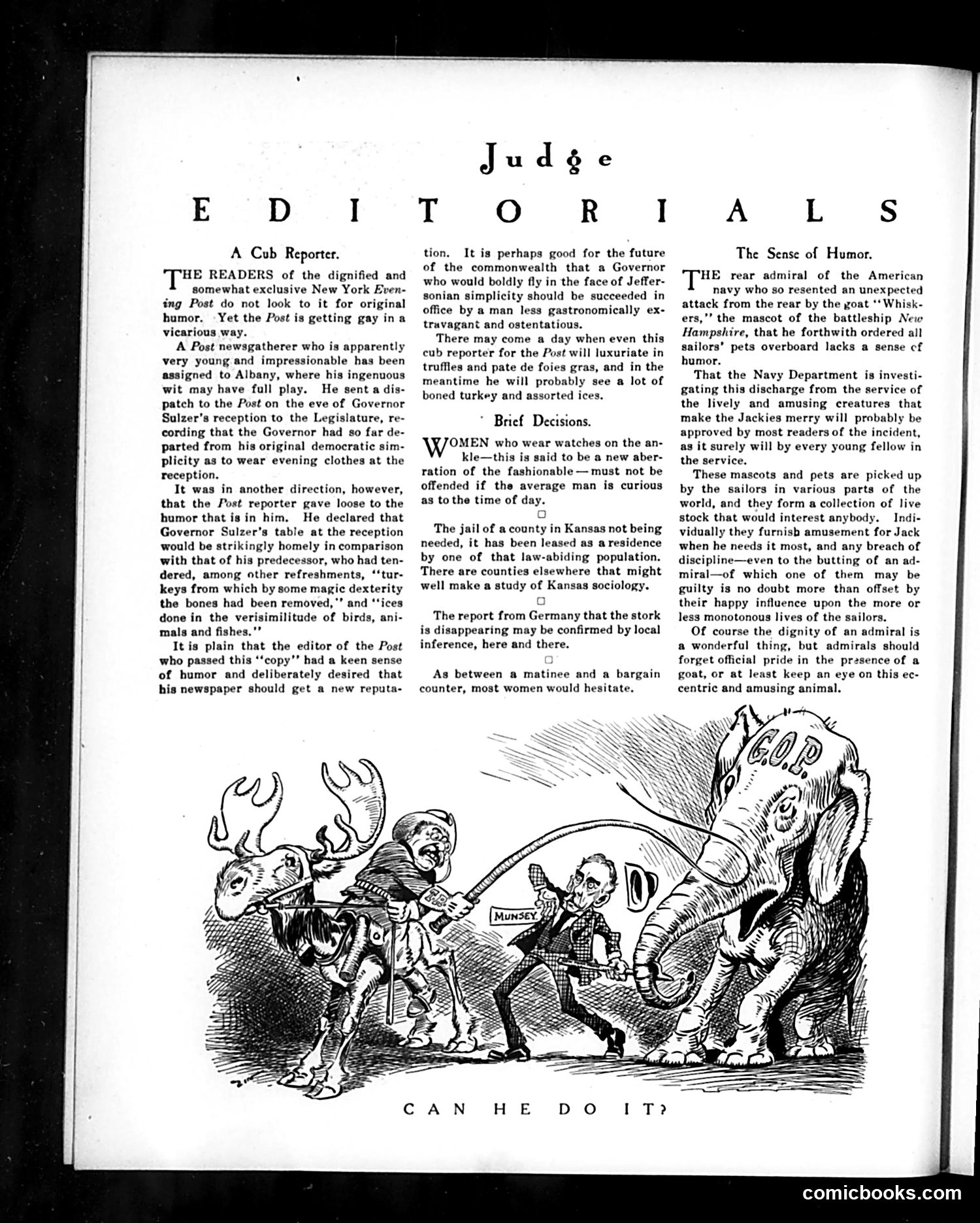
The bottom cartoon depicts a man labeled "Munsey" (likely Frank Munsey, a prominent publisher) being pulled in opposite directions by figures representing competing interests. One pulls toward what appears to be a Republican elephant, the other toward a Democratic donkey, while a third figure (possibly representing labor or another constituency) holds a rope marked "CAN HE DO IT?" The satire questions whether Munsey can maintain editorial independence or balance competing political and commercial pressures. The cartoon suggests the tension between a publisher's business interests, political affiliations, and public credibility—a common satirical theme in Judge magazine's critique of American media and politics during the Progressive Era.
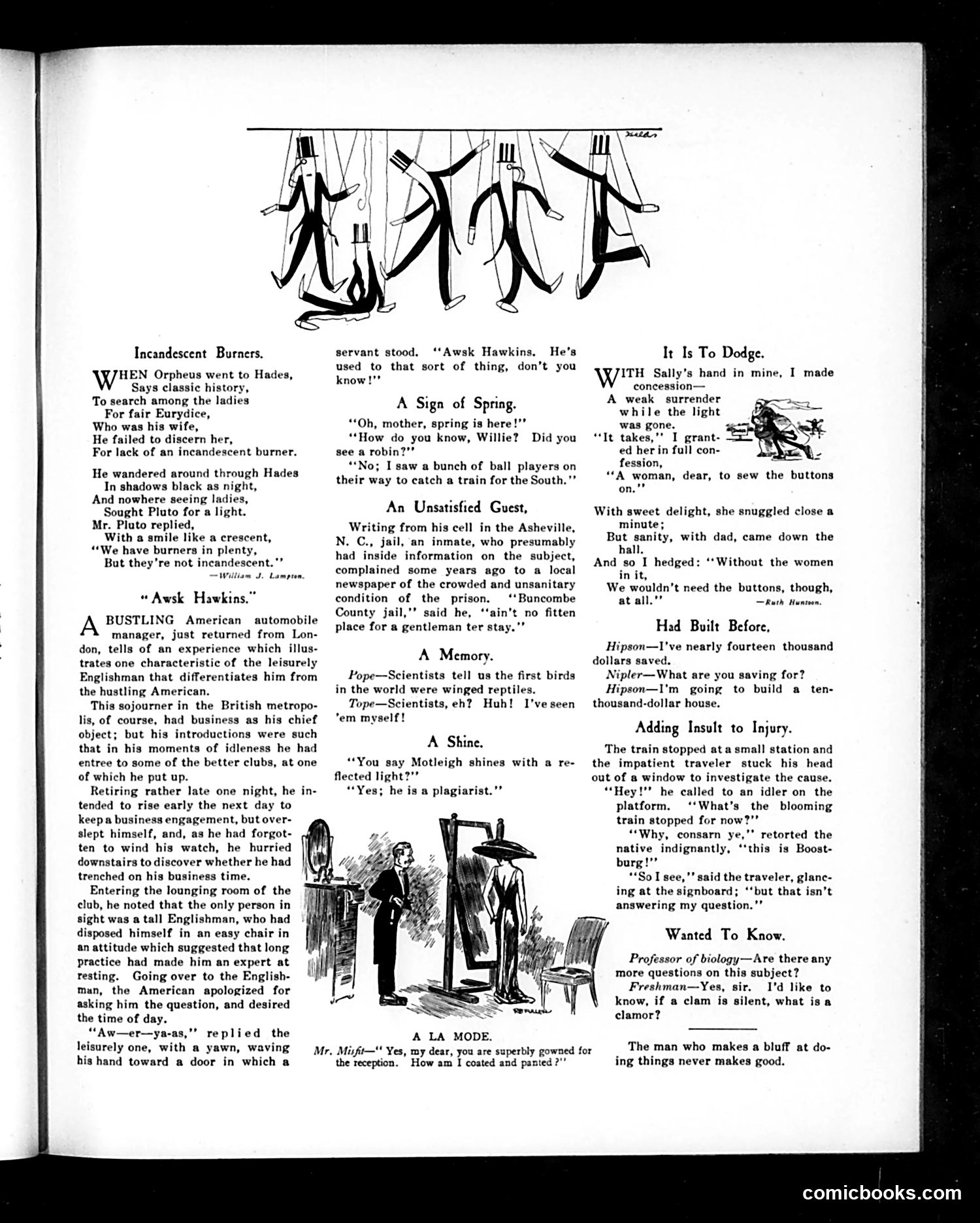
This page contains miscellaneous humor pieces rather than political cartoons. The content includes: **"Incandescent Burners"** — a poem about Orpheus in Hades searching for his wife, using "incandescent burner" as a metaphor (likely referencing early electric lighting technology). **"Awk Hawkins"** — a story about an American automobile manager from London who represents a stereotypical "hastily Englishman" character type. **Various short jokes and anecdotes** including "A Sign of Spring," "An Unsatisfied Guest" (about a prisoner complaint), and "A Shine" (about plagiarism accusations). The page appears to be general-audience humor rather than focused political satire. The illustration shows two men in what appears to be a domestic scene. Without additional historical context about specific figures or events referenced, the humor relies on period-specific social observations about immigration, technology, and character types.
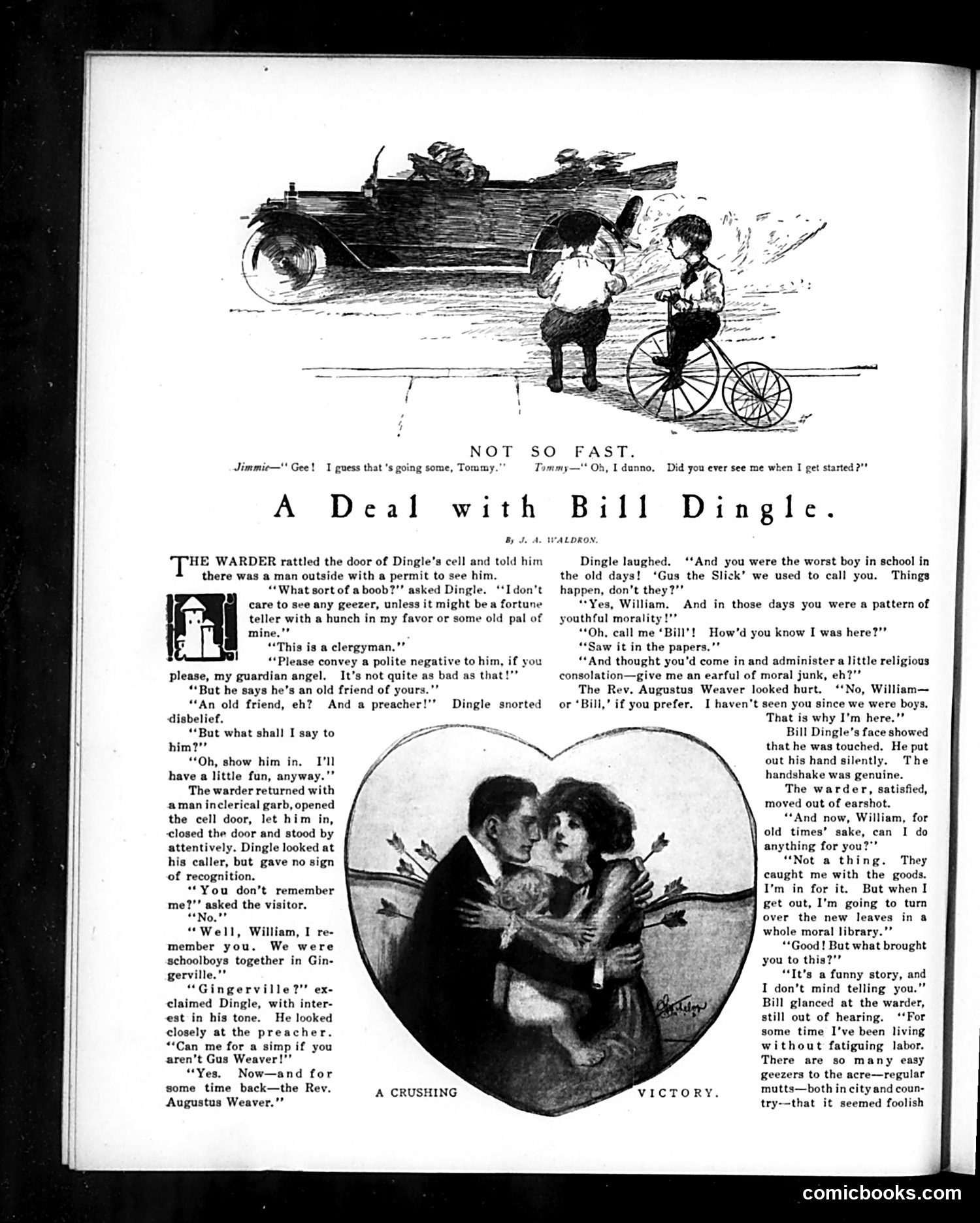
This story depicts a chance prison reunion between two childhood schoolmates: Bill Dingle, an inmate, and Rev. Augustus Weaver, his former classmate who became a clergyman. The satire targets redemption narratives and moral hypocrisy. The joke's setup: Dingle was "the worst boy in school," while Weaver became respectable. Yet Weaver appears genuinely moved to reconnect "for old times' sake" rather than to preach morality. The irony is that Dingle—imprisoned for theft—recognizes the authentic friendship beneath the clerical collar, producing a "genuine" handshake despite their opposite trajectories. The cartoon at top ("Not So Fast") shows children racing toys/bicycles, a thematic parallel: life's paths diverge unpredictably. The satire suggests that reformed criminals may respond better to genuine human connection than religious lecturing—a critique of sanctimonious charity alongside an oddly sympathetic portrayal of the criminal protagonist.
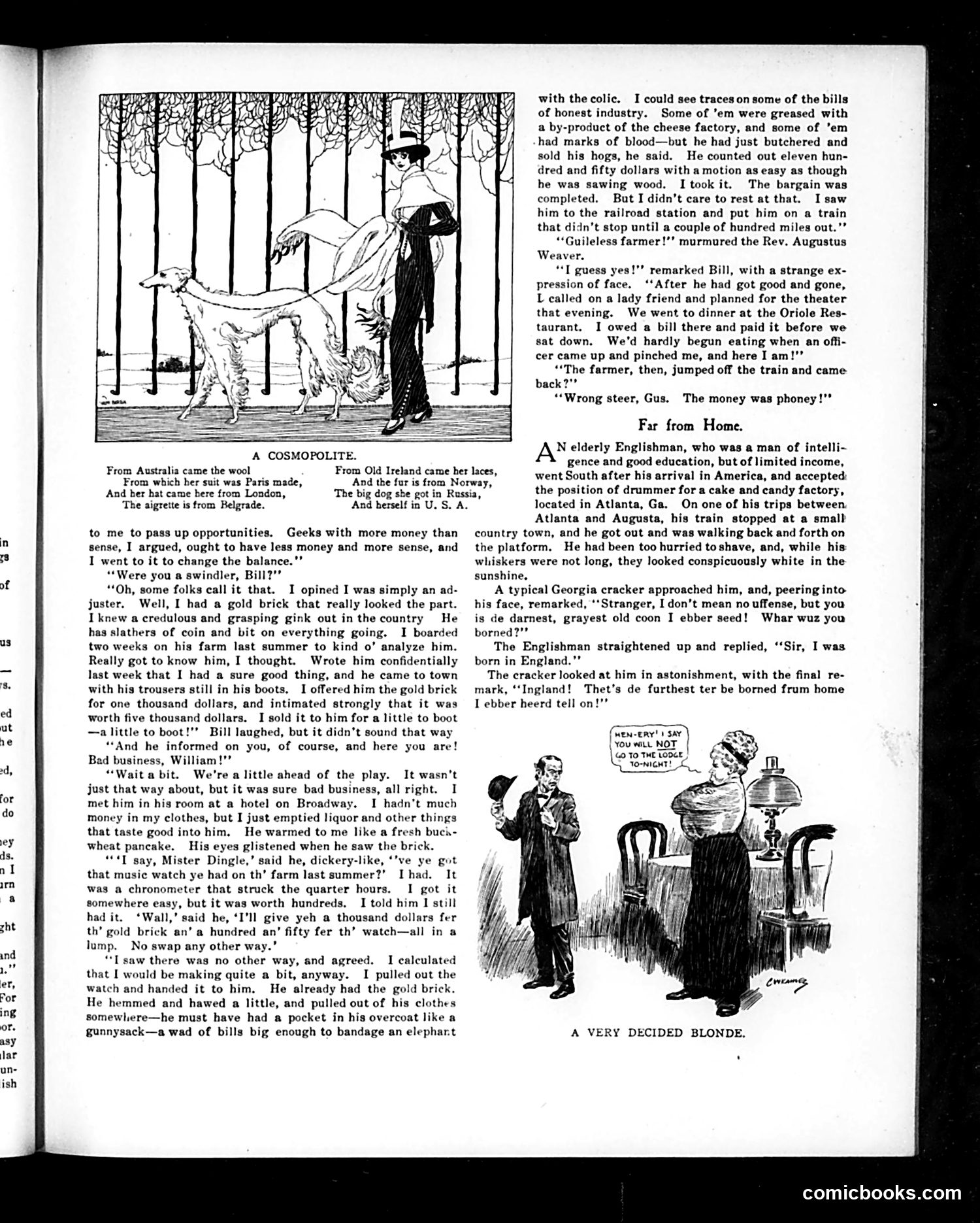
This page contains two distinct pieces of satirical content: **"A Cosmopolite"** (top): A poem mocking cosmopolitan affectation by cataloging a woman's fashionable outfit's international origins—wool from Australia, suit from Paris, hat from London, etc.—emphasizing how the globally sourced wardrobe exemplifies shallow materialism and status-seeking among the wealthy. **"Far from Home"** (main story and cartoons): A narrative about a con artist named Bill who swindles a gullible rural farmer with a gold brick scheme, taking $1,000+ plus a valuable watch. The twist: the money is counterfeit. The accompanying cartoon "A Very Decided Blonde" depicts a woman confronting someone about the scam, suggesting the farmer's revenge or exposure of the fraud. The satire targets both con men exploiting rural innocence and the gullibility of wealthy but unsophisticated businessmen. It reflects turn-of-century anxiety about fraud, sharp dealing, and the clash between urban sophistication and rural credulousness. The "phoney" money punchline undercuts the con artist's triumph.
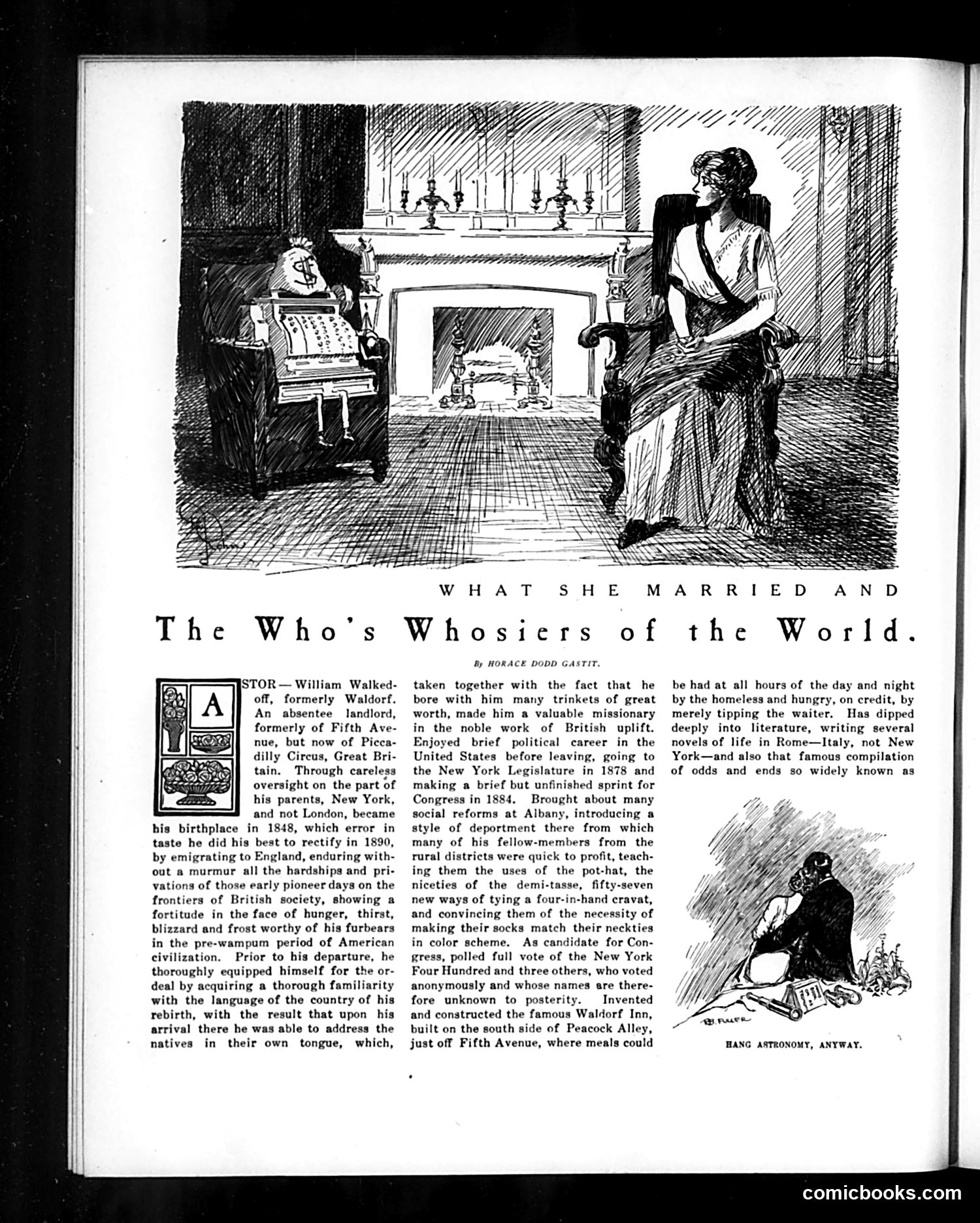
This satirical biography mocks **William Waldorf Astor**, a wealthy New York industrialist who emigrated to England around 1890. The article's heavy sarcasm targets his pretentious Anglophilia and social climbing. The satire hinges on several points: 1. **His abandonment of America**: Born in New York (1848), Astor "rectified" this "error in taste" by moving to England, treating his departure like a pioneer enduring hardship. 2. **Performative sophistication**: He taught rural New York legislators about fashion (pot-hats, matching socks and neckties, cravat-tying)—mocking nouveau-riche attempts at refinement. 3. **Failed politics**: His 1884 Congressional campaign received votes only from "the New York Four Hundred and three others"—sarcastically suggesting his social set plus virtually nobody else voted for him. 4. **The Waldorf Hotel**: Built for "homeless and hungry" guests who could eat "on credit, by merely tipping the waiter"—implying it served no real purpose beyond his vanity. The cartoon's domestic scene illustrates upper-class leisure while the biography ridicules Astor's pretension and irrelevance.
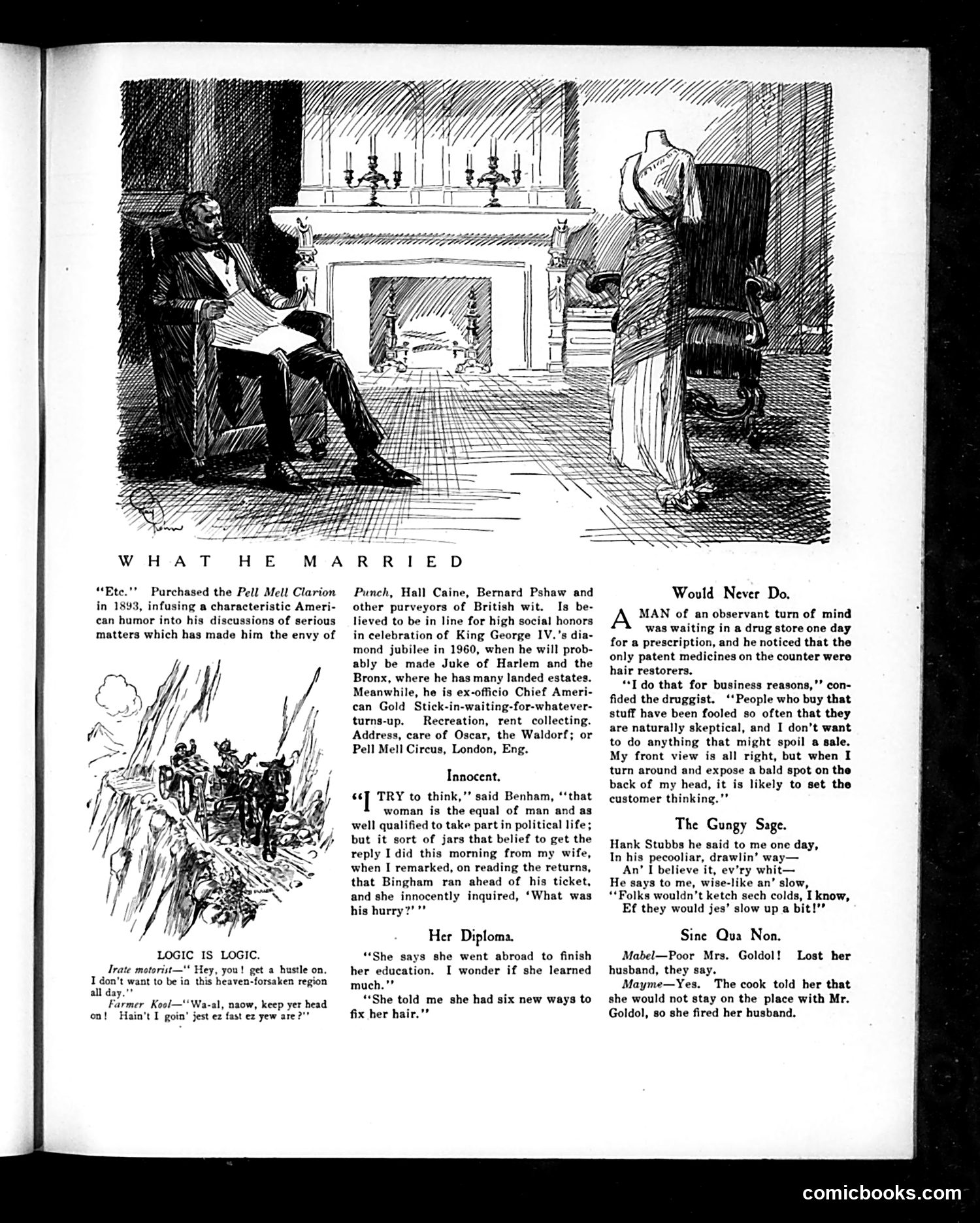
This page contains several brief satirical pieces mocking early-20th-century social pretensions and gender dynamics: **"What He Married"** targets a British publisher of *Pell Mell* magazine, satirizing his inflated social ambitions—he's jokingly positioned to become "Duke of Harlem and the Bronx" by 1960 and holds a meaningless title ("Chief American Gold Stick-in-waiting"). **"Innocent"** ridicules women's political awareness, depicting a wife who doesn't understand basic election terminology, reinforcing the period's stereotype that women lacked intellectual fitness for civic participation. **"Her Diploma"** mocks women's education as frivolous—a woman abroad "finishing" her education supposedly learned only hairstyling tricks. **Other pieces** include jokes about bald druggists, rural wisdom, and a domestic scenario where a wife prioritizes her cook's preferences over her husband's employment. The overall theme: satirizing pretension, female incompetence in serious matters, and class anxieties typical of Judge's conservative humor.
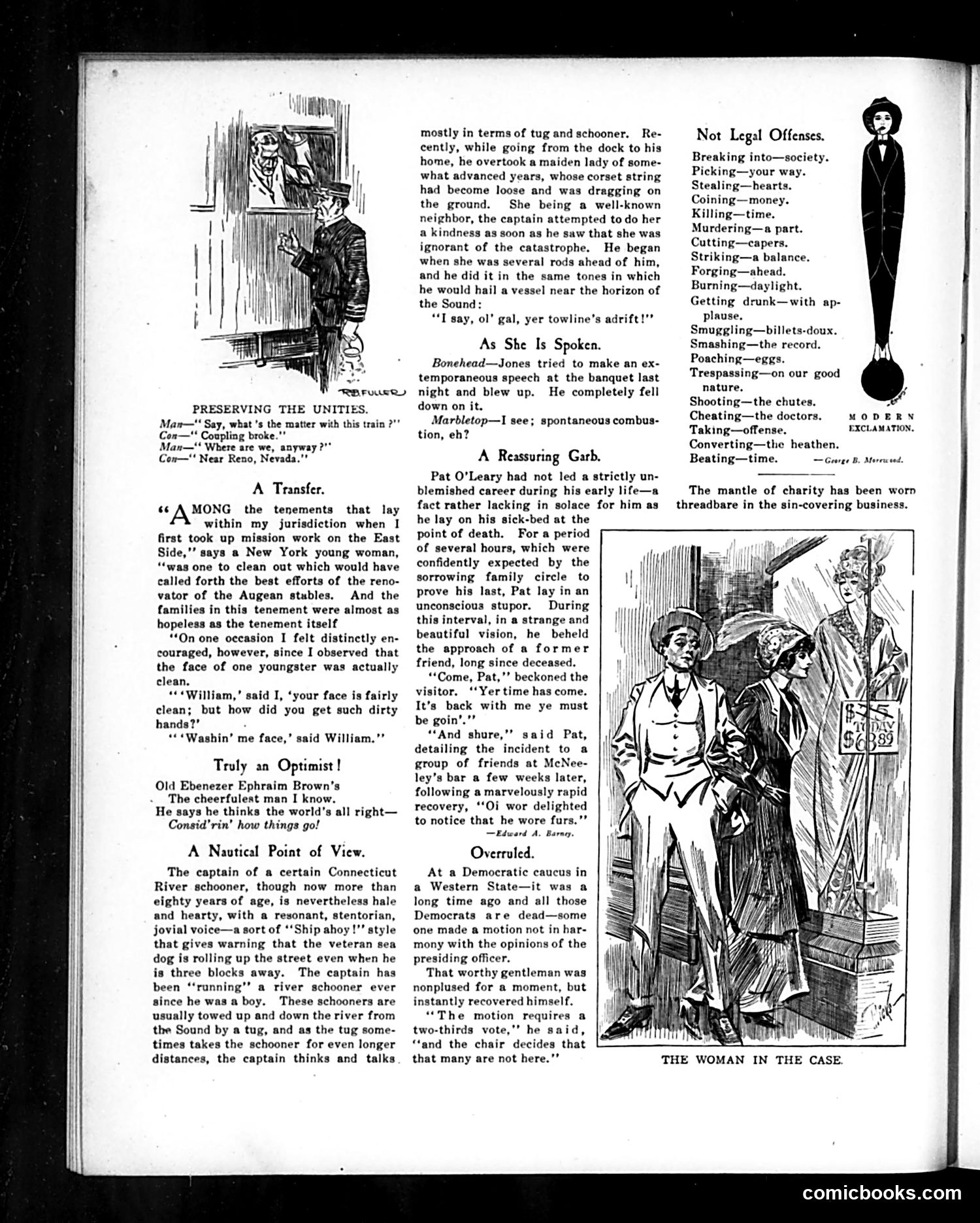
This page contains several brief humorous sketches typical of Judge's satirical format: **"Preserving the Unities"** jokes about a train coupling failure near Reno, Nevada—likely referencing Reno's reputation as a divorce destination, suggesting the "coupling" (marriage) has broken down. **"A Nautical Point of View"** depicts an elderly Connecticut River ship captain shouting at an elderly woman whose corset string is dragging, using nautical language ("yer towline's adrift!"). The humor lies in his inability to communicate except through maritime terminology. **"A Reassuring Garb"** uses Irish dialect humor: Pat O'Leary, a man of questionable moral character on his deathbed, has a vision of a deceased friend coming to collect him—but is comforted seeing the friend wears furs, apparently suggesting respectability or good standing in the afterlife. **"Overruled"** satirizes Democratic political corruption: a presiding officer blocks an unwanted motion by declaring the required two-thirds quorum absent, a transparent procedural manipulation. The page reflects early 20th-century American attitudes toward class, ethnicity (Irish stereotypes), and political cynicism.
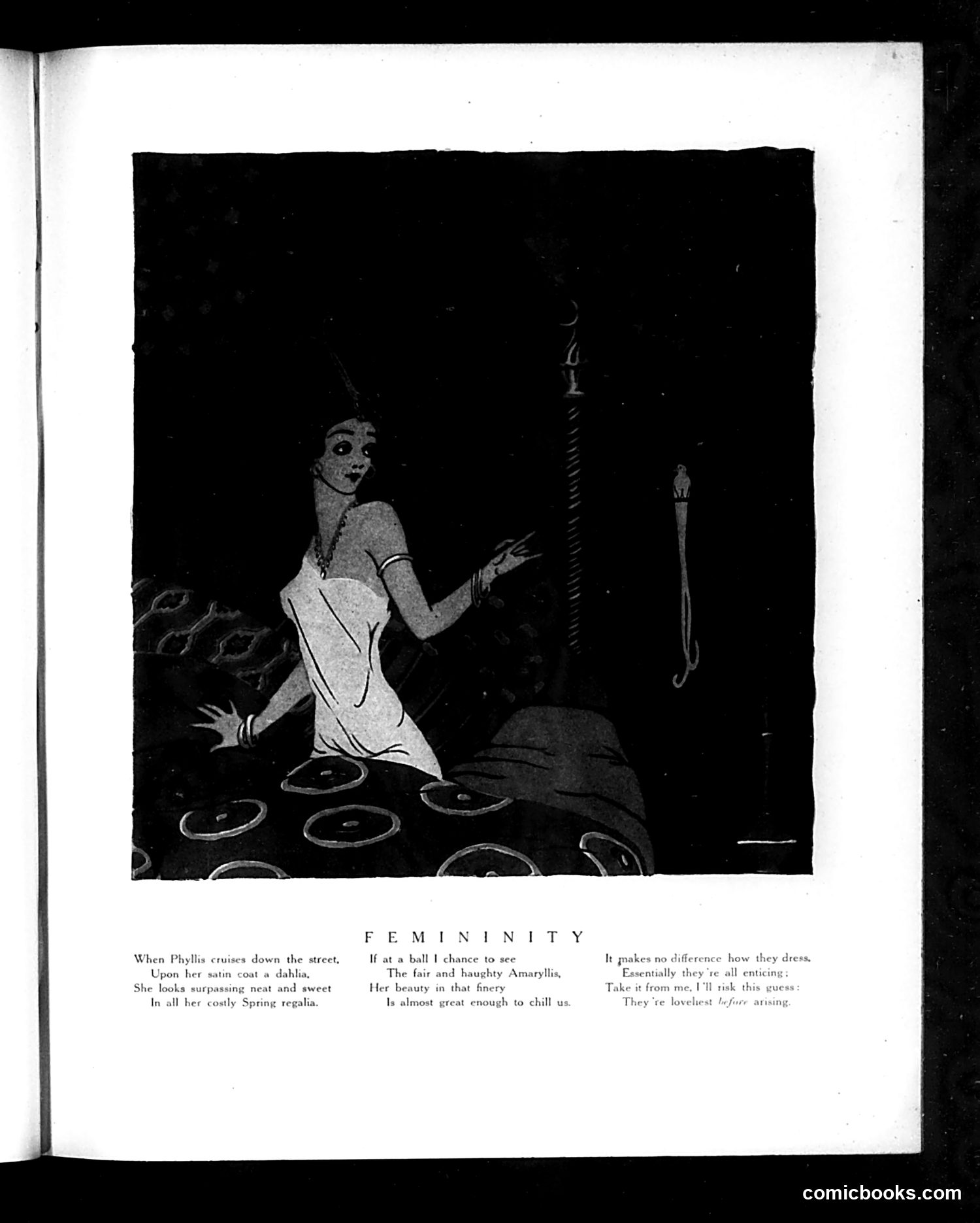
This illustration satirizes early 20th-century ideas about "femininity" and women's allure. The image depicts a woman in fashionable dress surrounded by circular objects (possibly coins or mirrors), holding what appears to be a rope or whip—suggesting control or dominance rather than traditional feminine passivity. The accompanying poem contrasts two women: Phyllis, described as "neat and sweet" in her "costly Spring regalia," with the "fair and haughty Amaryllis," whose beauty is intimidating ("great enough to chill us"). The satire mocks the era's contradictory expectations of women—that they should be both demurely attractive and mysteriously powerful. The poem's final line suggests that despite superficial differences in dress or manner, women are fundamentally captivating ("loveliest before arriving"), poking fun at male fascination with feminine mystique regardless of actual behavior or presentation.
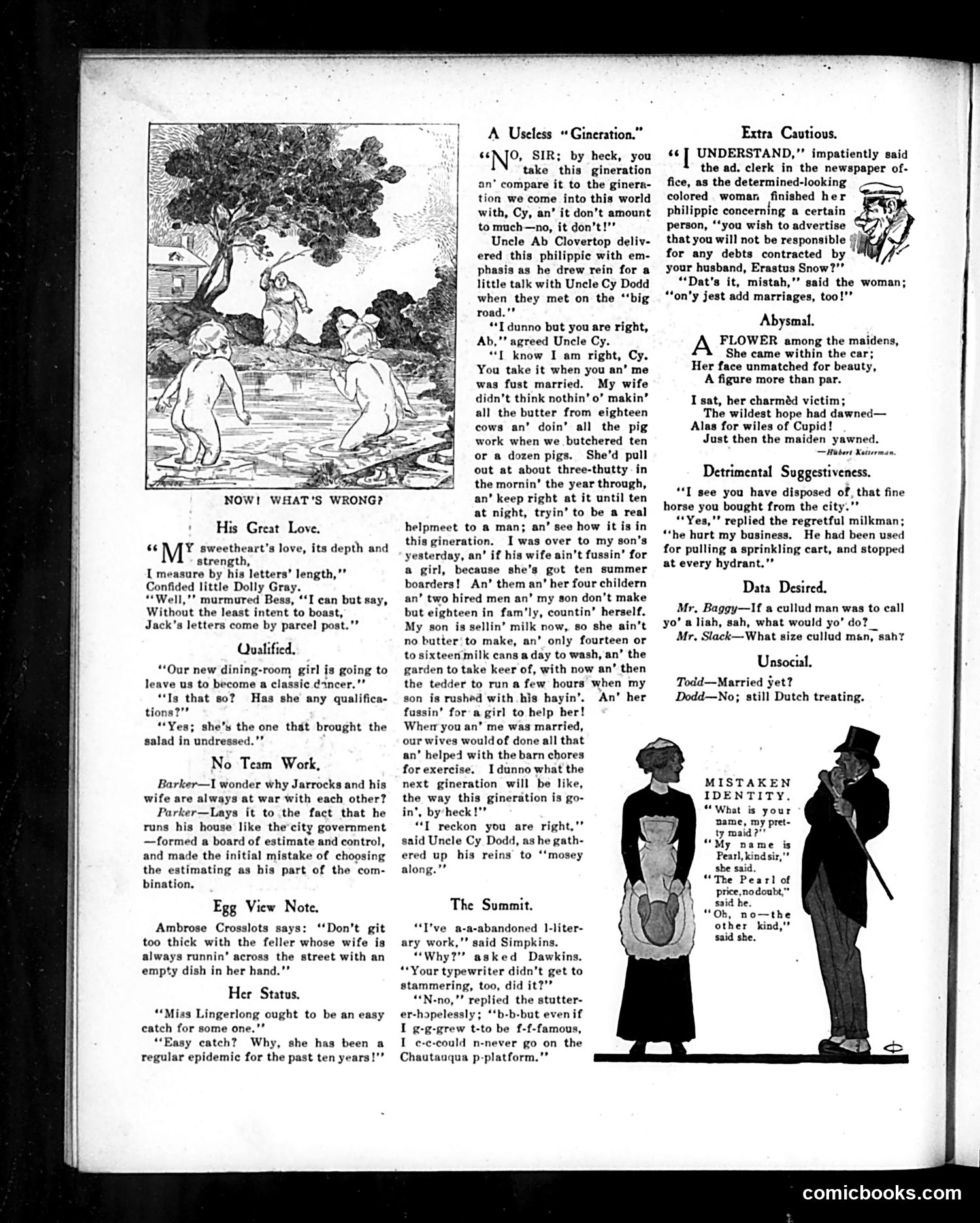
This page contains multiple short humorous pieces typical of early 20th-century American satirical journalism: **Main cartoon** ("Now! What's Wrong?"): Two rural men (Uncle Ab Clovertop and Uncle Cy Dodd) lament that the younger generation lacks the work ethic of their time. Uncle Ab complains his daughter-in-law wants hired help despite having only eighteen family members and light chores (milk cans, gardening). The satire mocks older generations' romanticizing of past hardship and their blindness to their sons' wives' actual labor burdens. **Other pieces** include brief jokes about: a woman's romantic letters measured by postage weight; a dining-room girl's qualifications; municipal government inefficiency; stammering literary types; and newspaper liability disclaimers. The humor relies on wordplay, rural dialect, and social observation typical of Judge's early 1900s readership.
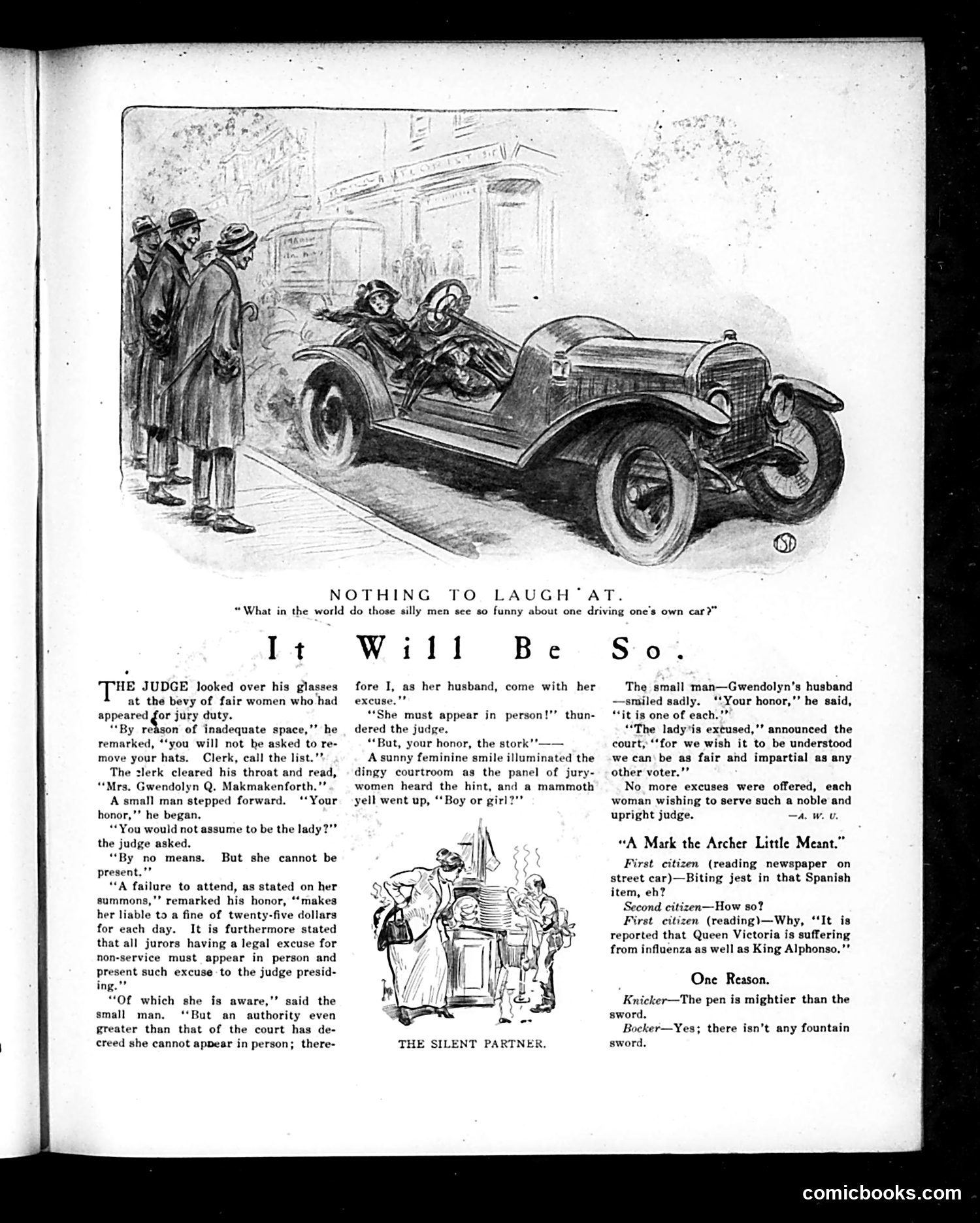
The main cartoon satirizes early 20th-century gender discrimination in the legal system. A husband appears in court on behalf of his wife, Mrs. Gwendolyn Q. Makmakenforth, claiming she cannot serve jury duty because she's pregnant (the "stork" reference). The judge initially insists she appear in person, but when the husband reveals she's expecting twins, the courtroom erupts in laughter—and the judge immediately excuses her. The satire cuts both ways: it mocks the absurdity of legal rules requiring physical presence for a pregnant woman, while also ridiculing the judge's sudden "fairness" once he learns about the pregnancy. The final line—that the court can be "as fair and impartial as any other voter"—is sarcastic commentary on women's legal inequality and lack of voting rights at this time. The smaller items below are unrelated humor pieces about pens and wordplay.
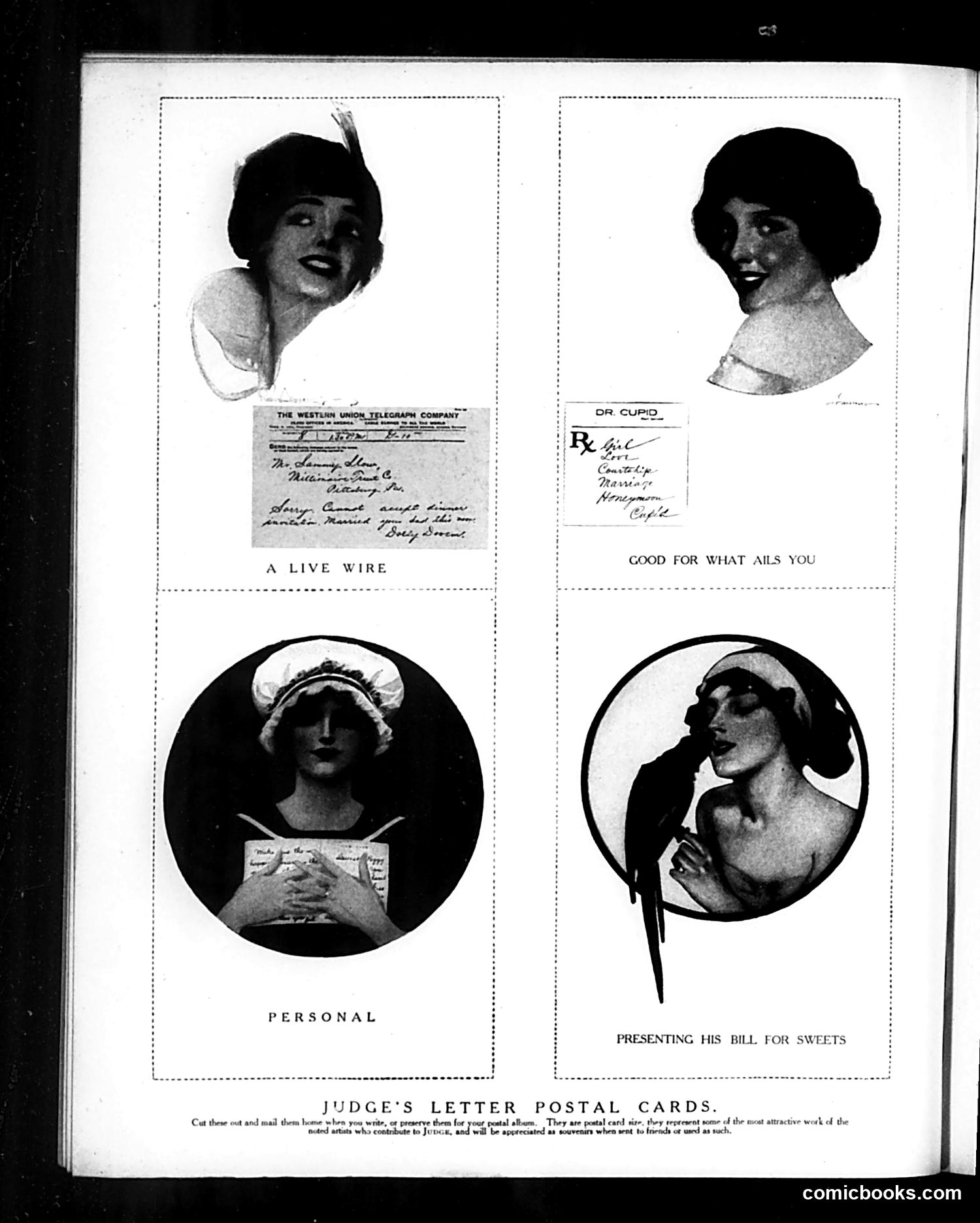
This page presents four satirical postal cards from *Judge* magazine, each depicting romantic or courtship scenarios with humorous titles: **"A Live Wire"** (top left) shows a woman sending a telegram, suggesting energetic, modern courtship communication. **"Good for What Ails You"** (top right) features "Dr. Cupid" offering a prescription—a common early-20th-century joke format treating romance as medical remedy. **"Personal"** (bottom left) depicts a woman in sailor outfit, likely playing on contemporary gender-role humor or military romance themes. **"Presenting His Bill for Sweets"** (bottom right) shows a figure presenting charges, satirizing the financial costs of courtship—a recurring *Judge* theme mocking male suitors' expenses on romantic gestures. These cards parody popular courtship conventions of the era while maintaining *Judge*'s genteel, middle-class humor. The postal card format itself was contemporary advertising, encouraging readers to mail them as mementos.
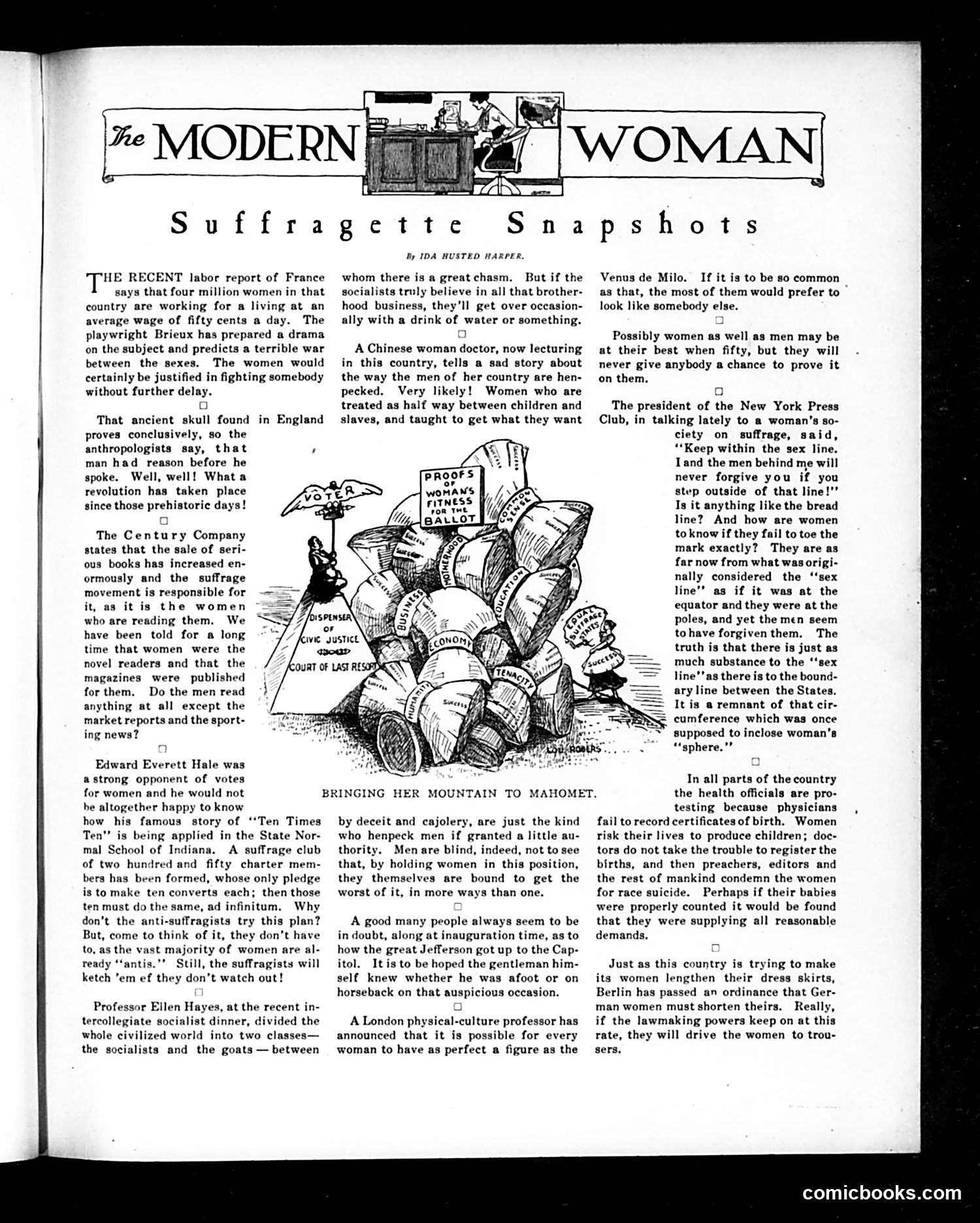
This page from *Judge* magazine presents satirical commentary on women's suffrage and rights, circa early 1900s. The central cartoon depicts a woman pushing an enormous boulder labeled with various women's issues ("Woman's Rights," "The Ballot," etc.) uphill—illustrating the phrase "bringing her mountain to Mahomet," meaning women must do all the work to achieve equality. The accompanying text by Ida Husted Harper mocks anti-suffrage arguments through irony. It references French labor reports, a Chinese woman doctor's observations about henpecked men, and a New York Press Club president's warning that women shouldn't "step outside" the "sex line"—which Harper ridicules as arbitrary and already blurred. The satire's point: opponents of women's rights use contradictory logic, women already work and contribute significantly, and resistance to suffrage lacks rational foundation. The magazine uses humor to advance pro-suffrage arguments by exposing the illogic of the opposition.
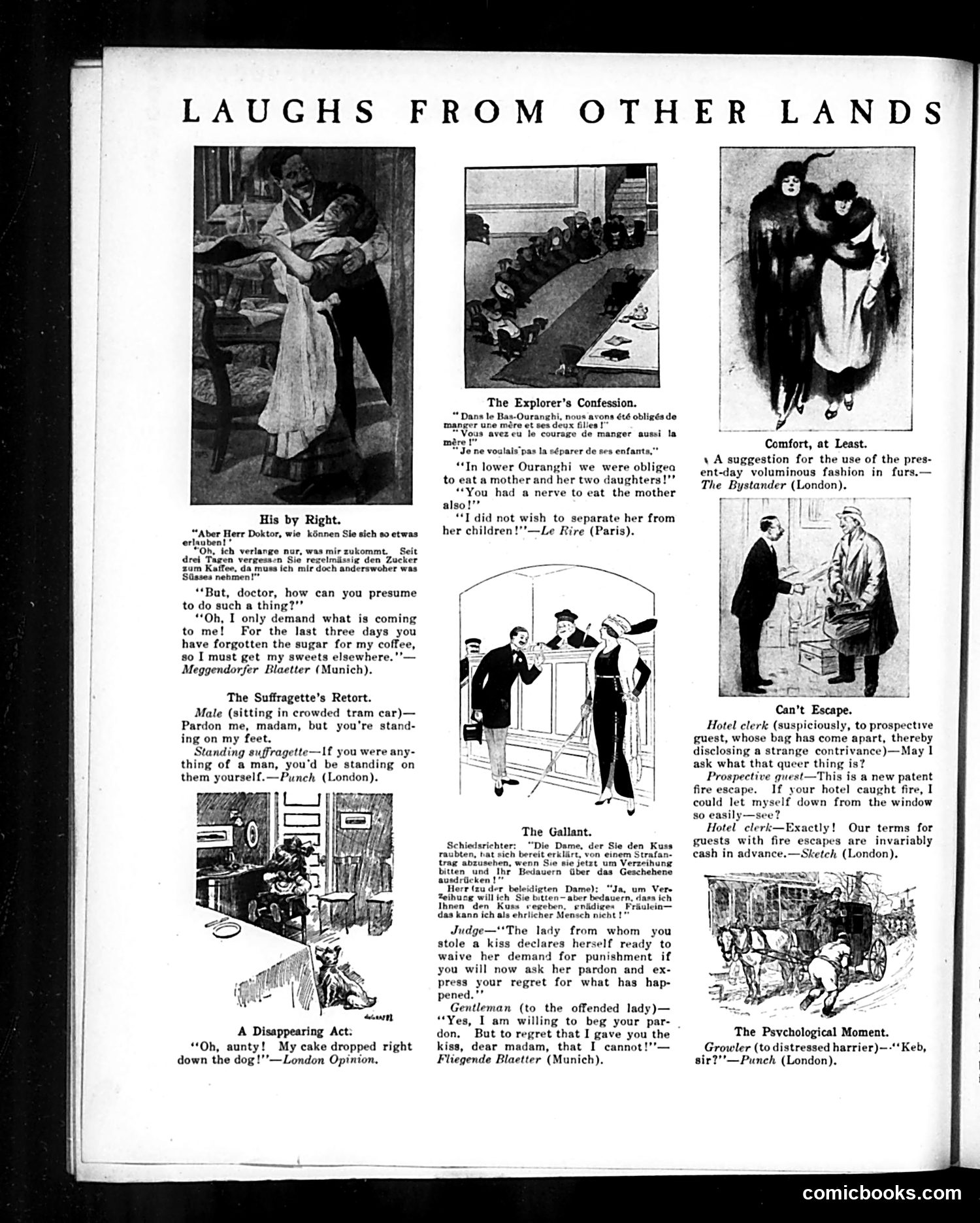
This page collects brief comic sketches reprinted from European satirical magazines (Munich, Paris, London). Each targets social absurdities: **"His by Right"** mocks a doctor's entitlement—demanding sweets elsewhere after his patient forgot sugar in his coffee. **"The Suffragette's Retort"** captures early 20th-century gender politics: a woman standing on a man's feet in a crowded tram responds to his complaint by suggesting *he* should be the one making sacrifices, satirizing male privilege. **"The Explorer's Confession"** presents dark humor about colonial cannibalism—a explorer justifies eating a mother with her daughters by claiming he wouldn't separate families. **"The Gallant"** mocks male honor: a gentleman admits stealing a kiss but refuses to express regret, claiming he cannot honestly regret it—prioritizing dishonest gallantry over actual contrition. **"Can't Escape"** satirizes hotel profiteering: a clerk welcomes guests with patent fire escapes only to charge premium rates, inverting safety into a commercial opportunity. The page demonstrates Judge's internationalist approach to humor while reflecting period attitudes toward gender, colonialism, and class.
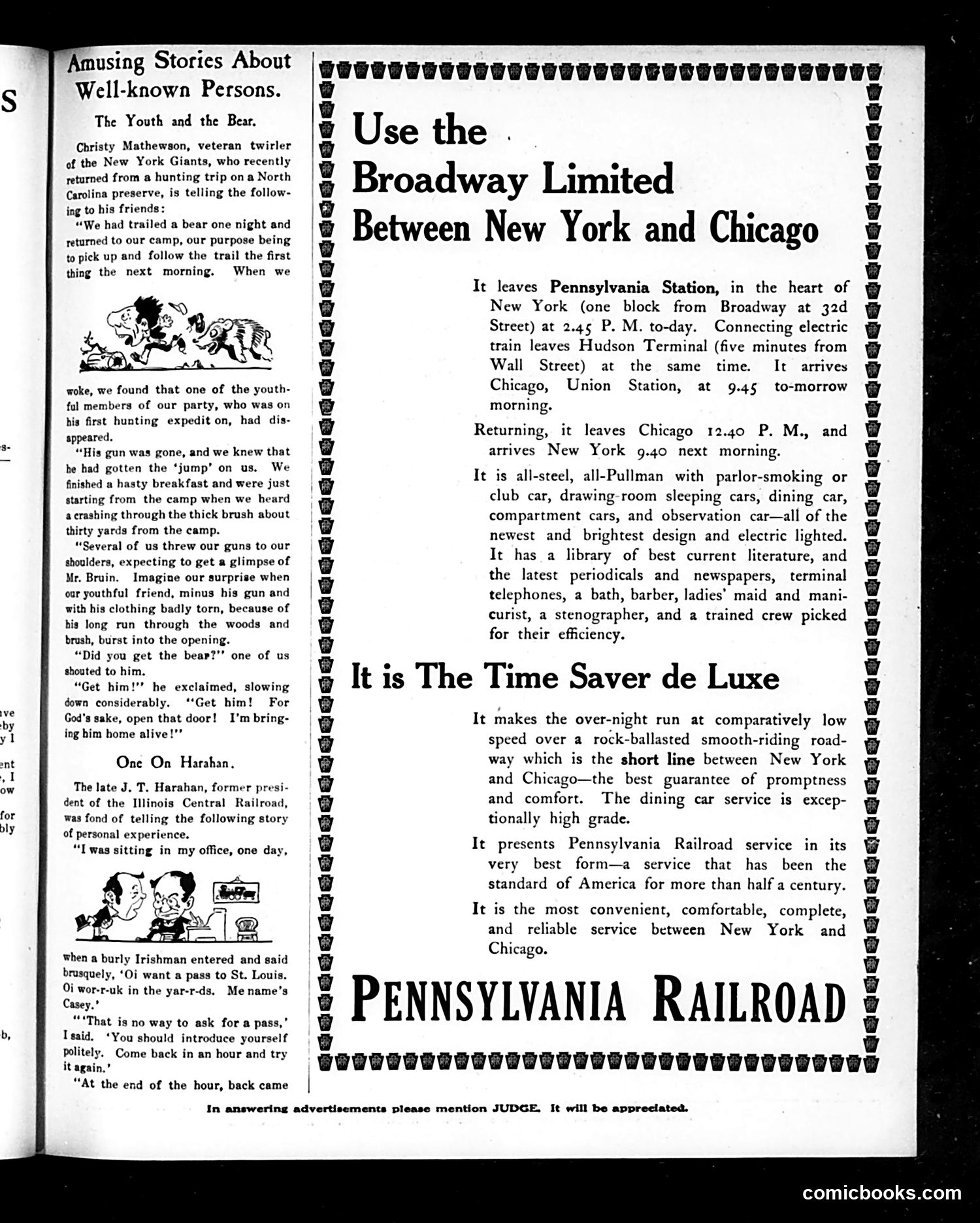
This page combines humor columns with a railroad advertisement. **"The Youth and the Bear"** attributes a hunting anecdote to Christy Mathewson, star pitcher for the New York Giants. The joke's humor derives from the novice hunter chasing a bear back to camp and desperately asking others to open the door—implying he's fleeing rather than triumphantly bringing it home. It's gentle, self-deprecating humor about an inexperienced sportsman. **"One On Harahan"** credits J. T. Harahan, former Illinois Central Railroad president, with a story about an Irish railroad yard worker requesting a pass. The joke centers on dialect humor and class dynamics: the worker's rough manners are corrected, he returns with formal politeness, and presumably receives his pass. This reflects early-20th-century attitudes toward working-class immigrants and "proper" conduct. The **Pennsylvania Railroad advertisement** dominates the right half, promoting the Broadway Limited train service between New York and Chicago, emphasizing luxury, speed, and modern amenities. The decorative border of small pot symbols suggests quality or prestige.
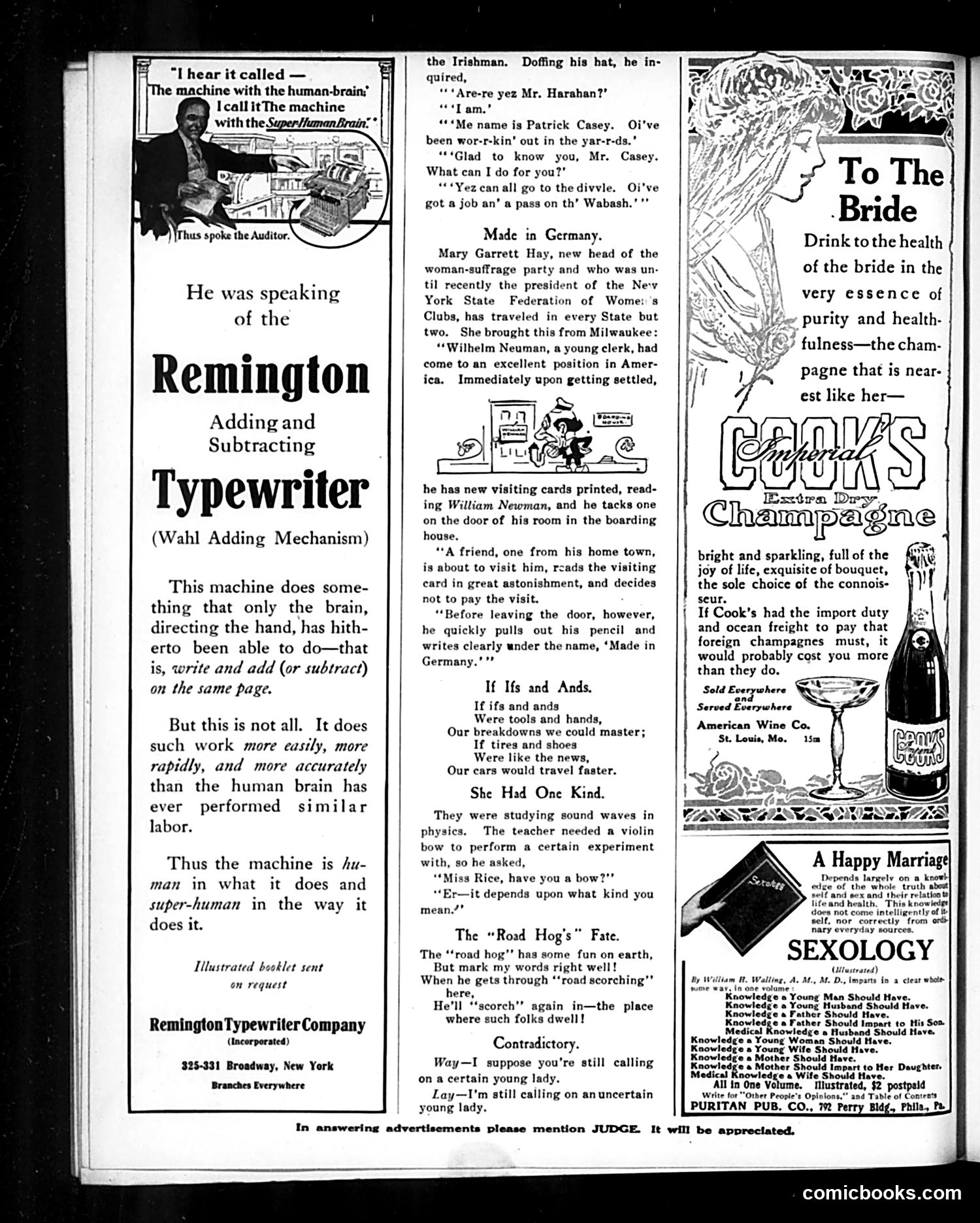
This page from *Judge* contains mostly **advertisements and humor snippets** rather than political cartoons. The main content includes: **The Remington Typewriter ad** (left): Markets an adding/subtracting typewriter as a "super-human" machine—capable of performing mathematical calculations alongside typing, surpassing human mental labor. This reflects early-20th-century anxieties and enthusiasm about automation replacing human cognition. **Short humor pieces** (center): Include Irish-immigrant dialect jokes, a story about a German immigrant embarrassed by his "Made in Germany" business card, and puns about uncertain courtship and reckless driving ("road hogs"). These reflect common period stereotypes. **Cook's Champagne and Sexology book ads** (right): Period advertisements for luxury goods and self-help literature on marriage and sexual education. The page exemplifies *Judge's* mix of satirical content, social observation through ethnic humor, and commercial advertising—typical of American humor magazines from this era (appears to be early 1900s based on references and style).
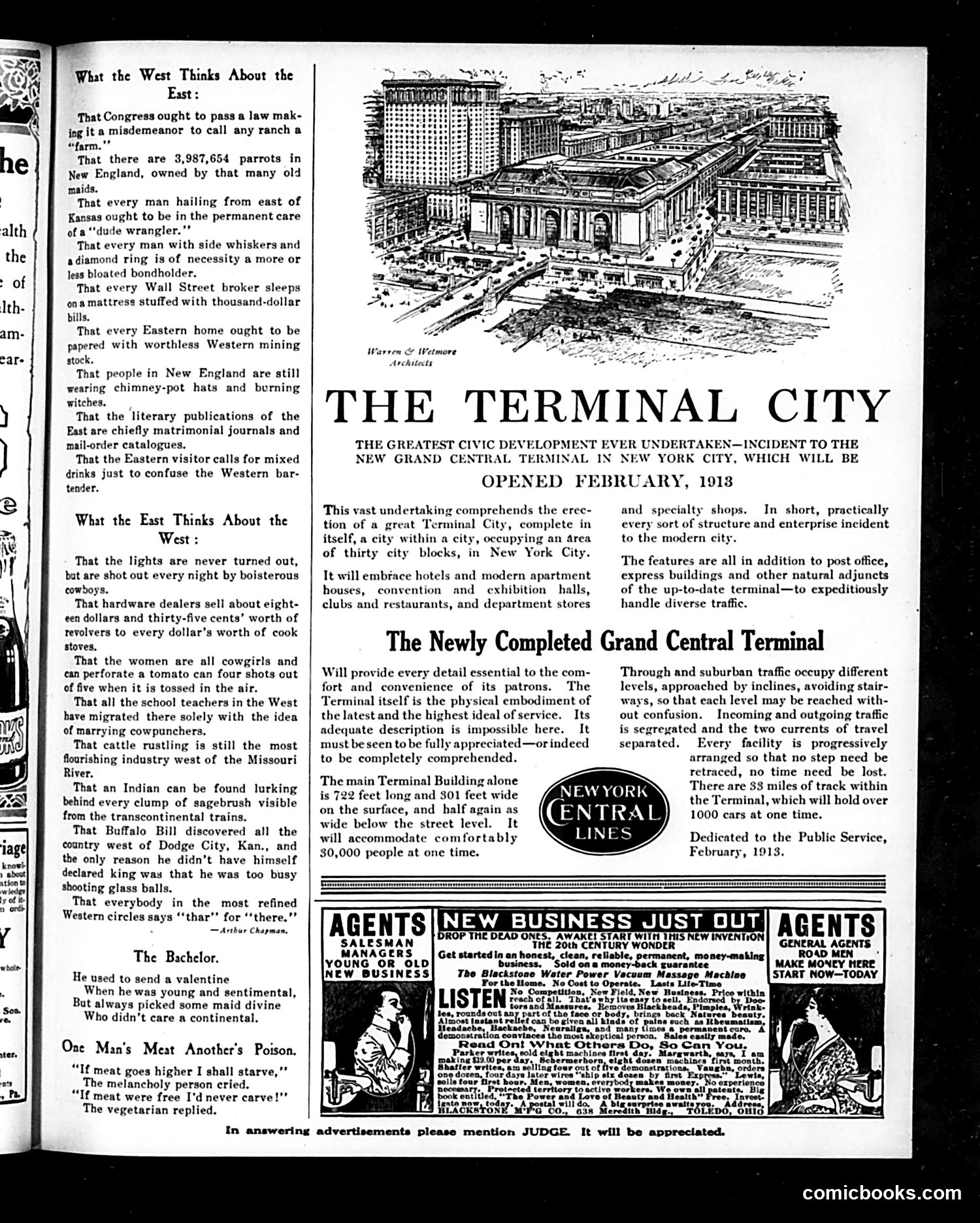
This page presents **regional stereotypes as satire**. The left column lists exaggerated, mutually contradictory misconceptions: Easterners think Westerners are gun-slinging, illiterate cowboys; Westerners think Easterners are effete Wall Street parasites obsessed with mining stocks and witchcraft. The humor lies in how ridiculous both sets of prejudices are—recognizing that Americans harbored absurd caricatures of unfamiliar regions. The right side pivots to **earnest boosterism**: a full-page advertisement for Grand Central Terminal's February 1913 opening, celebrating it as "The Terminal City"—a modern urban marvel with hotels, shops, and efficient traffic segregation. The contrast itself is satirical: immediately after mocking regional ignorance, the magazine promotes technological progress and rational urban planning, implying that such modern infrastructure might overcome provincial attitudes. The small poems at bottom ("One Man's Meat Another's Poison") reinforce the theme of opposing perspectives.
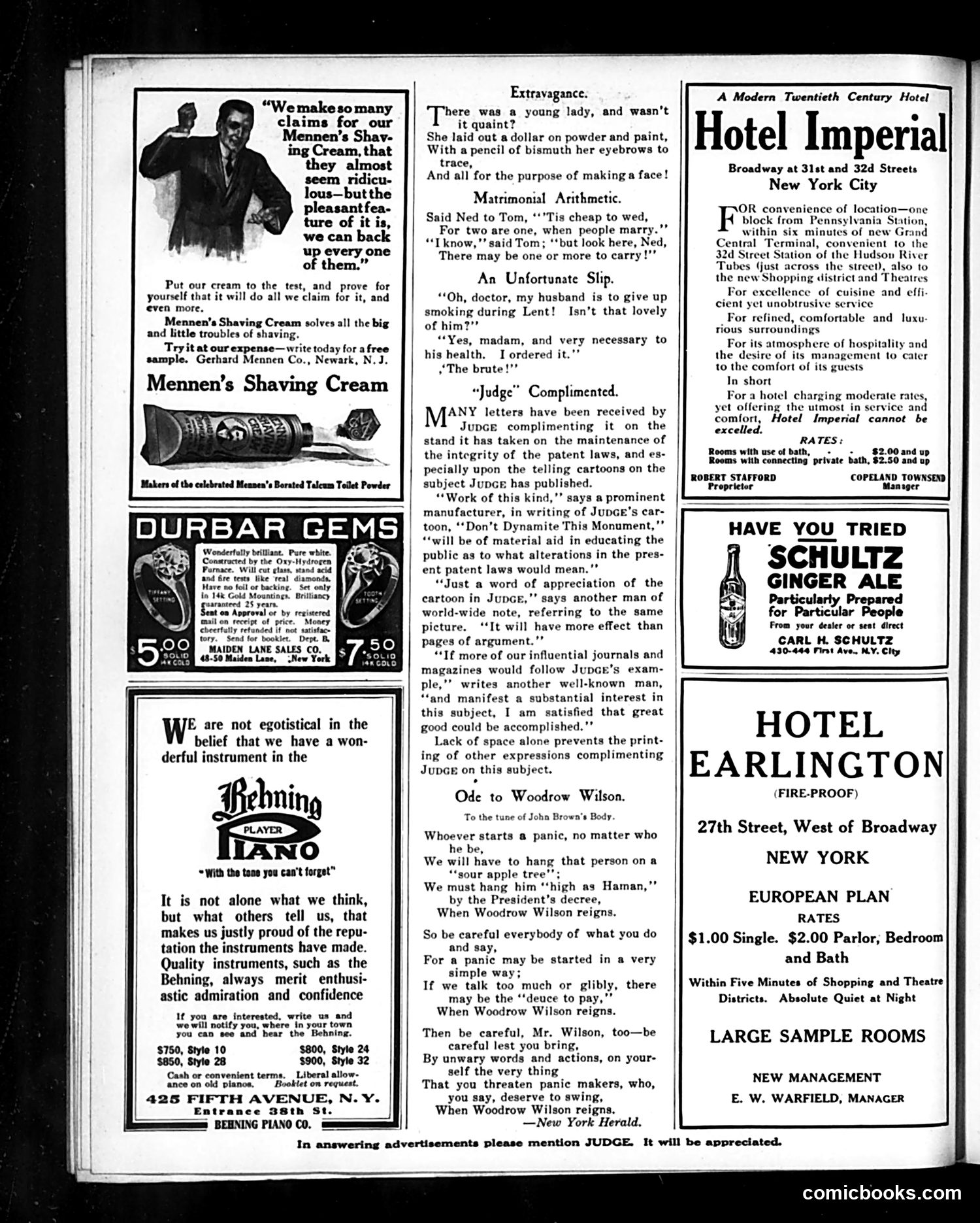
This page is primarily **advertising with brief humorous filler content**, not political cartoons requiring historical context. The advertisements dominate: Mennen's Shaving Cream, Durbar Gems (jewelry), Behning pianos, and several hotels. The editorial humor includes light domestic jokes ("Matrimonial Arithmetic," "An Unfortunate Slip") with no specific political reference, plus **a section praising Judge's own editorial cartoons on patent law protection**—essentially self-congratulatory commentary from manufacturers approving the magazine's pro-business stance on intellectual property. Most notably, there's **"Ode to Woodrow Wilson,"** a satirical poem apparently criticizing Wilson-era panic about economic disruption. References to hanging people on "sour apple trees" and threats of "deuce to pay" suggest anxiety about Wilson's policies or enforcement actions, though the specific context is unclear without the complete text. Overall, this reflects early 20th-century concerns about commerce, patents, and presidential authority rather than sustained political satire.
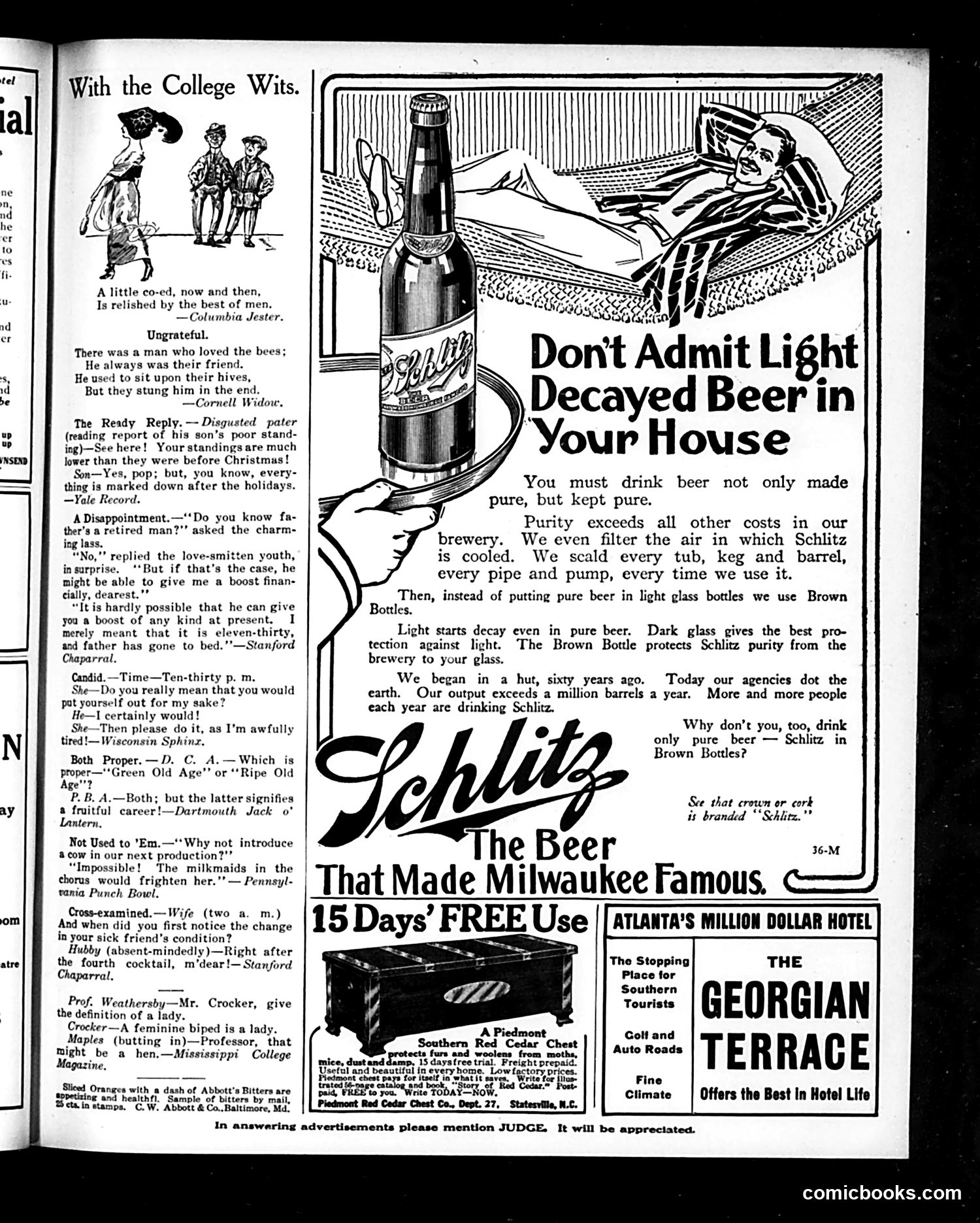
This Judge magazine page contains two distinct sections: **Left side:** College humor reprints from various university publications (Columbia, Cornell, Yale, Stanford, etc.). These are brief jokes about undergraduate life—poor grades blamed on post-holiday markdowns, a father retiring to bed at 10:30 p.m., a woman asking her tired date to "pat himself out" (rest). The humor relies on wordplay and domestic situations familiar to college-age readers of the 1910s. **Right side:** A full-page advertisement for Schlitz beer. The ad warns against "decayed beer" exposed to light, promoting Schlitz's brown bottles as protection. It emphasizes purity, sanitation (scalding equipment), and the brewery's sixty-year history producing "a million barrels a year." This pre-Prohibition advertisement uses pseudo-scientific language about light degradation to justify premium pricing and packaging. The page also advertises a Southern hotel and a cedar chest. The humor and advertising coexist without irony—typical of Judge's mixed content approach.
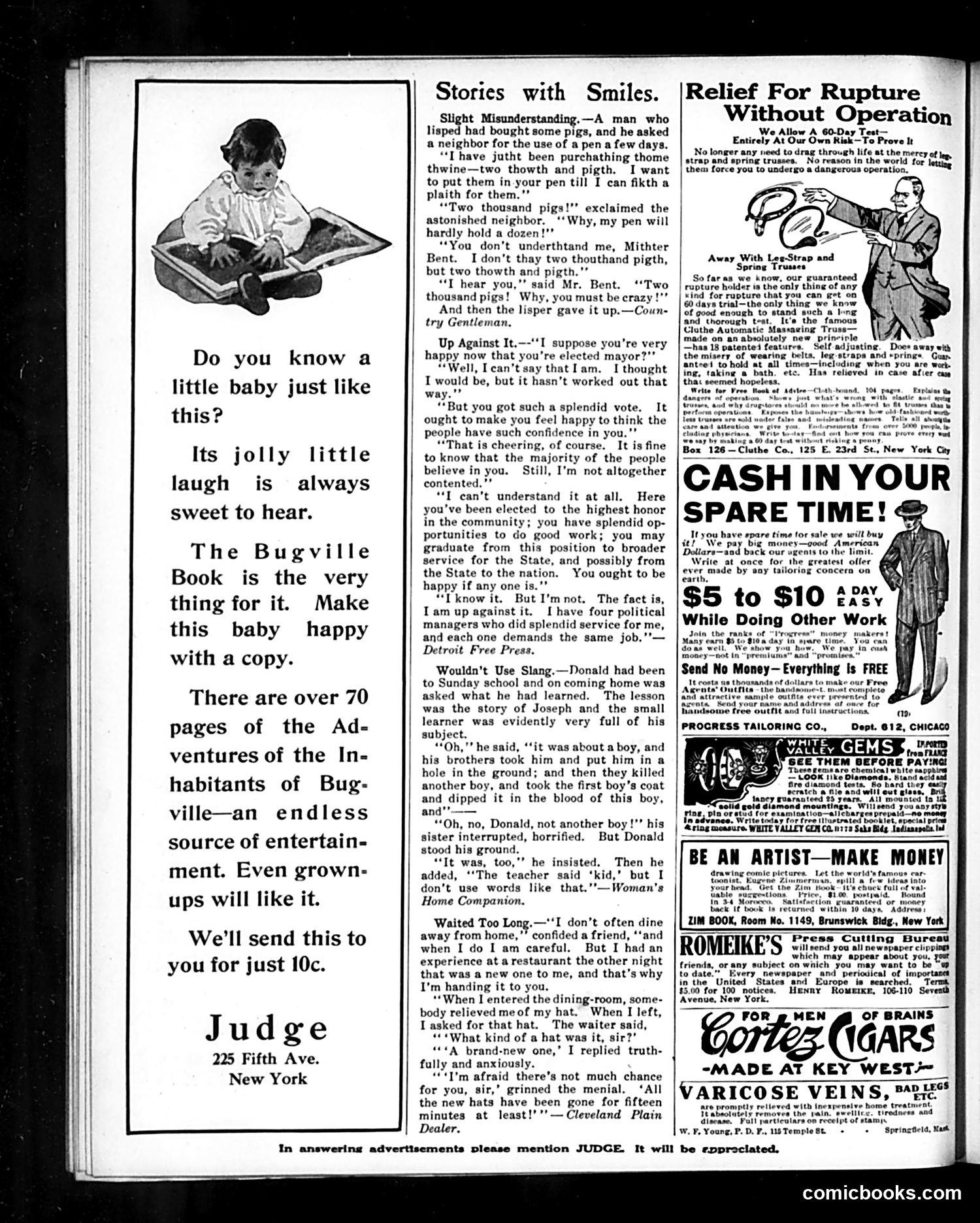
This page contains three humor pieces and period advertising. The three "Stories with Smiles" are short comedic anecdotes: 1. **"Slight Misunderstanding"** plays on a man with a lisp asking to borrow a pen for pigs. The neighbor repeatedly mishears "two sows and pigs" as "two thousand pigs," creating absurdist confusion. 2. **"Up Against It"** satirizes a newly elected mayor who, despite winning office and receiving public confidence, is miserable because four political operatives who helped elect him each demand the same patronage job—poking fun at machine politics and the burdens of political obligation. 3. **"Wouldn't Use Slang"** humorously depicts a child recounting the Biblical story of Joseph to his sister, pedantically refusing to use the teacher's word "kid" while describing brothers murdering another boy—innocent humor about childhood literalism. The page is primarily advertisement-driven, including pitches for rupture relief devices, money-making schemes, and cigars. The Bugville Book advertisement (left) targets families with children.
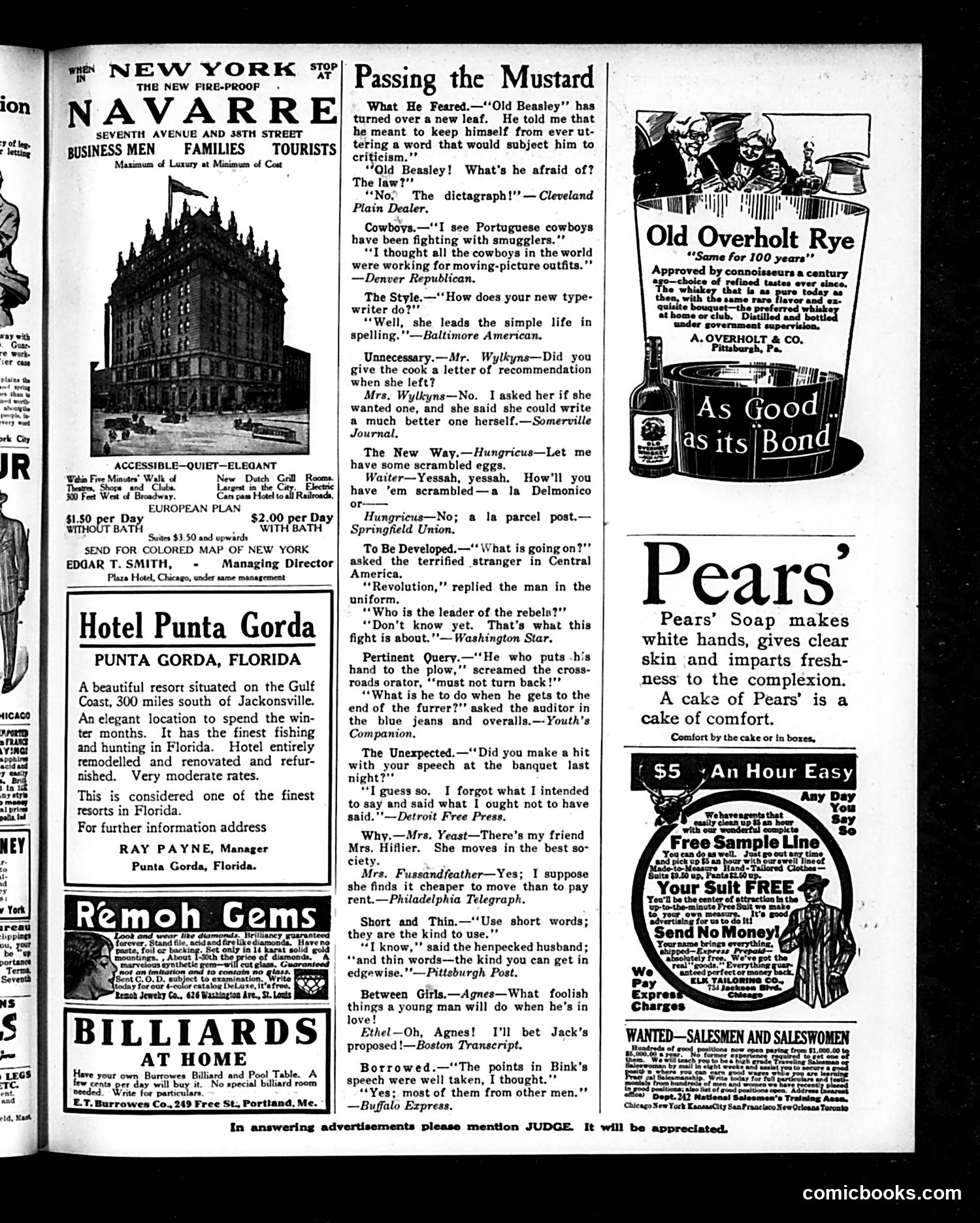
This page is primarily **advertising with brief comedic filler content** rather than political satire. The dominant features are hotel and product advertisements (Hotel Navarre, Hotel Punta Gorda, Old Overholt Rye whiskey, Pears' Soap, and billiard tables). The "Passing the Mustard" section contains short humorous anecdotes typical of early-20th-century American humor magazines. These jokes mock contemporary concerns: a man avoiding criticism from the "dictagraph" (early recording device), cowboys displaced by motion pictures, a typewriter with poor spelling, and scrambled eggs ordered "a la parcel post" (satirizing postal delivery trends). The humor relies on wordplay, puns about modern technology, and social commentary on employment changes—all accessible to literate urban readers of the era. There are **no identifiable political figures or specific dated references** that require historical context beyond general awareness of early-1900s American life. The page reflects Judge's formula: mixing light satire with commercial material.
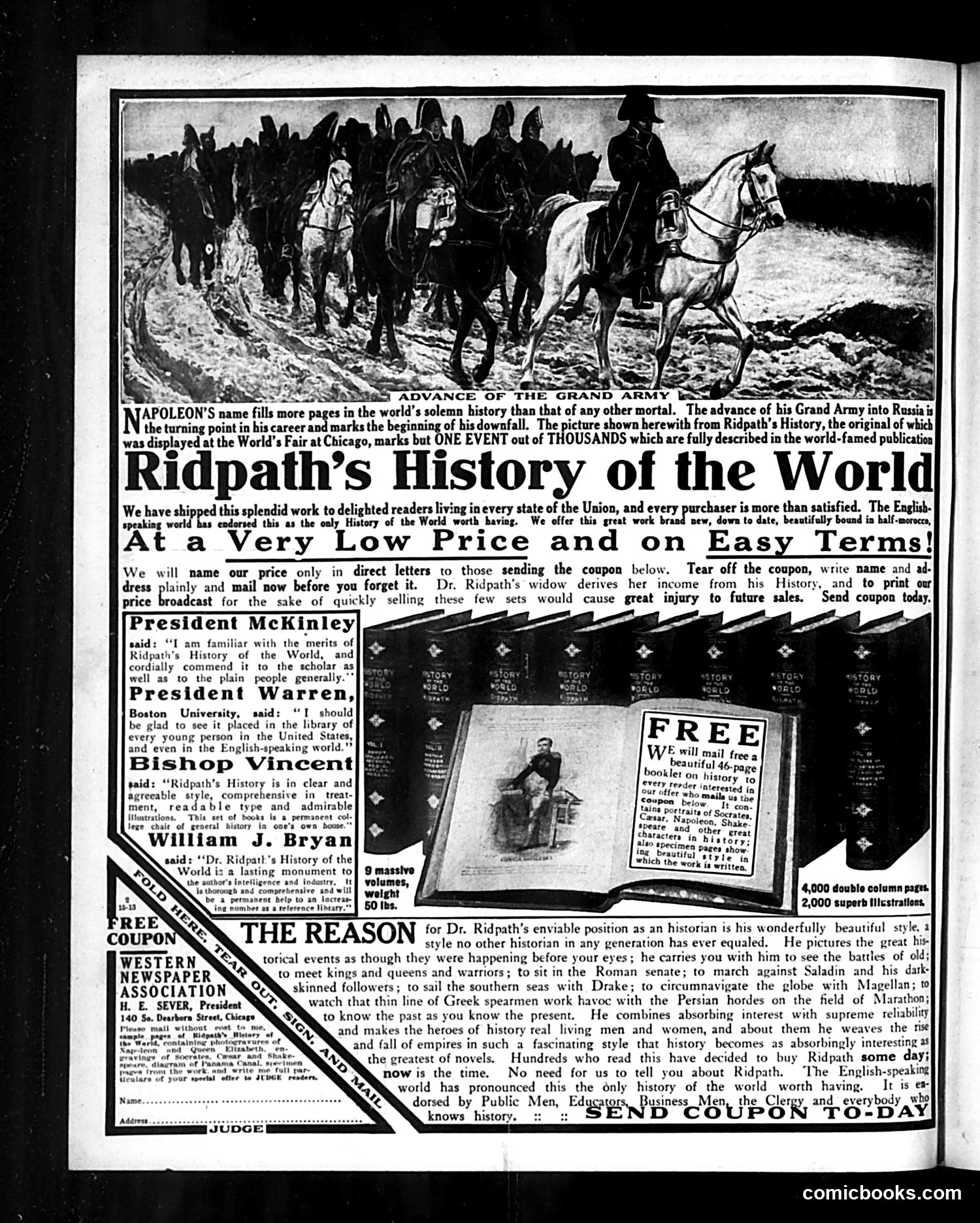
This is primarily a **full-page advertisement**, not political satire. It promotes *Ridpath's History of the World*, a comprehensive encyclopedia-style history book being sold on installment plans. The top illustration depicts **Napoleon's advance into Russia**—presented as an example of the historical events covered in the work. The accompanying text emphasizes this was "the turning point in his career and marks the beginning of his downfall." The advertisement features endorsements from prominent figures including **President McKinley**, **William J. Bryan**, and various educators, attesting to the book's quality and educational value. Notably, the price is deliberately withheld from the printed page; interested buyers must mail a coupon to receive pricing information in a private letter. The ad claims this protects future sales, though the strategy also creates exclusivity and urgency. The emphasis on "4,000 double column pages" and "2,000 superb illustrations" targets readers seeking authoritative, comprehensive historical knowledge—reflecting late 19th/early 20th-century educational aspirations.