
Judge, 1913-02-15 · page 7 of 24
Judge — February 15, 1913 — page 7: what you’re looking at
What you’re looking at
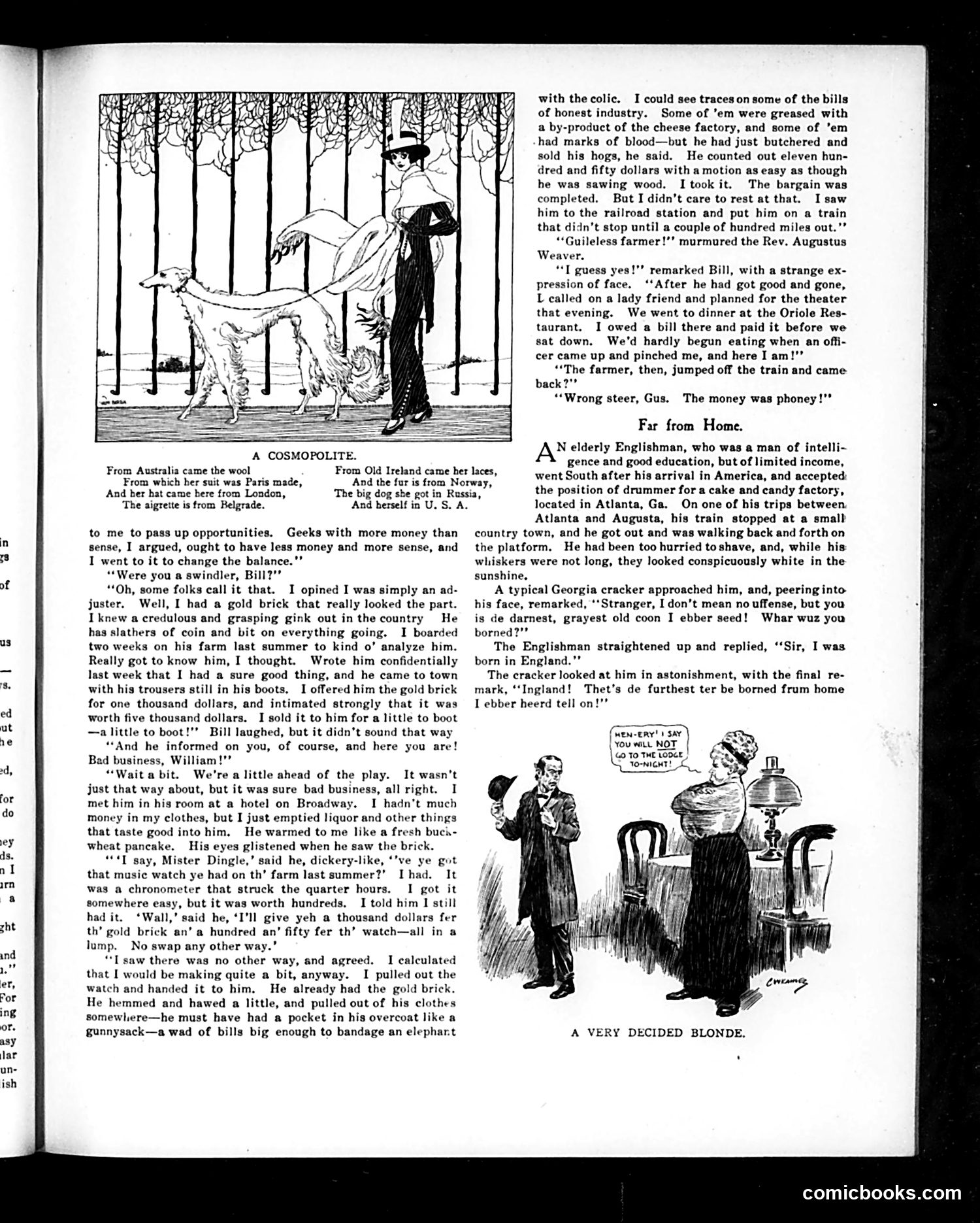
This page contains two distinct pieces of satirical content: **"A Cosmopolite"** (top): A poem mocking cosmopolitan affectation by cataloging a woman's fashionable outfit's international origins—wool from Australia, suit from Paris, hat from London, etc.—emphasizing how the globally sourced wardrobe exemplifies shallow materialism and status-seeking among the wealthy. **"Far from Home"** (main story and cartoons): A narrative about a con artist named Bill who swindles a gullible rural farmer with a gold brick scheme, taking $1,000+ plus a valuable watch. The twist: the money is counterfeit. The accompanying cartoon "A Very Decided Blonde" depicts a woman confronting someone about the scam, suggesting the farmer's revenge or exposure of the fraud. The satire targets both con men exploiting rural innocence and the gullibility of wealthy but unsophisticated businessmen. It reflects turn-of-century anxiety about fraud, sharp dealing, and the clash between urban sophistication and rural credulousness. The "phoney" money punchline undercuts the con artist's triumph.
📄 Transcribed text from this page (OCR, searchable)
Machine-transcribed from the original scan — historical spelling and the odd misread are preserved.
fas ea 4% it She, with the colic, I could see traces on some of the bills of honest industry. Some of ’em were greased with a by-product of the cheese factory, and some of ’em had marks of blood—but he had just butchered and sold his hogs, he said. He counted out eleven hun- dred and fifty dollars with a motion as easy as though he was sawing wood. I took it. The bargain was completed. But I didn’t care to rest at that. I sa’ him to the railroad station and put him on a train that didn’t stop until a couple of hundred miles out.’” “‘Guileless farmer!’ murmured the Rev. Augustus Weaver. “T guess yes!" remarked Bill, with a strange ex- pression of face. ‘‘After he had got good and gone, L called on a lady friend and planned for the theater that evening. We went to dinner at the Oriole Res- taurant. I owed a bill there and paid it before we sat down. We'd hardly begun eating when an offi- cer came up and pinched me, and here I am!’” “The farmer, then, jumped off the train and came back?"* “Wrong steer, Gus. ‘The money was phoney !"* Far from Home. A COSMOPOLITE. From Australia came the wool From which her suit was Paris made, And her hat came here from London, The aigreite is trom Belgrade. And herself in U. S. A. to me to pass up opportunities. Geeks with more money than sense, I argued, ought to have less money and more sense, and I went to it to change the balance.”’ “Were you a swindler, Bill?’’ “Oh, some folks call it that. I opined I was simply an ad- juster. Well, I had a gold brick that really looked the part. I knew a credulous and grasping gink out inthe country He has slathers of coin and bit on everything going. I boarded two weeks on his farm last summer to kind 0’ analyze him. Really got to know him, I thought. Wrote him confidentially last week that I had a sure good thing, and he came to town with his trousers still in his boots. I offered him the gold brick for one thousand dollars, and intimated strongly that it was worth five thousand dollars. I sold it to him for a little to boot —a little to boot!’’ Bill laughed, but it didn’t sound that way “And he informed on you, of course, and here you are! Bad business, William!’" “Waita bit. We're a little ahead of the play. It wasn’t just that way about, but it was sure bad business, all right. 1 met him in his room at a hotel on Broadway. I hadn't much money in my clothes, but I just emptied liquor and other things that taste good into him. He warmed to me like a fresh buci- wheat pancake. His eyes glistened when he saw the brick. “*T say, Mister Dingle,’ said he, dickery-like, ‘’ve ye got that music watch ye had on th’ farm last summer?’ I had. It was a chronometer that struck the quarter hours. I got it somewhere easy, but it was worth hundreds, I told him I still had it. ‘Wall,’ said he, ‘I’ll give yeh a thousand dollars fer th’ gold brick an’ a hundred an’ fifty fer th’ watch—all in a lump. No swap any other way.’ “saw there was no other way, and agreed. I calculated that I would be making quite a bit, anyway. I pulled out the watch and handed it to him. He already had the gold brick. He hemmed and hawed a little, and pulled out of his clothes somewhere—he must have had a pocket in his overcoat like a gunnysack—a wad of bills big enough to bandage an elephant From Old Ireland came her laces, And the fur is from Norway, The big dog she got in Russia, AN elderly Englishman, who was a man of intelli~ gence and good education, but of limited income, went South after his arrival in America, and accepted: the position of drummer for a cake and candy factory, located in Atlanta, Ga. On one of his trips between. Atlanta and Augusta, his train stopped at a small country town, and he got out and was walking back and forth on the platform. He had been too hurried to shave, and, while his: whiskers were not long, they looked conspicuously white in the sunshine, A typical Georgia cracker approached him, and, peering into his face, remarked, **Stranger, I don’t mean no uffense, but you is de darnest, grayest old coon I ebber seed! Whar wuz you borned?”” The Englishman straightened up and replied, ‘‘Sir, I was born in England.”” The cracker looked at him in astonishment, with the final re- mark, ‘‘Ingland! Thet’s de furthest ter be borned frum home I ebber heerd tell on!’" (wen-eRv" 1 SAY [You witt NOT @ To THe 10D«E } A VERY DECIDED BLONDE, comicbooks.com