
Judge, 1913-02-15 · page 6 of 24
Judge — February 15, 1913 — page 6: what you’re looking at
What you’re looking at
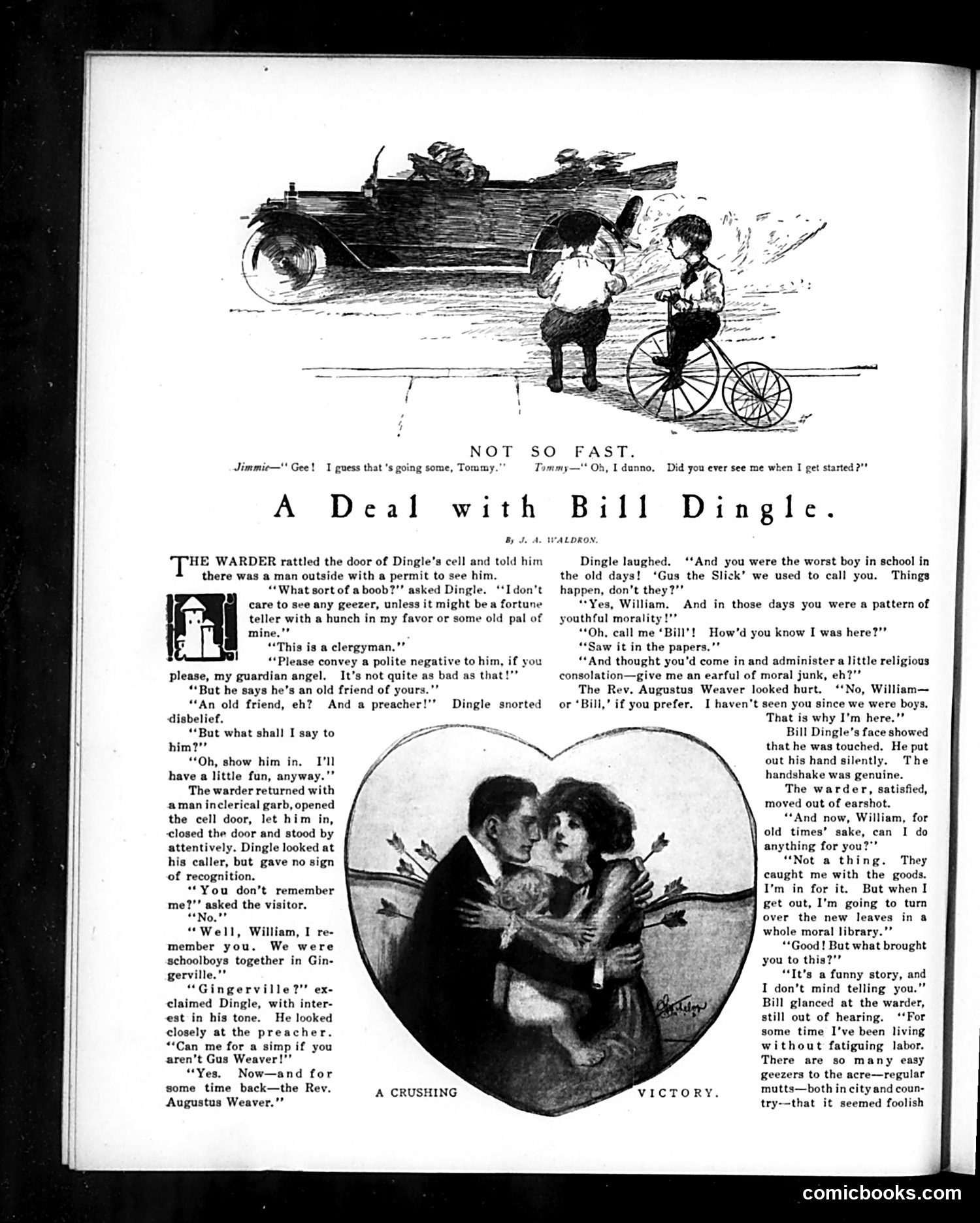
This story depicts a chance prison reunion between two childhood schoolmates: Bill Dingle, an inmate, and Rev. Augustus Weaver, his former classmate who became a clergyman. The satire targets redemption narratives and moral hypocrisy. The joke's setup: Dingle was "the worst boy in school," while Weaver became respectable. Yet Weaver appears genuinely moved to reconnect "for old times' sake" rather than to preach morality. The irony is that Dingle—imprisoned for theft—recognizes the authentic friendship beneath the clerical collar, producing a "genuine" handshake despite their opposite trajectories. The cartoon at top ("Not So Fast") shows children racing toys/bicycles, a thematic parallel: life's paths diverge unpredictably. The satire suggests that reformed criminals may respond better to genuine human connection than religious lecturing—a critique of sanctimonious charity alongside an oddly sympathetic portrayal of the criminal protagonist.
📄 Transcribed text from this page (OCR, searchable)
Machine-transcribed from the original scan — historical spelling and the odd misread are preserved.
NOT SO FAST. Jimmie—* Gee! I guess that 's going some, Tommy." A Deal HE WARDER rattled the door of Dingle’s cell and told him there was a man outside with a permit to see him. “‘What sort of aboob?”’ asked Dingle. ‘*I don’t care to see any geezer, unless it might bea fortune teller with a hunch in my favor or some old pal of mine.’” “This is a clergyman.” “Please convey a polite negative to him, if you please, my guardian angel. It’s not quite as bad as that!"’ “But he says he’s an old friend of yours.’’ “An old friend, eh? And a preacher!"’ disbelief. “But what shall I say to him?"’ “Oh, show him in. I'll have a little fun, anyway."’ The warder returned with aman inclerical garb, opened the cell door, let him in, ‘closed the door and stood by attentively. Dingle looked at his caller, but gave no sign of recognition. *“*You don’t remember me?’’ asked the visitor. “*No.”” “Well, William, I re- member you. We were schoolboys together in Gin- gerville.”” “Gingerville?” ex- claimed Dingle, with inter- est in his tone. He looked closely at the preacher. “Can me for a simp if you aren’t Gus Weaver!"’ “Yes. Now—and for some time back—the Rev. Augustus Weaver."’ with By J. AL WA Dingle snorted —_ A CRUSHING Tommy—** Oh, I dunno, Did you ever see me when I get started ?”” Dingle. “And you were the worst boy in school in Things Bill ALDRON. Dingle laughed. the old days! ‘Gus the Slick’ we used to call you. happen, don’t they?” “Yes, William. youthful morality !”” “Oh, call me ‘Bill’! How'd you know I was here?’’ “Saw it in the papers.’” “And thought you'd come in and administer a little religious consolation—give me an earful of moral junk, eh?’’ The Rev. Augustus Weaver looked hurt. No, William— or ‘Bill,’ if you prefer. I haven't seen you since we were boys. That is why I'm here."” Bill Dingle’s face showed that he was touched. He put out his hand silently. The handshake was genuine. The warder, satisfied, moved out of earshot. “‘And now, William, for old times’ sake, can I do anything for you?’ “Not a thing. They caught me with the goods. I'm in for it. But when I ] get out, I’m going to turn over the new leaves in a whole moral library. “*Good ! But what brought you to this?’” “It’s a funny story, and I don’t mind telling you.” Bill glanced at the warder, still out of hearing. ‘‘For some time I've been living without fatiguing labor. There are so many easy geezers to the acre—regular mutts—both in city and coun- try--that it seemed foolish And in those days you were a pattern of VICTORY. comicbooks.com