
A complete issue · 24 pages · 1912
Judge — September 7, 1912
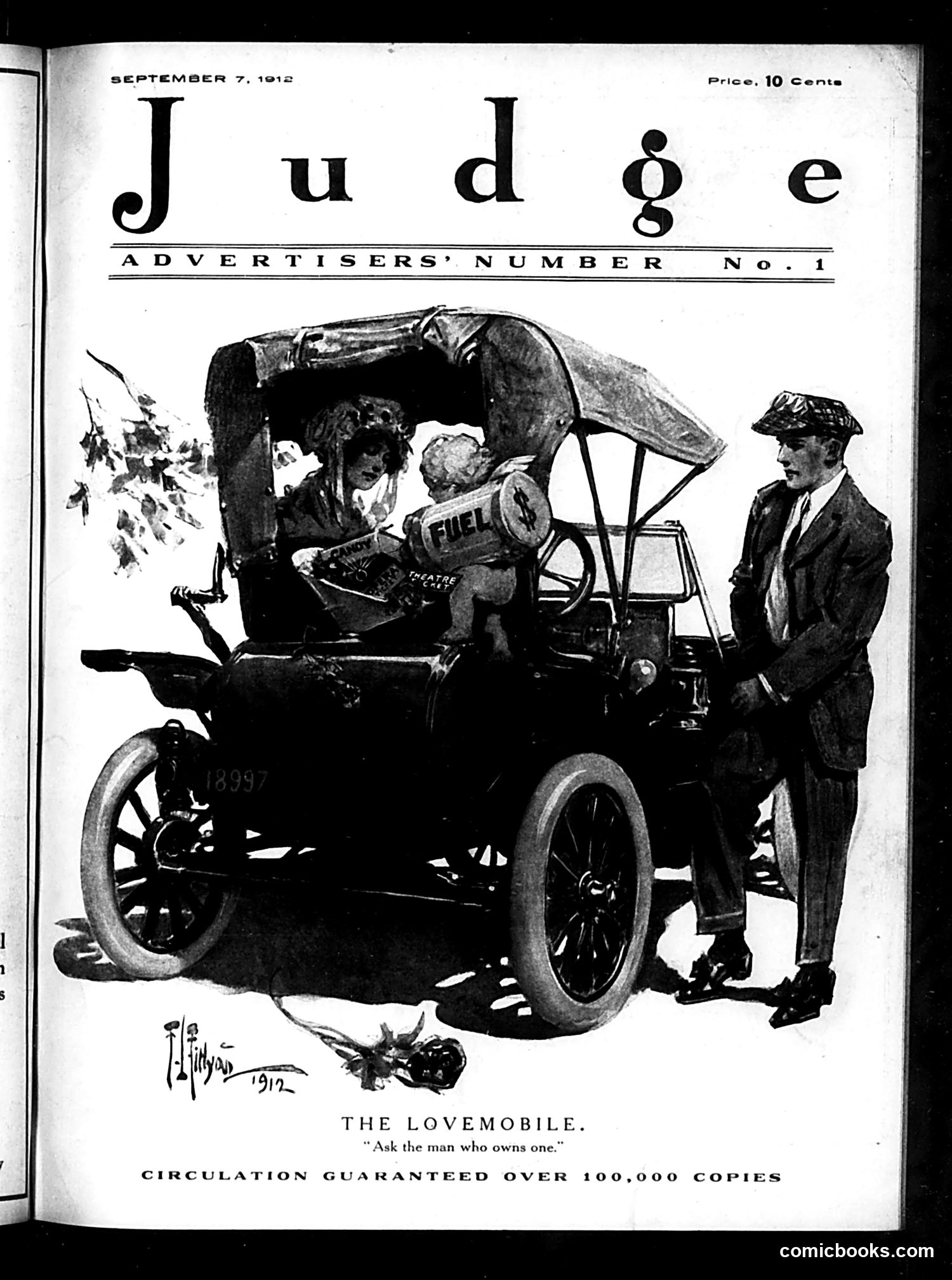
This is an advertisement disguised as satirical cartoon. The illustration shows a man standing beside an early automobile containing couples in an enclosed cab, with the tagline "Ask the man who owns one." The satire plays on the automobile's reputation as a vehicle enabling romantic privacy—hence "Lovemobile." In 1912, cars represented modern courtship freedom, allowing young couples to escape chaperones and parental supervision. The enclosed cabin was novel technology that scandalized conservatives. The cartoon humorously suggests automobiles facilitate illicit romance or elopement. The man outside appears to be a salesman or promoter. This advertisement exploits both the car's novelty and contemporary anxiety about automobiles undermining traditional courtship restrictions and parental control over young relationships.
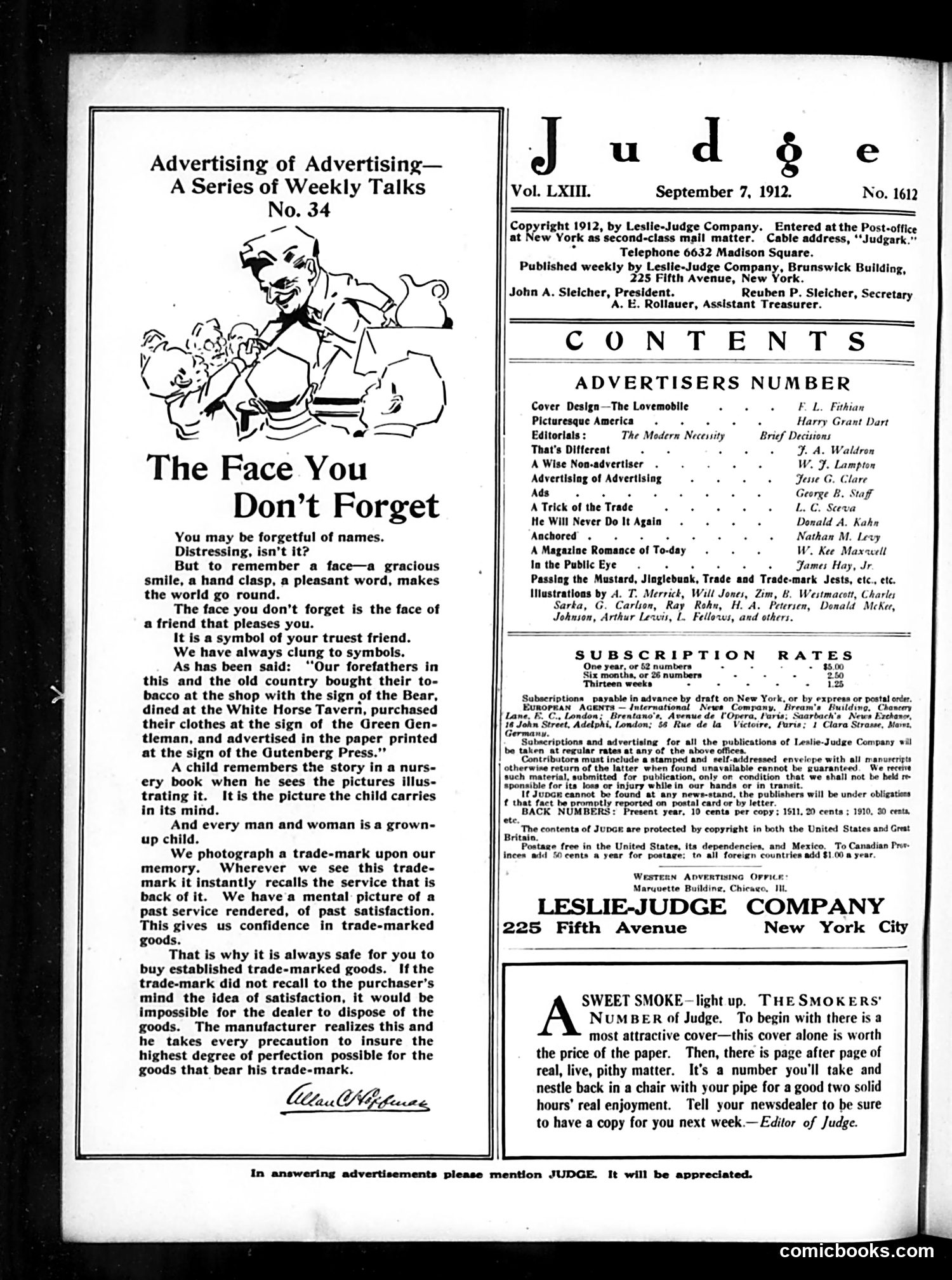
The left page features "The Face You Don't Forget," an article about advertising and trade-marks signed by what appears to be a company executive. The piece argues that memorable faces and symbols—like trade-marks—create lasting customer loyalty and trust. It uses nostalgic examples (a White Horse Tavern sign, children's book illustrations) to justify why established, recognizable brands deserve consumer confidence. This reflects early 20th-century marketing philosophy: that visual identity and familiarity breed commercial success and repeat purchases. The article essentially defends brand loyalty as psychologically rooted in memory and symbol recognition—a foundational concept in modern advertising still used today. The right page is primarily table of contents and subscription information for Judge magazine.
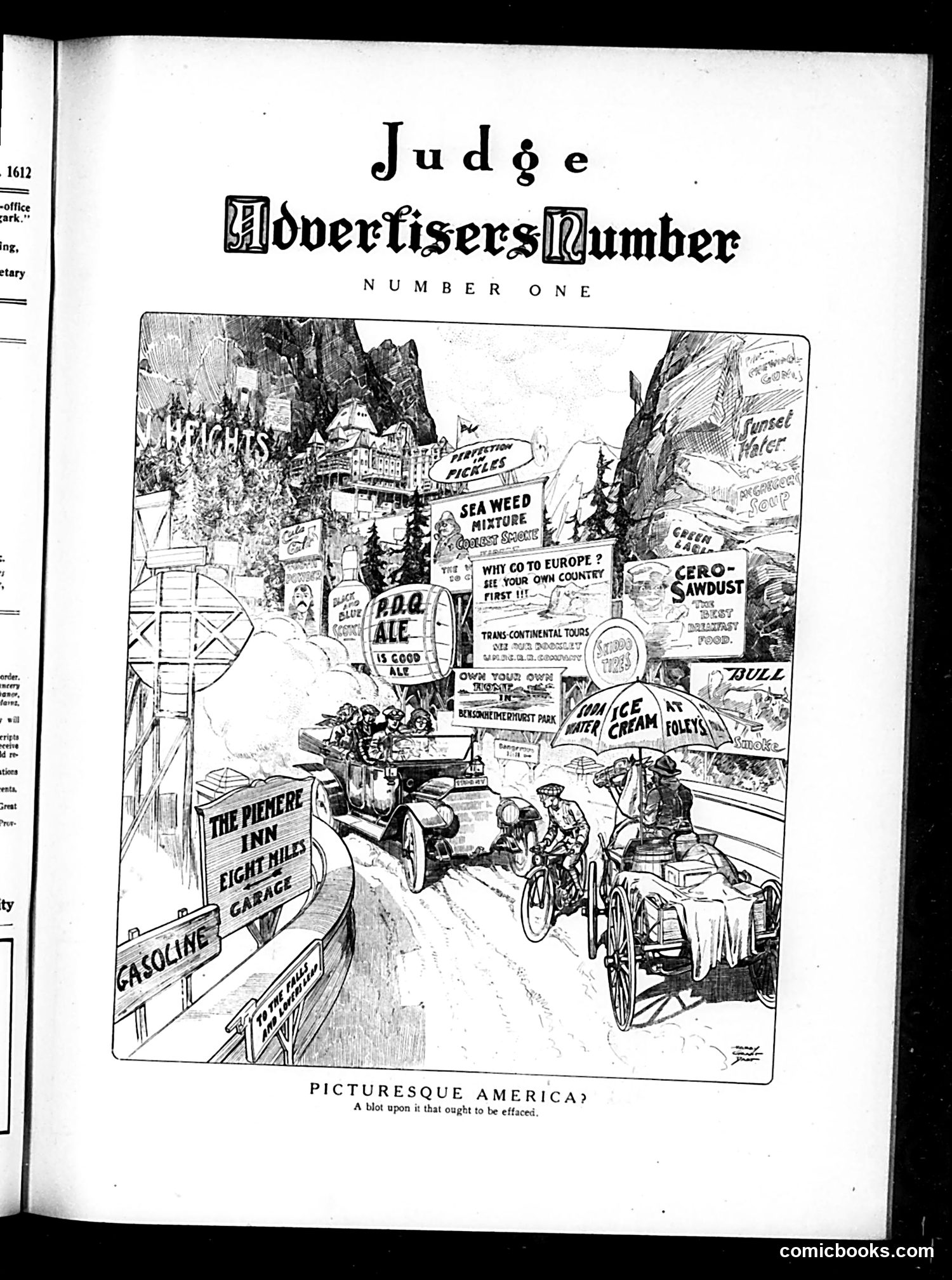
This is a satirical cartoon titled "Picturesque America" with the subtitle "A blot upon it that ought to be effaced." The image depicts a scenic American roadside cluttered with commercial billboards and signs advertising products like gasoline, ice cream, ale, seaweed mixture, and tourist services. The satire targets America's commercialization of its natural landscape. Rather than preserving scenic routes as picturesque destinations, advertisers have plastered the countryside with garish signs. Early-20th-century travelers (shown in cars and on bicycles) navigate through this visual chaos. The cartoon critiques how American commerce exploits natural beauty for profit, transforming "picturesque America" into an eyesore of competitive advertising—a commentary on unregulated commercial expansion damaging the nation's aesthetic heritage.
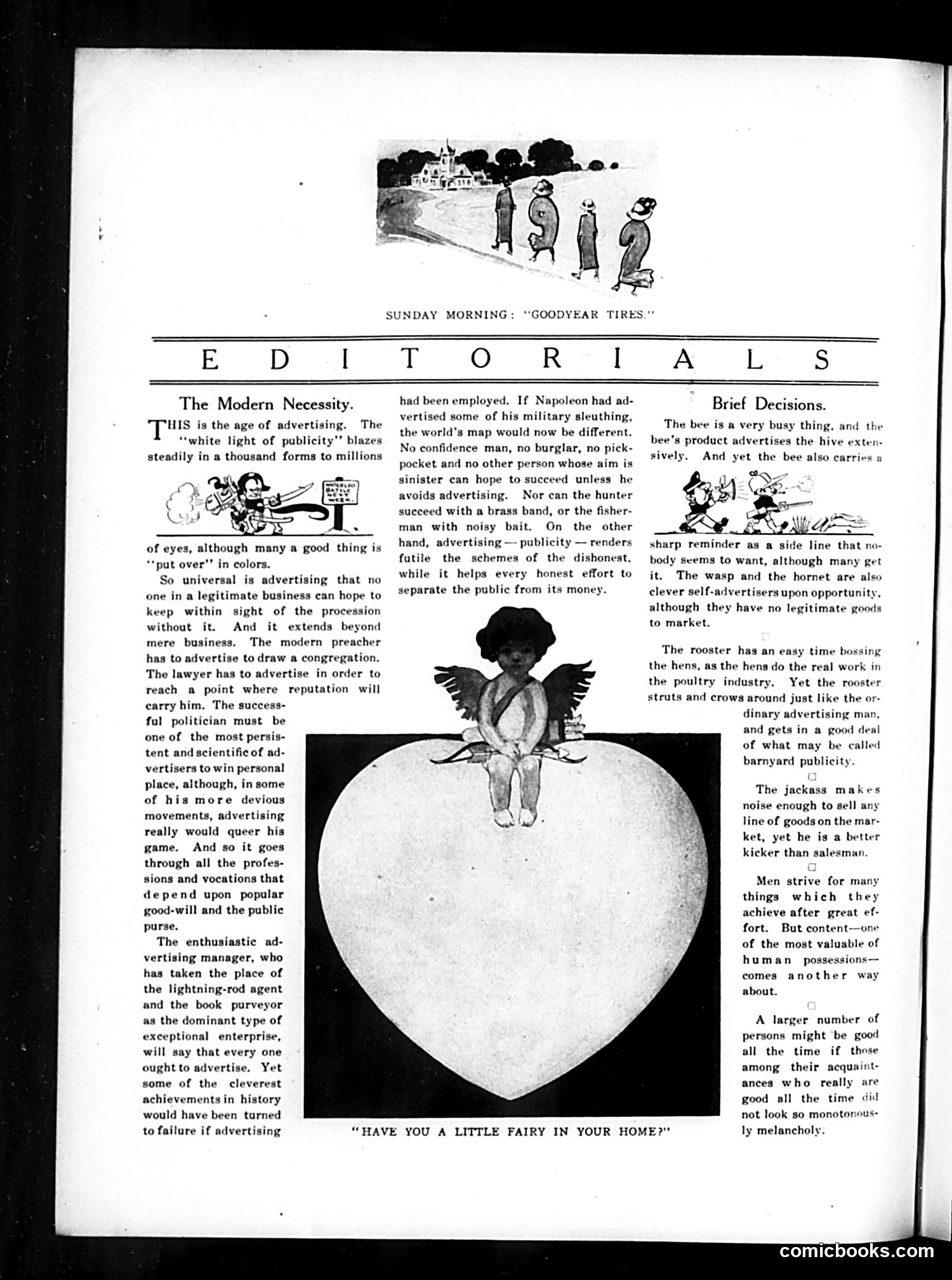
This page from *Judge* magazine contains two distinct pieces: **Left column ("The Modern Necessity"):** An editorial arguing that advertising is essential to modern commerce and society. The author contends that even historical figures like Napoleon would have failed without advertising, and that honest advertising actually protects the public by separating legitimate businesses from fraudsters. The piece advocates for advertising across all professions—preachers, lawyers, politicians—suggesting it's become fundamentally necessary rather than merely optional. **Right column & illustration ("Have You a Little Fairy in Your Home?"):** A whimsical illustration of a cherub or fairy sitting on a large sphere, accompanied by brief aphorisms about human nature—observations on bees, roosters, jackasses, and contentment. These appear to be light social commentary rather than political satire, offering gentle moral lessons about human behavior and virtue. The page reflects early 20th-century attitudes toward advertising's legitimacy and cultural role.
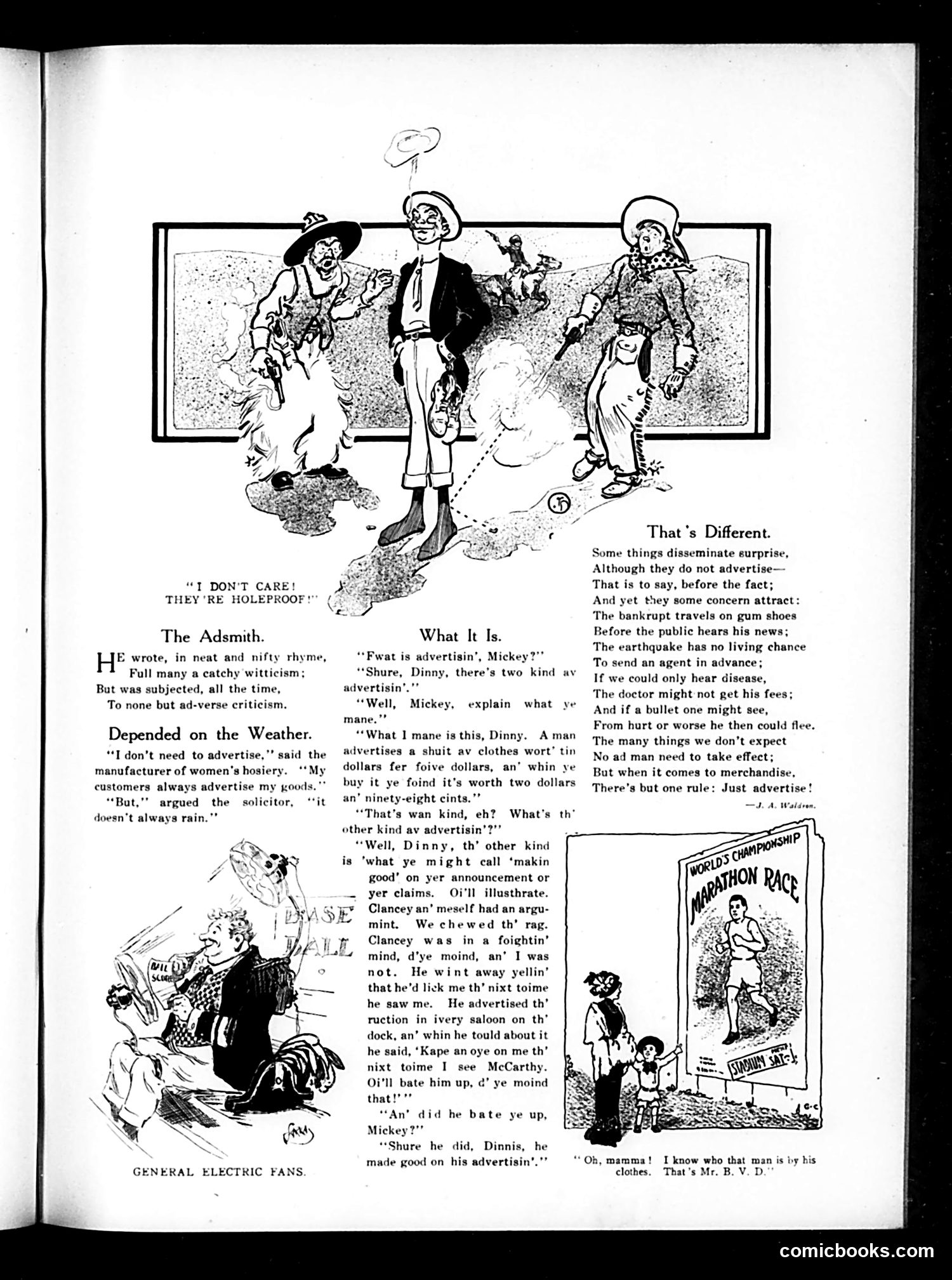
This page contains several early 20th-century satirical pieces about advertising. **Top cartoon**: Three cowboys/frontier characters discuss advertising's value. The humor centers on the irony that disreputable things (bankruptcy, earthquakes, disease, bullets) spread their "news" without formal advertising, yet legitimate businesses must pay to advertise. It's social commentary on how scandal and disaster spread naturally while honest commerce requires investment. **Included poems and stories** ("The Adsmith," "Depended on the Weather," "What It Is") use dialogue to joke about advertising effectiveness and necessity—suggesting advertising's paradoxical nature: essential yet often ineffective, and sometimes only working when circumstances align. The **General Electric Fans ad** and **Marathon Race poster** represent typical magazine advertising from the period. The overall message critiques advertising's role in American commerce.
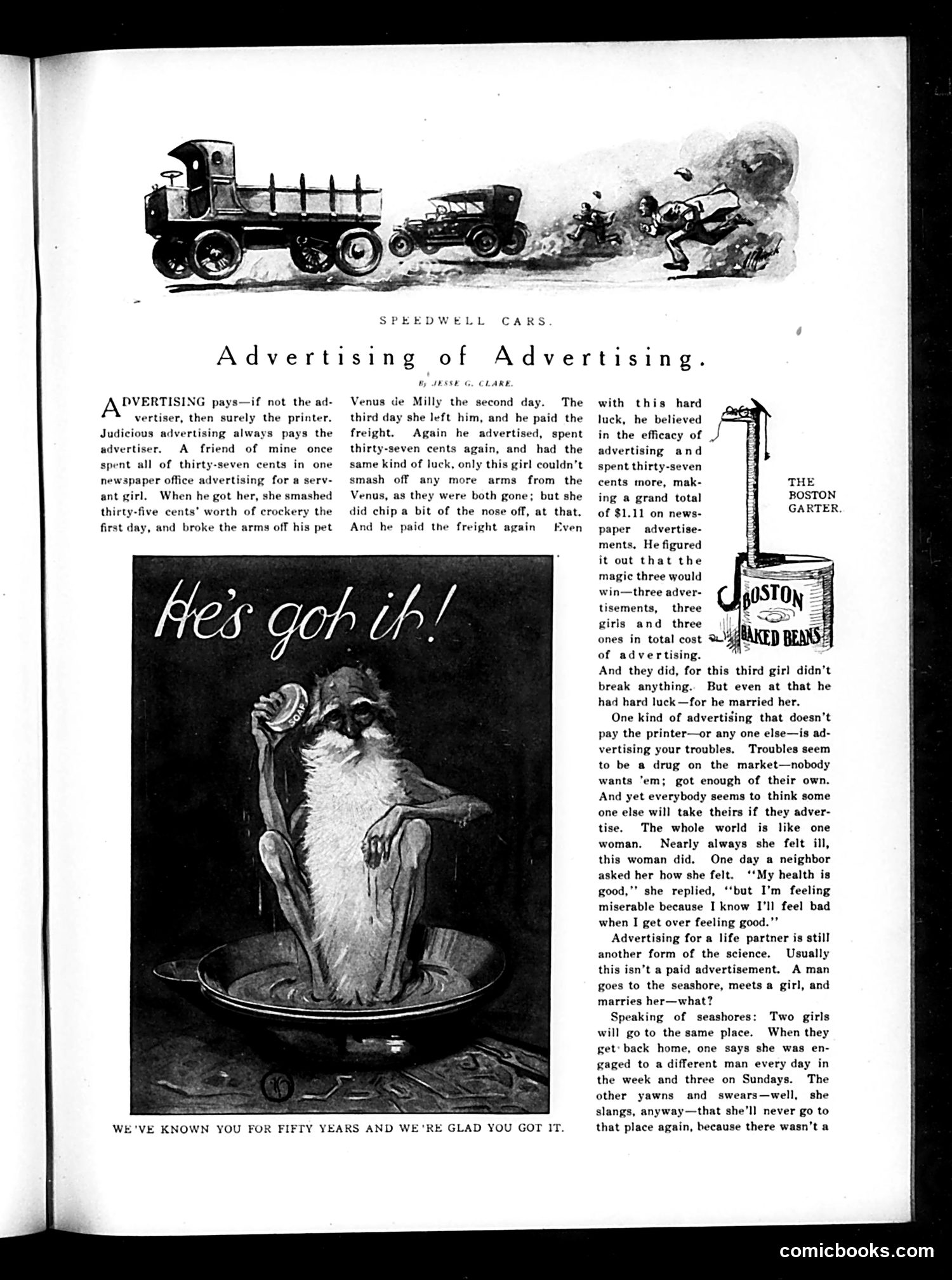
This satirical article by Jesse G. Clare mocks the excessive faith people place in newspaper advertising as a universal solution. The main joke concerns a man repeatedly advertising for a servant girl, each time attracting disaster: the first breaks expensive items (including a prized statue), the second damages it further, the third causes no breakage but he foolishly marries her—the worst outcome of all. Despite three failures costing $1.11 total, he remains convinced advertising "works." The piece extends this mockery to other life situations: advertising personal troubles (unmarketable), seeking romantic partners (unpredictable outcomes), and women's different experiences at seashores (one claims multiple engagements, another finds nothing). The underlying satire critiques both advertisers' inflated claims about advertising's power and the public's gullible belief in it as a cure-all. The Boston Garter ad on the page may be intentionally ironic—an advertisement within an article criticizing advertising's efficacy.
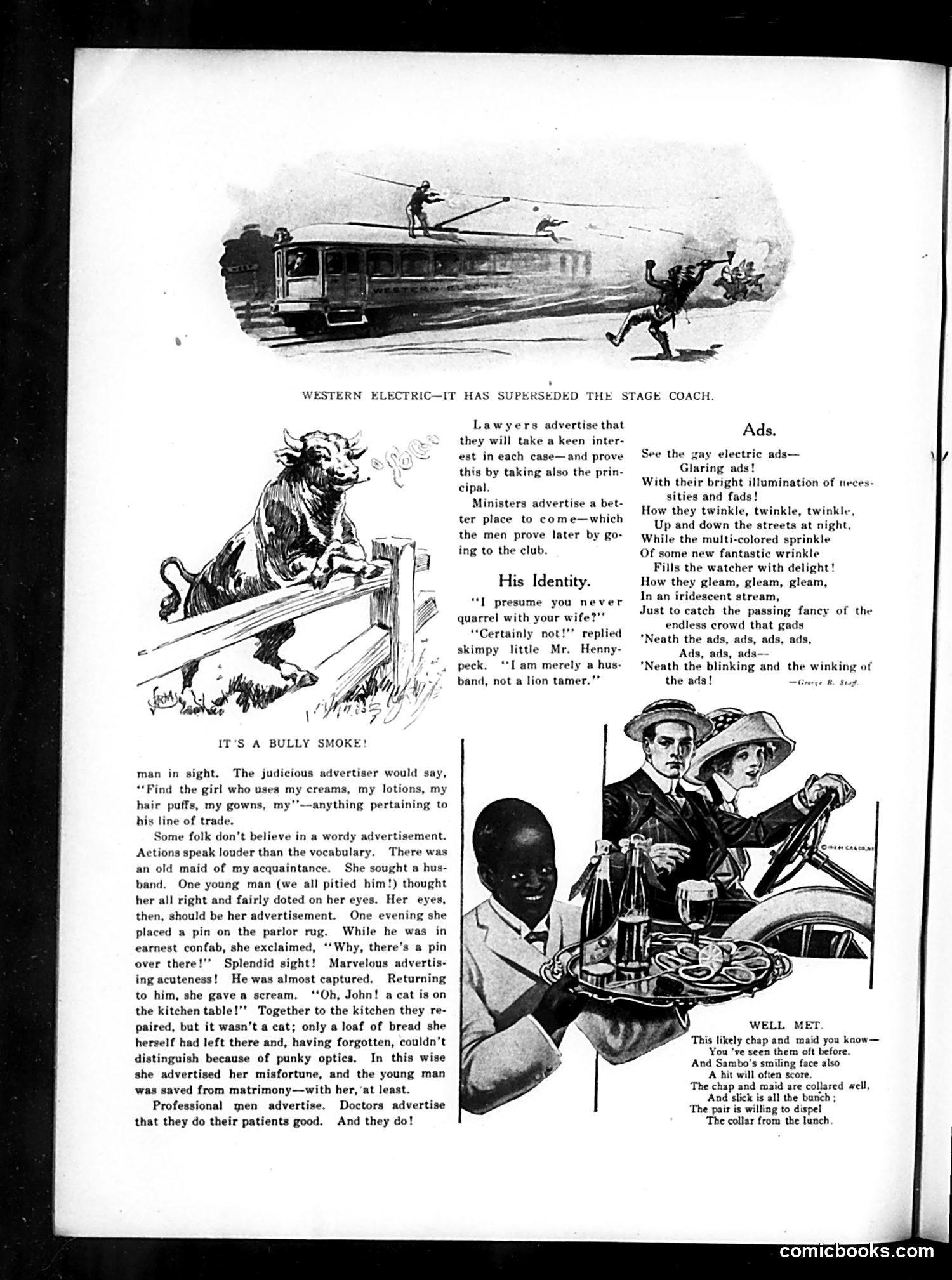
This page satirizes American advertising practices and social pretensions circa early 1900s. The top cartoon mocks the electric streetcar's replacement of stagecoaches—showing modern "progress" as chaotic. The main text section ridicules various professions' advertising claims: lawyers who pocket clients' money alongside their cases, ministers advertising heaven while congregants actually prefer clubs, and doctors claiming credit for patient recoveries. The "His Identity" joke mocks henpecked husbands, with Mr. Hennypeck claiming he's merely a husband, not a "lion tamer"—suggesting wives are dangerous animals requiring taming. The "Ads" poem celebrates the new phenomenon of electric illuminated advertisements lighting city streets at night—treating commercial glare as entertainment. The bottom illustration labeled "Well Met" uses a caricatured Black man and well-dressed white couple in a drinking scene, with crude racist imagery typical of the era. The accompanying verse makes jokes about collars and lunch—likely referring to servitude.
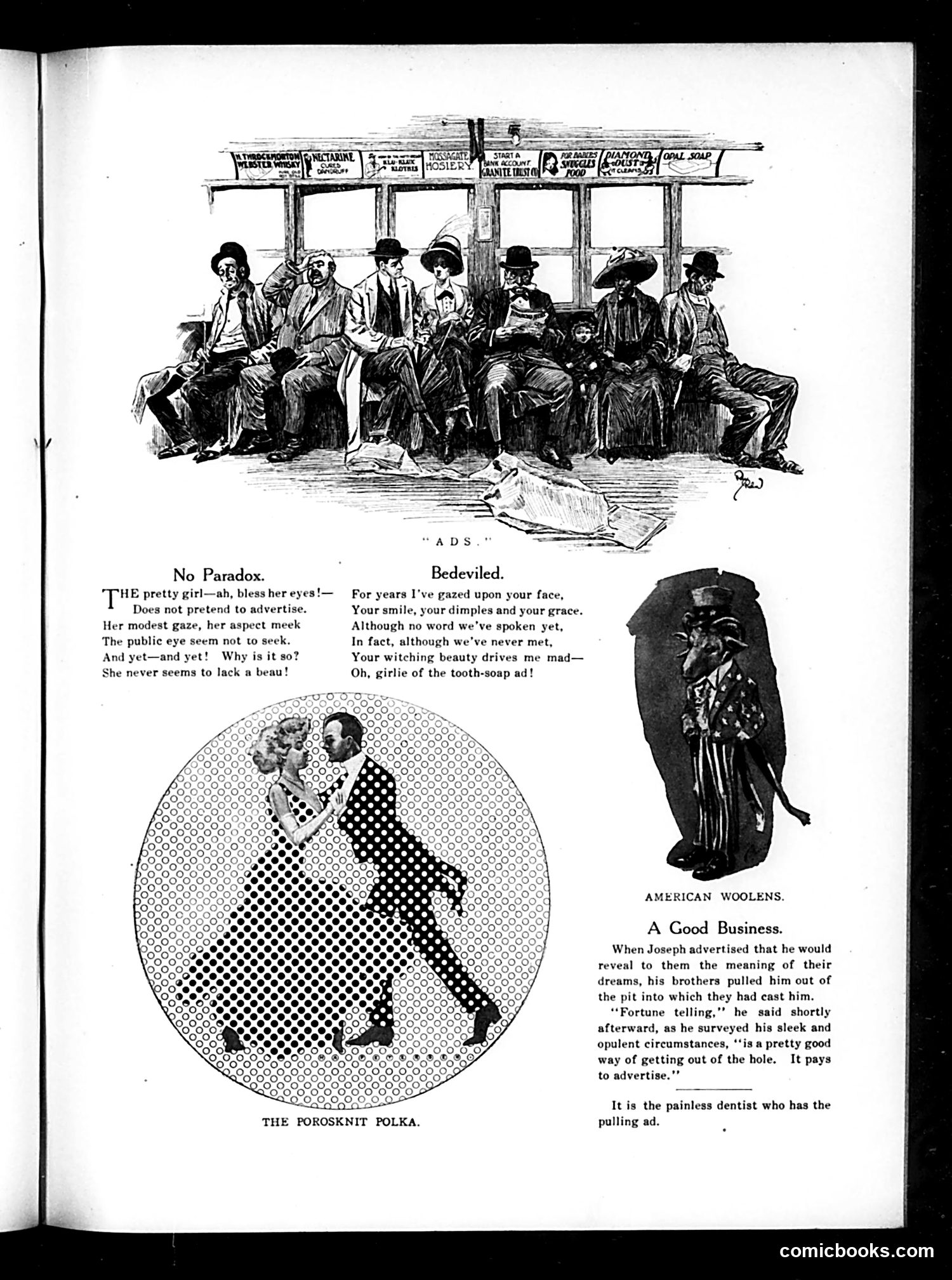
This page satirizes the power of advertising in early 20th-century America through three interconnected pieces: **"No Paradox" and "Bedeviled"** are paired poems mocking how advertising creates desire. A modest girl who doesn't advertise somehow attracts suitors, while a man becomes obsessed with a woman he's never met—solely because she appears in a toothpaste ad. The satire suggests advertising manufactures attraction and romantic interest artificially. **"The Porosknit Polka"** illustration shows a couple dancing in a circular pattern, likely advertising Porosknit brand clothing. **"A Good Business"** retells the Biblical Joseph story as a joke about fortune-telling as profitable "advertising"—suggesting that any product or service can succeed through promotion, even dubious ones like fortune-telling or dentistry. The final line quips that even painful dentistry profits from advertising. The collective message: advertising has become society's dominant force, capable of selling anything—beauty, dreams, even pain—by creating artificial demand rather than addressing genuine need.
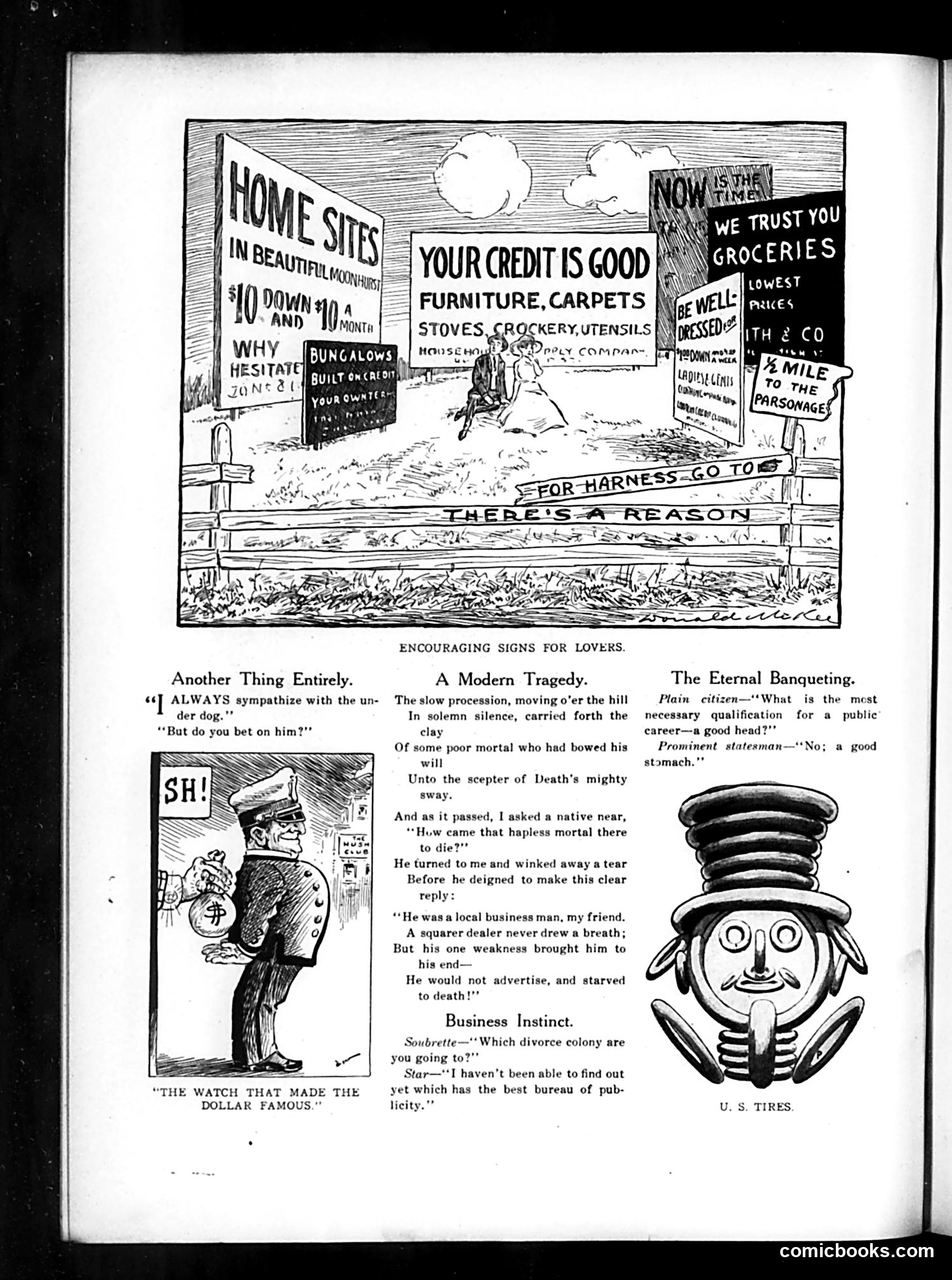
This satirical page mocks early 20th-century American consumer culture and business ethics through several interconnected jokes. The top cartoon depicts a rural couple surrounded by commercial signs offering credit for homes, furniture, and groceries—satirizing aggressive marketing to unsophisticated buyers with limited means ("$10 down and $10 a month"). Below, "The Watch That Made the Dollar Famous" shows a businessman, likely referencing a real famous watch advertisement, emphasizing commerce's grip on American identity. The main satirical pieces target business hypocrisy: "A Modern Tragedy" darkly jokes that a local businessman died from refusing to advertise—implying that in modern commerce, self-promotion matters more than honest dealings. "Business Instinct" mocks that publicity trumps actual qualification. "The Eternal Banqueting" suggests politicians prioritize appetite (greed) over intellect. Together, these pieces critique 1920s American capitalism's emphasis on marketing, credit consumption, and appearance over substance—a surprisingly modern critique for the era.
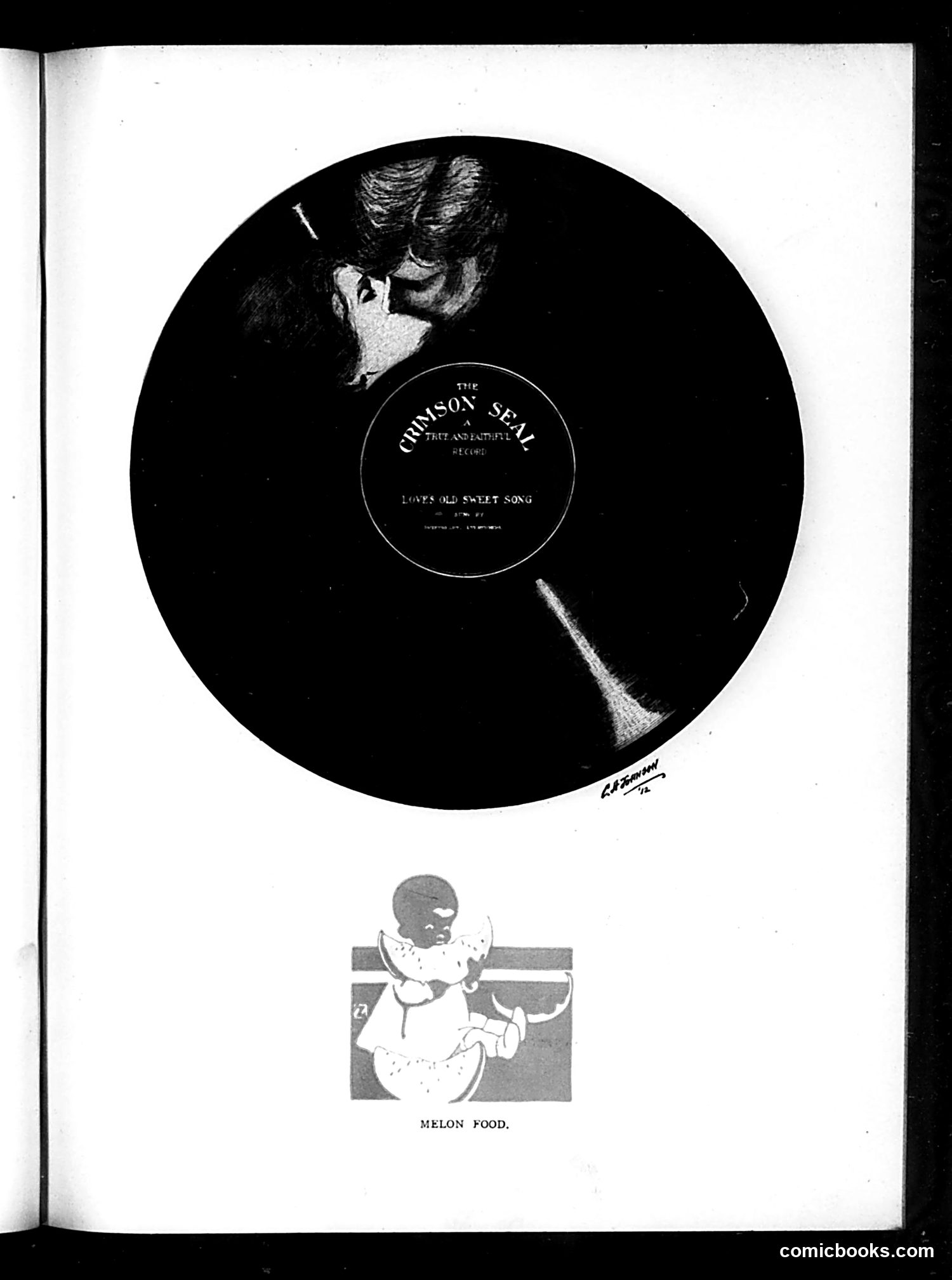
This page from *Judge* magazine contains two satirical images. The top shows a vinyl record labeled "The Crimson Seal" with "Love's Old Sweet Song" visible on the label, accompanied by an illustration of a man's face. The bottom image, titled "Melon Food," depicts a caricatured Black infant sitting on a bench holding a slice of watermelon. The "Melon Food" cartoon reflects a deeply racist stereotype from this era that associated Black people with watermelon consumption—a dehumanizing caricature used to mock and demean. The connection between the two images on this page remains unclear from the visible text alone, though both appear designed as satirical commentary, likely mocking popular culture or social figures of the period.
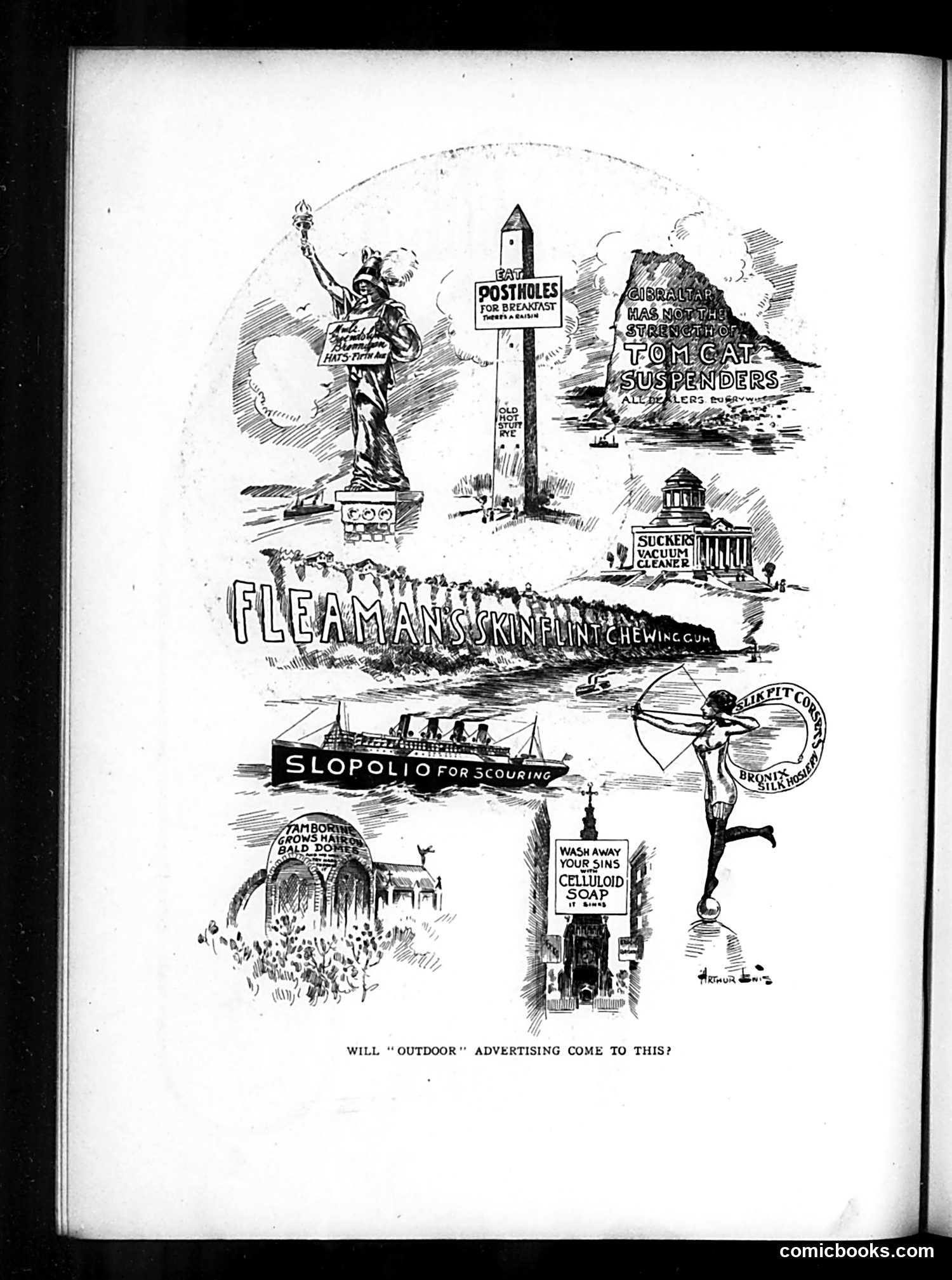
This satirical cartoon mocks the proliferation of outdoor advertising by imagining famous landmarks and monuments defaced with product advertisements. The Statue of Liberty advertises a product (unclear which), while a classical obelisk bears a "Postholes for Breakfast" ad. Gibraltar's rock promotes "Tom Cat Suspenders," a domed building advertises "Suckers Vacuum Cleaner," and other monuments feature ads for "Fleam's Skin Food," "Slopolio for Scouring," and other goods. The cartoon's central question—posed sarcastically in the caption—critiques the aggressive expansion of commercial advertising into public spaces and natural landmarks. Rather than preserving these iconic sites, the illustration suggests advertisers would commercialize anything for profit, turning cultural treasures into billboards. This reflects turn-of-the-century anxieties about unchecked commercialism.
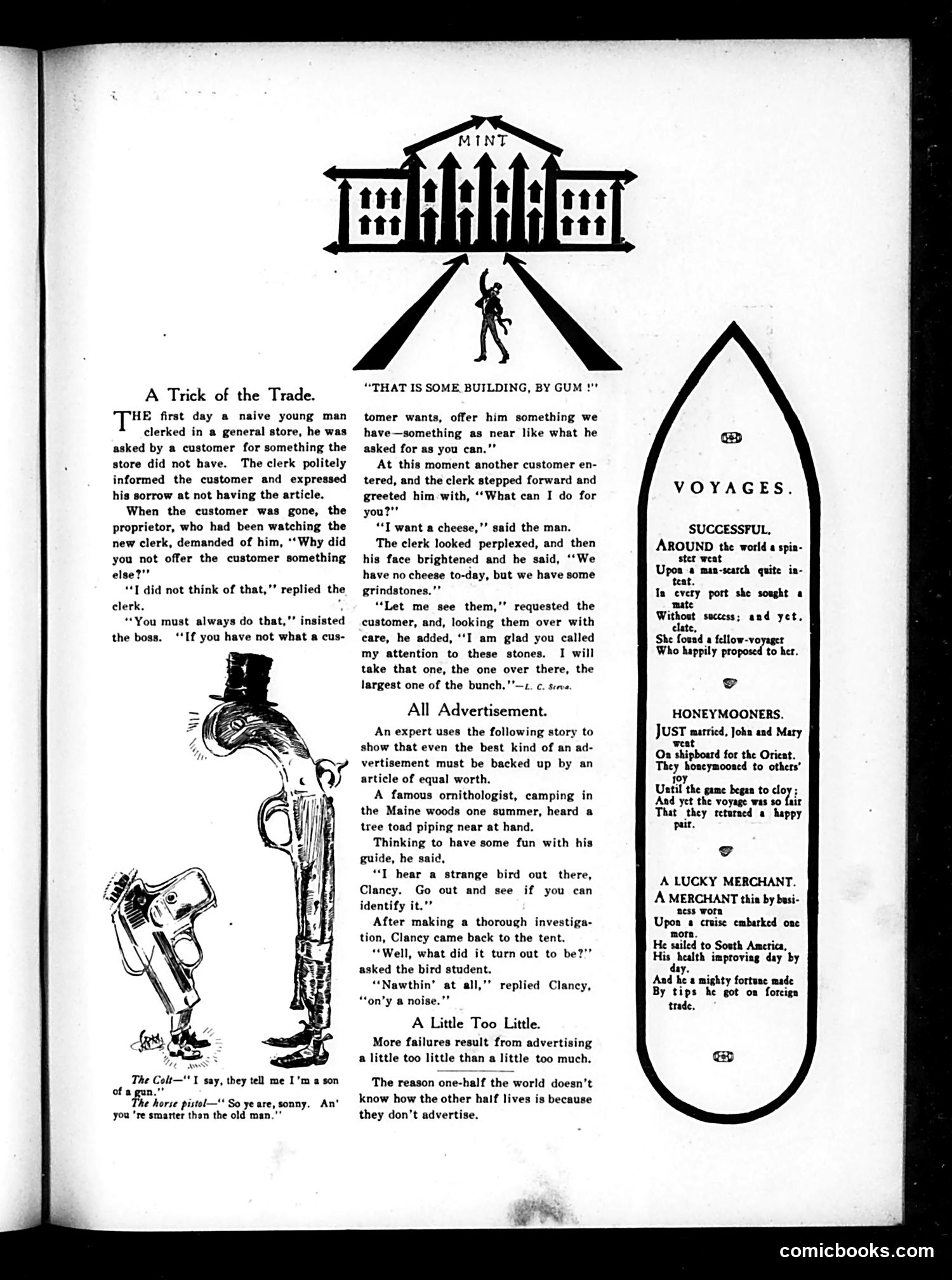
This page contains three separate pieces of humor targeting early 20th-century commercial culture: **"A Trick of the Trade"** satirizes retail deception. A store clerk learns to "upsell" customers by substituting unavailable items with anything remotely similar. The joke's punchline—offering grindstones when cheese is requested—exposes how absurd this practice becomes when taken literally. The accompanying cartoon of a colt and horse pistol makes a crude visual pun about guns. **"All Advertisement"** presents two cautionary tales about advertising. One mocks ornithologists and guides (a Maine woods setting); another criticizes businesses that advertise too little, using the aphorism that "one-half the world doesn't know how the other half lives" because of poor marketing. **The right column** contains three brief comic poems about voyages, honeymooners, and a merchant—lighthearted verse filler typical of Judge. The overall message: commerce thrives on both clever salesmanship and adequate advertising, though excessive deception undermines both.
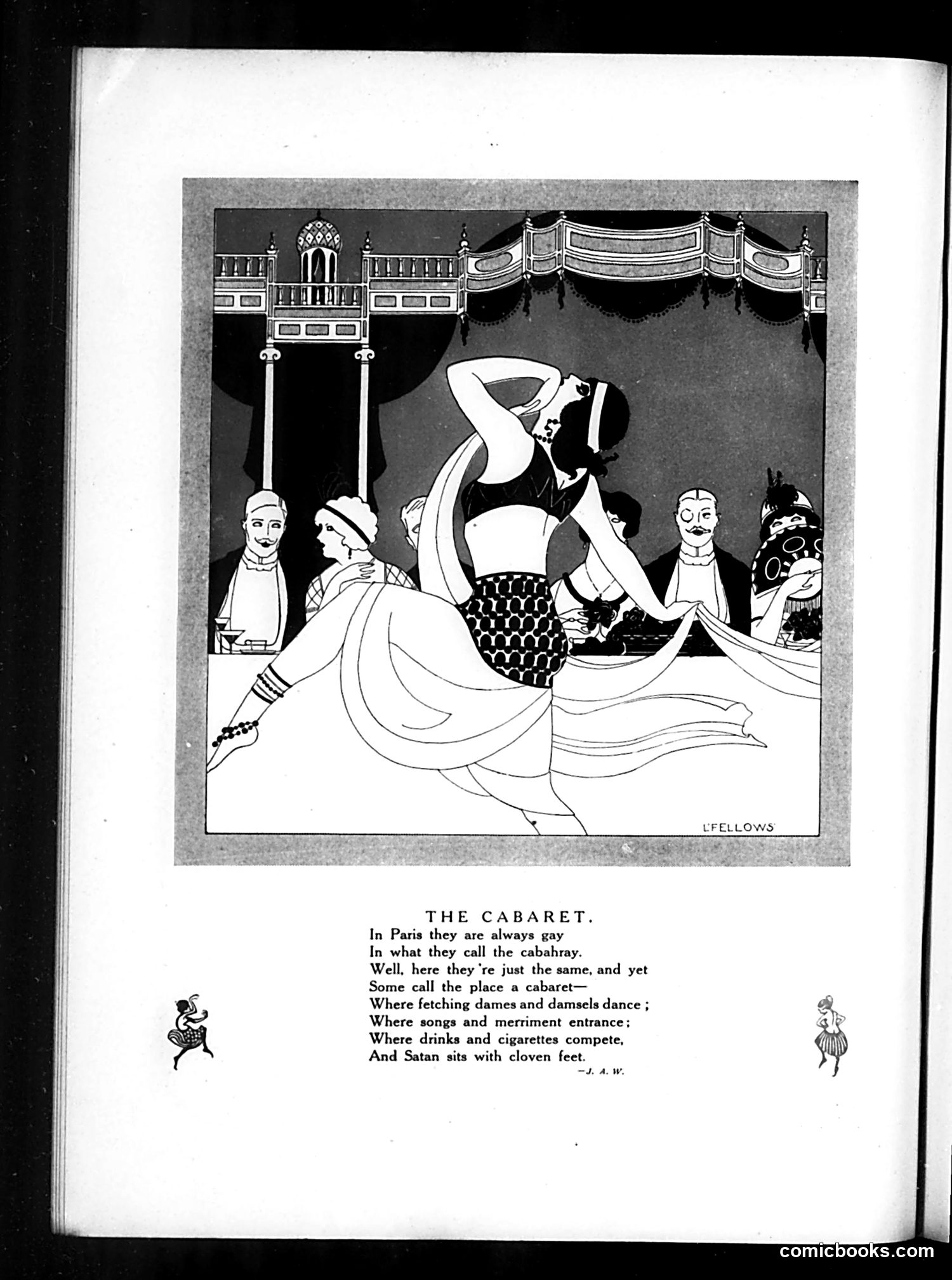
This illustration satirizes American cabarets by comparing them to their Parisian counterparts. The poem, credited to J.A.W., uses light mockery to describe cabaret culture: a venue featuring dancing women, music, drinking, and smoking. The final line—"Satan sits with cloven feet"—signals moral disapproval, suggesting cabarets represent sinful indulgence. The artwork depicts an elaborately dressed dancer performing for an audience in an ornate theatrical setting. This likely reflects early 20th-century American anxiety about cabaret culture, which was viewed as morally questionable, particularly regarding alcohol (relevant during Prohibition era discussions) and female performers. The satire gently criticizes American adoption of supposedly decadent French entertainment customs.
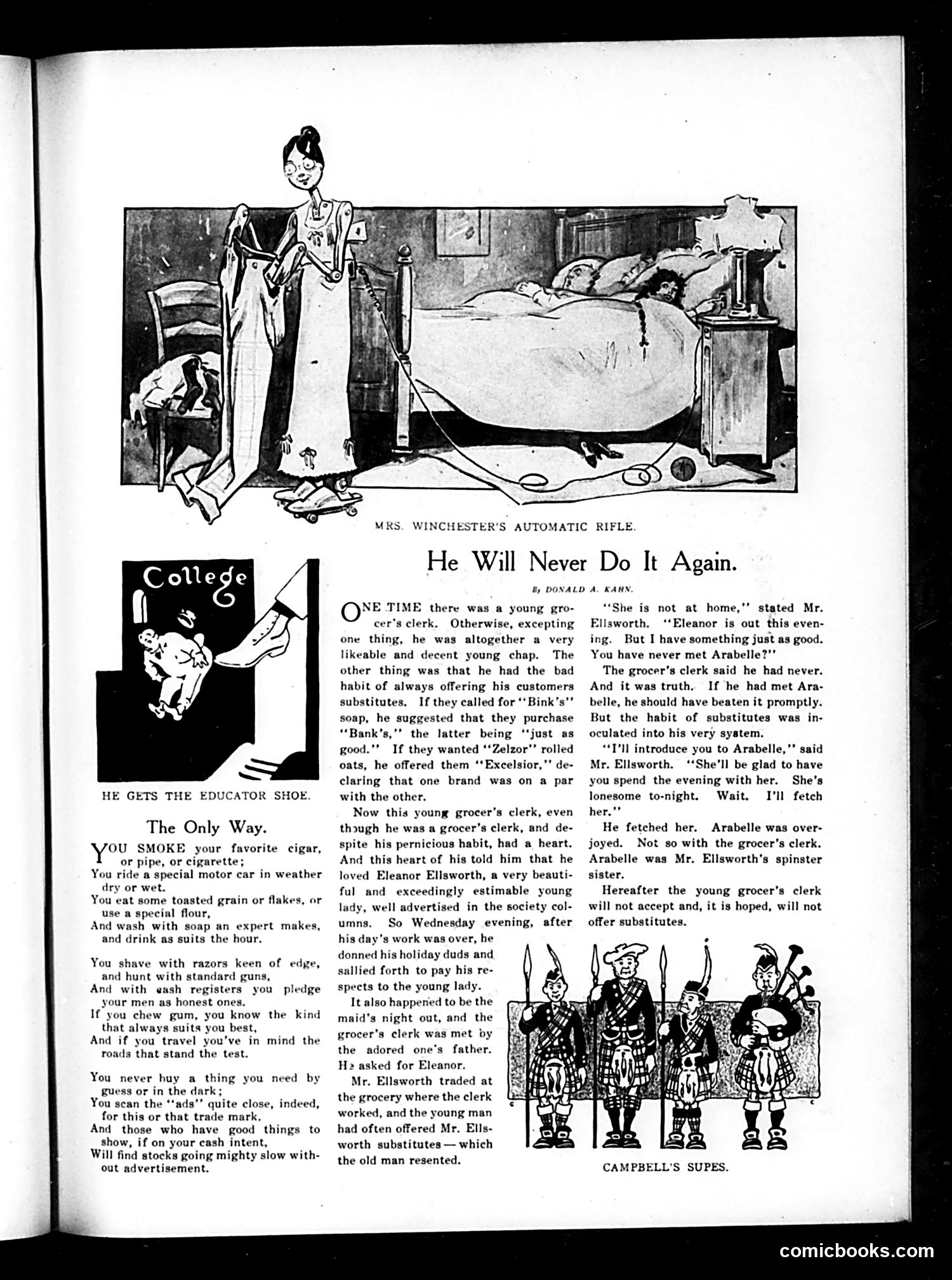
This page contains two separate pieces of satirical advertising commentary: **"The Only Way"** is a poem mocking consumer culture and brand loyalty. It satirizes how Americans obsessively seek advertised brand names for everything—cigars, cars, cereal, soap—rather than making independent choices. The joke is that advertising has become the primary decision-making tool for modern consumers. **"He Will Never Do It Again"** is a short story satirizing a grocery clerk with an annoying habit of pushing inferior substitute brands on customers. When he visits his girlfriend Eleanor, her father—a customer he's offended with substitutes—punishes him by offering his own "substitute": Eleanor's homely spinster sister Arabelle instead. The ironic comeuppance: the clerk, accustomed to accepting substitutes professionally, cannot refuse this personal one. The cartoon illustrations (including "Mrs. Winchester's Automatic Rifle") visually reinforce the substitute theme. Together, these pieces critique both aggressive advertising and the social pressure to accept inferior alternatives.
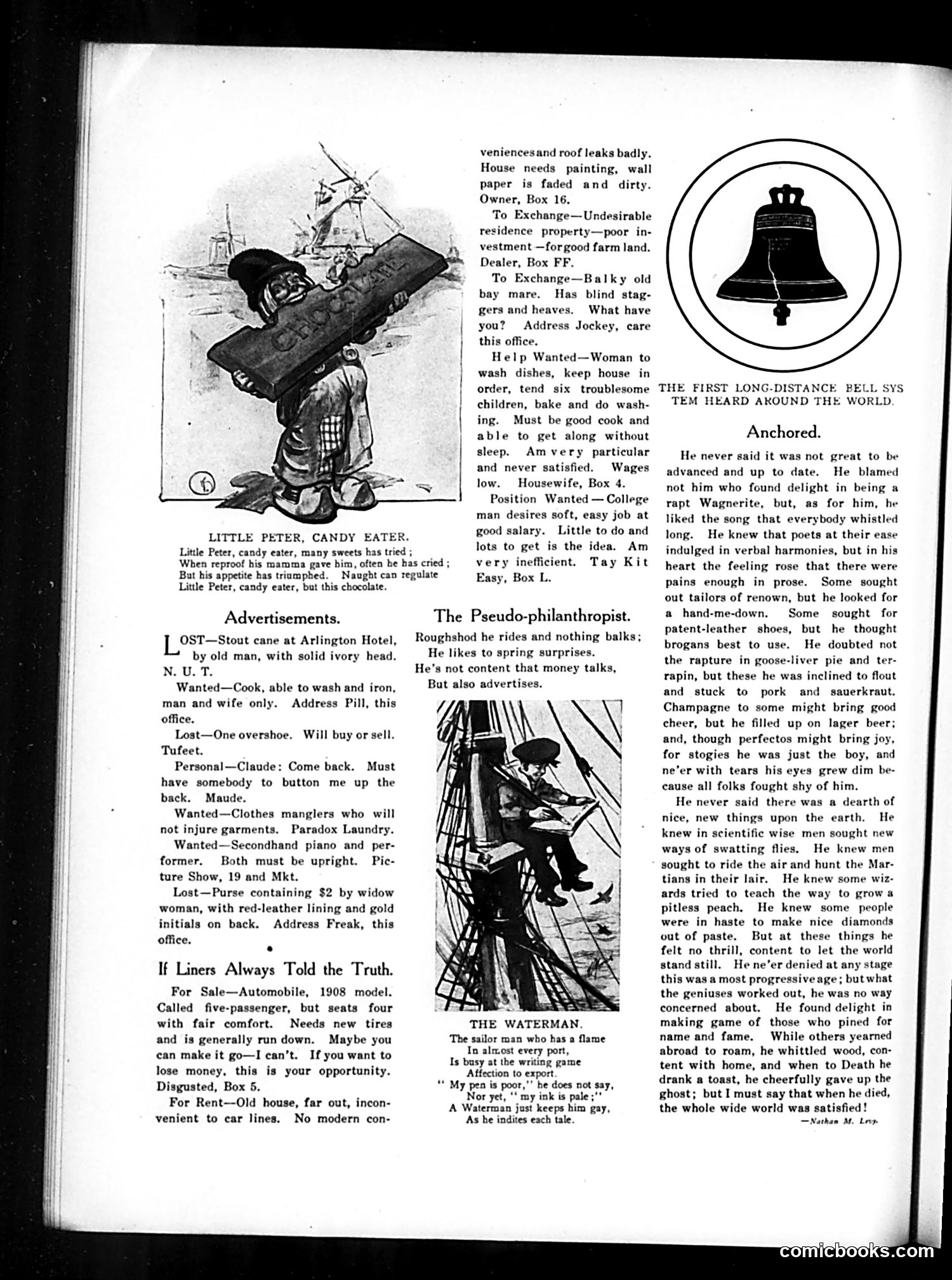
This page from *Judge* magazine contains satirical advertisements and light humorous content typical of early 1900s American humor. The main cartoon depicts "Little Peter, Candy Eater"—a cautionary tale about a child whose appetite for sweets cannot be controlled despite maternal discipline. The verse humorously suggests only chocolate can satisfy him, playing on period anxieties about children's dietary habits and parental authority. The bulk of the page features the satirical section **"If Liners Always Told the Truth,"** which mocks classified advertisements' dishonesty. Fake listings for a deteriorating house, unreliable automobile, and lazy college graduate expose common deceptive advertising practices—a genuine social complaint. An employer's ad seeking an impossible houseworker (cook, cleaner, childcare for low wages without sleep) satirizes exploitative labor conditions. Additional light humor pieces mock pretentious philanthropy and feature advertisements for Waterman pens and Bell telephone systems, typical period advertising integrated with editorial content. The page demonstrates *Judge*'s approach: gentle social satire mixed with commercial promotion.
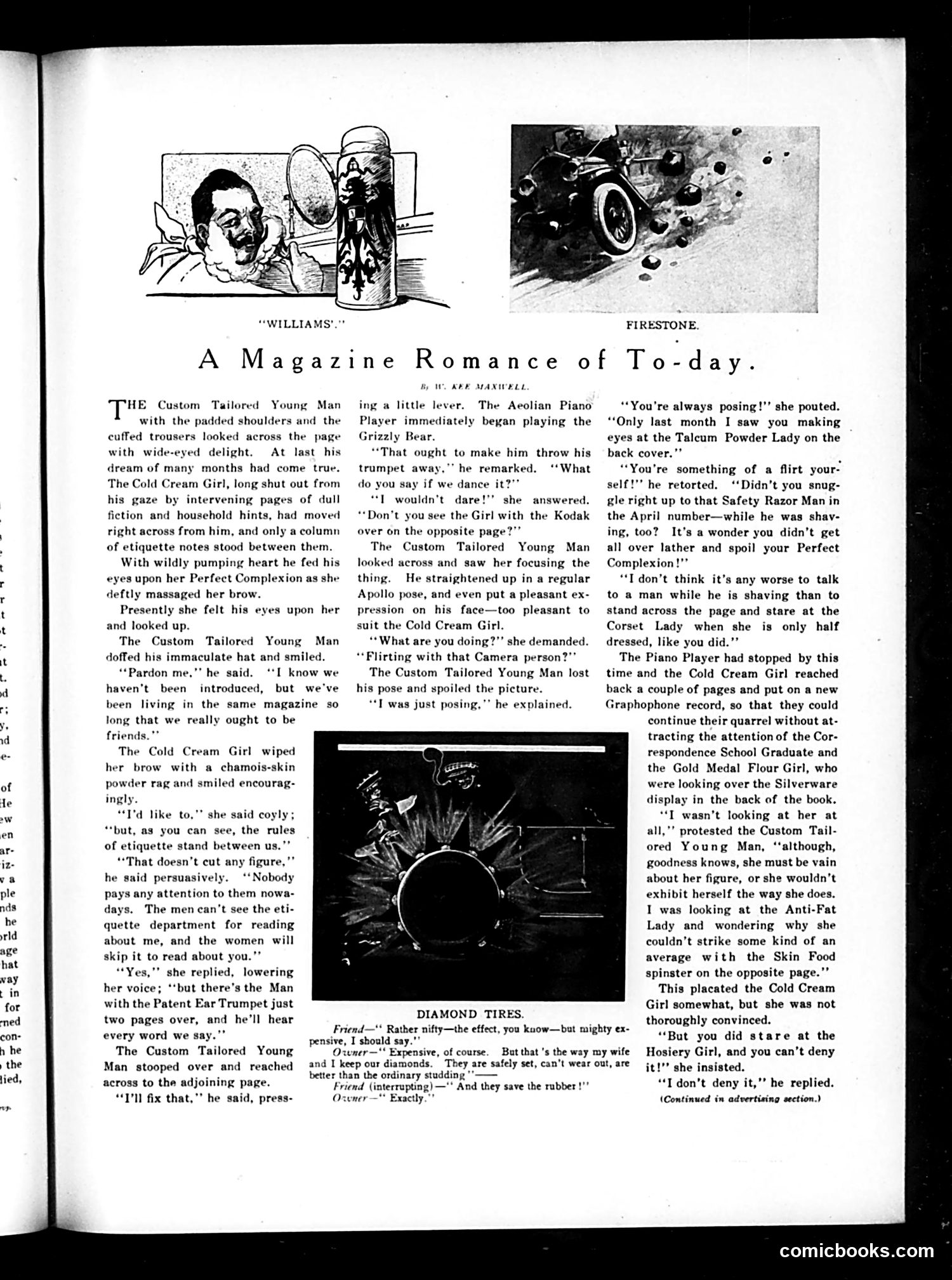
This satirical story mocks magazine advertising by depicting characters who are literally *advertisement illustrations* aware of each other's existence across magazine pages. The "Custom Tailored Young Man" flirts with the "Cold Cream Girl," while worrying about being photographed by the "Girl with the Kodak" and observed by other ad characters (the "Safety Razor Man," "Corset Lady," "Gold Medal Flour Girl"). The joke targets early-20th-century magazine culture: ads occupied so many pages that readers spent nearly as much time with product imagery as editorial content. By treating these illustrations as sentient beings concerned about their appearances in ads, the satire critiques both the ubiquity of advertising and consumers' parasocial relationships with brand imagery. The "Diamond Tires" advertisement below reinforces the theme—even within the story, actual ads intrude, blurring fiction and commerce. This reflects Judge magazine's frequent mockery of commercial culture's creeping influence on American life.
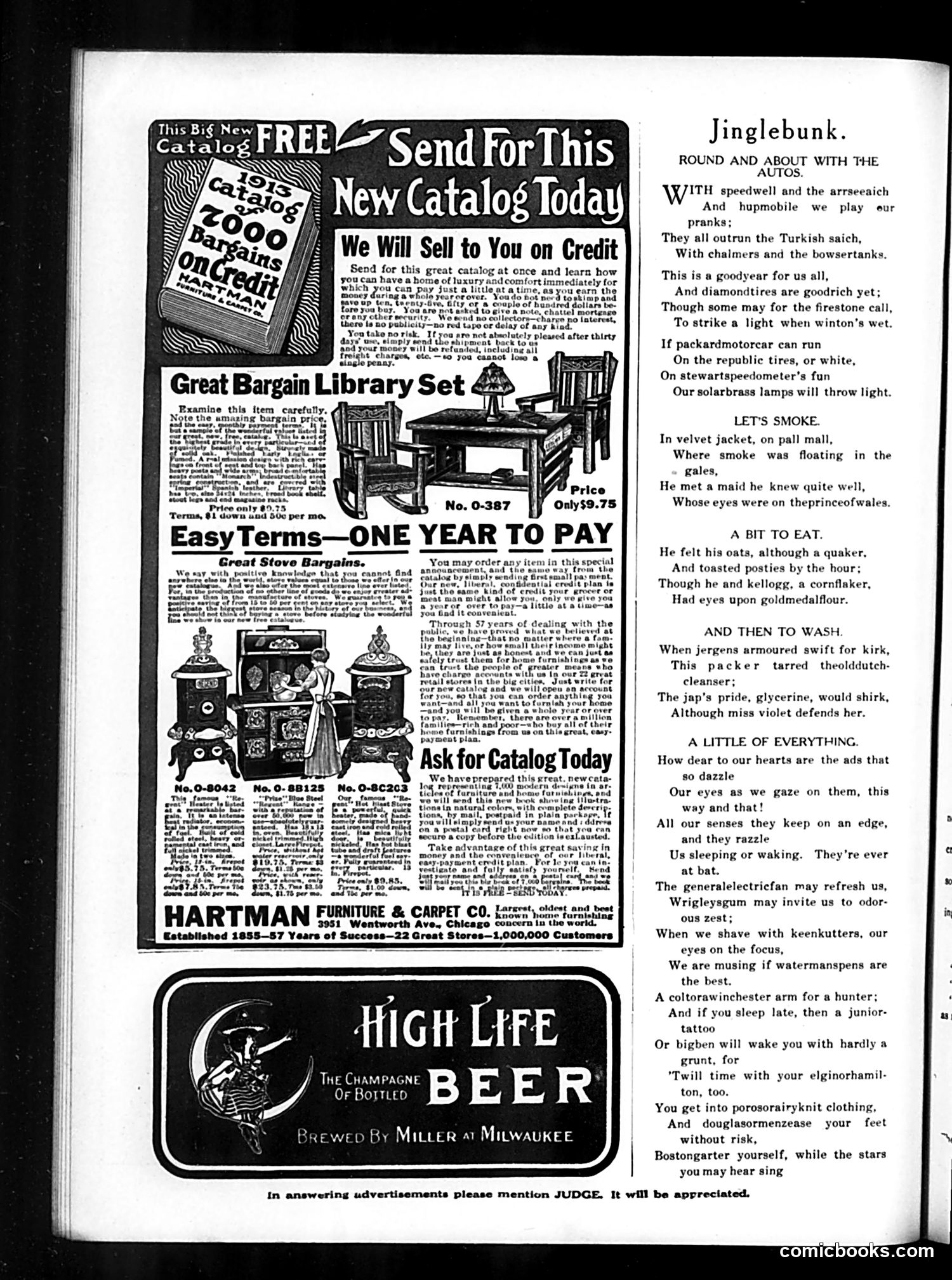
This page is primarily **advertising**, not political satire. The left side features Hartman Furniture & Carpet Co.'s catalog promotion and stove advertisements using buy-now-pay-later credit schemes—common early 20th-century sales tactics. The right side contains "Jinglebunk," a humorous poem about automobiles and consumer products. It's a **clever advertising disguise**: the poem appears to be whimsical verse but is actually a long list of brand names woven into rhyming couplets (Speedwell, Hupmobile, Goodrich, Firestone, Pall Mall, Kellogg's, Colgate, etc.). **The satire**: The poem mocks America's consumer culture and advertising saturation by creating absurdist verses where brand names *are* the content. Phrases like "A LITTLE OF EVERYTHING" explicitly highlight how advertisements dominate every aspect of modern life—from morning shaving to bedtime clocks. It's satirizing consumerism itself: the endless proliferation of branded products and their constant presence in American consciousness.
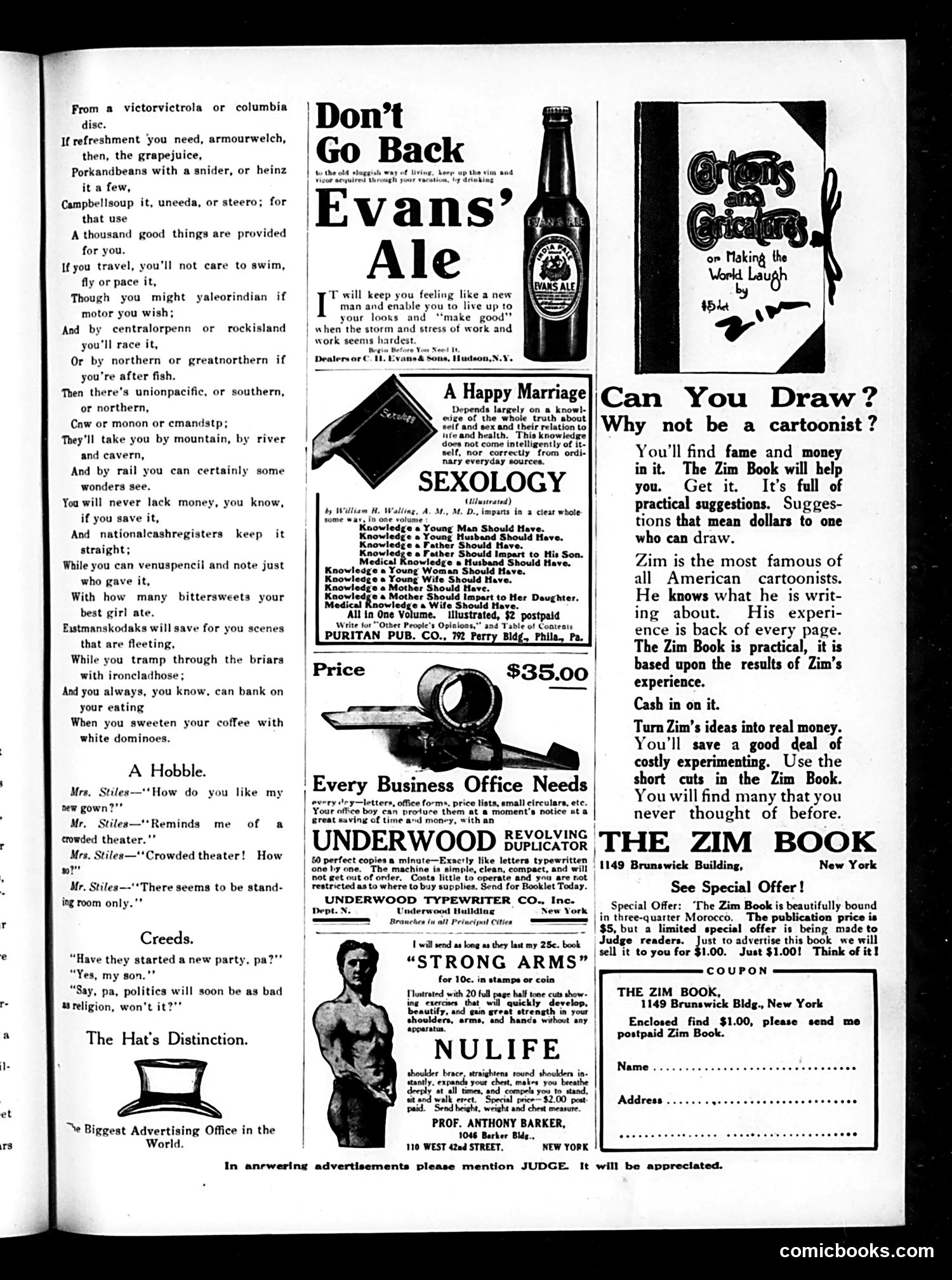
This page is primarily **advertising**, not political satire. It contains multiple product advertisements typical of early 20th-century magazines: **Main ads include:** - Evans' Ale (beverage) - "Sexology" (a marriage/sex education book by William H. Walling, M.D.) - The Zim Book (cartooning instruction guide) - Underwood Typewriter (duplicating machine) - Strong Arms (bodybuilding/fitness product by Prof. Anthony Barker) - Nulife (health/fitness product) **The small satirical sections** ("A Hobble," "Creeds," "The Hat's Distinction") are brief humor pieces mocking contemporary topics like theater-goers and political parties—standard Judge filler content. **Notable for modern readers:** The "Sexology" book's frank advertising about marriage and sexual knowledge would have been considered progressive/scandalous for the era. The Zim Book's pitch explicitly promises cartooning could make readers money—reflecting early commercial cartoon market opportunities.
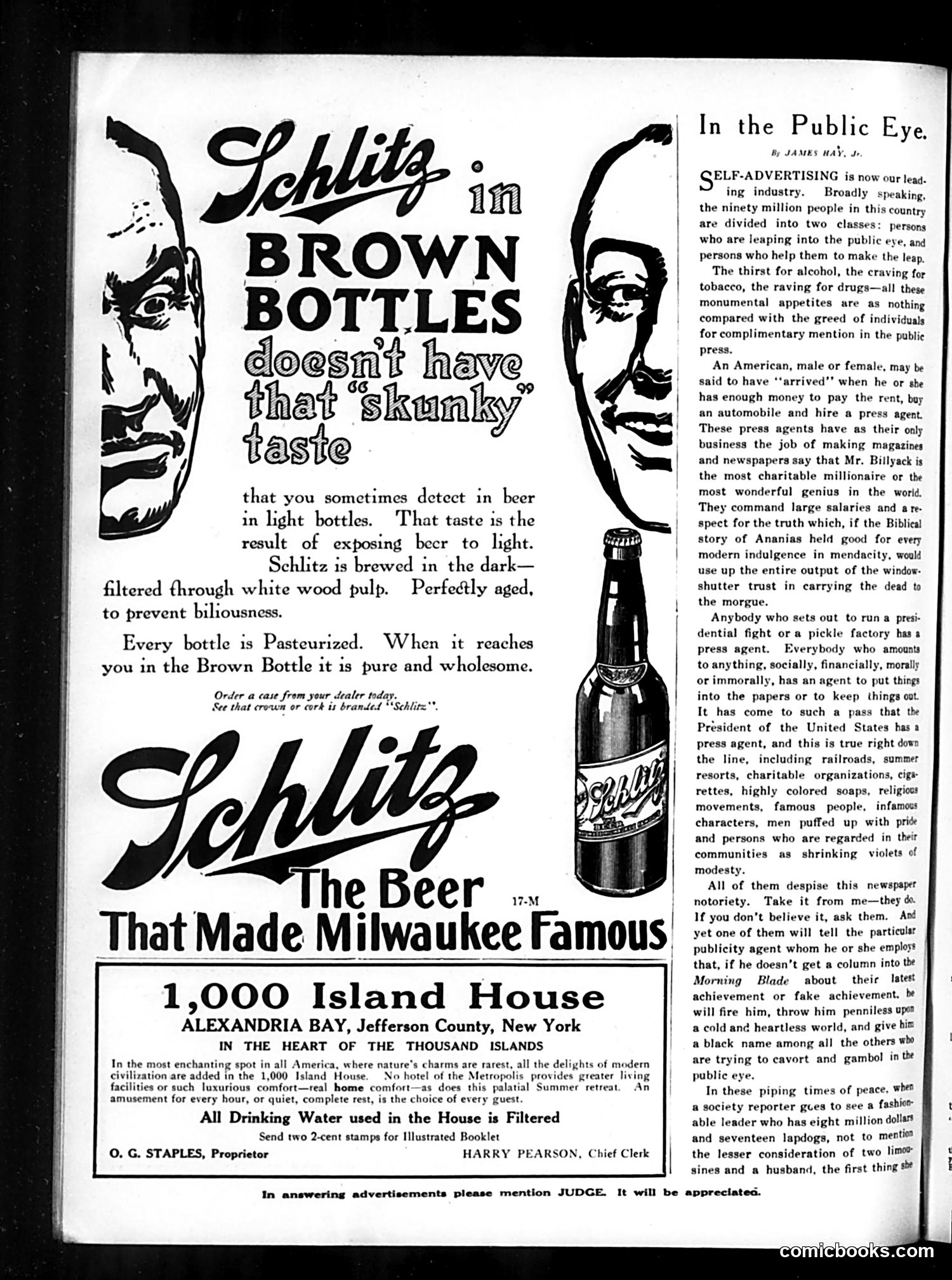
This page is primarily **advertising**, not political satire. It contains two ads: Schlitz beer (prominent left side) and the 1,000 Island House resort (bottom). The Schlitz ad features **caricatured male faces** (likely meant to represent drinkers or critics) alongside product messaging about the beer's superior brewing in dark bottles to avoid a "skunky" taste from light exposure—a legitimate technical claim about beer quality. The right column, "In the Public Eye" by James Hay Jr., is **social commentary** (not cartoon). It satirizes American self-promotion culture: the prevalence of press agents hired by wealthy individuals, corporations, and even the President to generate favorable publicity. Hay mocks how Americans obsessively pursue public notice and employ publicists despite claiming to despise newspaper coverage—a critique of vanity and hypocrisy in early 20th-century American society. The piece presents no identifiable political figures, focusing instead on systemic behavior and cultural values.
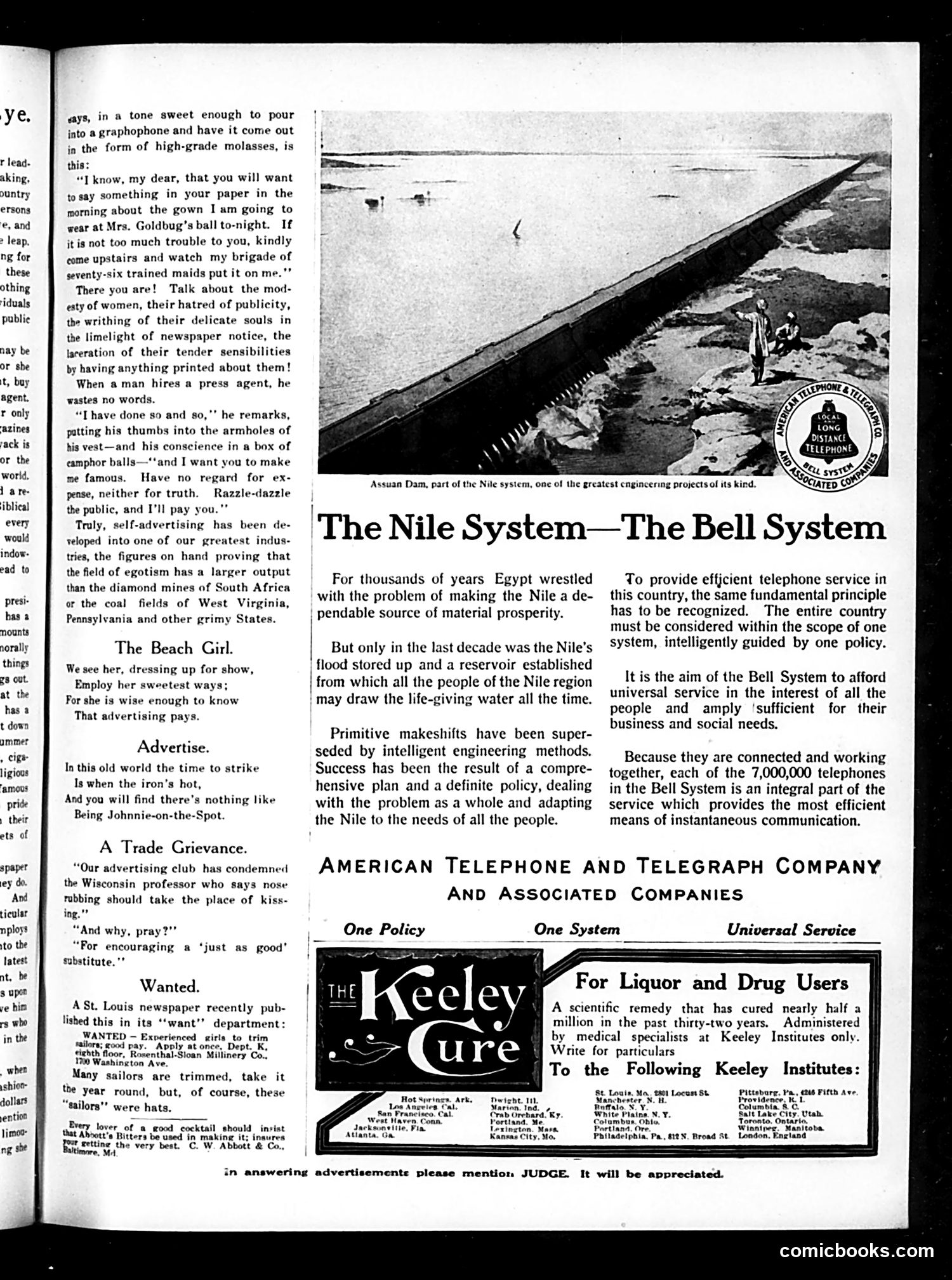
This page contains **no political cartoon**—it's primarily advertising and miscellaneous humor pieces. The main content is a **corporate advertisement** by American Telephone and Telegraph Company (AT&T/Bell System). It compares the Bell telephone system to Egypt's Nile Dam project: just as the dam unified water distribution for all Egyptians under "one policy," the Bell System claims to provide "universal service" nationwide under unified management. This is **early pro-monopoly propaganda**. AT&T was defending its position as a single, integrated telephone provider against competitors and regulators questioning monopoly practices. The comparison to Egypt's engineering marvel attempts to legitimize centralized control as scientifically rational and beneficial to all users. The page also includes minor humor items about advertising and self-promotion, plus ads for various products (liquor cures, Abbott's Bitters), reflecting the magazine's commercial nature.
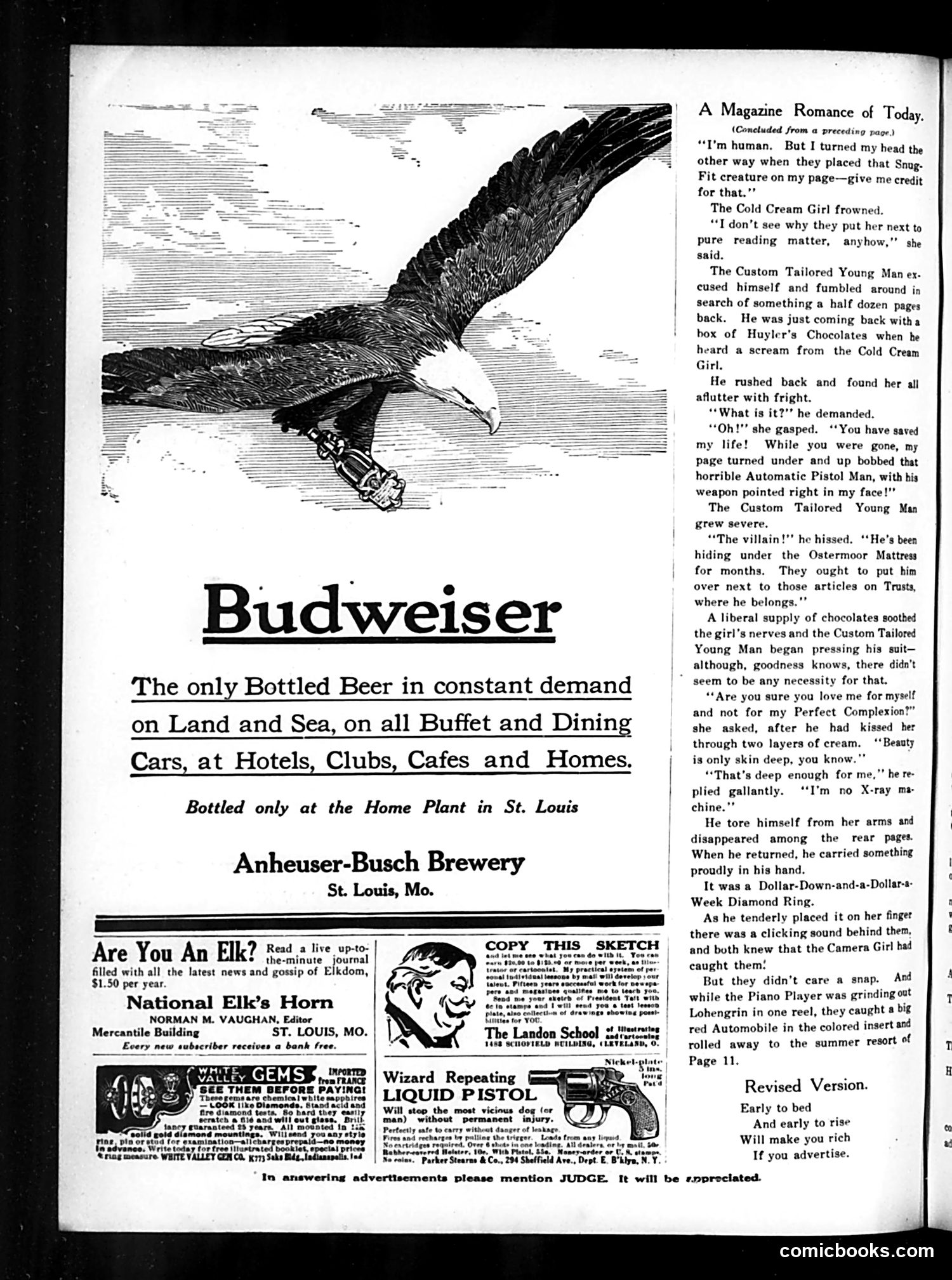
This page is primarily **advertising**, not political satire. The dominant content is a Budweiser beer advertisement featuring an eagle, plus ads for Elks magazine, a "Liquid Pistol" (dog repellent), and other products. The editorial content is a serialized romantic story ("A Magazine Romance of Today") that satirizes **magazine advertising itself**. The narrative mocks how advertisements interrupt reading matter: characters include "The Cold Cream Girl," "The Custom Tailored Young Man," and "The Automatic Pistol Man"—essentially personified ads competing for attention within magazine pages. The humor derives from treating advertisements as physical obstacles the romance characters must navigate and avoid. This reflects early 20th-century anxieties about **ad saturation in magazines**. The joke—that ads have become so intrusive they literally interrupt romantic narratives—suggests Judge's readers found excessive advertising increasingly annoying. The final "Revised Version" poem about advertising's effectiveness serves as ironic commentary on the very ads filling the magazine.
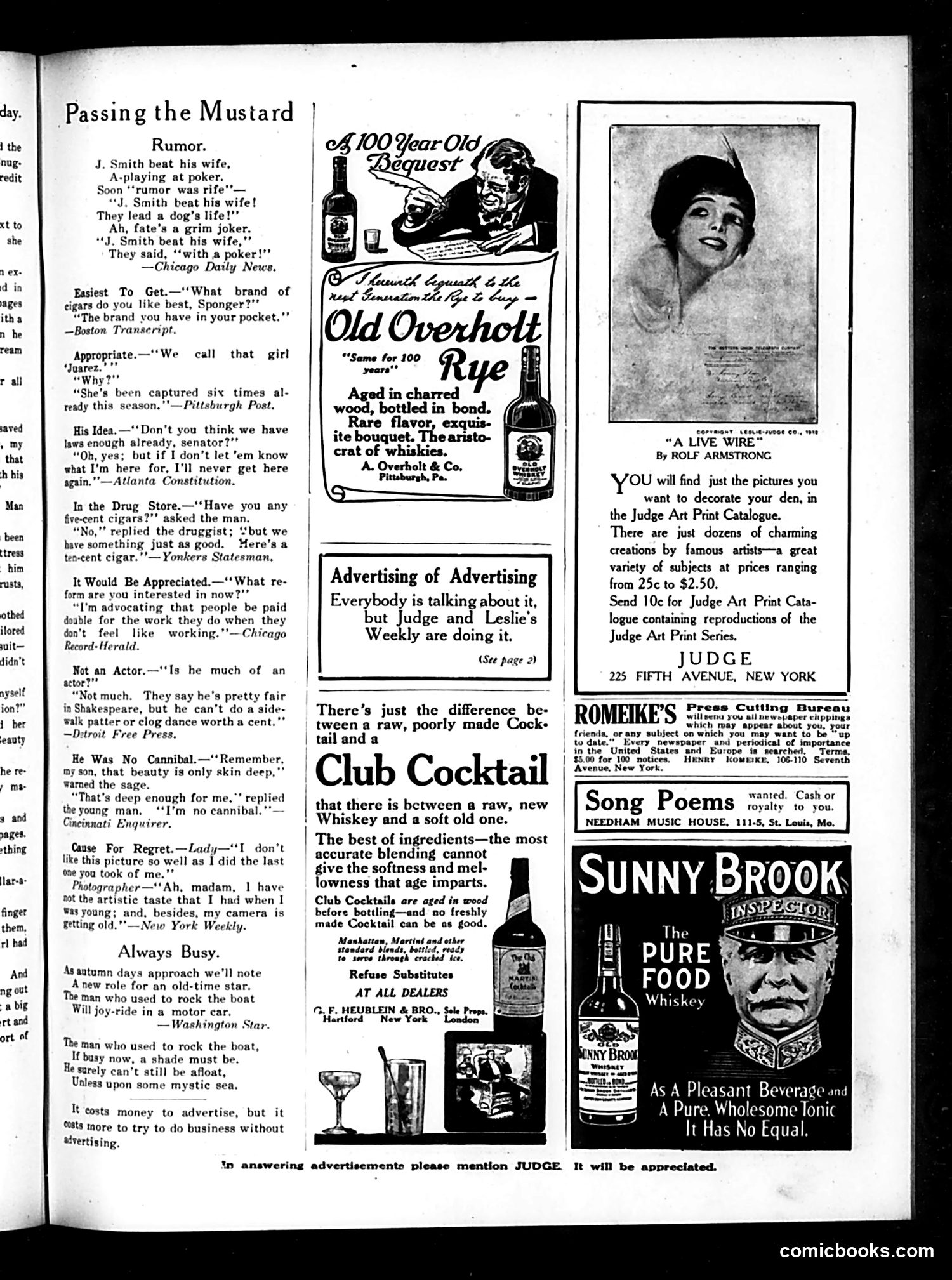
This page is primarily a **humor/joke column** with various brief satirical anecdotes mocking contemporary social foibles, plus advertising. The title piece plays on a mishearing: "J. Smith beat his wife" at poker becomes rumor-mill fodder suggesting spousal abuse with a poker—the joke being how gossip distorts truth through repeated telling. Other short jokes target: **cigar snobbery**, **political self-interest** (a senator passing useless laws to justify his seat), **pharmacy upselling**, **labor reform absurdity**, and **aging actors**. One anecdote mocks a photographer blaming his old camera for poor portraits—really excusing his lost talent. The **advertising section** includes whiskey and cocktail promotions (Overholt Rye, Club Cocktails, Sunny Brook), plus Judge's self-promotion about its print catalog and art reproductions. The page reflects **early 20th-century urban American humor**: cynical takes on business practices, marital relations, and vanity—typical Judge magazine fare before Prohibition's impact.
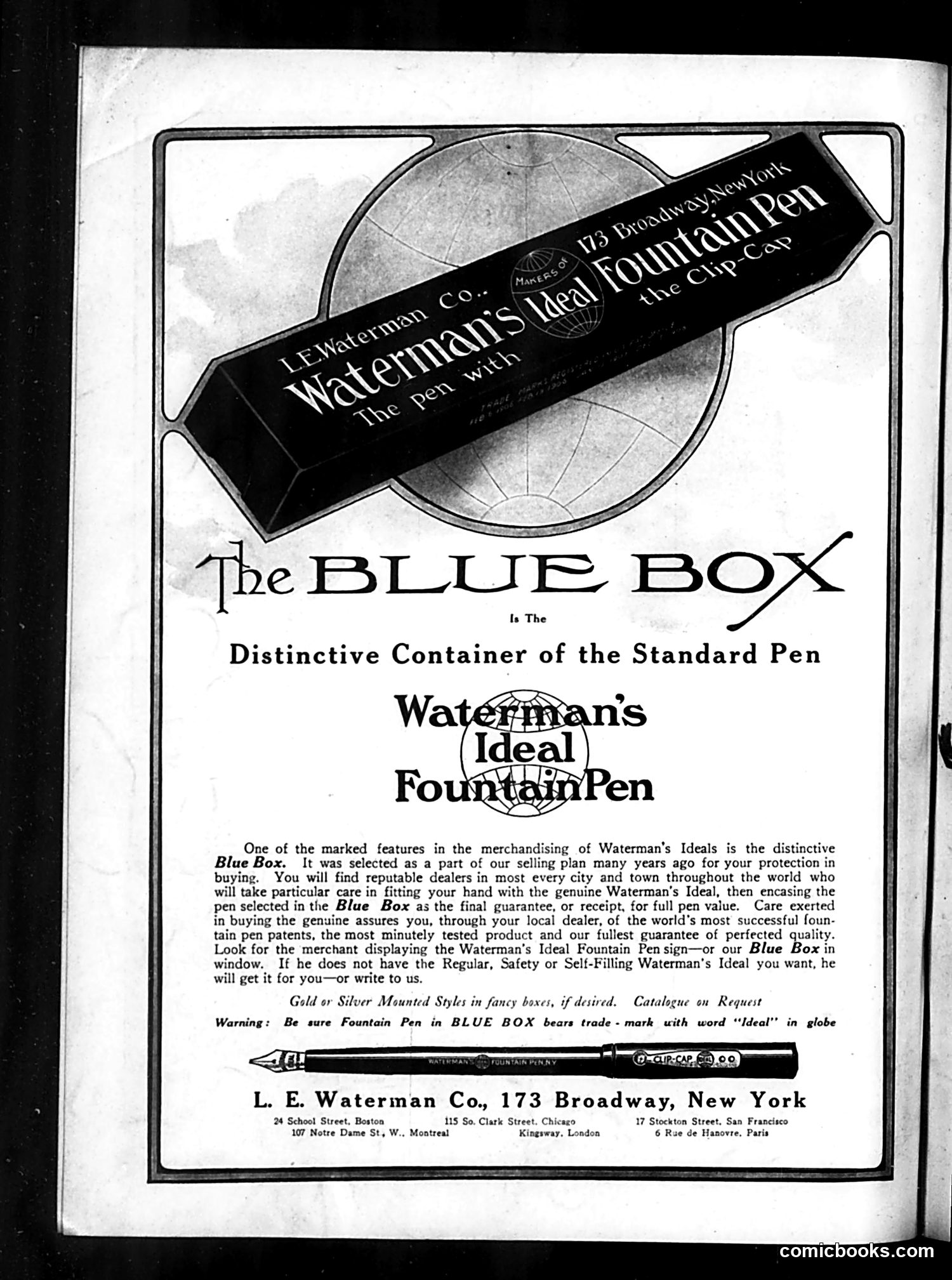
This page is **not a cartoon or satire** — it is a full-page advertisement for Waterman's Ideal Fountain Pen, appearing in *Judge* magazine. The ad promotes the distinctive "Blue Box" packaging as a guarantee of authenticity and quality. The marketing pitch emphasizes that the blue box serves as proof of purchase and assurance that customers are buying genuine Waterman pens from reputable dealers worldwide. The ad warns consumers to look for the "Ideal" trademark in a globe on the box to avoid counterfeits. The company lists five international office locations (New York, Boston, Chicago, San Francisco, Montreal, London, and Paris), indicating Waterman's was a major international business at this time. This reflects early 20th-century concerns about counterfeit products and the importance of distinctive packaging as consumer protection — before modern product authentication methods existed.