
Judge, 1912-09-07 · page 7 of 24
Judge — September 7, 1912 — page 7: what you’re looking at
What you’re looking at
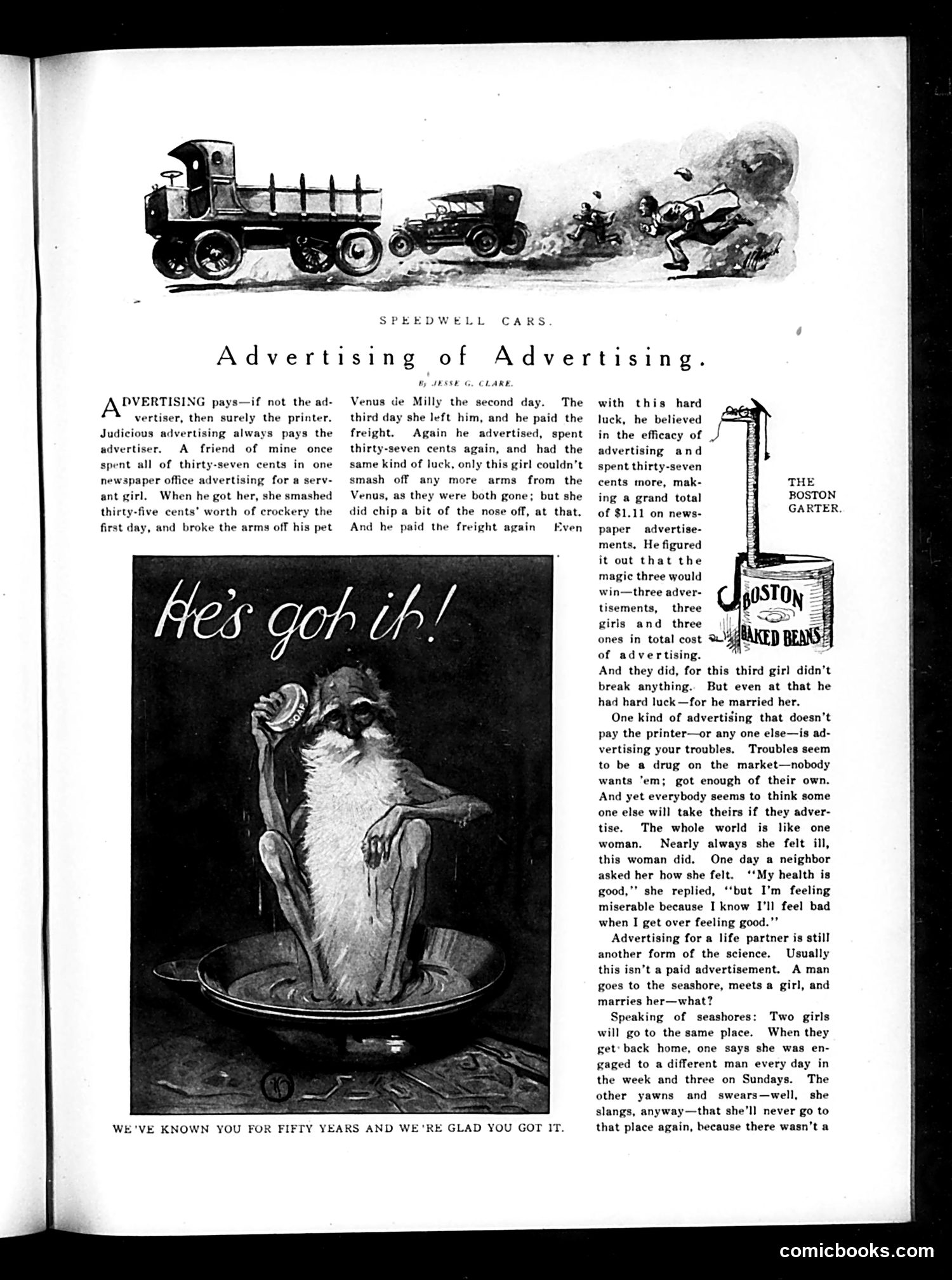
This satirical article by Jesse G. Clare mocks the excessive faith people place in newspaper advertising as a universal solution. The main joke concerns a man repeatedly advertising for a servant girl, each time attracting disaster: the first breaks expensive items (including a prized statue), the second damages it further, the third causes no breakage but he foolishly marries her—the worst outcome of all. Despite three failures costing $1.11 total, he remains convinced advertising "works." The piece extends this mockery to other life situations: advertising personal troubles (unmarketable), seeking romantic partners (unpredictable outcomes), and women's different experiences at seashores (one claims multiple engagements, another finds nothing). The underlying satire critiques both advertisers' inflated claims about advertising's power and the public's gullible belief in it as a cure-all. The Boston Garter ad on the page may be intentionally ironic—an advertisement within an article criticizing advertising's efficacy.
📄 Transcribed text from this page (OCR, searchable)
Machine-transcribed from the original scan — historical spelling and the odd misread are preserved.
Advertising of DVERTISING pays—if not the ad- vertiser, then surely the printer. Judicious advertising always pays the advertiser. A friend of mine once spent all of thirty-seven cents in one newspaper office advertising for a serv- ant girl. When he got her, she smashed thirty-five cents’ worth of crockery the first day, and broke the arms off his pet SPEEDWELL CARS By JESSE G. CLARE Venus de Milly the second day. The third day she left him, and he paid the freight. Again he advertised, spent thirty-seven cents again, and had the same kind of luck, only this girl couldn’t smash off any more arms from the Venus, as they were both gone; but she did chip a bit of the nose off, at that. And he paid the freight again Even WE'VE KNOWN YOU FOR FIFTY YEARS AND WE'RE GLAD YOU GOT IT. Advertising. with this hard luck, he believed in the efficacy of J advertising and spent thirty-seven cents more, mak- ing a grand total of $1.11 on news- paper advertise- ments. He figured it out that the magic three would win—three adver- THE BOSTON GARTER three tisements, girls and three { ones in total cost 2% of advertising. And they did, for this third girl didn’t break anything. But even at that he had hard luck—for he married her. One kind of advertising that doesn’t pay the printer—or any one else—is ad- vertising your troubles. Troubles seem to be a drug on the market—nobody wants ‘em; got enough of their own. And yet everybody seems to think some one else will take theirs if they adver- The whole world is like one Nearly always she felt ill, this woman did. One day a neighbor asked her how she felt. ‘‘My health is good,’’ she replied, ‘‘but I’m feeling miserable because I know I'll feel bad when I get over feeling good.”” Advertising for a life partner is still another form of the science. Usually this isn’t a paid advertisement. A man goes to the seashore, meets a girl, and marries her—what? Speaking of seashores: Two girls will go to the same place. When they get' back home, one says she was en- gaged to a different man every day in the week and three on Sundays. The other yawns and swears—well, she slangs, anyway—that she’ll never go to that place again, because there wasn’t a tise. woman. comicbooks.com