
Judge, 1912-09-07 · page 4 of 24
Judge — September 7, 1912 — page 4: what you’re looking at
What you’re looking at
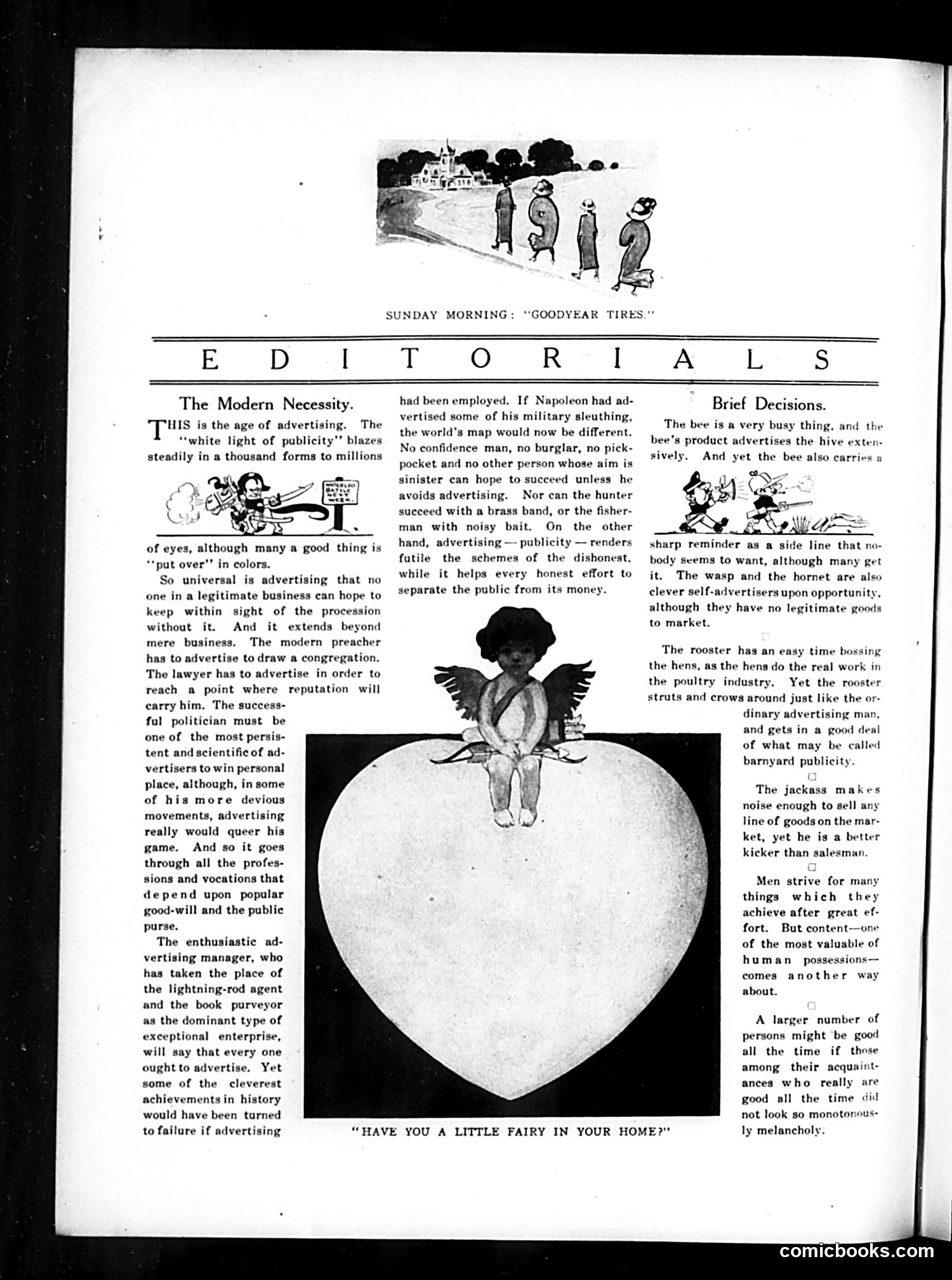
This page from *Judge* magazine contains two distinct pieces: **Left column ("The Modern Necessity"):** An editorial arguing that advertising is essential to modern commerce and society. The author contends that even historical figures like Napoleon would have failed without advertising, and that honest advertising actually protects the public by separating legitimate businesses from fraudsters. The piece advocates for advertising across all professions—preachers, lawyers, politicians—suggesting it's become fundamentally necessary rather than merely optional. **Right column & illustration ("Have You a Little Fairy in Your Home?"):** A whimsical illustration of a cherub or fairy sitting on a large sphere, accompanied by brief aphorisms about human nature—observations on bees, roosters, jackasses, and contentment. These appear to be light social commentary rather than political satire, offering gentle moral lessons about human behavior and virtue. The page reflects early 20th-century attitudes toward advertising's legitimacy and cultural role.
📄 Transcribed text from this page (OCR, searchable)
Machine-transcribed from the original scan — historical spelling and the odd misread are preserved.
SUNDAY MORNING: “GOODYEAR TIRES.” E D T O R A LS The Modern Necessity. HIS is the age of advertising. The “white light of publicity’’ blazes steadily in a thousand forms to millions of eyes, although many a good thing is **put over’? in colors. So universal is advertising that no one in a legitimate business can hope to keep within sight of the procession without it. And it extends beyond mere business. The modern preacher has to advertise to draw a congregation. The lawyer has to advertise in order to reach a point where reputation will carry him. The success- ful politician must be one of the most persis- tent and scientific of ad- vertisers to win personal place, although, in some of his more devious movements, advertising really would queer his game. And so it goes through all the profes- sions and vocations that depend upon popular good-will and the public purse, The enthusiastic ad- vertising manager, who has taken the place of the lightning-rod agent and the book purveyor as the dominant type of exceptional enterprise, will say that every one ought to advertise. Yet some of the cleverest achievements in history would have been turned to failure if advertising had been employed. If Napoleon had ad- vertised some of his military sleuthing, the world’s map would now be different. No confidence man, no burglar, no pick- pocket and no other person whose aim is sinister can hope to succeed unless he avoids advertising. Nor can the hunter succeed with a brass band, or the fisher- man with noisy bait. On the other hand, advertising — publicity — renders futile the schemes of the dishonest, while it helps every honest effort to separate the public from its money. “HAVE YOU A LITTLE FAIRY IN YOUR HOME?" Brief Decisions. The bee is a very busy thing, and bee's product advertises the hive e sively. And yet the bee also carries a ay fl SS $s (aeS2- eel sharp reminder as a side line that no- body seems to want, although many get it. The wasp and the hornet are also clever self-advertisers upon opportunity, although they have no legitimate goods to market. The rooster has an easy time bossing the hens, as the hens do the real work in Yet the rooste: struts and crows around just like the or- the poultry industry. dinary advertising man, and gets in a good deal of what may be called barnyard publicity The jackass makes noise enough to sell any line of goods on the mar- ket, yet he is a better kicker than salesman. Men strive for many things which they achieve after great ef- fort. But content—one of the most valuable of human_ possessions— comes another way about. A larger number of persons might be good all the time if those among their acquaint- ances who really are good all the time did not look so monotonous- ly melancholy. comicbooks.com