
Judge, 1912-09-07 · page 16 of 24
Judge — September 7, 1912 — page 16: what you’re looking at
What you’re looking at
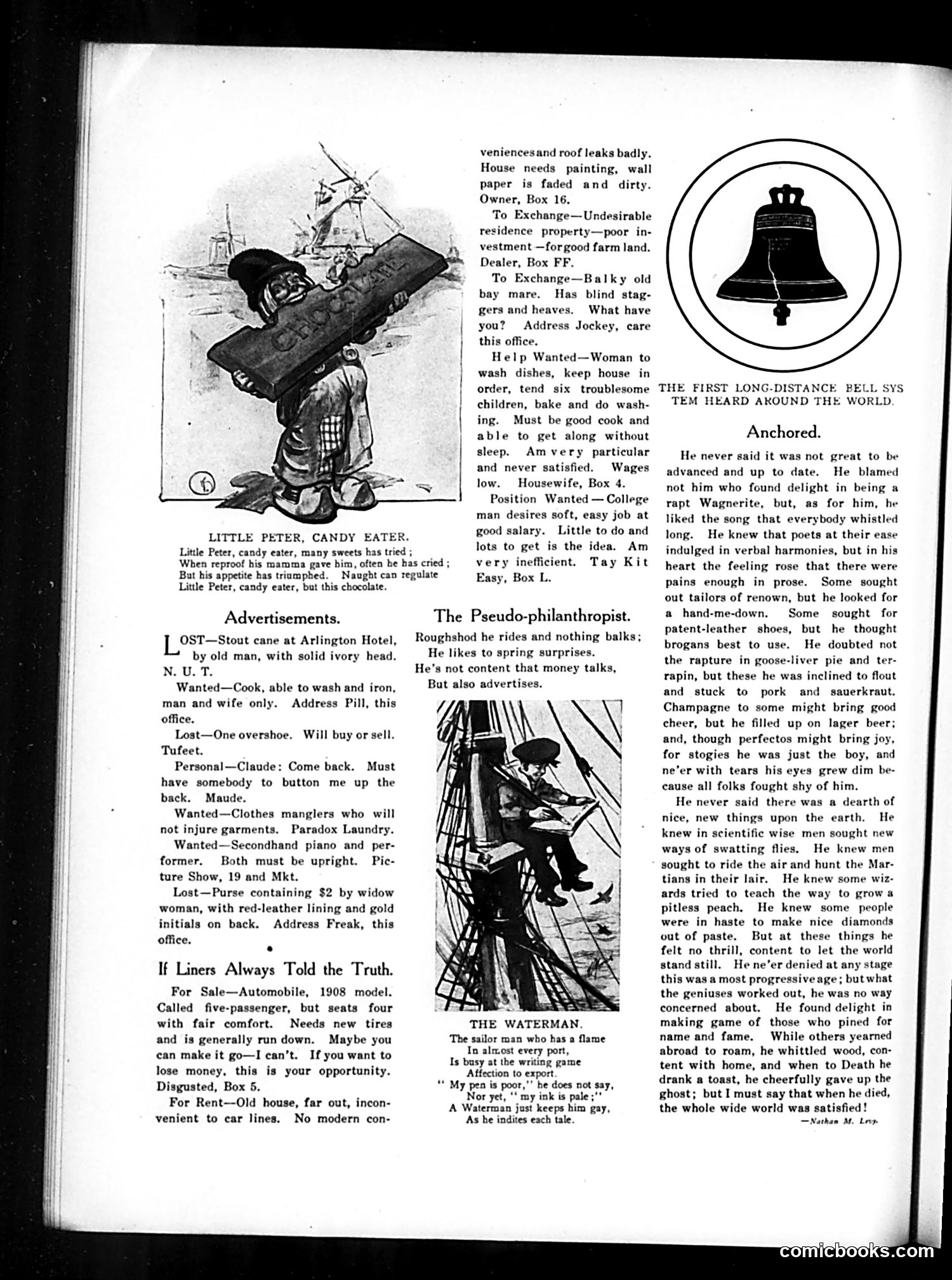
This page from *Judge* magazine contains satirical advertisements and light humorous content typical of early 1900s American humor. The main cartoon depicts "Little Peter, Candy Eater"—a cautionary tale about a child whose appetite for sweets cannot be controlled despite maternal discipline. The verse humorously suggests only chocolate can satisfy him, playing on period anxieties about children's dietary habits and parental authority. The bulk of the page features the satirical section **"If Liners Always Told the Truth,"** which mocks classified advertisements' dishonesty. Fake listings for a deteriorating house, unreliable automobile, and lazy college graduate expose common deceptive advertising practices—a genuine social complaint. An employer's ad seeking an impossible houseworker (cook, cleaner, childcare for low wages without sleep) satirizes exploitative labor conditions. Additional light humor pieces mock pretentious philanthropy and feature advertisements for Waterman pens and Bell telephone systems, typical period advertising integrated with editorial content. The page demonstrates *Judge*'s approach: gentle social satire mixed with commercial promotion.
📄 Transcribed text from this page (OCR, searchable)
Machine-transcribed from the original scan — historical spelling and the odd misread are preserved.
LITTLE PETER, CANDY EATER. Little Peter, candy eater, many sweets has tried ; When reproof his mamma gave him, often he has cried ; But his appetite has triumphed. Naught can regulate Little Peter, candy eater, but this chocolate. Advertisements. OST—Stout cane at Arlington Hotel, by old man, with solid ivory head. N. U. T. Wanted—Cook, able to wash and iron, man and wife only. Address Pill, this office. Lost—One overshoe. Will buy or sell. Tufeet. Personal—Claude: Come back. Must have somebody to button me up the back. Maude. Wanted—Clothes manglers who will not injure garments. Paradox Laundry. Wanted—Secondhand piano and per- former. Both must be upright. Pic- ture Show, 19 and Mkt. Lost—Purse containing $2 by widow woman, with red-leather lining and gold initials on back. Address Freak, this office. . If Liners Always Told the Truth. For Sale—Automobile, 1908 model. Called five-passenger, but seats four with fair comfort. Needs new tires and is generally run down. Maybe you can make it go—I can’t. If you want to lose money, this is your opportunity. Disgusted, Box 5. For Rent—Old house, far out, incon- venient to car lines. No modern con- veniencesand roof leaks badly. House needs painting, wall paper is faded and dirty. Owner, Box 16. To Exchange—Undesirable residence property—poor in- vestment —forgood farm land. Dealer, Box FF. To Exchange—Balky old bay mare. Has blind stag- gers and heaves. What have you? Address Jockey, care this office. Help Wanted—Woman to wash dishes, keep house in order, tend six troublesome children, bake and do wash- ing. Must be good cook and able to get along without sleep. Amvery particular and never satisfied. Wages low. Housewife, Box 4. Position Wanted — College man desires soft, easy job at good salary. Little to do and lots to get is the idea. Am very inefficient. Tay Kit Easy, Box L. The Pseudo-philanthropist. Roughshod he rides and nothing balks; He likes to spring surprises. He’s not content that money talks, But also advertises. THE WATERMAN. ‘The sailor man who has a flame In almost every port, Is busy at the writing game Affection to export “ My pen is poor,’’ he does not say, Nor yet, ‘‘ my ink is pale ;"" A Waterman just keeps him gay, As he indites each tale. THE FIRST LONG-DISTANCE BELL SYS TEM HEARD AKOUND THE WORLD. Anchored. He never said it was not great to be advanced and up to date. He blamed not him who found delight in being a rapt Wagnerite, but, as for him, he liked the song that everybody whistled long. He knew that poets at their ease indulged in verbal harmonies, but in his heart the feeling rose that there were pains enough in prose. Some sought out tailors of renown, but he looked for a hand-me-down. Some sought for patent-leather shoes, but he thought brogans best to use. He doubted not the rapture in goose-liver pie and ter- rapin, but these he was inclined to flout and stuck to pork and sauerkraut. Champagne to some might bring good r, but he filled up on lager bee and, though perfectos might bring joy, for stogies he was just the boy, and ne’er with tears his eyes grew dim be- cause all folks fought shy of him. He never said there was a dearth of nice, new things upon the earth. He knew in scientific wise men sought new ways of swatting flies. He knew men sought to ride the air and hunt the Ma: tians in their lair. He knew some wi: ards tried to teach the way to grow a pitless peach, He knew some people were in haste to make nice diamonds out of paste. But at these things he felt no thrill, content to let the world stand still. He ne'er denied at any stage this was a most progressive age ; but what the geniuses worked out, he was no way concerned about. He found delight in making game of those who pined for name and fame. While others yearned abroad to roam, he whittled wood, con- tent with home, and when to Death he drank a toast, he cheerfully gave up the ghost; but I must say that when he died, the whole wide world was satisfied! —Nathan M. Ley 2