
Judge, 1912-09-07 · page 13 of 24
Judge — September 7, 1912 — page 13: what you’re looking at
What you’re looking at
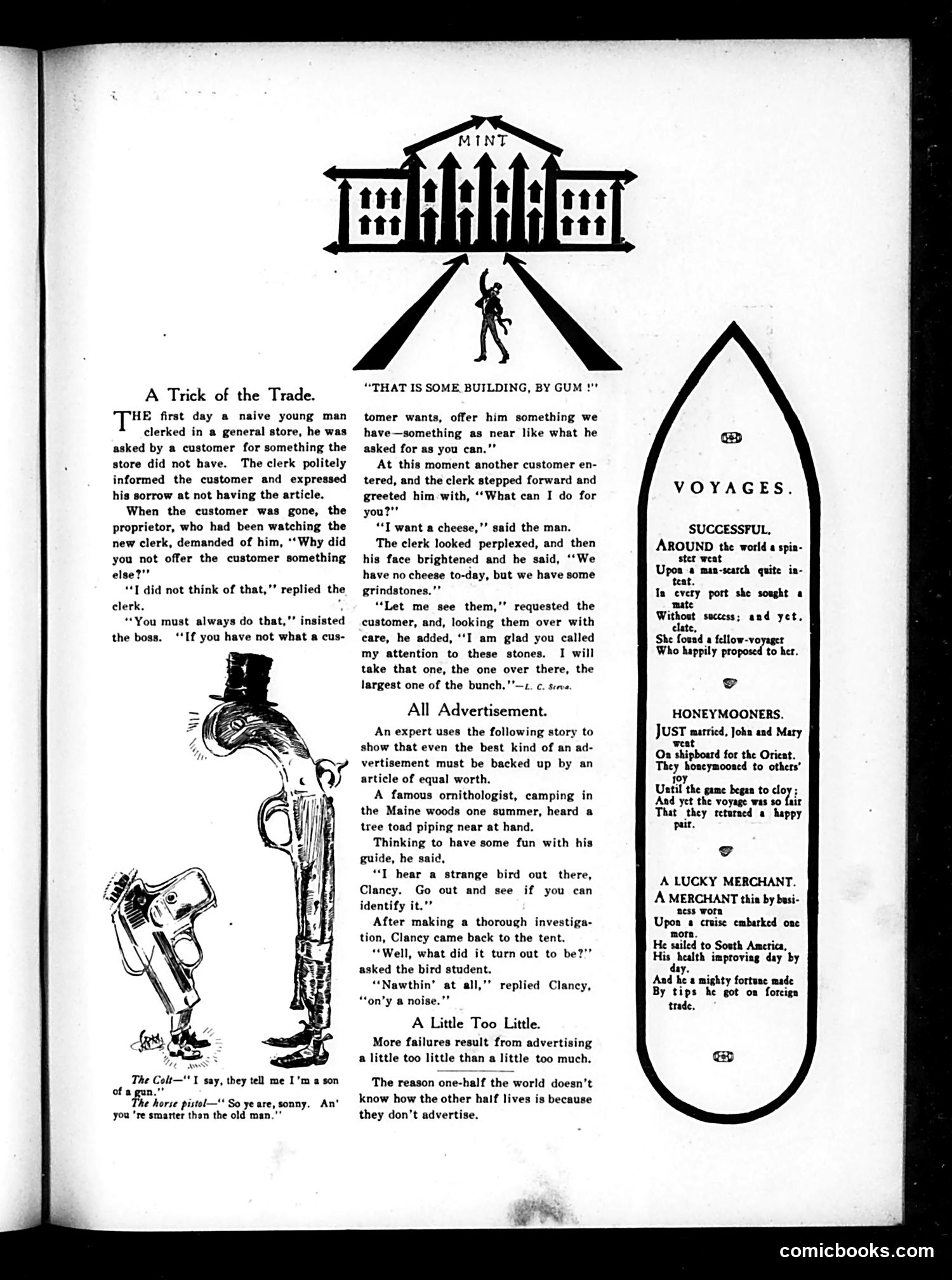
This page contains three separate pieces of humor targeting early 20th-century commercial culture: **"A Trick of the Trade"** satirizes retail deception. A store clerk learns to "upsell" customers by substituting unavailable items with anything remotely similar. The joke's punchline—offering grindstones when cheese is requested—exposes how absurd this practice becomes when taken literally. The accompanying cartoon of a colt and horse pistol makes a crude visual pun about guns. **"All Advertisement"** presents two cautionary tales about advertising. One mocks ornithologists and guides (a Maine woods setting); another criticizes businesses that advertise too little, using the aphorism that "one-half the world doesn't know how the other half lives" because of poor marketing. **The right column** contains three brief comic poems about voyages, honeymooners, and a merchant—lighthearted verse filler typical of Judge. The overall message: commerce thrives on both clever salesmanship and adequate advertising, though excessive deception undermines both.
📄 Transcribed text from this page (OCR, searchable)
Machine-transcribed from the original scan — historical spelling and the odd misread are preserved.
A Trick of the Trade. 'HE first day a naive young man clerked in a general store, he was asked by a customer for something the store did not have. The clerk politely informed the customer and expressed his sorrow at not having the article. When the customer was gone, the proprietor, who had been watching the new clerk, demanded of him, ‘‘Why did you not offer the customer something else?”’ “T did not think of that,’’ replied the clerk. 5 **You must always do that,’’ insisted the boss. ‘‘If you have not what a cus- The Colt— I say, they tell me I'm a son of a gun." the horse pistel—"* So ye are, sonny. An’ you 're smarter than the old man. “THAT IS SOME BUILDING, BY GUM !"’ tomer wants, offer him something we have—something as near like what he asked for as you can.’’ At this moment another customer en- tered, and the clerk stepped forward and greeted him with, ‘‘What can I do for you?” “T want a cheese,’’ said the man. The clerk looked perplexed, and then his face brightened and he said, ‘‘We have no cheese to-day, but we have some grindstones.’’ “Let me see them,’’ requested the customer, and, looking them over with care, he added, ‘‘I am glad you called my attention to these stones. I will take that one, the one over there, the largest one of the bunch.’’—c. c. sera. All Advertisement. An expert uses the following story to show that even the best kind of an ad- vertisement must be backed up by an article of equal worth. A famous ornithologist, camping in the Maine woods one summer, heard a tree toad piping near at hand. Thinking to have some fun with his guide, he said, “T hear a strange bird out there, Clancy. Go out and see if you can identify it.” After making a thorough investiga- tion, Clancy came back to the tent. ‘Well, what did it turn out to be?’’ asked the bird student. “Nawthin’ at all,’ replied Clancy, “‘on’y a noise.”” A Little Too Little. More failures result from advertising a little too little than a little too much. The reason one-half the world doesn’t know how the other half lives is because they don’t advertise. @ VOYAGES. SUCCESSFUL, AROUND the world a spia- ster weat Uren: R man-search quite in- In rey port she sought a Without success; and yet, elate, She found a fellow-voyager Who happily proj to her. So HONEYMOONERS. Just. mented, John and Mary On “Shipboard for the Orient. Wee Le) to others’ Until’ the game began to cloy ; And yet the voyage was so air That they returned a happy pair. Ss A LUCKY MERCHANT. ‘A MERCHANT thin by basi- ness worn Upon cruise embarked one Ha sailed to Soath America, uh ep improving day by Aad’ te a mighty fortune made By tips he got on forcign trade, comicbooks.com