
Judge, 1912-09-07 · page 5 of 24
Judge — September 7, 1912 — page 5: what you’re looking at
What you’re looking at
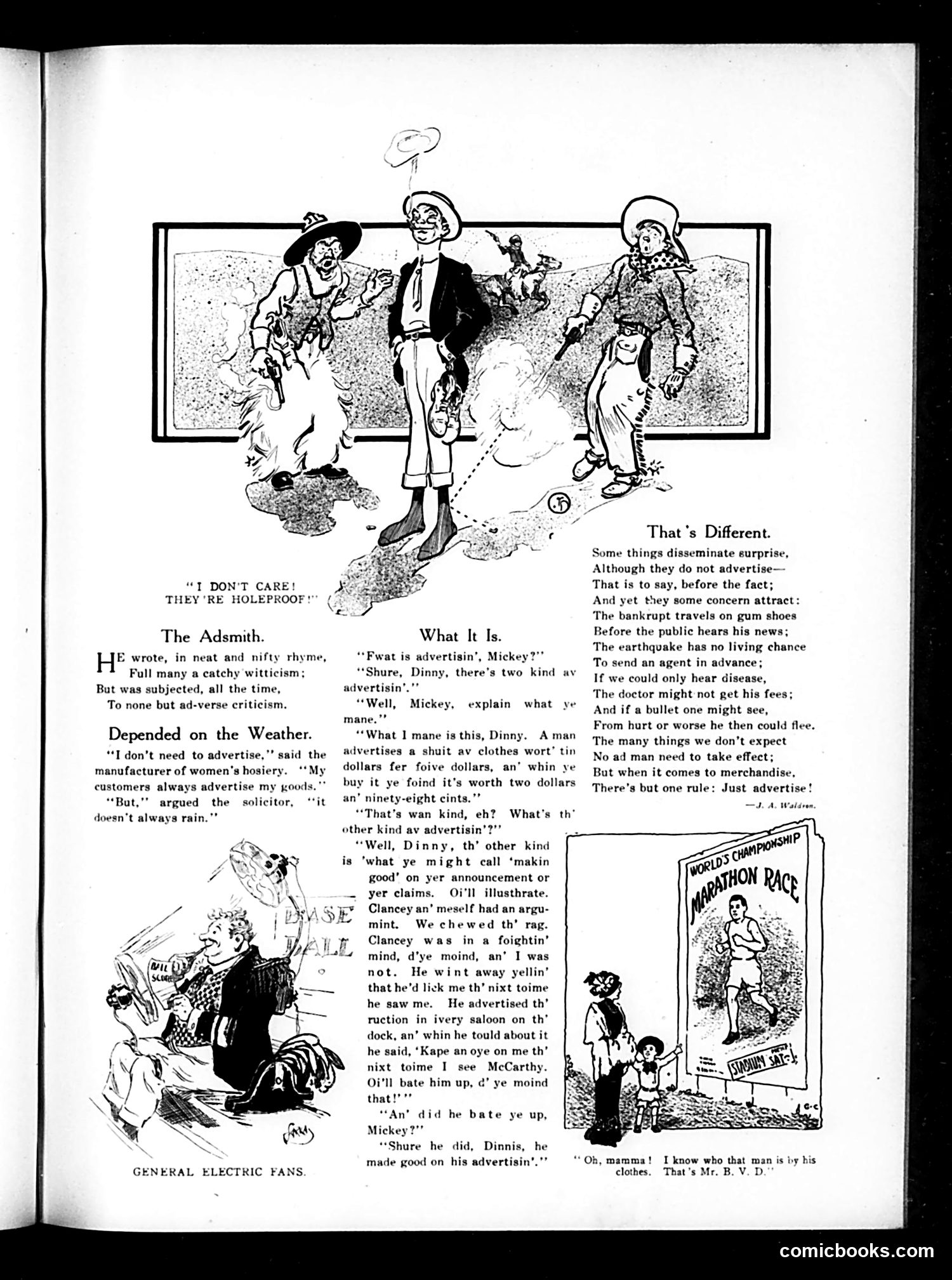
This page contains several early 20th-century satirical pieces about advertising. **Top cartoon**: Three cowboys/frontier characters discuss advertising's value. The humor centers on the irony that disreputable things (bankruptcy, earthquakes, disease, bullets) spread their "news" without formal advertising, yet legitimate businesses must pay to advertise. It's social commentary on how scandal and disaster spread naturally while honest commerce requires investment. **Included poems and stories** ("The Adsmith," "Depended on the Weather," "What It Is") use dialogue to joke about advertising effectiveness and necessity—suggesting advertising's paradoxical nature: essential yet often ineffective, and sometimes only working when circumstances align. The **General Electric Fans ad** and **Marathon Race poster** represent typical magazine advertising from the period. The overall message critiques advertising's role in American commerce.
📄 Transcribed text from this page (OCR, searchable)
Machine-transcribed from the original scan — historical spelling and the odd misread are preserved.
“T DON'T CARE! THEY 'RE HOLEPROOF!” t The Adsmith. wrote, in neat and nifty rhyme, Full many a catchy witticism; But was subjected, all the time, To none but ad-verse criticism. Depended on the Weather. “I don't need to advertise,’’ said the manufacturer of women's hosiery. ‘*My customers always advertise my 40 . “But,"’ argued the solicitor, doesn’t always rain.” H “it GENERAL ELECTRIC FANS What It Is. ‘*Fwat is advertisin’, Mickey?" “Shure, Dinny, there’s two kind av advertisin’."" ‘Well, mane.”’ “What I mane is this, Dinny. advertises a shuit av clothes wort’ tin Mickey, explain what ye Aman dollars fer foive dollars, an’ whin ye buy it ye foind it’s worth two dollars an’ ninety-eight cints.’” “That's wan kind, eh? other kind av advertisin’ “Well, Dinny, th’ other kind what ye might call ‘makin good’ on yer announcement or yer claims. i'll illusthrate. Clancey an’ meself had an argu- mint. We chewed th’ rag. Clancey was in a foightin’ mind, d’ye moind, an’ I was not. He wint away yellin’ that he’d lick me th’ nixt toime he saw me. He advertised th’ ruction in ivery saloon on th’ dock, an’ whin he tould about it he said, ‘Kape an oye on me th’ nixt toime I McCarthy. Oi’ll bate him up, @’ ye moind that!’"’ “An' did he bate ye up, What's th’ see “Shure he did, he made good on his advertisin’. Dinnis, That's Different. Some things disseminate eurprise, Although they do not advertise— That is to say, before the fact; And yet they some concern attract: The bankrupt travels on gum shoes Before the public hears his news; The earthquake has no living chance To send an agent in advance; If we could only hear disease, The doctor might not get his fees; And if a bullet one might see, From hurt or worse he then could flee. The many things we don’t expect No ad man need to take effect; But when it comes to merchandise, There's but one rule: Just advertise! J. A, Waldron. “Oh, mamma! I know who that man is by his clothes. That's Mr. B. V. D. comicbooks.com